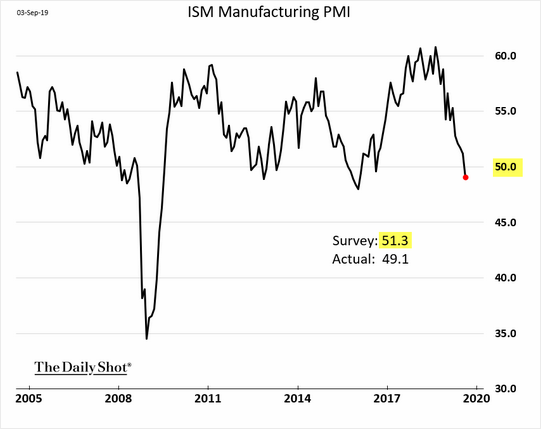
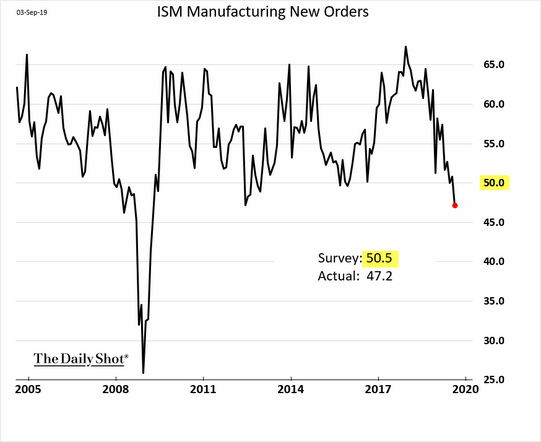
1.ISM Manufacturing Index Dropped Below 50….New Orders Fell to 2012 Levels.
The August ISM Manufacturing PMI report unexpectedly dipped below 50, which indicates a contraction in factory activity.
https://blogs.wsj.com/dailyshot/
Continue readingThe August ISM Manufacturing PMI report unexpectedly dipped below 50, which indicates a contraction in factory activity.
https://blogs.wsj.com/dailyshot/
Continue readingBarrons
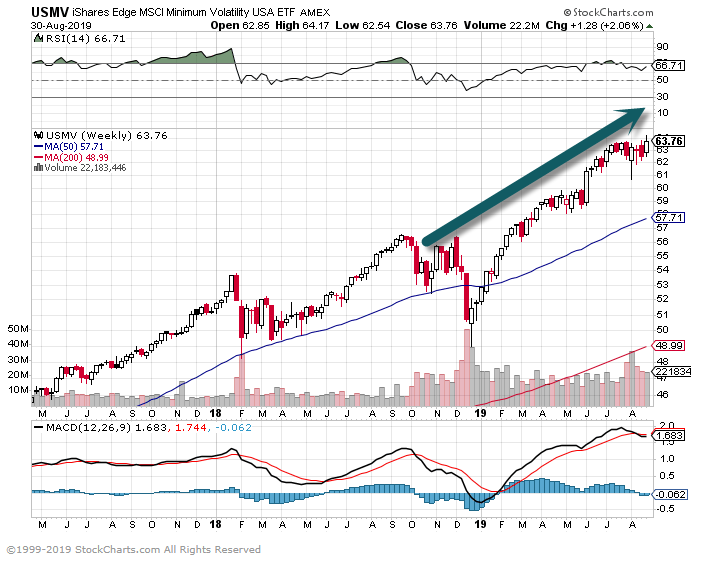
The iShares Edge MSCI Min Vol U.S.A. ETF (ticker: USMV) has attracted nearly $9.5 billion this year, second only to the broader and much better known Vanguard S&P 500(VOO). The iShares ETF has swelled 42% in the past eight months to $32 billion
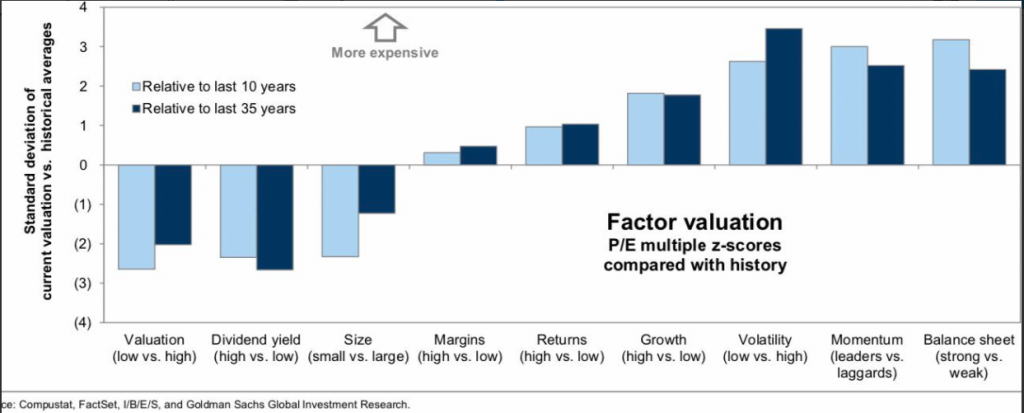
The average stock in the iShares ETF trades for 24 times trailing 12-month earnings, versus 19 for the S&P 500; the ETF overall trades at a 17% premium to its MSCI benchmark. A recent study from Leuthold Group found that low volatility stocks, relative to their higher volatility peers, are 99% more expensive than they have been over time, going back to 1990.
2 Big Volatility ETFs Have Very Different Approaches
By Stephen Gandel
https://www.barrons.com/articles/how-to-choose-a-volatility-etf-51567200240?mod=past_editions
Published: Aug 28, 2019 1:41 p.m. ET
Occurred only once before in last 40-plus years: Bespoke
By William Watts
Here’s another consequence of the rally in government bonds that’s sent yields crashing around the globe — U.S. stocks now offer more yield than the 30-year U.S. Treasury bond.
As the chart below, going back to 1977, from Bespoke Investment Group highlights, the Tuesday move marked the first time since the financial crisis that the dividend yield on S&P 500 index companies SPX, +0.57% has topped the yield on the long bond TMUBMUSD30Y, -1.14%.
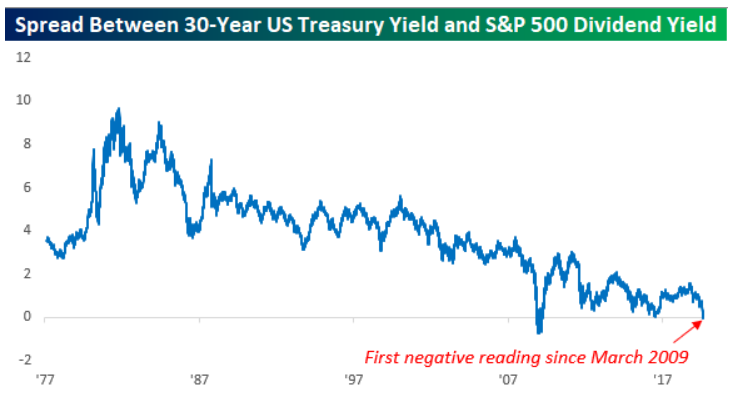
“The only other time in the last 40+ years where we have seen a similar inversion was for a few months in late 2008 through March 2009 (the low point of the Financial Crisis),“ Bespoke analysts wrote. “In July 2016 right after the Brexit vote, the S&P 500 dividend yield came within 0.01% of the 30-year’s yield, but it couldn’t quite make it higher.”
All in all, the higher dividend yield should make stocks more attractive.
Bespoke said it was “pretty amazing” to see how many stocks in the S&P 500 now yield more than the 5-, 10- and 30-year Treasurys. As of Tuesday, 333 stocks were yielding more than the 5-year at 1.38%; 313 more than the 10-year at 1.48%; and 256 more than the 30-year at 1.97%.
But for now, falling yields for Treasurys seems to be a negative for stocks as the yield on the 10-year note falls further below the 2-year yield, after slipping below the yield on the 3-month bill earlier this year.
Investors appear to be piling into government bonds, pushing yields down, in part out of fears of a global economic slowdown and the potential for recession as worries over an intensifying U.S.-China trade war mount. An inverted yield curve in particular is seen as a warning signal for a potential U.S. recession, albeit with a lag. Meanwhile, the yield on the 30-year bond has fallen to an all-time low below 2%, while the yield on the 10-year note ended Tuesday at its lowest since 2016, and is within hailing distance of its all-time low below 1.4%.
The S&P 500 and the Dow Jones Industrial Average DJIA, +0.83% have both pulled back more than 3% in August.
Continue reading
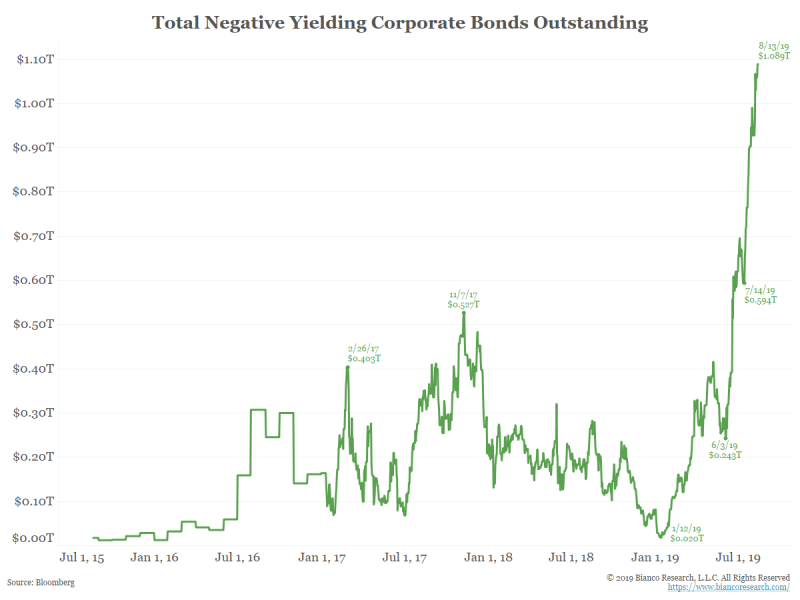
Negative yields are not confined to just Sovereign debt. The chart below shows there is over $1 trillion in corporate debt with negative yields and growing. This will not end well. hashtag#investing hashtag#markets hashtag#economy hashtag#finances hashtag#hedgefunds
https://www.linkedin.com/in/donsteinbrugge/
Continue readingIn the U.S., the NFL rules sports—and television. Its games make up 60% of the top 100 most-watched telecasts in a typical year, and over 70% in years when there are no Olympic Games.
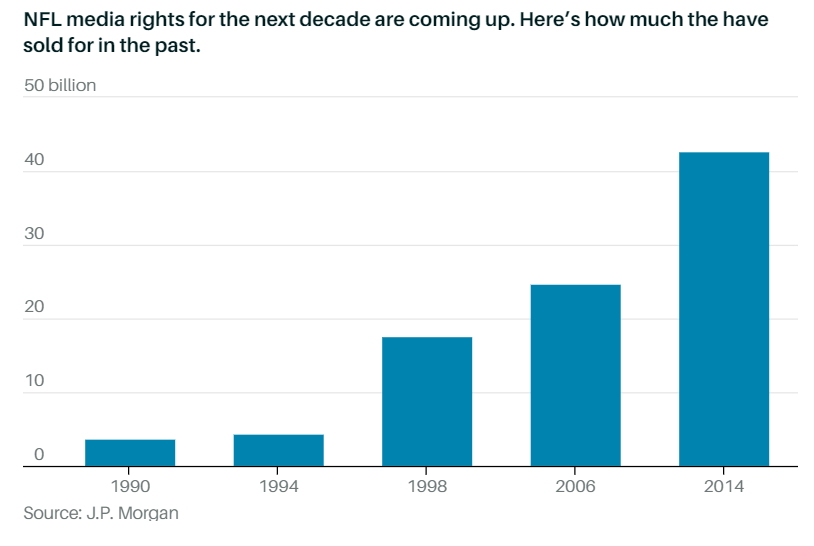
Football Season Is Here and It’s a Key Moment for the Future of TV
|
Daniel
Rodriguez Vice President – Private Wealth Director Franklin Templeton |
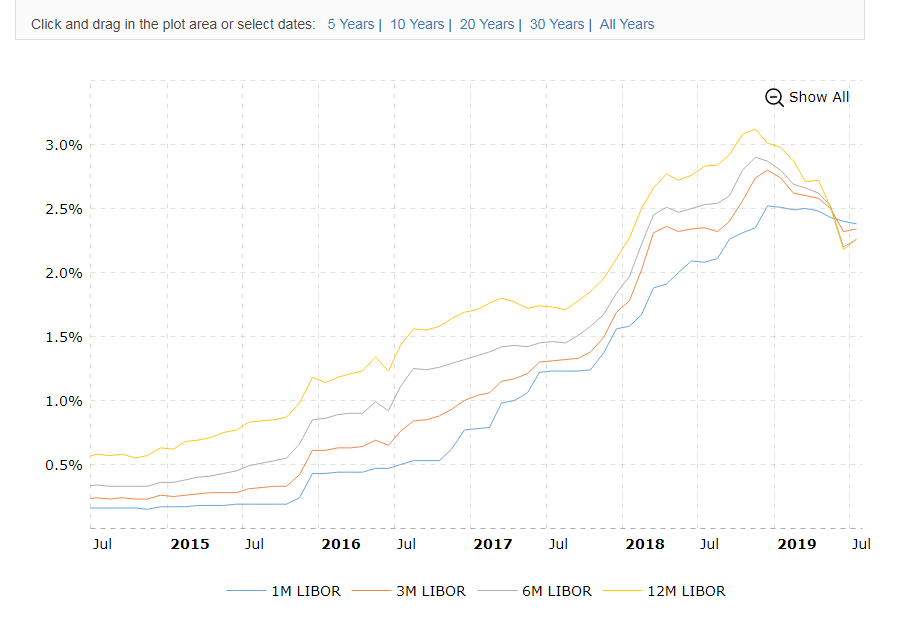
Interactive chart of the 12 month LIBOR rate back to 1986. The London Interbank Offered Rate is the average interest rate at which leading banks borrow funds from other banks in the London market. LIBOR is the most widely used global “benchmark” or reference rate for short term interest rates. The current 1 year LIBOR rate as of August 09, 2019 is 1.99%.
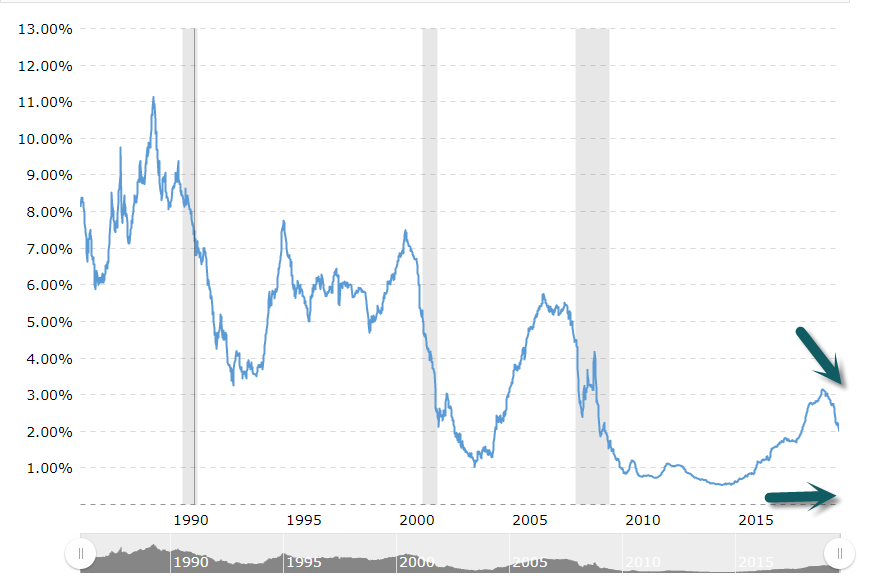
https://www.macrotrends.net/2515/1-year-libor-rate-historical-chart

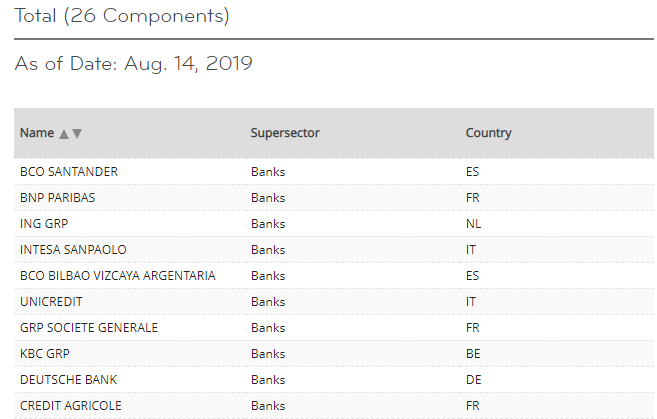
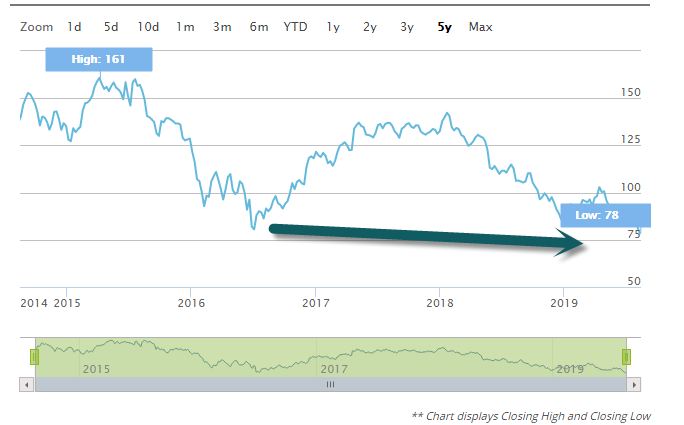
https://www.stoxx.com/index-details?symbol=SX7E
Continue readingMon, Aug 12, 2019
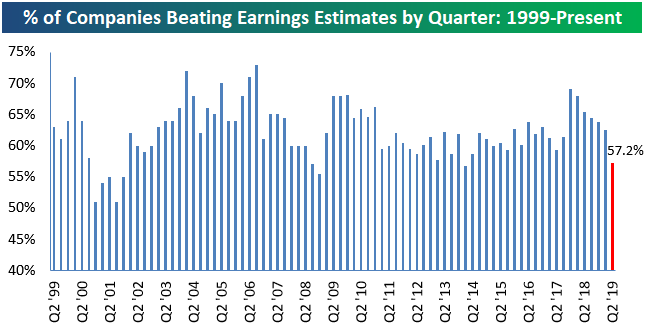
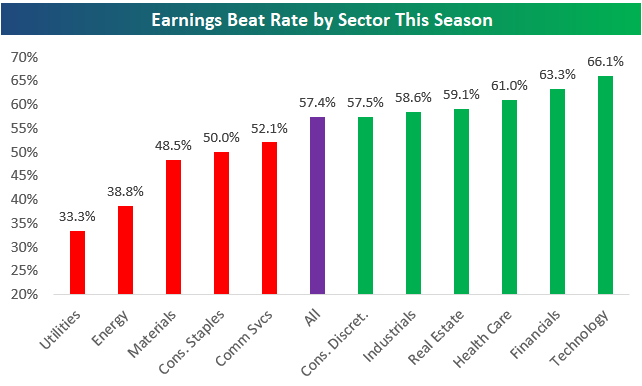
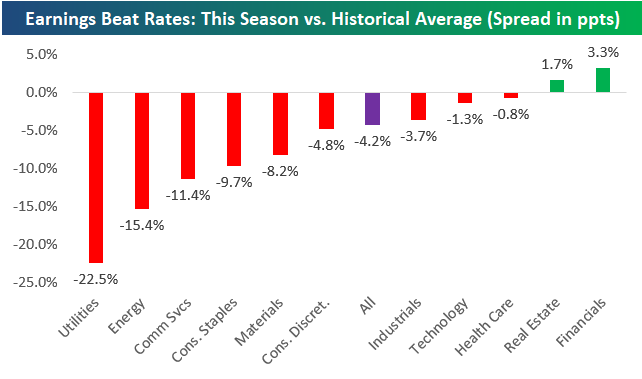
The unofficial Q2 earnings reporting period comes to an end on Thursday when Wal Mart (WMT) releases its numbers. More than 2,000 companies have reported earnings since the season began in early July, and 57.2% of them have beaten consensus analyst EPS estimates. As shown in the chart below, this quarter’s earnings beat rate is down significantly from recent quarters where 60%+ was pretty much a guarantee. If the current reading holds through Thursday, it will be the lowest beat rate since the Q1 2014 reporting period (April and May 2014).
Below is a look at earnings beat rates by sector this season. Technology has the strongest beat rate at 66.1%, followed by Financials at 63.3%. Utilities and Energy have the weakest beat rates at 33.3% and 38.8%, respectively.
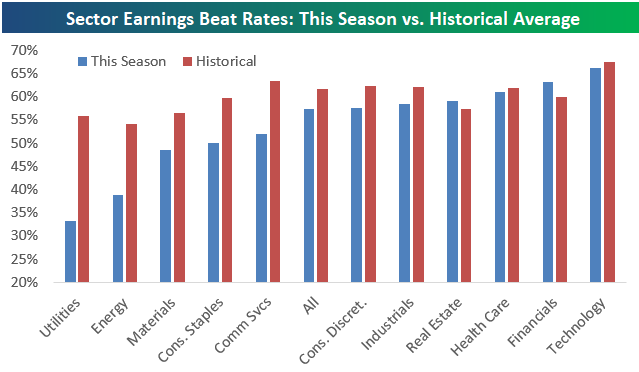
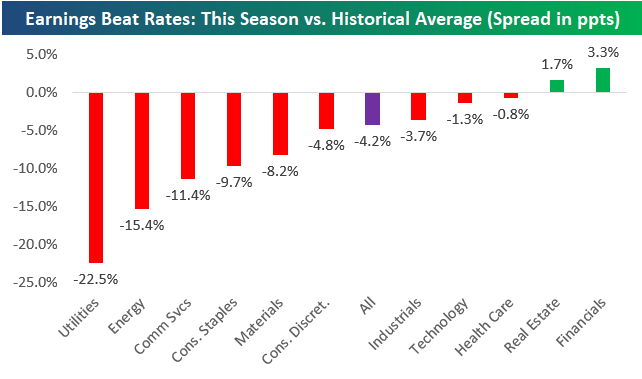
Below we show this season’s earnings beat rates by sector versus the sector’s historical earnings beat rate going back to 2001. All but two sectors have beat rates this season that are below their historical average. The Financial and Real Estate sectors are the only two that have seen stronger-than-normal beat rates. Start a two-week free trial to Bespoke Institutional to access our Trend Analyzer, Chart Scanner, Earnings Explorer and much more.
In late 2018, shares of Silicon Valley’s finest tanked some 16% in three months. Since then, Big Tech has been busy climbing back near record highs. And, as The Economist points out, listed tech firms now make up more than 25% of the value of U.S. stock markets.

The last time tech was this important was 2000, when the sector briefly made up one-third of the value of all U.S.-listed equities. Back then, the concern was that tech firms were “too flimsy” for their valuations. We all know how the dotcom bubble ended, but…
Today’s a different story—tech’s big five (Microsoft, Apple, Amazon, Alphabet, and Facebook) account for 12% of pre-tax profits among the U.S.’ non-finance firms, up from 4% in 2010.
Zoom out: Those big five make up half the tech industry’s market value, meaning new worries for the new millennium. Today, the concern is less about financials and more about the idea that Big Tech has accumulated too much power.
Morning Brew
Continue reading
By Ana Swanson, Alexandra Stevenson and Jeanna Smialek
Aug. 5, 2019
WASHINGTON — The trade war between the United States and China entered a more dangerous phase on Monday, as Beijing allowed its currency to weaken, Chinese enterprises stopped making new purchases of American farm goods and President Trump indicated he would look for ways to retaliate.
The escalation shook world markets on Monday, as nervous investors looked for safe places to park their money. Wall Street suffered its worst day of the year, with the S&P 500 closing down nearly 3 percent. Selling was especially heavy in the trade-sensitive technology, consumer discretionary and industrial sectors. Yields on United States Treasuries, which fall as prices rise, dropped as investors sought safety in government-backed bonds. Benchmark indexes in Asia and Europe also fell.
On Sunday, the People’s Bank of China, the country’s central bank, allowed its currency to weaken past the psychologically important point of 7 to the American dollar for the first time in more than a decade. In an unusually blunt statement, the bank blamed the currency fall on Mr. Trump’s “unilateralism and trade protectionism measures and the imposition of increased tariffs on China.”
Mr. Trump’s decision to impose additional tariffs on Chinese goods also prompted Chinese enterprises to halt purchases of American agricultural goods, according to China’s state-run Xinhua News Agency, which called the president’s proposed tariffs a “serious violation” of an agreement reached in June with Chinese President Xi Jinping.
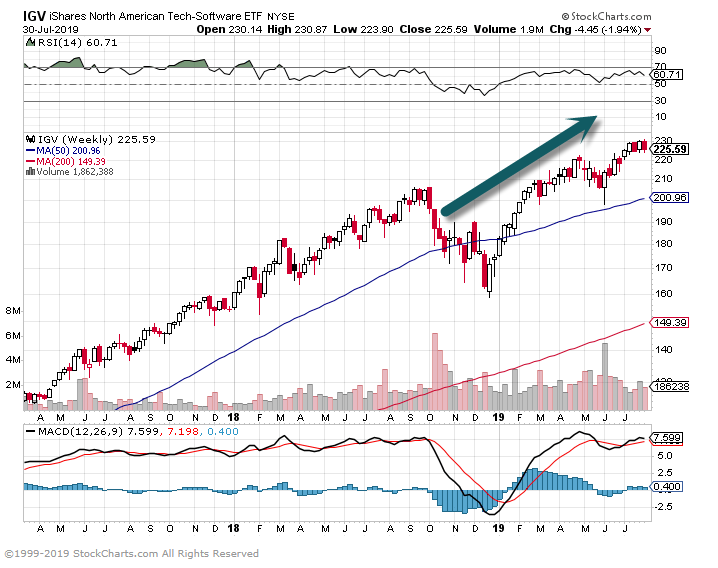
The exchange-traded fund (ticker: IGV) is up 32% this year and 100% over the past three years. Many software companies are now valued at more than 20 times projected 2019 sales—and without any earnings. No major industry has a higher valuation. The S&P 500 index is valued at about two times sales
Sky-High Software Stocks Are Beginning to Look Like They’re Forming a Bubble–Andrew Bary
IGV-Software ETF
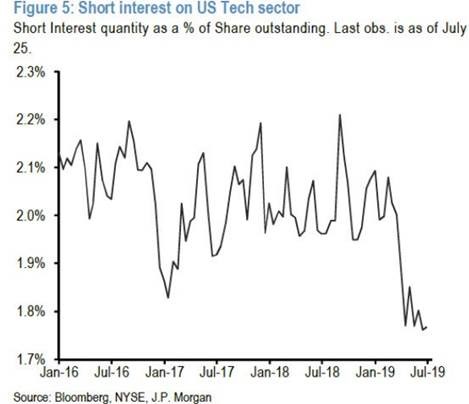
And Tech shorts have capitulated. Usually sign of top, says the always negative Zero Hedge – Growth Tech was shredded yesterday
From Dave Lutz at Jones Trading
While they are not an explicit component of its mandate, changes in the Fed’s monetary policy often have an observable effect on US securities markets. Rate decisions are often discussed as they relate to fixed income markets, as rate movements have a direct and inverse relationship to bond prices. However, as we saw earlier this year when dovish comments from Chair Powell led to an equity rally, fed rate policy can have also have important implications for the US stocks. So, what’s in store for the US equity market should the Fed cut rates next week as anticipated?
The expected rate reduction from the Fed comes against the backdrop of a US equity market that has seen each of the major large cap benchmarks hit new all-time highs within the last week. Based on research by John Lewis, Senior Portfolio Manager at Nasdaq Dorsey Wright, since 1990, when the Fed has initiated a rate cut when the S&P 500 SPX was within 5% of its high, on average, the index has posted positive returns over the next one-, three-, six-, nine-, and 12-month period; with an average 12-month gain of almost 11%. In fact, the only two occasions when we saw negative 12-month returns following a rate cut when SPX was within 5% of its high were the two successive cuts in September and October 2007, which preceded the global financial crisis. On the other hand, when a rate cut has been initiated when the S&P 500 is more than 15% below its high, on average, the index has posted negative returns over the next one-, three-, six-, nine-, and 12-month period.
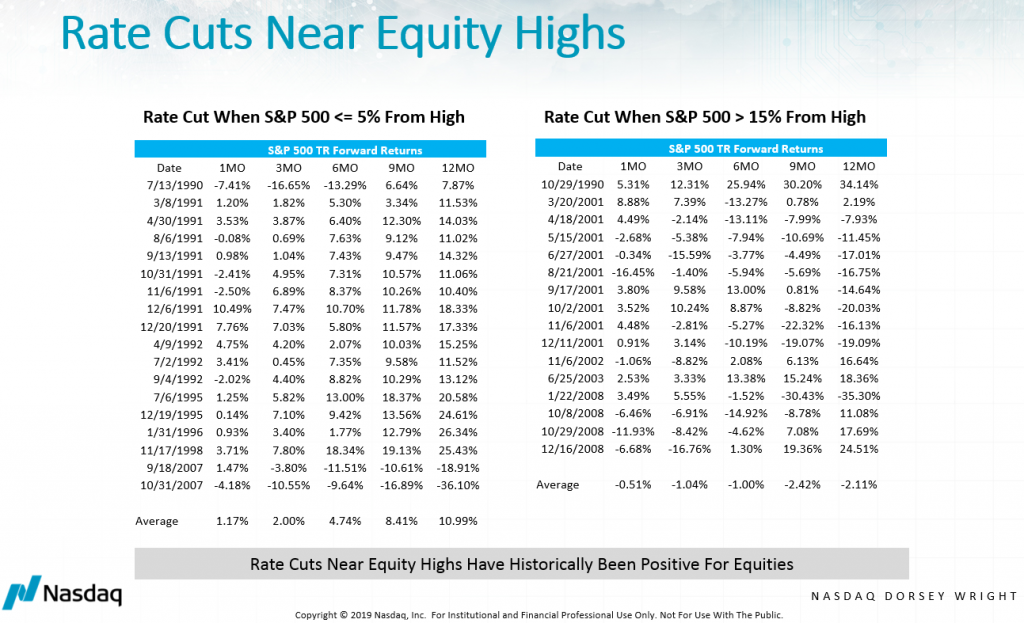
Nasdaq Dorsey Wright.
What is China’s STAR Market?BY MARK KOLAKOWSKIThe Shanghai Stock Exchange has created a hot new market showcasing some of China’s most promising tech companies, all with the goal of catching up to America’s Nasdaq, the birthplace of many of the world’s legendary and pathbreaking tech giants. The Shanghai Stock Exchange Science and Technology Innovation Board is being called the STAR Market for short by Chinese authorities, and began trading on Monday with 25 listed companies. These stocks ended the opening day with sizzling gains ranging from 84% to 400%, The Wall Street Journalreports.
“It’s a bit crazy, but I think the situation will calm down a bit in the next few days,” Jack Zhang, an analyst at BOC International, a securities brokerage and investment banking subsidiary of the Bank of China, told the Journal. He believes that individual investors with an appetite for risky speculation drove most of the first-day action.
“Gains were much stronger than expected, either due to unreasonable IPO pricing or speculative trading,” Zhu Junchun, a Shanghai-based analyst with Lianxun Securities Co., told Bloomberg. “It’s going to be a liquidity game in the first half year or one year of trading. Judging by the trading activity and gains on the board, it’s definitely a success,” he added.
KEY TAKEAWAYS
https://www.investopedia.com/what-is-china-s-star-market-4693703
China STAR Market stocks lose trader interest as ‘temporary craziness’ wears off, curbs kick in
Louise Moon https://www.scmp.com/business/markets/article/3020464/china-star-market-stocks-lose-trader-interest-temporary-craziness
Key Points
U.S. companies are on pace to break another record for share repurchases in 2019, using a combination of cash and debt to push the total to close to $1 trillion.
For the first time since the financial crisis, companies have given back more to shareholders than they are making in cash net of capital expenditures and interest payments, or free cash flow, according to Goldman Sachs calculations.
The level of buybacks to free cash flow hit 104% for the 12 months ending in the first quarter of 2019, the first time that number has topped 100% during the economic recovery that started in 2009. In 2017, the level was 82%.
https://www.cnbc.com/2019/07/29/buybacks-companies-increasingly-using-debt-to-repurchase-stocks.html
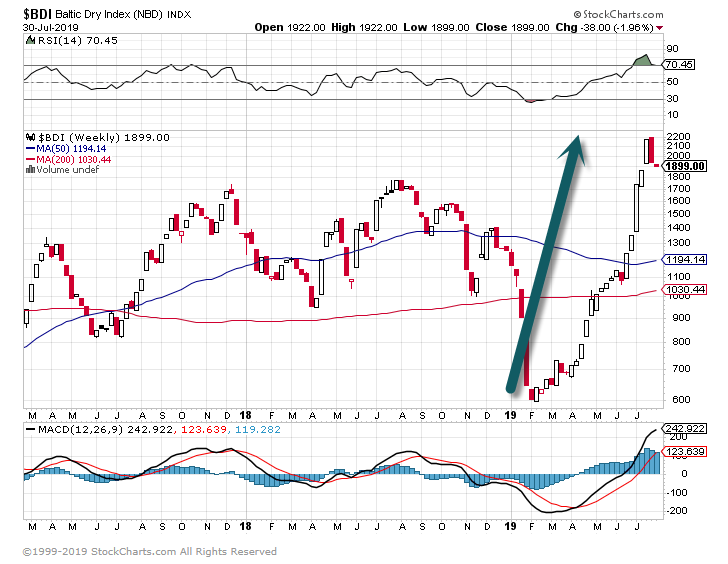
Baltic Dry Index – BDI
REVIEWED BY BEVERLY BIRD
Updated Apr 12, 2019
What Is the Baltic Dry Index – BDI?
The Baltic Dry Index (BDI) is a shipping and trade index created by the London-based Baltic Exchange. It measures changes in the cost of transporting various raw materials, such as coal and steel.
Members of the exchange directly contact shipping brokers to assess price levelsfor given shipping paths, a product to transport, and time to delivery or speed. The Baltic Dry Index is a composite of three sub-indices that measure different sizes of dry bulk carriers or merchant ships: Capesize, Panamax, and Supramax.
How the Baltic Dry Index – BDI Works
The Baltic Exchange calculates the index by assessing multiple shipping rates across more than 20 routes for each of the BDI component vessels. Analyzing multiple geographic shipping paths for each index gives depth to the index’s composite measurement. Members contact dry bulk shippers worldwide to gather their prices and they then calculate an average. The Baltic Exchange issues the BDI daily.
KEY TAKEAWAYS
https://www.investopedia.com/terms/b/baltic_dry_index.asp

The Dutch company Port-Liner is building two giant all-electric barges dubbed the ‘Tesla ships‘. The company announced that the vessels will be ready by this autumn and will be inaugurated by sailing the Wilhelmina canal in the Netherlands.
The 100 million-euro project supported by a €7m subsidy from the European Union is expected to have a significant impact on local transport between the ports of Amsterdam, Antwerp, and Rotterdam.
Chief executive of Port-Liner Ton van Meegen told The Loadstar:
“There are some 7,300 inland vessels across Europe and more than 5,000 of those are owned by entrepreneurs in Belgium and the Netherlands. We can build upwards of 500 a year, but at that rate it would take some 50 years to get the industry operating on green energy.”
The battery-powered barges – pictured above – are capable of carrying 280 containers.
The first 6 barges are expected to remove 23,000 trucks from the roads annually in the Netherlands and replace them with zero-emission transport.
Port-Liner is developing its own vessels, but they developed a battery pack technology that houses the batteries inside a container.
Meegen says that it could allow them to retrofit existing barges:
“This allows us to retrofit barges already in operation, which is a big boost for the industry’s green energy credentials.The containers are charged onshore by carbon-free energy provider Eneco, which sources solar power, windmills and renewables.”
The first vessels will complete their maiden voyage later this year.
Get a chance to win a Tesla Model 3 Performance with Wall Connector and $20,000 in the frunk
Electrek’s Take
As we have often discussed in the past, all modes of transportation are gradually being converted to electric propulsion and that includes maritime transport.
It’s also an important mode of transportation to convert since it produces a lot of pollution. Some of the world’s largest cargo ships emit pollution comparable to millions of passenger cars put together.
I think it’s an exciting time on that front because we have seen several major projects like this one in the past few months. A new all-electric cargo ship with a massive 2.4 MWh battery pack in China and two massive all-electric ferries in Sweden and Denmark come to mind.
Liz Ann Sonders
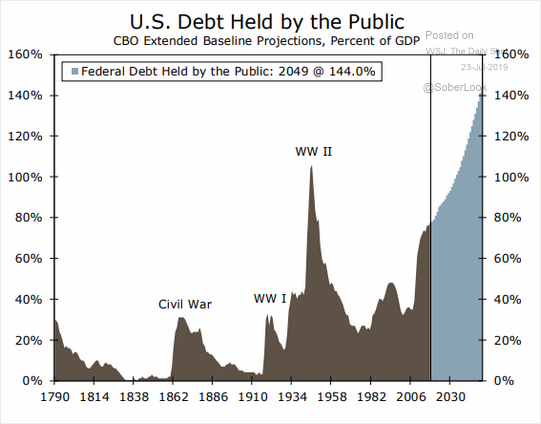
It’s amazing to me how often I hear folks (including our politicians…on both side of the aisle) conflate the terms deficit and debt. The latter is the cumulative effect of running the former. As you can see in the chart below, per Congressional Budget Office (CBO) projections, the U.S. budget deficit is expected to exceed $1 trillion each year starting in 2022; with deficits likely to be well above the 50-year average. Outlays are expected to jump to 23% of GDP by 2029, from 20.8% this year due to demographics and rising health care costs.
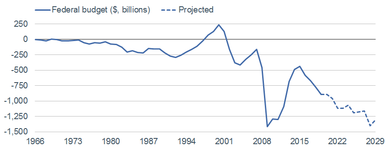
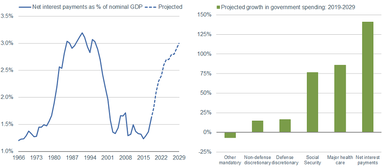
Source: Charles Schwab, CBO (Congressional Budget Office) May 2, 2019 Report: Updated Budget Projections: 2019 to 2029.
At TED the self-made billionaire explained why the usual business playbook is flat-out dumb.
By Jessica StillmanContributor, Inc.com@EntryLevelRebel
There are few things as American as a classic rags to riches story, and Chobani founder Hamdi Ulukaya seems to fit this classic narrative to a T. Born into a family of nomadic sheep herders in Turkey, he came to America with just $3,000 in his pocket and, through hard work, vision, and a bit of luck, managed to build a billion-dollar yogurt business.
But while Ulukaya might seem like the perfect example of old-fashioned business success, from the TED stage in April (hat tip to Swiss Miss) he explained that his views on what it means to be successful are wildly different from the traditional business playbook.
In fact, rather than seeing himself as the usual pull-yourself-up-by-your-bootstraps capitalist hero, he thinks of himself as an “anti-CEO” calling the shots at his company from the “anti-CEO playbook.” The typical rules of business success, he flatly declares, are stupid. Here’s what he’s replaced them with.
1. Businesses exist to maximize shareholder value? Nope.
“Today’s business books say businesses exist to maximize profit for the shareholders. I think that’s the dumbest idea I’ve ever heard in my life,” Ulukaya says. If businesses shouldn’t try first and foremost to make money for their owners, what should they aim for? “Businesses should take care of their employees first,” he insists.
In 2016 Ulukaya took the unusual step of giving his 2,000 employees shares in the company. “Some people said it’s PR. Some said it’s a gift. I said, ‘It’s not a gift’… They earned it with their talent and their hard work,” he explains.
2. Ask not what your community can do for you; ask what you can do for your community.
In a veiled swipe at Amazon’s recent HQ2 beauty contest, where cities competed to show how many tax breaks and incentives they could offer the online behemoth, Ulukaya believes companies shouldn’t approach communities with their hand out. Instead, businesses should go to struggling communities and ask, “How can I help you?”
“Go search for communities that you can be part of. Ask for permission and succeed together,” Ulukaya advises, citing the resurgence of the community around his company’s second factory in rural Idaho to show how this can work out for the benefit of everyone.
3. Your boss isn’t the board. It’s the consumer.
“Today’s playbook says the CEO reports to the board. In my opinion the CEO reports to the consumer,” says Ulukaya. He takes this point so seriously that, in the early days of Chobani, the telephone number on each pot of yogurt was his own personal line. Customers could literally phone up the CEO to chat.
“The consumer is in power. That’s the reason business exists,” he reminds leaders.
All of which sounds idealistic. And it is. But Ulukaya insists it is also a recipe for a deeper, more meaningful (and clearly still very remunerative) kind of success.
“If you’re right with your people, if you’re right with your community, if you’re right with your product, you’ll be more profitable, more innovative, and you will have more passionate people working for you and a community that supports you,” he concludes.
The Daily Shot https://dailyshotbrief.com/the-daily-shot-brief-july-23rd-2019/
Continue readingPosted by lplresearch
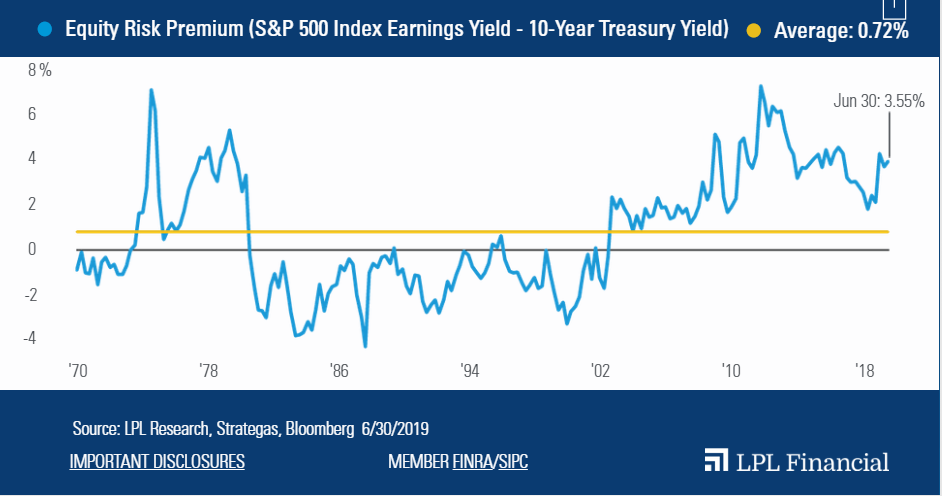
U.S. stocks have powered back to record highs, and they could benefit more from a relatively expensive fixed income market.
As shown in the LPL Chart of the Day, Stocks Appear Historically Cheap Relative to Bonds, S&P 500 Index stocks are at their most attractive valuations relative to Treasuries in nearly three years. This data is based on a metric we track called the equity risk premium (ERP), which compares the earnings yield on equities (or company profitability as a percent of share price) to the 10-year Treasury yield.
There are several different ways to view stock and bond valuations, so the ERP is only one piece of the puzzle. However, the ERP’s recent ascent shows how much global buying pressure has crimped U.S. yields this year.
There are several different ways to view stock and bond valuations, so the ERP is only one piece of the puzzle. However, the ERP’s recent ascent shows how much global buying pressure has crimped U.S. yields this year.
https://lplresearch.com/2019/07/23/a-case-for-stocks-from-bond-valuations/#more-13591
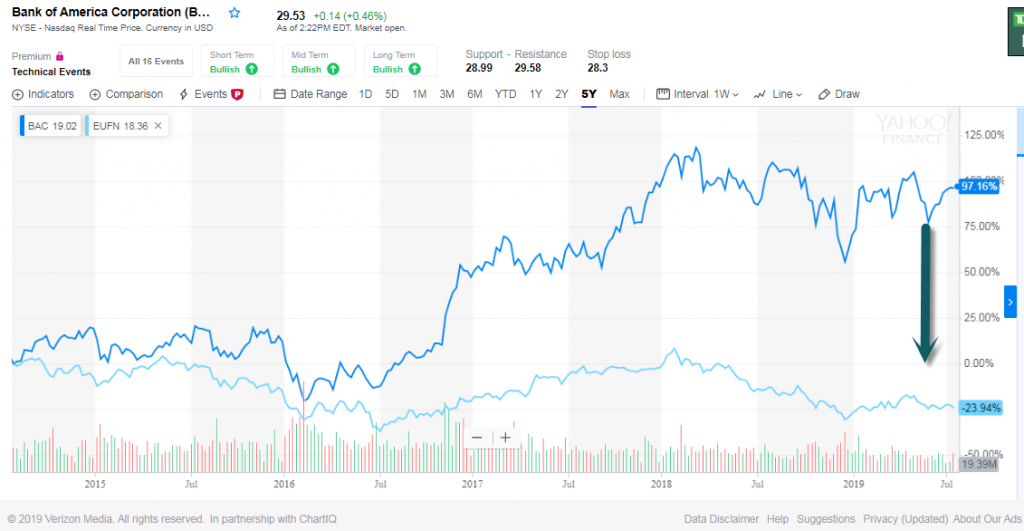
Continue readingThe result: Six leading European banks— UBS (UBS), Credit Suisse Group (CS), Barclays (BCS), BNP Paribas (BNP.France), Société Générale(GLE.France), and Deutsche Bank (DB) now have a combined market value of around $200 billion, less than that of Bank of America (BAC) alone.
5 Year Chart BAC +100% vs. EUFN (Euro financials) -22%
The Bain & Company data showed multiples for companies being bought in the US and Europe are close to 11 times earnings before interest, tax, depreciation and amortisation.
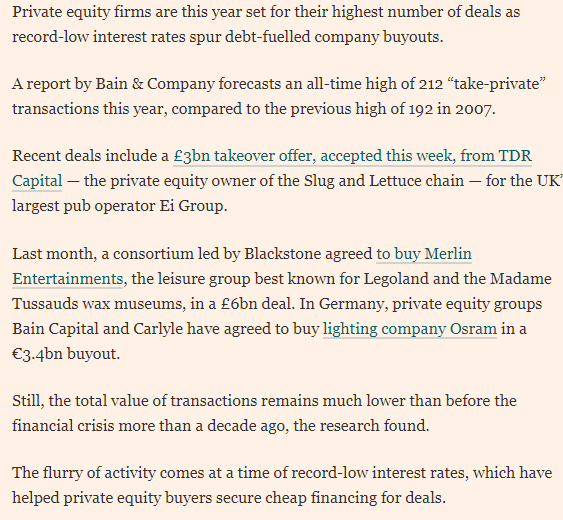
https://www.ft.com/content/e86ae276-a964-11e9-b6ee-3cdf3174eb89
Continue reading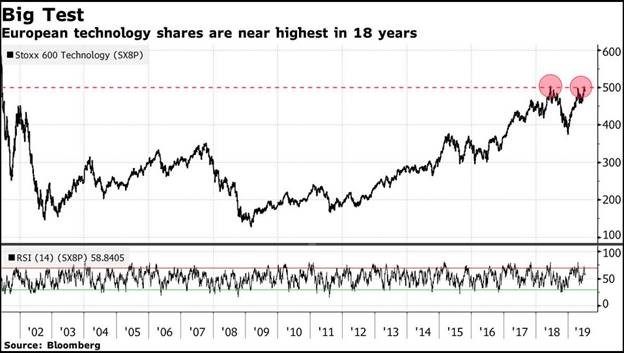
Among tech companies, SAP, ASML and Ericsson are scheduled to report this week, which might signal what’s next for the shares of Europe’s best-performing industry this year – The region’s technology sector is up 26% in 2019, keeping up with the Nasdaq 100, while the Philadelphia Semiconductor Index SOX has soared more than 30%
Dave Lutz at Jones Trading.
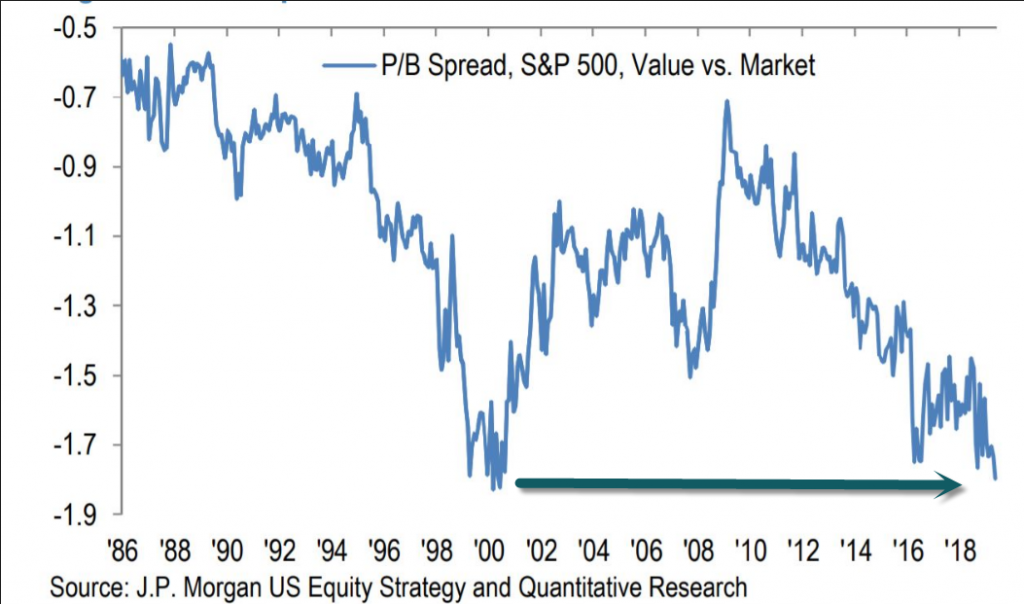
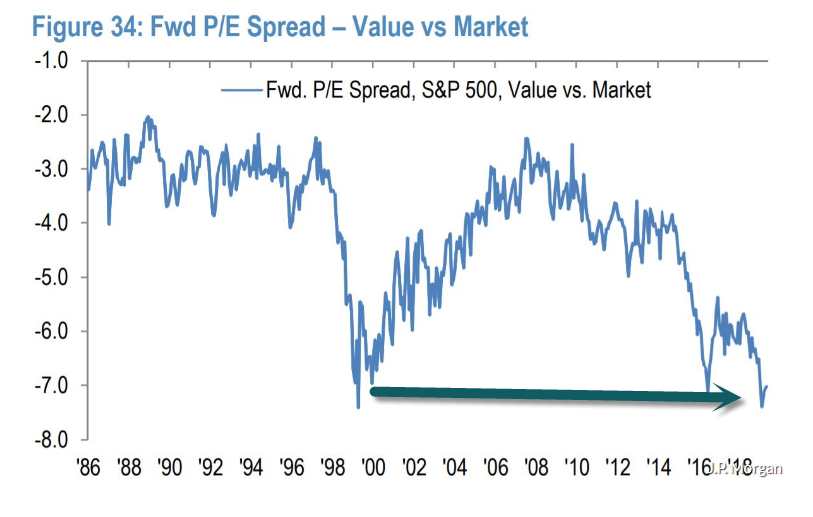
Chris Matthews
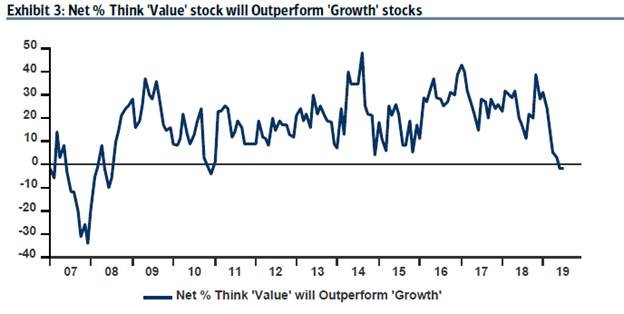
Just 2% of global fund managers think value will outperform growth, and that’s after one of the biggest underperformance in history.
2 Charts Today From Dave Lutz at Jones…Thanks Lutzie
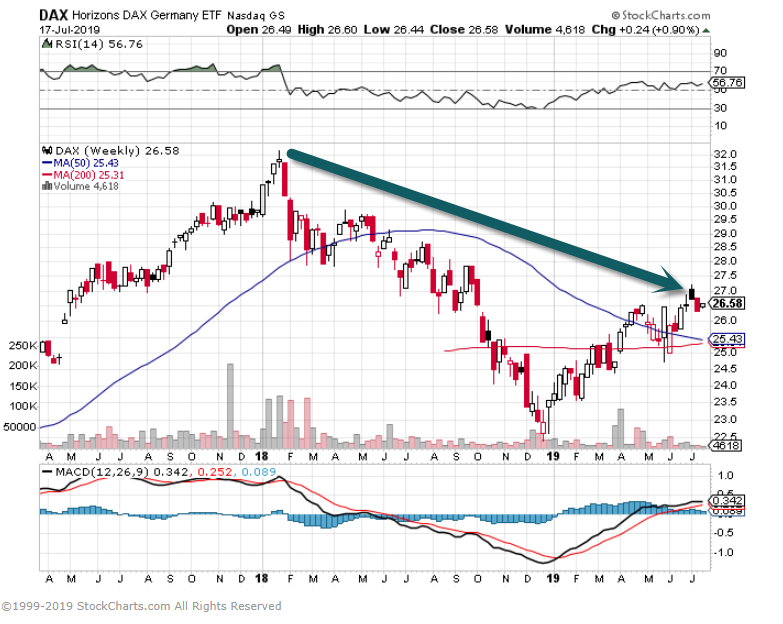
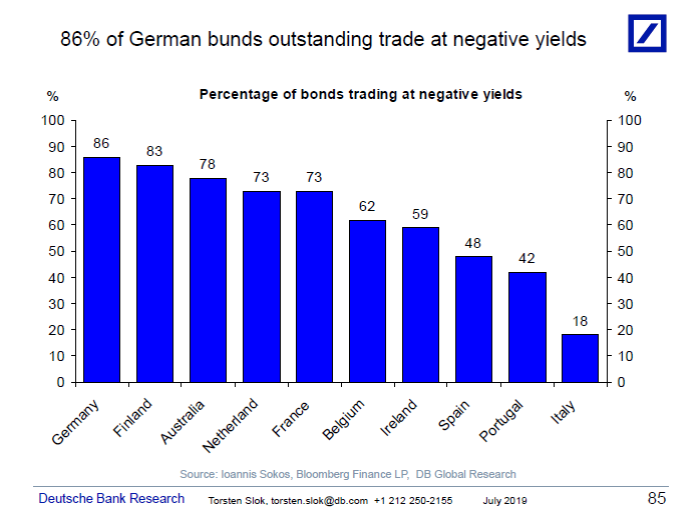
Torsten Slok
Deutsche Bank
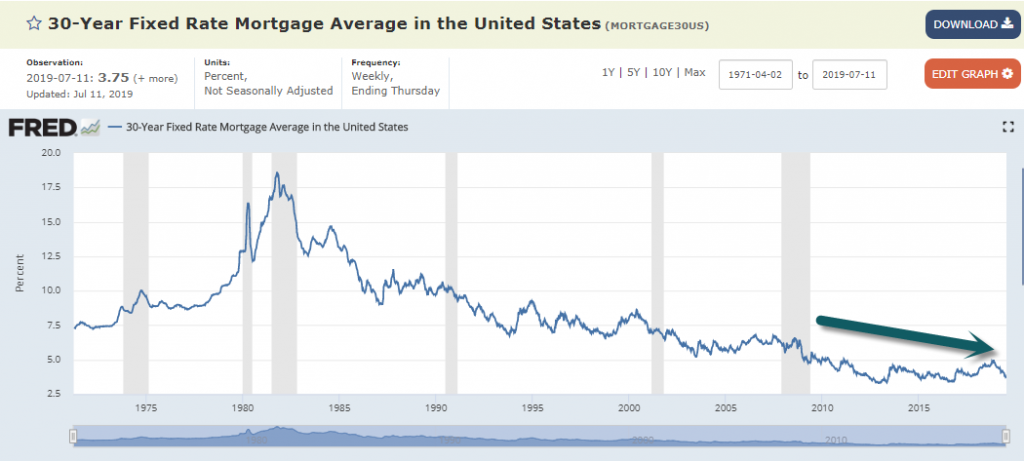
The Capital Group
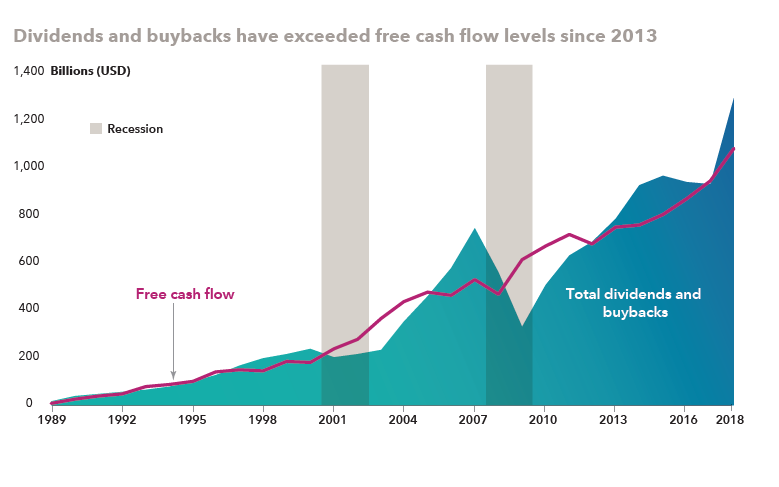
source: Capital Group. Universe is made up of 2,902 non-financial U.S.-based companies that represent more than 98% of the U.S. public equity market. As of 12/31/18.
https://www.thecapitalideas.com/
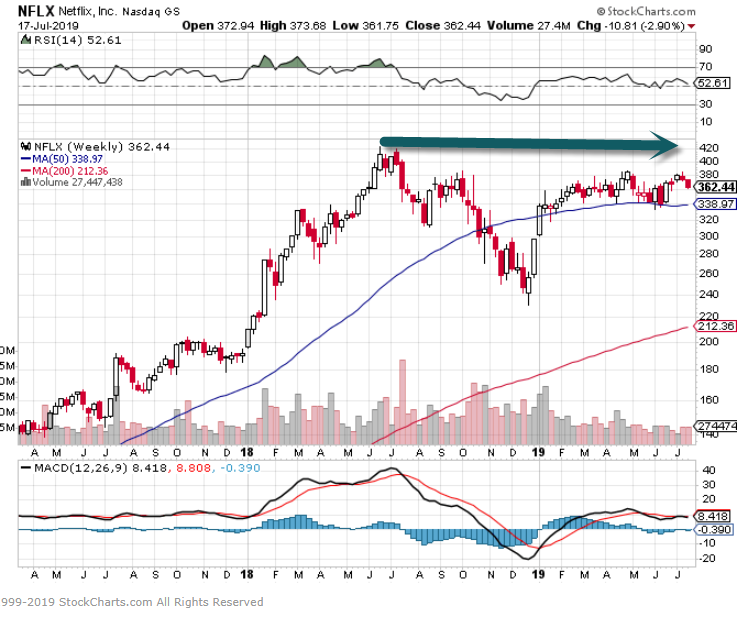
Netflix Pullback Yesterday…Never Made New High with S&P

Francis Scialabba
While Wall Street is still drooling over Beyond Meat, researchers are looking one step ahead to the next generation of meat cultivation: cellular agriculture.
What it is: Cellular agriculture uses cultures to build cell-based products outside of an organism. This can include animal-derived products, such as meat, eggs, and dairy, as well as byproducts like silk, leather, and fur.
The first hamburger grown in a lab burned the roofs of taste-testers’ mouths in 2013. But it cost $330,000, and that was before guac. Researchers are betting that in a few years, similar meat products will 1) be affordable and 2) taste and feel even more like the “real” thing.
The warm reception of plant-based meat alternatives (like Beyond Meat) is a good indicator of future demand for cellular agriculture products. Consumers want clean, ethical, and sustainable food, and meat farmed in a lab setting could change what it means to be “vegetarian” or “vegan.”
Prepare to debate what counts as meat. Plant-based products have already received pushback from the meat and dairy industries over labeling. Even cauliflower rice has not emerged unscathed.
Actually, let’s debate it right now. Should cell-based, lab-developed meat count as real meat? Vote here.
Boil it down
The promise: Clean, sustainable, safe meat products, without any of the ethical or environmental problems that plague today’s livestock and aquaculture industries.
The roadblocks: Cellular agriculture has never been conducted on a commercial scale or with price constraints. Customers also have to get on board.
The projected timeline: Researchers are betting that in a few years, cellular agriculture-derived meat products will be affordable and taste and feel even more like the “real” thing.
The major players: Meat (Aleph Farms, Mosa Meat, Memphis Meats), seafood (Finless Foods, BlueNalu), and animal-derived products (Clara Foods, Perfect Day Foods, Modern Meadow).
Alex Tsepko,
Minutes
Last year, my company, Skylum, experienced some tough times. We grew sizably, but we were also navigating new markets and facing unexpected challenges. Ultimately, we had to ask — and answer — some hard questions of ourselves. Today, the company is more successful than it’s ever been. But our year of growth and adjustment also had another side effect: Everyone in the company — myself very much included — struggled with new and difficult levels of stress.
This doesn’t make us unique. According to The American Institute of Stress, 80 percent of employees today experience stress at their job. CEOs and company leaders suffer the most, with a majority reporting feeling regularly overworked, exhausted, and anxious. The problem is so pervasive that it now feels commonplace and almostrequired of working and keeping a good job.
The truth, however, is that workplace stress is remarkably damaging — both to our health and to our general effectiveness in the office.
It’s the ultimate distraction. It tires your brain and prevents you from applying 100 percent of your mental energy to whatever task is at hand.
So if you’re attempting to achieve any kind of goal, stress is something you need to combat rather than accept. Here are the four primary types of stress — and how to manage them.
Stressor 1: Having too much work
Focus on results, and prioritize from there. Nattakorn_Maneerat/Shutterstock
Problem: Company leaders and managers constantly have things to do, along with people who rightfully need our attention and time. Trying to complete all these tasks runs us down and drains our focus and happiness.
Solution: Focus on results, not the workload itself. Many of us — CEOs included — tend to focus on the amount of work we have, as if the number of nights we spend at the office is indicative of our success. Guess what? It’s not. So instead, prioritize your individual responsibilities in accordance with your short-term and long-term goals. This will help you determine what you actually need to do today in order to achieve your most pressing goals. If you have a new product you’re launching in two months, for example, ensuring that launch is successful is likely your most important goal. You should make sure that everything you do furthers your progress in achieving that end. To help you make such determinations, use metrics and data. Then eliminate, delegate, or ignore processes and tasks which won’t contribute to your growth.
Stressor 2: Having too little work
It may seem paradoxical, but more free time can add to stress.funkyfrogstock/Shutterstock
Problem: One of the ways CEOs manage major influxes of work is by delegating tasks. But with delegation comes more free time. I experienced this first hand. As Skylum grew, suddenly I had roughly 70% more free time, and I had to figure out how to best spend it. As I discovered, this can be even more stressful than having too much work; I felt like I wasn’t adding as much value as before, and I feared employees might get frustrated.
Solution: Focus your energy on new and specific goals. One of those goals in my case was building and managing highly effective teams. Sure, I wasn’t running PR and marketing by myself anymore, but I could help ensure those who were now in charge had everything they needed to be successful. Once you’ve identified your new areas of focus, apply yourself to add as much value in those verticals as you can. As you grow, this is what your role as a CEO or manager will always look like: identifying areas of weakness at your company, and then applying yourself to address those as best you can.
Stressor 3: Losing connection with your team
Stay in touch, and stay grounded with outside advice. Shutterstock / UfaBizPhoto
Problem: You always want to stay connected with your team, but as a company leader, this isn’t always possible. I’m reminded of this whenever I’m on the road for long periods. You worry about whether your team will suffer without direct access to their leader. You also worry that without you managing or directing things, productivity, engagement, or happiness might dip.
Solution: It’s threefold:
Stressor 4: Things not happening as fast as you’d like
It can take time to see progress on big projects. Shutterstock
Problem: This one, again, is especially hard for company leaders; you want things to grow and move along quickly, but often, they don’t. And you won’t always have control over that.
Solution: Take time to reflect and evaluate the effectiveness of each individual component of your company. Determine whether disparate teams are putting in maximum effort toward delivering the result you want. If they’re not, weigh potential solutions, and decide whether those folks may need a bit of a nudge. If folks areworking hard, recognize that sometimes, progress simply can’t be rushed. I find that with big projects, you often don’t see results for more than six months or a year after you start working. So in those moments, turn your attention to something else — something that is in your control and that you can have a tangible impact on.
At the end of the day, stress management is necessary. And the best way to go about doing it is to look at your sources of stress objectively, and work smart to identify solutions. Your solutions may look different than those which I ultimately employed, but I’m confident the methodology will be the same.
Alex Tsepkois the CEO of Skylum Software.
Read the original article on Minutes. Copyright 2019. Follow Minutes on Twitter.
Posted by lplresearch
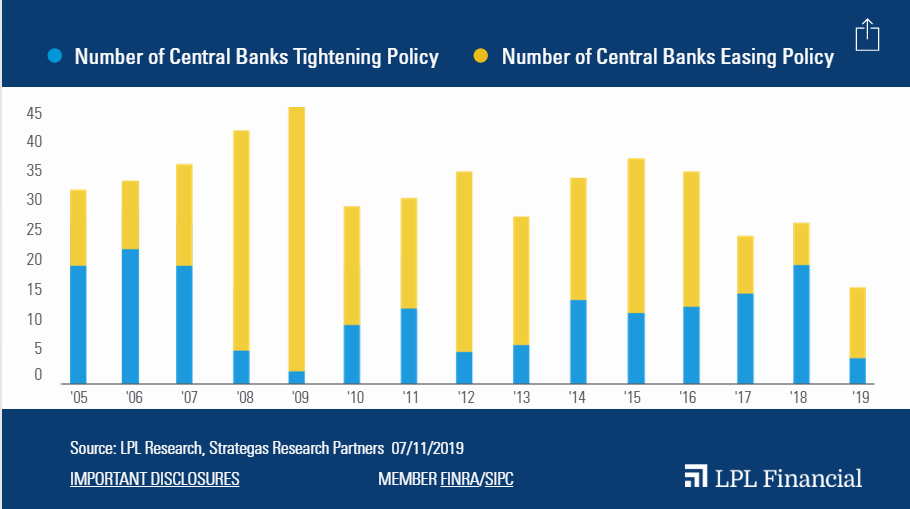
Central banks are back in easing mode, to the dismay of coupon-clipping fixed income investors.
As shown in the LPL Chart of the Day, Global Central Banks Back in Easing Mode, central banks around the world are embarking on a marked policy shift as trade tensions pressure the global economy and government becomes more intertwined with policy decisions.
Two of the world’s most influential central banks, the Federal Reserve (Fed) and the European Central Bank (ECB), are eyeing looser policy in the months ahead. We expect the Fed to implement a 25 basis point (0.25%) “insurance” rate cut at its July meeting, and policymakers have already announced plans to end balance sheet runoff in September. The ECB has all but promised a new wave of accommodation, likely through asset purchases.
https://lplresearch.com/2019/07/16/central-banks-and-the-search-for-yield/
Continue reading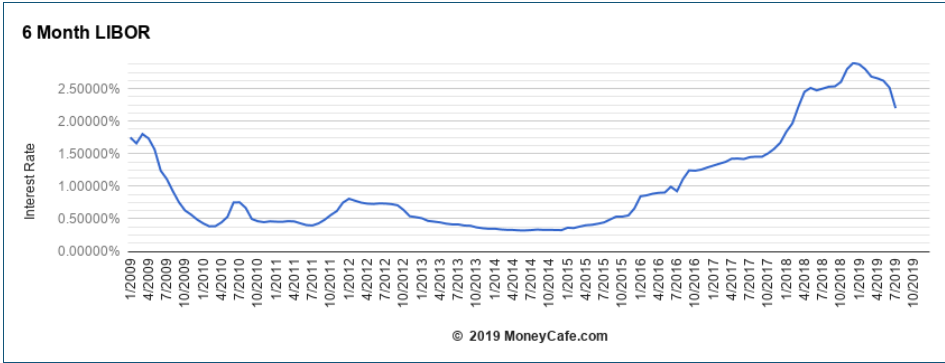
https://www.moneycafe.com/6-month-libor/
https://www.macrotrends.net/1433/historical-libor-rates-chart
Continue reading
Cigna’s quarterly sales per share are expected nearly to double, even with significant dilution from issuing shares to help pay for its acquisition of Express Scripts.
Despite all the good economic news, earnings growth is expected to slow to a crawl this year for large U.S. companies. It may also surprise you that the health-care sector is seen as one of the exceptions.
During the first quarter of 2019, earnings per share declined from a year earlier for six of the S&P 500’s SPX, +0.45% 11 sectors. These are the five that countered the trend, according to S&P Global Market Intelligence:
| S&P 500 sector | Increase in Q1 EPS |
| Health Care | 9.8% |
| Real Estate | 7.4% |
| Financials | 6.2% |
| Industrials | 5.9% |
| Information Technology | 4.0% |
| Source: S&P Global Market Intelligence |
For the second quarter, consensus estimates among analysts polled by S&P Global Market Intelligence are for the S&P 500’s weighted aggregate EPS to increase 2.2% from a year earlier. Even so, all but these three sectors are expected to show declines:
| S&P 500 sector | Expected increase in Q2 EPS |
| Financials | 4.3% |
| Health Care | 2.0% |
| Industrials | 0.2% |
| Source: S&P Global Market Intelligence |
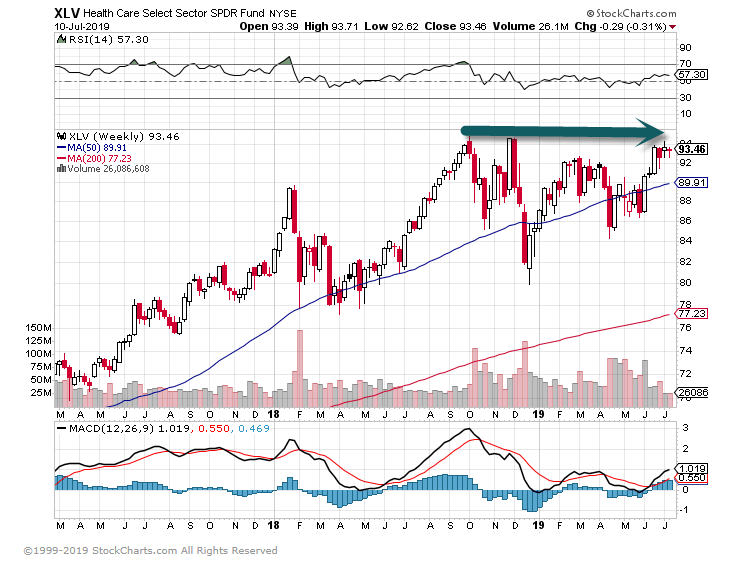
Health care is one of the stock market’s healthiest sectors right now
Apple Downgraded to Sell at Rosenblatt Securities
(Bloomberg) — Wall Street hasn’t been this down on Apple Inc. in a long time.
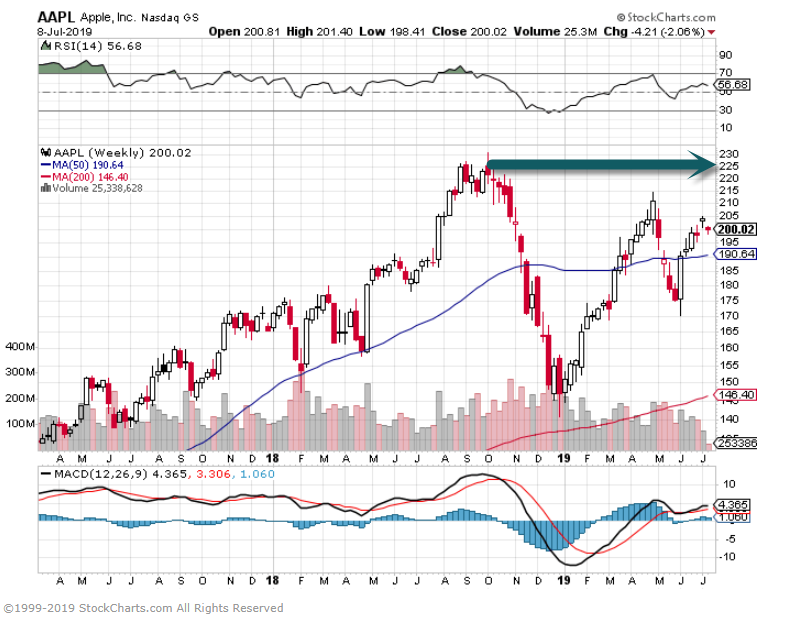
Rosenblatt Securities downgraded the company to sell on Monday, bringing the total number of bearish analysts up to five, among the 57 ratings tracked by Bloomberg. Five is the highest number of sell ratings the iPhone maker has had since at least 1997, according to historical data compiled by Bloomberg. To put that into context, Apple wouldn’t release its iMac computer until August 1998, and the iconic iPod wouldn’t debut until October 2001.
In another sign of the growing caution around the company, Apple’s consensus rating — a proxy for the company’s ratio of buy, hold, and sell ratings — is currently 3.76, according to Bloomberg data. That’s the lowest since 2004.
Skepticism surrounding the company has accelerated in 2019, with all five of the sell ratings coming in this year. Both New Street Research and HSBC lowered their ratings on the stock to sell in April, and in January, the number of firms with buy ratings dropped below 50% for the first time since 2004.
The caution has been largely driven by uncertainty surrounding demand for the company’s critical iPhone line, with the U.S.-China trade war seen as a particular headwind. In January, Apple cut its revenue outlook for the first time in almost two decades, in large part because of iPhone weakness. Apple’s third-quarter results are currently expected to come out on July 30.
According to data compiled by Bloomberg, more than 60% of Apple’s 2018 revenue was related to the iPhone, while roughly 20% came from China, which is also a critical part of its supply chain. Last week, Citi wrote that Apple’s China sales “could be cut in half” due to “a less favorable brand image desire.”
Rosenblatt’s downgrade came as analyst Jun Zhang expects the company “will face fundamental deterioration over the next 6-12 months,” based on disappointing sales trends. The downgrade pushed Apple stock lower by as much as 2.9% in Monday trading.
Still, the sell-equivalent ratings hardly represent a consensus view. A plurality of 23 firms recommend buying the stock, while another 21 have hold ratings, according to data compiled by Bloomberg.
The 2019 caution hasn’t really been reflected in Apple’s stock performance. Shares are up more than 40% from its January low, though they remain about 14% below record levels.
The news was not entirely negative for Apple on Monday, however, as Wedbush wrote it was “incrementally more positive on global iPhone demand” following checks in Asia. “We saw a ‘slight uptick’ out of Apple suppliers during our checks although overall handset demand remains challenging,” analyst Daniel Ives wrote. He affirmed his outperform rating and $235 price target.
(Adds context in second paragraph, consensus rating in third, and stock performance in ninth.)
To contact the reporter on this story: Ryan Vlastelica in New York at rvlastelica1@bloomberg.net
To contact the editors responsible for this story: Catherine Larkin at clarkin4@bloomberg.net, Steven Fromm
For more articles like this, please visit us at bloomberg.com
©2019 Bloomberg L.P.
Continue reading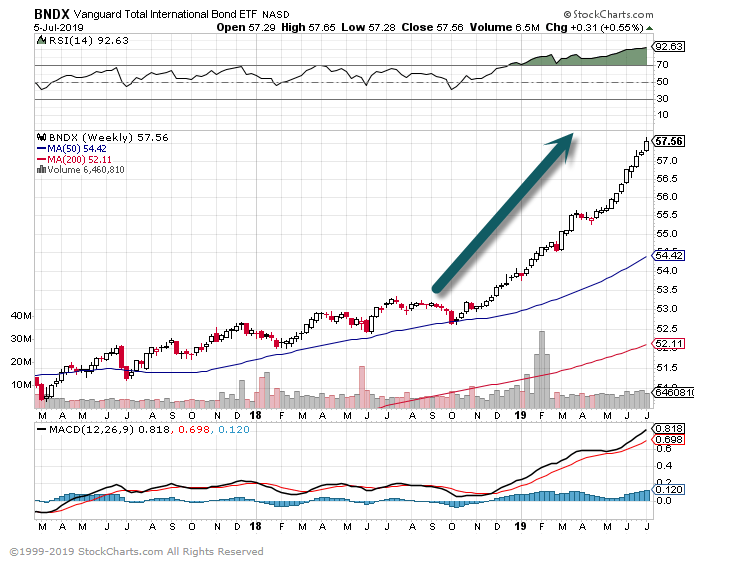
Jim Grant in Barrons.
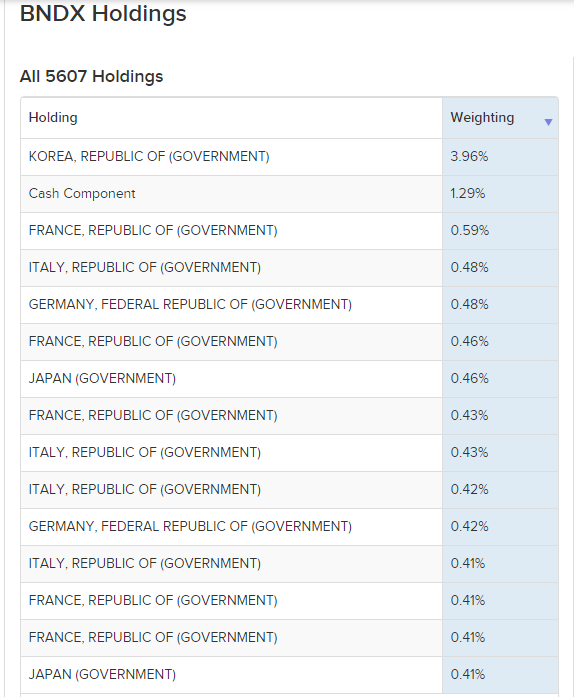
Jim Grant: The Trouble With Austria’s 100-Year Bonds By James Grant
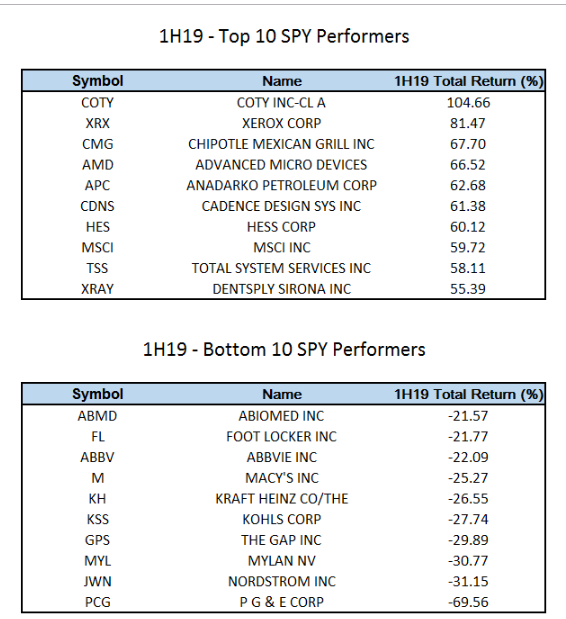
From Nasdaq Dorsey Wright www.dorseywright.com
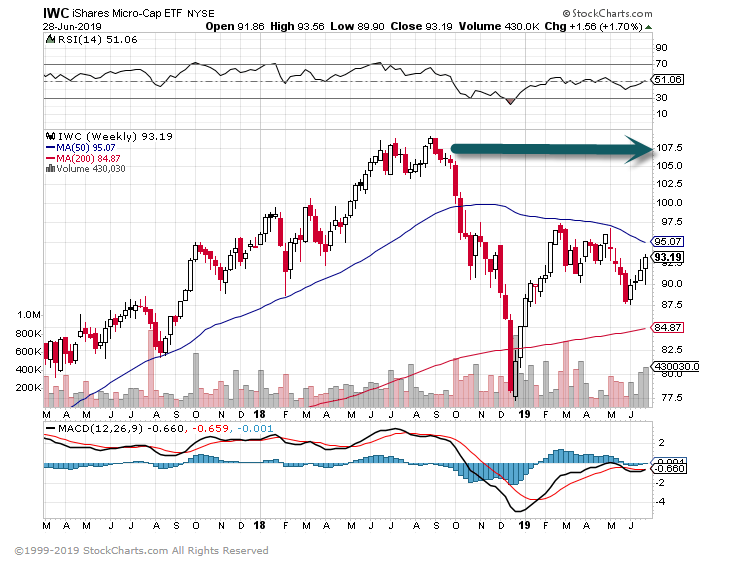
Holger Zschaepitz @Schuldensuehner 1h1 hour ago
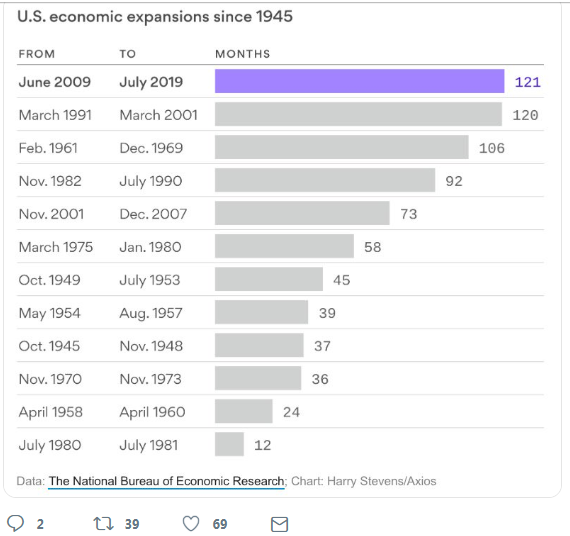
Tomorrow is July, which means that we will officially be entering the longest economic expansion the U.S. has ever seen. https://www.axios.com/newsletters/axios-edge-b333a2bd-e9ac-4a7b-ba5d-bca2a660a9b1.html?chunk=5&utm_term=twsocialshare#story5 …
Barrons
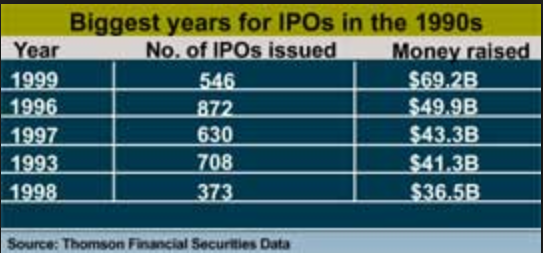
Initial offerings could raise a record level of capital in 2019, potentially breaking the nearly $97 billion record set in 2000. But Wainwright, and IPO investors, have returned wiser and more disciplined.
In a sense, the IPO market has simply grown up. For one thing, the median age of tech companies going public in 1999 was four; last year, it was 12. And having been burned in the bubble years by IPOs for wildly speculative and ultimately failed businesses, such as theGlobe.com and eToys, investors have tightened their standards. They now want established businesses with substantial revenue and high growth.
The RealReal Is No Pets.com and Today’s IPO Market Is Not the Next Dot-Com BubbleBy Eric J. Savitz
https://money.cnn.com/1999/12/27/investing/century_ipos/

https://www.cbinsights.com/research/tech-ipo-dead/
PUBLISHED SAT, JUN 29 2019 8:30 AM EDTYun Li@YUNLI626
KEY POINTS
It’s no secret that machines are taking up a bigger and bigger share of investing, but the extent of their influence is approaching shocking proportions. It is as high as 80%, according to one major investing firm.
Passive investments such as index funds and exchange-traded funds control about 60% of the equity assets, while quantitative funds, those which rely on trend-following models instead of fundamental research from humans, now account for 20% of the market share, according to estimates from J.P. Morgan.
This means so much of stock trading is now in the hands of automated buyers and sellers that the market is increasingly sensitive to headlines and more prone to sharp price swings, many notable investors believe.
Omega Advisors founder Leon Cooperman previously said computer trading is creating a “Wild West” with the markets, calling for an investigation by the Securities and Exchange Commission.
DoubleLine Capital CEO Jeffrey Gundlach has taken a shot at passive investing, saying it is causing widespread problems in global stock markets. He called it a “herding behavior.”
“I’m not at all a fan of passive investing. In fact, I think passive investing … has reached mania status as we went into the peak of the global stock market,” Gundlach said in December.
While algorithmic models have gained popularity on Wall Street, low-cost passive vehicles keep raking in assets from Main Street. Passive funds have attracted $39 billion of inflows so far this year, whereas active funds lost a whopping $90 billion in 2019, according to J.P. Morgan.

“The pace of outflows from Active is at a cycle high while the pace of passive equity inflows has bottomed and [is] beginning to reaccelerate,” Dubravko Lakos-Bujas, J.P. Morgan’s chief U.S. equity strategist, said in a note on Friday.
https://www.cnbc.com/2019/06/28/80percent-of-the-stock-market-is-now-on-autopilot.html
Posted by lplresearch
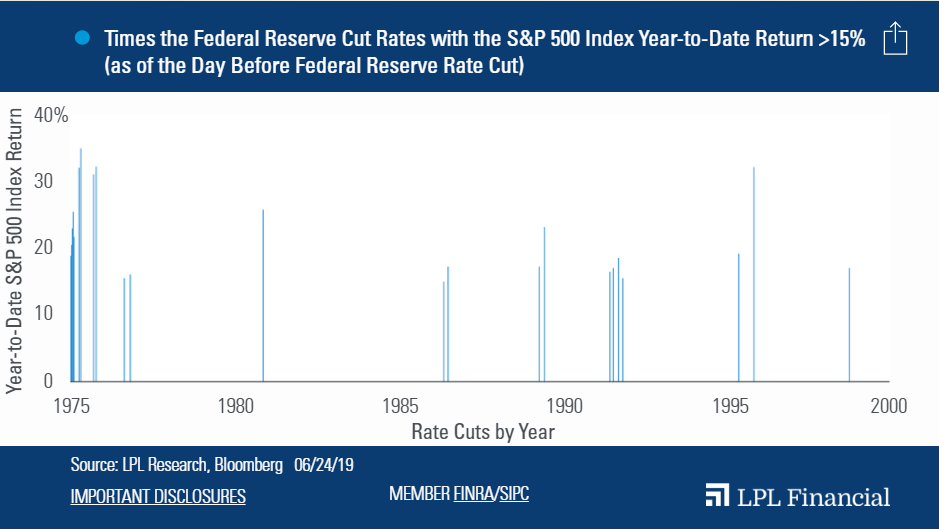
The Federal Reserve (Fed) will likely cut rates at its next meeting in late July. This begs the question: Will the Fed really cut rates with stocks up so much year to date and near all-time highs? “It might sound strange for the Fed to cut rates with stocks up a lot for the year,” explained LPL Senior Market Strategist Ryan Detrick. “But since 1975, the Fed has cut rates 26 times with the S&P 500 Index up at least 15% for the year, most recently in 1995 and 1998.”
Here’s the catch: A year after those cuts, the S&P 500 was higher 23 out of 26 times—with a very solid average gain of 13.4%. So it would appear monetary policy could be a continued tailwind.
As our LPL Chart of the Day, “Will the Fed Really Cut Rates When Stocks Are Up Big?”, shows, rate cuts when stocks have been up big for the year have actually occurred quite often over the years.
https://lplresearch.com/2019/06/25/can-the-fed-cut-with-stocks-up-big/

Oregon Has So Much Extra Weed it Could Take Years to Smoke it All
MAY 31, 2019
SALEM, Ore. — Oregon is awash in pot, glutted with so much legal weed that if growing were to stop today, it could take more than six years by one estimate to smoke or eat it all.
Now, the state is looking to curb production.
Five years after voters legalized recreational marijuana, lawmakers are moving to give the Oregon Liquor Control Commission more leeway to deny new pot-growing licenses based on supply and demand.
The bill, which passed the Senate and is now before the House, is aimed not just at reducing the huge surplus but at preventing diversion of unsold legal marijuana into the black market and forestalling a crackdown by federal prosecutors.
“The harsh reality is we have too much product on the market,” said Democratic Gov. Kate Brown, who intends to sign the bill if it wins final passage as expected.
Supply is running twice as high as demand, meaning that the surplus from last year’s harvest alone could amount to roughly 2.3 million pounds of marijuana, by the liquor commission’s figures. That’s the equivalent of over 1 billion joints.
https://time.com/5598922/oregon-weed-pot-supply/
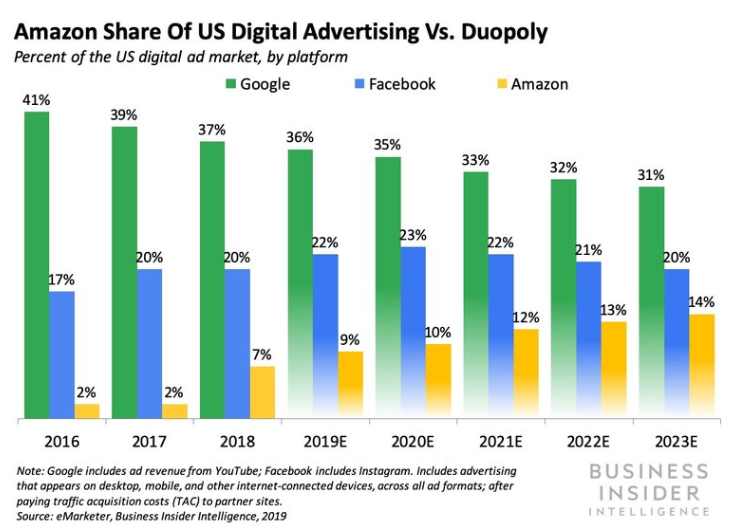
THE RISE OF AMAZON ADVERTISING: This is exactly what Amazon is doing to siphon billions of ad dollars from Google and Facebook and why brands love it
Jun. 4, 2019, 1:07 P
https://www.businessinsider.com/the-rise-of-amazon-advertising-2019-5
Marovember 19, 2018 Mark Manson
Mark Manson
One massive plot of land out in the frigid wasteland of the northern Yukon and build a vast complex of unnecessarily poorly-designed buildings. There will be no roads that lead there. No utilities. No central heating. And insufficient staff to maintain the structure. I’ll then call it, “The Hall of Fame of Bad Decisions.”
It will be perfect. Because not only will the hall itself be a bad decision, but anyone who ever attempts to visit it will clearly be making a bad decision as well.
Inside the hall, we will have exhibits for all of the worst decisions ever made. There’d be one for that time when Kodak, despite owning 90% of the market share of the camera industry and inventing the digital camera, decided not to sell them and went bankrupt as a result. There will be another for the time when Decca Records passed on signing The Beatles because they thought “guitar bands are on the way out.” There will be a whole wing for stupid military leaders who tried to invade Russia. And we’ll have a special “Tiger Woods” wing where we rotate in/out celebrities who wreck their own careers by doing something exceedingly dumb.
It’ll be great.
And I guess, while people are there, we’ll trot out a speaker or two and give seminars on how to not make such awful choices. They’ll offer some principles on how to make better life decisions.
Maybe that seminar would go something like this:
1. UNDERSTAND VALUE AND BIASES
All tough decisions are essentially about weighing values. There’s financial value, emotional value, social value, intellectual value, and so on. You have to consider all of them, weighing them appropriately. And not just in the short-term, but in the long-term as well.
This “weighting” of values is incredibly difficult, largely because we struggle to see things clearly.
As a general rule, we are all heavily biased towards the short-term rewards and towards emotional value. We are biased towards our pre-existing beliefs and protecting our reputation. And we’re also bad at seeing long-term rewards clearly because it’s difficult to look past our immediate fears and anxieties. Our emotions color everything we see.
Our “default” decision-making also makes it incredibly painful emotionally to give up on something we’ve worked a long time on, or to consider that we may have been wrong for years.
The fact is, we’ve all been wrong for years. We’re all wrong about our value estimates. And until we can be honest about how wrong we were in the past, we won’t learn to make better value judgments moving into the future.
Our “default” decision-making also encourages us to avoid short-term failures, even if that means missing out on long-term successes.
No, the sweet spot in decision-making is to find the short-term failures that enable the huge long-term successes to happen in the first place. Because this is what most people are bad at. And because people are bad at it, this is where most of the opportunity lies…
2. LOSE ON PURPOSE (SOMETIMES)
Ever hear those stories of wildly successful entrepreneurs and how they had, like, 23 failed businesses before they made it big?
The lesson we’re all supposed to take from this is that persistence and hard work is the key to extraordinary success.
And sure, whatever…
Usually, we can’t help but look at them and think about how “lucky” they got. I mean, Amazon! Who knew?!
What we don’t consider is that out of those dozens of failed, half-baked business ideas were all wagers with limited downside and extremely high upside. That is, if they lose, they lose a little. But if they win, they win a lot.
Let’s say I gave you a pair of dice and I told you that if you roll double ones, I’ll give you $10,000. But each roll costs $100. How many times would you roll?
If you’re not bad at math, you would know that you should spend all the money you have rolling those damn dice.
Most people look at each decision as a single roll of the dice. They don’t think about the fact that life is a never-ending sequence of dice rolls. And a strategy that loses a lot per roll can actually make you a big winner in the long run.
Yes, you will lose the dice game way more than you win. But when you win, your winnings will far outstrip your losses, making it a worthwhile wager.
You can apply the same “risky” behavior in your life to achieve more optimal long-term results:
When you think purely in terms of the immediate result, you cut yourself off from the biggest potential gains in life. And the reason most of us do this is because of our pesky emotions. Our emotions are short-term biased. They are obsessed with the present moment. And this prevents good decision-making.
3. TREAT YOUR EMOTIONS LIKE YOU’D TREAT A DOG
Here’s one thing I’ve noticed over the years: shitty dogs almost always have shitty owners. The dog’s level of discipline is reflected in the owner’s emotional maturity and self-discipline. It’s very rare to see a dog that’s wrecking the house, eating all the toilet paper and pooping all over the couch and the owner has their own shit together.
This is because our connections with dogs are purely emotional. And if we suck at dealing with our own emotions, then we’ll suck at dealing with our dogs. It’s that simple. If you don’t know how to limit yourself and tell yourself “no” when necessary, then, well, don’t get a dog. And if you do, don’t fucking move into my building.
Our emotions are kind of like our dog that’s living inside our head. We have this part of ourselves that just wants to eat, sleep, fuck and play, but has no conception of future consequences or risks.
That’s the part of ourselves we need to train.
Our emotions are important. But they’re also kind of dumb. They’re not able to think through consequences or consider multiple factors when acting.
Our emotions overreact to things by design. They evolved to keep us alive when we were hunting water buffalo on the savannah and shit like that. When we’re scared we want to run away or hide. When we’re angry we want to break stuff.
Thankfully, our brains evolved logic and the ability to consider the past and the future and all that great stuff. That’s what makes us humans. And not dogs.
The problem is, our “dog brain” is actually what controls our behavior. You can intellectually know that eating ice cream for breakfast is a bad idea, but if your dog brain wants fucking ice cream for breakfast, then that’s ultimately where your body is going to go.
It’s only by training your dog brain with your people brain, “No, bad Mark, ice cream for breakfast is bad, go do something else that feels good and is healthy,” that your dog brain gradually learns.
Do that enough and you have a well-behaved dog brain.
Emotions are great for giving you that umph of passion and spirit, the same way a dog is great for running and fetching stuff and being a great friend and barking when someone weird is hanging out by your bedroom window.
But the dog is limited. It needs context and direction to behave well and function. And that’s your job as the dog owner. Similarly, your dog owner brain must train the dog brain to sit down and shut up when necessary. You must give yourself context and direction. Train yourself to adopt the correct habits and make better decisions. Reward and punish yourself.
Love your dog brain (i.e., love yourself), accept your dog brain (i.e., accept your emotions), but also discipline them.
And every once in a while, indulge yourself… that’s a good boy. Yeah, who’s a good boy? Who’s a good boy? Yes, you’re a good boy.
4. OPTIMIZE YOUR LIFE FOR FEWEST REGRETS
Regret is sometimes called a “rational emotion” by psychologists. And not really because regret itself makes us more rational—at least not directly—but rather the way we predictregret is often done in a rational-looking way.1
In making decisions, we’ll often consider the options available to us, imagine our future selves after choosing one of these options, and then try to feel how much regret we experience in this simulated future state. We then run this simulation again, choosing a different option, and compare that simulated state of regret/non-regret to the others.
This ability is both a) fucking amazing when you think about it and b) incredibly useful as long as we use the most accurate and complete information available to us (by using all the ideas we’re covering here, of course).
Most of us are afraid of failing or screwing something up. But we rarely ask, “Would I regret that failure?” If the answer is “no,” then that is absolutely a risk you should pursue.
Similarly, a lot of us love envisioning massive success. But if we ask, “Would I regret never having that success?” usually we find that the answer is “no.” Only when it’s “yes” should we probably make the sacrifices to achieve it.
Sometimes, the right decision becomes crystal clear when put into these terms. Legend has it that Jeff Bezos left his cushy, high-paying job to start Amazon because it was so obvious to him that he’d regret it if he got old and didn’t at least try this whole “internet thing.” Staying at his job, on the other hand, carried a lot of future regret that was apparently quite palpable for Bezos.
I personally know a lot of people—myself included—who ultimately made big life decisions largely based on the path of least regret. These decisions are almost always described as the best decisions they’ve ever made. Go figure.
Instead of basing your decisions around success/failure, or happiness/pain, base them around regret avoidance. Our regrets are usually the best measurement of what is actually valuable to us in the long-run.
5. WRITE SHIT DOWN
The best way to help you sort out all of your emotional drivel from actual decision-making is to write things down.
Writing things down is a simple but powerful way to clarify everything that’s swirling around in your head. I get emails from readers all the time with long screeds about the issues in their lives only to have them say at the end that they don’t need a reply because writing it all out was so cathartic and revealing for them.
The act of writing forces you to organize and make concrete all the emotional turbulence swirling around in your brain. Vague feelings become structured and measured. Your self-contradictions are laid bare. Rereading what you write reveals your own logic (or lack thereof). And it often reveals new perspectives you hadn’t considered.
And when it comes to mulling over a decision, there are a few specific things you can write about to help you if you’re having difficulties:
Last night, I was motivated by hunger to eat something and there was a burrito in front of me, so I shoveled it into my face hole.
Sometimes it’s not so straightforward though. Problems arise when our intentions a) aren’t very clear to us and/or b) conflict with our core values.
For example, are you buying that car because you would genuinely benefit from owning it, or because you’re trying to impress the people around you?
Or are you filing for full custody of your kids because you think it’s truly in their best interest, or are you trying to get revenge on your ex after finding out they are dating someone new?
Are you trying to start a business because you enjoy the challenges and ups and downs of making your own way, or are you jealous of your friends that have successful businesses and feel like you don’t quite measure up to them?
If you identify some ulterior motives when weighing a decision, stop and ask yourself if your intentions align with who you want to be.
And if you’re asking yourself, “Well shit, I’ve never thought about who I want to be. What should I do?” Then I think you should take out a fresh piece of paper and start writing that down.
For instance, here’s my Horrible Decisions Hall of Fame Table:
| Pros * It’s funny * Oh, Canada! * Get to research celebrities with hookers | Cons * Expensive * Lot of work * Really, really far away * Joke is only funny for so long | Long-Term * Illiquid asset * Seriously, when am I ever going to travel to this thing? * For the rest of my life, I’ll be the “Dumb Hall of Fame” guy. | Potential Regrets * DOING: Tons, lost time, money, etc. * NOT DOING: Uhh… none, really. | Rep. Value * Do I really want to dedicate a huge portion of my life and legacy to being a clever smart ass? Probably not. |
So there you have it. No “Horrible Decision Hall of Fame.” Why? Because it’s a horrible decision.
HOW TO KNOW WHO YOU REALLY ARE
We all think we know ourselves well, but psychological studies show otherwise. In fact, most of us are somewhat deluded about ourselves. I put together a 22-page ebook explaining how we can come to know ourselves better, just fill out your email in the form.
You’ll also receive updates on new articles, books and other things I’m working on. You can opt out at any time. See my privacy policy.
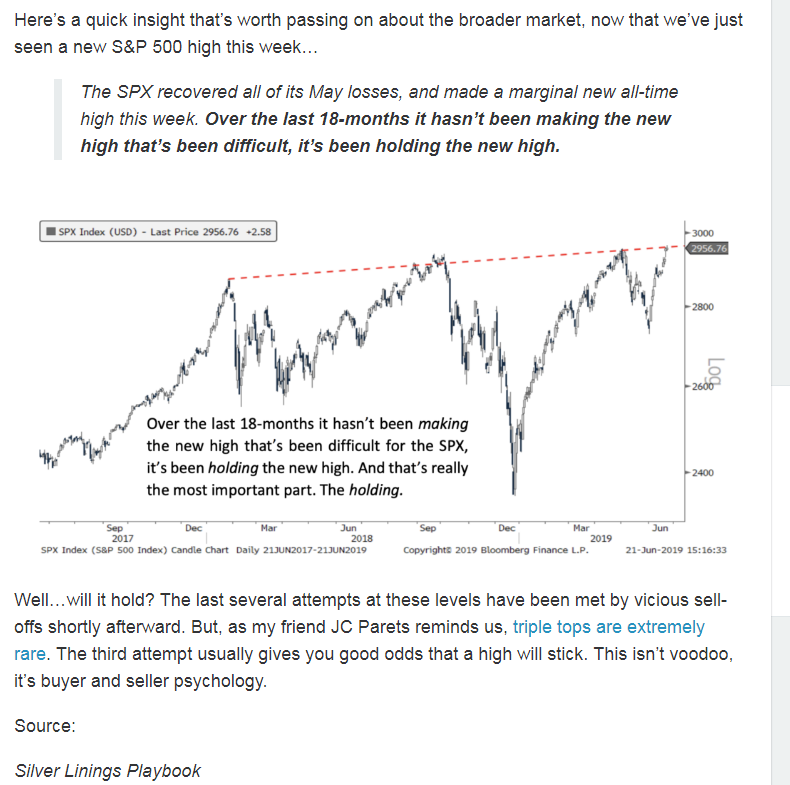
From Josh Brown Blog…Reformed Broker
https://allstarcharts.com/triple-tops-rare-quad-tops-fuggedaboutit/
https://thereformedbroker.com/2019/06/23/will-it-hold-2/ Continue reading
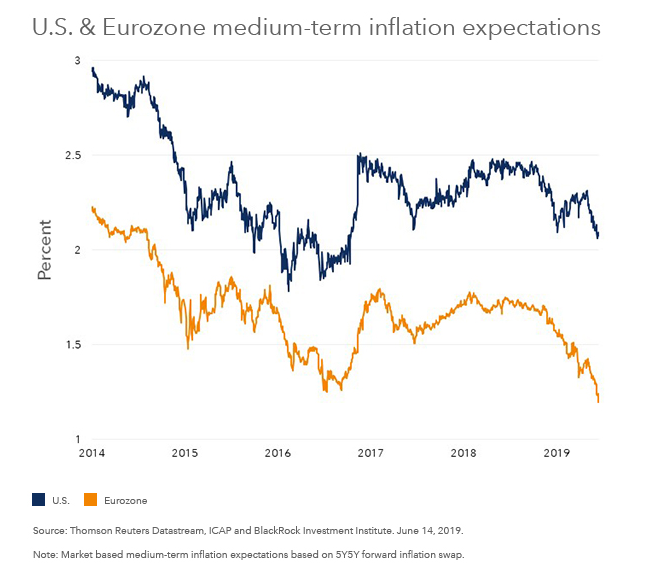
The risk of too little inflation
Written by Russ Koesterich, CFA Low inflation may sound appealing, but as Russ explains, it has drawbacks for investors.
By any account the U.S. equity market is having a stellar year. Stocks have benefited from easier financial conditions, which have in turn pushed up market multiples. By a happy coincidence, gains in market multiples have exactly matched the 15% gain in the S&P 500 Index.
But while stocks have benefited from cheap money and higher multiples, they have more recently been constrained by concerns over growth. The challenge is that the same slowdown that led the Federal Reserve to pivot and stop raising rates also puts earnings at risk. Recent developments in the inflation-linked bond market (i.e., Treasury Inflation Protected Securities, or TIPS) suggest that investors are right to be a bit more cautious.
Inflation expectations embedded in the TIPS market are signaling that already low inflation will fall even lower. In late April, the 10-year TIPS breakeven (BE), i.e. the amount of inflation TIPS investors expect during the next decade, was about 1.95%. Today, the 10-year BE is below 1.70%. The outlook for the next five years is even softer, roughly 1.50%. And while inflation expectations are higher using different market measures, such as inflation swaps, the direction is still down (see Chart 1).
https://www.blackrockblog.com/2019/06/25/the-risk-of-too-little-inflation/ Continue reading
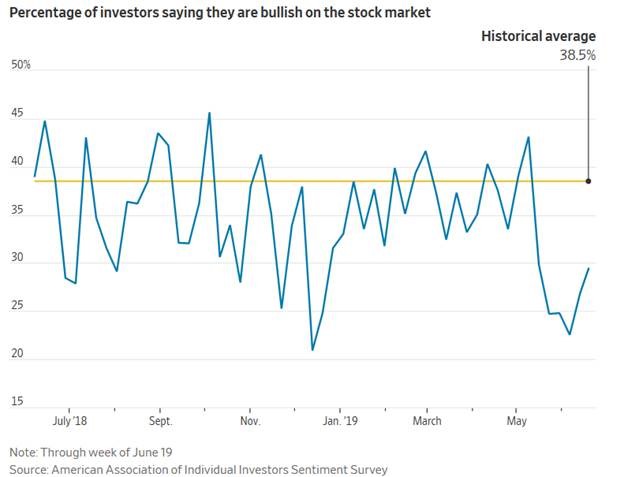
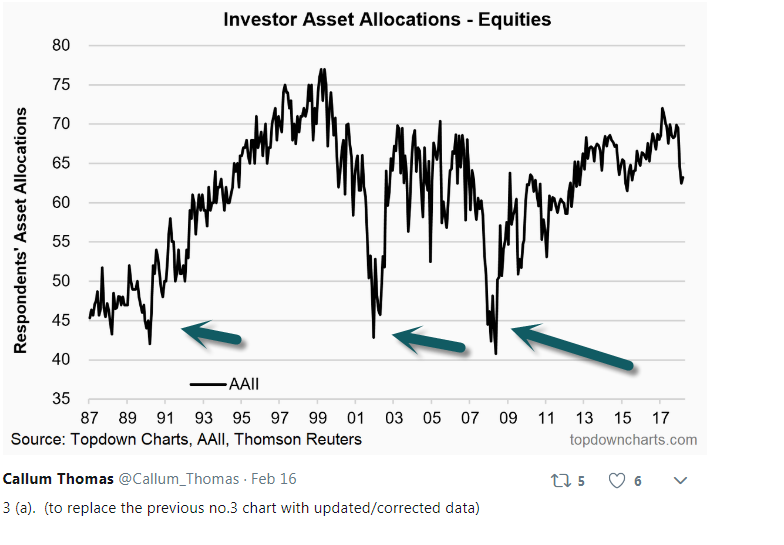
AAII Surveys show Investors still quite cautious on the market (WSJ), which is clearly bullish
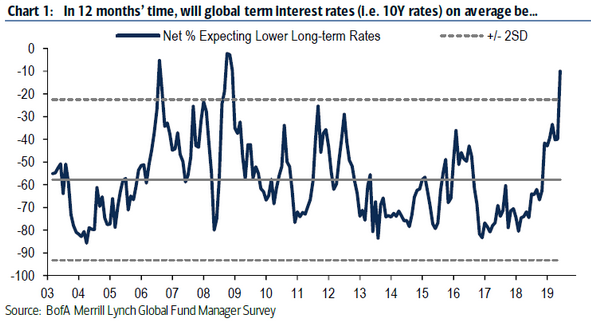
The percentage of investors expecting lower long-term bond yields is the highest since late 2008, according to
the latest BofAML fund managers’ survey.
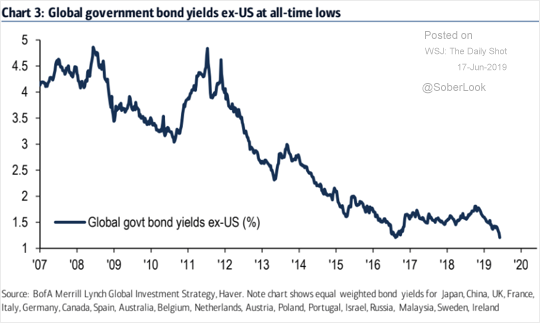
https://dailyshotbrief.com/the-daily-shot-brief-june-17th-2019/ Continue reading
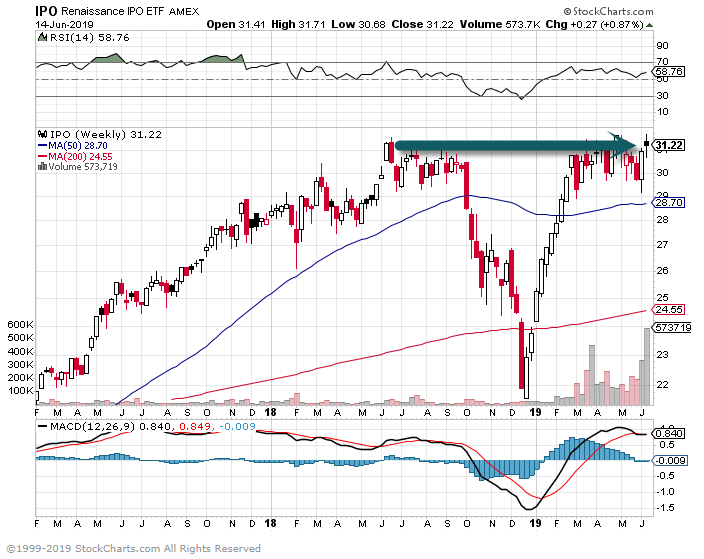
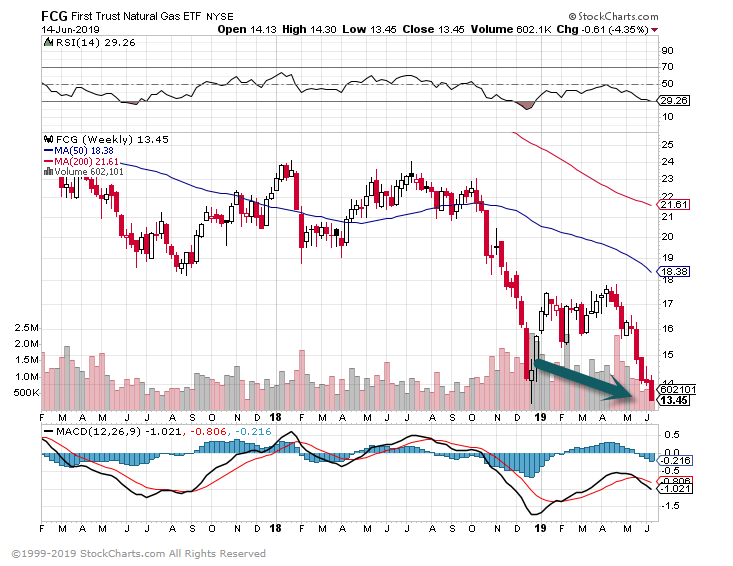
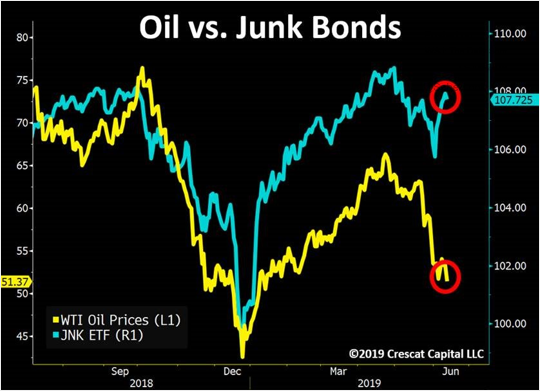
From The Daily Shot
https://dailyshotbrief.com/the-daily-shot-brief-june-13th-2019/
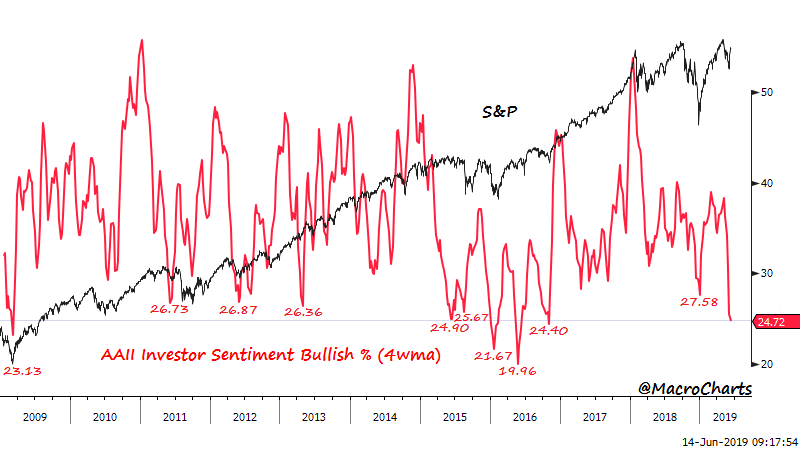
Callum Thomas @Callum_Thomas · 24h24 hours ago
https://twitter.com/i/moments/1139991497367928833
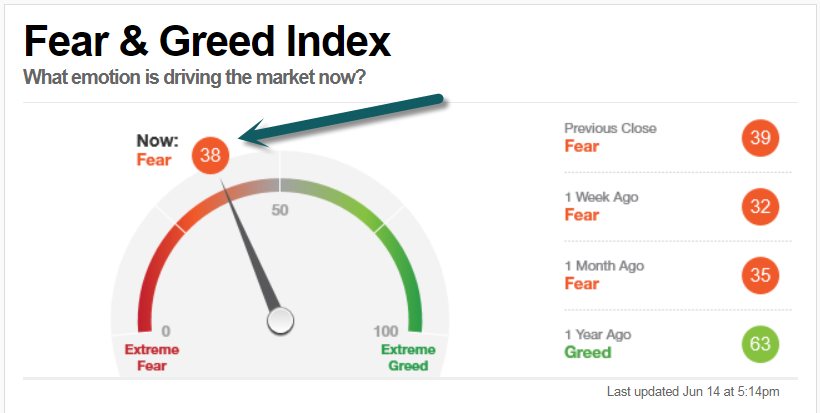
https://money.cnn.com/data/fear-and-greed/
That messaging apps have increasingly become our go-to mode of communicating isn’t a revelation, but the idea that encryption is becoming the norm is striking.
Meeker’s numbers show that in the first quarter of this year, 87% of global web traffic was encrypted, up from 53% just three years ago.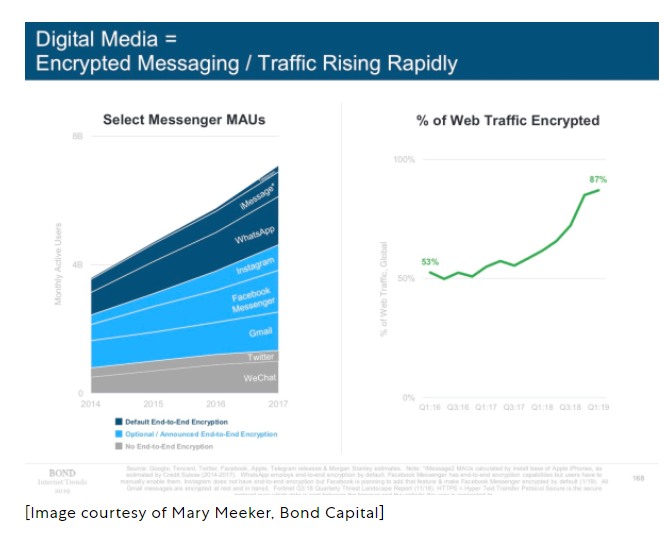
BC-Americans-Now-Spend-More-at-Internet-Stores-Than-Restaurants , Alex Tanzi
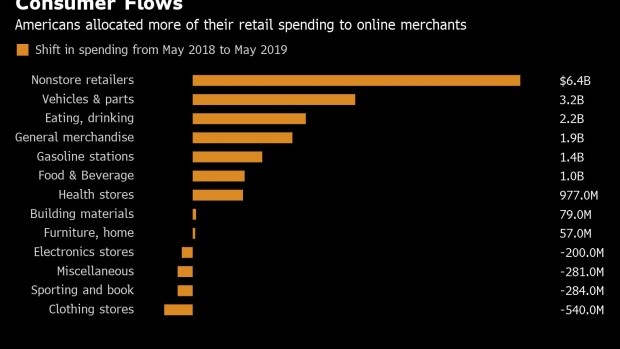
(Bloomberg) — U.S. stores reported broad-based gains in activity last month as 10 of 13 major sectors increased sales from a year earlier.
But, just how concentrated are the gains? The dominance of online merchants is becoming increasingly clear. In the past year, Americans’ boosted spending to “nonstore retailers” while clothing, food & beverage and building-material stores felt the brunt of consumers’ changing habits.
Spending at nonstore retailers, mostly Internet merchants, increased by $6.4 billion from a year earlier to $62.04 billion on an annualized basis. The nonstore retailer category is now a larger spending category than restaurant and bars.
Given the pace of growth, nonstore spending will likely pass food and beverage — mainly grocery stores — spending soon and move to the second largest retail category behind vehicles and parts.
To contact the reporter on this story: Alex Tanzi in Washington at atanzi@bloomberg.net
To contact the editors responsible for this story: Alex Tanzi at atanzi@bloomberg.net, Wei Lu
©2019 Bloomberg L.P.
https://www.bloomberg.com/https://www.bnnbloomberg.ca/americans-now-spend-more-at-internet-stores-than-restaurants-1.1273711
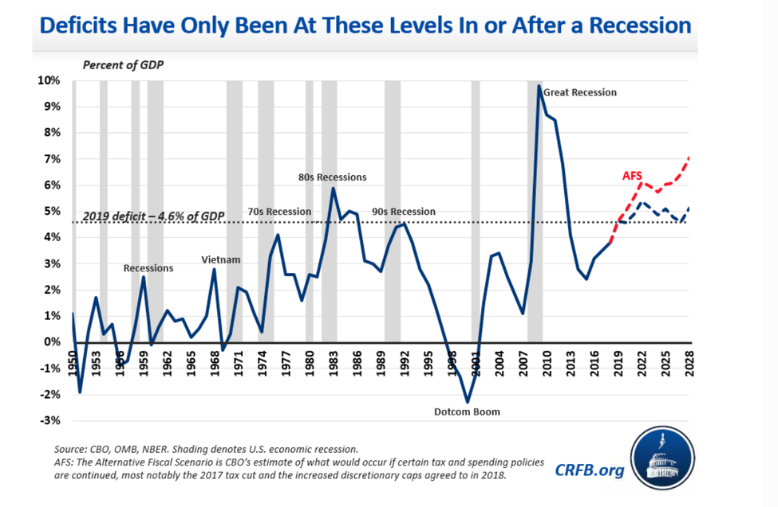
Political support for taming deficits has melted away, with Republicans accepting bigger deficits in exchange for tax cuts and Democrats making big spending promises around 2020 election campaigns. Global demand for U.S. Treasury assets has displaced the “bond-market vigilante” mentality of the 1990s that scared Washington.
Debt as a share of economic output has more than doubled over the past decade. Deficits, after falling in the expansion’s first six years as a share of the economy, are rising again, approaching $1 trillion a year.
In theory, an increased supply of government bonds—sold to raise funds when spending exceeds revenues—should increase government borrowing costs. Theory also says big deficits crowd out business borrowing and increase private borrowing costs, too.
The opposite has happened. While government debt soared after the 2007-09 financial crisis, 10-year Treasury yields have fallen to near 2% from more than 5% in 2006, holding down government interest payments. U.S. business debt rose to $15 trillion in 2018 from $9 trillion in 2006.
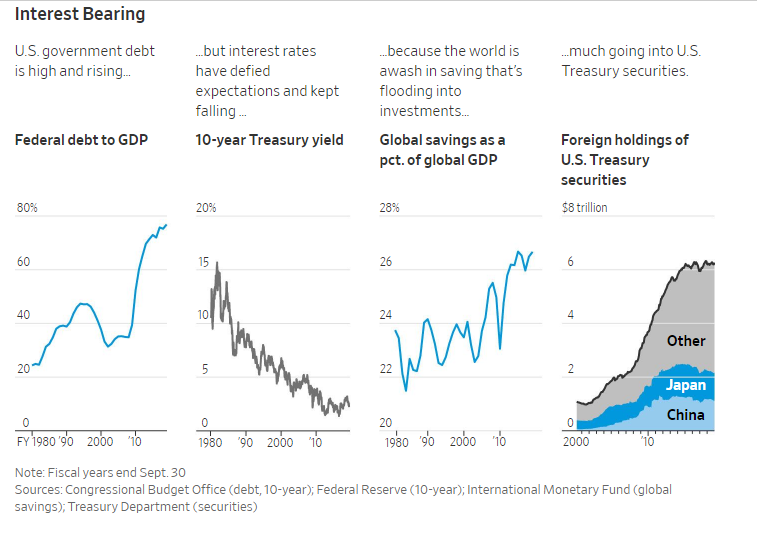
Political support for taming federal debt has melted away, and the U.S. is testing just how much it can borrow
By Kate Davidson and Jon Hilsenrath
https://www.wsj.com/articles/how-washington-learned-to-love-the-deficit-11560436380?mod=itp_wsj&ru=yahoo
The housing market looks a lot different today than it did a couple generations ago.
That’s something that more and more millennials, the group between the ages of 23 and 38, are discovering firsthand every day, whether they’re renting their first apartment or already on to their second purchase of a house.
Why is the housing market so different for millennials compared to the one their parents and grandparents faced?
In large part it’s because of how much housing costs have risen, but it’s also because of the student debt with which many members of the generation are saddled. Some 70% of recent college graduates finish school with an average of $29,800 in debt to repay, plus the inevitable interest.
Faced with these financial challenges, it’s little wonder that millennials are buying different types of homes and in different types of locations than their parents did. And they are buying under different circumstances, too, often waiting longer, buying before marriage, or living with their parents to save cash so they don’t have to wait years for homeownership.
Here are nine surprising facts about the millennial housing market that put it in perspective.
Millennials face house prices 39% higher than their parents did in the 1980s
Housing prices have soared by nearly 40% in the past three-plus decades, far outpacing wage increases and making homeownership much more of a challenge for today’s buyers. The increase is even more dramatic the further back you look: Today’s average home price is more than 70% higher than what a buyer faced in the 1960s.
Rent prices are up nearly 50% over the last half century
While traditionally renting an apartment or house while saving up to buy your own residence was once a logical approach, since the 1960s, average rent rates have increased by 46%, meaning just affording a rental is harder than ever, let alone saving up to buy.
Many millennials turn to ‘super commuting’ to find homes they can afford
Super commuters are those who travel more than an hour in each direction to and from home and work. In order to find homes they can afford while sticking with a job, many millennials are buying residences in the exurbs and accepting a daily commute of two or more hours.
Birmingham, Alabama, has seen the biggest growth of millennial home ownership increases in recent years
In 2017, millennial homeowners accounted for an impressive 18% of total homeownership in Birmingham, Alabama. That was a dramatic increase over the 11.9% of the homes owned by millennials just one year before in 2016.
33 of the nation’s top 50 housing markets saw increases in millennial home buying
Contrary to the misconception that fewer and fewer millennials are buying homes in major metro areas, themajority of the nation’s top 50 housing markets have actually seen increases in millennial homeownership in recent years.
In some markets, homes built before 2012 are selling at close to 50% discounts because they’re too big and spacious for millennials
Most millennial homebuyers are looking for smaller, more manageable properties than the mini mansions so popular a generation before. And they like sleek, simple interiors. The result is a steep drop in the value of many of the homes baby boomers are now hoping to sell as they downsize after emptying the nest or retiring.
According to the Wall Street Journal, homes around Scottsdale, Arizona, that are worth millions of dollars are selling at discounts of close to 50% because younger buyers aren’t interested in all that space.
A quarter of home-buying millennials are buying homes before getting married
The traditional approach to life put marriage ahead of buying a home with a partner, but millennials aren’t overly concerned with tradition. As many as a quarter of all millennials who buy a house with a partner do so before marriage.
One in three millennial homebuyers tapped into a retirement account to get cash for the purchase
About a third of millennial homebuyers took money out of a retirement account or even took a loan against the account to pay for the purchase. This trend alarms financial experts, who advise people to be paying into these accounts during these younger working years, not depleting them.
Nearly two thirds of millennial homeowners have regrets about their purchase
According to CNBC, 63% of millennial homeowners report some degree of buyer’s remorse. Their most common complaints are miscalculating the hidden costs of the purchase and the ongoing expenses the home demands.
Start your meeting off on the right foot, and you’ll be much more productive.
By Elise Keith, Co-Founder of Lucid Meetings
“How can I get my team to engage? I’m doing everything right, but they’re still just sitting there.”
I was talking with a frustrated leader at a healthcare facility. Her team meetings had always been lackluster, so she’d decided to fix them. She’d scoured the internet for best practices, then worked hard to get organized.
For the past month, she’d sent an agenda in advance of every meeting. She started precisely on time. She’d taken notes and ended on time too. And yet, after she talked through the agenda and they’d heard their first report, her requests for comments were met with crickets. No one had much to add. Many didn’t seem to be paying attention at all.
Unfortunately, while she’d diligently followed all those “best practices,” she’d missed the most important step.
If you want people to engage during a meeting, you have to make that clear up front. Great meetings get everyone engaged within the first five minutes.
Here are four ways to successfully open your meeting, and why it matters.
You can’t have a meeting of the minds if the minds aren’t in the meeting. Remember: Every person invited to your meeting was in the middle of doing something else right before it started. People arrive with minds full of tasks left undone and needs unfulfilled.
A successful opening should capture everyone’s attention. The phones will go dark, the typing stops, and eyes connect.
For example, some leaders welcome everyone at the door. A personal greeting and welcome works just as well in meetings as it does when hosting at home. Teams at Starbucks often pour each other coffee for a short tasting before the meeting begins. Even starting by clearly stating the meeting’s purpose, rather than the logistics, creates more energy.
There are many ways to command the attention of a room, but reading the agenda is not one of them. We do not meet in order to get through an agenda; we meet for a purpose. We meet to create shared understanding, to make decisions, and to set plans in motion.
We meet to make these decisions because we want everyone there to weigh in, to help find the best option, and then to commit to it. If we didn’t need that input or that commitment, we wouldn’t meet.
A successful opening makes the purpose of the meeting — why the meeting matters and why it’s relevant to everyone there — clear. The agenda is the how. Never start with how; start with why.
Then, to cement that purpose for each person, ask for their participation. If your team hasn’t engaged much in the past, don’t assume they know you care about that. After all, they didn’t have to engage before. I’m always surprised when a leader seeking more engagement admits that they’ve never asked for it.
So you’ve captured their attention and worked to make your aspirations for the meeting clear. Now, should you go over the agenda?
No. Not yet. First, you have to prove that you welcome engagement by getting everyone engaged right then and there: Everyone in the meeting should directly engage within the first five minutes.
This is why many meetings begin by going around the room to answer a simple question; it’s neither feasible nor polite to continue texting when a room full of people turns to you for an answer.
Other teams might choose to begin with a few minutes of meditation. This helps clear the mind of lingering distractions, while making it impossible to continue fiddling about with a laptop.
Fighting off distraction makes productivity possible, and that’s a worthy goal.
Take a look again at those first three steps, and consider the message you can send in these first five minutes of your meeting.
There’s one more big one: A successful meeting opener should also tell people that it’s safe to speak up in this group. It tells each person that they matter, that they belong, and that the other people there care about what they have to bring to the table. Doing this sets the frame for everything that follows, and the right frame makes meetings more productive and more meaningful.
Knowing you’ll meet with your team once a week, consider the impact that investing in these first five minutes might have on your team’s culture. Then, start experimenting. Don’t worry about getting it perfect on your first try. If you’re clear about your purpose and ask your team to engage with you, you won’t have to get it right on your own. You’re meeting so that you can get it right together.
Originally published on Business Insider.
While we’ve seen the 5th best start to June on record, this is also the best start to any month through seven trading days since October 2011 when the S&P rallied 5.67%. Below we show all 4%+ starts to a month through seven trading days since 1980. The most notable takeaway from this data in our view is that the last nine times we’ve seen the S&P gain 4%+ in a month’s first seven trading days, the index has been up over the next week 8 out of 9 times, and it has been up 9 out of 9 times for the remainder of the month. To access our most actionable market research, start a two-week free trial to Bespoke Institutional.
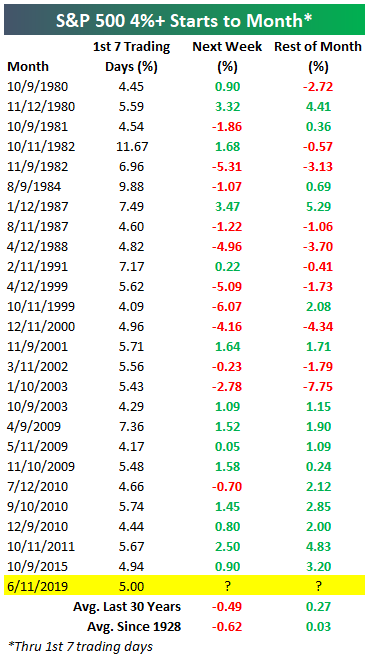
https://www.bespokepremium.com/interactive/posts/think-big-blog/best-starts-to-june-any-month Continue reading
US companies’ massive cash hoard is finally coming down Financial reserves dropped 10% in the first half of last year, Moody’s finds Share on Twitter (opens new window) Share on Facebook (opens new window) Share on LinkedIn (opens new window) The cash holdings of US companies fell nearly 10 per cent in the first half of this year, signalling a turning point in the historic financial reserves they amassed in past two decades. Corporate America’s cash mountain peaked at close to $2tn at the end of last year, according to rating agency Moody’s. Some 70 per cent of the money had piled up offshore, as companies hoarded their overseas profits rather than face tax charges by bringing them home and spending the money on things like acquisitions and stock buybacks. But US tax reforms enacted at the end of last year subjected all past profits to tax, though at a lower rate, ending the incentive to hoard. That released the cash that had been stranded offshore and by the middle of this year total cash reserves had fallen $190bn, or 9.5 per cent, according to a Moody’s calculation published on Tuesday.
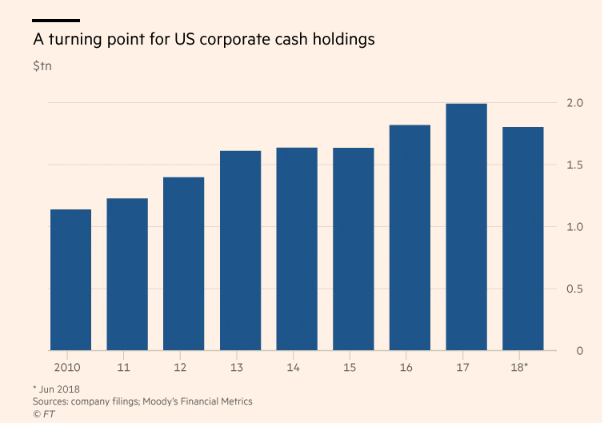
https://www.ft.com/content/2c0cf0a4-f25a-11e8-ae55-df4bf40f9d0d
Francis Scialabba
Moody’s Investors Service said yesterday that the 928 U.S.-based, non-financial companies it covers claimed $1.7 trillion in cash and liquid investments at the end of 2018.
Driving the news: 2018’s drop in cash hoards serves as a master class in chain reactions.
And put it to use they did. Last year, capital expenditures leaped 12% to $851 billion, dividends climbed 6.7% to $412 billion, and net share buybacks almost doubled to $467 billion.
The top five cash-holders last year—Apple, Microsoft, Alphabet, Amazon, and Facebook (heard of ’em?)—held 33% of the total balance in 2018. Apple alone laid claim to 14.5%, a balance larger than the aggregate amount for every other non-tech U.S. sector.
Before the tax overhaul…
U.S.-based companies had slowly built up giant cash reserves in foreign countries, keeping profits at arm’s length from the frightful 35% corporate tax they faced when bringing it home.
Then in 2017, changes in the tax code opened the floodgates for what’s known as “repatriation.” The Commerce Department said companies sent $664.9 billion in foreign earnings back to the U.S. as dividend payments in 2018, up from $155.1 billion a year earlier.
Looking ahead…Moody’s Point is that companies will continue to put money to use paying down maturing debt, boosting buybacks, and upping dividends until there’s a reason not to. Look for those piles of to keep shrinking.

https://www.blackrockblog.com/
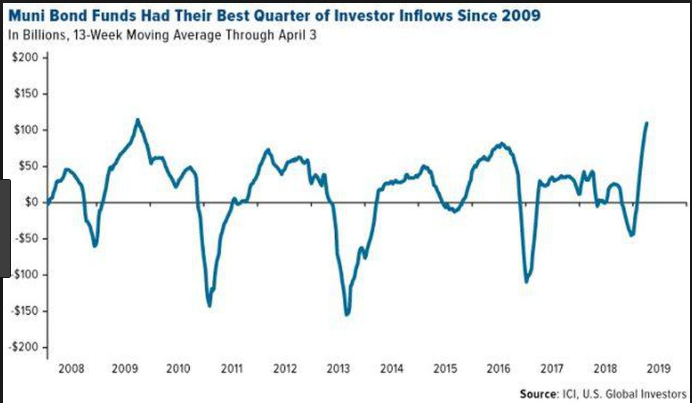
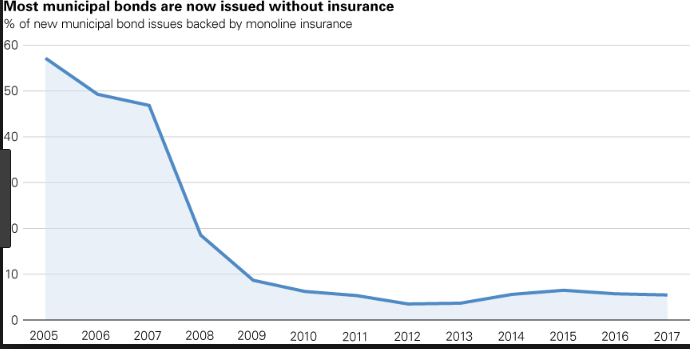
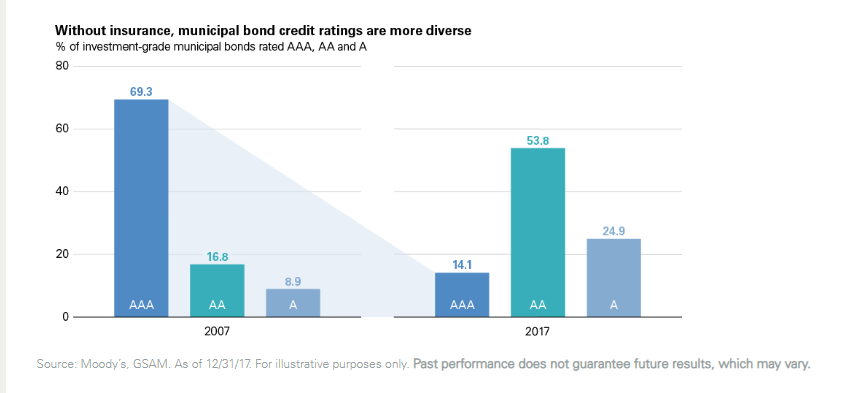
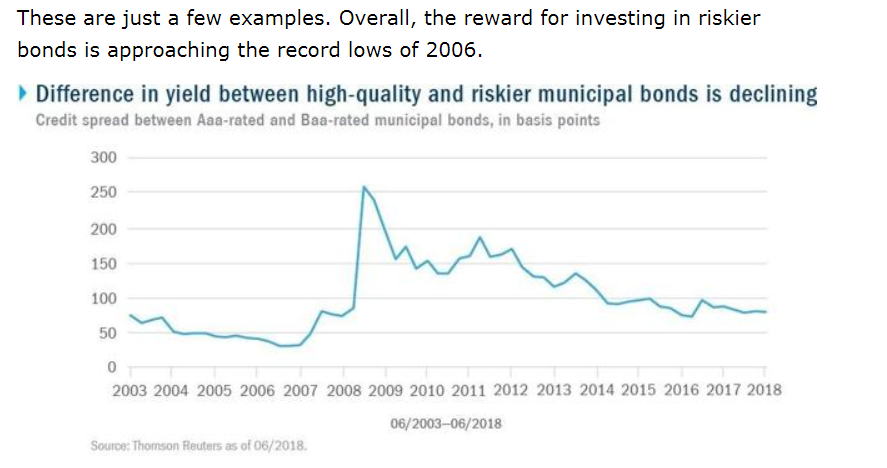
The municipal bond market has evolved significantly over the last decade. Historically, many municipal bonds were backed by insurance, which resulted in AAA credit ratings and a high correlation to US government bonds. Today, few municipal bonds are backed by insurance, increasing the diversity of municipal bond credit ratings while reducing their correlation to government bonds.
https://seekingalpha.com/article/4205448-investing-munis-risk-paying-well?page=2
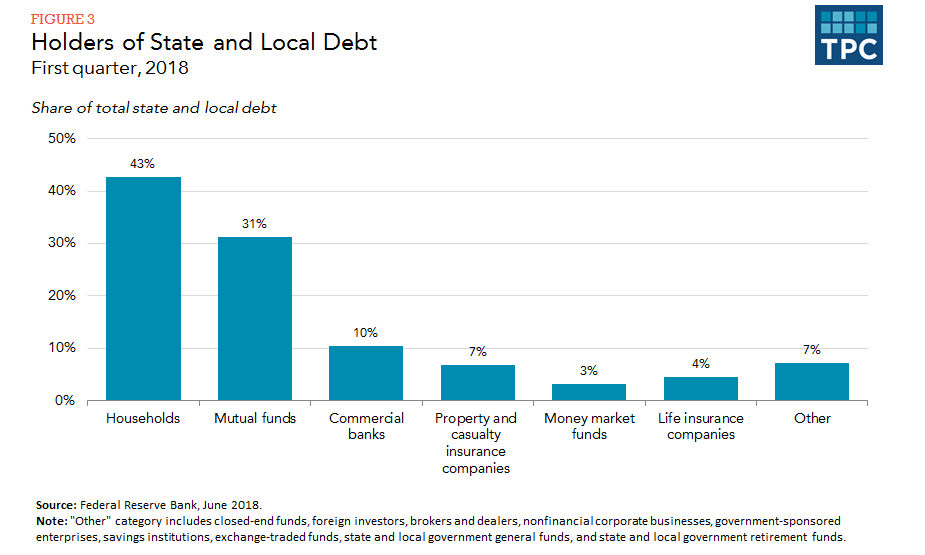
https://www.taxpolicycenter.org/briefing-book/what-are-municipal-bonds-and-how-are-they-used
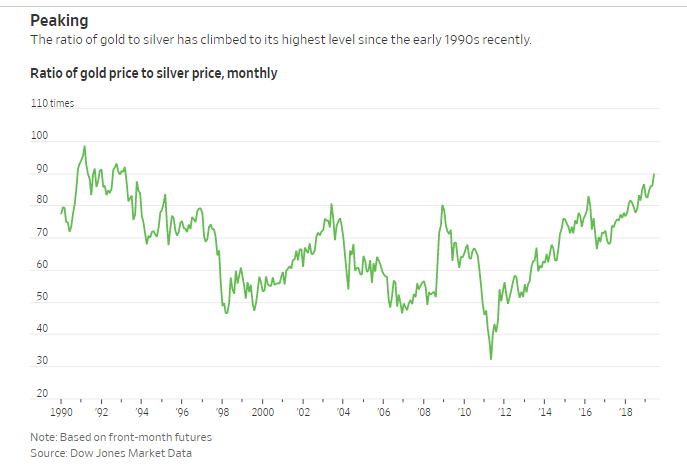
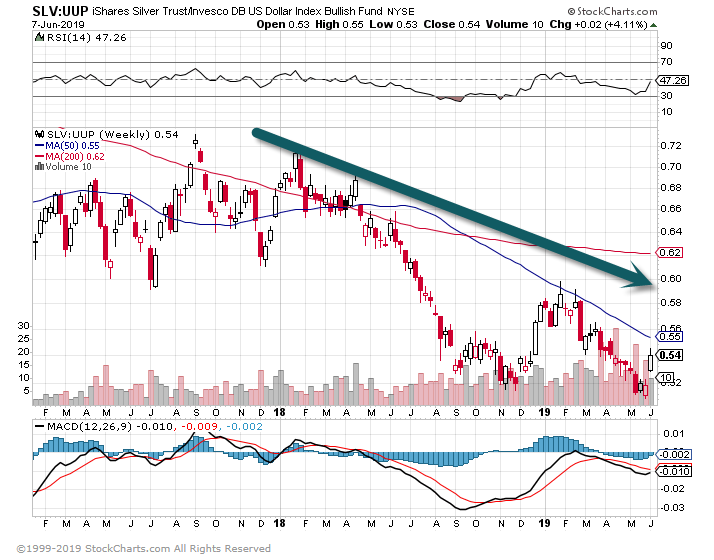
Silver has fallen nearly 6% this year; gold-to-silver ratio has climbed to its highest point since March 1993
By Amrith Ramkumar
https://www.wsj.com/articles/in-silvers-slide-another-sign-of-global-growth-worries-11559499172?mod=itp_wsj&ru=yahoo
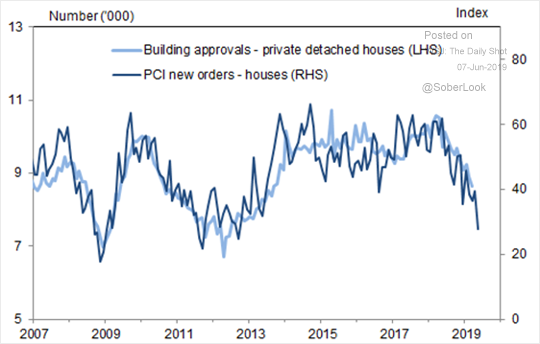
The Daily Shot
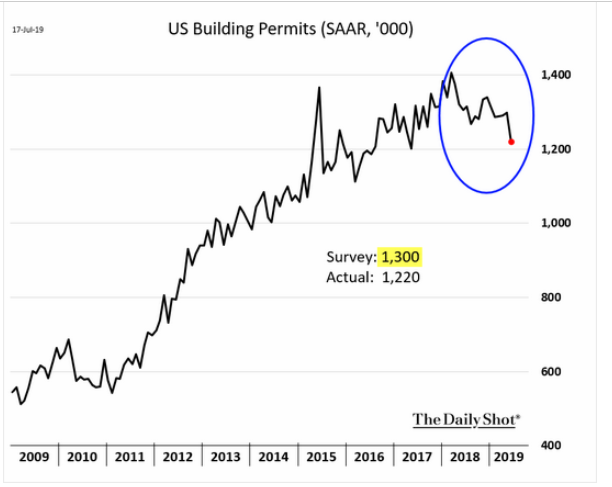
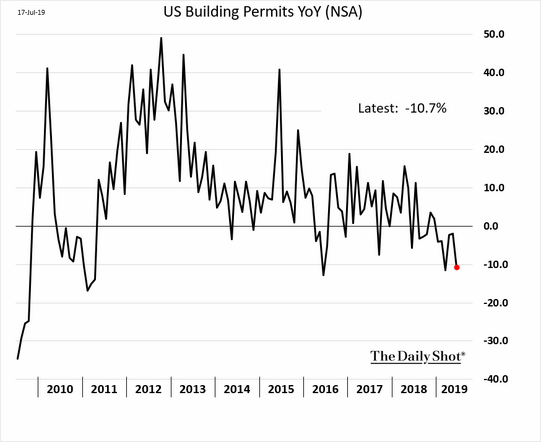
Declining orders for new homes don’t bode well for the sector.
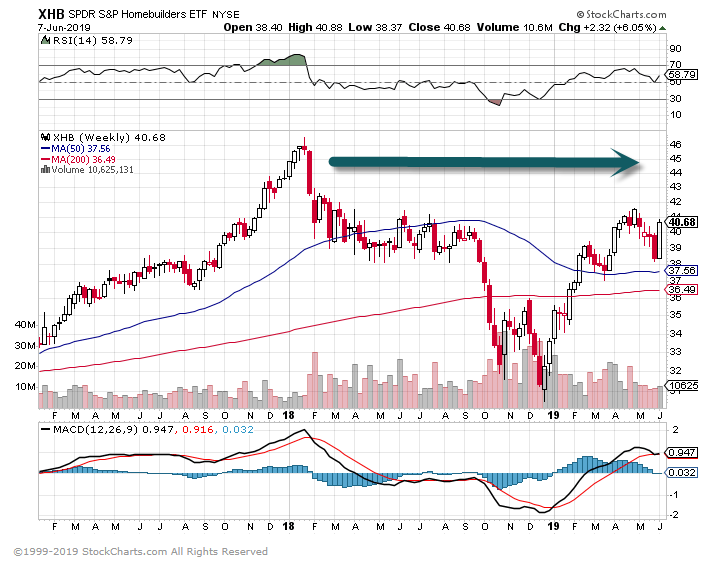

https://www.seametrics.com/blog/water-crisis-things-you-should-know/
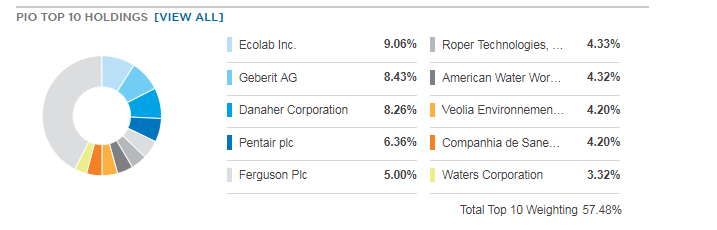
Global Water ETF-PIO
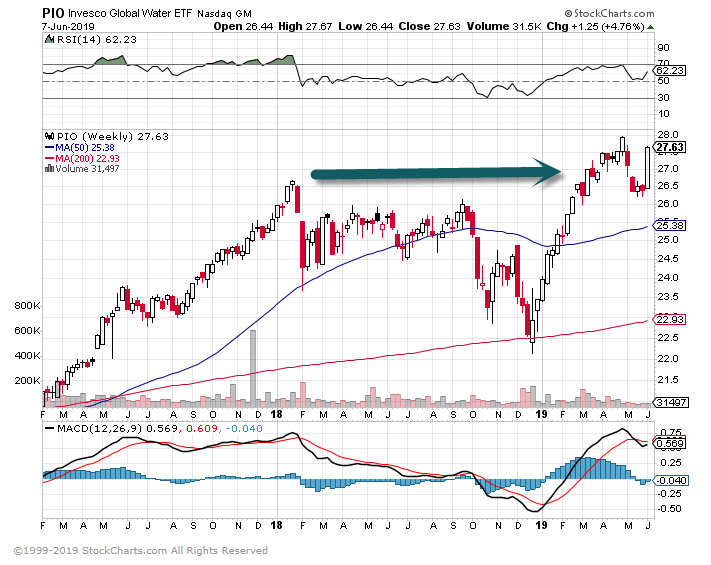
https://www.etf.com/PIO#overview
Interest-rate cut probabilities stay ‘high’ after report ByROBERTSCHROEDER
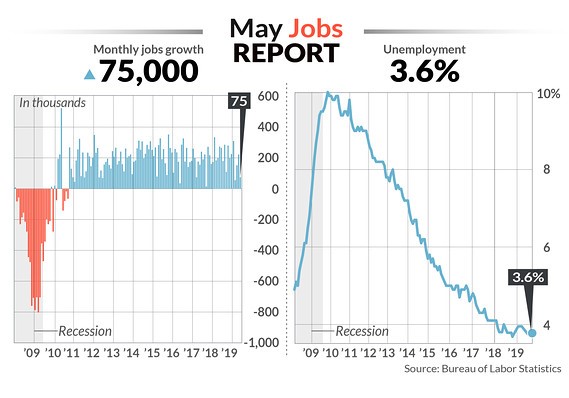
Economists said the May jobs report didn’t offer much in the way of good news but that it increased bets the Federal Reserve would cut interest rates before the year is over.
The U.S. created only 75,000 new jobs in May and employment gains in the prior two months were scaled back, offering more evidence that the economy is slowing. The unemployment rate was flat at 3.6%. The increase in new jobs was way below the 185,000 MarketWatch forecast
U.S. stock futures DJIA, +1.16% pivoted higher after the report was released.
Greg Daco, chief U.S. economist at Oxford Economics, called the overall report “disappointing.”
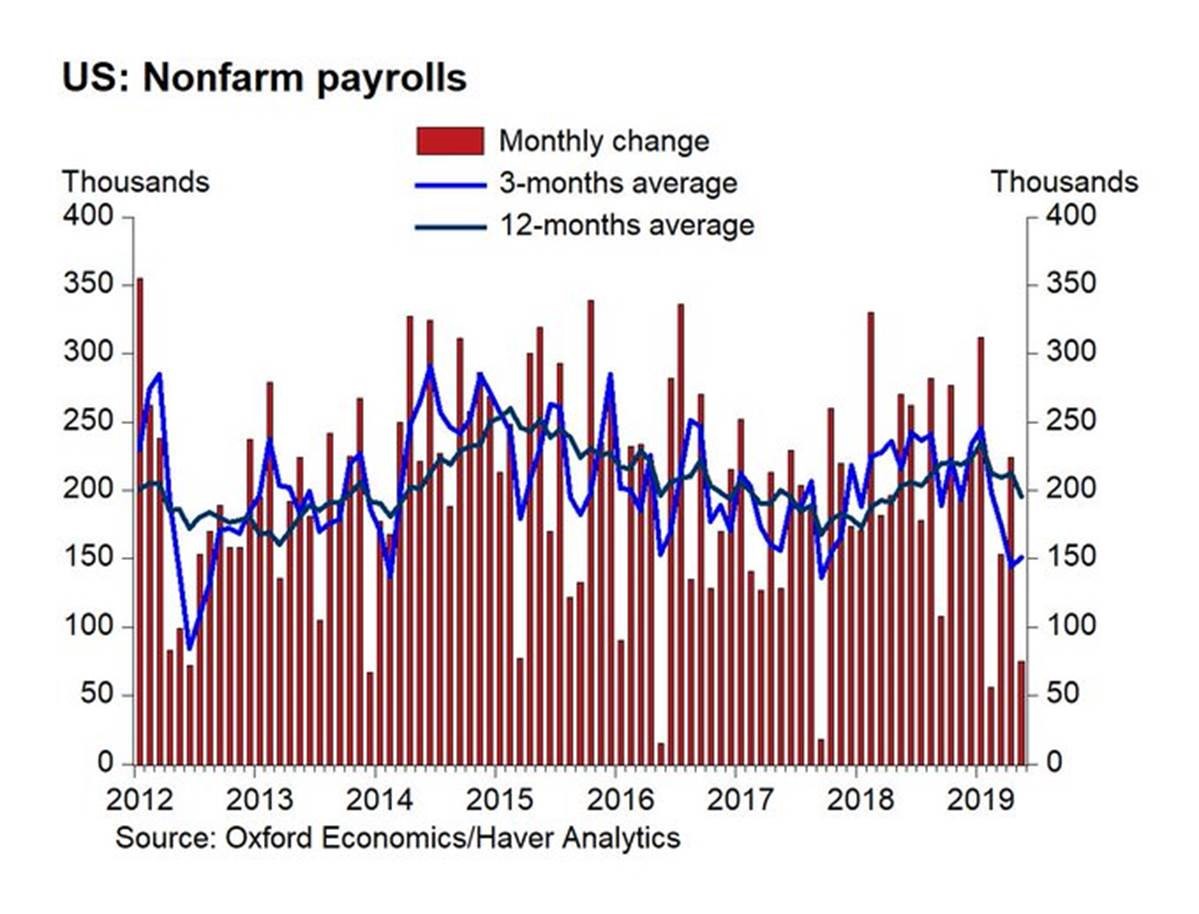
US #jobsreport: disappointing +75k jobs May:
– large downward net revisions -75k
– 12-mo avg still strong 196k
– 3-mo avg points to cooling labor market 151k
– #unemployment rate stable 3.6% (50yr low)
– labor force part 62.8%
– wages +0.2% & cools to 3.1% y/y (but still >3%)
Liz Ann Sonders, chief investment strategist at Charles Schwab & Co., said the report “keeps [interest] rate cut probabilities high.”
Weak jobs, consistent with @ADP: 75k nonfarm payrolls in May (retail biggest loser); both April & March revised down for total of 75k; UR steady at 3.6%; AHE +0.2% … keeps rate cut probabilities high
Frustrating that wage growth is not continuing to pick up – one would expect it to continue to accelerate at this point in this cycle
https://medium.com/invisible-illness/the-deadliness-of-loneliness-21e6ecaa3bdd
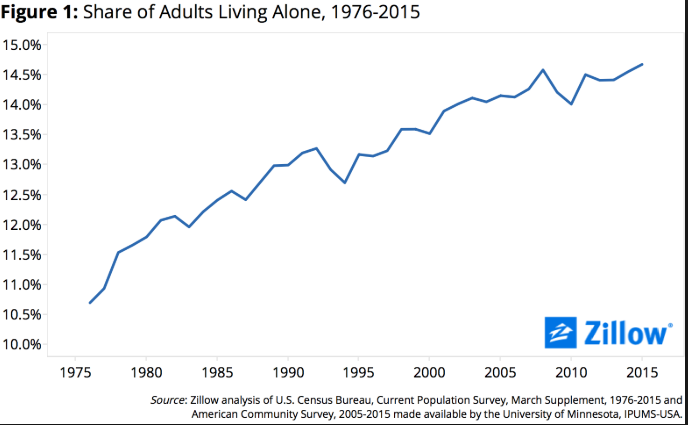
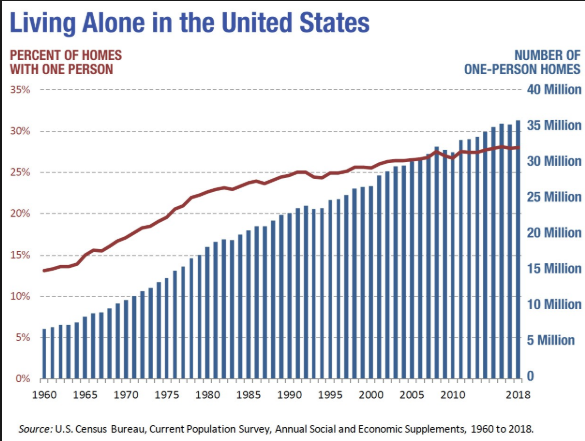
https://www.zillow.com/research/americans-living-alone-12639/
If the bulls have momentum, they lack a margin of safety. Even a 4% yield (never mind a 14% yield) would wreak havoc on a government-bond portfolio. As it is, Germany’s 10-year Bond yields minus 23 basis points and commands a price of almost 105. If yields shot to 4%, that safe haven would suffer a 33% loss of principal. Britain’s 10-year gilt yields 86 basis points and changes hands at a price of 107. Lift that yield to 4% (a future Prime Minister Jeremy Corbyn might do it all himself) and you are staring at a 24% drawdown in price. Here in America, the same hypothetical yield upsurge would cost you 15% of your principal.
Could it happen? Only consider what people of a certain age have already seen: unprecedented extremes in interest rates, the invention of radical monetary policy, the Republican Party’s embrace of the essential tenets of modern monetary theory, the Fed’s shift from the Volcker-era doctrine of killing inflation to the post-Ben Bernanke program of nurturing that former scourge, and the shriveling of real yields almost to the vanishing point.
Lower and lower interest rates for ever and ever? It generally doesn’t work that way.
James Grant is founder and editor of Grant’s Interest Rate Observer. Sample a free issue or subscribe here. His new book, Bagehot: The Life and Times of the Greatest Victorian, will be published in July.
Jim Grant: Low Interest Rates Forever? Don’t Get Used to That Idea
By James Grant
https://www.barrons.com/articles/jim-grant-low-interest-rates-forever-dont-count-on-it-51559904301?mod=hp_DAY_5
The world’s shortest course in self-help.– Marty Nemko Ph.D.
Some people who want self-improvement prefer deep dives into a particular technique. Others prefer quick-and-dirty. This article is for the latter.
As I think back on my 5,500 career and personal coachingclients, I believe these 10 items are most central to self-improvement:
I read this aloud on YouTube.
https://www.psychologytoday.com/us/blog/how-do-life/201906/10-self-improvement-musts
With that said, while market “pullbacks” are normal, they have come with much less frequency this decade than most. So far in the 2010s the market has seen a 5% pullback 27 times, or 2.7 times on average each year. This is lower than the overall average of 3.3 per year and much lower than the average of the previous decade of 4.7 per year as the 2000s experienced a total of 47 such moves.
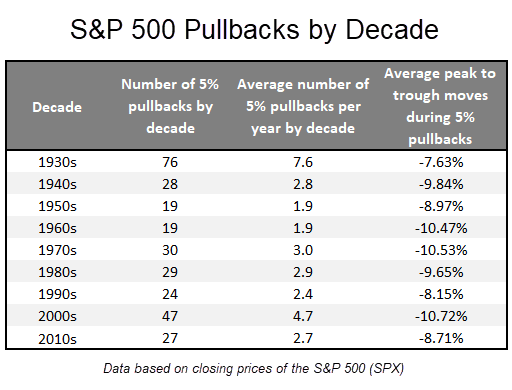
Dorsey Wright
This chart from TD Securities shows that traders in the fed fund futures market now foresee around two rate cuts before the end of 2019 as heightening trade tensions have stoked worries over the economic outlook. Expectations of easier policy gained ground on Friday after President Donald Trump threatened to wield tariffs against Mexican imports unless the country stemmed the flow of migrants to the U.S. southern border.
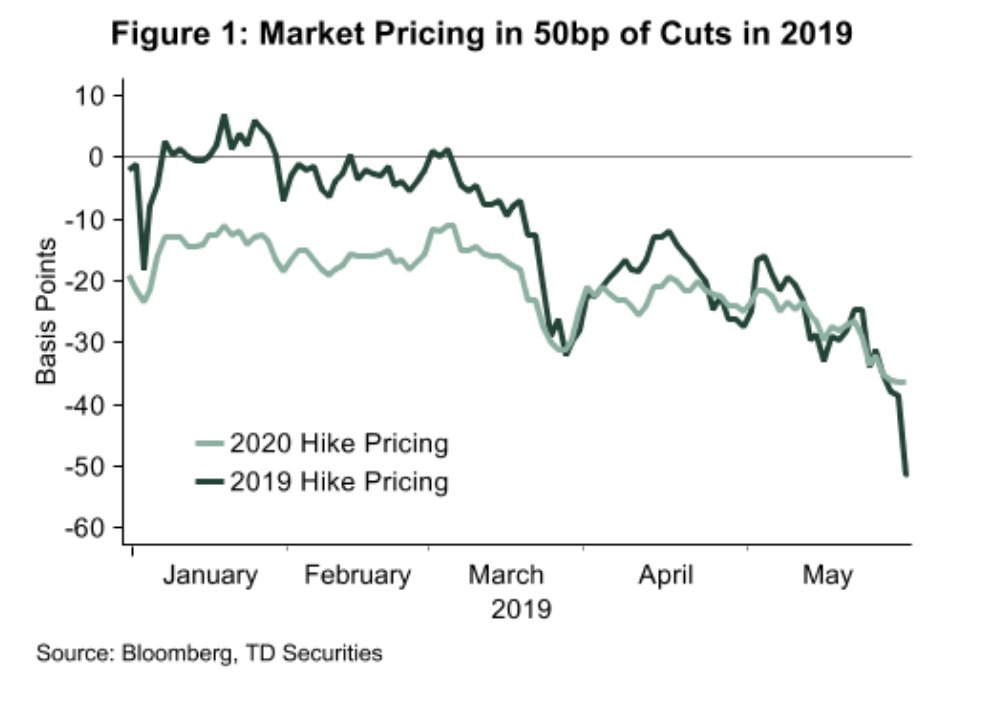
“When the industry starts to move toward commoditization over the next decade,” says Henderson, “Colombia is the only place that makes sense.” An equatorial climate and low-cost, skilled labor give Colombia a clear advantage in agricultural trade. And that makes the nation a threat to North American companies like Canopy Growth (ticker: CGC), Tilray (TLRY) andAurora Cannabis (ACB). These firms have invested hundreds of millions of dollars in building the climate-controlled grow-operations needed to grow weed in cold latitudes.
Most Canadian companies nurse the long-term hope of getting their production costs below two Canadian dollars per gram of cannabis. Colombian producers say their costs will start well below 50 cents a gram—and go down from there.
The Next Threat to Big Marijuana Companies Comes From Way South of the Border
Bill Alpert
https://www.barrons.com/articles/colombia-marijuana-production-51559321831?mod=hp_DAY_7
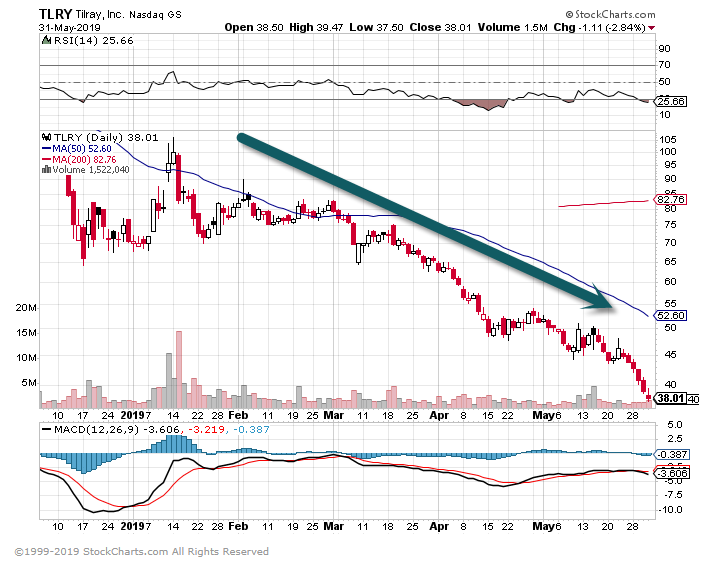
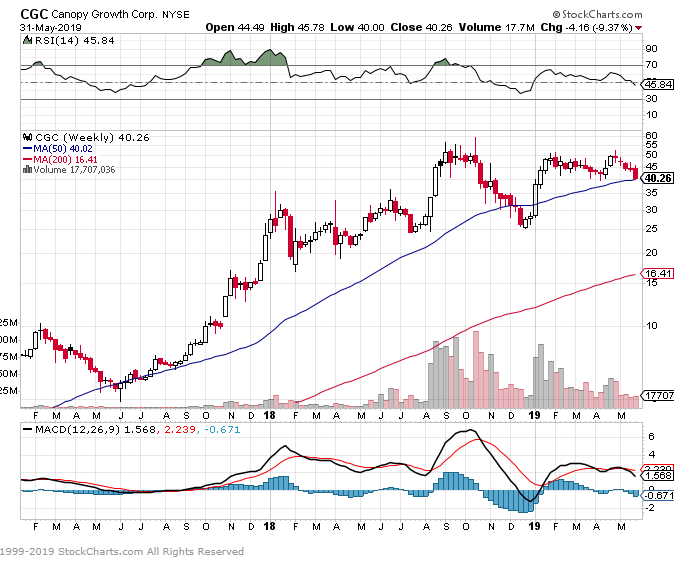
Investors seeking yield are piling into the riskiest corner of the municipal bond market at a pace not seen in decades.
They have poured $8 billion into funds that deal in high-yield muni bonds—or junk munis—this year, the most through May since at least 1992, according to Refinitiv data. Muni-bond funds overall have attracted $37 billion during that same period, the most in almost three decades.
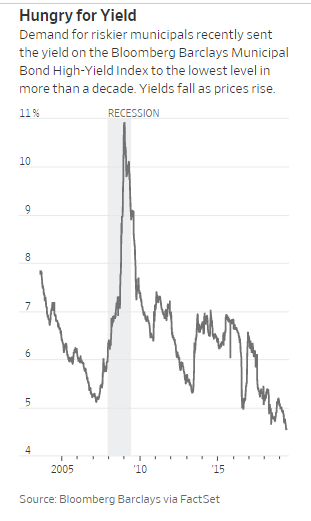
Funds dealing in high-yield munis have drawn $8 billion as investors search further afield for returns
By Gunjan Banerji
https://www.wsj.com/articles/risky-municipal-bonds-are-on-a-hot-streak-11558949401?mod=itp_wsj&ru=yahoo
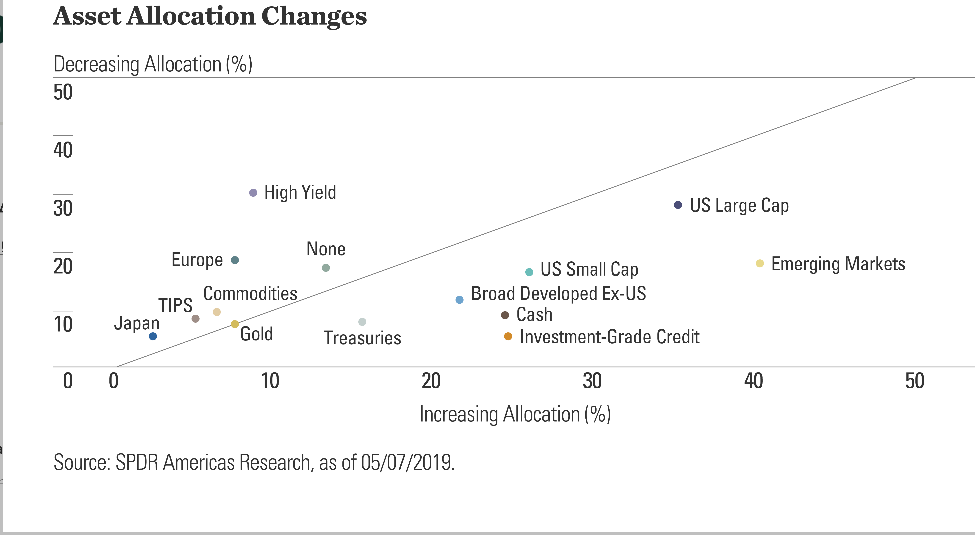
With respect to asset allocation trends, the chart below reveals where investors are willing to increase or decrease exposure as we head into the second half of 2019. Any asset class below the line indicates more bullish sentiment, where respondents are more inclined to increase allocations relative to the percentage seeking to decrease. Investment-grade credit has the highest ratio of increase to decrease percentages, reflecting the strongest agreement among respondents on where to position. This indicates investors’ preference to move up in quality this late in the cycle.
Emerging markets is a key area where investors are increasing allocations, with 40% of those surveyed indicating that they plan to do so. This is likely a result of the attractive valuations in the region combined with supportive demographic trends. However, we note that this survey was taken while trade tensions appeared to be softening. As recent rhetoric has reignited fears of a trade war escalation, the results of this survey might look somewhat different today.
On the bearish side, investors cited high yield bonds as an area where they plan to reduce allocations, with 30% planning a decrease. High yield not only had the highest decrease percentage, but also had the highest ratio of decrease to increase. As credit spreads continue to tighten—currently they’re 34% below the long-term 20-year median—high yield bonds present less upside relative to downside on a forward-looking basis,1 and may partially explain these survey results.
Consistent with our theme of ‘cautiously optimistic’ attitudes toward US equity markets, US large cap results were mixed. While investors are planning to increase their small-cap allocations, they are also expecting to increase allocations to cash. Lastly, while broad developed ex-US is on the bullish side of the ledger, specific country or region allocations to Europe or Japan are not. The latter reflects the unwillingness of investors to take on country- or region-specific risk, but rather be broadly diversified outside the US.
https://global.spdrs.com/blog/post/2019/May/2019-midyear-survey-investors-remain-confident-albeit-less-willing-to-take-on-risk.html?WT.mc_id=em_spdr-insider_us_ssga_may19&link=textlink2&mkt_tok=eyJpIjoiTmpneU56azVNREJsTm1GaiIsInQiOiJVaHpSb0tjc0duclRwQm81OVNRYWY3eE50Smk2K0xVMlNaMDZhZVBVSkRaTXBjSGU5dEhhYjh5dHNlck9hOWdZUGtqZFwvcVdHNHBaa0R0WmVJbTJQamtkSVF6U2V2RnNDQXJkN0lTenRlc1N6aVFObzNNR2dcL2VjZXk3SU5XRlUwIn0%3D Continue reading

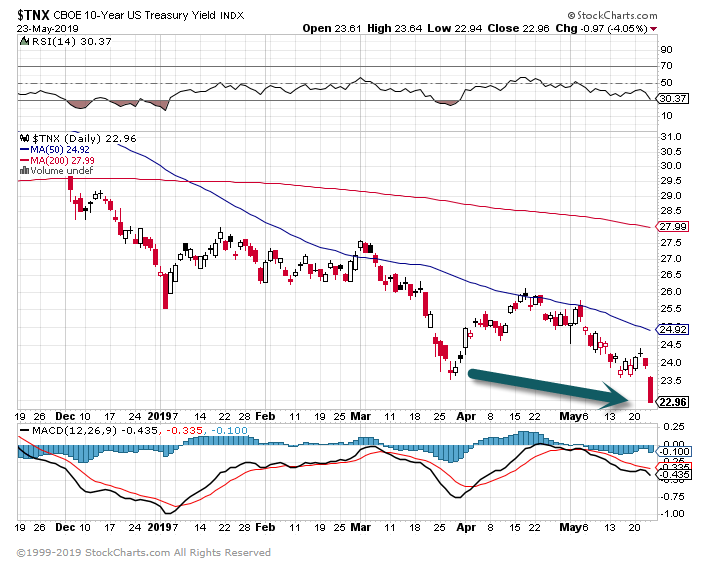
Even if a recession does not appear to be imminent, it’s never too early to think about how one could affect your portfolio. That’s because bear markets and recessions usually overlap at times — with equities leading the economic cycle by six to seven months on the way down and again on the way up.
During a recession, the stock market typically continues to decline sharply for several months. It then often bottoms out about six months after the start of a recession, and usually begins to rally before the economy starts humming again. (Keep in mind, these are market averages and can vary widely between cycles.)
Aggressive market-timing moves, such as shifting an entire portfolio into cash, can backfire. Some of the strongest returns can occur during the late stages of an economic cycle or immediately after a market bottom. It’s often better to stay invested to avoid missing out on the upswing.
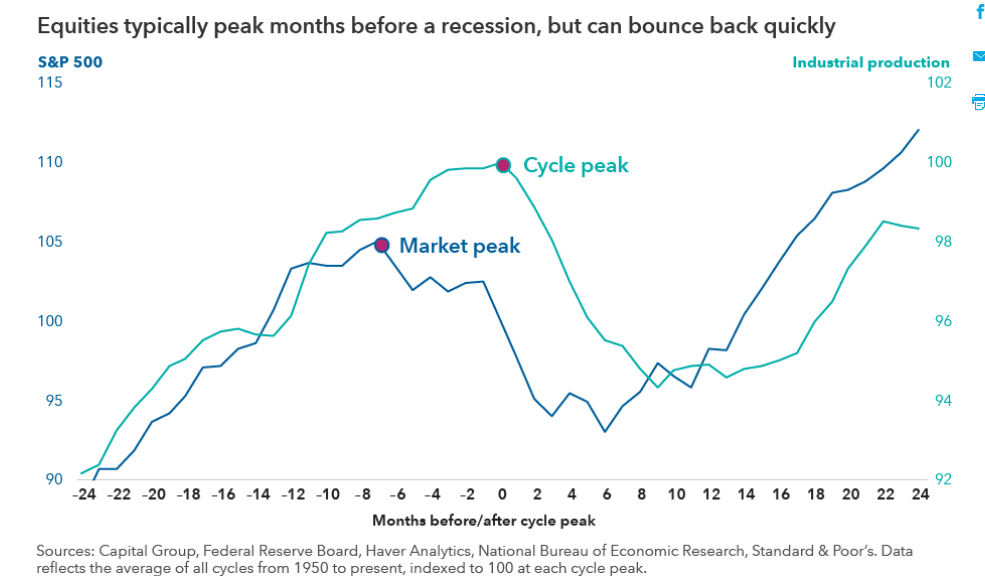
Economic indicators are a way to take the temperature of the U.S. economy. One or two negative readings could be meaningless. But when several key indicators start flashing red for a sustained period, the picture becomes clearer and far more significant. In our view, that time has not yet arrived.
Although some imbalances are developing, they don’t seem extreme enough to derail economic growth in the near term. The culprit that ultimately sinks the current expansion may one day be obvious: Rising interest rates, higher inflation, or unsustainable debt levels can be major triggers.
These events, if they continue, suggest that the economy could weaken in the next two years, placing a 2020 recession on the horizon. But we are not there yet.
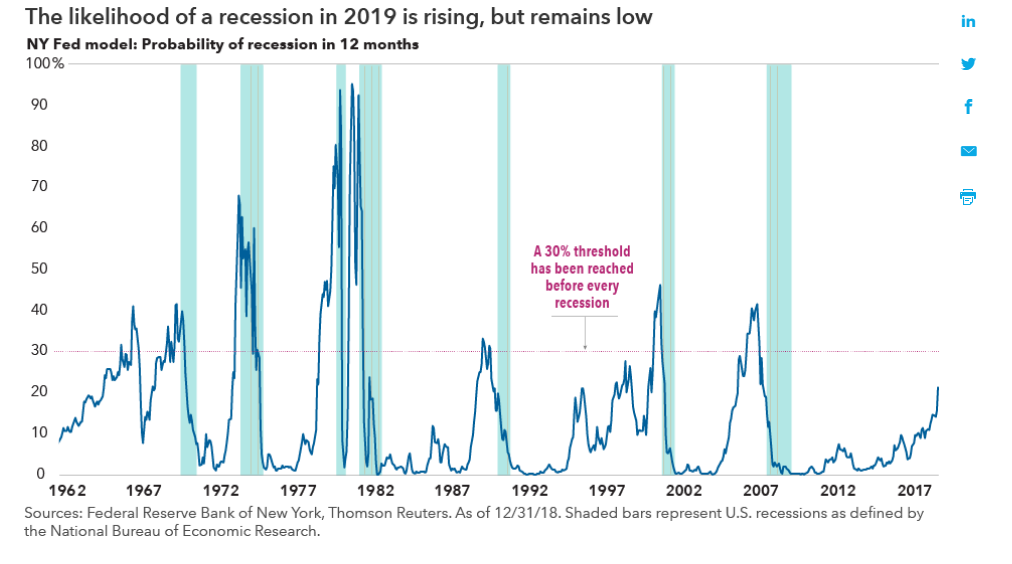
Capital Ideas Group
https://www.thecapitalideas.com/articles/guide-to-recessions
IMPORTANT: The projections and other information generated by the Vanguard Capital Markets Model® (VCMM) regarding the likelihood of various investment outcomes are hypothetical in nature, do not reflect actual investment results, and are not guarantees of future results. Distribution of return outcomes from VCMM are derived from 10,000 simulations for each modeled asset class. Simulations as of December 31, 2018. Results from the model may vary with each use and over time. For more information on VCMM, see the Important Information.
Source: Vanguard Investment Strategy Group.
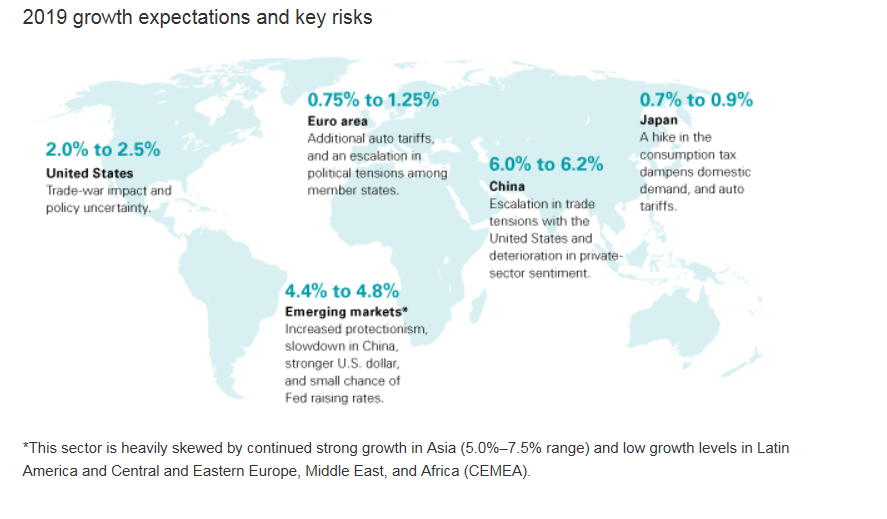
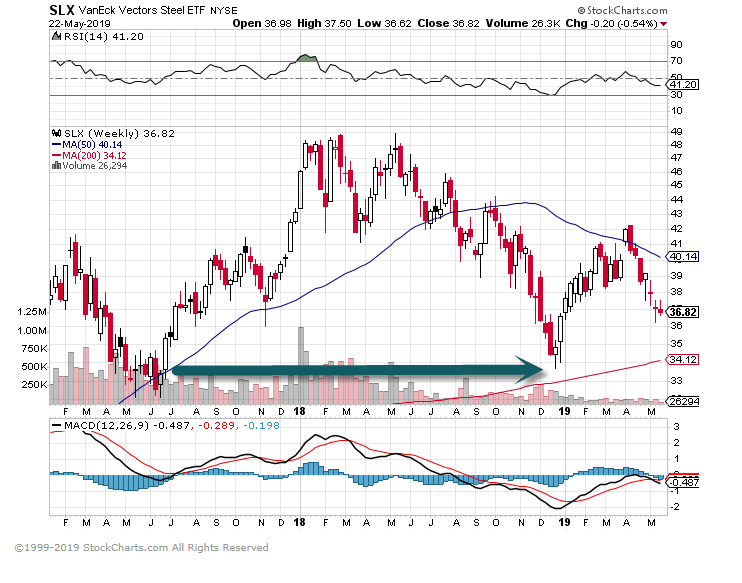
U.S. steelmakers woke last week to the brutal reality of evaporating tariffs on Canadian and Mexican steel. But an even greater problem is waiting in the wings: China may soon be tempted to ship more of its unwanted steel to foreign shores.
President Trump said Friday that the 25% tariffs he imposed on Canada and Mexico in mid-2018 would be lifted and that both countries would drop retaliatory levies. That removes a major hurdle to congressional approval for Mr. Trump’s revamped Nafta, the U.S.-Mexico-Canada Agreement.
U.S. steel companies will certainly take a hit, given that the tariffs boosted U.S. prices significantly above the global average for most of 2018, at the expense of steel-consuming industries like oil and autos. Even with the 25% tariff, imports of Canadian and Mexican hot-rolled coil steel are roughly 5% cheaper, according to Moody’s.
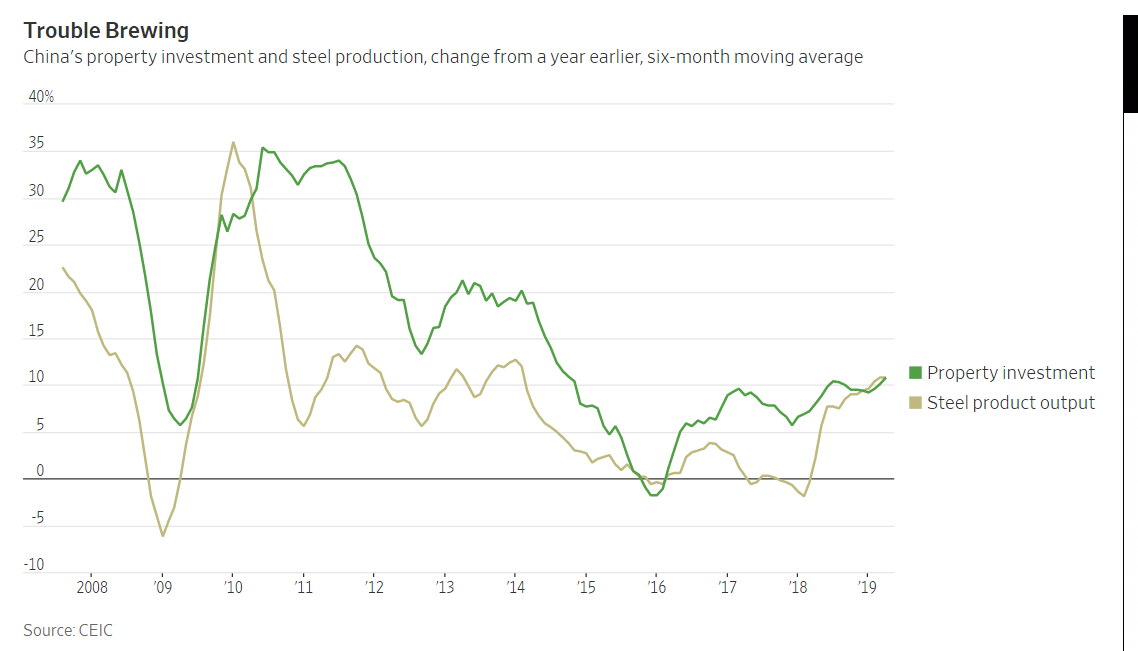
The vanishing levies on Canada and Mexico could be just the beginning of the industry’s problems
By Nathaniel Taplin
https://www.wsj.com/articles/trump-tariffs-and-china-spell-trouble-for-american-steel-11558524149?mod=itp_wsj&ru=yahoo
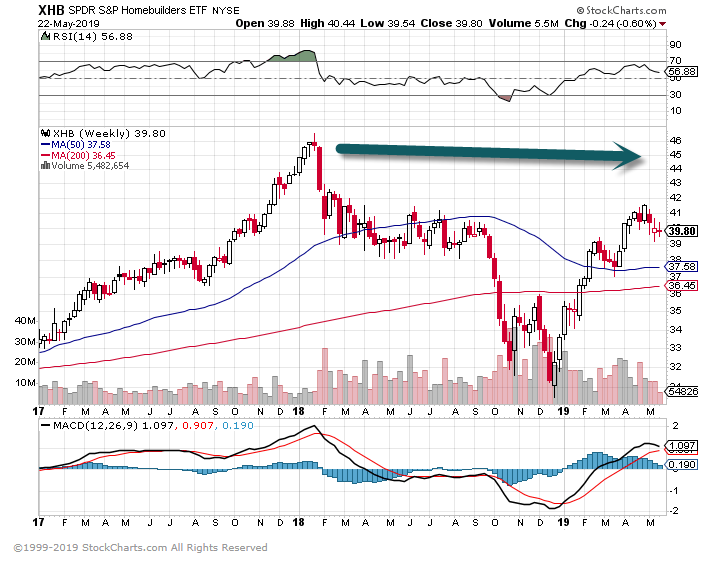
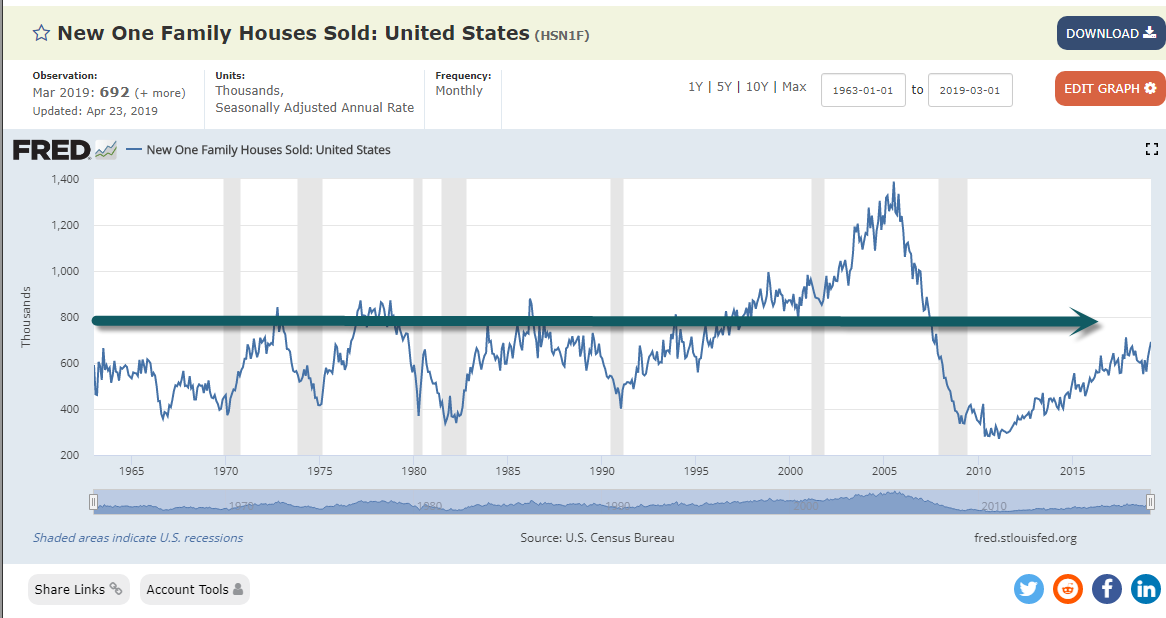
https://fred.stlouisfed.org/series/HSN1F
Tue, May 21, 2019
Today Eurozone banks are lagging the market, but that’s nothing new. During the mid-2000s banks were the key drivers of European equity market performance, outperforming by almost 40% from mid-1999 through mid-2007. Since, it’s been a seemingly never-ending series of disasters: the global financial crisis, the Eurozone crisis, non-performing loan build-ups, recapitalization, negative interest rates, and more. As a result, Eurozone banks have underperformed the broadest measure of European stock prices by 77% since the 1990s came to a close. How much lower can this ratio go? Buying Eurozone banks here would certainly qualify as “buying low.” Start a two-week free trial to Bespoke Institutional to read more on international equity markets and the global macro backdrop.
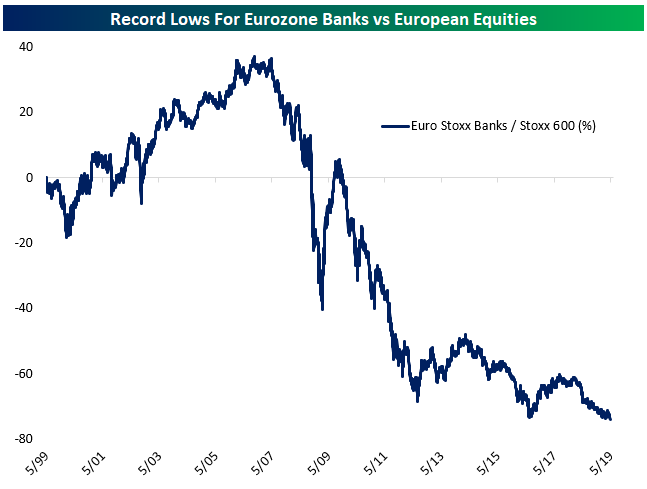
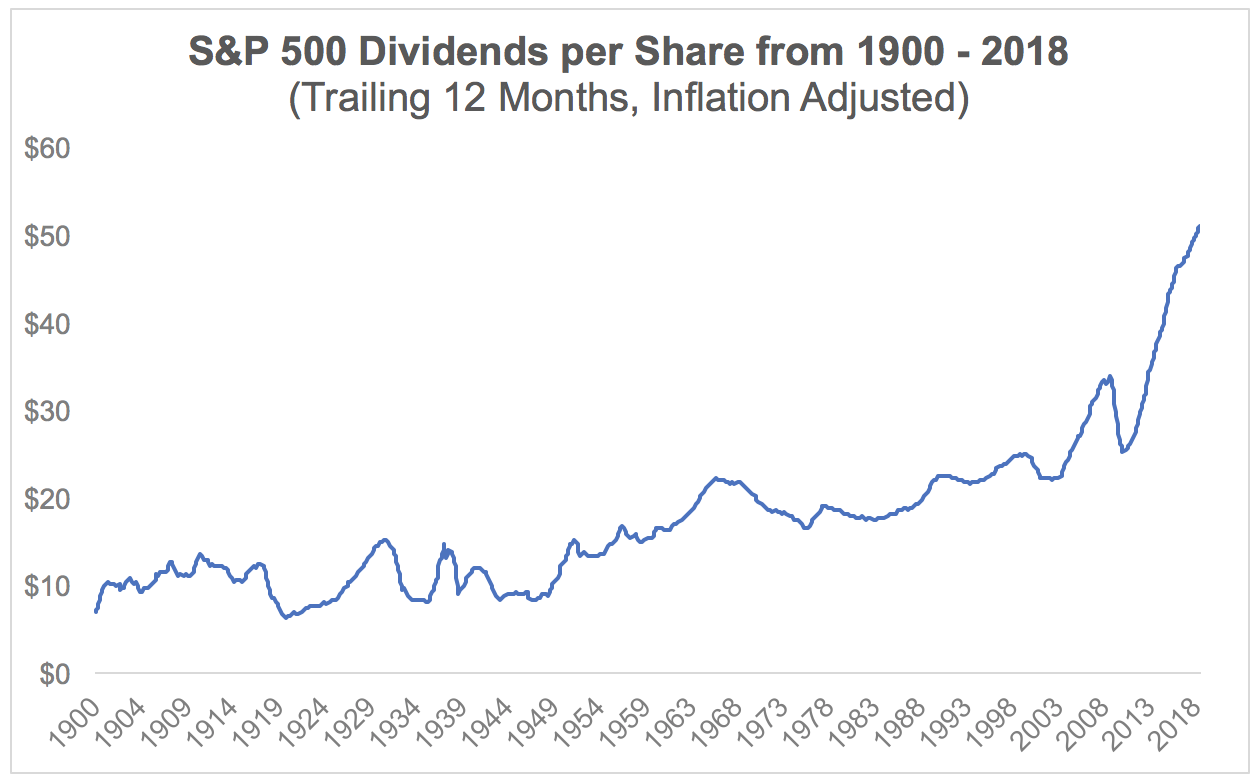
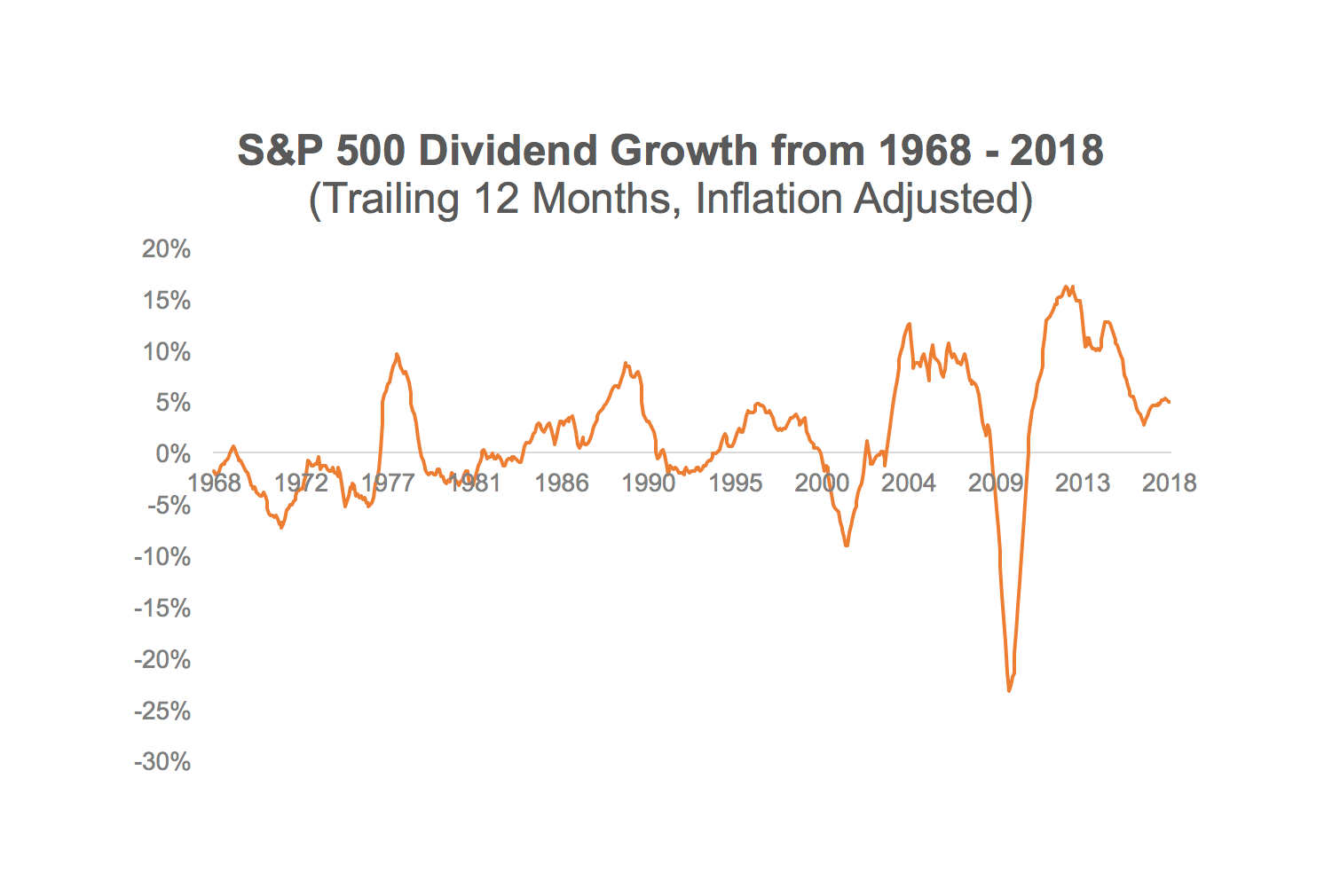
What Happens to Dividends During Recessions and Bear Markets? https://www.simplysafedividends.com/intelligent-income/posts/1038-what-happens-to-dividends-during-recessions-and-bear-markets
Google, Qualcomm and Broadcom are among the companies that have reportedly frozen their supply of components and software to the Chinese technology giant to comply with a crackdown by the Trump administration.
The moves follow a Trump administration clampdown. The Commerce Department announced last week that U.S. companies would need special permission to sell some products to Huawei.
It’s not yet clear how long or deep the crackdown will be. Some commentators have said that it could be a short-lived part of U.S. trade war posturing. But the administration has been vocal about its concerns over possible threats to national security, and Huawei has said that it was prepared for being frozen out.
How the moves could hurt Huawei. Existing products would continue to receive Google updates, but future devices would have to use the open-source version of the operating system, without services like YouTube and Google Maps. The chip freeze-out means it might be forced to use its stockpile of U.S. components.
“We can now expect China to redouble efforts to roll out a homegrown smartphone operating system, design its own chips, develop its own semiconductor technology (including design tools and manufacturing equipment), and implement its own technology standards,” Tim Culpan of Bloomberg Opinion writes. “This can only accelerate the process of creating a digital iron curtain that separates the world into two distinct, mutually exclusive technological spheres.”
More: U.S. intelligence chiefs have warned American tech companies of the dangers of doing business in China. Senator Mark Warner, a Democrat on the Senate Intelligence Committee, is doing something similar.
This year, Gartner organized the 17 technologies into five major trends: Democratized artificial intelligence (AI), digitalized ecosystems, do-it-yourself biohacking, transparently immersive experiences and ubiquitous infrastructure.
“As a technology leader, you will continue to be faced with rapidly accelerating technology innovations that will profoundly impact the way you deal with your workforce, customers and partners. The trends exposed by these emerging technologies are poised to be the next most impactful technologies that have the potential to disrupt your business, and must be actively monitored by your executive teams,” says Mike Walker, Research Vice President at Gartner.

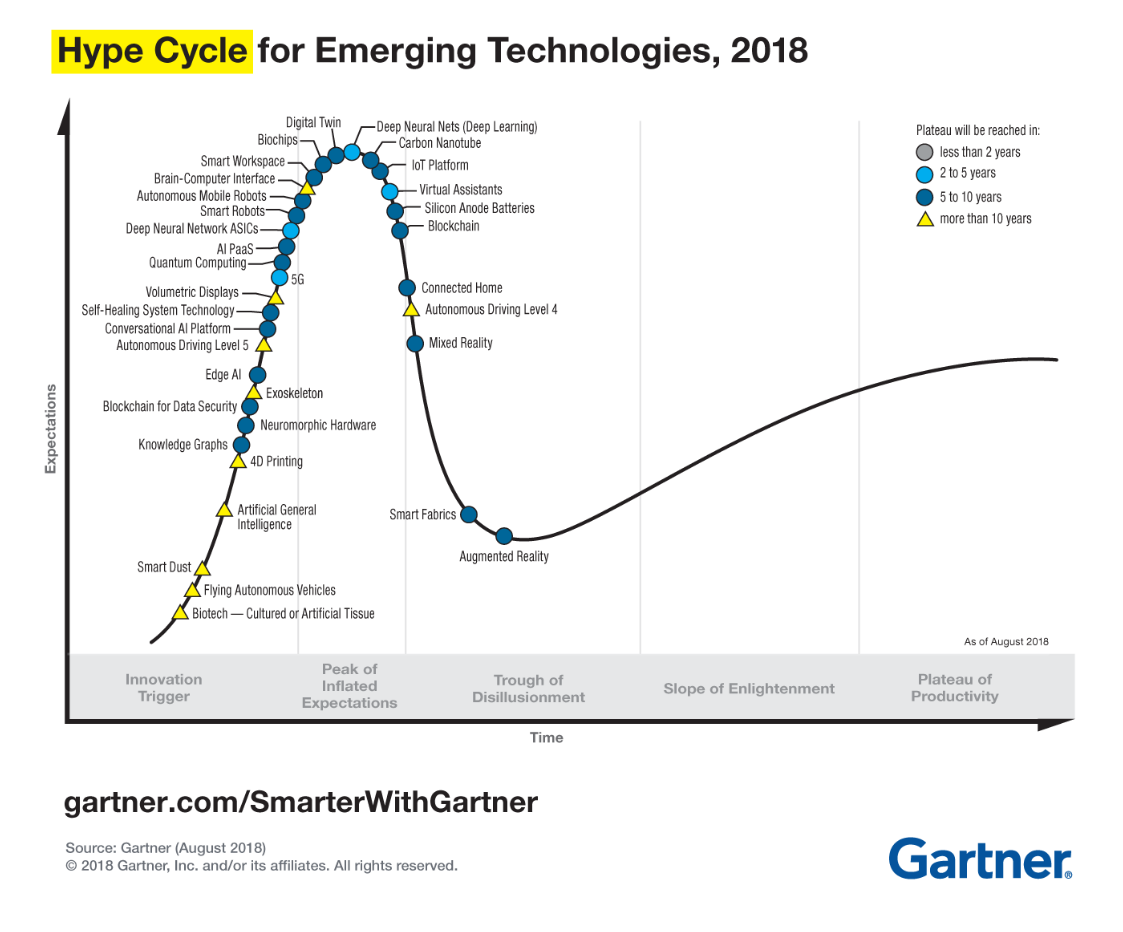
By Laszlo Bock
A lot of ink has been spilled and consultant hours racked up talking about the ins and outs of hiring heuristics. What deeply nuanced psychological traits should we be looking for? What tactics can you use to see them? What’s the one surprising trick that will help you identify the exceptional among the average?
According to some of the so-called savviest of executives, the secret to identifying future stars lies in the following interview questions:
While these prompts might lead to delightful conversations, no candidate’s response will indicate how well they’ll be able to do a particular job. Not to mention: How does one stack-rank applicants who most recently dressed up as an ice cream sundae or a box of crayons?
The truth is, the best way to hire isn’t outrageous, groundbreaking, or clickbaity. It’s incredibly structured and boring. And that’s why no one does it.
Too many people see hiring as an instinct art form, honed by years of their own experience: when asked, three-fourths of people involved in the interview process at elite law, banking, and consulting firms admitted to making hiring decisions based on their gut.
But our instincts are rarely, if ever, scientifically valid. Humans are error-prone creatures. We get excited about people who have impressive zombie apocalypse strategies or send thank you notes—and then we hire them over candidates who might have become our best-performing employees.
To test how helpful interviews really are, Yale professor Jason Dana and his colleagues had two groups of students predict their classmates’ GPAs. One group had access only to past GPAs and current course lists, while the other was also allowed to conduct free-for-all interviews. The students who interviewed their classmates were over 50 percent worse at predicting future GPA.
To fix the hiring process, we have to replace hubris with heuristics. Here are five steps to identifying the very best candidates. **
**Warning: the rest of this article might seem dry, but I promise it will improve the quality of your hires.
#1: Define job attributes
The goal of any interview process should be to predict how candidates will perform once they
join the team. Start by clearly outlining what missing skills your team needs to succeed, and identifying themes across people you did hire, as well as those you didn’t. At Google, we found four distinct attributes that predicted whether or not someone would be successful on the job: general cognitive ability, leadership, “Googleyness” (e.g., a dose of humility and comfort with ambiguity), and role-related knowledge. Once we identified these attributes, we required all interview feedback to comment specifically on each one.
#2: Ask for a work sample
This entails giving candidates a sample piece of work, identical to that which they would do in the job, and assessing their performance on it. But even this can’t predict performance perfectly, since actual performance also depends on other skills, and worse, many jobs don’t have nice, neat pieces of work that you can hand to a candidate.
The truth is, the best way to hire isn’t outrageous, groundbreaking, or clickbaity. It’s incredibly structured and boring. And that’s why no one does it.
#3: Ask behavioral questions
Which brings us to interviews. Asking behavioral questions (something like, “Give me an example of a time when you solved an analytically difficult problem”) will get you two kinds of information: one is you get to see how the candidate actually interacted in a real-world situation, and the valuable “meta” information you get about the candidate is a sense of what they consider to be difficult.
Ask candidates a consistent set of questions, in the same order, with clear criteria to assess the quality of responses. This ensures that any variation in responses is a result of the candidate’s performance, not because an interviewer has particularly high or low standards, or asked harder or easier questions.
#4: Average scores and make a decision
The “wisdom of crowds” works for hiring decisions, too. An average score has the virtue of eliminating the ability of a single person to veto or politic for a candidate. Equally weight each interviewer’s rating—a subordinate’s feedback is at least as valuable, if not more so, than a hiring manager’s feedback. And finally, when you sit down to compare candidates, look at and rank all the scores on the first attribute or question. Then look at and rank all the responses on the second one, and so on. This prevents you from focusing on a single candidate for too long, which is when bias creeps in.
#5: Constantly check that your hiring process actually works
Most organizations never go back a year or two after hiring someone to find out if that thank you note really did predict their performance—which is why they keep letting jokes and notes shape their staff. Continue to identify themes across your top performers, and then work your findings into the interview process.
Following these five steps might not feel exciting or entertaining, and in fact that’s why most companies don’t bother. Sometimes doing something right means doing it in a staid, measured, repeatable way. But by doing so you’ll discover that structure and science (not sentiment or social cues) are the keys to a successful—and unbiased—hiring process.
Laszlo Bock is CEO of Humu, a company that’s making work better with science, machine learning, and a little bit of love. He is the author of The New York Times bestseller Work Rules! and the former senior vice president of people operations at Google.
https://behavioralscientist.org/hiring-isnt-rocket-science-why-the-most-boring-strategy-is-best/
Found at Abnormal Returns Blog www.abnormalreturns.com
When thinking about how to develop in our careers, most of us tend to focus on promotions, projects, courses, certifications. We seek out expanded roles, more senior titles, extra money. We overlook one very key piece of the learning puzzle: proactively surrounding ourselves with people who will push us to succeed in unexpected ways and, in so doing, build genuinely rich, purposeful lives of growth, excellence, and impact.
Back in the 1990s, when I was working full-time as a partner in our executive search firm, I pursued one such friend—a leading researcher and writer—and cultivated the relationship for several years. And then, in 1998, during a walk along the Charles River in Cambridge, he surprised me with a challenge. He suggested that, in addition to my client practice and internal leadership roles at Egon Zehnder, I could find even more meaning (and have a larger reach) by using my knowledge of and passion for talent-spotting and development to also become a writer, teacher, and public speaker. I took his advice, and it has drastically changed my life, both professionally and personally.
We typically spend at least two decades in our formal education and, in developed countries, hundreds of thousands of dollars. We carefully choose our places of employment and invest significant time and effort in training within them. However, few of us engage in a deliberate, determined search for those wise individuals who, through their inspiration and advice, can literally make us new.
This article is one in a series related to the 10th Global Peter Drucker Forum, with the theme “Management. The human dimension” taking place on November 29 & 30, 2018 in Vienna, Austria.
My dynamic circle of advisers and confidantes has included, in addition to my wife María and my Charles River friend, several other academics in the United States, an undergraduate professor in Argentina, a McKinsey director in Spain, and colleagues working in Egon Zehnder offices across the Americas, Europe, and Asia. They have, throughout my career, successively inspired me into different possibilities I would never had envisioned, from teaching statistics to applying for an MBA, from becoming a strategic consultant to spending three decades and taking on global leadership roles in executive search, from publishing books to teaching executives at Harvard.
They have been companions on my journey, offering honest feedback, helping me to discover new identities and pushing me to become a highly different yet significantly better version of myself. How can you find a similar group? The following guidelines should help:
Think about the people who inspire you. These can be teachers of certain disciplines; inventors; entrepreneurs; business, social, or public leaders. I have always been moved and inspired by specific people, not just abstract professions. I “met” them originally in many cases by reading their work or about them, but also via social media and at conferences.
Don’t be afraid to chase. Conferences are a great place to get inspired, approach, and start a relationship with some of the people you’ve identified. Likewise, contacting even top academics is usually much easier than you think. Other cases may require a much more determined investment. For example, I flew back and forth from Buenos Aires to a little town in Massachusetts just to meet my Charles River friend. While this double red-eye may sound excessive, think how little time commitment it was compared to what we invest in our education, or to the opportunity cost and frustration of a poor career choice or wrong job decision.
Aim for a mix of people inside and outside your organization. Lots of healthy change can and should ideally happen within your own company. However, external contacts can potentially have the benefit of greater independence, a broader perspective with radically new horizons, as well as potential connections across both worlds which will benefit everyone.
Be candid about the reason for your interest. Most truly great people live their lives with genuine passion and want to expand their missions. Most times, they will be delighted to both inspire you and help you see how to close the gap between dream and reality.
Ask them specifically about how to get started. After suggesting my new potential persona, my Charles River friend gave me some invaluable advice about what I had to do. He said to me: “You need three Cs: capability, which you have; connectivity, which at least initially you can do through the global network of your firm; and credibility, which you don’t have yet. In order to achieve it, you need to publish a great article in a credible magazine and ideally a book.” He then put me in touch with a senior editor at HBR, with whom I worked to make that first article happen.
Proactively offer them help. These great companions who lead us to greater lives deserve our very best. I have always offered them that, with no strings attached. That included becoming a pro bono assistant professor, conducting intensive research for a full year for someone’s new book, becoming the critical reader of a best-selling author, and much more. And whenever I get a message from them, I drop everything I’m doing and respond right away. I have constantly done this out of gratitude but, as always, I also gained in the form of more learning, opportunities, and deeper friendships.
Have crucial conversations in the right settings. Meeting face-to-face with no distractions will help you reach a level of intimacy which simply can’t achieve remotely. I would add that many of my life-changing moments have occurred while walking with my trusted friends in beautiful surroundings – whether by a river, in the countryside, on the beach, along a snow-covered mountain, or across peaceful villages. One of my Egon Zehnder colleagues and I have done this in more than 30 different parts of the world. The combination of exercise and nature makes me particularly energetic, enthusiastic and positive – and therefore more willing to consider new possibilities.
Don’t hesitate to ask the truly big questions. What shall I do with my life? What really motivates me? What am I doing that I really don’t like to do? While pondering these questions, in addition to checking my capability, connectivity and credibility, I also engage my friends in conversation about three other Cs: contemplation (Am I in touch with my inner compass?), compassion (Do I show it for myself and others?), and companions (Who else might inspire me to new growth?)
Proactively seeking out and cultivating those who will help us become better versions of ourselves is, by a wide margin, the key for living a truly happy and meaningful life. I sincerely hope these guidelines help you.
Claudio Fernández-Aráoz is a senior adviser at the global executive search firm Egon Zehnder, an executive fellow at Harvard Business School, and the author of It’s Not the How or the What but the Who (Harvard Business Review Press, 2014).
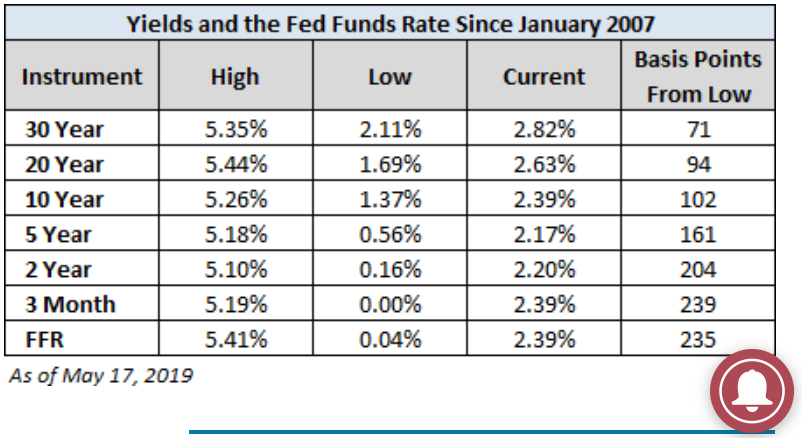
by Jill Mislinski, 5/17/19
https://www.advisorperspectives.com/dshort/updates/2019/05/17/treasury-snapshot-10-year-yield-at-2-39-30yr-mortgage-4-07 Continue reading
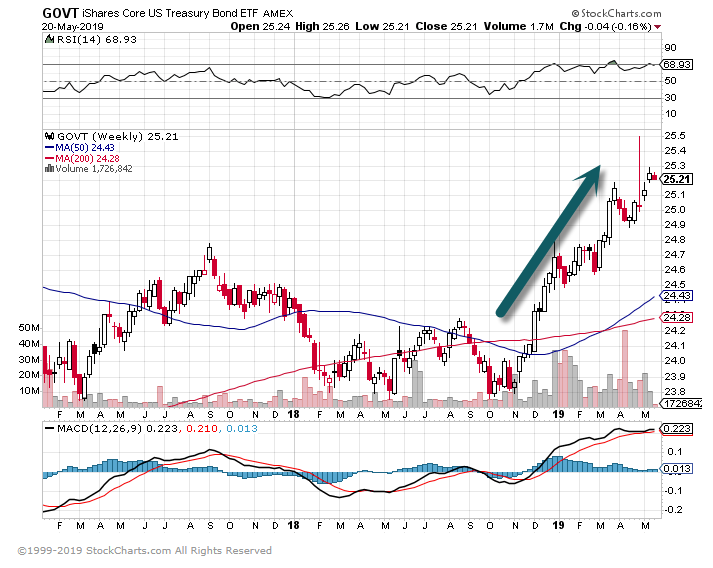

Barrons
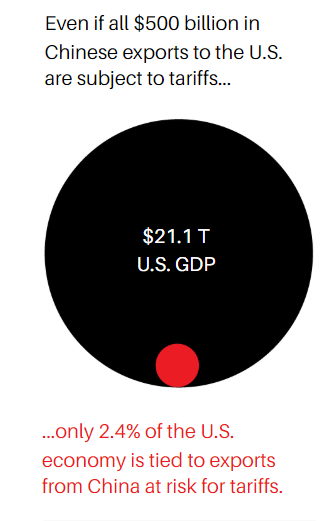
 The Trade War Will Make Stocks Scary. 5 Reasons Not to Panic. By Reshma Kapadia
https://www.barrons.com/articles/trade-war-stock-market-outlook-51558120641?mod=hp_HERO
From Dave Lutz at Jones Trading
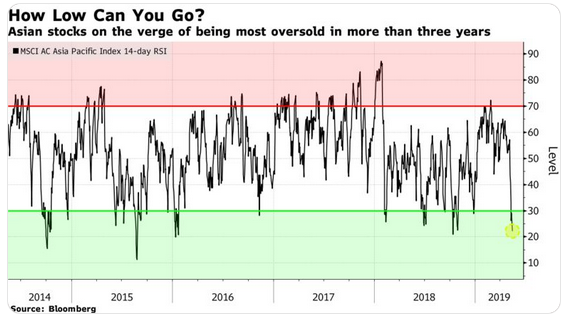
Despite the news that MSCI announced to double Chinese stocks’ weightings in its global gauge by the end of the month, overseas traders sold 10.6 billion yuan (US$1.54 billion) worth of mainland-traded shares through the exchange links today. That was the biggest single-day outflow since at least December 2016, when the stock connect programme between Shenzhen and Hong Kong started
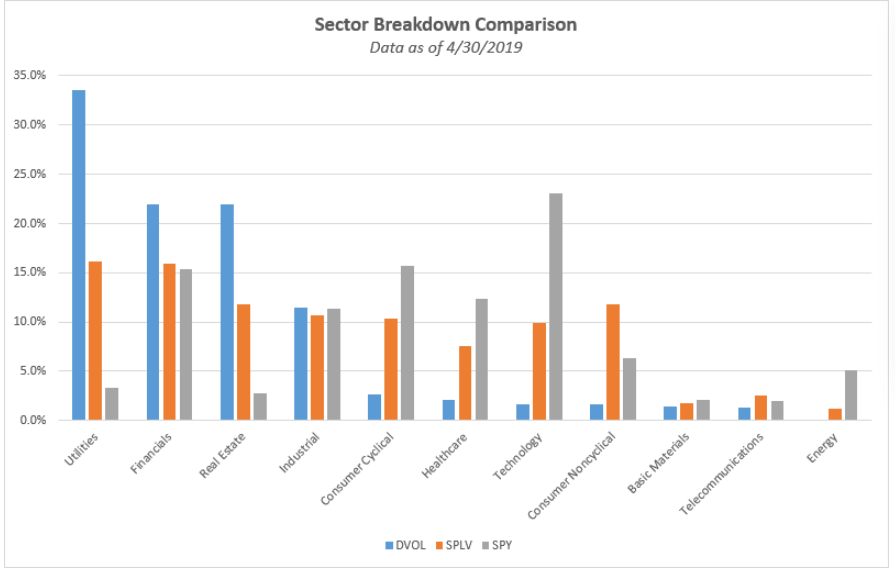
Nasdaq Dorsey Wright
https://business.nasdaq.com/intel/dorsey-wright/index.html
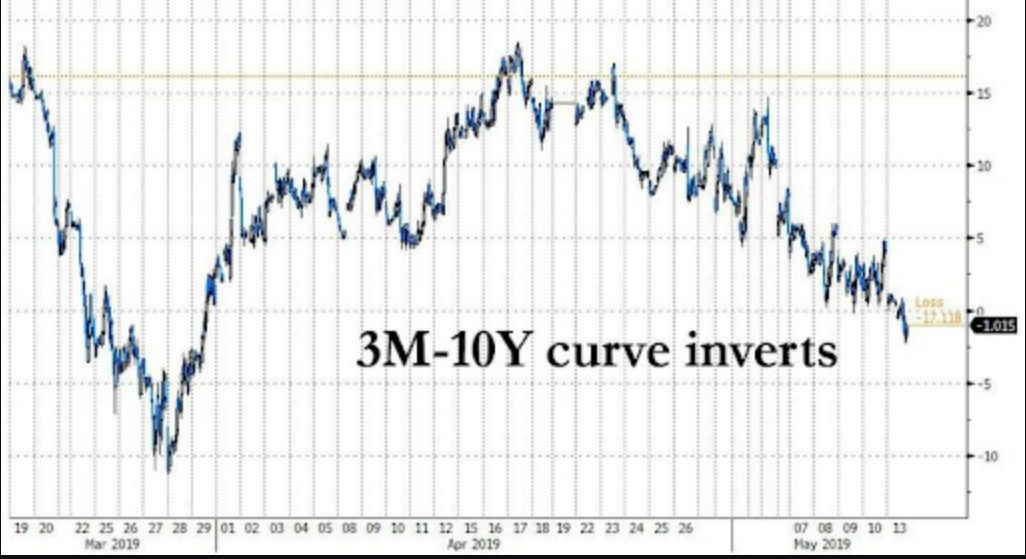
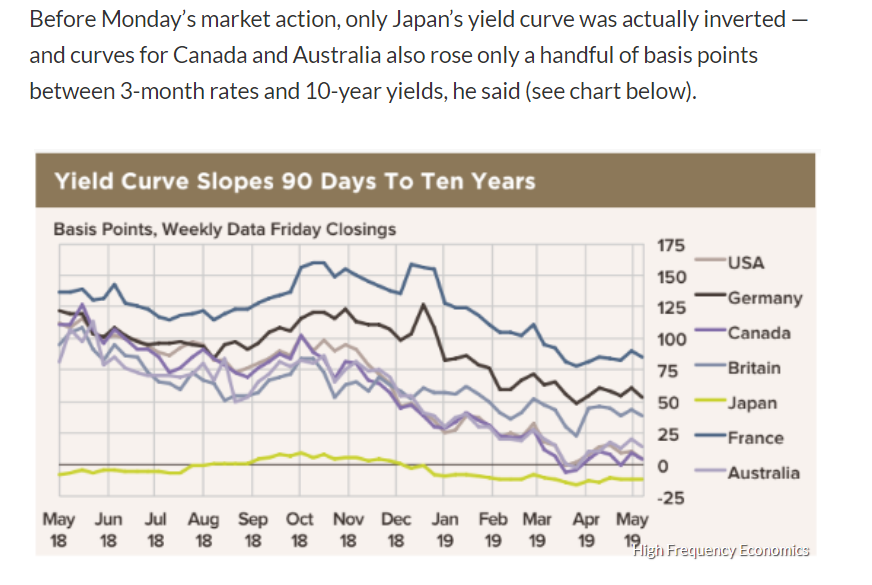 Stock-market bears say don’t forget about this yield-curve signal as trade fears sink equities
Published: May 13, 2019 4:31 p.m. ET Flattening curves around world will stoke slowdown fears: economist
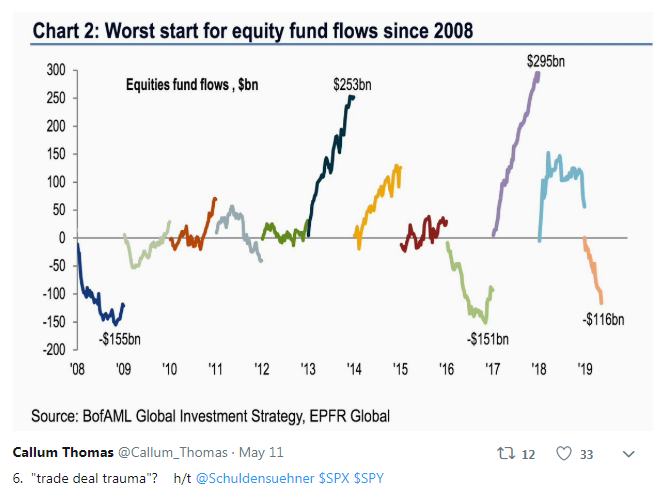
https://twitter.com/i/moments/1127307062789042176 Continue reading
From Dave Lutz at Jones.
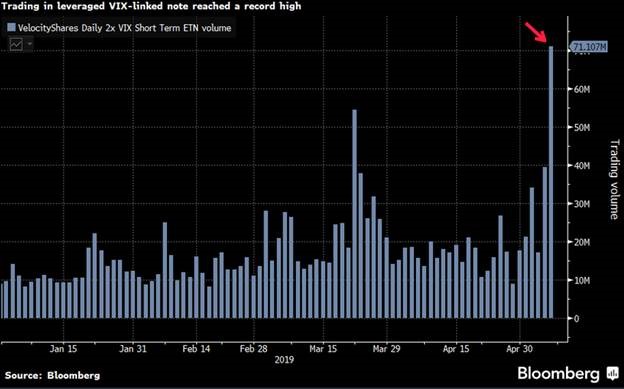
“The fact that inversion occurred with futures expiration still over two weeks away gives us confidence that this move isn’t just noise (the front of the curve can be volatile near futures expiration) but is actually showing a demand for protection in the market,” said Vinay Viswanathan, an equity derivatives strategist at Macro Risk Advisors – There was record volume in TVIX, the 2x VIX ETF, yesterday
Millennial spending will account for 25% of total U.S. retail sales in 2020,
or $1.4 trillion annually.
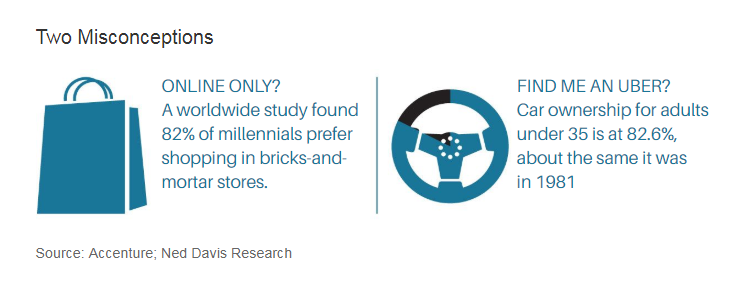
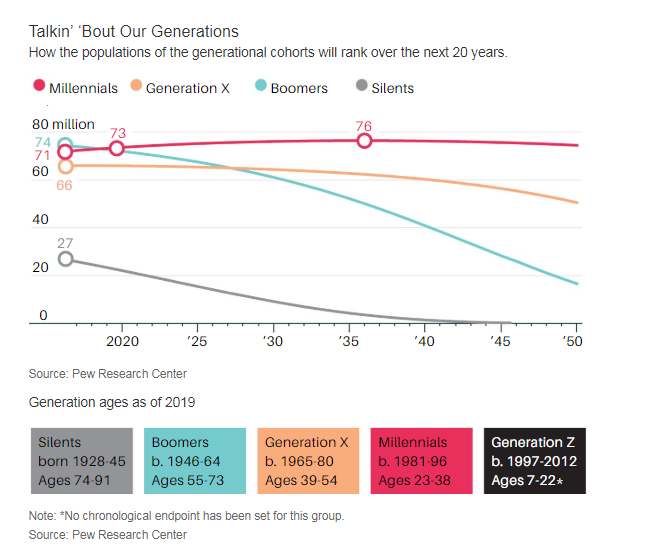
Source: Accenture
5 Stocks to Ride the Coming Wave of Millennial Spending
Daren Fonda
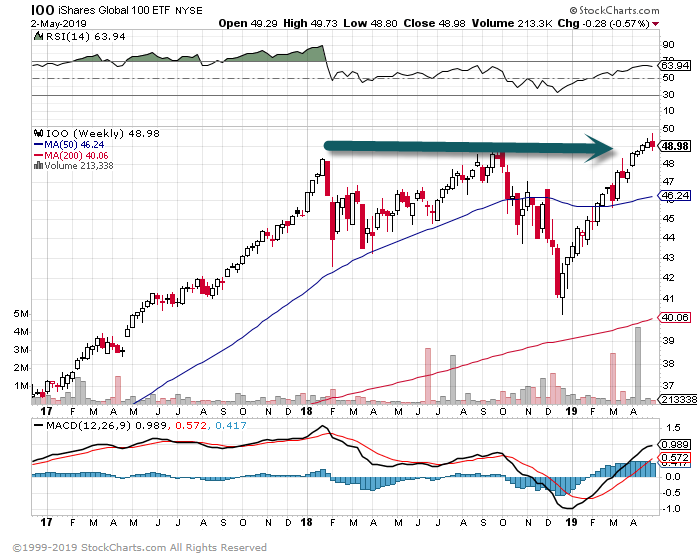
https://www.ishares.com/us/products/239737/ishares-global-100-etf
by Wolf Richter • Apr 30, 2019 • 73 Comments • Email to a friend
According to chip makers, the plunge isn’t over yet. Now hoping it won’t turn into the mess as in 2001 when the last tech bubble became the dotcom bust.
Global semiconductor sales dropped 15.5% in the first quarter, from the fourth quarter last year, to $96.8 billion, the World Semiconductor Trade Statistics (WSTS) organization reported Monday afternoon. The three-month moving average in March has now plunged 25% from the three-month moving average at the peak last October, the deepest plunge since the Financial Crisis:
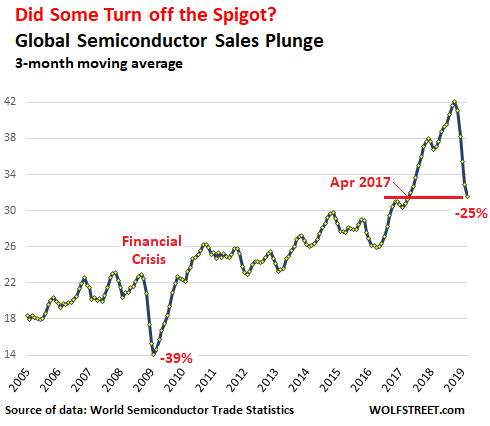
Demand was down across all regional markets: The global 15.5% drop in sales from Q4 2018 to Q1 2019 split up regionally this way – and the problem isn’t just China:
The co-working company told employees yesterday that it has confidentially filed paperwork with the SEC to go public.
WeWork reportedly hasn’t picked bankers yet, and an offering wouldn’t happen until the third or fourth quarter of this year. But there’s more you should know about 2019’s latest mega-offering.
It’s as meaty as a WeWork company card will allow
A WeWork IPO would likely be the second-biggest offering in the U.S. this year behind Uber. WeWork was last valued at $47 billion and has 400,000 members in 100 cities.
It’s not just WeWork
It’s the We Company after a rebranding earlier this year to focus on more than just the short-term office space rental service that (along with its notorious tenant Morning Brew) made it famous. Now, it’s diversified into businesses like housing, a children’s school, and a coding academy.
Wherefore the rebrand? Fend off skepticism over WeWork’s ability to withstand a market downturn, when fewer D2C birdseed startups will look for low-commitment office space. But we may always need apartments for “modern-day nomads.”
And speaking of skeptics…there are plenty. WeWork is a “love it or hate it” company, writes Axios. A “person close to the company” told Axios WeWork could become the second-most shorted stock after Tesla.
But as for believers…
WeWork is no mere co-working company. It serves a higher purpose.
From CEO Adam Neumann: “As one of the world’s largest physical networks, it is our responsibility to help lead the way and set the global example for people and corporations on how we should take care of each other and of our planet.”
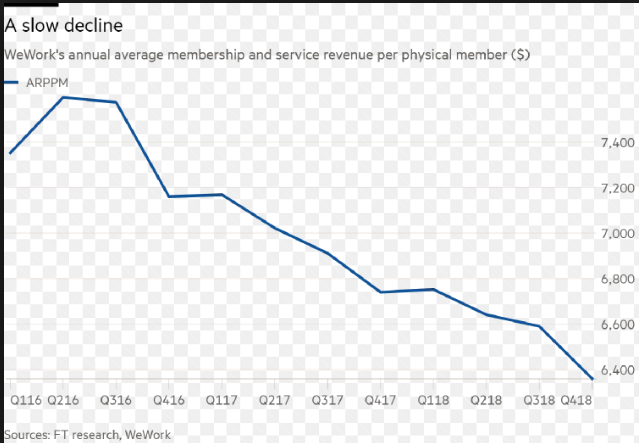
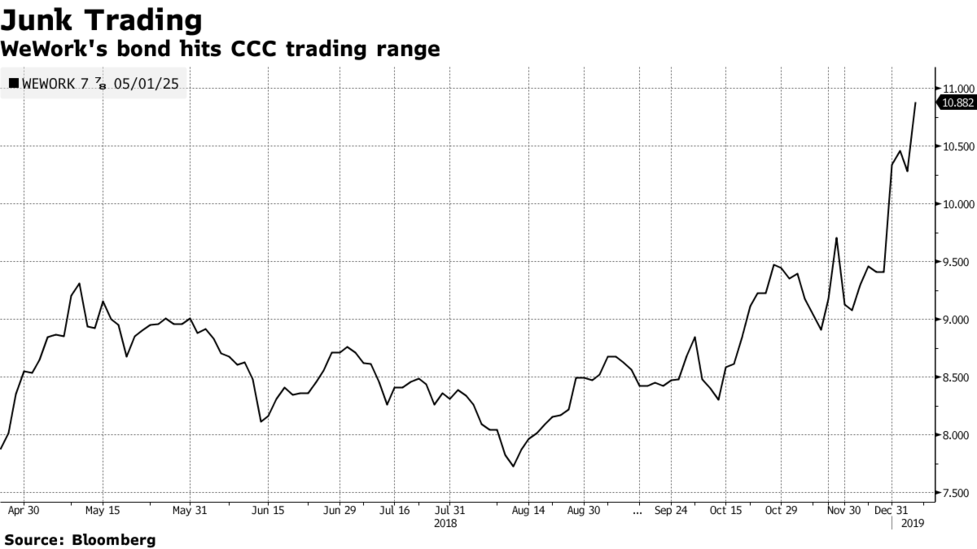
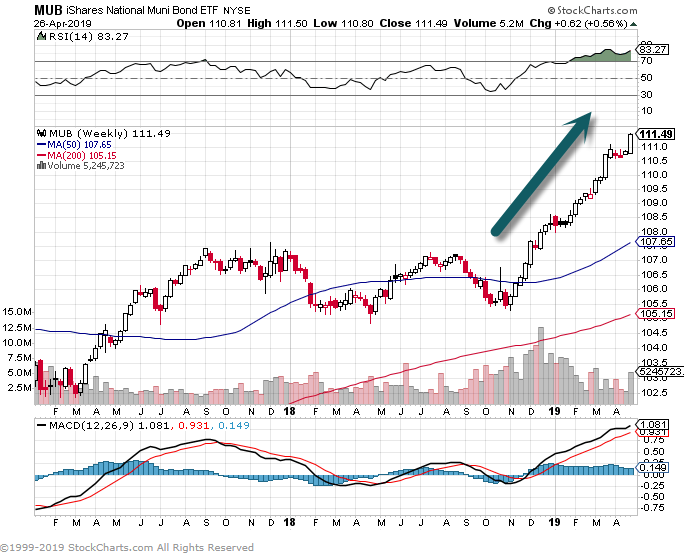
Bid to drive down tax bills pushes munis to pricey levels
It’s only four months into 2019, and already mutual funds that invest in state and local-government debt have raked in more cash than they usually do in a year.
Investors added $1.1 billion to such funds in the week ended April 17, the fifteenth straight weekly influx, the Investment Company Institute reported Wednesday. That bumped the total to about $30 billion since January, more than they’ve drawn during any full year since 2012, according to an analysis of the data by CreditSights.
Equities
The stock rally paused on Wednesday, pressured by the rising US dollar. Outside of the trade-related uncertainties, the dollar now poses the highest risk to equities. A firmer dollar tends to make US products more expensive for customers abroad and depreciates the value of foreign earnings for US companies. Imported products in the US become cheaper, making it harder for domestic firms to compete.
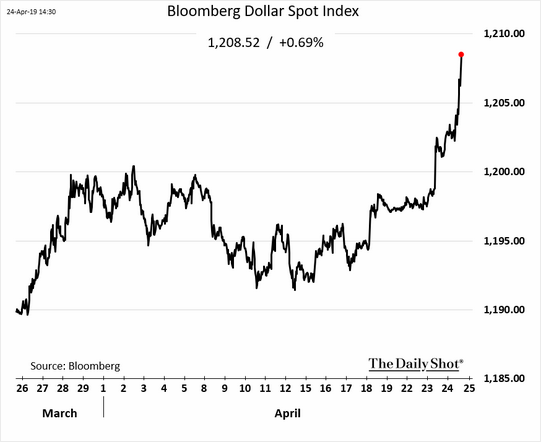
Weak economic data out of Germany (see the Eurozone section) and a more dovish Bank of Canada (Canada section) boosted the dollar on Wednesday. Rate differentials with other economies will provide tailwinds for the dollar over the long run.
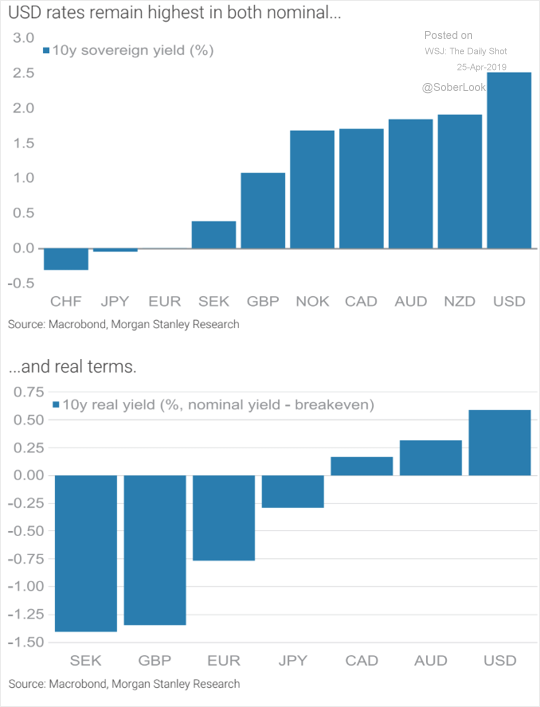
Source: Morgan Stanley Research
The Daily Shot
https://blogs.wsj.com/dailyshot/2019/04/25/the-daily-shot-a-stronger-dollar-could-hinder-the-market-rally/
Talk of an earnings recession is so last-week. With numbers in for just over 20% of S&P 500 members, the latest growth prediction stands at negative 3.3%. That’s as good as a gain, and it pushed market indexes to new highs on Tuesday.
Two things we knew going into reporting season were that the earnings growth consensus stood at negative 4.3%, and that companies would surely surprise to the upside. They almost always do. The only question was whether it would be a big surprise or a small one.
It’s a big one so far. According to FactSet, earnings have come in 6.3% ahead of expectations. The five-year average is 4.8%. At this rate, better-than-expected results might be enough to pull earnings just above break even versus a year ago, averting an earnings recession.
https://www.barrons.com/articles/stock-market-new-highs-earnings-51556051344?mod=hp_LEAD_1
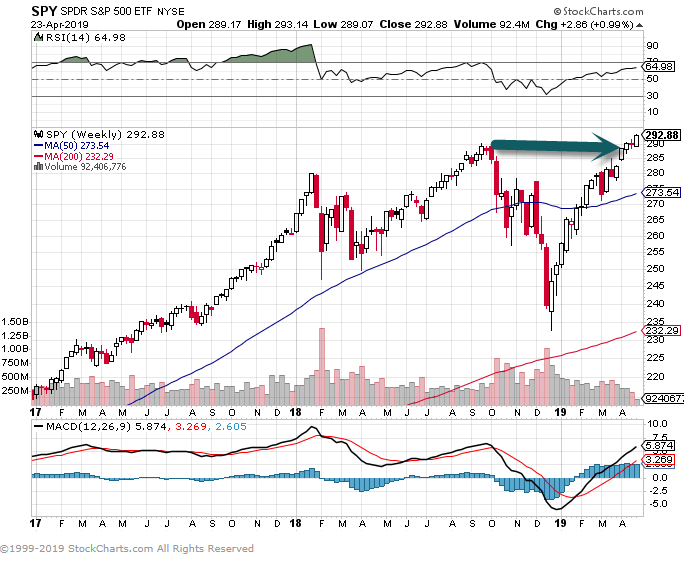
Barrons
So far, the 2019 crop of gig-economy IPOs aren’t performing like the dot.com era, when investors just “had” to own internet stocks. IPO research from Jay Ritter shows the first-day return of 476 IPOs in 1999 averaged a whopping 71%. What’s more, the Nasdaq Composite rose another 100% between the middle of 1999 and the market’s peak in March 2000. Dot.com stocks kept working even after internet companies sold shares to the public.
Pinterest Stock Is Hot After Its IPO. Why You Should Keep Your Cool.Al Root
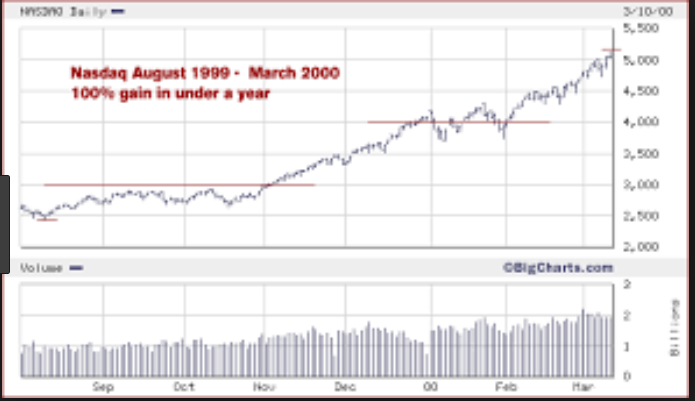
Bond sales are booming in 2019, running at a record pace globally for the year so far, as a pivot in monetary policy among the world’s central banks prompts a fresh binge in corporate borrowing – Global corporate bond issuance has reached almost $747bn for the year to Monday, according to FT, edging ahead of the previous record of $734bn issued over the same time period in 2017, which ended up being the biggest year on record for new debt sales.

From Dave Lutz at Jones
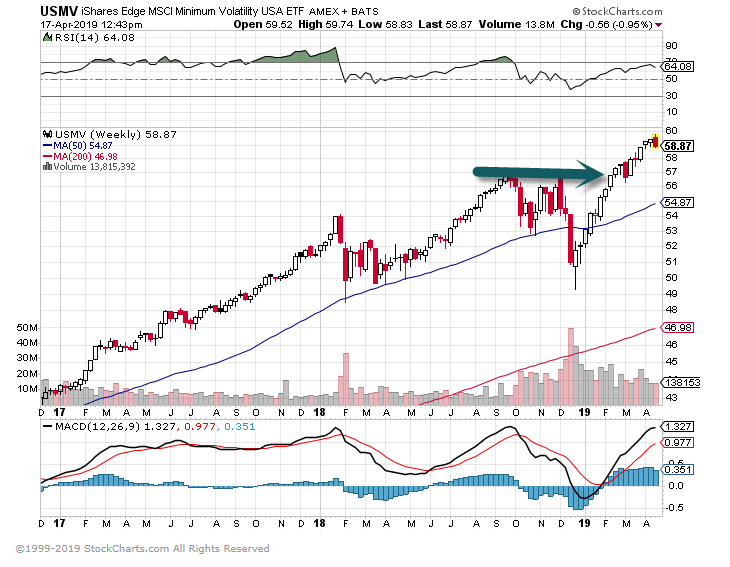
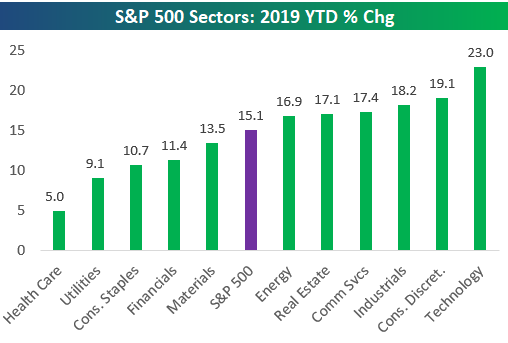
©2019 Bespoke Investment Group
https://www.bespokepremium.com/interactive/posts/think-big-blog/bespokes-sector-snapshot-4-11-19
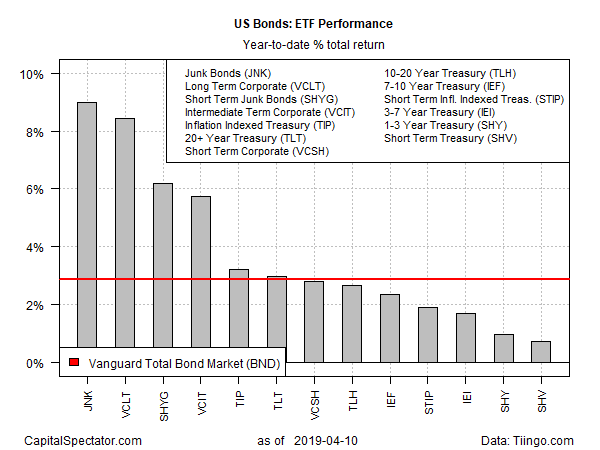
http://www.capitalspectator.com/junk-and-long-term-corporates-top-2019s-us-bond-market-rally/
Found at Abnormal Returns Blog www.abnormalreturns.com
Seven has been a lucky number for U.S. stocks. The S&P 500 Index just notched its first seven-day winning streak since October 2017. As shown in the LPL Chart of the Day, this feat has occurred just seven other times in the current bull market.For the most part, each winning streak preceded both short-term and long-term gains.
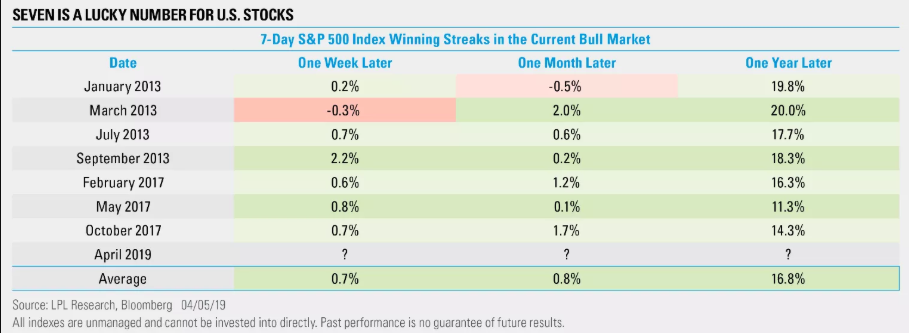
https://lplresearch.com/2019/04/08/lucky-number-seven/#more-12513 Continue reading
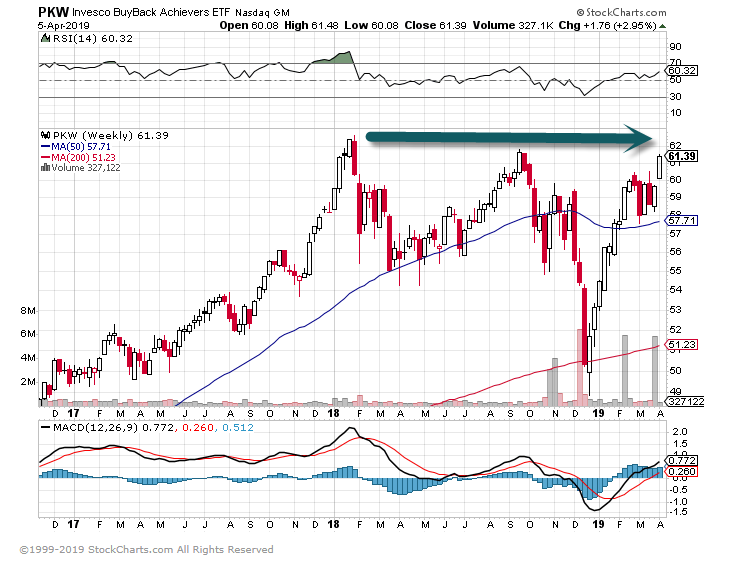
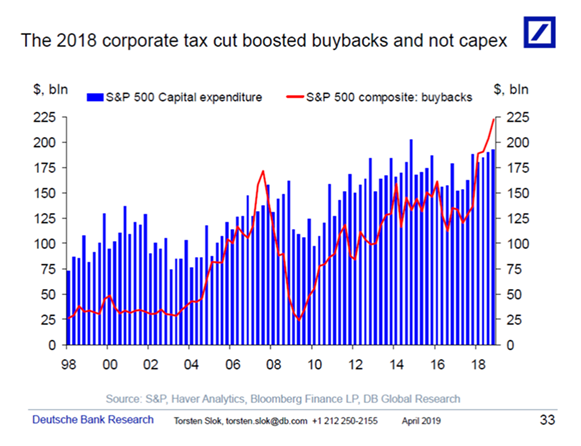
Torsten Sløk, Ph.D.
Chief Economist
Managing Director
Deutsche Bank Securities
by Jill Mislinski, 4/4/19
In response to a standing request, here is an updated comparison of four major secular bear markets. The numbers are through the Friday, March 29 close.
This chart series features an overlay of the Four Bad Bears in U.S. history since the equity market peak in 1929. They are:
The series includes four versions of the overlay: nominal, real (inflation-adjusted), total return with dividends reinvested and real total return. The starting point is the aligned peaks prior to the four epic declines. We’ve used an interval of 252 days for the x-axis as it is roughly the number of market days in a calendar year.
The first chart shows the price, excluding dividends for these four historic declines and their aftermath. As of the year-end close, we are now 2,887 market days from the 2007 peak in the S&P 500.
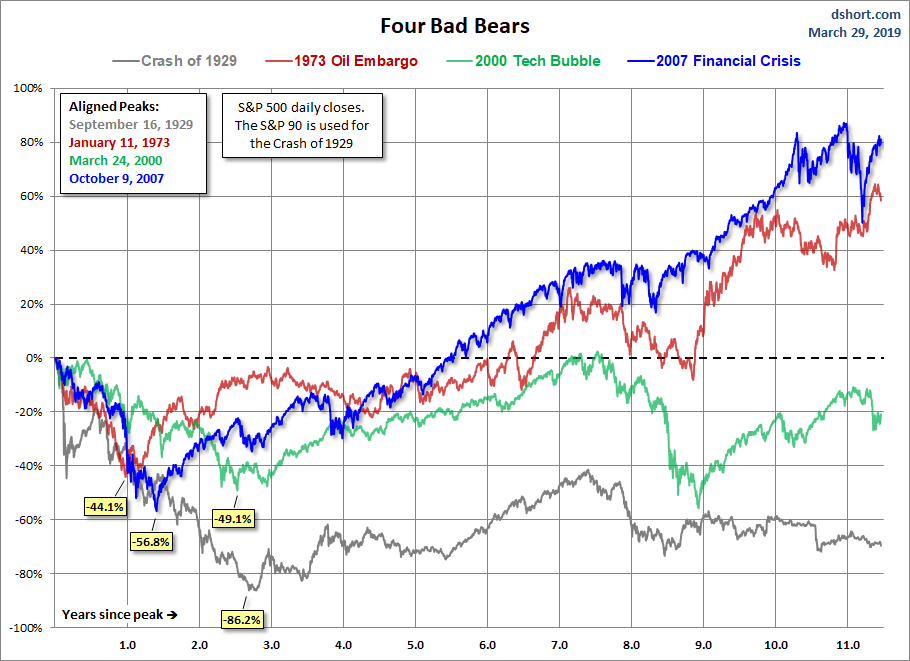
A risk tho – The “Pain Trade” is the VIX breaking north – The positioning in short VIX has turned super short again and even shorter than prior to both the February and October-December sell-offs From Dave Lutz at Jones
Holger Zschaepitz @Schuldensuehner Mar 30
Mad world. While Stocks have gained $9tn in mkt cap, global bonds have gained a whopping $1.8tn in value in Q1 2019 as cheap money from the central banks have inflated all assets. Part of this crazy world is that bonds in a volume of $11tn have negative yields.
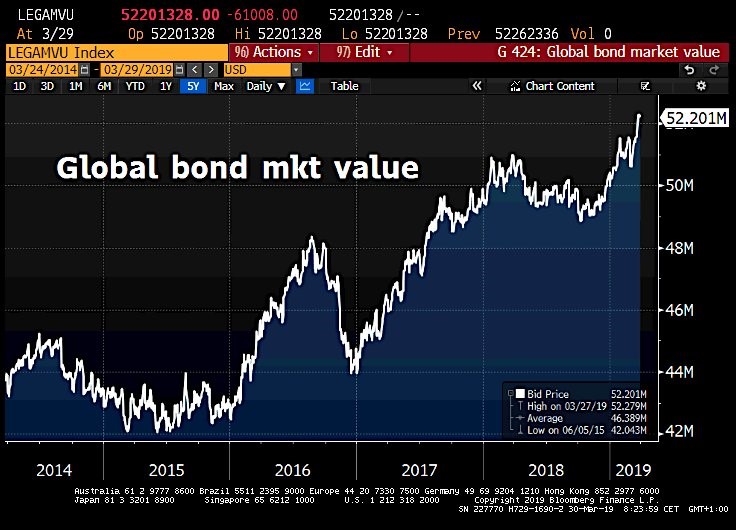
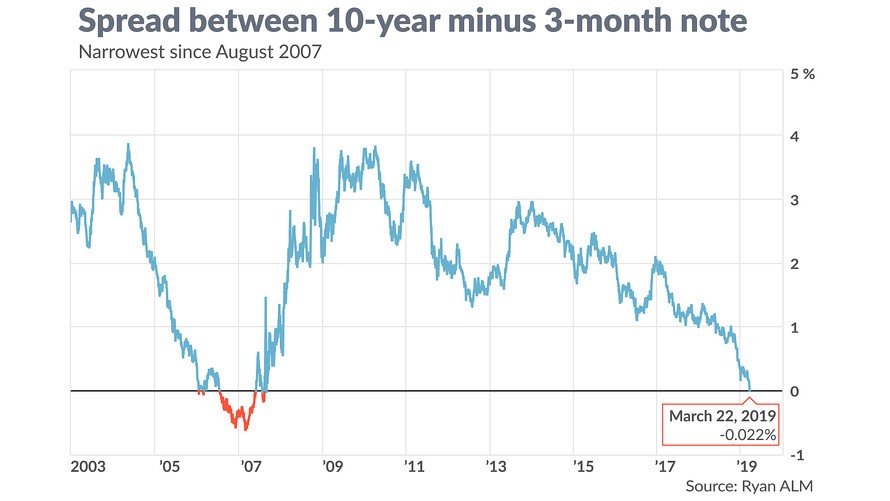
A closely watched measure of the yield curve briefly inverted Friday — with the yield on the 10-year Treasury note falling below the yield on the 3-month T-bill — and rattled the stock market by underlining investor worries over a potential recession.
But while that particular measure is indeed a reliable recession indicator, investors may be pushing the panic button prematurely. Here’s a look at what happened and what it might mean for financial markets.
What’s the yield curve?
The yield curve is a line plotting out yields across maturities. Typically, it slopes upward, with investors demanding more compensation to hold a note or bond for a longer period given the risk of inflation and other uncertainties. An inverted curve can be a source of concern for a variety of reasons: short-term rates could be running high because overly tight monetary policy is slowing the economy, or it could be that investor worries about future economic growth are stoking demand for safe, long-term Treasurys, pushing down long-term rates, note economists at the San Francisco Fed, who have led research into the relationship between the curve and the economy.
They noted in an August research paper that, historically, the causation “may have well gone both ways” and that “great caution is therefore warranted in interpreting the predictive evidence.”
What just happened?
The yield curve has been flattening for some time. On Friday, a global bond rally in the wake of weak eurozone economic data pulled down yields. The 10-year Treasury note yield TMUBMUSD10Y, +0.00% fell as low as 2.42% and remains off nearly 9 basis points at 2.45%, falling below the three-month T-bill yield at 2.455%.
Why does it matter?
The 3-month/10-year version that is the most reliable signal of future recession, according to researchers at the San Francisco Fed. Inversions of that spread have preceded each of the past seven recessions, including the 2007-2009 contraction, according to the Cleveland Fed. They say it’s offered only two false positives — an inversion in late 1966 and a “very flat” curve in late 1998.
Is recession imminent?
A recession isn’t a certainty. Some economists have argued that the aftermath of quantitative easing measures that saw global central banks snap up government bonds may have robbed inversions of their reliability as a predictor. Since so many Treasurys are held by central banks, the yield can no longer be seen as market-driven, economist Ryan Sweet of Moody’s Analytics, recently told MarketWatch’s Rex Nutting.
Meanwhile, recessions in the past have typically came around a year after an inversion occurred. Data from Bianco Research shows that the 3-month/10-year curve has inverted for 10 straight days six or more times in the last 50 years, with a recession following, on average, 311 days later
Per @biancoresearch the 10-year/3-month curve has inverted for 10 consecutive days or more 6 times in the last 50 years. On each of those occasions a recession has followed (on average 311 days later).
Bianco Research@biancoresearch
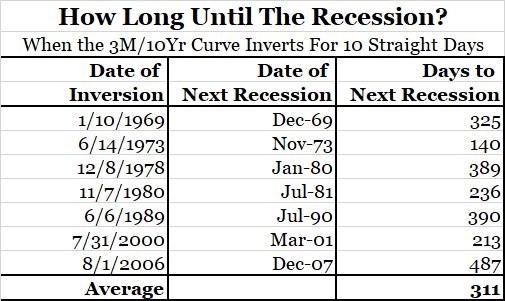
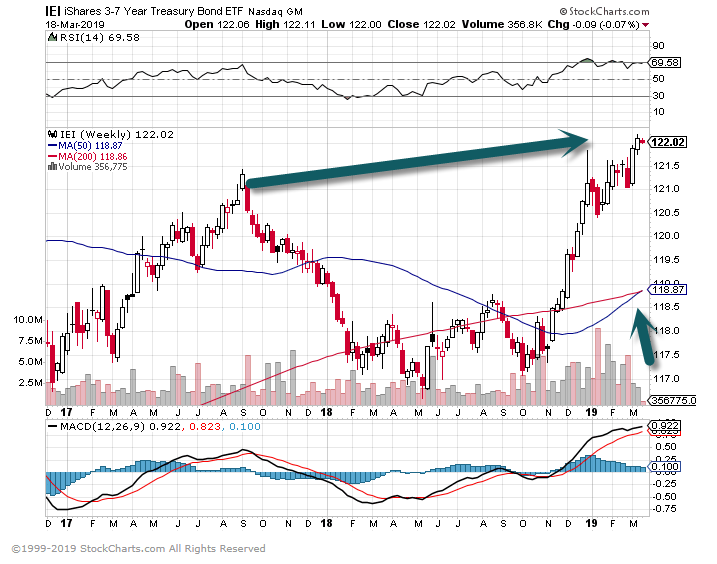
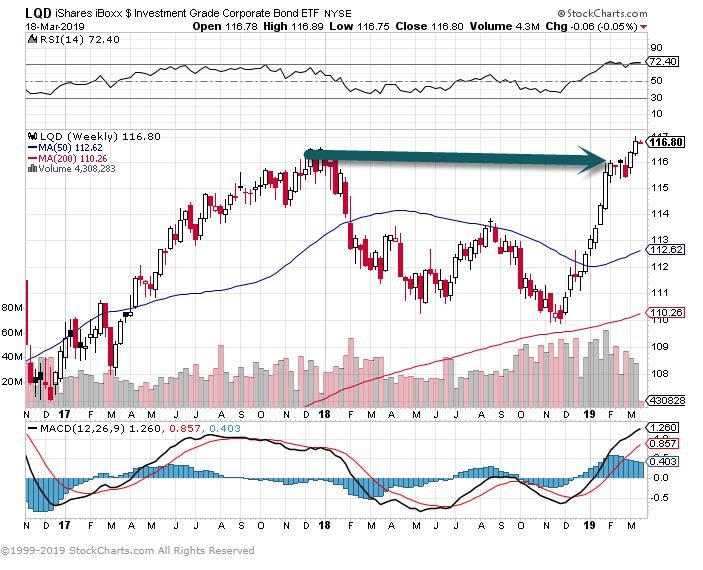
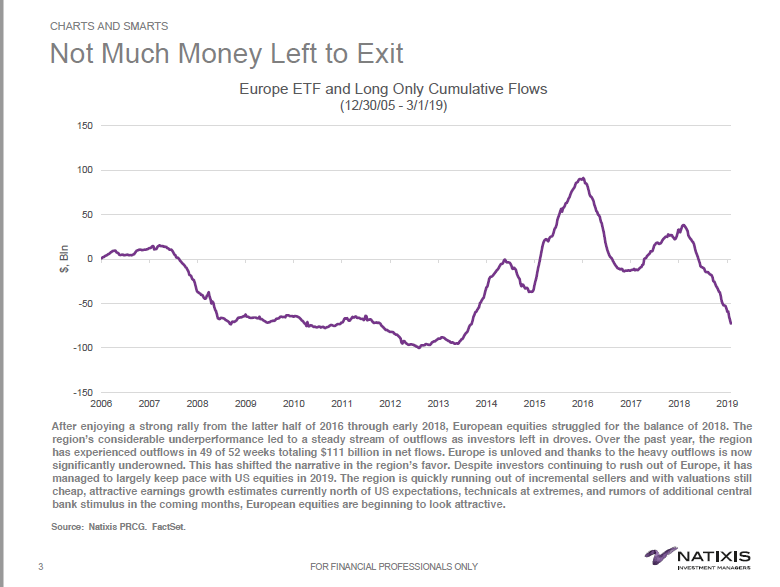
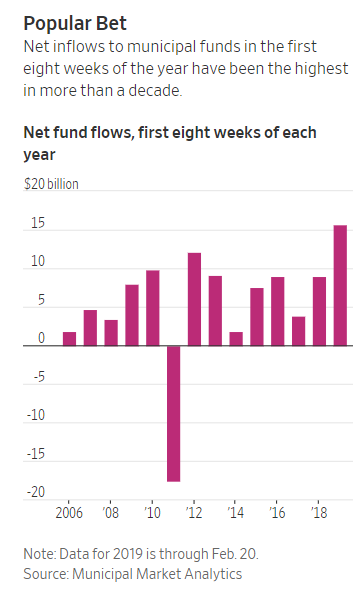
Muni Bonds Enjoy Historic Run Despite Tax Overhaul
Investors this year have poured the most money into municipal bond funds in at least 13 years
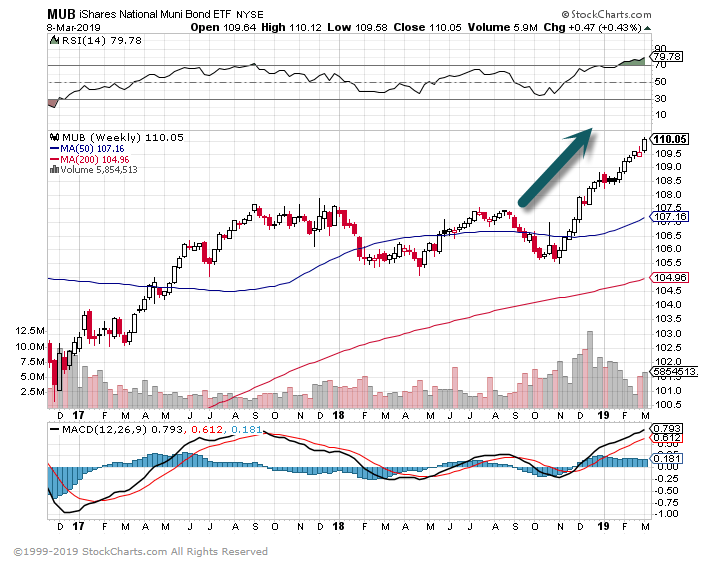
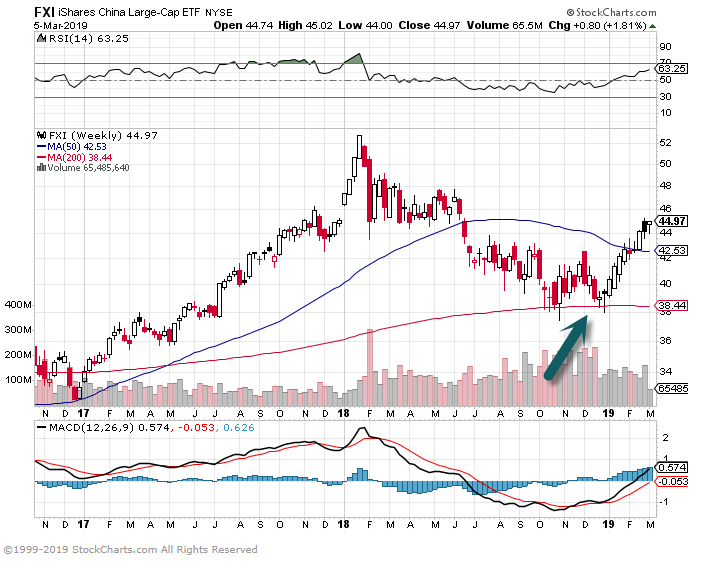
Kyle Bass says trade deal with China must address IP theft: ‘They’re stealing our game from us’
“The U.S.’ No. 1 asset, in my view, is our ingenuity, our intellectual property, our ability to innovate,” Bass tells CNBC’s Brian Sullivan.
Hayman Capital Management founder Kyle Bass thinks any trade deal with China must include enforcement mechanisms against intellectual property theft for the U.S. to truly benefit from it.
“Over the last decade, they’ve stolen $2-to-$3 trillion in IP from us. The U.S.’ No. 1 asset, in my view, is our ingenuity, our intellectual property, our ability to innovate,” Bass told CNBC’s Brian Sullivan in a pre-taped interview that aired on “Worldwide Exchange.” “That’s our game and they’re stealing our game from us. It’s really important for this new agreement to be measurable and punishable.”
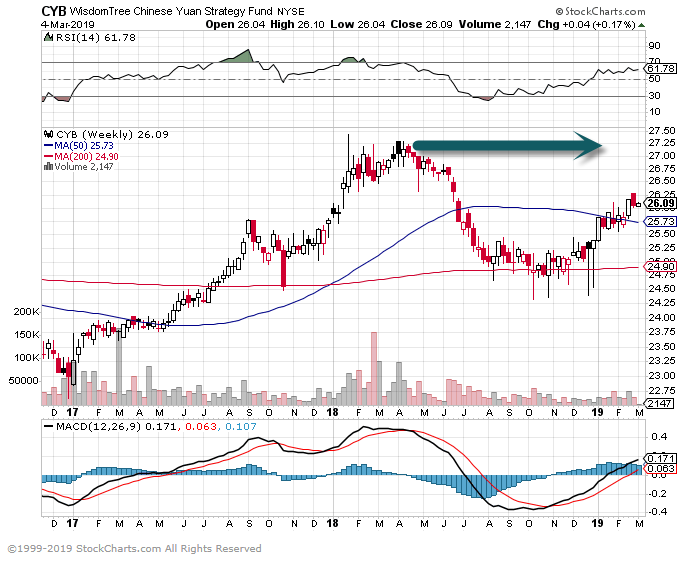
Vito J. Racanelli
A higher-than-expected December payrolls number helped push the market up 3.4% on Friday. Yet stocks had their worst first two days of the year since 2000. Where the market will be in a year has little to do with where it is now. Twelve months ago, stocks were coming off a 22% return in 2017 and feeling fine, thank you very much—until September. Then, the wheels fell off.
Ironically, there is more certainty in picturing the market’s next 10 or 20 years. That’s the time frame investors should use. They rarely examine the trailing returns of past decades, but they should. There’s one number that explains a lot of things: 5.52%. Over the 20 years ended 2018, that’s been the nominal compound annual growth rate (CAGR) of the S&P 500.
It might not feel like it after a decade-long bull market, “but we are coming off 20 of the worst years for compounded returns since the Great Depression,” says Nicholas Colas, co-founder of DataTrek Research. The average trailing 20-year market CAGR since 1928 is 10.7%. Blame the two negative-35%-plus bear markets since 2000.
This low return has given birth to, among other things, the rise of passive investing and the growth of exchange-traded funds. It has forced commissions down and encouraged the use of automation to further reduce broker expenses. Institutional investors, pension funds, and sovereign-wealth funds have taken on more risk—shoveling money to venture capital and private equity—to make their required rates of return, typically 7% to 10%, Colas says.
It is hard to imagine our most recent big winners, theAmazon.com s (ticker: AMZN), Alphabet s (GOOGL), andApple s (AAPL) of the world doubling their market capitalizations in the next 10 years (a 7% CAGR). To start seeing better long-run returns, the market needs lots of new blood, he says, a fresh crop of disruptive tech companies, to come public. The good news is that some, like Uber Technologies and Lyft—and potentially Airbnb and others—are preparing to do so.
The best thing about sitting at the low end of a historical range is that mean reversion should start to kick in, Colas says, and the next 10 to 20 years from here will likely be pretty good. Happy now? As for 2019, tell me if there will be a recession, and I’ll tell you where the market is going
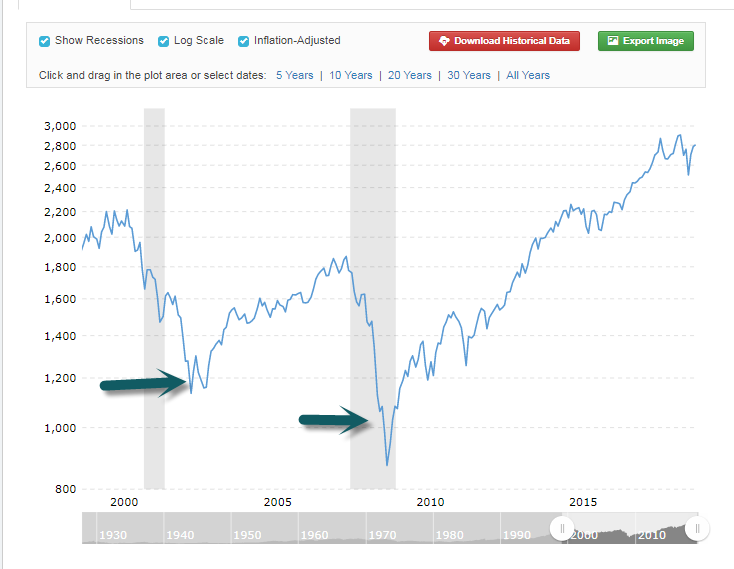
https://www.macrotrends.net/2324/sp-500-historical-chart-data
The idea is that an earnings recession would lead to a conventional economic downturn, with rising unemployment, falling consumption and even broader downward pressure on profits — but that’s not actually true, Belski said in an interview.
Indeed, an earnings recession has happened six times since 1987 — but a real recession has followed only twice, Belski said. That alone should mitigate any fears that an earnings slowdown would come back to bite the market, he said.
Furthermore, when earnings downturns happen and economic recessions don’t follow, the S&P has risen an average of 17.6% over the next year, he said, citing the five times this has happened since 1967
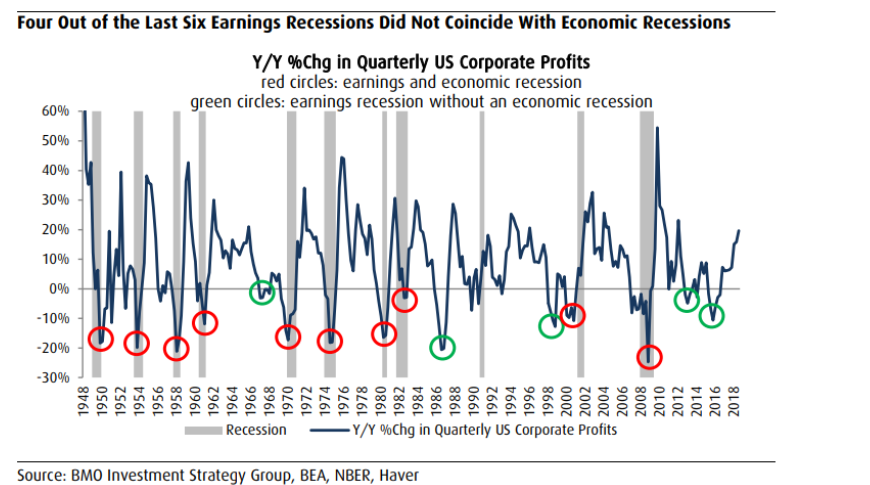
Opinion: What ever happened to that earnings recession?By Tim Mullaney
https://www.marketwatch.com/story/what-ever-happened-to-that-earnings-recession-2019-02-27
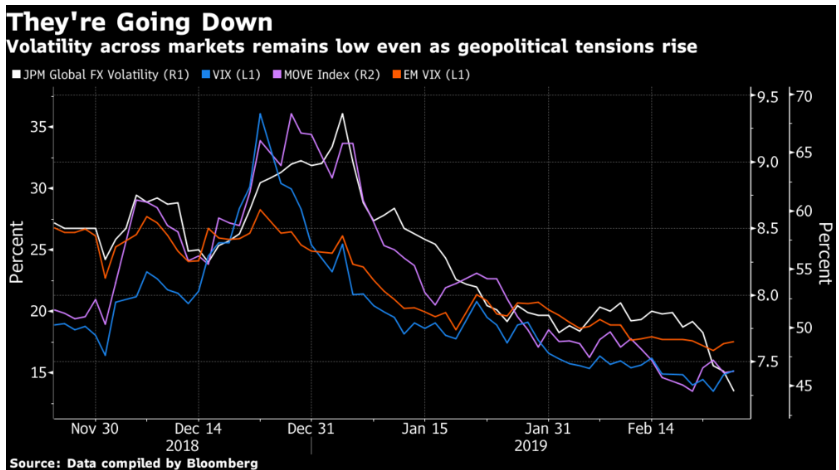
Five Things You Need to Know to Start Your Day Get caught up on what’s moving markets. By Lorcan Roche Kellyhttps://www.bloomberg.com/news/articles/2019-02-27/five-things-you-need-to-know-to-start-your-day-jsn4mcso?srnd=premium
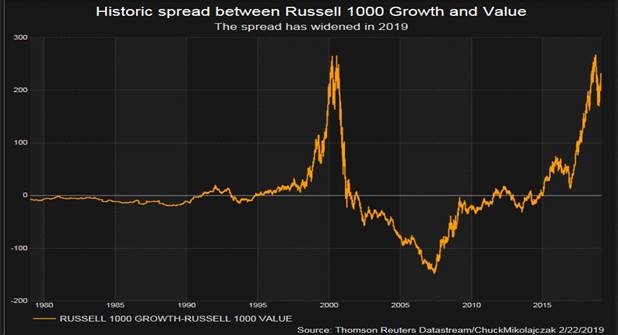
The spread between the Russell 1000 growth and value indexes is again nearing levels hit during the end of the dot-com era
| Margin Call — Margin Debt Accelerometer: Here’s an interesting chart, basically a bear market warning indicator; the year over year change in US margin debt [note it used to be called NYSE margin debt, but now FINRA publishes a broader set of data]. The basic concept is that when margin debt is contracting on an annual basis it can serve as a bear market warning signal (margin calls and lower risk appetite). Only thing I would add is that in the 2000 & 2008 experiences there was a substantial acceleration in margin debt growth before the contraction signal was triggered, so one might argue the lack of that acceleration weakens the signal this time around… |
Feb 21, 2019
If you were sent back in time to 2004 and had the choice to buy Domino’s Pizza (DPZ) or Alphabet (GOOGL) at their IPO, which would have been the better choice? Due to the epic size and influence of its business, impulse would probably have you choose Alphabet. But DPZ has actually seen significantly better returns than GOOGL since the companies’ IPO dates. Since inception, DPZ has seen a total return of 3,604% even after today’s 9.03% decline in the stock in reaction to an earnings miss this morning. Not that GOOGL’s 2,490% return is something to turn your nose at, but it is dwarfed by DPZ’s returns. For the stocks’ first decade, up until 2014, this was not the case though. GOOGL had actually outperformed DPZ for much of their lifespans as public companies. From then up until early 2016, the two stocks alternated between being the leader, but in the last two years, Domino’s ran away with things. Part of the reason for this is DPZ has fairly consistently paid a dividend since 2004 which is why returns for the stock have been considerably better over the long term.
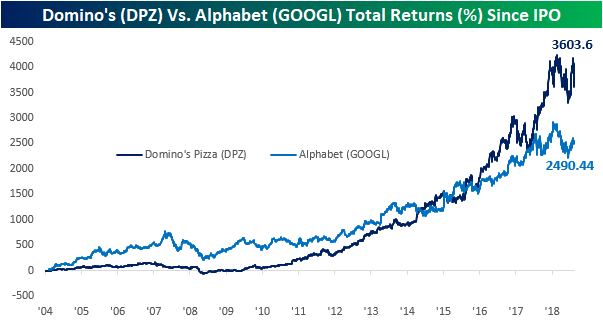
Torston SLok
In December foreigners sold a record $91bn in US stocks and bonds, see chart below. Roughly 85% of this amount, or $77bn, was the rest of the world selling US Treasuries. Despite this significant upward pressure on US rates during the stock market rout in December 10-year rates still went from 3.20% in November to 2.60% in early January. This reveals how strong the domestic bid is from pension funds and banks for US Treasuries at the moment, see also the second chart below. For more on the rates outlook see also our latest Fixed Income Weekly here.
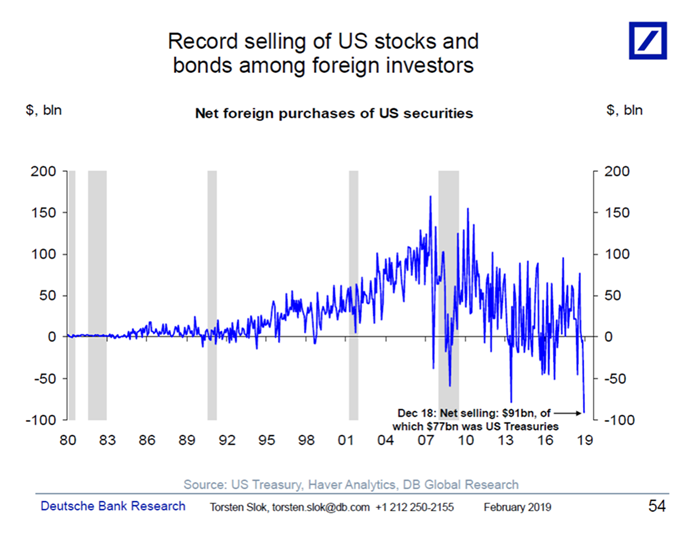
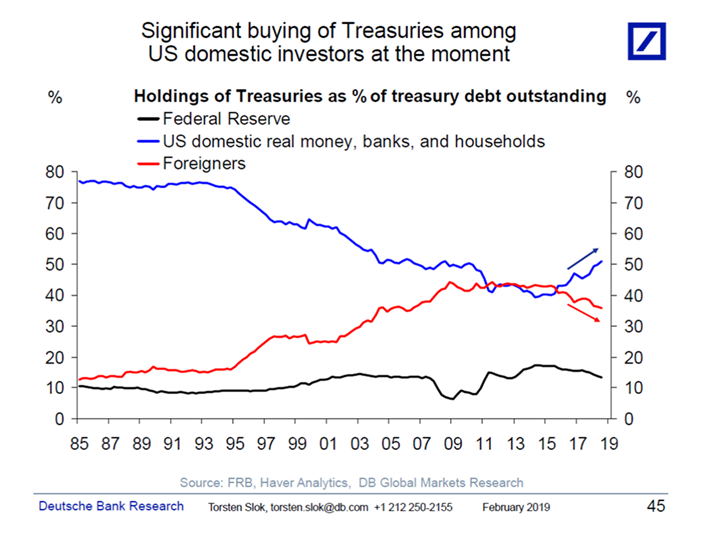
“The dollar’s not weakening, and the reason for that is that the Fed is just the beginning, in the sense that all other central banks are most likely going to become dovish,” said Momtchil Pojarliev, head of the currencies group.
The greenback climbed 0.5 percent Monday to recoup its year-to-date losses, and is enjoying its longest winning streak since January 2016. The currency’s surprising strength has upended forecasts across Wall Street, with firms such as Morgan Stanley and Nomura having called for dollar losses. It’s also put a chill on U.S. corporate earnings.
While the Fed’s about-face would typically vindicate those calls, the darkening outlook for the dollar’s peers should support it in the days ahead, according to Kit Juckes, a Societe Generale SA global fixed-income strategist. The euro is a case in point: A lurch lower in German yields and sputtering European growth saw the common currency touch its lowest level since November on Monday.
“The problem for dollar bears is that there is a chronic shortage of currencies to like,” Juckes said. “Lower bund yields, not to mention weak growth, political uncertainty and Brexit, make a good set of reasons to hate the euro as much as you hate the dollar.”
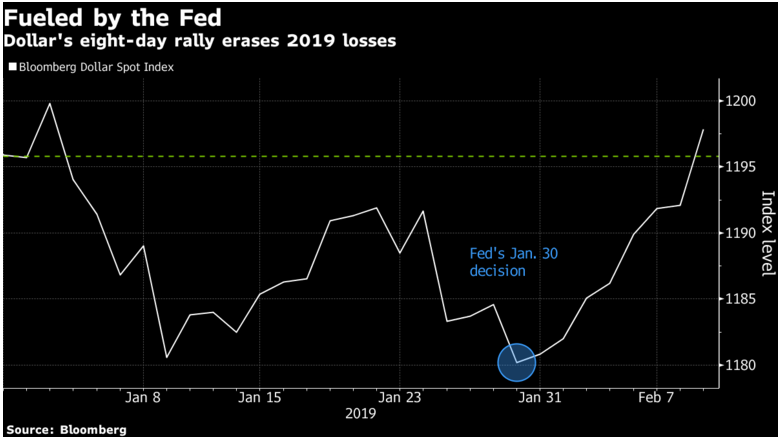
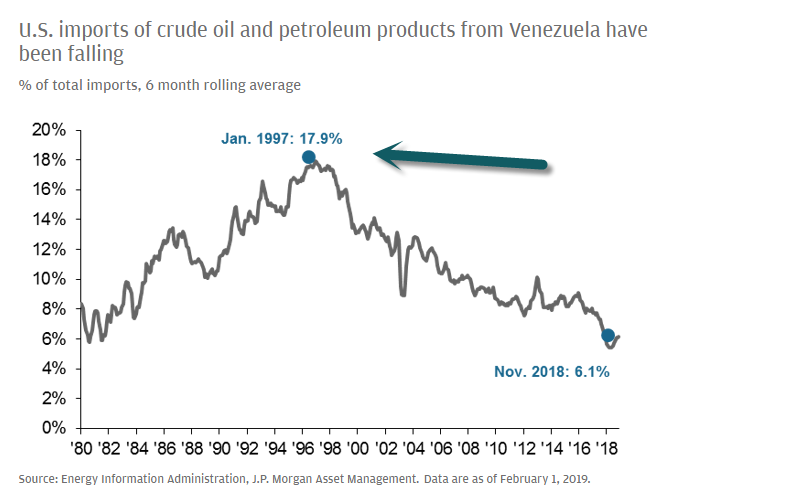
https://am.jpmorgan.com/us/en/asset-management/gim/adv/insights/investor-questions
Continue reading
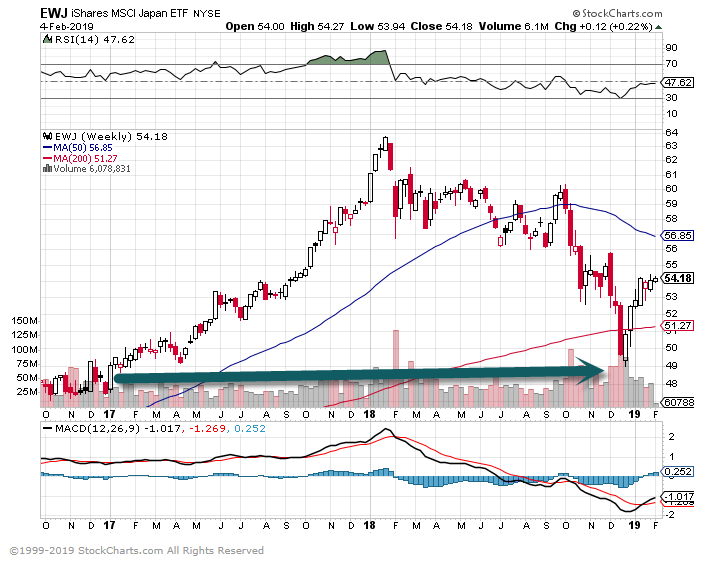

From Dave Lutz at Jones Trading.
After a record $53.4 billion in deals during 2018, M&A activity in 2019 has already broken that record, fueled by the $78 billion Bristol-Myers Squibb/Celgene deal and the $7.2B Eli Lilly/Loxo Oncology deal that are now likely to ignite further buyout speculation across the industry1

LINGLINGWEI
BEIJING– China’s economic expansion languished to its slowest pace in nearly three decades last year, as a bruising trade fight with the U.S. exacerbated weakness in the world’s second-largest economy.
The 6.6% growth rate for 2018 reported Monday is the slowest annual pace that China has recorded since 1990. The economic downturn, which has been sharper than Beijing expected, deepened in the final months of 2018, with fourth quarter growth rising 6.4% from a year earlier.
Adding to the gloom was the trade conflict with Washington. The uncertain outlook for Chinese exporters caused companies to delay investing and hiring and in some cases even to resort to layoffs–a practice that is often discouraged by China’s stability-obsessed Communist Party rulers. The official jobless rate ticked up to 4.9% last month from 4.8% in November.
In the southern technology and export-manufacturing center of Shenzhen, for instance, many private makers of electronics, textiles and auto parts furloughed workers more than two months before the Lunar New Year holiday, which begins in February, according to business owners and local officials. The neighboring city of Guangzhou saw growth slump to 6.5% last year–well short of the 7.5% annual target set by the city government–as trade tensions hit the city’s manufacturing sector hard.
Some economists and investors have said China’s economy is far more anemic than the government’s 6.6% rate of expansion for 2018. They note the government’s move on Friday, just ahead of Monday’s data release, to cut the 2017 growth rate to
“The economy faces downward pressure,” said Ning Jizhe, head of the National Bureau of Statics, at a news conference Monday. In particular, Mr. Ning pointed to “complicated and severe external environment.”
Write to Lingling Wei at lingling.wei@wsj.com
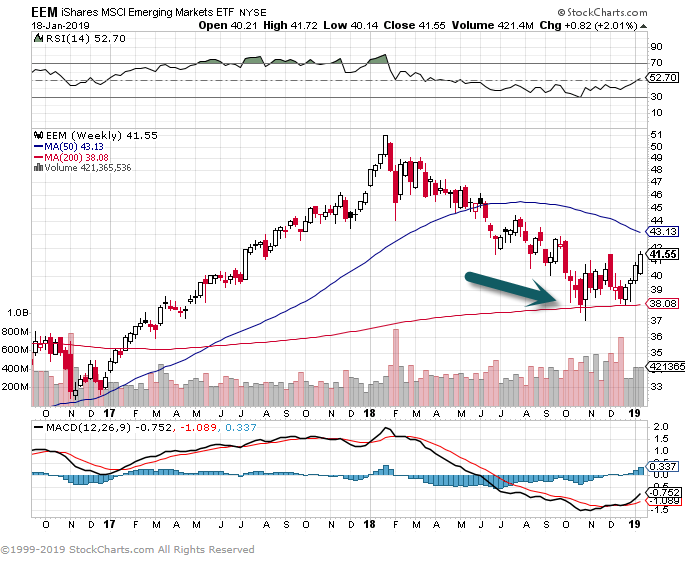
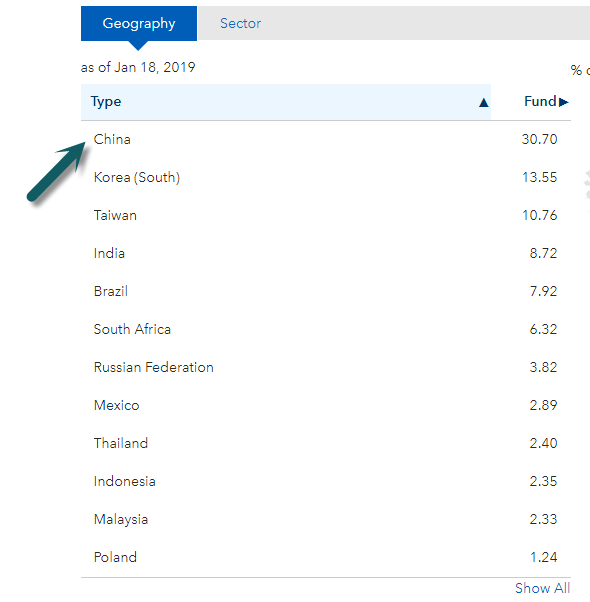
https://www.ishares.com/us/products/239637/ishares-msci-emerging-markets-etf