
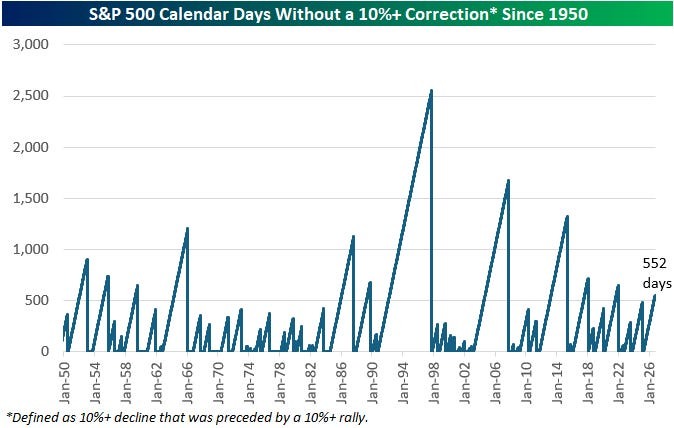
1. Calendar Days Without -10% Correction in S&P…QQQ has Two -10% Corrections 2026
Bespoke Investment Group-As shown below, the current 552-day streak without a correction is the sixth-longest since 1990, and it’s more than twice as long as the average gap of 246 days between corrections going back to 1928. If you think the last 552 days have been calm, however, remember that we went nearly seven years without one from late 1990 to late 1997!
2. Investors Max Overweight Tech
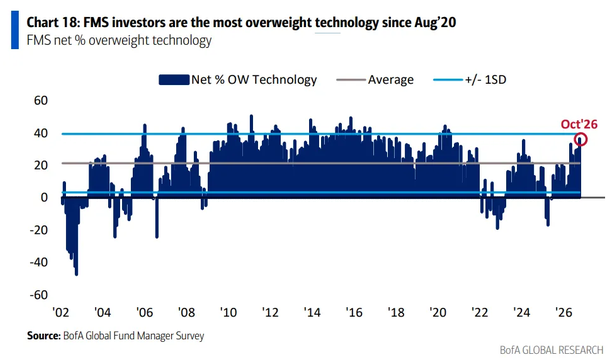
Dave Lutz Jones Trading Global investors chasing the AI-powered equity rally are the most exposed to technology stocks since the rebound from the Covid pandemic six years ago, according to Bank of America. Respondents in the October BofA survey said global semiconductor stocks were the market’s most crowded trade.
3. Free Cash Flow from AI Players
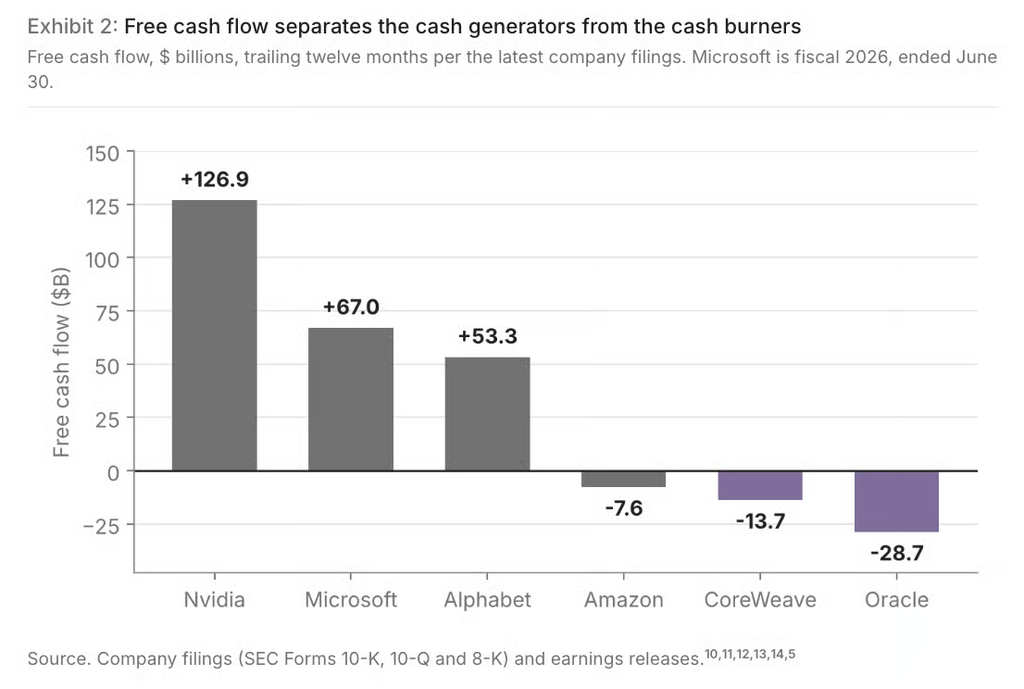
Free cash flow is where the AI buildout shows up first, and at Amazon, Alphabet and Microsoft it is still falling.
Phil Rosen
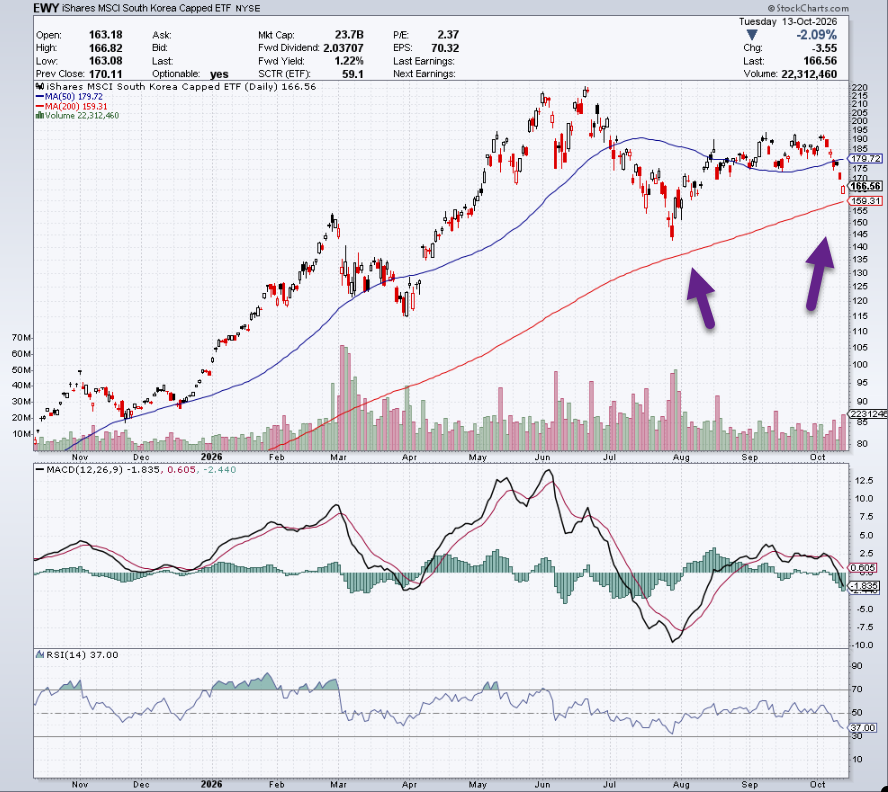
4. South Korea EWY Second Pullback to 200 Day in 3 Months
Stockcharts
5. Just 10 Stocks Have Driven 70% of the S&P 500 Gains Since March 30th
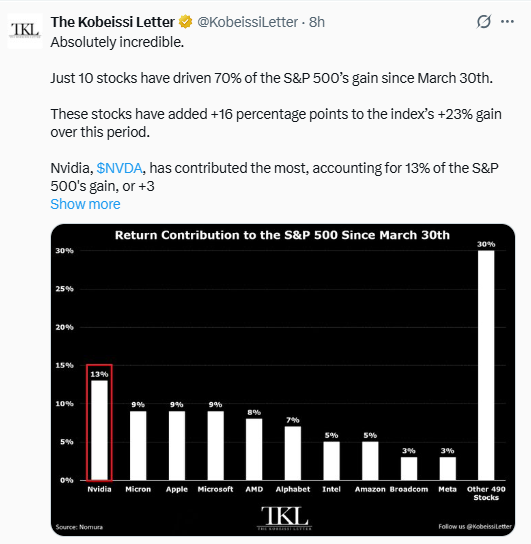
The Kobeissi Letter
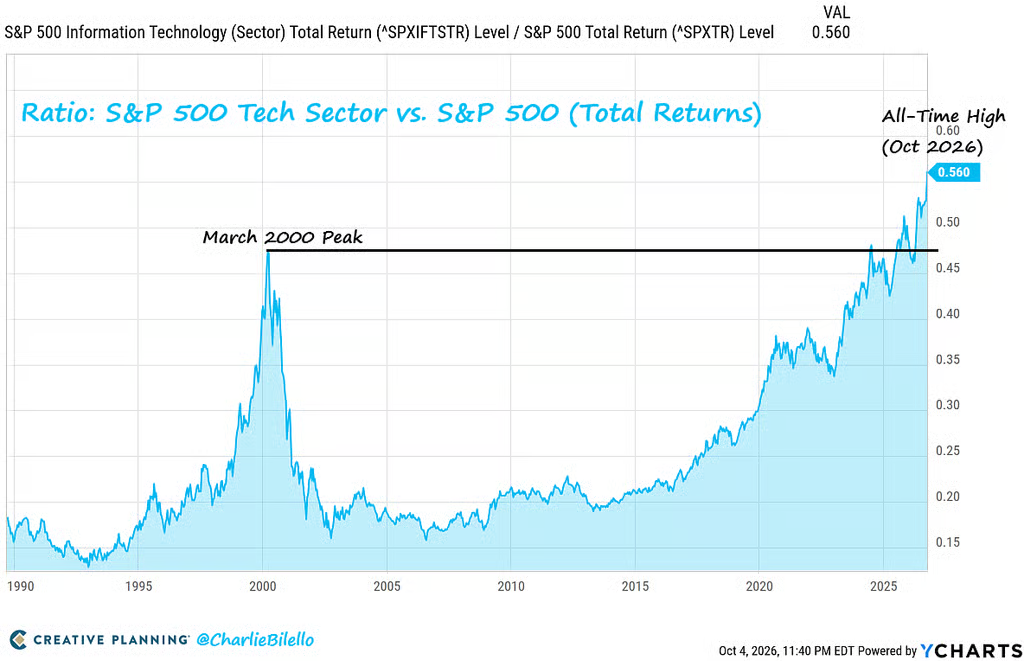
6. Tech vs. S&P Relative Strength at Record High
The relative strength of the technology sector hit another all-time high this month. @Charlie Bilello
7. Split Congress is Bullish
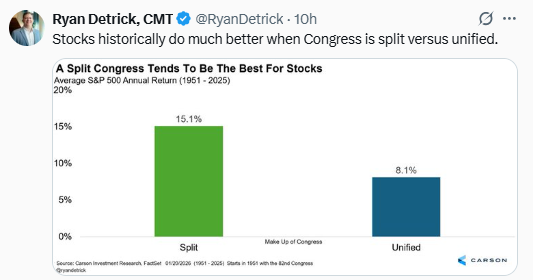
Ryan Detrick
8. Brazil Stocks vs. S&P
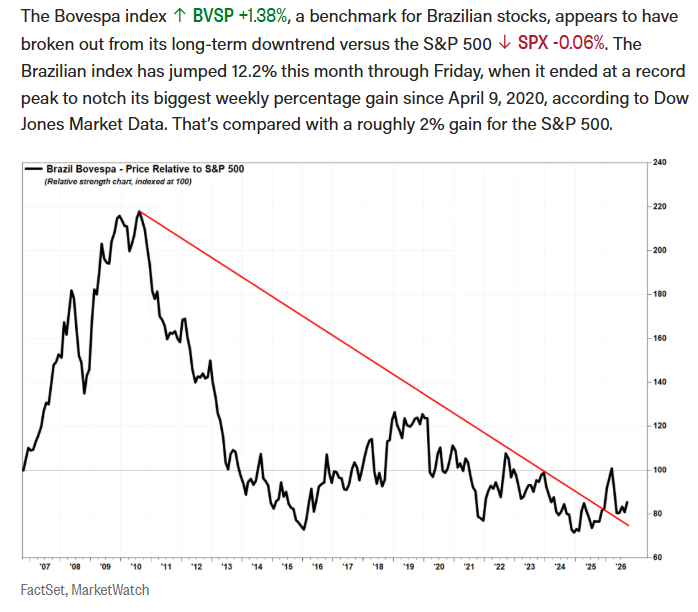
Marketwatch
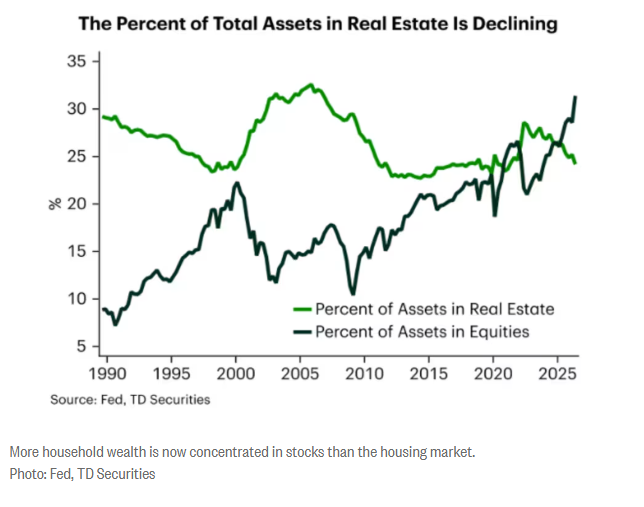
9. American Stock Holdings are Larger than Real Estate Holdings
Marketwatch-Stocks now account for more than a 30% share of total U.S. household assets, versus real estate at closer to 25%, according to the below chart from TD Securities. That wasn’t always the case. Back in the mid-2000s, real estate was a much larger share of total household wealth at more than 30%, while stocks were around 15%.By Joy Wiltermuth
Marketwatch
10. The Secret to Maintaining Happiness as You Age
Preserving contentment through perceived control.-Psychology Today
Wendy L. Patrick, J.D.
Key points
- The perception of control counteracts the negative effects of age-related changes.
- Interventions to improve developmental adaptation over time improve perceptions of aging.
- Perceiving loss can decrease happiness by undermining one’s concept of self.
“Young people don’t realize how good they have it,” we remark as adults. Young life flourishes with defining moments, age-related milestones, and motivation for the future. Mid-life experiences, in contrast, range from perceived crises to the wisdom of maturity, often both. Yet aging does not need to be a negative experience, particularly for people who are able to maintain a sense of peace and happiness throughout the lifespan through a perception of control. Research explains.
Age Is Just a Number: The Comfort of Control
As we age, change happens. The key to preserving peace and contentment may have less to do with the changes, whether positive or negative, and more to do with perceived control over changing circumstances.
Maria Wirth et al. (2026) examined how perception of control impacts individual awareness of age-related change and happiness.[i] They begin by acknowledging that in late adulthood, an awareness of age-related losses and the absence of age-related gains is associated with decreased feelings of well-being, including lower amounts of happiness. Yet the perception of control is a promising method of counteracting the negative effects of perceived age-related changes. In their research, studying 268 middle-aged and older adults ranging in age from 50 to 91, they found that perceptions of age-related losses were linked with lower levels of happiness only for participants who experienced a low level of perceived control. Wirth et al. thus recognize the importance of the perception of control on maintaining happiness in the face of age-related changes, and that interventions designed to improve developmental adaptation in later years should include improved self-perceptions of aging and a stronger sense of control.
Realistic Recognition of Loss
As we age, we confront and accept changes in a variety of areas—physically, mentally, and financially, to name a few. Yet the awareness of age-related losses, whether we accept them or not, can impact personal happiness. Wirth et al. note, for example, that merely accommodating something as basic as changes in physical fitness might include limiting physical activity to avoid injury, which could lead to additional loss of existing physical capability. More broadly, avoiding or limiting pleasurable activities or behaviors can negatively impact enjoyment of life, which is a basic contributor to happiness.
Wirth et al. recognize that the perception of loss may decrease feelings of happiness by undermining one’s concept of self. Perceiving gains, on the other hand, should improve happiness and can enhance strivings for resource accumulation, improve the appreciation of social life and relationships, enhance life experiences, and spark desire to engage in pleasant activities. Conversely, a perceived absence of age-related gains can cause individual happiness to decrease.
Controlling the Narrative Cultivates Contentment
Wirth et al. recognize that maintaining or improving quality of life strongly relies on individual perception of control—the extent to which actions can bring results. Perceiving oneself as at the mercy of external factors could exacerbate the perception of age-related loss, while perceiving a high level of control could act as a motivational response that can spark active coping and adapting to age-related challenges. They note that perceiving a high level of control can even counteract negative stereotypes that are linked to perceived age-related losses.
Growing older involves gaining life experience and appreciation, acquiring wisdom and maturity in the process. Considering the fact that everyday happiness later in life is linked to daily changes in self-observations of aging and perceived control, there is cause to consider the positive aspects of aging. Credibility, experience, wisdom, patience, and other benefits of a life well-lived are personally fulfilling, are interpersonally engaging, and contribute to health, happiness, and peace.