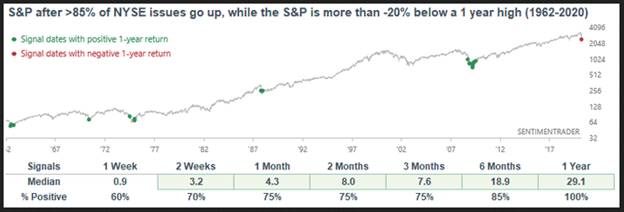
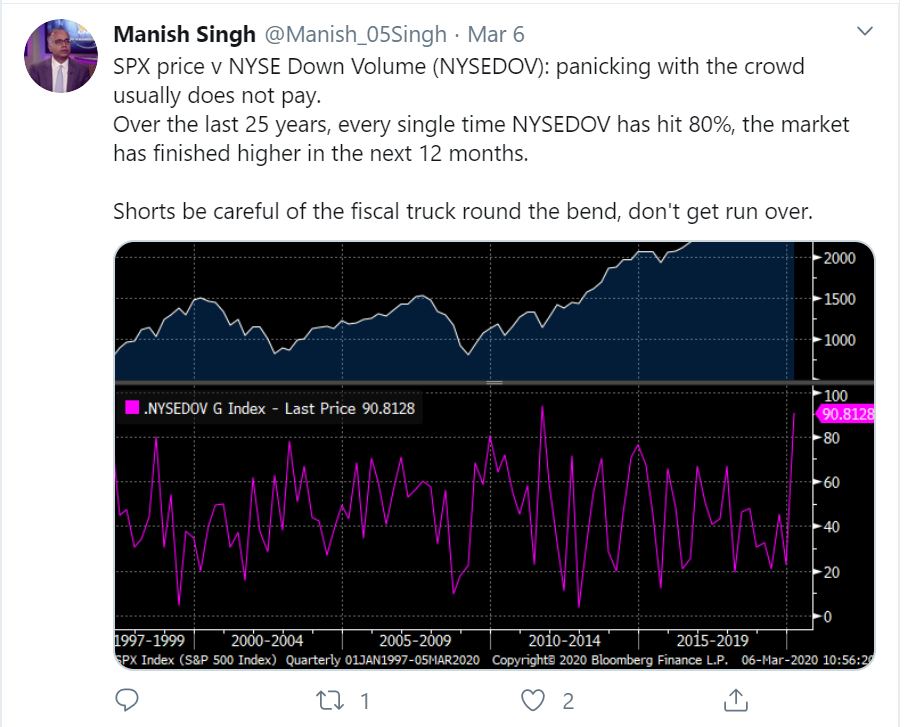
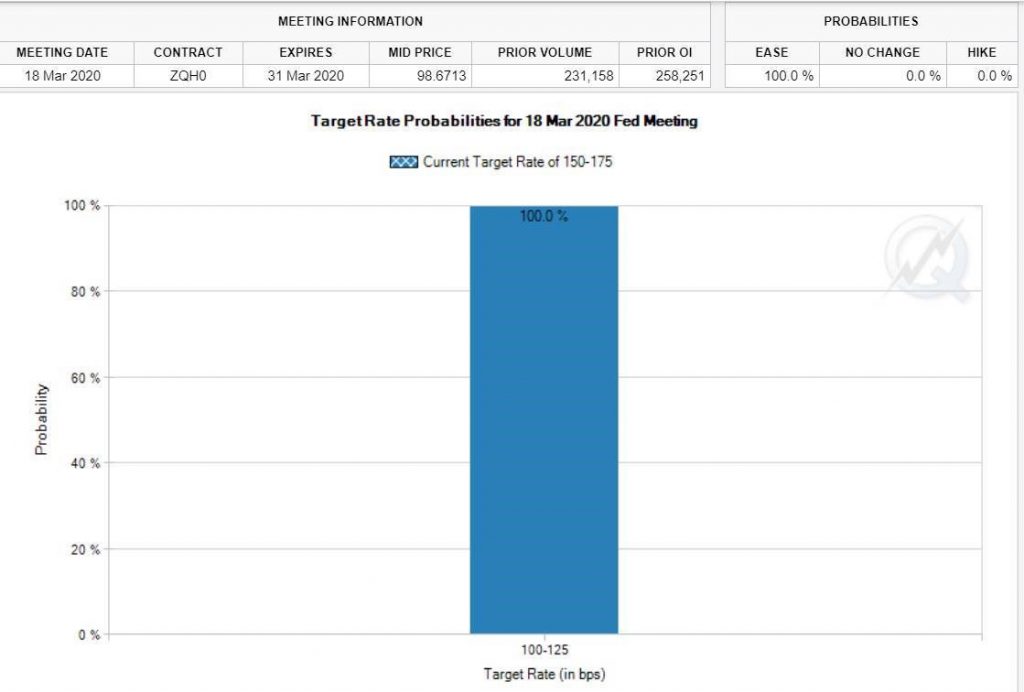
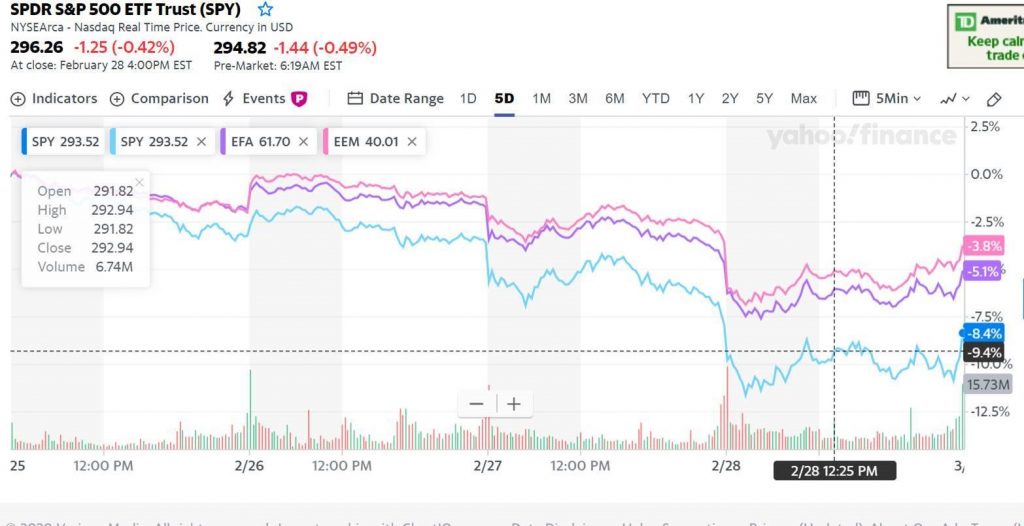
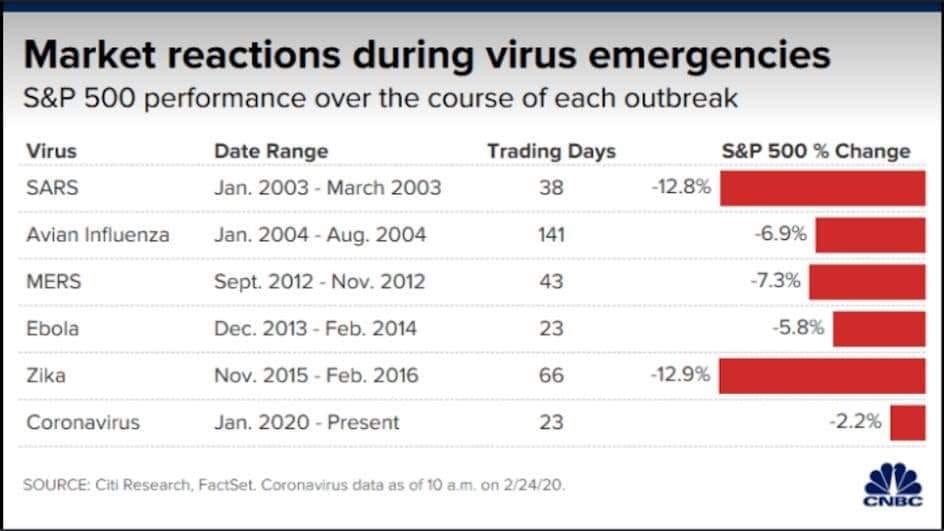
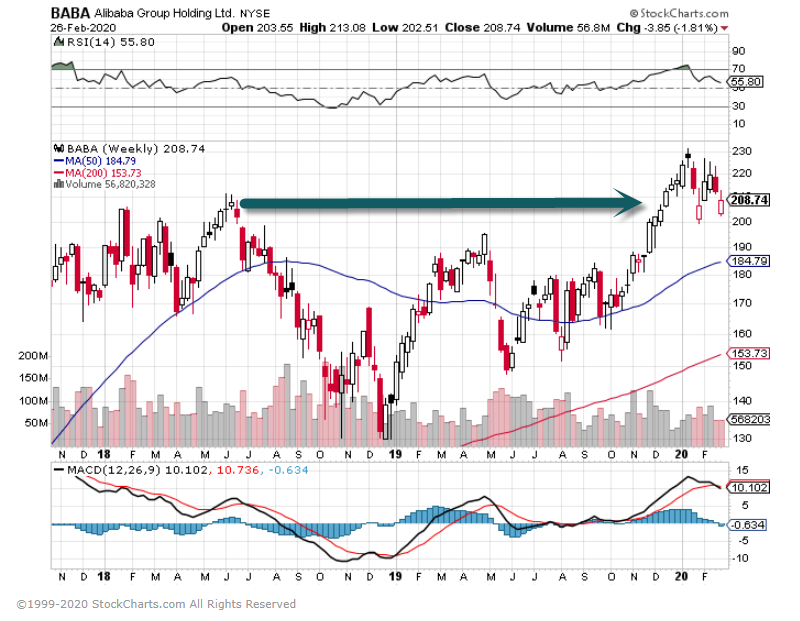
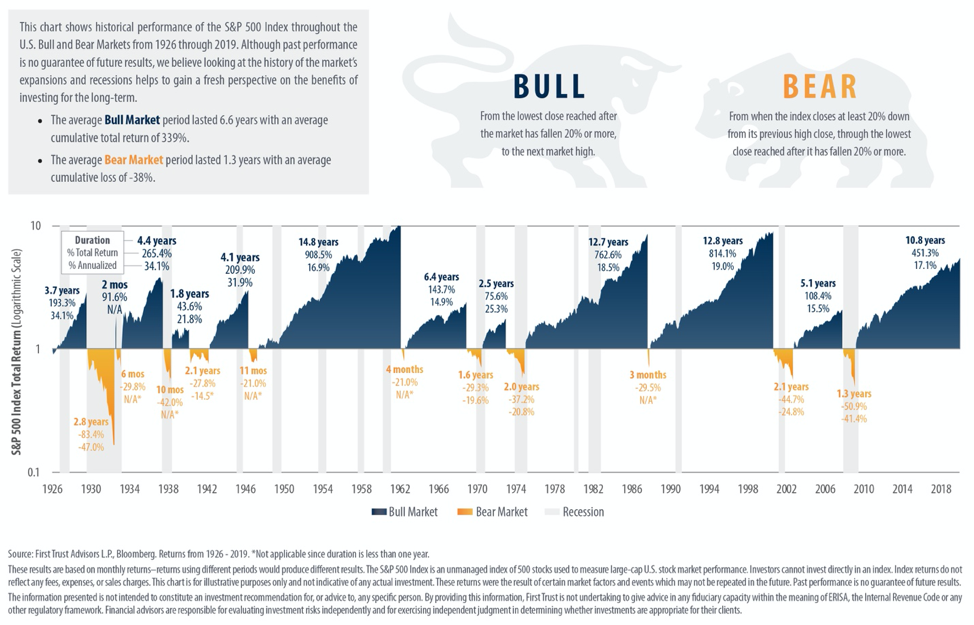
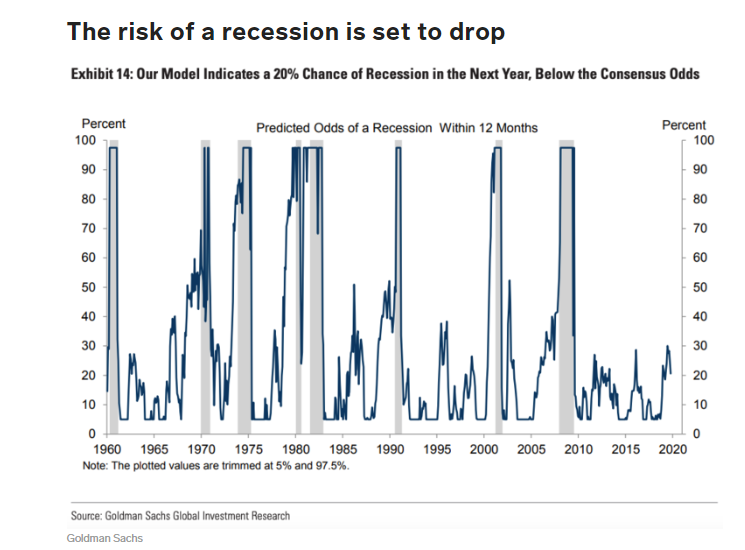
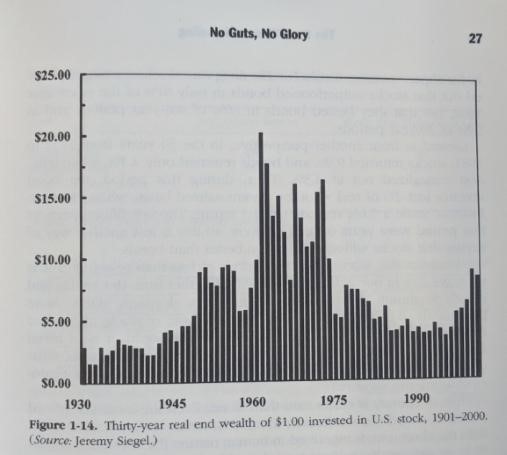
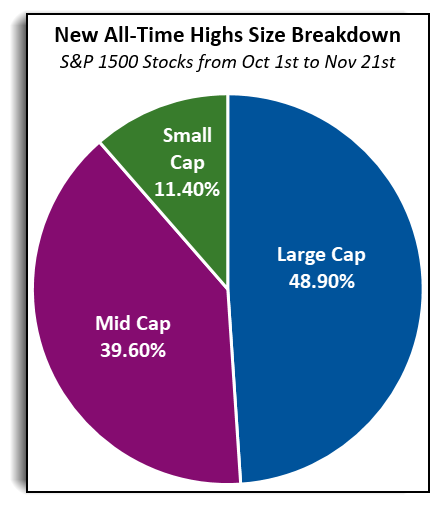
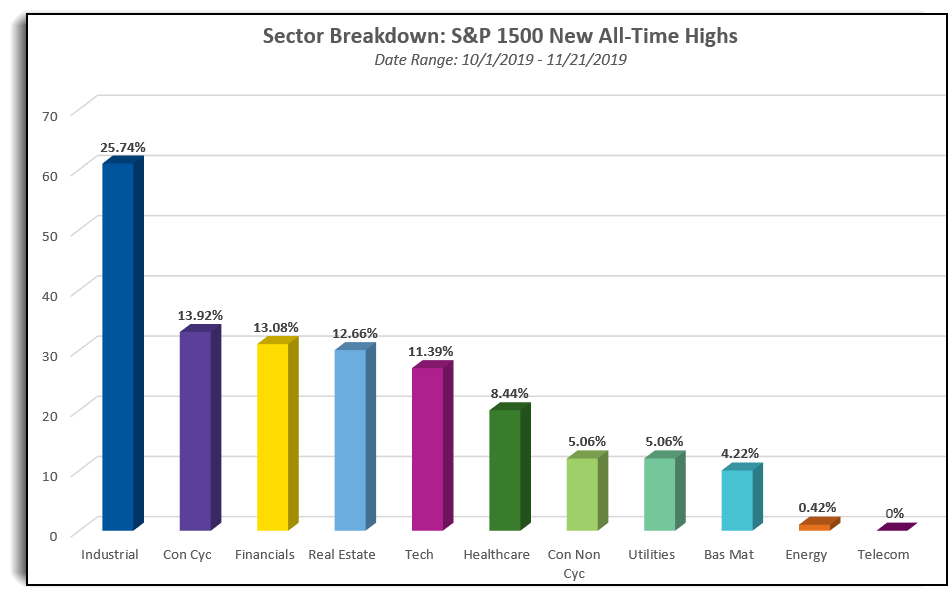
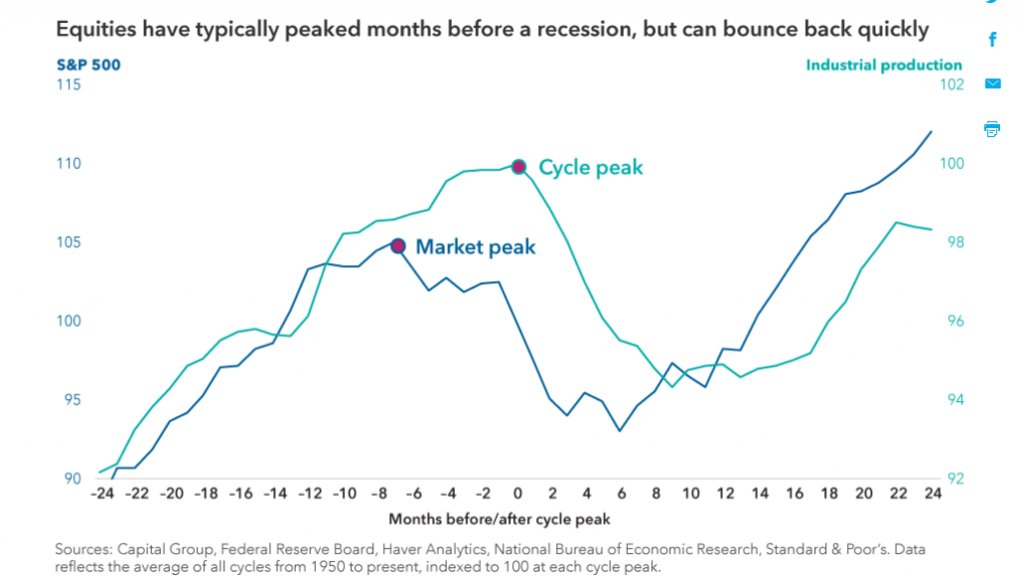
More than 90% of NYSE issues went up yesterday – When so many issues rallied while the S&P was in a bear market in the past, SPX had a VERY STRONG tendency to rally over the next few weeks and months. “Up 100% of the time over the next year by a median of +29%”
FED Backstopping Everything On the policy side the day started with a bang as the Fed continues to try and do everything in its power to provide liquidity and support from a monetary perspective. First and foremost the new round of quantitative easing is effectively unlimited as Treasury and MBS purchases are open-ended from a previously announced $700bn. They also announced facilities to provide support for corporate bonds, asset-backed securities, and variable rate demand notes. The Fed also expanded the previously announced Money Market Mutual Fund Liquidity Facility and the Commercial Paper Funding Facility to include a wider range of eligible securities. The Fed also expects to announce the Main Street Business Lending Program that will support lending to eligible small and medium-sized businesses. The actions take the Fed across the line – joining the ECB – in buying corporate bonds and the Fed can now buy Fixed Income ETFs which will hopefully be a big stabilizing force in what has been a troubling segment of the market over the last few weeks.-Goldman Sachs
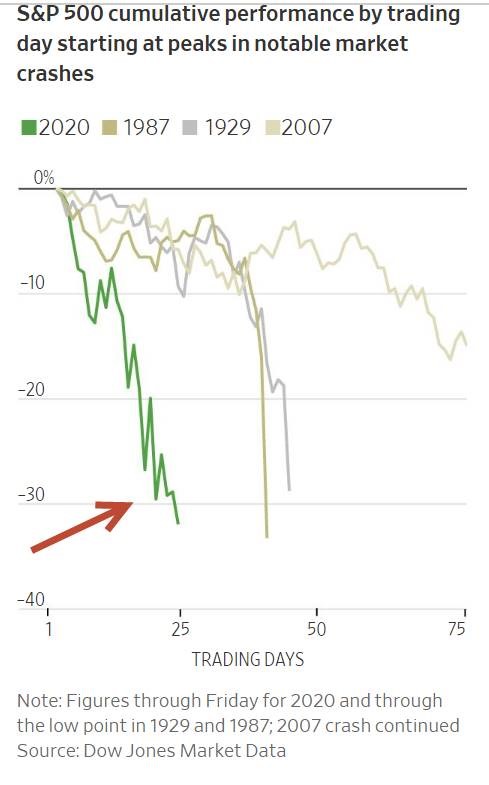
1.2020 Crash Equal to 1929 and 1987
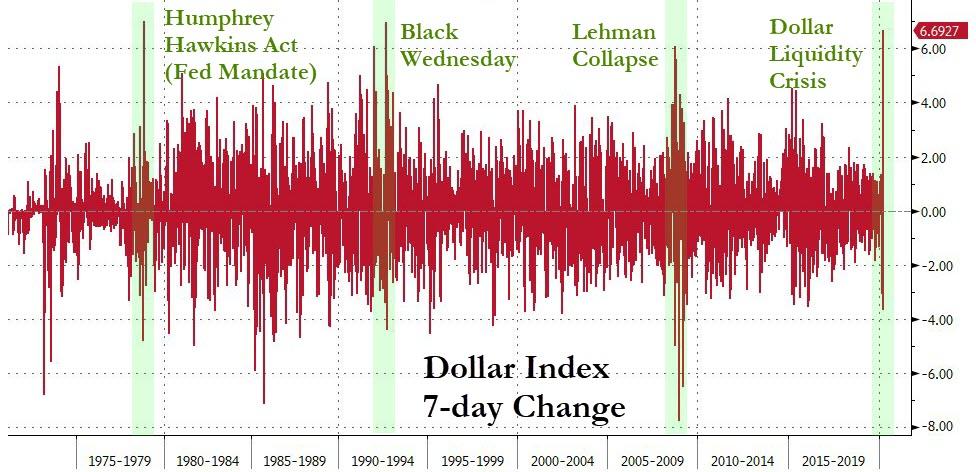
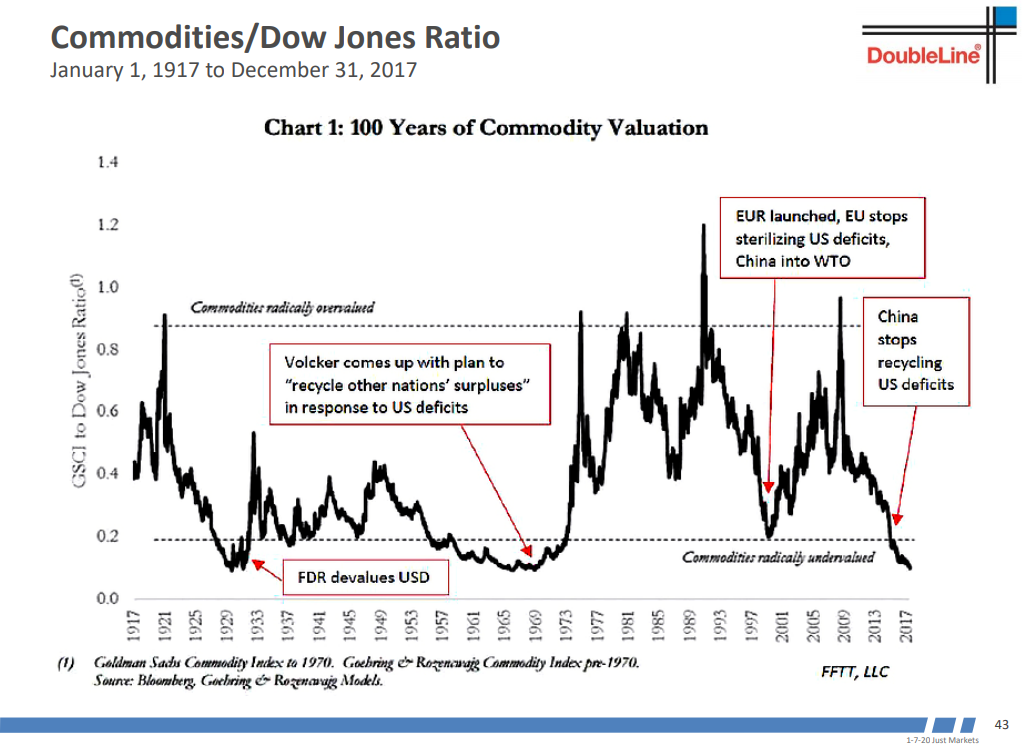
Stocks are falling faster than they did during the financial crisis, the crash of 1987 or the Great Depression. Investors are retreating from corporate bonds at the swiftest pace ever. An index of raw materials is at all-time lows. And funding shortages around the world have fueled a race for dollars, powering the U.S. currency to a nearly 18-year high.
By Amrith Ramkumar WSJ
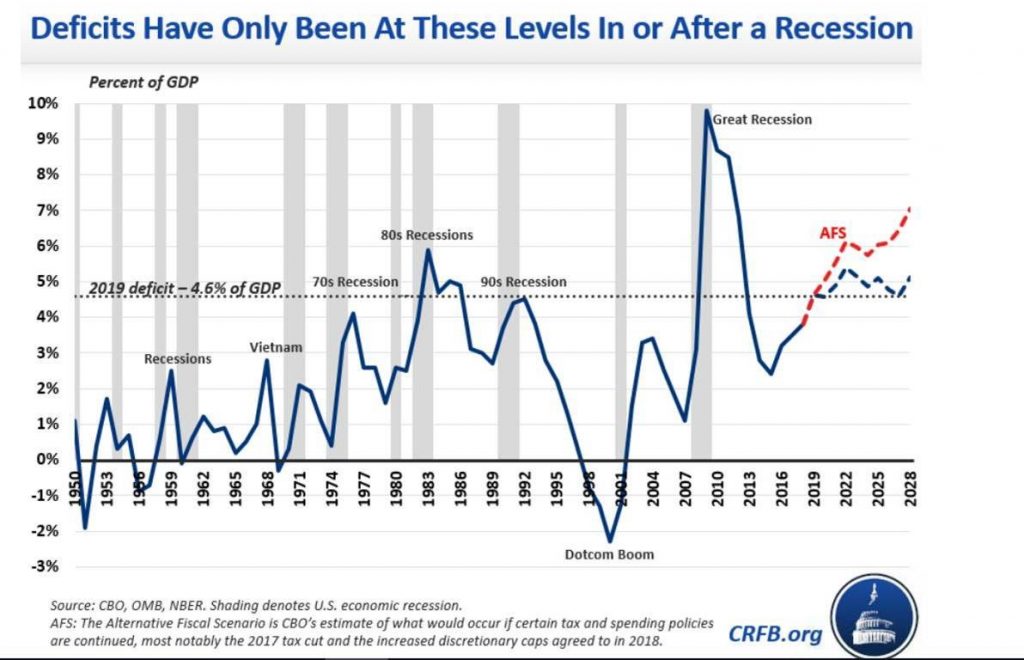
1.Big Numbers Coming for Deficit…View In Relation to GDP.
Barrons March 18: Just how big could fiscal stimulus get? During the Great Recession, the federal budget deficit peaked around 10% of gross domestic product. Were the federal government to run a similar deficit this year, it would amount to about $2.2 trillion. But even this 10% figure probably does not represent the true upper bound on federal borrowing. During World War II, the federal budget deficit peaked at nearly 30% of GDP in 1943, and was more than 20% each year in the 1943-45 period. A federal budget deficit of 30% of GDP today would amount to nearly $7 trillion. Of course, financing these deficits required extraordinary efforts, such as sizable war-bond programs and direct coordination between the Treasury and the Federal Reserve. While we doubt the fiscal response will be anything quite that big, the federal government possesses significant fiscal ammunition, particularly when real interest rates on Treasury securities remain negative.—Michael Pugliese https://www.barrons.com/articles/wall-street-views-on-the-virus-the-economy-and-the-markets-51584748842?mod=past_editions
We were at recession level deficits before recession.
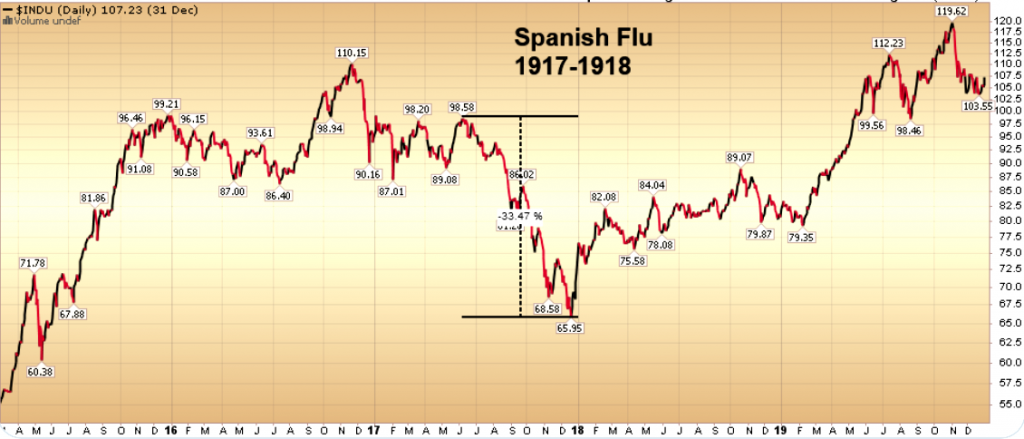
Sell-off lasted 6 months and took DOW 34% lower (-40% from highs set some months before the flu), stocks rallied 25% in less than 2 months following the trough. It took 18 months to erase the flu sell-off. The corona cycle likely will be faster and swifter because there was not electronics, twitter or texting back then!
Zach Goldberg
Head of Franchise Sales
Office: 212.284.2314
Cell: 240.355.5342
Disclaimer: http://www.jefferies.com/salesandtradingdisclaimer/
1.Trump Considers Delay in Mortgage Payments…Look for Massive Rental Relief.
Debt Deferrals – Trump Considering Plan to Let Homeowners Delay Mortgage Payments– “We’re thinking of the potential of several months of payments for a lot of homeowners” says the MBA. Also NYers with student debt, medical debt & other state-referred debtwill have payments frozen for at least 30 days. Dave Lutz at Jones Trading.
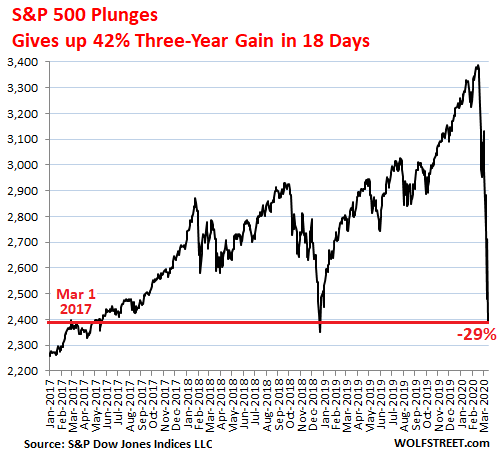
The S&P 500 index has now plunged 29% in the 18 trading days since the peak in February 19 and is below where it had first been on March 1, 2017 – which was over three years ago. In other words, the S&P 500 unwound three years’ worth of gains in 18 trading days.
S&P 500 Plunged Most Since 1987, Gave Up in 18 Days the 42% Gains of Past 3 Years. Boeing Shares Collapsed-Wolf Richter
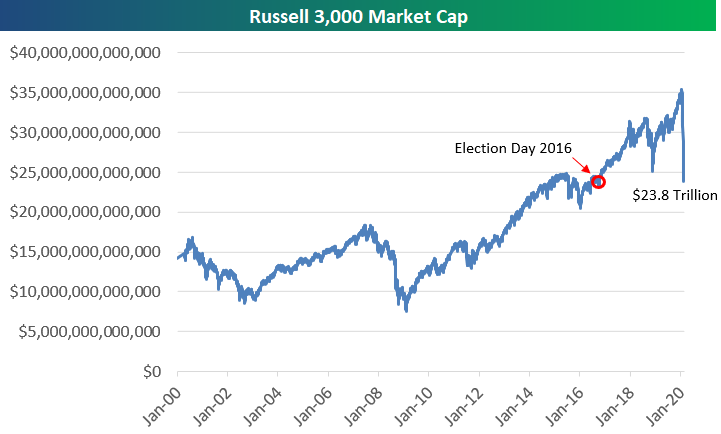
3.Selloff Erases All of US Market Cap Gains Since Election Day 2016
Bespoke
With the US stock market down nearly 7% yet again today, the total market cap of US companies as measured by the Russell 3,000 has fallen $11.5 trillion in less than a month. On February 19th, total US market cap was just over $35 trillion. It’s at $23.8 trillion as of this morning.
What makes this drop even more noteworthy is that $23.8 trillion was the market cap of US companies on Election Day 2016. At this point in time, all of the market cap gains seen since President Trump’s election victory have been wiped out. Visit our membership options page to learn more about Bespoke’s research.
Let us know if you would like to add a colleague to this distribution list.
Torsten Sløk, Ph.D. Chief Economist
S. Korea Testing 15,000 Citizens Per Day CORONAVIRUS Testing 1…2…3…
Francis Scialabba
One of the major criticisms of the U.S. government’s response to the coronavirus pandemic has been the woeful lack of testing capacity for the disease. Almost two months after the first U.S. case was announced, the NIH’s top infectious disease expert said, “The system is not really geared to what we need right now…it is a failing, let’s admit it.” That’s slowly being remedied. Yesterday, the FDA gave emergency clearance to a coronavirus test developed by the Swiss diagnostics giant Roche. This thing is Speedy Gonzales:It can test patients 10x faster than existing tests.Using Roche’s automated machines, it can produce results in 3.5 hours.The most powerful system can test up to 4,128 patients a day.Roche Diagnostics CEO Thomas Schinecker said getting a new test developed and approved typically takes years. An “emergency team” started working on this one in January. Other signs of lifeYesterday, the Trump administration made a few other moves to ramp up testing. First, someone is now finally in charge of the government’s testing effort—the assistant secretary of health, Brett Giroir. Next, the Department of Health and Human Services said it was funding two companies, DiaSorin Molecular and Qiagen, to push them along in developing diagnostic tests.The agency said these tests may be able to detect coronavirus in “approximately one hour.” Looking aheadDr. David Kessler, a former FDA commissioner, explained in the NYT yesterday that there are a few ways the private sector can help expand testing capacity: Delivery companies like FedEx, UPS, and Amazon can transfer specimens from mobile collection sites to labs.Then, bring in the big guns: Apple, Microsoft, Google, and Salesforce can supply the data management systems to take those specimens and turn them into useful information. Bottom line: “There’s no reason the testing infrastructure can’t be up and running in seven days so that every person in America who needs a test can be tested,” Kessler wrote.
Gates-funded program will soon offer home-testing kits for new coronavirus —By Sandi Doughton
Seattle Times staff reporter
Testing for the novel coronavirus in the Seattle area will get a huge boost in the coming weeks as a project funded by Bill Gates and his foundation begins offering home-testing kits that will allow people who fear they may be infected to swab their noses and send the samples back for analysis.
Results, which should be available in one to two days, will be shared with local health officials who will notify those who test positive. Via online forms, infected people can answer questions about their movements and contacts, making it easier for health officials to locate others who may need to be tested or quarantined, as well as to track the virus’ spread and identify possible hot spots.
The goal is to eventually be able to process thousands of tests a day, said Scott Dowell, leader of coronavirus response at the Bill & Melinda Gates Foundation. The project is ramping up as quickly as possible, but it’s not clear exactly when it will launch, he added. Among other things, software needs to be upgraded to handle the expected crush of requests, and a detailed questionnaire finalized for people who request tests.
“Although there’s a lot to be worked out, this has enormous potential to turn the tide of the epidemic,” Dowell said.
Associate Professor of Biology, Rochester Institute of Technology
The U.S. government is fighting to contain and slow down the spread of the coronavirus. Testing is central to these efforts. Molecular biologist and viral researcher Maureen Ferran answers some basic questions about how these diagnostic tests work – and if there are enough to go around.
Who gets tested for the virus?
Currently there are two main reasons someone would be tested for the coronavirus: having symptoms or exposure to an infected person.
The main symptoms of COVID-19, the disease caused by the coronavirus SARS-CoV-2, are fever, dry cough and shortness of breath. These look a lot like the flu and the common cold, so it takes a physician to determine if testing for the virus is necessary.
Initially, the Centers for Disease Control and Prevention recommended testing only people with symptoms and who had potentially been exposed to the virus. But to the surprise of public health officials, several of the first people in the U.S. who tested positive for the virus had no obvious exposure. This development suggested that the virus was being transmitted locally, meaning it was spreading from person to person easily and/or that people may have been transmitting the virus without experiencing serious symptoms.
As of writing this, there are no specific treatments available for COVID-19, but that does not mean testing is pointless. Perhaps most importantly, testing is done so that infected patients can be quarantined and the spread of the virus slowed. Another benefit of testing is that it lets public health workers build a more accurate picture of the number of cases and how the virus is spreading in the population.
While collecting a sample is easy, actually determining whether a person is infected with the coronavirus is much more complicated. The current method looks for the virus’s genetic material (RNA) in a patient’s cells.
In order to detect the presence of RNA in the patient’s sample, labs perform a test called reverse-transcription polymerase chain reaction. This method first converts any viral RNA to DNA. Then the DNA is replicated millions of times until there are enough copies to detect using a specialized piece of equipment called a quantitative PCR instrument.
If genetic material from the virus is found in the sample, then the patient is infected with the virus.
The availability of tests has been a big issue. Prior to Feb. 29, the CDC was the only place approved by the FDA to develop, produce and process tests. However, as the number of suspected cases climbed and doctors approved more people for testing, demand to be tested soared.
As pressure on the federal government to make tests available increased, the FDA announced a new policy on Feb. 29 that made it easier for commercial and academic laboratories to develop their own tests and allowed other certified labs to test patient samples.
Integrated DNA Technologies, a CDC contractor, shipped 700,000 tests to commercial, academic and health care laboratories on March 6. Quest Diagnostics and LabCorp, two large commercial test manufacturers, started making their own test kits, which became available on March 9. Many companies, hospitals and other institutions are now racing to develop more tests to diagnose COVID-19.
Realistically, it isn’t feasible to test everyone who is sick in the U.S. Therefore, most health officials believe it is important to prioritize the testing of people who need it the most: those at high risk such as health care workers who have been in contact with COVID-19 patients; symptomatic people in areas with high infection rates; and people 65 years of age and older with chronic health issues, such as heart disease, lung disease or diabetes. As more tests become available, it will be possible to test more people.
There’s also a need to develop faster tests that do not require special equipment and personnel. Testing allows experts to better understand how the outbreak is progressing and try to predict the impact the virus will have on society.
As with all outbreaks, this pandemic will end. In the meantime, however, people need to wash their hands and try to minimize their risk of exposure. There is much to be learned about this novel coronavirus. Only time will tell if it disappears from the human population, as SARS did in 2004, or becomes a seasonal disease like flu.
The S&P 500 index has now plunged 29% in the 18 trading days since the peak in February 19 and is below where it had first been on March 1, 2017 – which was over three years ago. In other words, the S&P 500 unwound three years’ worth of gains in 18 trading days.
S&P 500 Plunged Most Since 1987, Gave Up in 18 Days the 42% Gains of Past 3 Years. Boeing Shares Collapsed-Wolf Richter
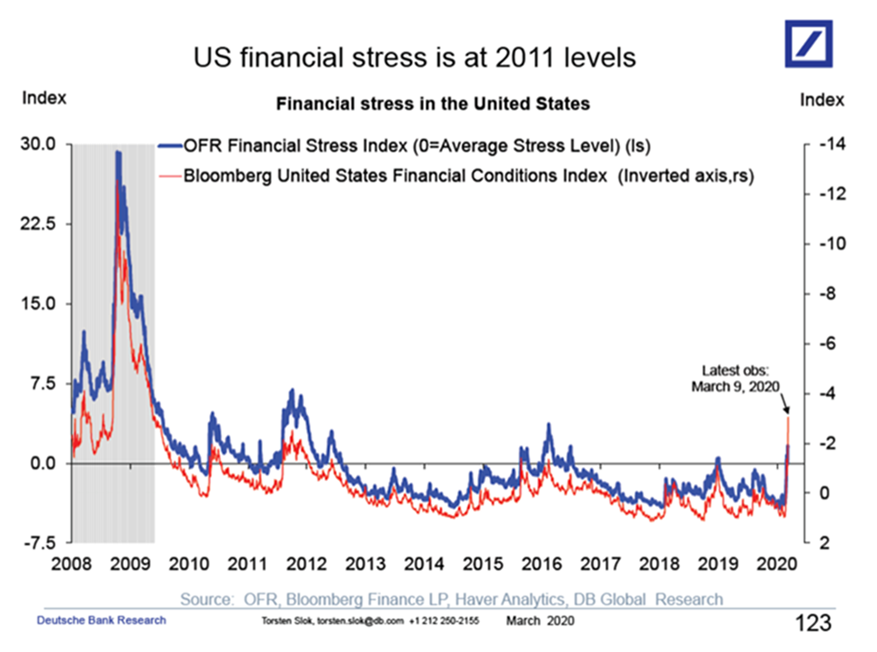
1.It’s Not
2008…U.S. Financial Stress at 2011 Levels.
A lot of my incoming client
conversations today are about the key question: “How bad is it?”. In other
words, what is the net impact on the economy and corporate earnings of lower
rates and a lower dollar versus lower equities and wider credit spreads? Tick-by-tick
measures of financial conditions show that financial conditions are currently
as tight as they were during the euro crisis in 2011. In other words, any
recession and slowdown in earnings associated with the ongoing moves in markets
will not be as bad as during the financial crisis in 2008/2009, see chart below
and here.
———————————————–
Let us know if you would like
to add a colleague to this distribution list.
Torsten Sløk, Ph.D. Chief Economist Managing Director Deutsche Bank Securities
Much
of the pessimism surrounding the virus focuses on the Chinese under-counting
the number of infected to save face. However, it’s important to note that a
shortage of specialized test kits has caused health officials in many countries
to rely on observable symptoms for diagnoses, and because coronavirus mimics
the flu and pneumonia in its early stages, it’s also possible that authorities
may be over-counting as well.
Instead of looking at it from a total confirmed case perspective, we think the
number of total active cases provides a better look into what is happening.
This measure takes total confirmed cases and subtracts deaths and recoveries.
This gives the total amount of people who have the potential to spread the
virus further.
According to Worldometer, which
aggregates statistics from health agencies across the world, total active cases
peaked about a week ago at 58,747 and have since been declining. Even with all
the new cases we are seeing in South Korea, Italy and Iran (where data is
suspect). There have been 30,597 cases with an outcome (2,699 deaths and 27,898
recovered). In other words, the total active cases now stand at 49,923, a drop
of 15% from the peak on February 17th.
One death is too many, but to put that number into a little bit of perspective,
according to the World Health Organization, in the United States alone for the
2019-2020 season, there have been at least 15 million flu illnesses, 140,000
hospitalizations and 8,200 deaths. Imagine if everyone with an internet
connection followed the spread of this annual flu, case by case, hour by hour.
It’s true that the death rate from Coronavirus appears to be around 2% in
China, which is much higher than the death rate from the normal flu, but like
the flu increases with age. However, outside of China the death rate is far
less than inside China, roughly 1%. And, there is already a drug that will
combat COVID-19 moving toward first phase clinical trials. It took three months
for this to happen in 2020, versus 20 months for SARS back in 2002/03 – a
testament to advances in drug technology.
From a macro-economic point of view, the real question is how will this impact
the US economy over the coming year. In short, our view has not changed. The US
we believe is relatively insulated, with a fantastic health system. The US
started the year with solid economic data and so far, nothing has changed. In
fact, with all the data we already have on hand, we are expecting around 2%
growth in Q1. Most of the impact to the US from the corona virus will come in
Q2.
Capital goods exports to China along with imports from China are sure to be
depressed given the struggles to reopen factories abroad. Most Chinese
factories are still only operating at about 50-60% of capacity. Shipping giant
Maersk has already said it has cancelled more than 50 trips to and from Asia.
With China being home to seven of the world’s busiest container ports there is
bound to be some impact. Inventories in the US will be depleted more rapidly,
but once the virus subsides, expect faster accumulation of inventories in the
second half of the year.
Revenues and earnings from companies that are highly exposed to China will
definitely be affected. China being shut down for a month will have a global
impact. But lower earnings in the first half of the year should be made up by a
strong rebound in the second half of the year with payback from lost months.
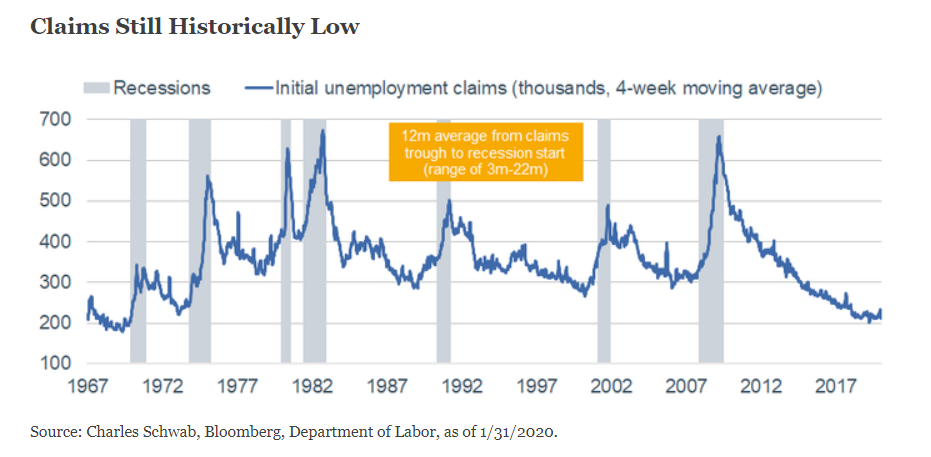
Demand remains strong and there has been no visible impact yet on the job market
as shown by initial unemployment claims. Supply disruption is the issue. We
suggest looking through any earnings weakness as we expect it to be transitory.
One small nugget of good news is that many companies had already been shifting
supply chains from China due to the Trump Tariffs. If they weren’t considering
it before they will be now as they realize the importance of diversification.
Expect this trend to accelerate moving forward.
The US consumer is on solid footing and will continue to be one of the key
drivers to US economic growth in the year to come. We believe, just like all
the other viruses we have seen over the past decades that have dissipated, the
Coronavirus will be no different. Some have suggested that the 1918 Spanish
Flu, which killed hundreds of thousands in the US could happen again. No one
knows, but 2020, is not 1918. Technology and news move much faster and the US
rebounded from the Spanish Flu when all was a said and done. We suspect that
any drop in earnings or economic activity will be short lived, and more than
made up for in the year to come. Don’t panic, stay invested.
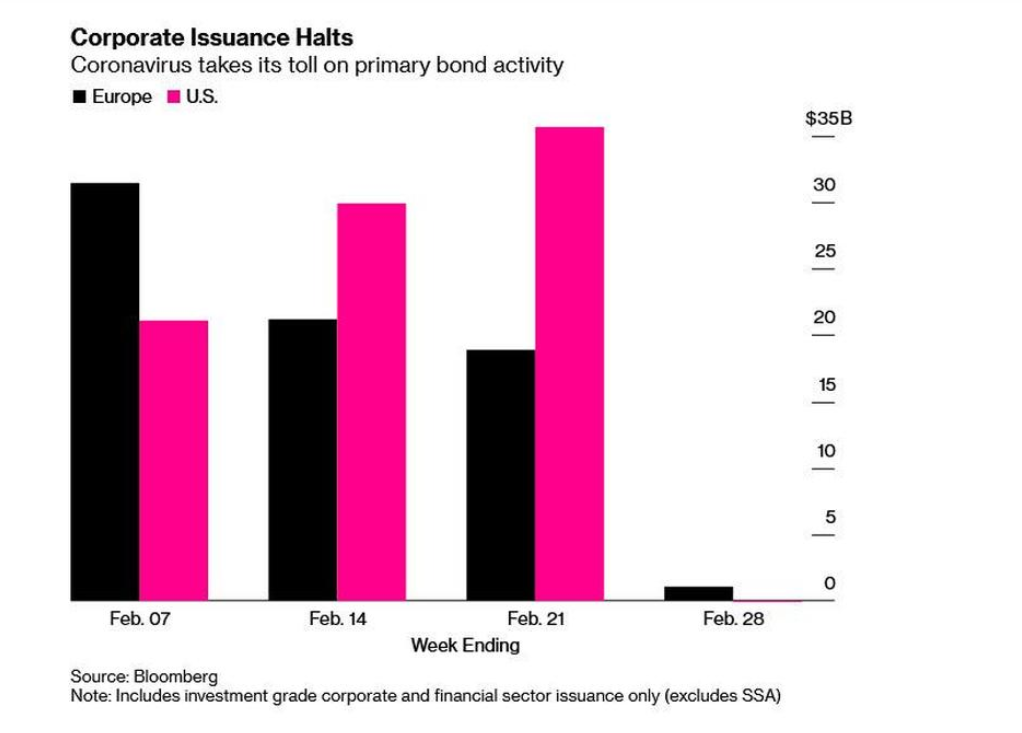
Wall Street
banks recorded their third straight day without any high-grade bond
offerings, an unheard of event
As Bloomberg puts it, “it has been a
remarkable turn of events for a market where investors had been snapping up
almost anything on offer amid a global dash for yield. Europe had
been enjoying its strongest ever start to a year for issuance, and
sales of U.S. junk bonds have been on the busiest pace in at least a decade.
With so many borrowers having postponed their issuance plans, a
, a calming in global markets could kickstart
debt sales again.”
“Coronavirus Paralyzes Global
Credit Market As New Issuance Crashes To Zeroby Tyler Durden
5.U.S. Small
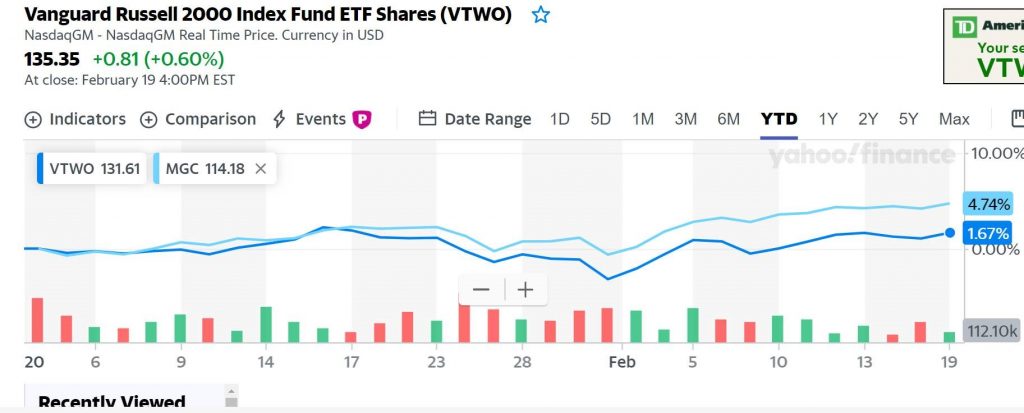
Cap Russell 2000 6th Time in History This Oversold.
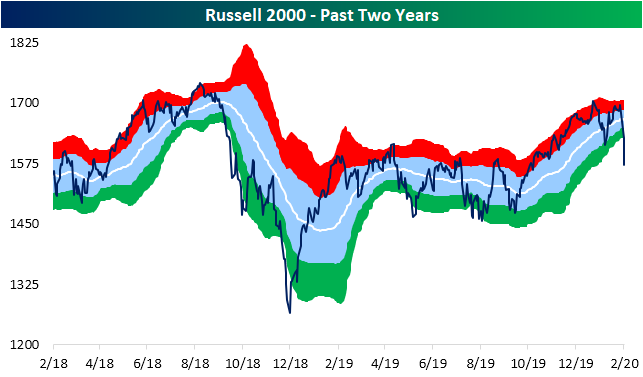
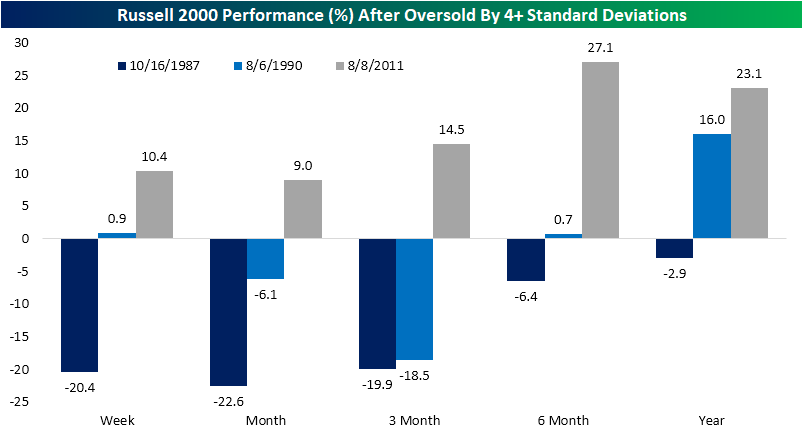
The small-cap Russell 2000 has generally underperformed large-caps for much of the past two years (it still has not gotten back up to its summer 2018 all time highs), and this recent weakness leaves it much more dramatically oversold than other major indices. As of yesterday’s close, the Russell sat over 4 standard deviations below its 50-DMA. That compares to the prior day when it was just over 2 standard deviations below and the day before when it was within one standard deviation of its 50-DMA.
This is only the sixth day in the index’s history that it had gotten this oversold. The last time this happened was in August 2011. Prior to that there was one occurrence in August 1990 and another cluster of three days in during the October 1987 crash. Performance following these prior instances have been very mixed. While the 1987 and 1990 instances were followed by severe declines in the Russell 2000 over the next few months, more recently in 2011 performance was very strong over the next year. Join Bespoke Premium to access Bespoke’s most actionable stock market research and analysis. Start a two-week free trial now!
7.The top 5 technologies that will change health care over
the next decade
Dr. Bertalan Mesko, aka The Medical Futurist,
says with advancements in exoskeleton technology, AI’s ever-increasing
importance in health care, and technologies like 5G and quantum computing soon
going mainstream, there’s much to be excited about
Illustration by Doug Chayka
ByDR.BERTALAN MESKO
The past decade was
about the rise of digital health technology and patient empowerment. The next
decade will be about artificial intelligence, the use of health sensors and the
so-called Internet of Healthy Things and how it could improve millions of lives.
The cultural
transformation of health care we call digital health has been changing the
hierarchy in care into an equal-level partnership between patients and
physicians as 21st century technologies have started breaking down the ivory
tower of medicine. But these milestones are nothing compared with what is about
to become reality.
With advancements in
exoskeleton technology, AI’s ever-increasing importance in health care, and
technologies like 5G and quantum computing soon going mainstream, there’s much
to be excited about.
Here are the five
biggest themes for health and medicine for the next 10 years.
Artificial intelligence in medicine
Developments in
artificial intelligence will dominate the next decade. Machine learning is a
method for creating artificial narrow intelligence — narrow refers to doing one
task extremely well — and a field of computer science that enables computers to
learn without being explicitly programmed, building on top of computational
statistics and data mining. The field has different types: it could be
supervised, unsupervised, semi-supervised or reinforcement learning, among
If we consider how
AlphaGo, the AI developed by Google’s DeepMind lab, beat world champion Lee
Sedol at the classic Chinese game Go by coming up with inventive moves that
took experts by surprise, we can get a glimpse at what AI can hold for health
care. Such moves were made possible by the combination of neural networks and
reinforcement learning that this AI uses. This enabled the software to operate
without the restrictions of human cognitive limitations, devise its own
strategy and output decisions that baffled experts.
We can expect to see
the same surprises in medical settings. Imagine new drugs designed by such
algorithms; high-level analysis of tens of millions of studies for a diagnosis;
or drug combinations nobody has thought of before. When applied to medicine, an
algorithm trained via reinforcement learning could discover treatments and
cures for conditions when human medical professionals could not. Cracking the
reasoning behind such unconventional and novel approaches will herald the true
era of art in medicine.
In global health, for
example, an algorithm can provide a reliable map of future measles outbreak hot
spots. It uses statistics on measles vaccination rates and disease outbreaks
from the Centers for Disease Control and Prevention, as well as non-traditional
health data, including social media and a huge range of medical records. That’s
just one example, but the field is already buzzing with smart algorithms that
can facilitate the search for new drug targets; improve the speed of clinical
trials or spot tumors on computed tomography (CT) scans.
However, while experts
believe that AI will not replace medical professionals, it also seems true that
medical professionals who use AI will replace those who don’t.
A myriad of health sensors
Medical technology went
through an amazing development in the 2010s, and there’s now no single square
centimeter of the human body without quantifiable data. For example, AliveCor’s
Kardia and Apple Watch measure electrocardiogram and detect atrial fibrillation
with high sensitivity. The EKO Core digital stethoscope records heart and lung
sounds as a digital stethoscope, while blood pressure is monitored with the
Omron Blood Pressure Smartwatch, the MOCAcare pocket sensor, and blood pressure
cuff, the iHealth Clear, the Skeeper, a pocket cardiologist, or the Withings
Blood Pressure Monitor, and of course, dozens of traditional blood pressure
cuffs.
There are dozens of
health trackers for respiration, sleep, and, of course, movement. And while
researchers can’t decipher your dreams yet — they are working on it, alongside
figuring out all kinds of brain activity. For example, through EEG. That’s a
method that records electrical activity in the brain using electrodes attached
externally to the scalp. The NeuroSky biosensor and the Muse headband use it to
understand the mind better and in the latter case allow for more effective
meditation. As you see, there’s not much left unmeasured in your body — and it
will even intensify in the future. For example, we expect digital tattoos to
become commercially available within five years, which will not only measure
the majority of the above-mentioned vital signs, but they will do so
continuously. These tiny sensors will notify us when something is about to go
wrong and we will need medical advice or intervention.
Moreover, with
developments in 3-D printing as well as circuit-printing technologies, flexible
electronics and materials, applying so-called digital tattoos or electronic
tattoos on the skin for some days or even weeks became possible.
Made of flexible, waterproof
materials impervious to stretching and twisting coupled with tiny electrodes,
digital tattoos are able to record and transmit information about the wearer to
smartphones or other connected devices. While these are only in use in research
projects, they could allow health-care experts to monitor and diagnose critical
health conditions such as heart arrhythmia, heart activities of premature
babies, sleep disorders and brain activities noninvasively. Moreover, by
tracking vital signs 24 hours a day, without the need for a charger, it is
especially suited for following patients with high risk of stroke, for example.
Although we are not there yet, there are certain promising solutions on the
market such as MC10’s BioStampRC Sensor.
Quantum computing puts medical decision-making
on a new level
In 2019, Google claimed
“quantum supremacy” and made the cover of Nature magazine. One example of how
this technology will have a major impact on the health-care sector is quantum
computing taking medical decision-making to a whole new level and even
augmenting it with special skills. What if such computers could offer perfect
decision support for doctors? They could skim through all the studies at once,
they could find correlations and causations that the human eye would never
find, and they might stumble upon diagnoses or treatment options that doctors
could have never figured out by themselves.
At the very endpoint of
this development, quantum computers could create an elevated version of PubMed,
where information would reside in the system but not in the traditional written
form — it would reside in qubits of data as no one except the computer would “read”
the studies anymore.
In addition, the
applications of quantum computing to health care are manifold, ranging from
much faster drug design to quicker and cheaper DNA sequencing and analysis to
reinforced security over personal medical data. While the technology does hold
such promises, we still have to be patient before practical solutions can be
implemented in medicine. However, with continued progress in this area, even
though quantum computing has been something from a science fiction novel, this
decade will see the first such computer used in the clinical practice too.
Chatbots as the first line of care
Symptom checkers that
function on the same principle as chatbots are already available, free of
charge. However, these rely on the user inputting symptoms and complaints
manually. We yearn for one that can make predictions and suggestions based on a
user’s data, like sleep tracking, heart rate and activity collected via
wearables. With such features, those bots can help users make healthier choices
without having to drag themselves to their doctor.
There was a “Black
Mirror” episode titled “Rachel, Jack, and Ashley Too” that featured an
incredibly smart and emotional chatbot that had human-like conversations with
the character. Think about having a similar personalized chatbot that’s
accessible via your smart device and with additional health and lifestyle
features. This chatty virtual being can wake you up at the appropriate time
based on your sleep pattern and advise you to take your antihistamines as the
pollen concentration is particularly high during your commute that day, before
you even get out of bed. It can even recommend what you should consume for each
meal based on your nutrigenomic profile. It could find the best words for you
to motivate you to go to the gym. It could find the best jokes that help you
get into a good mood. But would you rather bend to the rules of an AI,
essentially forgoing your freedom of choice, than experience life based more on
your own will?
5G serving the whole ecosystem of digital
health
5G networks will enable
data to be downloaded at more than 1 gigabit per second, allowing for downloads
10 to 100 times faster than the currently available 4G services. 4G networks
can only serve around a thousand devices within a square kilometer, while 5G
can serve a million. It will make the era of the Internet of Things (IoT)
possible by connecting a huge amount of health trackers with laptops,
smartphones and many more digital devices. There will be no connection issues
or latency, as the trackers will be able to work in harmony while getting the
most out of our data.
Such a boost will allow
for more reliable communication, which is a must in areas like telesurgery,
remote consultation and remote monitoring. With bigger bandwidth and faster
connection, there might be a boost in wearables as health IoT networks become
more stable and reliable, and further help with patient engagement in relation
to their health.
Major applications of
5G are expected to be apparent starting in 2021.
Dr. Bertalan Mesko, Ph.D., is The Medical Futurist and director
of The Medical Futurist Institute,
analyzing how science fiction technologies can become reality in medicine and
healthcare. As a geek physician with a Ph.D. in genomics, he is a keynote
speaker and an Amazon Top-100 author.
Engaging with the unfamiliar can
keep mind and body fit. So how to pump up one’s levels of curiosityAnyone
who has spent time around kids knows that their young minds are powered by
curiosity. The average child probably asks more questions in 10 minutes than
the average adult does in 10 days. Kids are curiosity personified.
But as people age, their
reservoirs of curiosity tend to dry up. Studies have found that, on average, a
person’s openness to new experiences and new sensations declines
steadily with age. At the same time, apathy increases. While plenty of older adults buck these trends,
there’s some truth to the cliché of the narrow-minded, novelty-averse fogey who
rigidly adheres to his time-worn routines and opinions.
For years, mental health
researchers have noted this age-related dip in curiosity. They’ve also noticed
that high levels of curiosity often correlate with many different measures of
mental health and vigor. One 2018 paper from the journal Neuroscience
& Biobehavioral Reviews found evidence that maintaining curiosity
in old age is protective against cognitive and physical decline. Compared to
the incurious, older adults who score high in curiosity tend to perform better
on tests of memory and general cognitive functioning. The authors of
that study point out that curiosity activates brain areas that are involved in
other high-level cognitive processes, and over time this increased activation
could help explain some of curiosity’s brain benefits.
And in people both young and
old, research has found that high and consistent levels of
curiosity correlate with mental well-being and life satisfaction. Curious people also
seem protected from depression.
The more that experts examine
curiosity, the more they find evidence to suggest that it’s the secret sauce in
a happy, fulfilling life. “If you take the fundamental things that people tend
to want out of life — strong social relationships and happiness and
accomplishing things — all of these are highly linked to curiosity,” says Todd
Kashdan, a professor of psychology at George Mason University and author
of Curious?
What exactly does it mean to
be curious? “If you go by the typical dictionary definition, curiosity is
simply a desire to seek out new knowledge or experiences,” Kashdan says. While
this definition is a useful starting point, he says curiosity also involves a
willingness to engage with complex, unfamiliar, and challenging concepts or
endeavors.
Kashdan has helped develop
two widely used scientific models for measuring curiosity. The newer of these
models breaks curiosity down into five different categories or
“dimensions.” He terms the first of these “joyous exploration,” and it hews
closely to the dictionary definition of curiosity. The second and third
dimensions have to do with a person’s level of focus and commitment when
confronted with the uncertainties that newness breeds. “When you explore new
terrain” — whether it’s an exercise class you’ve never attended or a dinner
date with a new friend — “you’ll probably be exposed to feelings of stress and
anxiety,” he says. While these states tend to be thought of as negative, he
says curious people are not easily deterred by them. In other words, they
display resilience or “grit” (to use the buzzword du jour) when exploring new
concepts or scenarios.
The more that experts
examine curiosity, the more they find evidence to suggest that it’s the secret
sauce in a happy, fulfilling life.
“The fourth dimension is
thrill-seeking, which is a willingness to take financial or social or personal
risks in pursuit of new experiences,” he explains. He says thrill-seeking could
take the form of extreme sports, experimenting with psychedelics, or starting a
new business venture. The fifth and final dimension is “social curiosity,” he
says, which is taking an interest in other people’s views and opinions.
People who score high on
some or all of these five measures of curiosity almost transcend questions of
happiness or fulfillment. “When you lose yourself in the exploration of things
that are new and that you find interesting, you’re not stopping to ask yourself
if you’re happy or depressed,” Kashdan says.
That said, there’s some
evidence that the relationship between curiosity and happiness is
bidirectional, meaning one fuels the other. A 2019 study in the Journal of Personality found
that on days when people experience positive emotions like happiness, they also
tend to display more curiosity than on days when they aren’t happy. These sorts
of findings have led some researchers to hypothesize that positive emotions may
exist in part to help encourage curiosity and the fruitful exploration it
encourages.
“There’s the ‘broaden and
build’ theory that says positive emotions have a lot of function, and one of
them is to get us to engage in things we wouldn’t normally do,” says David
Lydon-Staley, first author of that study and a postdoctoral researcher in the
department of bioengineering at the University of Pennsylvania. Curiosity can
lead to new relationships, new skills, or new areas of knowledge that enrich a person’s
life at many levels, he explains.
But is it possible to pump
up one’s levels of curiosity? Lydon-Staley’s research found that exercise seems
to promote curiosity — perhaps by improving a person’s mood. (The
mood-elevating effects of exercise are well established.)
Kashdan says having strong
personal relationships also seems to feed curiosity. “Having secure attachments
is like having a home base in a game of tag,” he says. “They allow people the
freedom to be less inhibited and to explore.”
But by far the best way to
feed curiosity is to engage with new people, new places, and new points of
view. Kashdan says an aversion to the unfamiliar — or what he calls “premature
closure” — stifles curiosity. But novelty, even if uncomfortable or scary at
first, acts like curiosity fertilizer. “The more you interact with new
experiences or information, the more you realize you don’t know, which makes
further exploration more attractive,” he says. At the same time, engaging with
something new tends to drain it of its power to cause anxiety. “The highest
level of anxiety you feel is always during the anticipation of something new,”
he says. “Stick it out, and you see that the anxiety is manageable and can even
be enjoyable.”
There may be safety and
security in the familiar. But there’s evidence that curiosity and the novel
experiences that nourish it may pave the way toward a more meaningful and
fulfilling life.
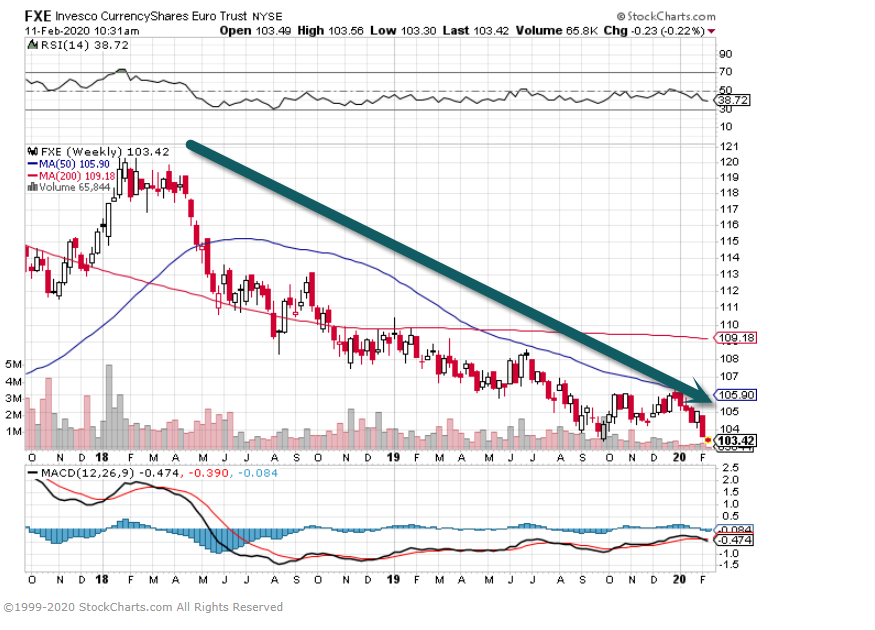
Sellers are following the
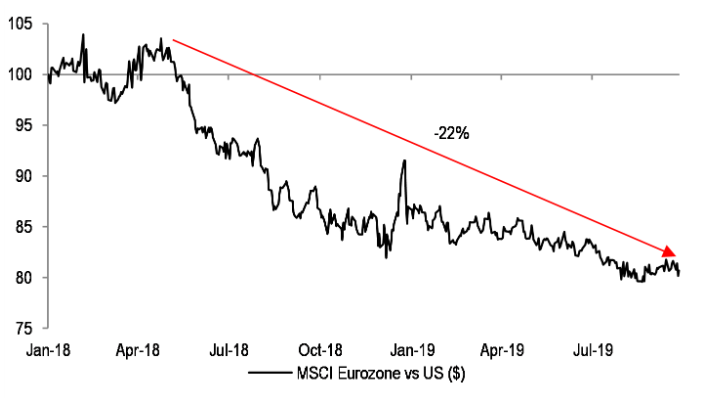
virus – China was smoked 1st, then Koreas, now Euros..
The Bank of Korea announces its policy decision on Thursday, with rising
risks of an interest-rate cut
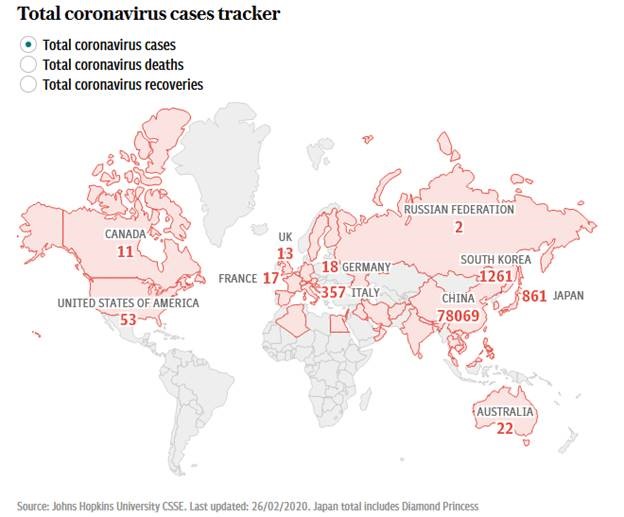
2.Primary Concern Coronavirus….Places Where Cases Increased
Fastest Over the Past 7 Days are Outside of China.
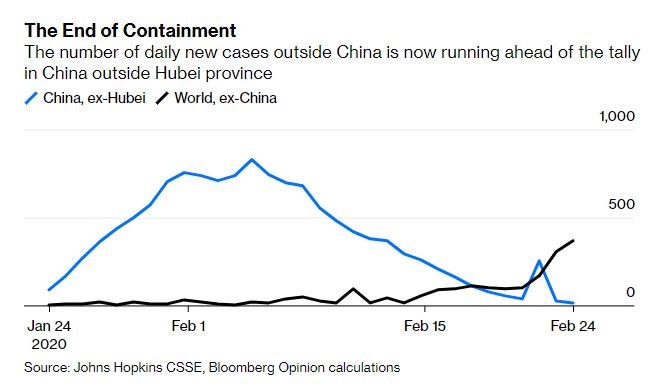
That prospect is looking increasingly remote
now. For most of the past month, just a percentage point of so of new daily
infections have occurred outside China. Since Thursday, that proportion has
risen to a fifth. Nearly half of cases so far found outside of China have
been reported in the past four days.
3. Scoop: Coronavirus threatens shortages of about 150 drugs Caitlin Owens
About
150 prescription drugs — including antibiotics, generics and some branded
drugs without alternatives — are at risk of shortage if the coronavirus
outbreak in China worsens, according to two sources familiar with a list of
at-risk drugs compiled by the Food and Drug Administration.
Why it matters: China
is a huge supplier of the ingredients used to make drugs that are sold in the
U.S. If the virus decreases China’s production capability, Americans who rely
on the drugs made from these ingredients could be in trouble.
What they’re saying: The
FDA declined to comment on the list, but said in a statement that it’s
“keenly aware that the outbreak could impact the medical product supply
chain,” and has devoted additional resources toward identifying potential
vulnerabilities to U.S. medical products stemming specifically from the
outbreak.
The agency has been in contact with hundreds of drug
and medical device manufacturers, and it’s also coordinating with global
regulators like the European Medicines Agency.
It pointed out that there aren’t any vaccines, gene
therapies or blood derivatives licensed by the FDA that are manufactured
in China, although raw materials for many products do come from China and
other southeastern Asian countries. The agency is in contact with
biologics manufacturers to monitor supply concerns.
“If a potential shortage or disruption of medical
products is identified by the FDA, we will use all available tools to
react swiftly and mitigate the impact to U.S. patients and health care professionals,”
said an FDA spokesperson.
The intrigue: FDA
commissioner Stephen Hahn is not a member of the task force that the
administration has assembled to handle the coronavirus. Only two of the dozen
members of the task force are physician-scientists, BioCentury noted on Friday.
Politico reported
Friday night that the White House is worried about how the coronavirus
outbreak could shape President Trump’s re-election prospects, and some
administration officials are concerned that the virus is already spreading
within the U.S., undetected.
The bottom line: Whether
or not the coronavirus spreads within the U.S., any potential drug shortages
would be felt acutely by the American patients that rely on them.
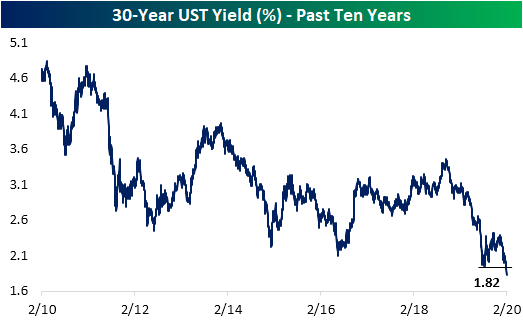
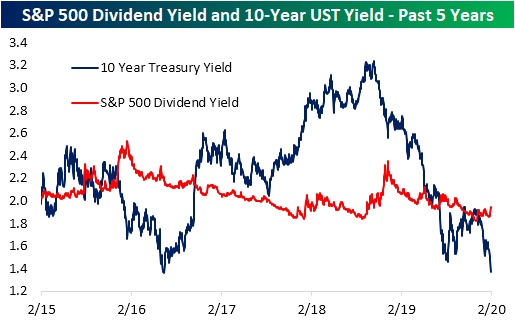
4 Dividend and Treasury Yield Spreads At Multiyear Highs
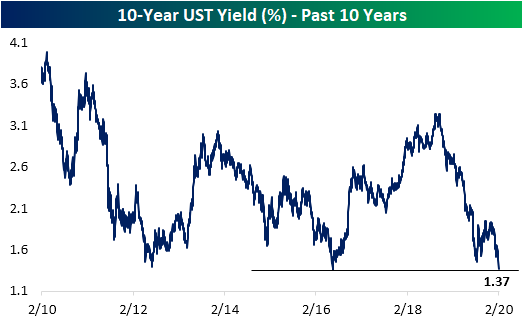
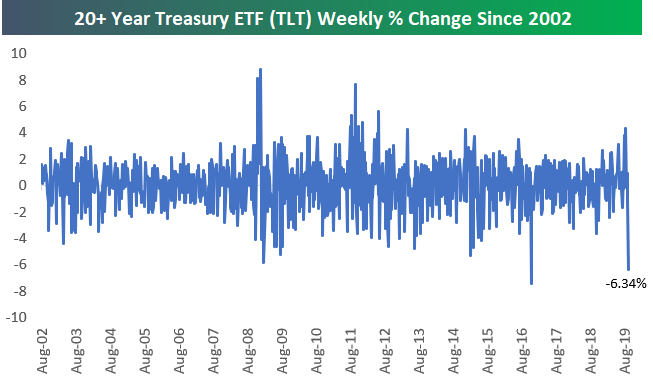
Meanwhile, Treasury yields are cratering with the 10-Year down over 10 bps. That is the largest one-day decline in the 10-Year yield since August 14th of last year when it fell 12.43 bps. That brings the yield down to 1.37%, which is the lowest level since July 2016.
Going further out on the curve, the yield on the 30-Year Treasury bond is now at a record low of 1.82%. Similar to the 10 Year, that is nearly a 10 basis point decline from Friday.
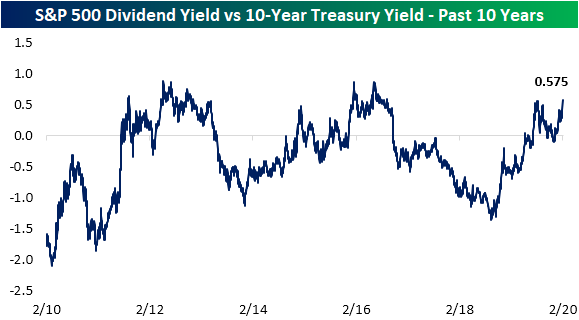
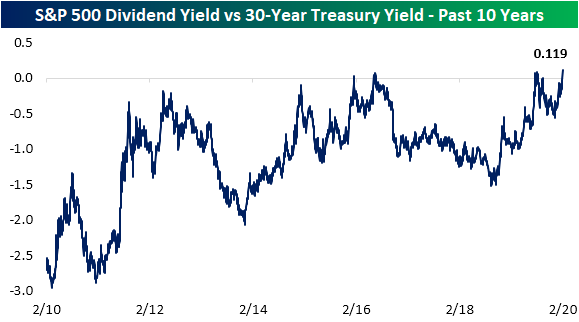
Given these moves, holding constant the difference in risks associated with the two assets, the spread between the S&P 500’s dividend yield is higher than the 10-Year yield by its widest margin since September of 2016 at 0.575, eclipsing the previous high from last August. Prior to 2016, the spread was higher throughout much of 2012.
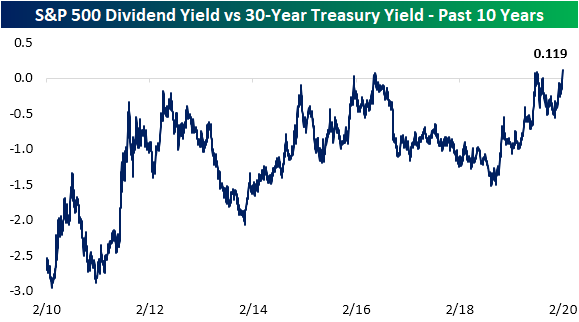
The spread between the S&P 500’s dividend yield and the 30-Year Treasury, on the other hand, is at its highest level in over a decade. The spread now stands at 0.119 which is the widest the spread has been since January 2009, and is favoring stocks (positive spread) for the first time since September. Unlike the spread between the S&P 500’s dividend yield and the 10-Year yield which has flipped back and forth between favoring stocks and Treasuries over the past decade, the 30-Year yield has much more consistently favored bonds. In fact, outside of today and briefly last September, the only other time we’ve seen a positive spread was in 2016. Get Bespoke’s most actionable ideas and analysis with a Bespoke Premium membership. Click here to start a two-week free trial.
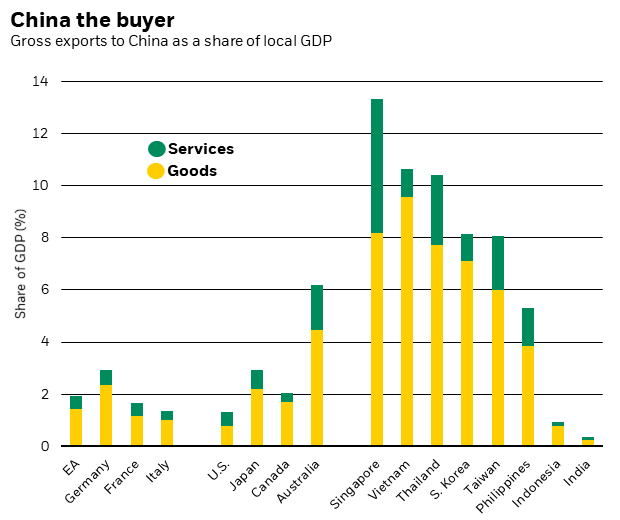
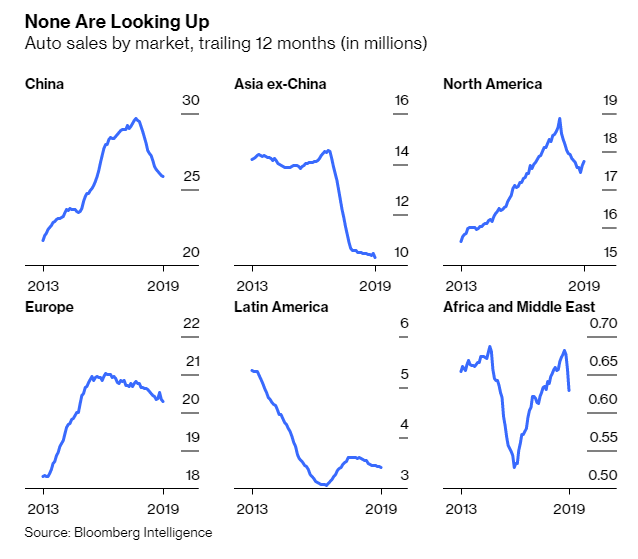
Blackrock–The euro
area is more exposed to Chinese export demand than the U.S. See the chart
above. And it has extra exposure to China through foreign affiliate sales,
especially in the car industry. But the euro area also relies less on
intermediate inputs from China in its domestic production than the U.S. or Japan,
making it less susceptible to any supply chain disruptions.
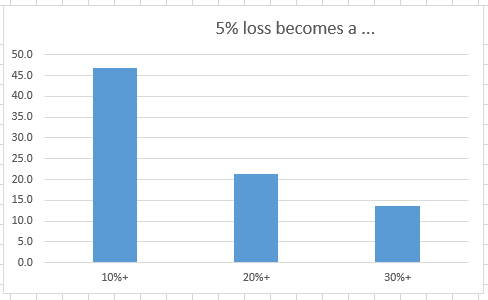
How often does that
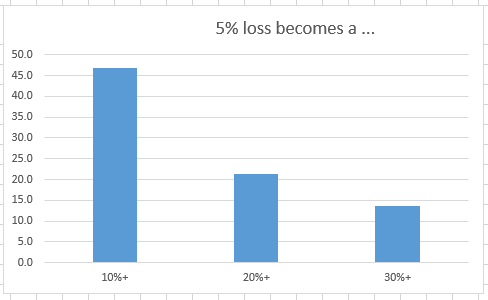
5% sell-off become an even larger sell-off?
The results are hypothetical results and are
NOT an indicator of future results and do NOT represent returns that any
investor actually attained. Indexes are unmanaged and do not reflect management
or trading fees, and one cannot invest directly in an index.
Those 5% sell-offs
often become 10% sell-offs at 47% of the time. But only 21% of the time do they
hit the dreaded 20% sell-off.
If the 5% sell-off
does not become a 20% sell-off, it will reach the reference high, on average,
in 80 trading days, or about 4 months, which is not that long.
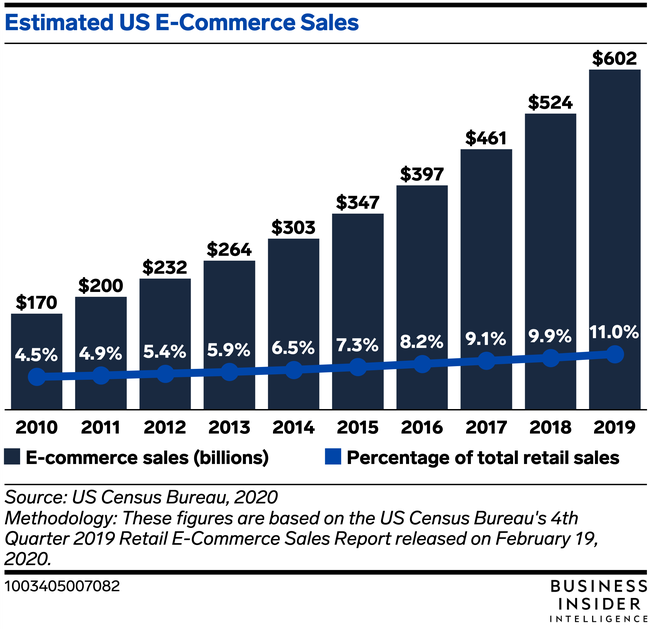
7.Follow Up
to Yesterday’s Comments on Q4 2019 Record E-Commerce Sales.
Business Insider
Here are three major takeaways based on the US retail industry’s
recently reported performance for Q4 2019 and 2019 overall.
-E-commerce cracked 10% of total retail sales in 2019, and its performance is still propelling the overall industry’s growth. The segment accounted for approximately 11% of total retail sales in 2019, up from its previous high of 9.9% in 2018. And e-commerce sales grew 14.9% for the year, accelerating from its 13.6% increase a year ago, while total retail sales growth in 2018 actually decelerated from 4.7% in 2018 to 3.4% in 2019. Because merchants must embrace e-commerce to boost their own growth, the roles of solutions providers like BigCommerce and Shopify, as well as marketplaces like Amazon, could expand further in the coming years, due to their ability to help merchants without the resources to develop their own e-commerce platforms to begin selling online.
-The industry managed to elevate its performance in Q4 despite the short holiday schedule. There were six fewer days between Thanksgiving and Christmas in 2019 than there were in 2018, and since Thanksgiving can serve as a milestone that triggers holiday shopping, the abridged holiday season could have limited retailers’ ability to rack up lucrative holiday sales. Merchants seem to have overcome this obstacle considering the industry’s improved performance in the holiday quarter. Further, this season’s success indicates that deploying tactics like offering sales early — Walmart launched its holiday deals in October this year — should be implemented in years with longer holiday schedules too, in hopes of extending the holiday season and creating more sales opportunities.
-While e-commerce is a key growth driver for retailers, offline retail remains the largest sales opportunity — making an omnichannel approach key to a merchant’s success. Retail sales other than e-commerce made up 89% of 2019’s sales, so brick-and-mortar retail remains the focal point of US retail. This is likely why e-tailers like Amazon and severaldigitalbrands and payments companies like Stripe have been pushing into physical stores, since it gives them access to the channel and another way to attract volume. Since we are likely still decades away from e-commerce bringing in the majority of retail sales, sellers looking to maximize their performances should be working to sell both online and in-store in order to tap into e-commerce’s growth and physical retail’s size, while also developing offerings like click-and-collect to take advantage of the strengths of both channels.
Research has
determined that EQ determines an employee’s overall success when it comes
to work, relationships, and general well-being. In the age of artificial
intelligence and automation, emotional intelligence may be not only
what saves us from the robots, it may also be what saves us from
ourselves. Consider these findings:
EQ is one of the top 10 job skills required for
workers to thrive in 2020.
Let’s
flip the coin. What about low emotional intelligence, or
even no emotional intelligence at all? What does that look
like in practice, and how can we identify those habits that are holding us
back?
5 questions to assess low emotional intelligence
For
the record, if you recognize some of your own habits as you read over the
signs, cut yourself some slack and know that you’re not broken or bad. What it
does mean is, you suffer from blind spots. You may not see them but those
around you–peers, co-workers, customers, family members–can firmly nod in
agreement that they do, sometimes routinely.
Rest
assured that anyone is capable of changing these scenarios to improve
their lives or leadership skills. But there’s got to be a first step:
identifying whether your EQ is low or not. Here’s how you will
know.
1. Are you quick to judge?
People
with low EQ often jump to conclusions quickly because they don’t have a good
understanding of how to read other people’s emotions or their own. Since
those who judge are typically negative and impulsive, they may form a
negative impression of someone before assessing the context of a situation
and their initial emotions for truth and accuracy. Sadly, what they may be
left with is a distorted view of something or someone.
2. Do you have a hard time accepting criticism?
Taking
criticism can wreak havoc emotionally on a person who lacks EQ.
However, in honest, self-confident, high-EQ individuals, it is much easier
to accept criticism because they are able to process their
emotions, assess their strengths and weaknesses, and take note of
something they need to improve on.
3. Do you increasingly feel stressed or anxious?
I’m
not negating stress–we all experience some level of it; it is inevitable.
But people with high EQ, as opposed to their low-EQ
counterparts, have the capacity to get perspective on a
situation, seek input from various angles, and practice mindfulness
before spiraling down the devious path of anxiety.
4. Are you a bad listener?
Low-EQ
individuals lack empathy; they often neglect to listen to the opinions and
thoughts of others to consider another point of view. Recent
research published in Harvard Business Review supports evidence
that leaders who listen well “are perceived as people leaders,
generate more trust, instill higher job satisfaction, and increase
their team’s creativity.”
5. Do you find it hard to recover from mistakes?
High-EQ
individuals are resilient; low-EQ individuals dwell on mistakes and have a
tough time bouncing back. To these people, I offer one simple solution that
will change your world for the better: Heal from the hurt, learn from your
mistake, let go of the past, and move on to your glorious future.
In
closing, building up your EQ could have a profound
effect on your personal and work relationships. But first, assess where
you stand in relation to the tenets of emotional intelligence and ask some key “hold
up the mirror” questions to determine where you measure up.
1.High
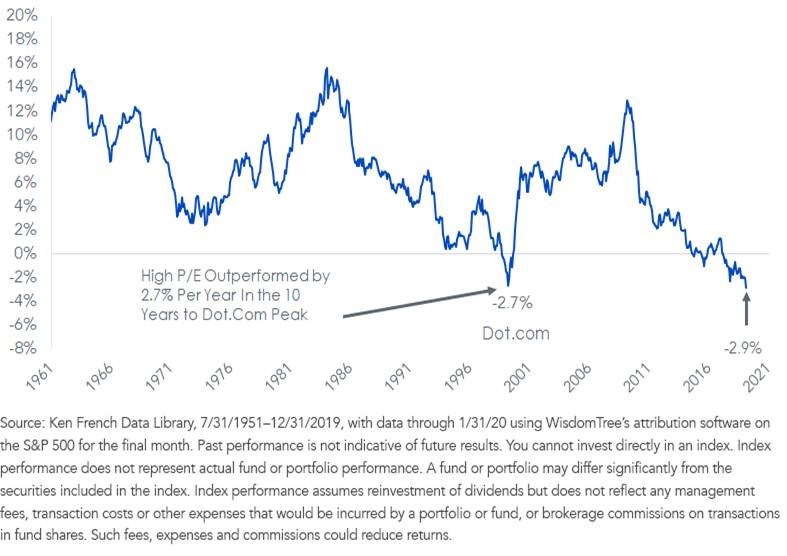
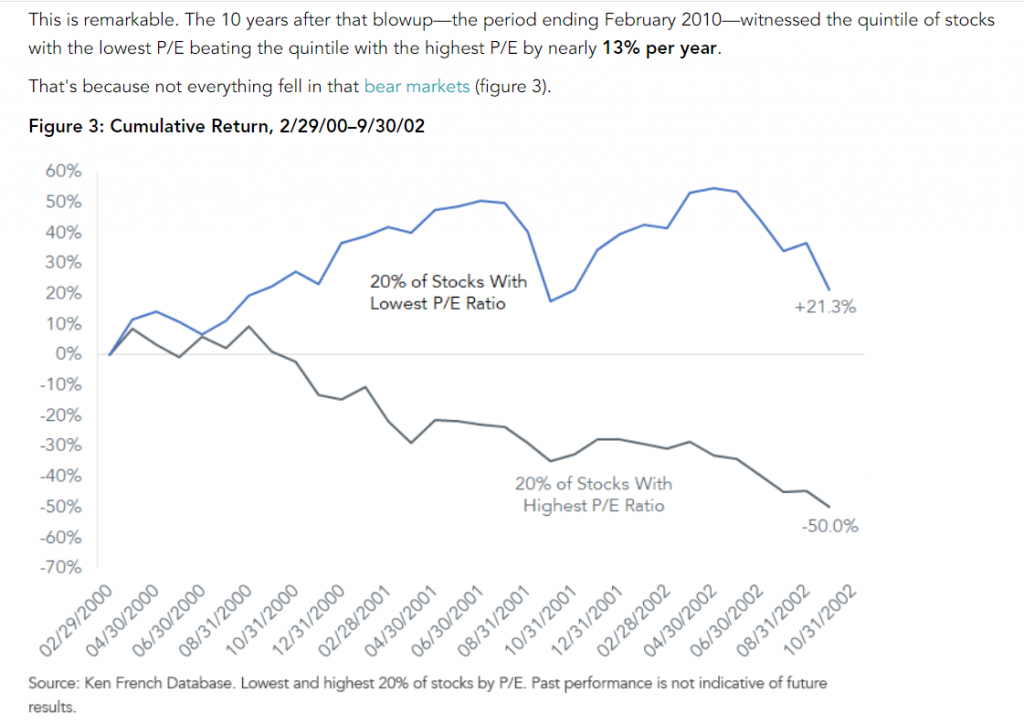
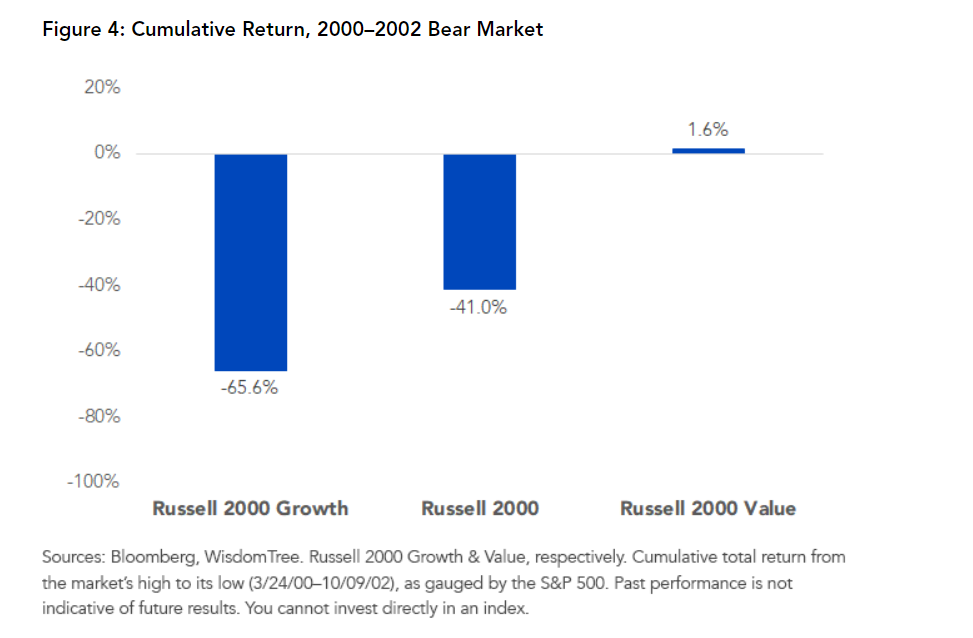
P/E Stocks Outperformance Vs. Low P/E Stocks Surpasses Internet Bubble.Wisdom
Tree
But even
the best performing value factor was no contest for a market that has avoided
value stocks like the Bubonic plague. Figure 2 is my favorite chart right now.
If the
Bear Lurks, High P/E Stocks Are the Dreaded “Phone Ringers”Jeff
Weniger, CFA
Figure 2:
10-Year Rolling Annualized Outperformance, Low P/E vs. High P/E Stocks
Face it:
The amount by which high P/E stocks have outperformed low P/E stocks in the
last 10 years exceeds the amount observed at the apex of the dot-com bubble.
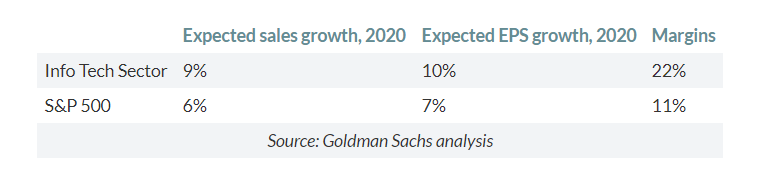
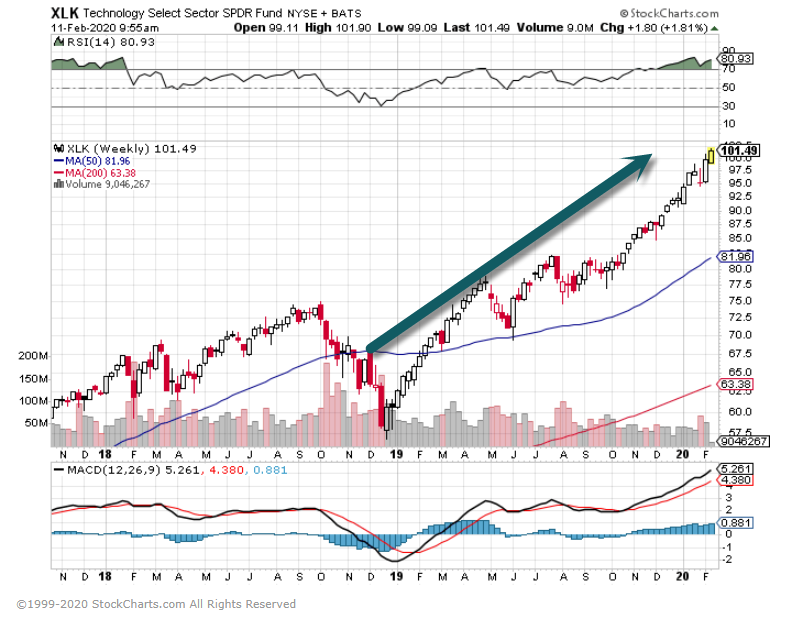
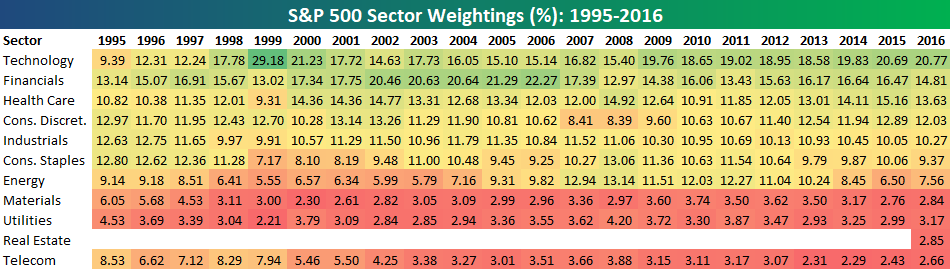
1.Technology Sector vs. 1999. 1995-1999
Information Technology Returned 700%
Information technology stocks have rallied 47.8% in the past
12 months, according to FactSet data. But that “still pales in comparison to
the Tech Bubble.” Over the past five years, the sector has returned 149%;
between 1995 and 1999, the sector returned nearly 700%. Meanwhile, the tech
group’s forward price/earnings ratio trades at a 22% premium to the S&P 500
now, on a relative basis, the analysts wrote, below the long-term average of
31%.
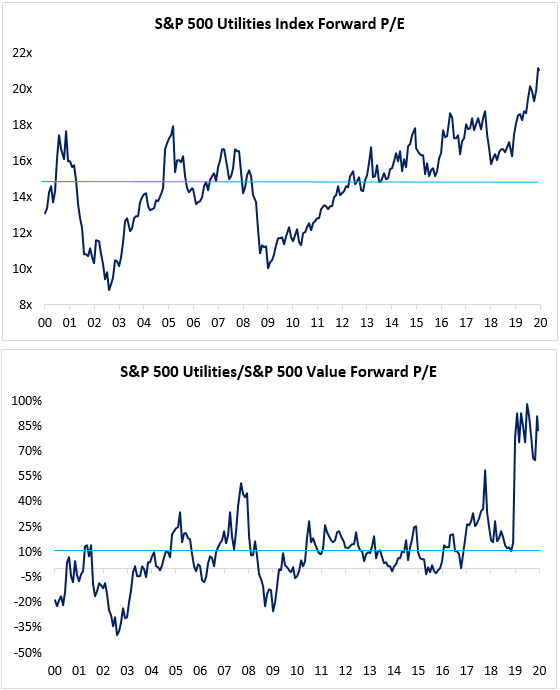
2.
Utilities are trading at the highest absolute forward P/E and highest relative
P/E to S&P 500 Value over the past 20 years:
Percy Allison Desk Strategist Jefferies LLC
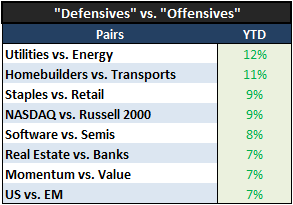
Defensives
have steeply outperformed offensives:
Source: Jefferies
Trading Desk
Utilities
are trading at the highest absolute forward P/E and highest relative P/E to
S&P 500 Value over the past 20 years:
Source: Jefferies
Trading Desk
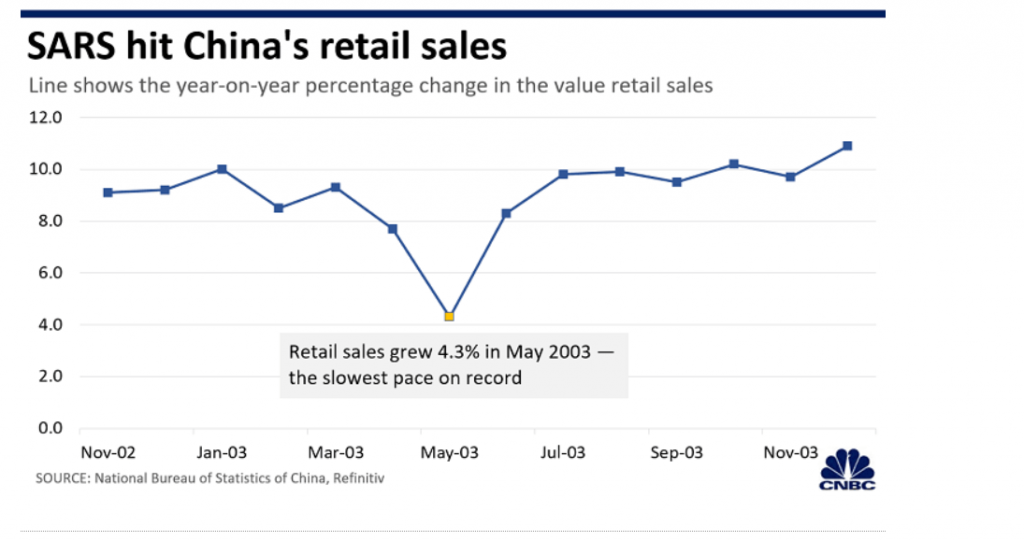
3.Coronavirus
vs. SARS
The new coronavirus and SARS come from the same family of
viruses that usually infect animals, but can sometimes evolve and spread to
humans.
Investors and analysts often compare the two viruses to gauge
the potential economic impact from the latest outbreak.
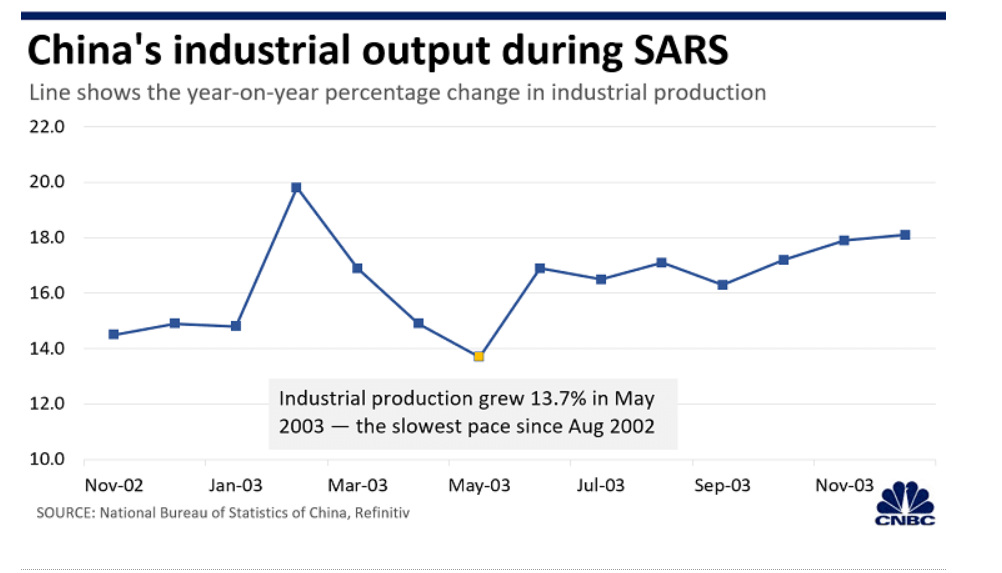
The SARS outbreak nearly 20 years ago caused China’s economic
growth to slow from 11.1% year over year in the first quarter of 2003 to 9.1%
in the following three months.
Growth in retail sales and industri al production
in China was also slower around May 2003, but expansion in exports remained
steady throughout that year.
4 charts show how SARS hit China’s economy nearly 20 years ago
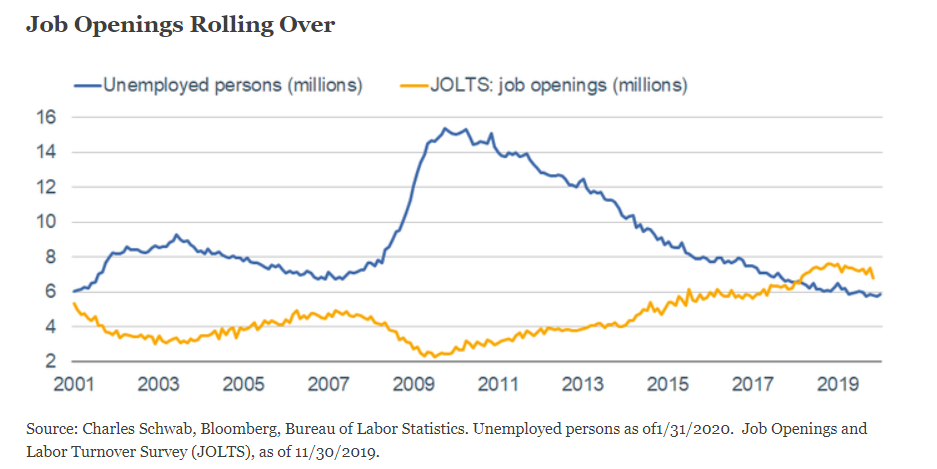
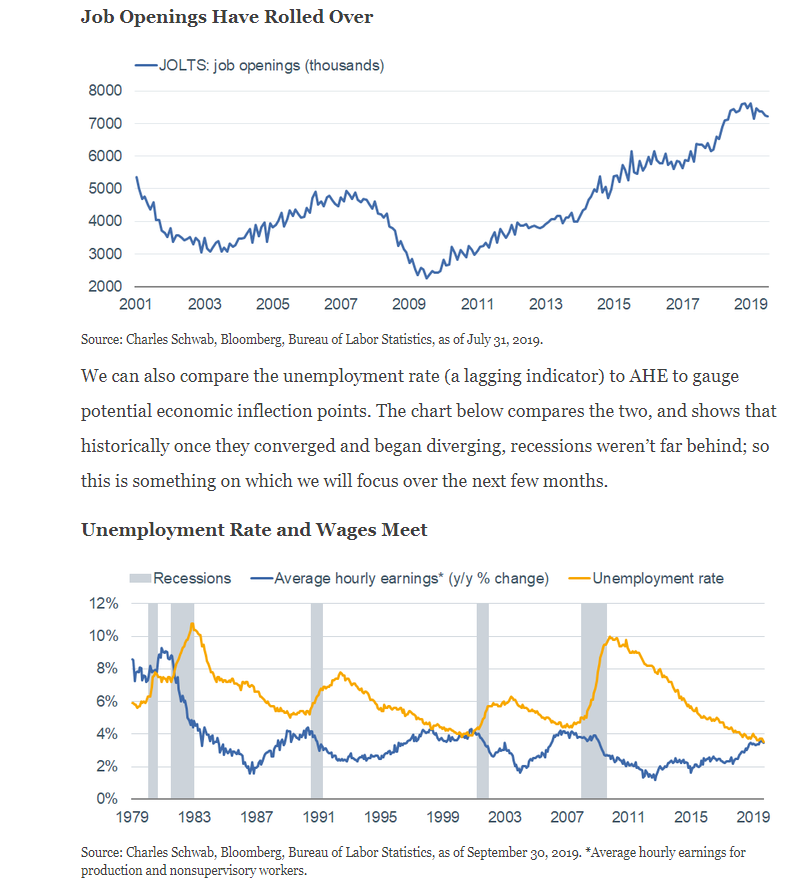
Job openings have also rolled over, as you can
see in the yellow line in the chart below. On the other hand, openings remain
comfortably above the number of unemployed persons in the United States—notwithstanding
the aforementioned skills gap problem.
Sleight of Hand: Dissecting the Latest Employment DataBy Liz Ann Sonders
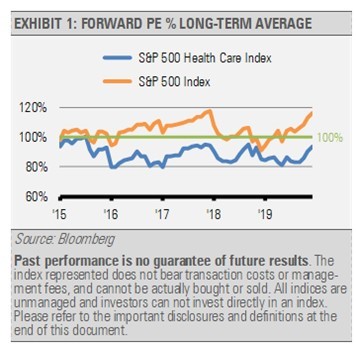
9.Healthcare Sector Trading at Discount to
Historical Average
As the graph below illustrates, the S&P 500 Index is trading
at a premium (>100%) to its historical average forward price-to-earnings
ratio (PE), while the broad health care space trades at a discount (<100%)
to its historical average.
It’s not clear to me why
business plans are the way they are, but they’re often misused to obfuscate,
bore and show an ability to comply with expectations. If I want the real truth
about a business and where it’s going, I’d rather see something else. I’d
divide the modern business plan into five sections:
Truth
Assertions
Alternatives
People
Money
The truth section
describes the world as it is. Footnote if you want to, but tell me about the
market you are entering, the needs that already exist, the competitors in your
space, technology standards, the way others have succeeded and failed in the
past. The more specific the better. The more ground knowledge the better. The
more visceral the stories, the better. The point of this section is to be sure
that you’re clear about the way you see the world, and that you and I agree on
your assumptions. This section isn’t partisan, it takes no positions, it just
states how things are.
Truth can take as long as
you need to tell it. It can include spreadsheets, market share analysis and
anything I need to know about how the world works.
The assertions section
is your chance to describe how you’re going to change things. We will do X, and
then Y will happen. We will build Z with this much money in this much time. We
will present Q to the market and the market will respond by taking this action.
This is the heart of the
modern business plan. The only reason to launch a project is to change
something, and I want to know what you’re going to do and what impact it’s
going to have.
Of course, this section will
be incorrect. You will make assertions that won’t pan out. You’ll miss budgets
and deadlines and sales. So the alternatives section tells me
what you’ll do if that happens. How much flexibility does your product or team
have? If your assertions don’t pan out, is it over?
The people section rightly
highlights the key element… who is on your team, who is going to join your
team. ‘Who’ doesn’t mean their resume, who means their attitudes and abilities
and track record in shipping.
And the last section is all
about money. How much do you need, how will you spend it, what does cash flow
look like, P&Ls, balance sheets, margins and exit strategies.
Your local VC might not like
this format, but I’m betting it will help your team think through the hard
issues more clearly.
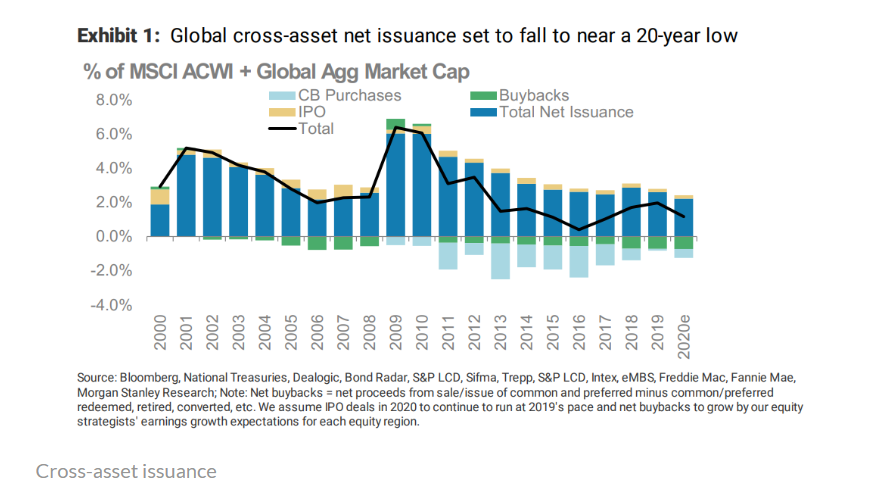
1.Global Supply of Stocks and Bonds at 20 Year Low.
Investors will face the tightest global supply
of stocks and bonds in a year since 2000, a silver lining for fund managers
that are grappling with the onset of global growth concerns at the start of
2020.
That’s
based on calculations from Morgan Stanley strategists who don’t expect a deluge
of issuance to be among the problems investors could confront this year.
Analysts say too much debt or equity supply can sometimes overwhelm fund
managers and other institutional investors, weighing on short-term returns.
“The
supply/technical backdrop in 2020 looks manageable, and is not high on our list
of full-year concerns,” Morgan Stanley analysts wrote in a late Friday note.
The global supply of stocks and bonds is
the tightest in 20 years, says Morgan Stanley—Sunny OH. Marketwatch
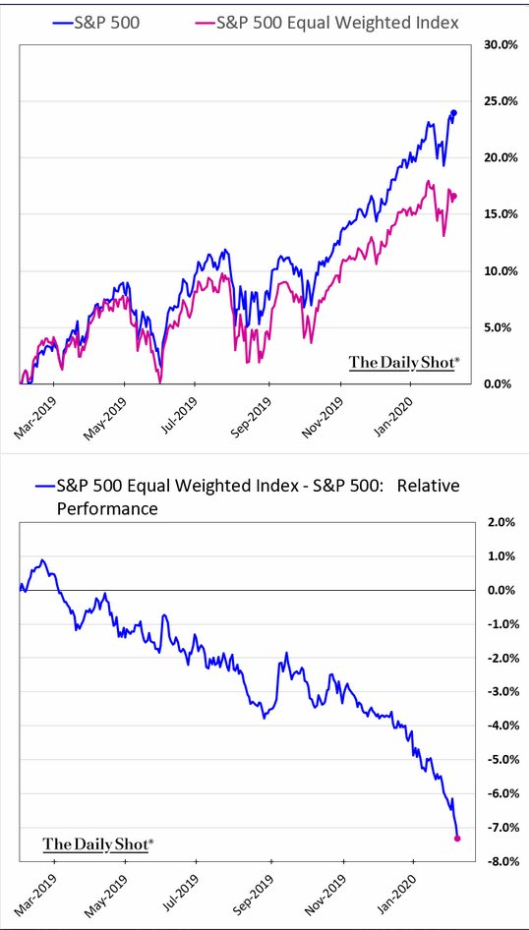
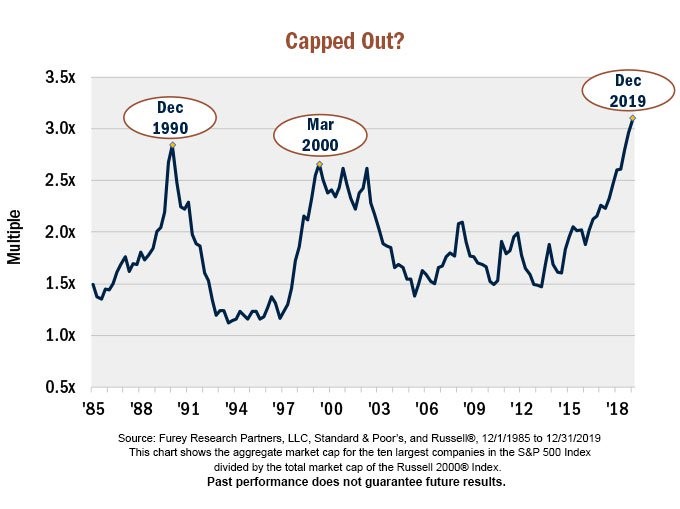
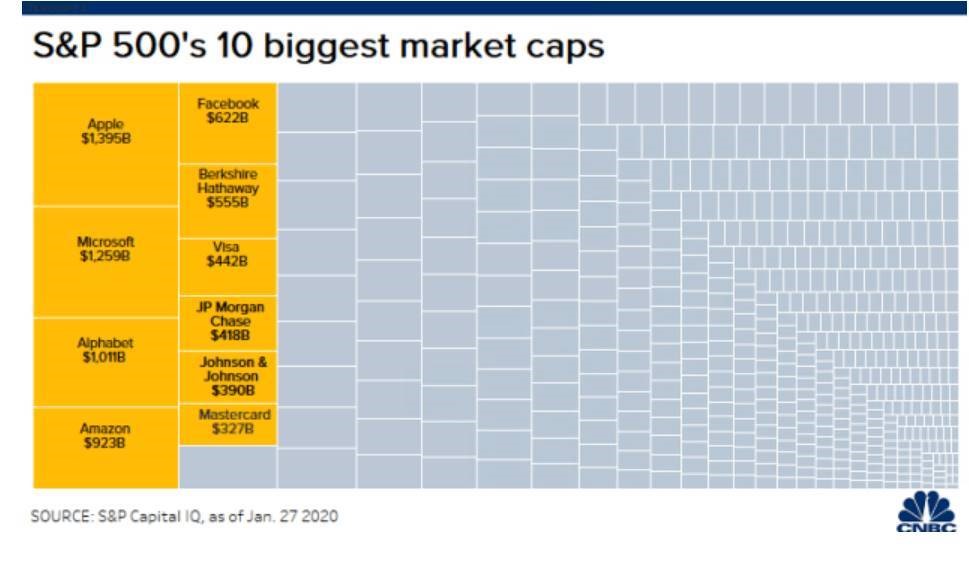
1.The 10 Largest Companies in the S&P Have a Combined Market Cap of More Than 3x the Entire Russell 2000 Index.
The march higher took on a familiar feel as
larger names continued to outpace smaller. The pull of large companies has
become so strong that, as shown [below] [to the right], the 10 largest
companies in the S&P 500 have a combined market cap of MORE THAN 3X
THE ENTIRE RUSSELL 2000® INDEX of small companies.
This type of stampede into pricey mega-caps has historically ended poorly for
those who followed the crowd.
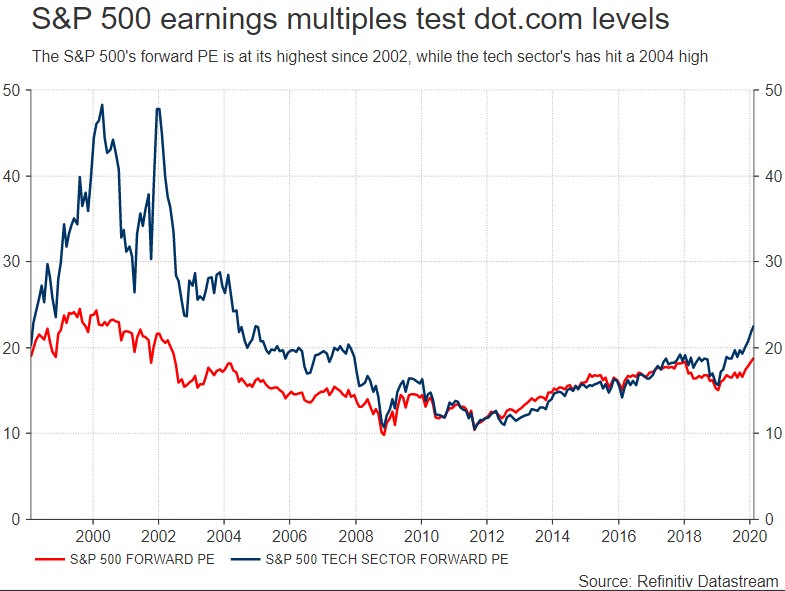
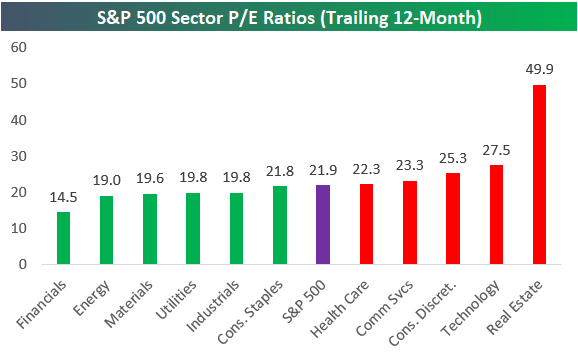
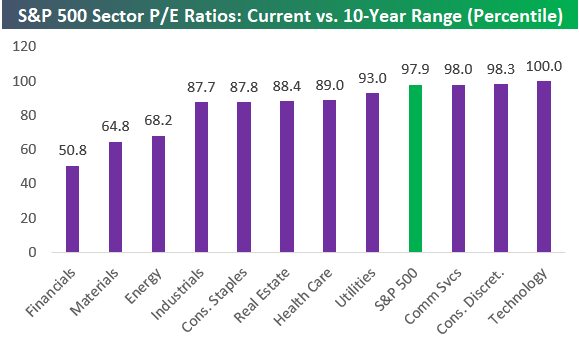
We continue to see elevated P/E ratios. The S&P’s trailing 12-month P/E is currently 21.9, while Real Estate is at 49.9, Technology is up to 27.5, and Consumer Discretionary is at 25.3. The only sector with a P/E ratio below 19 is Financials at 14.5.
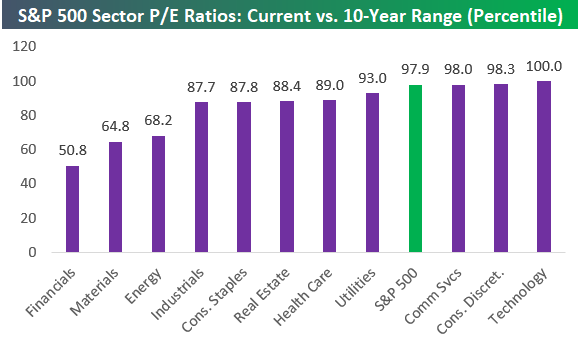
Absolute levels of valuations like the chart above don’t tell you much. The chart below shows where valuations stand for sectors relative to levels seen over the last ten years. As shown, the S&P 500’s current P/E ratio is higher than 97.9% of all other P/E readings seen for the index over the last ten years. That’s high! And three sectors have valuations in the 98th percentile or higher, with Technology at the top at 100%. Over the last ten years, Tech’s P/E ratio has never been higher.
The only sector where valuations are currently “average” compared to the last ten years is Financials. Sign up for Bespoke Premium and get half off your first three months. Click here for this special offer.
Qassem Soleimani, leader of the foreign wing of
Iran’s Islamic Revolutionary Guard Corps, was killed in a U.S. airstrike at
Baghdad’s international airport Friday, local time, escalating long-brewing
animosities between Tehran and Washington.
President Donald Trump authorized the airstrike that
killed Soleimani, a top Iranian general who is considered
one of the most revered military leaders in the Islamic Republic: “At the
direction of the president, the U.S. military has taken decisive defensive
action to protect U.S. personnel abroad by killing,” the U.S. Department of
Defense said in a statement.
In a tweet, Iran’s
Foreign Minister Mohammad Javad Zarif described the strike that killed the
general as an act of international terrorism: “The US’ act of international
terrorism, targeting & assassinating General Soleimani—THE most effective
force fighting Daesh (ISIS), Al Nusrah, Al Qaeda et al—is extremely dangerous &
a foolish escalation,” he wrote on Twitter. “The US bears responsibility for
all consequences of its rogue adventurism,” he said.
The US’ act of international terrorism, targeting &
assassinating General Soleimani—THE most effective force fighting Daesh (ISIS),
Al Nusrah, Al Qaeda et al—is extremely dangerous & a foolish escalation.
The US bears responsibility for all consequences of its rogue adventurism.
The U.S. has said that
the assassination of Soleimani was an attempt to deter attacks against U.S.
embassies, service members or diplomats.
Here’s why the death of
the general is particularly significant in the intensifying tensions between
the U.S. and Iran.
Who was Soleimani?
“He’s probably the most powerful figure that is
generally unknown outside Iran and the Middle East. He’s essentially Iran’s
viceroy for Iraq,” Jim Phillips, Middle East analyst for conservative think
tank the Heritage Foundation, was quoted as saying in a 2015 interview with NBC News.
Soleimani rose to prominence during
the 1980–’88 Iran-Iraq War, and by 2013 had become one of Iran’s most important
figures.
Soleimani was named major general of the Quds
Force in 1998 and ran it until his death. The Quds Force has no equivalent in
the U.S. but has been described as “analogous to a combined CIA and Special
Forces,” according to an article in the New
Yorker back in 2013. The Quds Force, which is estimated to
consist of about 20,000 personnel, has been designated a terrorist group by the
U.S. since 2007, according to reports.
The New Yorker article also
described Soleimani as “ the single most powerful operative in the Middle East
today,” citing former CIA officer John Maguire.
Reports have had also
described Soleiman as second to only the Supreme Leader Ayatollah Ali Khamenei
in power in Iran.
In fact, Khamenei has
referred to Suleimani as “a living martyr of the revolution,” and last March
expressed hope that he would die as one.
“I hope that Allah the Exalted will reward and
bless him, that he will help him live a blissful life and that he will make his
end marked by martyrdom,” Khamenei said as
he awarded Soleimani the Order of Zulfaqar — the
highest miliary honor in Iran that was established in 1856 and had not been
awarded since 1979 until it was revived to honor the Quds Force commander.
To some U.S. leaders, Soleimani has been viewed
as a shadowy figure. Secretary of State Mike Pompeo referred to him as “dangerous
as Islamic State leader Abu al-Baghdadi,” who was killed in
a U.S.-led raid in northwestern Syria in late October.
“Qassem Soleimani has the blood of Americans on
his hands, Bret, as does the force that he leads, and America is determined each
time we find an organization, institution or an individual that has taken the
lives of Americans, it is our responsibility,” Pompeo told Fox News’s Bret
Baier in an interview back in April 2018, after the U.S. designated Iran’s
Revolutionary Guards Corps a foreign terrorist organization,
marking the first time that the U.S. has labeled an entity of another
government as a terrorist organization.
It isn’t clear how Iran will respond to the
death of the revered leader, but analysts and observers on Friday were
speculating that Tehran would consider Soleimani’s death an act of war.
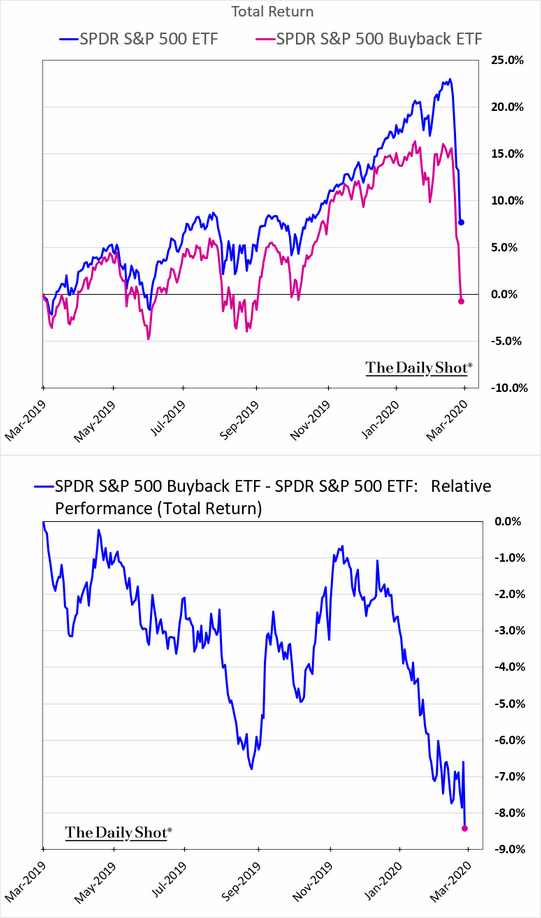
1.334 Out of
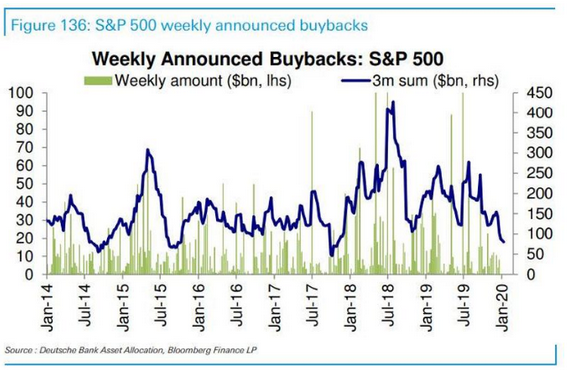
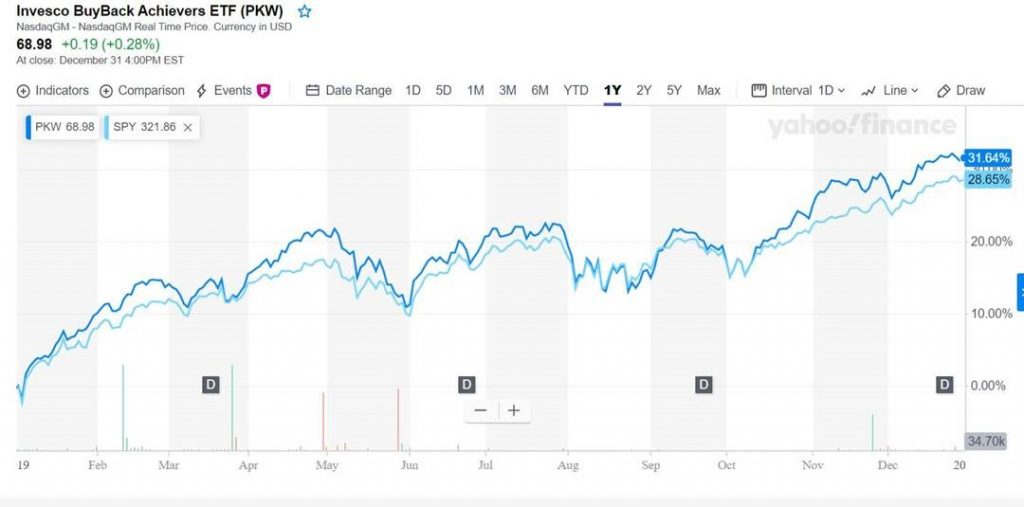
500 S&P Companies Shrank Shares Thru Buybacks This Year.
Yet unprecedentedly low interest rates have allowed the private
and public sectors to borrow cheaply and seemingly without cares. U.S.
corporations have been able to issue bonds to repurchase shares, arbitraging
the cheaper cost of debt versus equity capital, as Nicholas Colas, co-founder
of DataTrek Research, points out in a research note. Some 334 of the S&P
500 companies shrank their shares outstanding in the past year, with 115 of
them cutting their share count by at least 4%. The U.S. government,
meanwhile, runs a trillion-dollar annual budget deficit with the economy at
full employment, and the markets barely notice.
Count on This: Next Year’s Financial
Markets Won’t Be So Nice-Randall W. Forsyth
1.Ten Years
Into Expansion Discretionary Spending for Consumers and Corporates is Still
Below Historical Average.
Check out Torsten Slok on
CNBC Monday
I will be on CNBC tomorrow
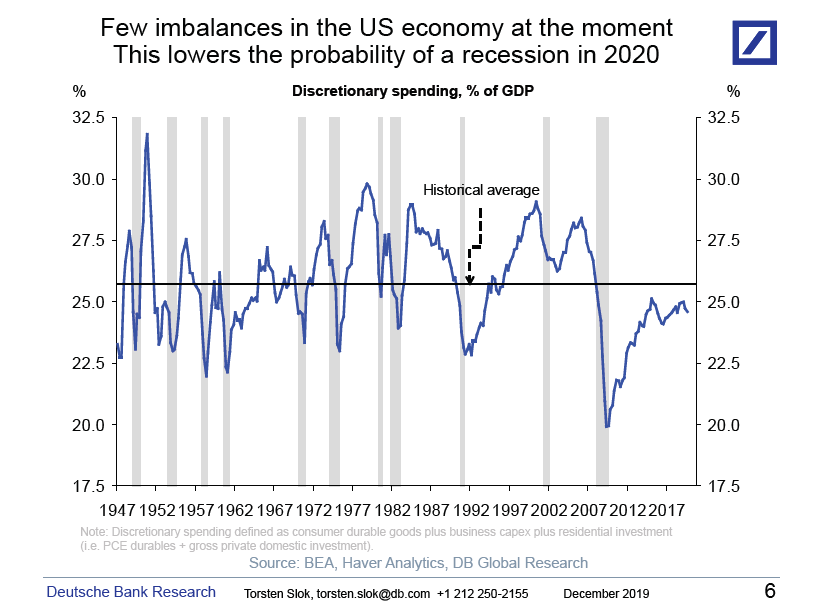
at 10 am to discuss the outlook for markets in 2020. This expansion has been characterized by an extreme
degree of caution among consumers and corporates. Because of the experience in
2008-2009, households and companies have been hesitant to spend too much money
and take too much risk. As a result, ten years into this expansion,
discretionary spending for consumers and corporates is still below its
historical average. As the chart below shows, this is highly unusual compared
with previous cycles. The lack of willingness to spend on consumer durables and
corporate capex is also the reason why this expansion has been so weak. And it
is also the reason why this expansion could continue for many more years; we
are simply less vulnerable to shocks in 2020 because there are few imbalances
in the economy, see again chart below and here
and here.
———————————————–
Let us know if you would like
to add a colleague to this distribution list.
Torsten Sløk, Ph.D. Chief Economist Managing Director
1.Since
1928 the S&P is Up Just Over 50% of Trading Days But that Translates to a
18,000% Return.
Happy holidays from Bespoke! Please see the bottom of this email for a great membership deal. Also, tune in to CNBC between 12:15 PM ET and 1:15 PM ET today to see Bespoke’s Paul Hickey.
52.3%. That’s the percentage of all trading days throughout the S&P 500’s history since 1928 that have been up days for the market. Even though just barely more than 50% of trading days have been up days, it has translated into a price change of 18,157% for the S&P 500.
Casinos are wildly profitable using a similar format. They only have to win slightly more than 50% of all bets made to make a tremendous amount of money. The beautiful thing about investing in the stock market is that you get to be the casino for once!
2019 has been a great year for the S&P 500 with a gain of more than 28%. As shown below, the index only needed to trade higher on 59.3% of days to generate a 28% gain. But positive days occurring 59.3% of the time in a trading year is actually very rare. Only five other years since 1928 have seen up days more consistently with the most recent coming in 1995 when 61.9% of all trading days were positive.
(Past performance is no guarantee of future results.)
Our 2020 Outlook report is a must-read heading into the new year. Really.
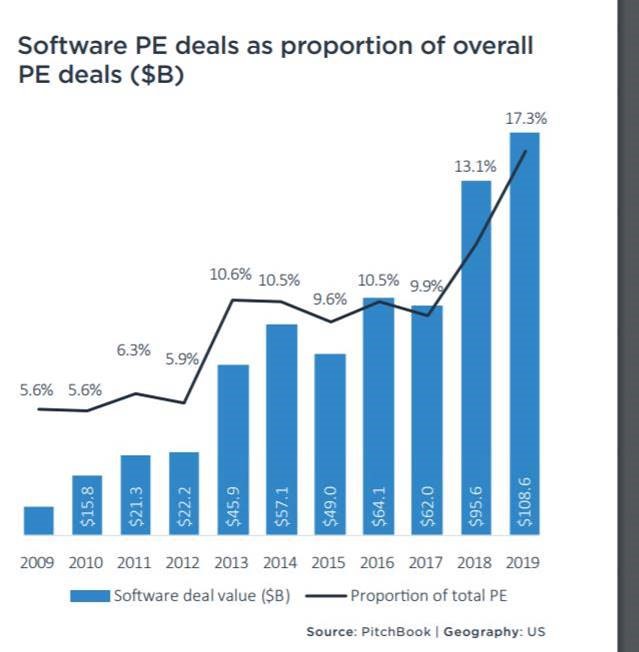
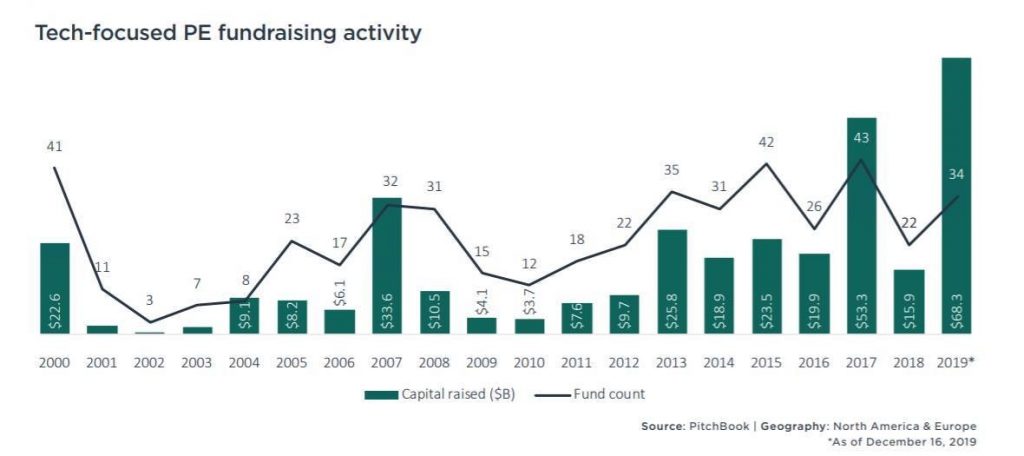
If you haven’t maxed out on holiday spending or if you have research budget left for 2019, consider joining Bespoke for HALF OFF for the next 12 months! Our 2020 Outlook report is included with whichever member From 2006 to 2017, the number of PE-backed companies increased 106% while the number of publicly traded companies fell 16%. ship level you choose.
1.Volatility of Equities
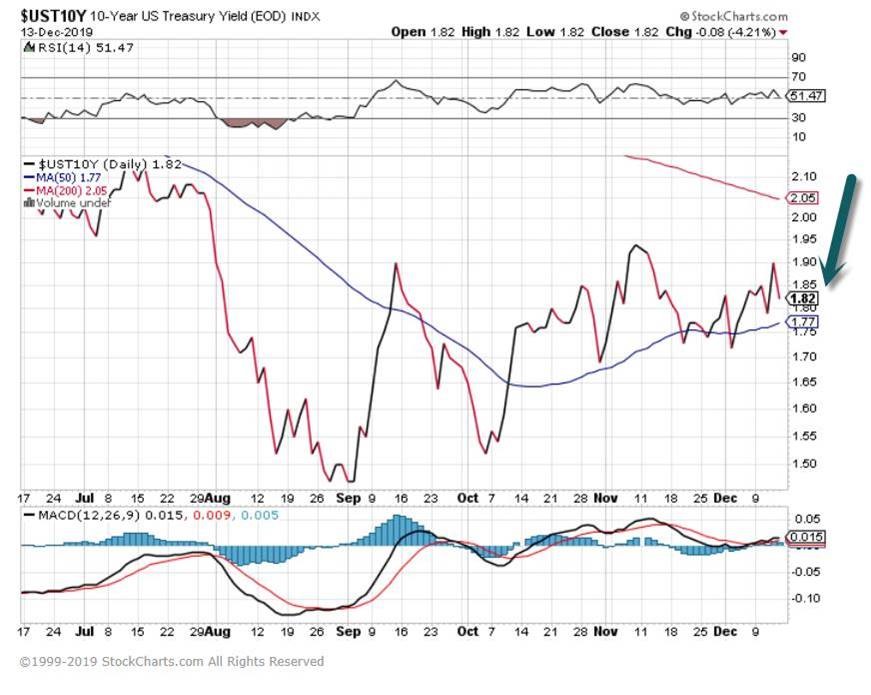
40% Lower When Bond Yields Below 3%
Barrons…That’s
key, since continued low rates provide the ideal environment for equity
investors, writes James Paulsen, chief investment strategist at the Leuthold
Group, in a client note: “At least for the last 93 years, the opportunity to
invest in stocks when the 10-year Treasury yield is below 3% has proved to be a
‘gift’.” (The benchmark note ended the week at 1.82%, down 0.02 of a percentage
point.)
Adding
equities to a portfolio when yields are under 3% sharply boosts returns without
significantly increasing overall risk, Paulsen finds, based on the record from
1926 to 2019. The volatility of an all-equities portfolio is 40% lower when
bond yields are below 3%, he further found, while future 12-month returns were
negative only 18% of the time. When bond yields rise to 3% to 4%, however,
the risk-reward trade-off for adding stocks is much less attractive, he says.
We Have a Trade Deal and Brexit
Clarity. That’s Good News for Stocks.
4.How SALT Has
Iced Home Prices in High Tax States
Wed,
Dec 11, 2019
In the past couple of days, we’ve released
a few more sections of our 2020 Outlook Report including those
on Washington, Commodities, and Housing. In addition to gauging the
overall health of the economy and potential for future economic growth, in
the Housing section, we also discussed home
price trends using the gold standard for housing prices: the Case-Shiller Home
price indices. Below is a complimentary excerpt from the Housing section of our 2020 Outlook Report. To view the
entire section and gain access to all of the other sections (plus the rest of
our research offering), join Bespoke Premium with this 2020 special offer.
The Case-Shiller indices saw home price growth slow sharply in 2018 from the
6% to 7% YoY range all the way down to the 2% range, but in 2019 home price
appreciation began to pick back up. One significant cause of the
fluctuations in home prices over the past couple of years has been the
implications of tax policy.
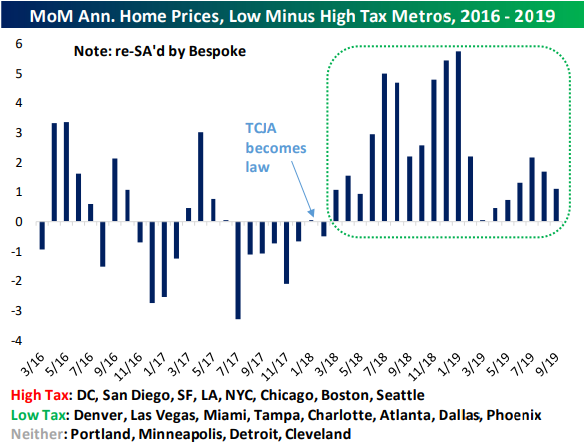
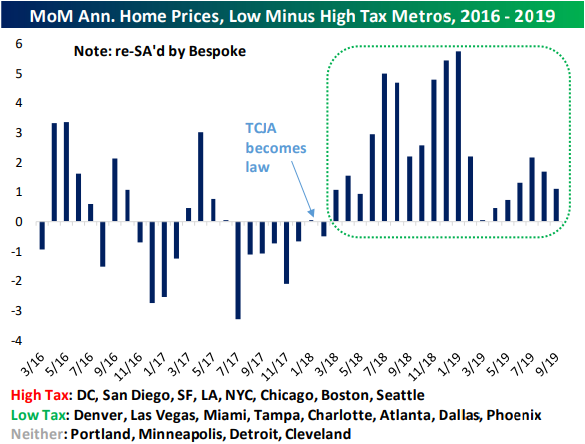
Prior to the passage of the Tax Cuts & Jobs Act (TCJA) at the end of
2017, relatively high and low tax metro areas had no consistent home price
trends relative to each other. The Trump tax bill capped SALT (state and
local taxes) deductions, however, which hurts higher-tax metro areas like DC,
LA, New York, and Chicago more than lower-tax metro areas like Denver, Las
Vegas, Charlotte, and Dallas. This has resulted in home prices rising more in
low-tax jurisdictions versus high-tax jurisdictions in each month since early
2018 as shown in the chart below. This trend is not likely to last forever,
especially as the effects have already waned in 2019 compared to 2018, but the
TCJA has certainly been a big penalty for homeowners in high tax metros, and
the data proves that out.
5.Percentage
of Investment Grade Corporate Rated Single A or Higher at an All-Time Low.
Jeffrey Gundlach on the Corporate Bond Market:
The percentage of the investment grade
corporate bond market that’s rated single A or higher is at an all-time low. It used to
be two-thirds of the corporate bond market was rated single A or higher, 25 years ago. Now it is 35% of
that market. So, the rating is actually worse. So, the yield spread should be
higher than average. Not at near a low level.
So, that is a very bad
sign.
Is the glass half full or half empty? Whether you’re an optimist
or a pessimist, your tendency could be hindering your ability to achieve career
success and attain a rich life.
If it is, Mark Ford explains how you can move forward.
Boldness
in taking on new business opportunities is considered a virtue by many… and
timidity a vice.
I’m not
so sure.
When I am
bold, I often gamely invest my time and money into projects that are foolish,
unnecessary, and/or unlikely to succeed. When I am feeling timid, I shy away
from good and likely opportunities.
Emotional
tendencies matter. If you know your basic nature, you’ll be able to make better
business and investment decisions by taking contravening measures against your
dominant mood.
But how
do you figure out such a thing?
Determining
Your Basic Nature
Are you
fundamentally an optimist or a pessimist? Answering the following questions
should help you find out.
When offered investment or business opportunities, are you
instantly and positively excited?
Do you often take on projects that you regret later on?
Do you enjoy meeting new people, seeing new sights and going on
adventures?
When talking about a new business or investment with friends or
colleagues, do you tend to exaggerate the benefits and profit potential?
Do you often take on social obligations you later regret?
If you
answered yes to three or more of the questions above, I would call you
generally optimistic. You may even be overly optimistic.
Now
answer these five questions.
Do you feel that, generally speaking, you have more challenges
and obligations than you can properly handle?
In social situations, do you find yourself often thinking about
business obligations or problems? Do you have difficulty staying in the “here
and now”?
Would you rate your boss and colleagues negatively?
Do you often feel anxious or even sad about going on business
trips or attending business functions?
Do you fantasize about retiring or quitting your job and getting
another one?
If you
answered yes to three or more of these last five questions, you might have
pessimistic tendencies. If you answered yes to all five, you are probably
overly pessimistic.
Admittedly,
this is not a scientific test. But optimism and pessimism aren’t really
scientific terms.
And as I
said above, emotional tendencies matter when it comes to business decisions. To
push back against your dominant mood, here is what I recommend doing…
Optimists,
Curb Your Enthusiasm
Understand
that there is a part of your brain that is not operating efficiently. That is
the part that, in other people, causes doubt and fear.
Be happy
that you have a frame of mind that gives you the feeling that you can
accomplish just about anything, but promise yourself that you’ll run all your
important impulses through an outside filter.
Don’t
sign any contracts or agree to any business deals without running them by a
trusted lawyer and accountant first. Tell your advisors that their job is to
spot the problems and to be tough on you when you try to dismiss them with
quick rhetoric. (That’s what you’ll want to do when they toss a pail of cold
water on your fire.)
Don’t buy
anything expensive on the spot. Don’t hire anyone on the spot. Don’t fire
anyone on the spot. Don’t take a job on the spot.
Don’t
send out “reactive” emails on the spot. Wait 24 hours, and then either delete
or modify the email. If, in reading the email 24 hours later, you get angry
again and want to send it out unchanged, hold off for another 24 hours. Don’t
send out that first email under any circumstances. You will regret it.
Don’t
ever say anything in an email about anyone unless you wouldn’t mind them
reading it… because they surely will. The same rule applies to anything written
in letters or spoken on the phone or in person.
Pessimists,
Fill Your Glass a Bit More
Accept
the fact that you have some deficiency in your brain chemistry. Recognize that
your instinctive tendency to see the dark side can sometimes limit your success
by dampening your enthusiasm or the enthusiasm of others.
Be happy
that you have a natural ability to detect the potential problems in every
situation. Use that talent to assess the risks and problems inherent in any
major venture you undertake.
Make it a
habit to always say something positive before you say whatever it is that’s on
your mind.
After you
get through writing your daily task list, spend five or 10 minutes visualizing
every task. Imagine yourself happily achieving the objective. Even if you find
the job odious and the person you are doing it with repugnant, find some way to
imagine actually enjoying the experience.
This may
seem like advice that borders on the silly – it certainly did to me when I
first tried it – but you’ll be amazed at how well it works.
Practice
smiling in the mirror. Do this as often as you can stomach it. And then do it
some more. Again, this advice may seem ludicrous… but it will work.
When
talking on the phone, smile. The person on the other end is cueing off the
energy from your voice. If you want him to respond enthusiastically to your
ideas, you need to breathe that enthusiasm into the tone of your voice.
Every
time you see someone for the first time, greet him or her with a firm
handshake, a smile and a confident “eye lock.”
Recognize
What Mood You Are In
You may find
that your mood swings between optimism and pessimism. If you are like me, that
swing can be very large.
After
going through a rather deep depression some time ago, I began to chart my
mental state in terms of how I felt, what I thought about and what sort of
functionality I had.
At the
bottom of the scale, I felt suicidal, had repetitively negative thoughts, and
could not get out of bed or even carry on a conversation. At the top of the
scale, I was euphoric. I loved everyone and everything I encountered.
By
logging my moods, I discovered that when I was below a 6, I made bad decisions.
I shied away from every challenge or opportunity, including many that could do
me nothing but good.
When I
was above an 8, I often made bad decisions in the other direction. I would take
on almost any new project or invest in any new business opportunity.
Nowadays,
I follow a rule that keeps me in good stead. I never make business or
investment decisions unless I’m in the 6 to 8 range.
You don’t
have to use my system to get the same effect. Simply recognize that if you have
significant mood swings, you should defer decisions when you are feeling
especially good or bad.
In other
words, say yes to new opportunities only when you are not being swayed by your
emotions. Whether optimistic, pessimistic or something in between, recognize
that whatever your goals are, you’ll have a better chance of achieving them if
you approach them with a level mood.
Advisor
Perspectives welcomes guest contributions. The views presented here do
not necessarily represent those of Advisor Perspectives
Clickhereto watch a video and learn more about
Evidence Based Advisor Marketing.
If your ego
is too loud, it stops you from reaching your goals and having a happier, more fulfilling
life.
That’s the
message from Scott Barry Kaufman, a psychologist at Columbia University, in an
insightful article published
in Scientific American.
The problem
Kaufman
defines your ego as, “that aspect of the self that has the incessant need to
see itself in a positive light.” He claims that, “the more the ego is quieted,
the higher the likelihood of actually reaching one’s goals.”
His views
are shared by Mark R. Leary, the author of The Curse of Self. Leary
observed that “egoism” can “profoundly affect people’s lives, interfering with
their success, polluting their relationships with other people, and undermining
their happiness.”
Kaufman and
Leary advocate self-awareness and reflection. Both are essential for reaching
your goals. Problems arise when our egos are so “noisy” they actually impede
the goals we are trying to achieve. Kaufman puts it this way: “A noisy ego
spends so much time defending the self as if it were a real thing, and then
doing whatever it takes to assert itself, that it often inhibits the very goals
it is most striving for.”
The
solution
Instead of
adopting a defensive posture in an effort to prove you are “right,” and being
concerned about self-enhancement, Kaufman suggests you quiet your egos, which
will foster a sense of well-being, health, self-esteem and other benefits.
Having a
quiet ego means being less concerned about getting across your point of view
and more concerned with identifying with the experience of others. Instead of
dominating a conversation, show your interest in what others are saying. Not
only is your behavior a form of kindness, it will be perceived by the other
person as being compassionate.
Those with
quiet egos have a “detached awareness,” which permits them to see both sides of
an issue. They are open to reexamining their thoughts, positions and beliefs.
They have
an “inclusive identity.” They are cooperative and compassionate toward
others, rather than focusing on themselves.
Marketing Services For
Evidence-Based Advisors…and a New Book!
We offer consulting services on how to convert
more prospects into clients through Solin Consulting, a division of Solin
Strategic, LLC. Our evidence-based persuasion strategies have
significantly increased conversion rates for our coaching clients. I’m
available to speak at events. I also provide individualized coaching using
videoconferencing.
We offer a full range of digital marketing
services exclusively to evidence-based advisors through Evidence
Based Advisor Marketing, LLC . These services include: web and
content creation and the creation of innovative videos. You can see websites we
have designed, content we have drafted and videos we have produced here.
Click here to request a
free, no obligation website evaluation.
I’m working on a new self-help book for the
general public. It’s called:
Why it’s
important
Success as
an advisor is largely dependent on your ability to make an emotional connection
with prospects and clients. A “noisy” ego leaves little room for focusing on
others. Your bandwidth is absorbed by a preoccupation with yourself – how you
are being perceived, your views on the issues, your background and expertise.
The list goes on…and on.
When you
quiet your ego, you appreciate it’s not about you. It’s about your ability to
focus intensely on your prospect, client, loved ones and colleagues.
On a macro
level, Kaufman observes, “I don’t think it’s an overstatement to say that the
cultivation of these skills in our society would lead to greater mental health,
useful reality-based information, as well as peace and unity among humans.”
Get Dan’s
investing insights by signing up for his free, weekly newsletterhere.
1.Trading in
U.S. Stocks Has Increased 177% Over the Last 15 Years.
Phil Mackintosh-Nasdaq–Nasdaq Says Fears ETFs Are
Eating Stock Liquidity Are Unfounded – Trading in U.S. stocks has increased 177%
over the last 15 years, Phil Mackintosh, the exchange’s chief economist,
wrote in a note last week.
U.S. markets hosted about $164
billion additional stock trades every day last year versus 2004; by contrast, average daily
ETF trading has increased $93 billion over the same time frame, albeit from a
smaller base.
These
are the 20 best-performing stocks of the past decade, and some of them will
surprise you–Some lesser-known companies have special advantages in their
industries PHILIPVAN DOORN
After delivering three interest-rate cuts this
year, the Federal Reserve seemed to indicate that it “would need to see a
really significant move up in inflation that’s persistent before we even
consider raising rates to address inflation concerns.” As a result of
this, the bank expects fund rates to remain unchanged in 2020.
Earlier this year, the bank’s economists put the risk of a US
recession within the next 12 months at one in three. Now it’s cut the chances
to one in five.
“The
current expansion is now the longest in US business cycle records dating to the
1850s, and some recession fears may simply reflect an instinctive sense that
its time is nearly up,” the economists said.
“This
has not been an unreasonable thought historically, as the two usual late-cycle
risks-inflationary overheating and financial imbalances-often did grow over
time. But so far both risks look limited,” they added.
Low recession risk, faster growth, and
unemployment at a 70-year low — here are Goldman Sachs’ predictions for the US
economy in 2020–Yusuf Khan
1.When
You’re Born Will Affect Returns….Two 30 Year Comparisons.
When you’re born has a
huge impact on lifetime investment returns. Genetics play a role
in our health, and when we’re born has a big effect on our portfolio. An
investor born in 1902 that invested 100% in U.S. stocks (VTI) from 1932 to 1962 earned 10.2% per
year – turning $100,000 into an inflation-adjusted $1.8 million.
Shifting the investment window to
1965 to 1995 results in only earning $343,000. We can’t control when we’re
born, so it’s important to focus on what we can control: saving more money,
reducing fees, and increasing diversification.
1.New
All-Time Highs in Equities Still Led by Large Cap.
When we examine these
areas of the broader market by way of the aggregated S&P 1500 Index, we
find that a total of 237 stocks (about 16%) within the index have moved to new
all-time highs since October 1st. As shown in the chart below, we can see that
some areas of the market are participating more in this rally than others.
Large caps have led the way, not only by performance but also by
headcount, accounting for 116 of the 237 stocks (48.9%) moving to new
highs. Mid-caps are next in line with 94 stocks (39.6%), followed by small
caps with 27 stocks (11.4%).
1.M2 Money
Supply Growing at 10.4% Clip Over Last 3 Months.
“Jason
DeSana Trennert, who runs Strategas Securities, notes that the M2 money
measure—cash, checking, savings deposits, small certificates of deposit, and
money-market funds—has been growing at a rapid 10.4% annual clip over the
past three months.
Supporting that growth
has been the rapid expansion of the Federal Reserve’s balance
sheet, which has climbed at a 31% yearly rate over that span. While the Fed
says its monthly buying of $60 billion of Treasury bills doesn’t represent
quantitative easing—the central bank’s past rounds of securities purchases to
stimulate the economy—Trennert calls it a “distinction without difference for
owners of risk assets,” such as stocks. The expansion has been international,
adds Evercore ISI, which points out that the balance sheets of the European
Central Bank and the Bank of Japan also are headed
higher.”
Going back to 1928, there have been 17 occasions when the S&P
500 has scored an annual gain bigger or equal to 25%.
And 71% of the time, the S&P 500 is positive in
the following year with an average gain of 7%, a CNBC analysis using
FactSet data found.
The S&P 500 has only had five negative years following a 25%
annual return since 1928.
The
record-breaking rally has brought the S&P
500′s return this year to nearly 25%, and if the gains hold up for
the rest of the year, the market could have more room to run in 2020 if history
is any guide.
Going back
to 1928, there have been 17 occasions when the S&P 500 has scored an annual
gain bigger or equal to 25%. And 71% of the time, the S&P 500 is positive
in the following year with an average gain of 7%, a CNBC analysis using FactSet
data found.
The S&P
500 was up 24.5% for the year through Friday’s close. Futures were pointing to
some more gains on Monday.
The average
is skewed by a 36% loss in 1936 around the Great Depression. Looking at the
average performance in the “modern” era from 1950 forward, the average annual
performance is a gain of 11.25% for the S&P 500 after a banner year.
The S&P
500 has only had five negative years following a 25% annual return since 1928.
Wall Street
strategists and investors have said it’s all coming down to President Donald Trump and
the China trade war if the market can close out the year with solid gains. The
market has been moving on any development in the U.S.-China trade war for
nearly two years.
Optimism on
a trade resolution has risen recently after the two countries reached a truce
and started working up a so-called phase one deal. White House economic advisor
Larry Kudlow said the two countries were “getting close” to reaching a trade deal,
sending stocks to new all-time highs.
To be sure,
next year could be unpredictable due to the upcoming presidential
election. Wall Street is already worried about the
ascent of Massachusetts senator Elizabeth Warren and her wealth tax proposals.
Notable investors including billionaire Paul Tudor Jones and longtime
investor Leon Cooperman have warned of a market correction, should Warren take
the White House.
1.Investors have Sold $230 Billion in
Shares this Year Amid a 20% Rise in Global Markets
That said, Citi Says Next Leg in
Bull Market Coming as Outflows Turn Around – Investors have sold a net $230
billion in shares this year amid a 20% rise in a gauge of global stocks – That has only
happened twice before and when the trend reversed, inflows helped spur another
20% gain over the next year, they said. “November is on track to be the
first month of inflows into emerging and developed market equities funds in two
years,” the Citi team wrote. “If they continue, this could add further momentum
to the rally.”
1.Per capita liquid milk
consumption in the U.S. has declined more than 40%
since 1975.
And the company’s
deeply distressed 6.5% bonds maturing in March 2023 recently traded at 15.5
cents on the dollar to yield 87.6%, according to IHS Markit. The spread is
8,584 basis points above comparable Treasury yields.
Dean Foods declares
bankruptcy …The drop to penny stock.
No. 1 milk company declares bankruptcy
amid drop in demand
Shares
outstanding in long-volatility ETPs are at record highs
Sheer size
of VIX short contracts still shy of 2019 peak
Bearish bets on stock volatility are close to a record
high, raising investor concern that the market is ripe for turmoil. There’s a more
benign explanation.
Futures linked to the measure of S&P 500’s implied
volatility, known as the “fear gauge”, tend to move inversely to equities. The
net non-commercial position — long contracts outstanding less short positions
— sank to minus 187,948 last week, its lowest level ever.
That valuation still seems bubblicious; a 1% yield on a bond is
analogous to a stock with a price/earnings multiple of 100. With a high P/E
stock, you’re betting on big growth down the road. A bond returns only face
value at maturity, assuming it’s paid off as promised.
The drop in Austria’s century bond’s price to 168 from 210 still
qualifies as a bona fide bear-market decline of 20%. Brigden’s price target is
for a further fall, to 143.50. Such price swings typically are associated with
tech stocks, not stodgy government bonds.
None of the negative bond yields (still totaling $12.8 trillion)
would be possible without European Central Bank policies, Brigden points out.
“The ECB brought European yields down by two policies; quantitative easing (a
pseudo fiscal policy) and negative rates (punishing thrift to boost asset
prices).” Those policies may be reaching their limits, however.
Not only is the ECB close to running out of bonds to buy, in the
case of German and Dutch debt, he writes, but other European monetary
authorities are beginning to question the usefulness of negative policy
rates, notably Sweden’s Riksbank. An
article published earlier this year by
the Federal Reserve Bank of San Francisco also questioned the effectiveness of
the Bank of Japan’s negative interest rates.
As earnings continue to roll in this earnings season, one interesting dynamic has been the contrast between the beat rates of companies based upon the share of revenues that come from abroad versus the US. Using data from our International Revenues Database to gauge international exposure and our Earnings Explorerto get third-quarter earnings results, so far this earnings season, the beat rates for companies with more than half of their revenues generated within US borders have held up much better than those with a majority of revenues coming from abroad. Heading into this week, 74.3% of companies with a greater domestic focus have reported EPS above analyst forecasts while only two-thirds of those with a more international focus have beaten estimates. That is a shift from what has typically happened so far in 2019 and illustrates the impact that the strong dollar has had on results.
As shown in the chart below, the current picture is nearly the exact opposite of where things stood a year ago when more than 74% of internationals were reporting EPS above analyst estimates. In regards to sales, although companies with domestic heavy revenues have generally seen higher beat rates, the spread between domestics and internationals has widened to more than 5 percentage points this quarter.
While this could be a result of multiple factors ranging from analysts potentially overestimating global demand to trade, the dollar is also likely a key factor. For large-cap US companies which often have multi-national exposure, movements in the currency markets often have large impacts on corporate results. For that reason, it’s extremely important for investors to know where the companies they own have the greatest exposure. One great tool to track revenue exposure is our International Revenues Database. If you don’t already have access, start a two-week free trial to Bespoke Institutional to unlock access to all of our interactive tools today!
BIG SPLASH– Earnings are making their biggest
splash in the stock market in years – Investors are sharply bidding up
the shares of companies that beat expectations—and appear more willing to
overlook some of the misses—helping to pull the stock market out of its recent
lull. More than three-quarters of the 358 companies in the index that
reported through Friday have beaten estimates. And 66% have risen in subsequent
trading sessions, a five-year high.
Shares of companies that topped
forecasts rose an average of 2% in the two days after reporting results,
beating the five-year average of 1%, according to data compiled by FactSet. Those that
fell short have averaged a 2.1% pullback, below the half-decade average of 2.6%, WSJ reports
1.Venture Capital Raised for Firms That Are Not Profitable
Second Highest Ever.
• Venture
capital and private equity funds have been selling. Of the $42 billion raised
via offerings, $29 billion of it was for firms that were not profitable. This
is the second-highest in at least 25 years. The only year that showed a greater
percentage was 86% in 2000. If they are unloading losing companies, that tells
us that they do not want to hold such companies during tough times. Cycles Research Early Warning
Serviceby Cycles Research
1. Amazon Stock..Cost of Shipping Jumps 46% Year Over Year….Stock Never Made New Highs From 2018
Amazon earnings fall for first time in more
than two years, stock drops in late trading
Amazon’s spending on
one-day delivery and other initiatives sends profit down year-over-year for
first time since 2017, forecast calls for even more spending in holiday quarter
Johannes Eisele/AFP/Getty Images
Amazon.com Inc. has
spent more than $1 billion this year to reduce the amount of time it takes to
deliver packages to Prime customers, and expects a $1.5 billion hit in the
holiday season.
Olsavsky
said in the call that the fourth quarter will see even larger costs from
one-day delivery efforts.
“So, as
we head into Q4 we’ve added what’s just nearly $1.5 billion penalty in Q4
year-over-year for the cost of shipping, which essentially is transportation
costs, the cost of expanding our transportation capacity, things like adding
additional roles and shifts in our warehouses,” the Amazon CFO said.
Amazon’s worldwide
spending on shipping jumped 46% year-over-year in the third quarter to a record
$9.6 billion, more than a half-billion dollars over what Amazon spent in the
busier holiday season a year ago. The company, which cut back on hiring a year
ago after absorbing the Whole Foods workforce and hiring quickly in 2017, also
increased its total employee count by 22% to 750,000 people. Amazon added
nearly 100,000 employees just in the third quarter, according to Thursday’s
release, which Baird analyst Sebastian deemed the “most surprising metric” in
the report.
The earnings outlook in the U.S. is
darkening, but the view from developing markets is perking up. The ratio of
earnings estimates between the S&P 500 and the MSCI Emerging Markets is at
the lowest since early August. Optimism of an end to the trade war
is sending EM stocks and currencies toward their second monthly advance.
Now that new
home sales have reached a new cycle high (in June), I’d like to update a couple
of graphs in a previous post (most of this from an earlier post).
For the economy, what we should be focused on are single family starts
and new home sales. As I noted in Investment and Recessions “New Home
Sales appears to be an excellent leading indicator, and currently new home
sales (and housing starts) are up solidly year-over-year, and this suggests
there is no recession in sight.”
For the bottoms and troughs for key housing activity, here is a graph of Single
family housing starts, New Home Sales, and Residential Investment (RI) as a
percent of GDP.
1.3Q
Earnings Preview….Energy and Tech Biggest Projected Declines.uu
Higher input and labour costs are
expected to have further crimped profit margins. The average net profit margin
is expected to fall to 11.3 per cent in the third quarter from 12.1 per cent in
the same quarter last year, according to FT – Energy is poised for the
biggest drop in earnings after a fall in US crude prices in the third quarter.
The tech sector, caught up in the US-China trade war, is next with EPS
projected to fall by more than one-tenth, according to FactSet. Revenues are
estimated to increase an anaemic 0.3 per cent.
This week’s fund flow numbers from the Investment Company Institute showed that the long, steady rotation from equity mutual funds and exchange traded funds to fixed income funds has continued. As shown below, the spread between equity fund flows and fixed income fund flows has reached a net reading of -$165.9bn over the last three months; that’s among the largest net flow out of equities and into bonds since the data starts.
Fixed income isn’t the only place that retail has been moving allocations to. As shown in the chart below, 13 week commodity fund flows have been among the largest of the periods since the data for ETF and mutual funds combined begins.
Investors are loading up on cash. That’s not a good
sign.-By Andrea Riquier
An analysis from research firm
DataTrek, drawing on fund flow data from the Investment Company Institute,
shows that there was $3.4 trillion in U.S. money market funds as of October 2.
That’s about 14% higher than at the end of 2018, and has risen nearly every
week since May.
“What’s strange about this recent influx of capital is that
short-term rates have been declining all year,” DataTrek founder Nicholas Colas
wrote. Money market funds “are seeing strong inflows in 2019 even as 2-year
yields have been cut in half,” he added.
The paranoia around
presidential elections is hitting record levels, we better stop and listen to
what’s going down. We spend a big portion of our life listening to
storytelling. As kids, parents and teachers tell us stories. As
adults the news media is about storytelling, investing is about storytelling,
and nothing paints a better story than politics. I may be early with this
letter as the presidential election is more than a year away but it’s possibly
shaping up to be the ultimate scary story for investors.
As I write this letter, it is
increasingly looking like a Trump vs. Warren election and a Trump impeachment
investigation, which may be the ultimate binary event for American
voters. Never in history has an election been so important except for
every other election in history. Most of my conservative friends thought
the world would end if Obama got elected and most of my liberal friends thought
the world would end if Trump got elected.
If you made either of those
investing bets based on politics, your wallet is probably lighter. The
chart below shows that Obama obviously did a better job with the economy.
Actually this would be a false assumption, as Obama took office when the
S&P was trading at generational low valuations. The single best
predictor of future returns is where valuations are today, the next President will
not have the luxury of beginning his or her term with low valuations.
The
U.S. labor market keeps chugging along, despite signs of weakness in other
pockets of the U.S. economy.
Nonfarm
payrolls rose 136,000 in September, and July and August payrolls growth were
revised up by 45,000. The 12-month average payrolls change climbed to 179,000
including Friday’s data, still slightly higher than the expansion average.
Overall,
the September jobs report showed hiring has been steady, defying recent worries
of economic weakness after surprisingly weak manufacturing and services surveys
were released earlier this week. Other labor-market measures also look healthy.
The unemployment rate fell to 3.5% in September, a new cycle low, and initial
jobless claims are still subdued.
Wage
growth slowed notably last month, though, hinting that inflationary pressures
could be moderating. As shown in the LPL Chart of the Day, average hourly
earnings growth fell to 2.9% year over year, the slowest pace since July 2018.
5.First
Sign of Peak Jobs? Job Openings Rolling Over.
There was no movement in average hourly
earnings (AHE) relative to the prior month; while the year-over-year growth
rate slowed from 3.2% to 2.9%. The weakness was concentrated in managers’ pay;
while production/non-supervisory wages, although softer for the month, are up
3.5% year-over-year. Wages historically follow corporate earnings, with about a
one-year lag; so the significant deterioration in profits growth this year
suggests further downward pressure on wages. Indeed, although still high in
absolute terms, job openings have rolled over.
In sum
Employment
releases are generally the most influential economic indicators for
economists—and the stock market—as they guide expectations for consumer
spending, consumer confidence, inflation, and income growth. But they have
taken on even greater importance lately for two reasons:
To gauge whether the weakness
in manufacturing is beginning to bleed into the services/consumer segments
of the economy.
The Fed has moved from a
predetermined path for interest rates to a data dependent path, with “full
employment” representing half of the Fed’s dual mandate (the other being
“price stability”).
Welcome to the Working Week: A Look at the State(s) of Employment
Hong Kong
is in the middle of a political crisis. Millions of citizens have been
protesting since June, sparked by an extradition bill that would have allowed
for criminal suspects in Hong Kong to be extradited to mainland China.
Opponents argued that the bill would put Hong Kong citizens at risk of unfair
and violent treatment by Chinese officials. And they worried the bill would
give China greater control over Hong Kong, which China has wanted for a long time.
Vanguard Group, the investment advisor with assets under
management (AUM) in excess of $5 trillion and the largest provider of mutual
funds in the world, is testing a new currency trading platform, reports Bloomberg
citing a person familiar with the matter. Based on blockchain technology, the
peer-to-peer (P2P) platform will enable asset managers to trade currencies with
one another directly, bypassing the need for investment banks.
Business Insider Intelligence
-The FX platform would mark one of the most significant
deployments of blockchain in financial services. Amid considerable hype around
blockchain’s potential to upend existing processes across the financial
services value chain, major players have invested billions on the technology.
Yet, despite those investments, firms have struggled by and large to move their
early experiments to large-scale enterprise operations. If Vanguard can
successfully navigate some of the challenges that have stymied this promise —
from scalability to interoperability — it would act as a litmus test for the
wider industry’s stumbling blockchain ambitions.
-And while success isn’t guaranteed, Vanguard’s pioneering
legacy gives it a considerable advantage. The company has been a major
driver of change within the investment space since it launched in 1975. And
it’s continued this streak in recent years: For instance, while a number of
banks have struggled to take
advantage of the hype around robo advisors, Vanguard’s bucked that trend
significantly. As of this year, the $115 billion AUM it’s amassed via its robo
platform makes it the largest robo advisor, per Robo-Advisor
pro. This ability to leverage emerging technology and trends within the
industry to increase its share of the market makes Vanguard’s efforts to upend
currency trading markets a serious threat to incumbent banks.
8.Blackstone
CEO Stephen Schwarzman: Even billionaires have problems
The chief executive of the world’s largest private equity
company on Trump, bubbles and whether he is on a farewell tour
Danilo Agutoli
By Chris Newlands and Selin Bucak
Even billionaires have problems that money cannot solve. Today,
Stephen Schwarzman’s is traffic.
The chairman, chief
executive and co-founder of Blackstone arrives 15 minutes late for our meeting
at the private equity giant’s London headquarters in Mayfair.
“So many cars on the road,” says
the 72-year-old, whose personal wealth is north of $18bn, according to Forbes.
“It’s a real problem, sorry.”
Schwarzman, who set up Blackstone with Peter Peterson, the
former chairman of now-defunct US bank Lehman Brothers, is in town to promote
his new book What It Takes: Lessons in the Pursuit of Excellence.
One of the lessons cited in
the book — essentially a how-to guide to being rich and successful — is
punctuality. Page 55 reads: “Be on time. Punctuality is the first indicator of
how much thought and preparation you have put into an interview.”
Schwarzman apologises again,
adding: “Have you read the book?”
Lots of people have.
The great and the good have lined up to provide endorsements,
including Jack Welch, the former chief executive of General Electric; Ray
Dalio, the co-chairman of investment company Bridgewater Associates; and
Henry Kissinger, the former US secretary of state.
Even Mark Carney, the
governor of the Bank of England, has taken the time to provide a quote for the
front cover (“This story literally has what it takes”) — a striking move
for the head of an independent British institution, which further illustrates
Schwarzman’s pull.
“Mark told me he has never
ever endorsed a book in his career,” says the American businessman, who hails
from Philadelphia. “I have known him for some time. I sent him the book and he
said: ‘This is terrific, I’m very happy to say what I think.’ You saw what he
wrote. I was very happy about that.”
Schwarzman is used to
rubbing shoulders with the most influential people in politics and finance.
After Donald Trump was elected president in 2016, Schwarzman became head of his
short-lived advisory council, which included Larry Fink, the chief
executive of BlackRock, and Jamie Dimon, the chairman of JPMorgan. The group
was disbanded in 2017 in the wake of the president’s controversial remarks
about a white supremacist rally in Charlottesville, Virginia.
Reports suggest Schwarzman’s
relationship with Trump, who he has known for more than 40 years, has become
frayed. Schwarzman had to distance himself last week from comments made by
the president about the son of former vice-president Joe Biden. Trump is facing
an impeachment inquiry after urging Ukraine to investigate a family member of
the veteran Democrat, who is running for president.
Would Schwarzman like to see
Trump get another term in the White House? “It isn’t relevant what I
think,” he says, sidestepping the question. “We have now, much like you in the
UK, real divided politics. It looks today, on the Democratic side, that we have
Joe Biden and then Elizabeth Warren and Bernie Sanders. And on the Republican
side, there is really only Donald Trump.
“Like any election outcome,
it all depends on who somebody is running against. The Democrats will be running
against Trump, but they as a group are going further and further left. The
further they go left, the more difficult it will be for the Democrats to win.”
We return to safer ground:
the nuts and bolts of the private equity market. Schwarzman and Peterson
launched Blackstone in 1985 following daily breakfasts at New York’s Mayfair
Hotel, where he and the former Lehman Brothers chief executive hashed out
their plan to create a business that would eventually become the biggest and
most influential private equity firm in the world.
In 1987 they raised their
first fund at $800m. Today, Blackstone has $545bn in assets, with its
biggest vehicle, Blackstone Capital Partners VIII, raising an eye-watering
$26bn, making it the largest buyout fund ever.
“When we started the firm we
had $400,000 — $200,000 from me, $200,000 from my partner, Pete, and last
week the company was [valued at] $60bn,” he says.
It raises the question of
whether there is too much money sloshing around the market and whether that
cash can be put to good use. “I’ve been asked that since 1992,” he says. “The
returns have stayed pretty good over the last 25-30 years regardless of peaks
of markets and real collapses.
“When you are managing more
money, the way historically we’ve always dealt with that is you just do bigger
deals. We have never found, despite that question over the decades, that the
amount of capital per se is the issue.
“The nice thing about our
industry is that you don’t have to invest the money for six years. If you think
things are high, you don’t have to play, you can wait. For those of us who have
been doing this for most of our careers, we are used to cycles, it doesn’t
bother us.”
This is not a bubble
compared with 2006/07, he adds. “That was a bubble. I said it was a bubble
then, and it was. Prices now are relatively high, but there is not that frenzy
that happens, because the people who manage the capital have been through the
global financial crisis, and once you’ve lived through that you are not anxious
for a repeat.”
In the book Schwarzman
writes that he does not “feel a day over 38”, the age he was when he launched
Blackstone. It is true that sitting across the table, Schwarzman has a youthful
energy about him for a man born in 1947 but the book, which was two years in
the making, certainly has the feel of a farewell tour.
“No, not at all,” he says
flatly, and we are ushered out of the room ahead of his next meeting.
Envestnet
CEO Jud Bergman could hold court on any of the technological disruptions
affecting financial planners, having co-founded the technological services
giant for the wealth management industry.
But few things could animate him
more than the mere mention of chess.
“I recently had the privilege of
moderating an event panel that included Jud, and I’ll never forget someone
pulling me aside and saying, ‘I’ll bet you anything Jud finds a way to talk
about the game of chess no matter what question you ask him,’” said Riskalyze
CEO Aaron Klein.
“Sure enough, it wasn’t more than
an answer or two into the panel that he started talking about how chess
strategy could teach us something about where financial services was
headed.”
Bergman, 62, and his wife, Mary
Miller-Bergman, 57, were killed in a car collision in San Francisco on Oct. 3,
the company said in a statement. The couple were in a taxi that was hit head-on
by a Volkswagen Cabrio going the wrong way on northbound Highway 101, according
to The Associated Press. The woman driving the other vehicle was intoxicated,
the AP said.
“Today, our entire industry
mourns this devastating loss. Jud’s vision and innovation forever changed the
face of the financial services industry, and will continue to do so for years
to come,” Klein said.
“Looking back, I’m not sure
there’s anyone who has made quite as many chess moves in financial technology
as Jud has, and each move has driven the industry forward and elevated the
profession of financial advice.”
Envestnet’s board appointed Bill
Crager, president of Envestnet and chief executive of Envestnet Wealth
Solutions, as interim chief executive officer. It also appointed Ross Chapin,
the lead independent director of Envestnet’s board, as interim chairman of
Envestnet’s board.
“On behalf of our board of
directors, management team and employees, we extend our deepest sympathies to
Jud and Mary’s family. As Envestnet’s founder, Jud was a remarkable leader whose
vision, brilliance and drive built the foundation for Envestnet’s success.”
Miller was the founder of Hanover
Hill Wealth Advisors in Chicago.
Under Bergman, Envestnet
underwent a remarkable trajectory of growth, from startup in 1999 to a tech
provider able to repeatedly execute multimillion-dollar acquisitions, many
leading brands themselves. The stack of technology Bergman assembled has become
so formidable some predict the company will become a custodian.
Financial planning software firm
MoneyGuidePro was among the latest. Envestnet purchased the Silicon Valley data
aggregator Yodlee in 2015 for $660 million.
At the time, industry leaders
questioned the strategy behind the acquisition, says Joe Duran, CEO of United
Capital. Envestnet stock fell after the announcement, but Bergman was willing
to endure short-term pain to improve his company and the advisors it supports,
Duran says.
“He knew what advisors
needed and was determined to shift the company to support a really complete
suite of services,” he said.
Duran too recalled Bergman’s love
for the game of strategy.
“We both play chess, but never
got the chance to play together,” Duran says. “I suspect he would have beaten
me.”
Industry leaders were stunned by
the news and many sought to convey just how much Bergman did for them on a
personal and professional level.
“I have watched him grow
Envestnet from a startup to one of the leading firms in the industry,” said
Joel Bruckenstein, founder of the Technology Tools for Today conference series.
“Despite his many achievements,
he always had time for others. He was extremely kind to me. He was an industry
visionary and leader. His intellect was impressive as was the breadth of his knowledge.
I will miss him as an industry leader, but more importantly as a friend.”
Orion CEO Eric Clarke expressed a
similar sentiment. “Jud and I had dinner on several occasions and I always had
great respect for the business he built and the way that he built it,” Clarke
says. “Jud had an unprecedented ability to see things that others just didn’t.
“Envestnet is in great hands with
Bill [Crager], but the entire industry will miss Jud terribly,” Clarke says.
Bergman was leaving behind a
legacy of leadership in technology, says Craig Iskowitz, founder and CEO of
fintech consultancy Ezra Group.
“How many different ways can
you say innovator or visionary? How can you explain how one person changed our
industry in ways that we’re just coming to understand? How can you talk about
one CEO who changed how every wealthtech firm approaches the market? There are
no words.”
Many took to Twitter to share
their thoughts.
“This quaint, intimate community
in which we work is never more evident than times like this; when we suffer the
unfortunate loss of one of our own, and this one is profound,” wrote Brian
Hamburger, founder of the Hamburger Law Firm and consulting firm MarketCounsel.
Earlier this year, Bergman
acknowledged in an interview with Financial Planning that
his chess analogies probably needed an update, reflecting on the challenge that
chess champion Gary Kasparov undertook when he played against IBM’s supercomputer
Deep Blue.
With the technological changes
happening on multiple fronts, the best advisors were now engaging in a game of
3-D chess, Bergman said.
“Experts plus machines deliver
better outcomes than experts or machines alone,” he said. “This is a framework
from which advisors, we think, ought to look at how they render advice, how
they manage portfolios and manage client relationships going forward.
“What are
the areas that computer software can do better and what are the areas that the
human expert can do better? This is what Gary Kasparov understood and what the
best advisors understand. There are some things that humans do better than
computers and vice versa.”
Most
of us grew up hearing the mantra “Don’t be a quitter,” and we’ve
internalized it to the point where we feel guilty if we don’t finish a book
that’s boring us to death. Our parents weren’t entirely wrong in saying
that persistence is necessary for success, but
sometimes quitting is the most effective course of action. Whether it’s a
failed project, a thankless job, or a doomed relationship, quitting can be a virtue.
“Quitting is leading too.” –Nelson Mandela
As
it turns out, some of us are really good at knowing when to quit, while others
have a hard time getting “unstuck.” Research from the University of
Rochester found that people are motivated by either “approach goals” or
“avoidance goals.”
Those
who fall into the approach camp are motivated by challenges and don’t waste
time trying to solve problems that simply don’t have a feasible solution. In
other words, they know when to quit.
People
motivated by avoidance goals, however, worry a lot more about failing. They
want to avoid failure at all costs, so they keep plugging away at things, long
after logic suggests it’s time to move on. This is typically a much less
productive way to work.
Knowing
when to quit is a skill that can be learned. If you tend to be stuck on things
long after it’s obvious that what you’re doing isn’t working, you can train
yourself to do better. You just need to practice quitting. Thankfully, life
provides plenty of opportunities to do this. Here are some things we should all
quit doing.
1. Quit doubting yourself. Confidence plays a huge role in
success. Hewlett-Packard conducted an interesting study of the process through
which people applied for promotions at the company. Women, it turned out, only
applied when they met 100 percent of the criteria for the job they wanted,
while men applied when they met 60 percent of the criteria. The researchers
postulated that one of the (many) reasons men dominated the upper echelons of
the company is that they were willing to try for more positions than females
were. Sometimes confidence is all it takes to reach that next level. The trick
is, you have to believe you can. If you doubt yourself, it won’t work. Faking
confidence just doesn’t produce the same results.
2. Quit putting things off. Change is hard. Self-improvement
is hard. Scrounging up the guts to go for what you want is hard, and so is the
work to make it happen. When things are hard, it’s always easier to decide to
tackle them tomorrow. The problem is that tomorrow never comes. Saying you’ll
do it tomorrow is just an excuse, and it means that either you don’t really
want to do it or you want the results without the hard work that comes along
with it.
3. Quit thinking you have no choice. There’s always
a choice. Sure, sometimes it’s a choice between two things that seem equally
bad, but there’s still a choice. Pretending that there isn’t one makes you a
victim who is voluntarily taking on a mantle of helplessness. To play the
victim, you have to give up your power, and you can’t put a price on that. To
succeed at the highest level, you have to quit giving your power away.
4. Quit doing the same thing over and over again and expecting a
different result. Albert Einstein said that insanity is doing the same thing
and expecting a different result. Despite his popularity and cutting insight,
there are a lot of people who seem determined that two plus two will eventually
equal five. The fact is simple: If you keep the same approach, you’ll keep
getting the same results, no matter how much you hope for the opposite. If you
want different results, you need to change your approach, even when it’s
painful to do so.
5. Quit thinking everything is going to work out on its own. It’s tempting
to think that it’s all going to work out in the end, but the truth is that you
have to make it work. This has many implications. Don’t expect your boss to
notice when you’re ready for a promotion, don’t expect your colleague to stop
sloughing work off on you if you’re always willing to do it, and don’t think
that anyone is going to stop walking all over you as long as you allow it.
Everything is not going to magically work out on its own; you
have to be proactive and take responsibility for yourself.
6. Quit saying yes. Every yes you utter is a tradeoff. By
saying yes to one thing, you’re saying no to something else. Saying yes to
staying late at work, for example, might mean saying no to the gym or to time
spent with your family. Research conducted at the University of California, San
Francisco, showed that the more difficulty you have saying no, the more likely
you are to experience stress, burnout, and even depression. Saying no is indeed
a major challenge for many people. No is a powerful word that
you should not be afraid to wield. When it’s time to say no, avoid phrases such
as I don’t think I can or I’m not certain. Saying
no to a new commitment honors your existing commitments and gives you the
opportunity to successfully fulfill them. When you learn to say no, you free
yourself from unnecessary constraints and free up your time and energy for the
important things in life.
Bringing It All Together
There
are dozens of ways we get in the way of achieving our full potential. We doubt
ourselves, we decide that something is just too hard, or we tell ourselves that
we’ll worry about it tomorrow. If you really want to succeed–and I mean really
succeed–stop focusing so much on what you should be doing and, instead,
take a really good look at the things you should quit doing.
What other things should people quit doing? Please share your
thoughts in the comments section, as I learn just as much from you as you do
from me.
1.You Call This A Bull Market?-Bespoke Investment Group
By just about all accounts, investors have been spoiled over the last ten years as the S&P 500 has rallied more than 13% on an annualized basis. However, when you compare returns for the market over the last one, two, five, ten, and twenty years, current returns are hardly at any sort of historical extreme. The chart below compares the S&P 500’s annualized performance on a total return basis to the average annualized return for all similar time frames. Looking just at the last year (through 9/30), the S&P 500’s total return is 4.3%, which is less than half of the historical average one year total return of 11.7%. Looking at two and five-year annualized performance figures, current returns are just modestly above their historical average. While the ten-year annualized return is almost three percentage points above the historical average, the current 20-year annualized gain of 6.3% is well below the S&P 500’s historical average of 11.0%.
1.IPO’s
2019-114 U.S. IPO Pricings-63 Positive Returns.
Follow up to my IPO
comments from last week
Barrons
Amid
the headlines about IPO disappointments, there is a broader takeaway: Investors
have become more discriminating, and that’s good for everyone. “Everything has
changed, and nothing has changed,” says Lise Buyer, founder of Class V Group,
an IPO consulting firm. “Lately, there’s been lots of noise and fireworks, and
hullabaloo about direct listings. But the No. 1 thing is that fundamentals have
not changed. Institutional investors are pretty darned smart when looking at
IPOs, regardless of structure and buzz. Investors will analyze the company, the
prospects for the future, and the price at which they’re being offered the
chance to invest. That has not changed as long as I’ve been in the business.”
S&P 500 sector weightings are important to
monitor. Over the years when weightings have gotten extremely lopsided
for one or two sectors, it hasn’t ended well. Below is a table showing
S&P 500 sector weightings from the mid-1990s through 2016. In the
early 1990s before the Dot Com bubble, the US economy was much more evenly
weighted between manufacturing sectors and service sectors. Sector
weightings were bunched together between 6% and 14% across the board. In
1990, Tech was tied for the smallest sector of the market at 6.3%, while
Industrials was the largest at 14.7%. The spread between the largest and
smallest sectors back then was just over 8 percentage points.
The Dot Com bubble completely blew up the balanced economy, and looking back
you can clearly see how lopsided things had become. Once the Tech bubble
burst, it was the Financial sector that began its charge towards
dominance. The Financial sector’s sole purpose is to service the economy,
so in our view you never want to see the Financial sector make up the largest
portion of the economy. That was the case from 2002 to 2007, though, and
we all know how that ended.
Unfortunately we’ve begun to see sector weightings get extremely out of
whack once again.
Is the market too complacent about the risk of higher oil
prices?
After all, rising prices can limit consumers’ ability to spend
on everything other than gasoline, natural gas, and heating fuel. All those
products become more expensive as oil prices rise. That can be bad for the
economy.
Rising oil prices can also increase headline inflation numbers.
And higher inflation makes it harder for the Federal Reserve to cut interest
rates to keep the economy chugging ahead. That also sounds bad.
Still, crude’s impact on the economy is far less than it used to
be.
Why Oil Prices Don’t Matter for Stocks Anymore-By Al Root
1.Long-Term
Treasury ETF (TLT) Has 2nd Biggest Weekly Drop Ever
Outside of equities, we saw a
massive move higher in Treasury yields this week and a massive drop in Treasury
bond prices. For the 20+ year Treasury ETF (TLT),
this week’s 6.34% drop was its second worst week on record since it began
trading back in 2002.
Below is a look at TLT’s historical weekly
percentage change, and we also show how TLT has performed in the weeks and
months following one-week drops of more than 5% like we saw this week. As
shown in the table, TLT has normally continued lower for a while following big
down weeks. Start a two-week
free trial to one of our three membership levelsto
receive Bespoke’s most actionable ideas.
Prior forays into negative
territory during this cycle (in 2011, 2012, 2013, and 2016) have accompanied
signs of slowing, but have also reflected the broader interest rate
environment. Slower global growth, increasingly accommodative central banks,
and some flight to safety due to trade uncertainty have all conspired to push
rates lower.
The
expected inflation rate implied by 10-year TIPS sits at about 1.5%, low
historically but still higher than the cycle low and well above the near 0% hit
in the heart of the last recession. Slower growth has minimized inflationary
pressure, but over the last three months we have seen a modest pickup in
inflation and wages.
The table below
details SPLV’s portfolio characteristics on a year-by-year basis versus SPY.
Values in red denote underperformance by the low-vol portfolio. The fund’s
lifetime numbers, shown in the gray row at the bottom of the table, are indeed
impressive: a higher average annual return, lower volatility and a resultant
higher Sharpe ratio, along with a positive alpha coefficient and information
ratio.
Within that time
span, however, there’s a lot of, um, volatility in the numbers. In those years
when SPLV’s standard deviation was higher than SPY’s, there was a cascading and
deleterious effect on returns and other portfolio metrics.
So, what’s the
point of all this? Simply put, capture of the low-volatility anomaly is path
dependent. Just because there’s a low-vol product available doesn’t mean you’ll
always derive immediate benefit from its use. Look at the back-to-back
underperformance in the 2012-2013 and 2013-2014 spans. Would you have been
disappointed by SPLV back then? Would you have bailed from the low-vol
strategy?
Many investors,
in fact, did just that. Net outflows mounted in the 2013-2014 period and even
spilled over into the subsequent period, just ahead of a couple of banner
years. And in the 2016-2017 span, SPLV’s net outflows totaled $1.4 billion as
the low-vol ETF significantly lagged SPY.
Good Full Read
When Low-Vol Is Not-Strategy may require some time to pay off. Brad Zigler
| Sep 09, 2019