Topley’s Top 10 – October 5, 2020

1. How Current Returns Stack Up to History

Thu, Oct 1, 2020

Even after September’s weakness, the S&P 500’s trailing 12-month total return stood at an impressive 14.9%.  Given the events of the last 12 months, one could even say that performance is remarkable.  What’s even crazier is that the S&P 500’s performance over the last 12 months is more than three times stronger than the 12 month period before that (+4.25%).  The chart below compares the S&P 500’s annualized total returns over the last one, two, five, ten, and twenty years and compares that performance to the historical average return of the index over those same time periods.

The S&P 500’s historical average 12-month return is 11.7%, so the current 14.9% gain exceeds that average by more than three full percentage points.  Over a two-year window, though, the S&P 500’s annualized return of 9.4% is more than a full percentage point below the historical average.  Looking further out, the S&P 500’s trailing five and ten-year annualized return has been much stronger than average, which makes sense given the long bull market we were in.  Over a 20 year window, though, the S&P 500 is only just starting to work off some of the declines from the dot-com bust and as a result, the 6.4% annualized gain is four and a half percentage points below the long-term average of 10.9%.

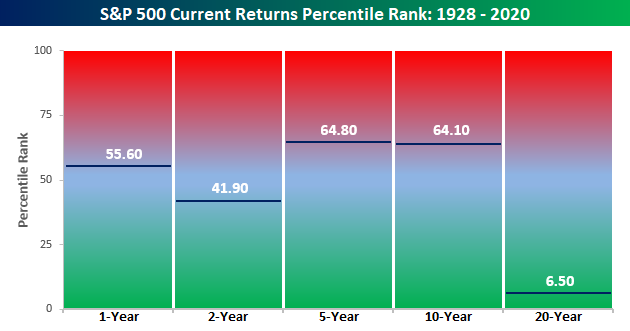
Below we show how the current performance of the S&P 500 in each of the time frames shown compares to all other periods on a percentile basis.  The S&P 500’s performance over the last year ranks just below the 56th percentile of all other periods, while the two-year performance ranks just below the 42nd percentile. Even as the five and ten-year periods have seen well above average returns, they still rank in just the mid-60s on a percentile basis. The S&P 500’s ranking over a 20-year time period is a completely different story ranking in single-digits on a percentile basis.  Even with the equity market right near record highs, the last two decades have been forgettable for US equities.  Click here to view Bespoke’s premium membership options for our best research available.

https://www.bespokepremium.com/interactive/posts/think-big-blog/how-current-returns-stack-up-to-history

2. Another Bull Market Chart That Has Not Made New Highs….PKW—Buyback ETF
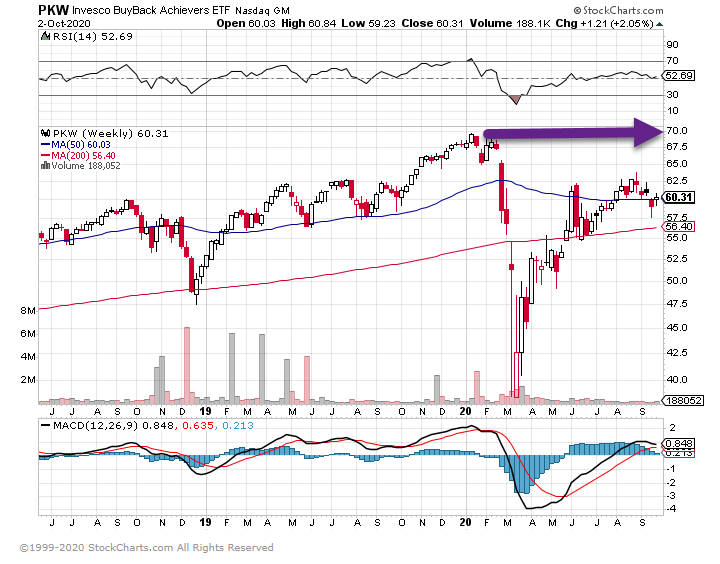
www.stockcharts.com

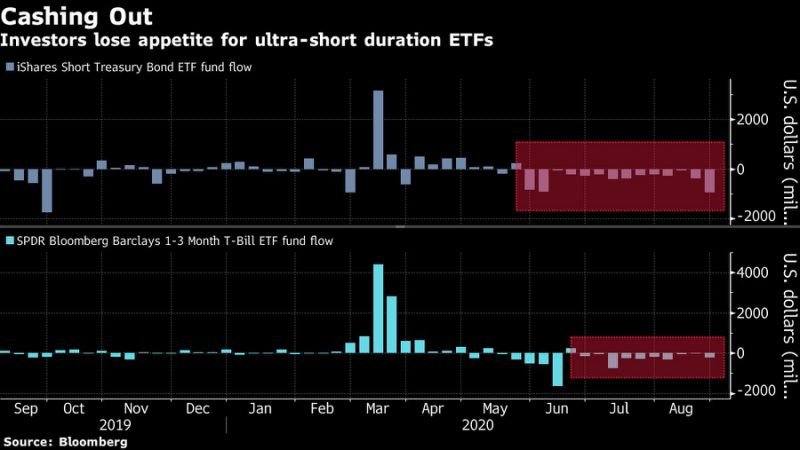
3. Negative Real Interest Rates…..But Record Bond Inflows

 Chart of the Day

2020 is the year of the bond ETF.

(ft.com)

Found at Abnormal Returns Blog. www.abnormalreturns.com

4. 30 Year Bond Duration is the Highest in History…..The effective duration of a 30-year Treasury is about 21 years,

If interest rates rose 1%…30 Year Treasury would drop -21%Historical yields on the 30-year U.S. Treasury have included the following:
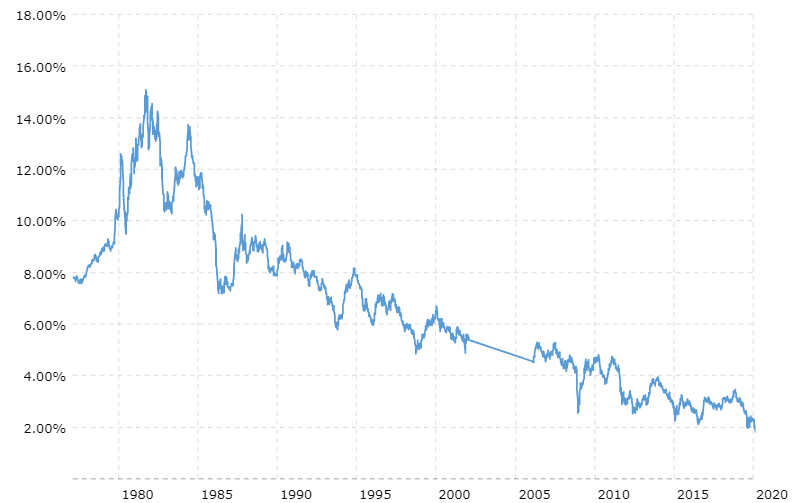
Historical 30-Year Treasury Yields

Historical 30-Year Treasury Yields.

Source: MacroTrends

https://www.investopedia.com/terms/l/longbond.asp

5. Without Dividends German Market Since 2000 Would Be Negative

Good Morning from Germany where dividends matter & artificially dope benchmark index Dax. Without dividends, German stocks’ return since 2000 high would be negative. While Dax has gained 60% since then, Dax Price Index, which like S&P500 does not incl dividends, has dropped 11.1%

Image

6. Housing Affordability Has Rarely Been Better

We start with housing affordability, which has rarely been higher on lower mortgage rates and growing wages:

https://www.zerohedge.com/commodities/visualizing-us-housing-frenzy-34-charts

7. Big 4 Bank Stocks Market Cap Back to 2004 Levels

The Big Four bank stocks.

JPMorgan Chase [JPM] is down 32% ytd. At $96.27 today, it’s back where it first was in October 2017. Having about doubled since the peak before the Financial Crisis, it’s the least-dirty shirt of the batch.

Bank of America [BAC] is down 33% ytd. At $24.09, shares are down 56% from the peak before the Financial Crisis, and are back where they’d first been in December 1996, well, 24 years ago.

Wells Fargo [WFC] is down 56% ytd. At $23.53, shares are down 61% from December 2017 and are back where they’d first been in October 2000.

Citigroup [C] is down 46% ytd. At $43.11, shares – adjusted for its infamous 1-for-10 reverse stock split in March 2011 – are back where they’d first been in 1993.

My Big Four Bank Index, based on market capitalization, closed today at $685 billion (yup, $60 billion below Facebook’s market cap). That’s down 46% from its peak ($1,258 billion) on January 26, 2018. You see, banks got hit two years before the Pandemic. And the index is now back where it had first been on December 28, 2004, nearly 16 years ago (data from YCharts):
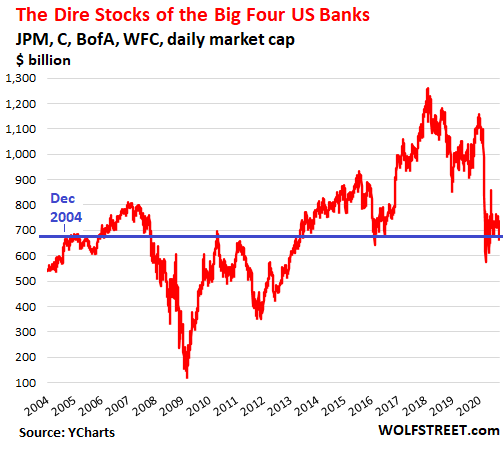
My Big-Four Bank Index already got crushed back to 2004 level.

By Wolf Richter for WOLF STREET.

https://wolfstreet.com

8. 53% of NYC Tax Revenue Generated From Real Estate

REBNY: Real Estate Generates More Than 50% of NYC Tax Revenues

New York City’s real estate industry generated $31.9 billion in taxes over the last fiscal year, representing 53% of the city’s tax revenue, according to an analysis by the Real Estate Board of New York, which is holding its 124th Annual Banquet Thursday evening. The industry’s share of revenues is more than twice as large as the next closest contributor: personal income tax, with a 21% share.

The $31.9 billion comes from commercial and rental apartment buildings. It doesn’t include one-and-two family homes, cooperatives and condominiums or schools, hospitals and other publicly-funded structures.

“This report demonstrates the importance of real estate related tax revenue to our thriving city,” said REBNY president James Whelan. “If we want a progressive city, then we need a prosperous city.  These findings underscore that policies that limit the amount of tax revenue generated by our industry are counterproductive to improving the lives of New Yorkers they aim to help.”

9. The staggering numbers that prove just how far Bryson DeChambeau is hitting the golf ball these days

Bryson DeChambeau hits his tee shot on the 16th hole during the Rocket Mortgage Classic golf tournament at Detroit Golf Club. Brian David Gordon·          

Bryson DeChambeau‘s radical transformation of his body and game has been one of the most polarizing issues of the summer. Just how crazy has DeChambeau been off the tee? Consider that over the five PGA Tour events since the three-month coronavirus shutdown, DeChambeau has hit 29 drives at least 350 yards, by far the most of any player. In fact, it’s more than the next two players combined. That is nearly the same number of drives of at least 350 yards as he had all of last season (30).

Most 350-Yard Drives Since PGA Tour Restart

PLAYERNUMBER OF DRIVES LONGER THAN 350 YARDS
Bryson DeChambeau29
Matthew Wolff15
Cameron Champ12

DeChambeau was not always this long off the tee. He’s averaging 323 yards per drive this season, up over 20 yards (+20.5) from 302.5. He is on pace to be the first player since 2005 to increase his driving distance by 20 yards over one season. The next-largest increase belongs to Tiger Woods, who increased his driving distance by 14.2 yards from 2004 to 2005.

Largest Year-Over-Year Increase In Driving Distance Last 15 Years

YEARPLAYERDISTANCE INCREASE IN YARDS
2019-20Bryson DeChambeau+20.5
2005Tiger Woods+14.2
2017-18Graeme McDowell+13.7

The massive distance has left DeChambeau just 149.2 yards to the hole on average for his approach shots this season. That is on pace to pass Bubba Watson (149.8 in 2014-15 season) for the shortest distance in a single season since 2005.

Shortest Average Distance To Hole After Tee Shot In Single Season Since 2005

YEARPLAYERDISTANCE TO HOLE AFTER TEE SHOT
2014-15Bubba Watson149.8
2012Bubba Watson152.2
2011J.B. Holmes152.7
2016-17Rory McIlroy152.9
* DeChambeau currently at 149.2 this season

Another way to look at it: DeChambeau’s drives have covered more than 67% of the courses’ yardage this season. That’s (again) on pace to pass Bubba Watson’s mark from back in 2014-15.

Highest Percentage Of Yardage Covered By Tee Shots Single Season Since 2005

YEARPLAYERPERCENTAGE OF DISTANCE COVERED BY TEE SHOT
2014-15Bubba Watson67.28
2016-17Rory McIlroy67.26
2012Bubba Watson67.05
* DeChambeau currently at 67.43

As for head-to-head comparisons with Woods, DeChambeau is already on his way to doing something Tiger never did — lead the PGA Tour in driving distance. Woods finished second in driving distance in four different seasons, but he never led the field. However, relative to his peers, Woods’ peak driving distance season (2005) was slightly better when comparing distances to the PGA Tour average. In 2005, Tiger was 27.7 yards longer off the tee than the average player; DeChambeau is currently 27.1 yards longer than the PGA Tour average thus far this season.

https://www.espn.com/golf/story/_/id/29467640/the-staggering-numbers-prove-just-how-far-bryson-dechambeau-hitting-golf-ball-days

10. Preventing Busyness from Becoming Burnout

by Brigid Schulte

The Busyness Paradox, Explained 

Here’s how the busyness paradox works: When we’re busy and have that high-octane, panicked feeling that time is scarce — what one participant called the “sustained moment of hecticness” through the work day — our attention and ability to focus narrows. Behavioral researchers call this phenomenon “tunneling.” And, like being in a tunnel, we’re only able to concentrate on the most immediate, and often low value, tasks right in front of us. (Research has found we actually lose about 13 IQ points in this state.) We run around putting out fires all day, racing to meetings, ploughing through emails, and getting to 5 or 6 PM with the sick realization that we haven’t even started our most important work of the day.

So we stay late at the office, or take work home in the evenings or weekends, and effectively steal time for work away from the rest of our lives. “If you’re in this firefighting state of time pressure and tunneling, you’re not making time to meet long-term goals. You’re not dealing with any of the root causes that led to the firefighting in the first place,” said Matthew Darling, ideas42 vice president and project lead. “The tendency is to do the stuff that’s easy to check off. That’s all you have the bandwidth for.” Tunneling and busyness are mutually reinforcing, Darling added. “Focusing on short-term tasks makes you not make strategic plans, which causes you to be busy.”

In theory, workers could just ignore any work they didn’t complete before, say, 5 PM, and call it a day. But it’s hard to break out of the tunnel now: Unlike a century ago, when Americans showed their status in leisure time, busyness has become the new badge of honor. So even as we bemoan workplaces where everyone is busy and no one is productive, busyness has actually become the way to signal dedication to the job and leadership potential. One reason for this is is that, while productivity is relatively easy to measure on a factory floor, or on the farm, we have yet to develop good metrics for measuring the productivity of knowledge workers. So we largely rely on hours worked and face time in the office as markers for effort, and with the advent of technology and the ability to work remotely, being connected and responsive at all hours is the new face time. “Tunneling” is no longer something that happens by accident,” Darling explained. “It’s a condition that workers are forced into by standard management practices.”

So how can behavioral science interventions begin to nudge this powerful busyness bias that keeps us all so stressed out?

One key will be to construct new mental modelsof the ideal worker. Right now, the model is someone who comes in early, eats lunch at their desk, stays late, emails at all hours, is always busy and always available to put work first — a definition that excludes anyone with caregiving responsibilities (which, in the U.S., is primarily women) or the desire for a healthy work-life balance.

So the interventions ideas42 are designing to improve work effectiveness and work-life balance may also wind up nudging the idea that an ideal worker in the 21st century is someone who does great work, is well-rested and healthy, and has a great life outside of work — not someone who’s trapped in the busy tunnel, chasing their tail, thinking small and on the road to burn out. These interventions are designed with the very foundation of behavioral science in mind: that human decision-making is shaped not by individual personality or willpower, but by the environment.

3 Ways to Break Your Employees Out of the Busyness Paradox 

Recognize the power of social signals. When we’re at work, all we see are other people working. And when we see late-night emails or texts, we assume that our coworker or boss has been working all day or night without interruption, when perhaps they’d been out walking the dog or having dinner with their families. But that life outside work doesn’t register because we don’t see it. (More, we often don’t want to share our lives outside work with coworkers and bosses in order to preserve the busyness myth that we are always working.)

“You end up miscalibrating,” Darling explained, or thinking that people are working more than they actually are, so you automatically think you have to as well in order to keep up. Researchers point to a classic study of such “norm misperception” and how prevalent and damaging it can be: one nationwide surveyfound that a large share of college students overestimated the amount of alcohol their peers consumed. Over time, the best predictor for how much students wound up drinking was how much they thought their peers were drinking, even though, in reality, their peers weren’t drinking that much.

To correct that “always-on” misperception, researchers at ideas42 are testing the idea of making non-work time more visible. They’re asking managers to be more open about: taking lunch breaks, leaving the office on time, working flexibly, going on vacation, talking about life outside of work or care responsibilities, and more demonstrably encouraging others to do the same — potentially even including life events on shared calendars. Another experiment involves automatic reminders. These reminders would go out at the beginning of every year and would prompt people to schedule their vacations.

Researchers are also working with teams to design email, phone, and texting protocols to cut down or eliminate work communication outside of normal hours, particularly from leaders who set expectations for everyone else. Behavior might be tracked and made transparent so that, through the powerful nudge of social comparison, people and leaders would be held accountable and the new systems more likely to stick.

Build in slack for important work. Humans are terrible at estimating how much time and effort are actually needed to accomplish things. It’s called the planning fallacy, and the busyness paradox only exacerbates that tendency to underestimate and overpromise. So one intervention being tested is for workers to intentionally create slack in their calendars every week — in other words, intentionally schedule a block of slack time to finish up any work that got delayed after an emergency popped up, or to finish a project that took longer than you thought it would. The team at ideas42 came up with the idea based on a study of hospital operating rooms that found leaving one room unused for emergencies, rather than booking to 100% capacity, actually increased the number of surgical cases and revenue while cutting down on staff overwork

Another idea is to create “transition days” at work before and after vacations, where the only expectation of workers would be to wrap up work before leaving, and catch up on what they missed while they were out. That would give workers a better chance of truly unplugging and recharging during vacation, and help people ease back into work after. People won’t feel as compelled to answer emails throughout for fear of falling behind, or dread juggling the awaiting inbox with immediate work demands. “You almost always need a lot more slack than you think you will,” Darling explained, “and it is actually markedly important for doing good work.”

Slack time requires a new mental model — recognizing that, no matter how carefully we plan, work emergencies and unexpected demands will always crop up and projects and tasks will usually require more time than we’ve allocated. So creating blank space isn’t slacking off (pun intended); it’s time that enables you to get your most important work done effectively and keeping it from spilling over into the rest of your life.

Increase transparency into everyone’s workload. Many people participating in our project felt they were always busy — going to meetings, answering emails, collaborating with others — but not necessarily productive. They found it difficult to find chunks of uninterrupted time to concentrate on a big project, much less plan or think or strategize. Some even said they used their paid time off just to have a day of uninterrupted, independent work.

So one intervention ideas42 researchers are experimenting with is an effort to “concretize” work by actually scheduling in time to work on the week’s priorities and making actual workloads transparent to bosses and coworkers. The thinking is that that transparency is likely to create positive friction every time someone wants to call a meeting. With priority work made more transparent, calling a meeting won’t be seen as cost free, but a values trade-off: what is everyone not doing because they’re at this meeting? And is the meeting the better use of everyone’s time?

Another idea involves “meeting hygiene” — can meetings become more efficient with a required agenda, limited time, and concrete action plan? Researchers may also test meeting and email black out days to encourage concentrated work time.

In the end, the hope is that these interventions will help people begin to act their way into a new way of thinking. If they see they can work more effectively andhave a healthier work-life balance, perhaps instead of praising people who brag about being super busy and working all the time, they’ll begin to think: If workers aren’t getting their most important work done, are on the verge of burnout, and have little time for life, what needs to change at this organization?


Brigid Schulte is a journalist, author of the New York Times bestselling Overwhelmed: Work, Love and Play When No One has the Time and director of the Better Life Lab at New America.

Disclosure

Lansing Street Advisors is a registered investment adviser with the State of Pennsylvania..
To the extent that content includes references to securities, those references do not constitute an offer or solicitation to buy, sell or hold such security as information is provided for educational purposes only. Articles should not be considered investment advice and the information contain within should not be relied upon in assessing whether or not to invest in any securities or asset classes mentioned. Articles have been prepared without regard to the individual financial circumstances and objectives of persons who receive it. Securities discussed may not be suitable for all investors. Please keep in mind that a company’s past financial performance, including the performance of its share price, does not guarantee future results.
Material compiled by Lansing Street Advisors is based on publicly available data at the time of compilation. Lansing Street Advisors makes no warranties or representation of any kind relating to the accuracy, completeness or timeliness of the data and shall not have liability for any damages of any kind relating to the use such data.
Material for market review represents an assessment of the market environment at a specific point in time and is not intended to be a forecast of future events, or a guarantee of future results.
Indices that may be included herein are unmanaged indices and one cannot directly invest in an index. Index returns do not reflect the impact of any management fees, transaction costs or expenses. The index information included herein is for illustrative purposes only.
Topley’s Top 10 – September 30, 2020

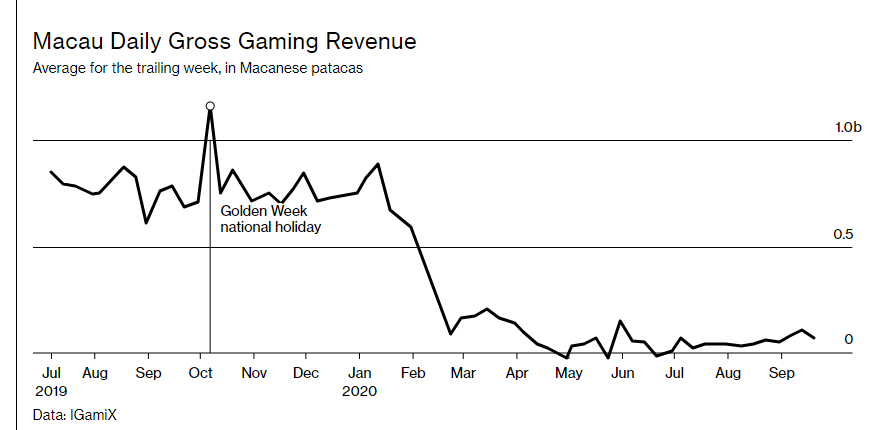
1. Shopping Is Not The Only Thing Going Online…..Gambling ???

Macau Gross Revenue-Bloomberg

Travel agents say that interest in visiting Macau has been weak because of inconvenient new requirements for those crossing the border between it and mainland China, such as a negative virus test. Any resurgence of coronavirus infections could also lead to abrupt new border controls imposed by China, and holiday makers don’t want to run the risk of being stranded in Macau. Meanwhile, vacation destinations on the Chinese mainland, such as the southern province of Hainan, are proving an alternate draw with such perks as duty-free shopping. Only five of 23 Macau hotels surveyed by Morgan Stanley were fully booked for the Golden Week holiday as of mid-September, down from 19 a year earlier.

Continue reading →

Topley’s Top 10 – September 29, 2020

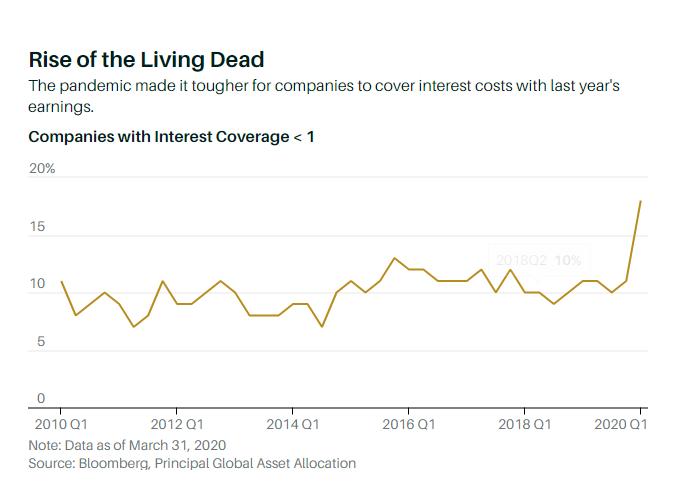
1. Zombie Company’s Grew During Covid.

Barrons

How do you identify a zombie firm? Principal Global offers a guide: companies that can’t cover interest costs twice with the previous year’s pretax earnings; whose spread between return on equity and cost of equity is less than four percentage points; whose one-year and average three-year sales growth is less than 3%; and whose Altman Z-Score—a measure of liquidity, solvency, and profitability sometimes used to predict bankruptcy—is below 1.8.

The Pandemic Has Swelled the Ranks of Zombie Companies. Here’s How to Recognize Them.

Continue reading →

Topley’s Top 10 – September 28, 2020

1. Small Caps Have Historically Outperformed Large-Cap Post Trough

2. Blackrock…U.S. Inflation Market Pricing vs. Our Estimate 2015-2025

Chart of the week
U.S. inflation market pricing vs. our estimate, 2015-2025

U.S. inflation market pricing vs. our estimate, 2015-2025

Forward-looking estimates may not come to pass. Sources: BlackRock Investment Institute and the Federal Reserve with data from Refinitiv Datastream, September 2020. Notes: The chart shows a market measure of what five-year inflation expectations based on the consumer price index (CPI) will be in five years’ time. We show it using the five-year/five-year inflation swap. The line is shifted forward five years. The orange dot shows the BlackRock Investment Institute’s current estimate of average U.S. CPI inflation for the same five-year period of 2025-2030.

We expect annual growth in the U.S. consumer price index (CPI) to average in the range of 2.5% to 3% between 2025 and 2030, as the chart shows. This is broadly consistent with inflation moderately above the Fed’s 2% target (CPI inflation tends to run above the Fed’s preferred gauge based on the personal consumption expenditures, or PCE, price index), and a jump from current market-implied inflation. Rising global production costs are the trigger. The Covid shock is driving up costs in contact-intensive services, and could speed up deglobalization and the remapping of supply chains for greater resilience against a range of potential shocks. Less offshoring could give domestic workers more bargaining power on wages, especially in places where the political pendulum is swinging toward addressing inequality. So-called superstar companies – many in the tech sector – could gain greater ability to pass on higher production costs to customers, having achieved dominant market shares.

https://www.blackrock.com/us/individual/insights


3. 69% FEWER S&P 500 COMPANIES ISSUING NEGATIVE EPS GUIDANCE FOR Q3 THAN AVERAGE

By John Butters  |  September 25, 2020  FACT SET

For the second quarter, 53 S&P 500 companies issued quarterly EPS guidance, which was the lowest number of S&P 500 companies issuing EPS guidance for a quarter since FactSet began tracking this metric in 2006. Are fewer S&P 500 companies issuing EPS guidance for the third quarter as well?

The answer is yes. To date, 67 S&P 500 companies have issued EPS guidance for Q3 2020, which is 36% below the five-year average of 104. If 67 is the final number for the quarter, it will mark the second lowest number of S&P 500 companies issuing EPS guidance for a quarter over the past 10 years (Q4 2009), trailing only the record-low number of 53 in the previous quarter. However, it will mark a 26% increase over the previous quarter as well.

No. of S&P 500 Cos Issuing Quarterly EPS Guidance 5-year

The low number of S&P 500 companies issuing EPS guidance for the third quarter is due to a substantial decrease in the number of S&P 500 companies issuing negative EPS guidance for the quarter. Of the 67 companies that have issued EPS guidance for Q3 2020, only 22 have issued negative EPS guidance. This number is 69% below the five-year average of 70.5. In fact, if 22 is the final number for the quarter, it will mark the lowest number of S&P 500 companies issuing negative EPS guidance for a quarter since FactSet began tracking this metric in 2006. The current record is 28, which occurred in the previous quarter. At the sector level, eight of the 11 sectors have seen fewer companies issue negative EPS guidance for Q3 2020 relative to their five-year averages (rounded to the nearest whole number), led by the Consumer Discretionary (1.0 vs. 15.5) and Health Care (1.0 vs. 11.2) sectors.

https://www.factset.com/?utm_feeditemid=,utm_device=c,utm_term=%2Bfactset,utm_source=google,utm_medium=ppc,utm_campaign={utmcampaign},hsa_cam=8835391608,hsa_grp=91984082834,hsa_mt=b,hsa_src=g,hsa_ad=412551945106,hsa_acc={9972562989},hsa_net=adwords,hsa_kw=%

4. Energy Consistent Worst Sector Performer for 5 Years.

Low Energy” Energy-Bespoke Investment Group

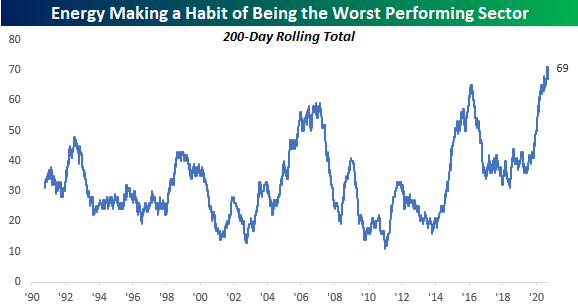
US stocks are looking to close out the week on a positive note with the S&P 500 up over 1%.  One sector that hasn’t been participating in the rally, however, is Energy.  While it just moved back into positive territory for the day, the sector remains at the back of the pack in terms of sector performance.  If these levels hold for the remainder of the trading day, it will be the69th time in the last 200 trading days that Energy has been the worst-performing sector. That works out to more than once every three trading days.  Talk about a sector that’s in liquidation mode!

The chart below shows the rolling 200-day total number of days that Energy has been the worst-performing sector in the S&P 500.  While the current level of 69 is extremely high, earlier this month the rolling 200-day total was even higher at 71.  Over this same period of time, no other sector has even seen close to as many days of ranking at the bottom as Energy.  The next closest is Utilities as it has been at the bottom of the pack in terms of performance on 36 of the last 200 trading days.  It hasn’t just been the last 200 trading days that have been rough for the Energy sector.  Over the last five years, the sector has been the worst-performing sector on just over 23% of all trading days.  Is this what it felt like for the horse and buggy companies in the early 1900s or the ice-harvesting companies after the invention of electric refrigeration?  

https://www.bespokepremium.com/interactive/posts/think-big-blog/low-energy-energy

5. S&P 500 Cash +35% Year to Date.

From Barry Ritholtz The Big Picture Blog

6. IPO Boom—80% of Money Raised=Healthcare, Technology or SPACS

WSJ-By Corrie Driebusch

–This year, more than 80% of the money raised by initial public offerings falls into three buckets: healthcare, technology and newly popular blank-check companies—shell firms whose only purpose is to acquire a private target and take it public. That is the most concentrated the IPO market has been since 2007, according to Dealogic, when new listings of banks and lending institutions flooded the market before the financial crisis.

More than 235 companies have joined the U.S. public markets this year, on track for the most since 439 companies went public in 2000, according to Dealogic. They’ll soon be joined by giants Airbnb Inc. and Palantir Technologies Inc., which will go public later this year after long tours as private companies.

IPO Market Parties Like It’s 1999

Even in the midst of a recession, investors are pouring money into newly public companies at levels on par with the dot-com era

https://www.wsj.com/articles/ipo-market-parties-like-its-1999-11601052419?mod=itp_wsj&ru=yahoo

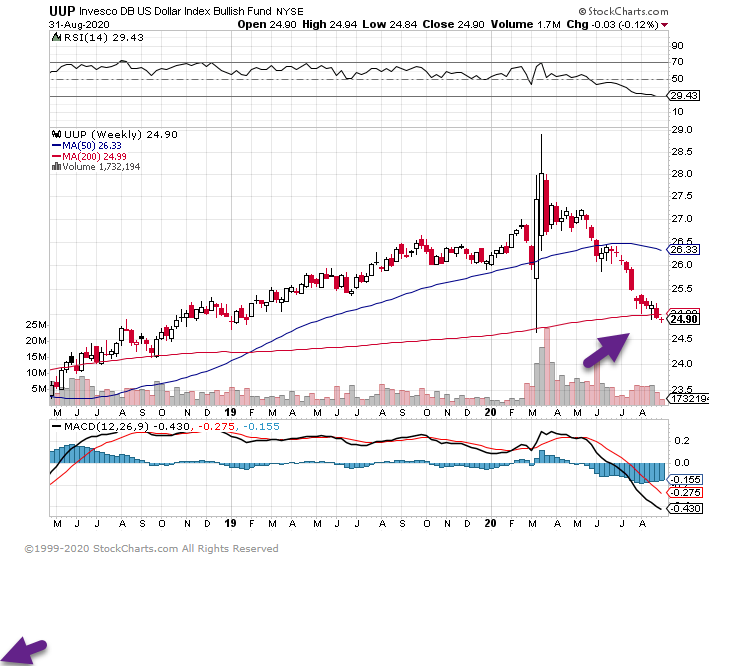
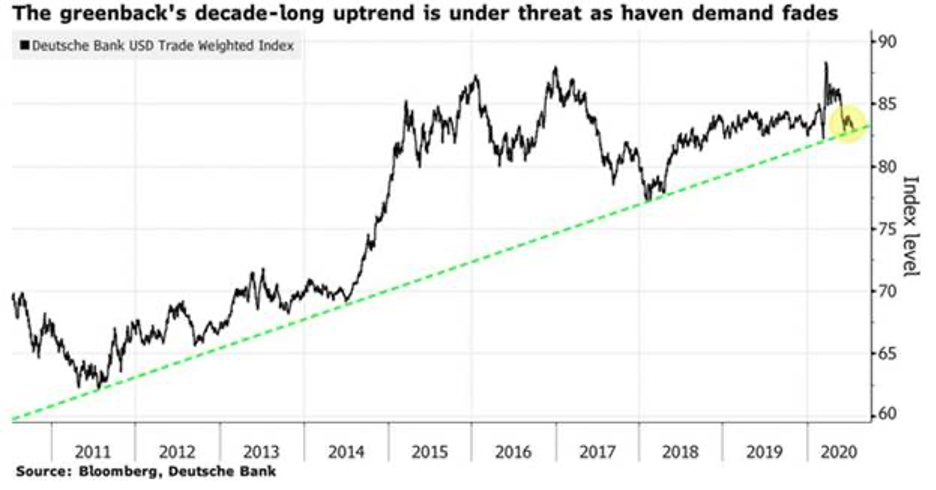
7. Dollar Rally This Week…Shorts Kept Selling Into Rally?

@MacroCharts

Dollar Positioning (updated). Despite the Dollar’s sharp rally this week, Futures traders SOLD another $2.5 Billion – now the biggest Short Dollar position in 9 years. If this USD rally continues, a lot of traders look headed for an expensive lesson in risk management.

9:00 AM · Sep 26, 2020·TweetDeck

Image

8. Who Has The Power Over Federal Law Enforcement?

Image

9. Institutional Money Pours Into Suburban Subdivisions

Wall Street’s New Suburban Subdivision Is Full of Renters-Bloomberg

Patrick Clarkand Noah Buhayar

Institutional money is pouring into single-family rentals

Demand for housing, affordability issues fuel industry

Wall Street won big buying up homes during the foreclosure crisis and renting them out. Now, it’s headed back to the suburbs in hopes of scoring again.

With the pandemic driving demand for larger living spaces, institutional investors are pouring money into single-family rentals. In addition to buying houses on the open market, they’re bankrolling subdivisions — inventing a new kind of suburban living that’s easier to afford, but where the financial benefits of homeownership go to Wall Street firms.

Blackstone Group Inc., Brookfield Asset Management Inc. and JPMorgan Chase & Co.’s asset-management arm have each made fresh bets on the industry since Covid-19 cases started surging, targeting a type of property big investors ignored until 10 years ago.

The investments come as publicly traded single-family landlords outperformed apartment owners, and social-distancing efforts make traditional commercial real estate, including hotels and retail properties, less appealing.

“It’s been a combination of the sector coming of age as well as the performance during the pandemic,” said Dana Hamilton, head of real estate at Pretium, whose Progress Residential manages roughly 40,000 rental homes. “Single-family rentals have been an island of strength during the storm.”

Same Homes

For decades, Americans have flocked to the suburbs in search of more space, better schools and a respite from the grind of city life. Those qualities have become more relevant in the era of Covid-19 and unrest in U.S. cities that has President Donald Trump promising to defend the suburban lifestyle.

Read more: Air Conditioners Break Faster in Work-at-Home Era

Whether landlords are shopping for existing homes or building them from the ground up, they want the same things that families have always favored. That means spare bedrooms, big garages and good neighborhoods.

Still, the new wave of investment shows how the single-family rental industry could change the U.S. housing market, providing affordable homes whose residents don’t benefit as values rise.

“It’s not a replacement if you’re trying to build wealth, but it gives you more options if you’re trying to figure out where to live, or you’re trying to build credit,” said Cheryl Young, an economist at Zillow.

On a September morning, several work crews were busy at one of American Homes 4 Rent’s new communities in Lake Stevens, Washington, about 35 miles (56 kilometers) northeast of Seattle. Rent is about $2,700 a month for a four-bedroom home with a fenced-in backyard in the 27-house development, which snakes down a street that ends in a roundabout backing up to a wooded area and an elementary school.

There’s little to distinguish the neighborhood from several others nearby developed by traditional homebuilders, and tenants are moving in just about as fast as the houses can be finished.

Rising Prices

American Homes, founded in 2012 by the self-storage billionaire B. Wayne Hughes, spent its early years building property-management systems to operate homes acquired in the aftermath of the foreclosure crisis.

After rising home prices made it harder for the company to score bargains, it decided to start building rental houses for itself. These days, it’s opening new communities at a pace of roughly one per week, chief executive officer David Singelyn said in an interview. The company’s share have gained 51% since the market hit a bottom on March 23.

Christopher Bernard, 34, signed a lease on a new American Homes property in Eagle Mountain, Utah, about 40 miles south of Salt Lake City, after he and his wife couldn’t close on a newly built home in the area. The rental house has nicer finishes, and costs less per month than what they would have paid on a mortgage.

“Someone who owns their house isn’t any different from someone who’s renting,” said Bernard, who teaches at a nearby university. “I’m proud because I can let my child run around on the lawn.”

Read more: Invitation Homes Eyes Next 80,000 Houses as Suburbs Boom

American Homes, which raised $625 million through a joint-venture with JPMorgan’s asset-management arm, isn’t the only company betting on purpose-built rentals. Amherst Group, another early industry player, hired a former construction executive as chief operating officer this summer with an eye to buying land and building its own homes. A former Colony Capital Inc. executive is raising $1.2 billion in equity and debt to build 5,000 rental homes.

Read more: Ex-Colony Executive Seeks $1.2 Billion for Single-Family Rentals

It won’t be easy for institutional landlords to remake the suburbs. Competition for construction workers, building materials and land could hold back rental developers, while low mortgage rates are helping boost home prices, making it harder to buy properties to convert for tenants.

Popular Bet

Mom-and-pop landlords still own the vast majority of single-family rentals, with large investors controlling roughly 2% of all rental homes, according to John Burns Real Estate Consulting.

Still, the industry has become a popular way for Wall Street to capitalize on the surging demand for housing, particularly as millennials look for more space and struggle to find homes they can afford to buy.

“If you take a step back, there’s not enough homes, and not enough affordable housing,” said Drew Flahive, who leads Amherst’s single-family rental business. “Our main focus with this business is creating supply that’s in such high demand.”

(Updates with American Homes 4 Rent share gain.)

https://www.bloomberg.com/news/articles/2020-09-23/wall-street-s-reimagined-suburban-subdivision-is-full-of-renters?sref=GGda9y2L

10. Take a Break Today, or You’ll Break Apart

Ryan Holiday

Author of The Obstacle is The Way — Portfolio/Penguin Random House

16 articles Following

Some people aren’t strict enough with themselves. But some of us are too strict. 

The work from home situation in the pandemic has highlighted this difference in many of us. While many folks have struggled to get by financially, those lucky enough to keep working seem to fall into two camps. Some are spending all day in their pajamas, others are working longer hours than before. We feel obligated to answer every email, to accept every phone call, to show up for every Zoom call. Plus untold additional family and personal obligations.

No wonder that, according to a recent study done by EPIC Provisions, 60-70% of work from homers are feeling burned out. As it happens, this is an issue that dates way way back. 

Musonius Rufus, like a lot of the Stoics, was a strict man. He was strict with himself. He was strict with his students. He believed in hard work, he did not ease up, just because other people did or because he had been successful.

A friend would describe one evening, when in Athens, when they were enjoying the Saturnalia—quite pleasantly, in fact: “We did not, however, let our minds go lax,” he wrote, “for, Musonius says, ‘to let one’s mind go lax is, in effect, to lose it.’”

Unfortunately, this is a common belief, not just among the Stoics. People think they are too important, the stakes of their work are too high, that there is not a minute to lose. So they never relax. They never shut off their minds. They never check out, or let go. And far too often they end up losing it. 

EPIC’s survey found that those who are feeling burnout associate it with feeling the need to respond immediately, be on all the time and stuck to their computer. Taking a mental break and eating healthy snacks helps both personally and professionally. 

I certainly relate to that. 

“The mind must be given relaxation,” Seneca said, “it will rise improved and sharper after a good break. Just as rich fields must not be forced…so constant work on the anvil will fracture the force of the mind.”

All muscles need rest. The brain is no exception. Fields must be alternated. Computers must occasionally be shut down or rebooted. To not do this is to risk injury, poor yields, or damage. We are not in this life for the short term. We are trying to build sustainable, enduring success.

I’ve been excited the last week to work with EPIC on a campaign to encourage people to take more breaks. It’s important stuff. If you don’t take a break…you might end up being the one breaking.

Me? I like to get up early, tackle my important projects and then around 10 or 11, I get up from my desk and take a break. It’s too early for lunch and too late for breakfast, so I’ll grab a snack. I’ll read a book. Or go for a walk or call a friend. Sometimes I just stare out the window. I do the same in the afternoon, usually in the pool with my kids. But the point is: I let the mind go lax. 

On purpose. So I don’t lose it. 

Do yourself a favor and give yourself permission to do the same. 

#TakeAnEPICBreak this week! so you can continue to be your best self. 

#sponsored

https://www.linkedin.com/pulse/take-break-today-youll-apart-ryan-holiday/?trackingId=u%2FSFwjaSvRqE%2BGVCgCdRSg%3D%3D

Disclosure

Lansing Street Advisors is a registered investment adviser with the State of Pennsylvania..
To the extent that content includes references to securities, those references do not constitute an offer or solicitation to buy, sell or hold such security as information is provided for educational purposes only. Articles should not be considered investment advice and the information contain within should not be relied upon in assessing whether or not to invest in any securities or asset classes mentioned. Articles have been prepared without regard to the individual financial circumstances and objectives of persons who receive it. Securities discussed may not be suitable for all investors. Please keep in mind that a company’s past financial performance, including the performance of its share price, does not guarantee future results.
Material compiled by Lansing Street Advisors is based on publicly available data at the time of compilation. Lansing Street Advisors makes no warranties or representation of any kind relating to the accuracy, completeness or timeliness of the data and shall not have liability for any damages of any kind relating to the use such data.
Material for market review represents an assessment of the market environment at a specific point in time and is not intended to be a forecast of future events, or a guarantee of future results.
Indices that may be included herein are unmanaged indices and one cannot directly invest in an index. Index returns do not reflect the impact of any management fees, transaction costs or expenses. The index information included herein is for illustrative purposes only.
Topley’s Top 10 – September 25, 2020

1. Insider Selling Fastest Pace Since 2012

INSIDERS SELL– S&P 500 execs sold shares of their own firms at a rapid pace in the last month. The selling picked up so much versus buying that a measure of insider velocity tracked by Sundial Capital showed the fastest exit since 2012. About $975 million of stock was dumped last week, more than twice the prior week, SEC data compiled by Bloomberg show.  Their purchases increased by roughly 10% to $11 million.

cidimg_5F6C946D013D01A201D80001_image010.jpg@01D6924D.E8C4B170@bloomberg.net
Continue reading →

Topley’s Top 10 – September 24, 2020

1. Small Caps Lag In 4th Quarter

Now is not a good time to be actively investing in small-cap U.S. stocks. That’s because small-caps typically lag their larger counterparts during the fourth quarter. 

Take a look at the accompanying chart, which plots the average monthly return advantage that the smallest stocks have over the largest. (The exact definitions of these two hypothetical portfolios are provided on the website maintained by Dartmouth College professor Ken French.)

Continue reading →

Topley’s Top 10 – September 14, 2020

1. Bond Prices Did Not Move in Opposite Direction of Stocks During Recent Nasdaq -10% Selloff.

Barrons

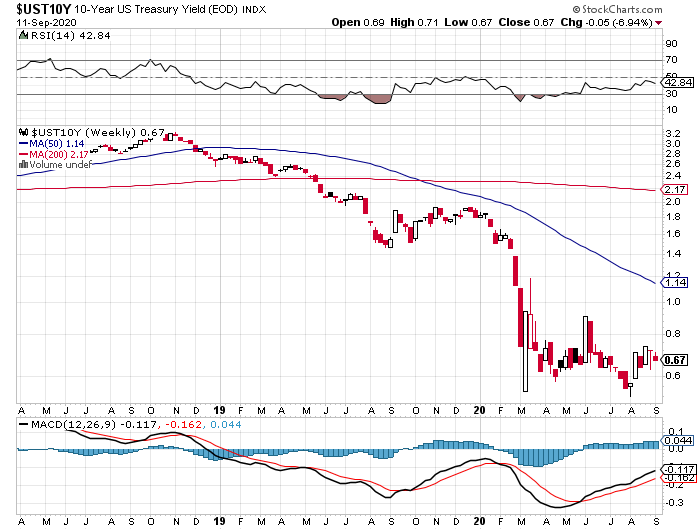
Inker’s thesis played out in markets just a few days later. On Sept. 4, as the tech-stock selloff got under way, the Nasdaq Composite sold off by as much as 5.1% to close with a 1.3% loss. And Treasury bond prices, which move opposite to yields, also sank. The 30-year Treasury yield rose 0.12 percentage point to 1.46%, in one of the largest single-day increases since the height of the pandemic panic. The 10-year yield jumped, as well, climbing 0.09 of a percentage point.

Treasuries Lose Some Haven Luster. Here Are Some Alternatives for Safety.-By Alexandra Scaggs

https://www.barrons.com/articles/treasuries-lose-some-haven-luster-here-are-some-alternatives-for-safety-51599836401?mod=past_editions

10 Year Treasury Yield….Will it go lower if stocks continue sell off?

sc%3fs=%2524UST10Y&p=W&b=5&g=0&i=t0740822687c&r=1600022513111

www.stockcharts.com

Continue reading →

Topley’s Top 10 – September 8, 2020

1.Softbank’s $4B Tech Stock Option Bet Weighing on Market?

SoftBank Group shares dropped over 7% on Monday after The Wall Street Journal reported the Japanese investment group bought $4 billion worth of options tied to around $50 billion worth of individual tech stocks.“There is a palatable maleficence level lingering about SoftBank’s large derivative position amid the recent tech selloff,” said Stephen Innes, chief global market strategist at AxiCorp. “And while there is not a great deal going on due to fast money risk neutrality after last week’s ‘wipeout,’ the supposed heft of ‘one man’s call position’ is still not sitting well with many bulls at the moment.”

https://www.barrons.com/

 Bloomberg

The Financial Times, Wall Street Journal and Zero Hedge reported that SoftBank was making massive bets on technology stocks using equity derivatives. The FT labeled SoftBank the “Nasdaq whale” that “stoked the fevered rally in big tech stocks,” though it didn’t include details of any trading.

The reports touched off concerns that billionaire founder Masayoshi Son is embarking on a risky endeavor in unfamiliar territory, which could lead to losses like those SoftBank suffered after its enormous bet on office-sharing startup WeWork. The stock decline came despite an FT report that SoftBank now has gains of about $4 billion from the derivative bets.

“SoftBank was riding the Nasdaq wave like a mutual fund,” said Mitsushige Akino, senior executive officer at Ichiyoshi Asset Management Co. “The market is falling now and investors have zero visibility, so they are selling SoftBank stocks.”

“In a world where volumes are distorted by the frantic trading of algos, any real order flows may have surprisingly large impact on prices,” Peter Tchir, head of macro strategy at Academy Securities, wrote in a note Tuesday. “By trading options, they leverage their position.”

SoftBank Stock Tumbles With Son’s Foray Into Options TradingBy Pavel Alpeyevand Takahiko Hyuga  https://www.bloomberg.com/news/articles/2020-09-06/softbank-s-4-billion-trading-gains-on-u-s-stock-option-bet-ft?sref=GGda9y2L

2. Speculative Demand for Call Options Has Been “Staggering”

The Daily Shot

Equities: Let’s begin with the options market where the speculative fervor is on full display. Speculative demand for call options (mostly deep out-of-the-money contracts) has been staggering (2 charts).

Short-term call options are notoriously difficult to hedge, and dealers who sold them rapidly become short the market as shares rise (and the probability that these options will get exercised increases). Dealers are forced to buy stocks to cover their exposure (delta-hedging), pushing the market higher. That, in turn, makes the dealers short again, creating a melt-up.

Source: @sentimentraderSource: @TheTerminal, Bloomberg Finance L.P.

Source: @markets Read full article

 https://dailyshotbrief.com/the-daily-shot-brief-september-3rd-2020-2/

3.  U.S. Election Priced as Worst Event Risk in VIX Futures History

–Michael P. Regan—

U.S. Election Priced as Worst Event Risk in VIX Futures History

View photos

(Bloomberg) — As the U.S. stock market continues to rally to record highs, the attention of many investors is turning toward November’s elections as a source of risk.

However, hedging against that potential volatility doesn’t come cheap. In fact, it’s currently the most-expensive event risk on record based on a common way to bet on volatility known as a “butterfly trade.”

Futures tied to the Cboe Volatility Index expiring in late October closed on Tuesday at 33.5, compared with a spot VIX that closed at 26.1. Those October contracts, which are currently the second-month futures and reflect expected volatility in the month after they expire on Oct. 21, are also higher than the first-month futures expiring in September and the third month expiring in November.

One “butterfly” trade would be to buy one unit each of the first- and third-month contracts while selling two units of the second. Currently, that trade prices with a reading of -6.9, the difference in costs between the butterfly’s “wings” in September and November and the “belly” in October. That pricing reflects the premium that investors are giving to own volatility over the election. Trading of VIX futures started in 2004.

“In the history of the VIX futures contracts, we’ve never had an event risk command this sort of premium into forward-dated vol at a specific tenor,” Bloomberg macro strategist Cameron Crise wrote in a blog post. “That obviously suggests that markets anticipate some pretty incredible fireworks.” He excluded a higher premium on March 18 of this year since front-month futures expired that day, when the S&P 500 fell 5.2%.

The spread between October and November VIX futures is also wide at about -1.7 instead of about 0.2, which history suggests it should be based on the level of the spot VIX, according to Crise.

“If it starts trading above where it ‘ought’ to be, particularly given the risk premium lavished on the election, that could be a sign that punters are worried about 2000-style uncertainty,” Crise wrote, referring to the presidential contest between George W. Bush and Al Gore, which ultimately was decided by the U.S. Supreme Court. “You don’t need a particularly vivid imagination to think that that could get pretty ugly this time around.”

For more articles like this, please visit us at bloomberg.com

Subscribe now to stay ahead with the most trusted business news source.

https://finance.yahoo.com/news/u-election-priced-worst-event-210637365.html

4. Non-Correlation to U.S. Stocks=Treasuries.

Long-term Treasuries tend to be less correlated with U.S. stocks than short-term Treasuries

https://www.advisorperspectives.com/commentaries/2020/09/02/why-own-bonds-when-yields-are-so-low

5. Valuations of Resource Based Equities at All-Time Lows.

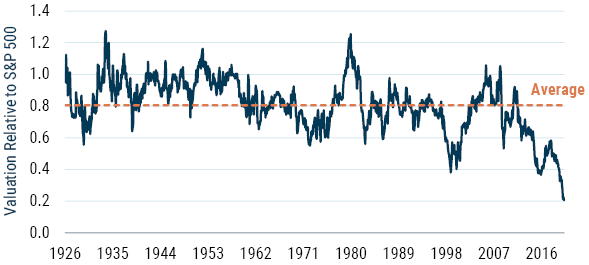
Resource Equities as a Value Opportunity and Inflation Hedge

Resource-based equities14 provide an interesting mix between a significant opportunity within Value equities today (thus lowering overall duration) and a hedge against future inflation. From a Value perspective, Resource equities, particularly Energy and Metals stocks, appear to be trading at the cheapest levels they have ever been relative to the S&P 500 (see Exhibit 5).


EXHIBIT 5: VALUATIONS ARE AT HISTORIC LOWS

As of 6/30/2020 | Source: S&P, MSCI, Moody’s, GMO
Valuation metric is a combination of P/E (Normalized Historical Earnings), Price to Book Value, and Dividend Yield.


Metal producers are also an interesting subset because they are in a secular growth mode as the world transitions to more clean energy. This cannot be done without metals such as copper, lithium, nickel, vanadium, etc.15

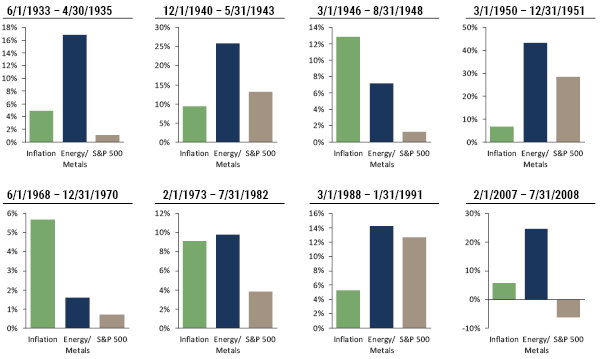
Resource stocks have also been a very useful tool in inflationary times. Exhibit 6 shows the return of Energy and Metals stocks during the more significant (CPI greater than 5% for a year or more) bouts of inflation we have seen in the U.S.


EXHIBIT 6: DURING INFLATIONARY PERIODS, RESOURCE EQUITIES HAVE PROTECTED PURCHASING POWER BETTER THAN THE BROAD EQUITY MARKET

Source: S&P, CRSP, Global Financial Data, MSCI, GMO
Annualized data. Inflationary periods have been identified as periods where inflation, as measured by CPI, was greater than 5% per annum for a period longer than one year.


During these inflationary periods, Energy and Metals stocks kept up with or beat inflation in six of the eight periods and outperformed the broad market in all eight periods.

2Q 2020 GMO Quarterly Letter

by Ben Inker, Matt Kadnar of GMO, 8/31/20

https://www.advisorperspectives.com/commentaries/2020/08/31/2q-2020-gmo-quarterly-letter 

6. Naz 100 Trading 35% Over 200 Day Moving Average.

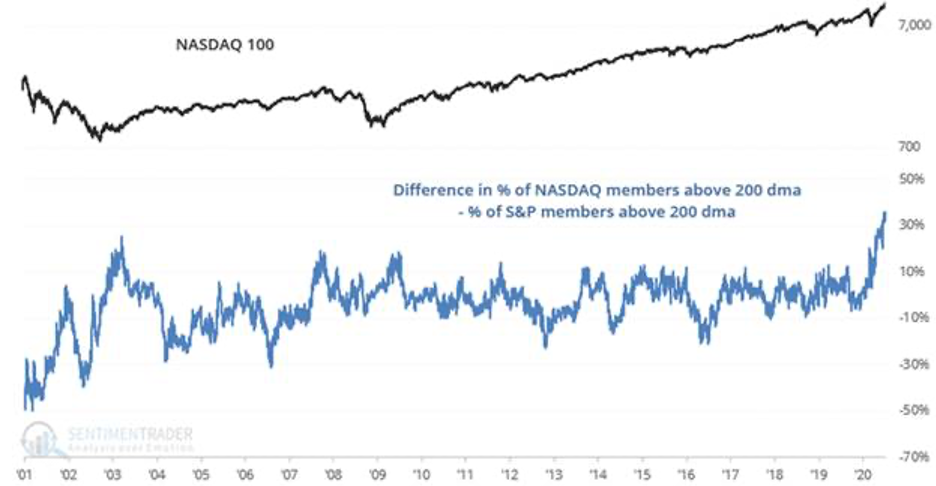
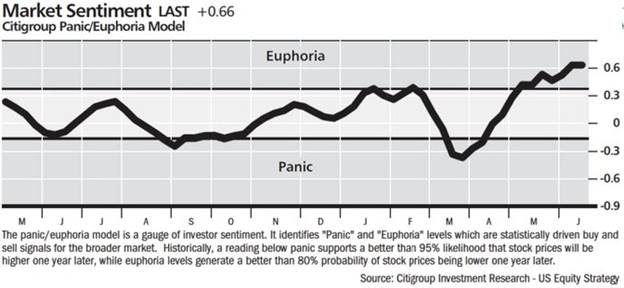
What we do know is that Big Tech was expensive, with the S&P 500 Information Technology index  trading at 27.5 times forward earnings; extended, with the Nasdaq 100 trading more than 30% above its 200-day moving average; and way too popular. Citigroup’s Panic/Euphoria model was nearly three times the level that signifies euphoria, and the percentage of bulls in the Investors Intelligence Survey was more the 40 percentage points higher than bears.

Tech Stocks Finally Got Crushed. Why the Stock Market Is on Shaky Ground.By  Ben Levisohn  https://www.barrons.com/articles/the-stock-markets-august-gains-turned-to-september-pain-what-happens-next-51599266176?mod=past_editions

www.stockcharts.com

7. Container Ships…All Available Capacity Deployed.

WSJ–Container volumes at the ports of Los Angeles and Long Beach rose by 24% and 21%, respectively, in July from June. Business at both ports had fallen by more than 6% in the first half of the year from the comparable period of 2019.

“The biggest pressure is on the West Coast, being the fastest way to get goods from Asia and get them onto the U.S. shop shelves,” said Nils Haupt, a spokesman for German shipping line Hapag-Lloyd AG . “All available capacity has now been deployed as retailers scramble to restock and this is driving the strong freight rates.”

Container Volumes Shipped to the U.S. Surge After Coronavirus Downturn–By Costas Paris

https://www.wsj.com/articles/container-volumes-shipped-to-the-u-s-surge-after-coronavirus-downturn-11599240926?mod=itp_wsj&ru=yahoo

8. A slowdown in U.S. business formation poses a risk to economy

Josh Boak

AP Economics Writer

View Comments

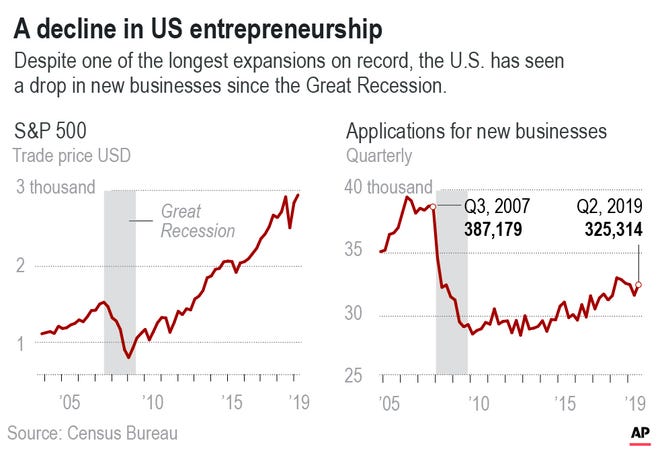
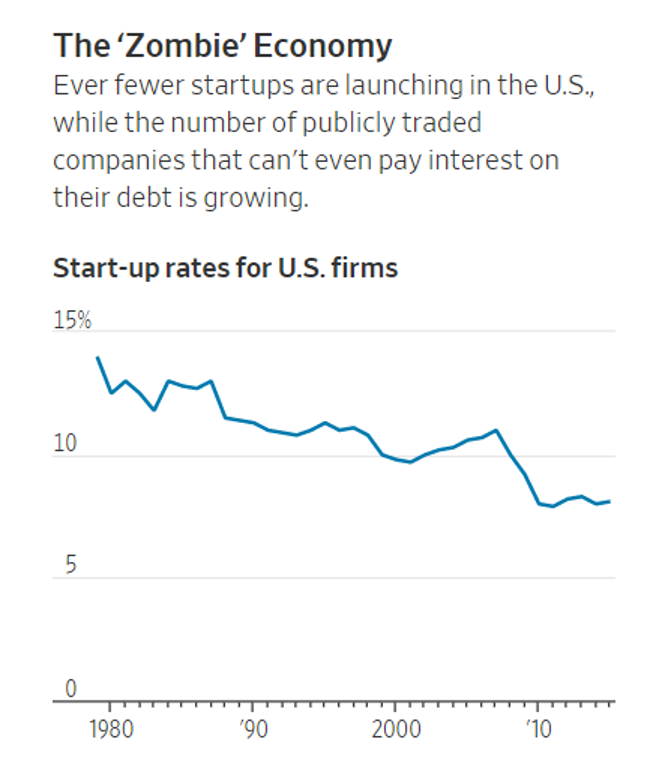
Washington – Despite a decade-plus of economic growth, Americans have slowed the pace at which they’re forming new companies, a trend that risks further widening the gap between the most affluent and everyone else.

The longest expansion on record, which began in mid-2009, has failed to restore entrepreneurship to its pre-recession level, according to a Census Bureau report based on tax filings.

FILE - In this July 1, 2019, file photo the sunlight flares around the buildings in lower Manhattan as the sun rises in New York. Despite a decade-plus of economic growth, Americans have slowed the pace at which they're forming new companies, a trend that risks further widening the gap between the most affluent and everyone else.

Between 2007 and the first half of 2019, applications to form businesses that would likely hire workers fell 16%. Though the pace of applications picked up somewhat after 2012, it dipped again this year despite President Donald Trump’s assertion that his tax cuts and deregulatory drive would benefit smaller companies and their workers. Applications are down 2.6% so far this year compared with the same period last year.

Business formation has long been one of the primary ways in which Americans have built wealth. When fewer new companies are established, fewer Americans tend to prosper over time.

In addition, smaller companies account for roughly 85% of all hiring, making them an entry point for most workers into the workforce. Even with the unemployment rate at a near-record-low of 3.7%, a decline in the creation of new companies means there are fewer companies competing for workers, a trend that generally slows pay growth. The pace of pay growth has stalled for the past five months even as hiring has remained healthy.

“What you see is reduced social and economic mobility,” said Steve Strongin, head of global investment research at Goldman Sachs. “It means that most of the growth is occurring in the corporate sphere, which keeps wage growth down and improves profits.”

Smaller companies and startups were generally cautious about expanding as they emerged from the Great Recession, in many cases choosing not to hire. The 2008 financial crisis delivered a warning to many would-be entrepreneurs that scaling back their ambitions might help them survive another recession.

“People became a lot more risk-averse after the Great Recession because so many people were hurt,” said Nicholas Johnson who founded Su Casa, a chain of four furniture stores based in Baltimore that employs 30 workers.

Johnson, 45, started Su Casa about 20 years ago. Emerging from the recession, he kept his staffing levels low to reduce his costs. Still, that meant having to pay well above the minimum wage to attract and retain workers who were specialized in home decor.

“I am super-concerned about an upcoming recession because we got so lean that I can’t get lean again,” Johnson said. “There is no more fat to trim.”

Goldman Sachs on Thursday is releasing a survey of business owners who took part in its “10,000 Small Businesses” program, which has provided management training to several thousand small companies since 2010. The survey concluded that entrepreneurs typically struggle to find qualified workers and to navigate complex regulations. Both factors tend to slow the formation of new companies.

Among the business owners who were surveyed, nearly eight in 10 said they favor a higher local minimum wage well above the federal baseline of $7.25 an hour. Focus groups conducted as part of Goldman’s survey indicate that smaller companies believe wages have failed to keep pace with the costs of living and the retention of employees.

Just 20% of the surveyed business owners said they felt that Trump’s 2017 tax cut would increase their companies’ growth, according to the online survey of 2,285 alumni of the Goldman program.

Social and demographic forces are also thought to be limiting opportunities for entrepreneurs and smaller companies. America is aging, many young adults are weighed down by student debt and larger retailers have used their scale to offer lower prices than smaller companies can afford to do so.

Roughly two-thirds of the decline in startups between the late 1970s and 2007 resulted from a slowdown in the growth of the U.S. workforce, according to research by Fatih Karahan of the Federal Reserve Bank of New York, Benjamin Pugsley of the University of Notre Dame and Aysegul Sahin of the University of Texas-Austin.

But the recovery from the Great Recession, which was induced by the housing bust, also reordered the economy in ways that complicated the creation of smaller businesses. Several sectors of the economy enjoyed no rebound at all in company formations compared with the number of business closures.

The economy now includes 116,459 fewer construction companies than it did in 2007, a roughly 15% decline, according to the Census Bureau. There are 54,045 fewer retailers that employ fewer than 20 people, a consequence in part of a shift to online shopping and the rise of national chain stores. More than 26,000 small manufacturers have shuttered.

The spillover effects have had damaging consequences in many cases. Downtowns in the industrial Midwest have empty storefronts. Home construction has been relatively weak, causing prices to accelerate. This has limited affordability and made it harder for people to join the middle class through home ownership.

Construction jobs often pay solidly middle wages. And home ownership is down 8 percentage points for people under 35 when compared to previous generations.

“If you’re thinking about the American Dream, trying to get into the middle class, homebuilding represents both of those objectives,” said Robert Dietz, chief economist at the National Association of Home Builders. “The unmet potential for homebuilding has been one of the frustrations” of this recovery.

Despite a decade-plus of economic growth, Americans have slowed the pace at which they're forming new companies.

John Dearie, founder of the Center for American Entrepreneurship, who holds roundtables around the country with small business owners, said he hears frequently about problems for younger companies caused by a shortage of skilled workers, immigration policies that thwart access to talent and difficulties in obtaining bank loans.

The number of tech startups – from software to computer systems design companies – has grown about 20% since 2007. But that sector represents just 2% of the roughly 6 million companies in the United States.

Dearie said he worries that the United States is losing its competitive edge because the obstacles for would-be startups are slowing the formation of innovative businesses.

He ran off a list of innovations that were derived from entrepreneurs: The cotton gin, the steam engine, railroads, the telegraph and telephone, electrification, the automobile, the airplane, air conditioning and refrigeration, the computer, internet applications and wireless communication.

“Declining startup rates,” Dearie said, “amount to nothing less than a national emergency.”

https://www.barrons.com/articles/the-stock-markets-august-gains-turned-to-september-pain-what-happens-next-51599266176?mod=past_editions

9. Winners and Losers By State in Covid Relocation Boom

New Yorkers Flee for Florida and Texas as Mobility SurgesBy Steve Matthews and Alexandre Tanzi  https://www.bloomberg.com/news/articles/2020-08-31/new-yorkers-flee-for-florida-and-texas-as-mobility-surges?sref=GGda9y2L

10. Finding a Business Idea

Some less obvious, lower-risk suggestions

No author listed, NeedPix, Public Domain

Source: No author listed, NeedPix, Public Domain

A number of my clients are tempted to start a business, often because they’ve been laid off because of COVID and are having a tough time landing a decent job.

I tell them that the idea is the least important part; success is mainly about execution. Nevertheless, many of them remain eager to hear some ideas. Here’s a buffet of the kinds of things I often suggest.

Don’t innovate; replicate. The leading edge too often bleeds, guinea pigs often die. It’s less risky to take an successful business concept and execute well. My favorite example is Noah Alper, who founded Noah’s Bagels. There already were a number bagel shops in the area but Noah came up with a better recipe and opened a store in a neighborhood with lots of bagel lovers. Little by little, he expanded to 38 stores whereupon he was bought out for $100 million.

So, think of stores that are doing well, visit (subject to COVID restrictions) and see what you can learn. Could you do it better, less expensively, or in a different location, or online?

Passion may not be required. Some people need to be passionate about the product or service,  but other people realize that as long as the product is worthy, they’ll derive plenty of satisfaction just from seeing those sales and satisfied customers. To broaden your options, you might want to  consider a wide range of ethical businesses, not just those selling products you’re passionate about.

Use inside knowledge. In your line of work, have you observed pain points, something that’s frustrating, especially to people in power? If not, might you query your friends? That resulted in a client learning that a railroad that operated on both sides of a major river spent a fortune on cab fares transporting employees from one side of the river to the other. The client offered to run a shuttle service, saving the company lots of money while making my client a good living. Another example: A client worked in the wine industry, where he learned that wineries find shipping a pain, so he opened a business that ships for a number of wineries in the Napa Valley.

Source an undervalued product?  I’ll change irrelevant specifics to avoid breaching client confidentiality, but a client, whom I’ll say is an electrical engineer, contacted manufacturers of I’ll say commercial lab equipment, bought, as-is, returned or obsolete. He repaired them and sold them to countries in which such equipment would be welcomed.

Serve less competitive markets. The just-mentioned client used that principle: He sold in locales where the latest-and-greatest would be too expensive. Another example: I had a client who bought used brand-name jeans for a couple bucks a piece by driving around to lots of Salvation Army and Goodwill stores. When he accumulated a shipping container full, he sent it to a developing nation where a local sold them for $8 a piece to eager customers.

Conversely, I had a client who, once a year, flew to central Europe where he placed ads in local newspapers for used vintage or antique violins. They’re in greater supply there than in the US and so could sell them at a tidy profit. When he had a shipping container full, he had it shipped to his home, where he stores the violins for sale—Picture a garage full of fiddle

Choose a dull-normal product. Few people graduate from a prestigious college wanting to start a business in mobile home park maintenance, used truck part brokerage, or a commercial printing machine service. Yet, according to the book, The Millionaire Next Door, which summarized interviews of 750 millionaires, the most common route to wealth was owning such a  “dull-normal” business. I had a client who decide to own a hot dog cart, and sold his franks on a busy downtown street. After learning the business hands-on, he hired someone to run that cart, expanded to six carts, and retired before he was 40.

Go further up the supply chain.  Say you’re passionate about beer. The obvious and thus too crowded choices are to start a craft brewery or brewpub. A less risky option is to start a beer business that’s further up the supply chain, for example, purveying spices for beer making. (One concoction is called Grains of Paradise.)  Of course, that may not be as sexy as welcoming people to your brewpub but getting in further up the supply chain may be a safer route to good income while still enabling you to be part of the beer community.

Search for new laws and policies, As you read the local or national news, keep your antennae out for business opportunities. For example, North Carolina mandated that henceforth, all students must take earth science. Well, a burned-out science teacher read that, whipped up a workshop for teachers and pitched every school district in the state: “I’ve developed a workshop that will prepare your teachers to teach earth science.” She was busy immediately.

The takeaway

I want to reiterate that what I’ve done in this post is the easy part: suggesting ideas. Thomas Edison was not wrong: Success is 5% inspiration, 95% perspiration. I’d add, “smart perspiration.”

I read this aloud on YouTube.

Marty Nemko Ph.D.

https://www.psychologytoday.com/us/blog/how-do-life/202009/finding-business-idea

Disclosure

Lansing Street Advisors is a registered investment adviser with the State of Pennsylvania..
To the extent that content includes references to securities, those references do not constitute an offer or solicitation to buy, sell or hold such security as information is provided for educational purposes only. Articles should not be considered investment advice and the information contain within should not be relied upon in assessing whether or not to invest in any securities or asset classes mentioned. Articles have been prepared without regard to the individual financial circumstances and objectives of persons who receive it. Securities discussed may not be suitable for all investors. Please keep in mind that a company’s past financial performance, including the performance of its share price, does not guarantee future results.
Material compiled by Lansing Street Advisors is based on publicly available data at the time of compilation. Lansing Street Advisors makes no warranties or representation of any kind relating to the accuracy, completeness or timeliness of the data and shall not have liability for any damages of any kind relating to the use such data.
Material for market review represents an assessment of the market environment at a specific point in time and is not intended to be a forecast of future events, or a guarantee of future results.
Indices that may be included herein are unmanaged indices and one cannot directly invest in an index. Index returns do not reflect the impact of any management fees, transaction costs or expenses. The index information included herein is for illustrative purposes only.

Continue reading →

Topley’s Top 10 – September 3, 2020

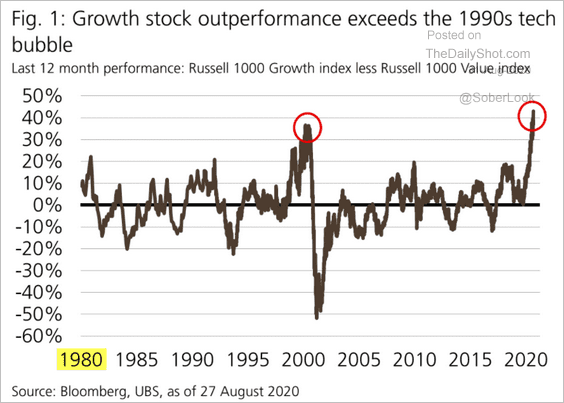
1. It’s Official…Growth Stock Outperformance Over Value Stocks Exceeds Internet Bubble.

https://dailyshotbrief.com/the-daily-shot-brief-august-31st-2020-2-2/

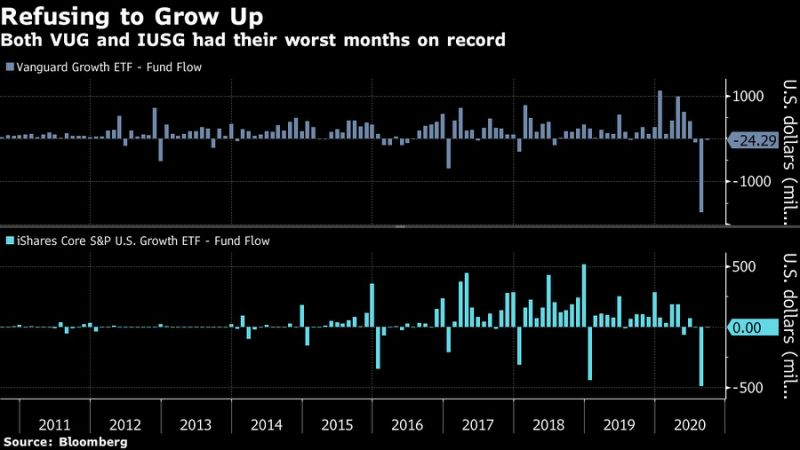
2. But Two Giant Growth Funds Suffer Biggest Selling Stampede on Record

Two Giant Growth Funds Suffer Biggest Selling Stampede on Record

Claire Ballentine

Two Giant Growth Funds Suffer Biggest Selling Stampede on Record

(Bloomberg) — After this year’s surge in high-growth stocks, two big exchange-traded funds tracking those companies are losing steam.

Both the $65 billion Vanguard Growth ETF (VUG) and the $10 billion iShares Core S&P U.S. Growth ETF (IUSG) posted their largest outflows on record last month, according to data compiled by Bloomberg. Funds focused on growth lost more than $2.4 billion in August, the most since 2016. Meanwhile, value ETFs attracted $1.9 billion — their best month since March.

High-growth companies such as megacap technology names with solid balance sheets have been among this year’s hottest trades. But their historic rally has fueled some skepticism about further gains amid concern that they may be too expensive relative to so-called value stocks.

“There’s hesitation that the significant outperformance led by a handful of megacap names like Amazon.com and Apple can continue to climb much higher,” said Todd Rosenbluth, head of ETF and mutual fund research at CFRA Research.

Yet signs of a slow economic recovery from the pandemic-induced recession and a spike in global coronavirus cases may still make a compelling case for growth shares. Those companies beat expectations by a stronger margin and more frequently than their value counterparts in the second-quarter earnings season.

Despite the monthly outflows for the sector, the performance ratio of the iShares Russell 1000 Growth ETF (IWF) hit new highs relative to its value counterpart (IWD), according to a recent report from Bloomberg Intelligence.

To Athanasios Psarofagis, an ETF analyst at Bloomberg Intelligence, there’s reason to believe that investors could still be favoring growth, but through more targeted approaches.

“For sure, growth ETFs will be heavy on tech, but there is also a lot of other stuff, and I just think people only want tech,” said Psarofagis.

Technology ETFs lured $2.1 billion in August, while thematic sector products received $3.2 billion — their best month since 2018. The $143 billion Invesco QQQ Trust Series 1 (QQQ), which tracks the Nasdaq 100 Index, added $2.1 billion last month. Meanwhile, the Ark Innovation ETF (ARKK), whose biggest holding is Tesla Inc., recently had its largest inflow on record.

For more articles like this, please visit us at bloomberg.com

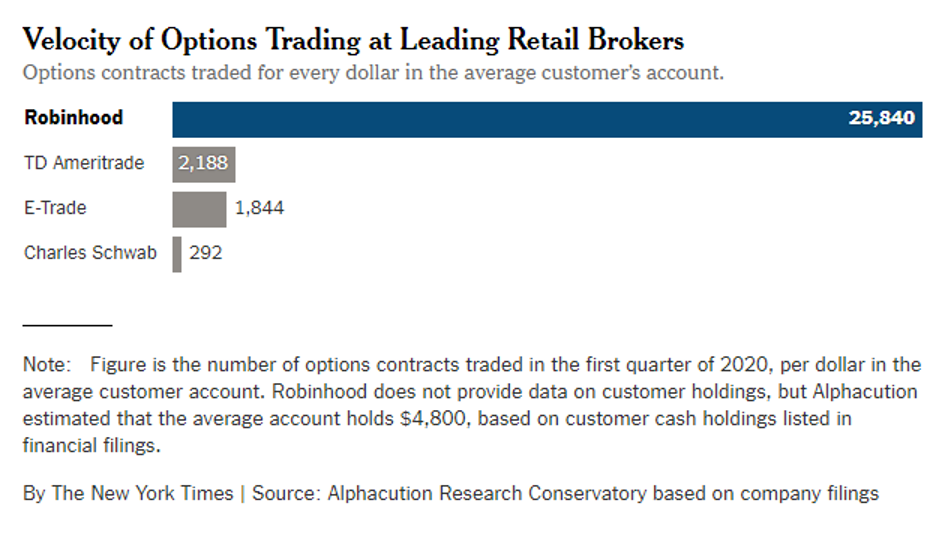
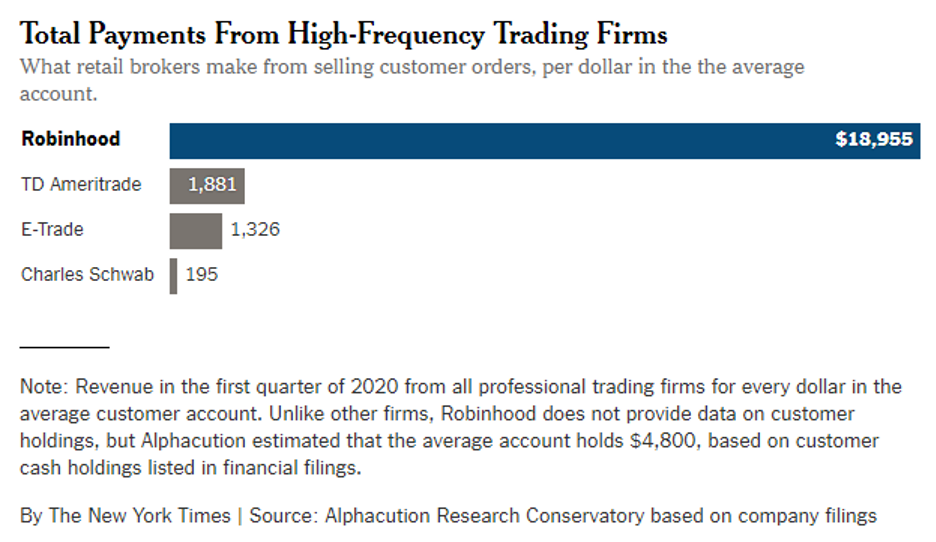
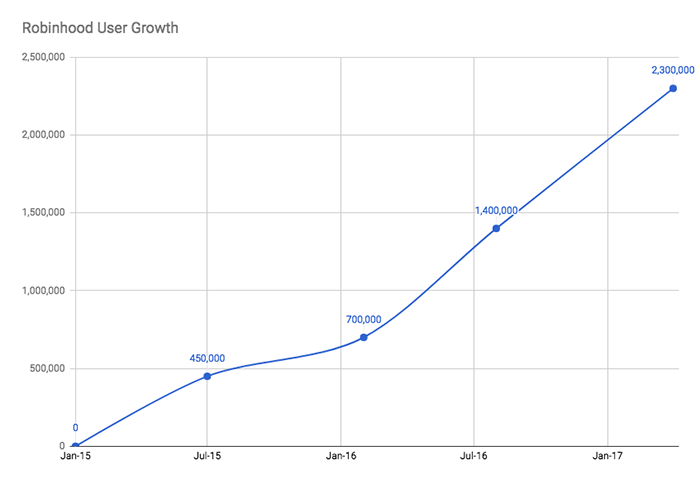
3. Robinhood faces SEC investigation over deals with high-speed trading firms, report says

Ben Winck

Summary List Placement

  • Robinhood is under investigation by the Securities and Exchange Commission over its deals with high-speed trading firms, The Wall Street Journal reported on Wednesday.
  • The investigation is focused on Robinhood’s failure to fully disclose its practice of selling customers’ orders to market-makers, sources told The Journal.
  • A settlement fine could exceed $10 million, but a deal is unlikely to be announced this month, the sources told the newspaper.
  • Visit the Business Insider homepage for more stories.
  • The Securities and Exchange Commission is investigating Robinhood over its deals with high-speed trading businesses, The Wall Street Journal reported on Wednesday.
  • The investigation is in advanced stages and focuses on Robinhood’s failure to fully disclose its practice of selling customers’ orders to market-makers, sources familiar with the matter told The Journal. The brokerage could be forced to pay a fine of more than $10 million if it settles with the SEC, a source told the newspaper.
  • A fine hasn’t been negotiated between the two sides, one source said. A deal is unlikely to be announced this month, sources told The Journal.

https://www.forbes.com/sites/jeffkauflin/2020/08/03/robinhood-doubles-its-second-quarter-trading-revenue-reaching-180-million/#3c5e0c20768c

4. Stock Options with Less Than 2 Weeks Maturity Now Compromise 75% of Option Volume

a close up of text and logo on a white background

From Nick Lampone Dalzell Trading https://www.linkedin.com/in/nicholas-lampone-9277986/

5. Asset Class Returns Rising Vs. Falling Dollar.

www.dorseywright.com

6. Art Cashin (legendary Trader) on the short-term effects of stock splits

Posted August 31, 2020 byJoshua M Brown

The legendary floor trader Art Cashin weighs in on the Tesla and Apple stock splits, which became effective today, in an emailed note. Excerpting a piece of it below…

Let’s begin with stock splits.  I watched as several self-styled pundits on the financial media were beside themselves trying to explain how stocks were actually gaining ground after split.  There were all the standard logical rationalizations.  You have not increased the company’s worth by the action of splitting up as people buy yet the capitalization goes up, etc., etc.  I give you five singles for a five-dollar bill, yet we haven’t really changed the value in any form.

The real point I can’t believe all of them have missed has to do with shorting the stock, particularly stocks like Tesla, Amazon and Apple where there are large short positions due to skeptics.  When someone sells a stock that he doesn’t own (short), he then has to borrow it from someone who owns it so he can make delivery.  He promises then to re-deliver an identical type of stock from whom he borrowed.   When the stock splits, it complicates life for short sellers and often they have to go into various negotiations that are the equivalent of a short squeeze to buy back the stock, rechanging it for stock that will be due after the split is effective.

So, it was perfectly natural to watch Apple split and then have people begin to buy it and Tesla split and people begin to buy it and, while as I say, the self-styled experts amazed me I guess by their apparent lack of experience.  So anyway, I wanted to make the point that stock splits can have a serious upward push on stocks, particularly heavily shorted.  I guess that’s what comes with over 60 years’ experience on the Street.

This is a piece of the story that I myself had not considered. As I type, Tesla, now having split, is up another (another!) ten percent on the day while the just-split Apple tacks on another five percent in market value. I don’t how you can calculate the exact amount of these audacious moves in price are directly related to short-seller buy-ins and other related mechanics, but it’s probably a bigger factor than many (myself included) have considered.

Art is the best. Love that guy.

Photo comes from my own collection – Barry and Art did a fireside chat at a conference we threw back in 2013. Our camera phones weren’t so great back then. 

For disclosure information please visit: https://ritholtzwealth.com/blog-disclosures/

7. 10 Year Treasury Rate Hooks Back Down

10 Year Yield Rolls Back Over

www.stockcharts.com

30 Year Yields

www.stockcharts.com

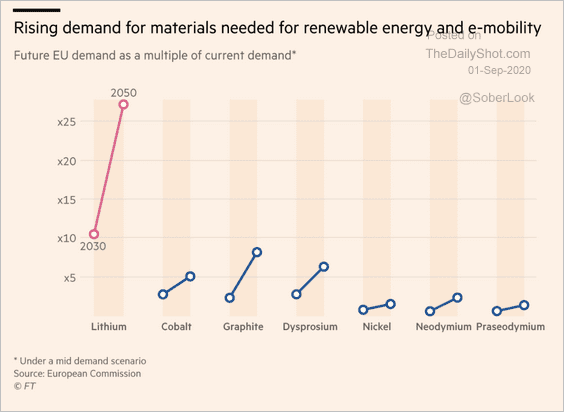
8. Commodities: This chart shows rising EU demand for materials used in electric cars and renewable energy.

Commodity Demand around electric cars growing at 25x

Source: @financialtimes Read full article

https://dailyshotbrief.com/the-daily-shot-brief-september-1st-2020/

9. VisualCapatalist World Population

Global Population Estimates 2100

10. Great Leaders Focus on the Why and the What – not the How.

Guest post by Steve Coughran:

my two decades of business experience, I have encountered many different flavors of leadership. Some leaders are strong-willed and autocratic, some are open-minded and democratic, some employ laissez-faire, employee-centric leadership styles, and most fall somewhere in the middle. While leadership style varies, in my experience, leaders across the board provide employees with a sincere depiction of the Why, an explicit description of the What, and freedom on the How.

Many of you reading are likely familiar with Simon Sinek’s Start with Why. His premise suggests that great leaders motivate with the “Why”, a deep-rooted purpose, before defining the “What”, the product or service, or the “How”, the process.  Expanding on Sinek’s thoughts, I believe that not only do great leaders deprioritize the “how,” but the most influential bosses leave the “how” to their employees to figure out.

Have you ever been in a work situation where your boss or manager is explaining in specific detail how to do your job? It’s frustrating when managers live in the weeds. Poor leaders provide specificity around how to complete a task but fail to share the big picture, the why, behind the request.  No one likes to be micromanaged. Unfortunately, many leaders result to meddling with the process in attempts to maintain a false sense of power. Micromanagers focus explicitly on the how, which often results in short-term success at the expense of the long-term strategy, overall scalability, and employee satisfaction.

Great leaders give little input on the how. Of course, this approach first requires leaders to equip employees with the tools and skills to solve for the how. They must invest heavily in training to ensure employees are prepared to think through the processes.

Training alone, however, isn’t enough to produce the desired results. After reinforcing the why and enabling employees, they get specific about the what. Great leaders share explicit expectations. When I first launched a high-end design build firm, I learned the hard way the importance of clearly communicating expectations. I was feeling on top of the world as my company flourished; customers were lining up for projects, and I had a diverse and talented staff to uphold my brand. To maintain this status, I was also working like a dog, putting in eighty-hour workweeks to keep up with demand. I jumped at my first opportunity to take a two-week vacation, leaving the company reins in the hands of one of my top managers. We were working on a high-end project, but I trusted my employees. I gave little instruction—my manager knew the business as well as I did—and was off to relax on a beach in Mexico and forget about work for a while.

I returned frustrated with the lack of progress. While I was away, the high-end project suffered from operational issues that led to cost overruns and schedule delays resulting in an upset client and some delayed payments. While I was upset with my team, I too was responsible for the situation. What did I count on my managers and employees to do while I was away? More importantly, how would I ensure they held up their end of the bargain? I failed to create an accountability structure. Through this experience, I learned a critical lesson: strong leaders follow up.

Great leaders build accountability structures that clearly define the desired results. Results are laid out specifically and comprehensively, often incorporating qualitative and quantitative data. By leaving little room for confusion, leaders establish fair expectations, which provide a foundation for equitable evaluation and constructive feedback. They create a “return and report” culture where employees are sent off with an understanding of the overarching strategy and the goals of the assignment. They present their findings after independently problem solving.

Giving employees freedom shows that you trust them (which according to research is critical for workplace engagement and productivity). Additionally, by encouraging employees to think, leaders boost their team’s development. Seeing how the employee problem solves allows his or her manager to clearly examine their comprehension of the task, the big picture, and detect any gaps in understanding or skills. They can then address these knowledge gaps with training and coaching, bringing the employees’ development full circle.

As we all continue along the journey to become the best leaders we can be, keep in mind Simon Sinek’s words of wisdom, “There is a difference between giving direction and giving directions.” Emphasize your purpose, explain your product or service, and leave the rest to your well-equipped team. 

About the author:  Author, CFO of an international billion-dollar company, and management consultant, Steve Coughran has over two decades of experience driving business excellence. His newest book is Outsizing: Strategies to Grow your Business, Profits, and Potential.  For more information visit www.SteveCoughran.com.

https://www.greatleadershipbydan.com/2019/10/great-leaders-focus-on-why-and-whatnot.html

Disclosure

Lansing Street Advisors is a registered investment adviser with the State of Pennsylvania..
To the extent that content includes references to securities, those references do not constitute an offer or solicitation to buy, sell or hold such security as information is provided for educational purposes only. Articles should not be considered investment advice and the information contain within should not be relied upon in assessing whether or not to invest in any securities or asset classes mentioned. Articles have been prepared without regard to the individual financial circumstances and objectives of persons who receive it. Securities discussed may not be suitable for all investors. Please keep in mind that a company’s past financial performance, including the performance of its share price, does not guarantee future results.
Material compiled by Lansing Street Advisors is based on publicly available data at the time of compilation. Lansing Street Advisors makes no warranties or representation of any kind relating to the accuracy, completeness or timeliness of the data and shall not have liability for any damages of any kind relating to the use such data.
Material for market review represents an assessment of the market environment at a specific point in time and is not intended to be a forecast of future events, or a guarantee of future results.
Indices that may be included herein are unmanaged indices and one cannot directly invest in an index. Index returns do not reflect the impact of any management fees, transaction costs or expenses. The index information included herein is for illustrative purposes only.

Topley’s Top 10 – September 1, 2020

1. What Did Stock Splits Look Like During the Internet Bubble vs. Today?

From Dave Lutz at Jones Trading

2. Get Ready for a Crazy Wave of IPOs. Here Are the Ones to Watch.

BYEric J. Savitz

Sandy Miller, general partner at Institutional Venture Partners, notes that the number of public companies has fallen in half over the last 20 years, as M&A has outstripped new issues. “There’s a real hunger for new names,” he says. 

Coming Attractions:

A few of the tech companies that filed for IPOs this past week.

CompanyLatest Fiscal Year SalesDescription
Corsair Gaming$1.1 billionVideo game accessories
Palantir743 millionData analytics
Bentley Systems608 millionConstruction engineering SW
Unity Software542 millionVideo game developer tools
Snowflake265 millionCloud data management
Sumo Logic155 millionData analytics
Asana143 millionWork management software
JFrog105 millionSoftware release management

Source: company reports

The supply is deep. Venture-backed unicorns—pre-IPO companies with valuations above $1 billion—are piling up like kindling. According to CB Insights, there are 490 unicorns. By contrast, there are just shy of 2,000 companies trading on the Nasdaq or the New York Stock Exchange with valuations above $1 billion. In other words, if all the unicorns magically listed at once, the number of large cap U.S.-listed companies would increase by 25%. Most but not all unicorns are tech businesses, so consider this: Over the past three years, there have been a total of 100 tech IPOs. The current supply of unicorns is equal to 14 years of tech stock debuts.

https://www.barrons.com/articles/the-ipo-market-is-about-to-go-crazy-here-are-the-ipos-to-watch-51598658370?mod=past_editions

 https://www.cbinsights.com/research/best-venture-capital-unicorn-spotters-2/Unicorn Hunters: These Investors Have Backed The Most Billion-Dollar  Companies

3. The Urge to Reverse Merge

SPACs are just getting started

The “blank check” acquisition funds known as special purpose acquisition companies, or SPACs, have raised more than $30 billionso far this year, versus $13 billion in all of last year. Can they keep it up? DealBook spoke with some of the most plugged-in SPAC bankers and lawyers on Wall Street, and they cited three factors driving the boom

1. Valuations are soaring for popular SPAC targets

“The pipeline is heavily weighted to technology and growth companies,” said Niron Stabinsky, who leads SPAC deals at Credit Suisse. He said that he speaks to big venture firms “weekly” about their portfolios. Many have taken notice of recent success stories, like Virgin Galactic’s merger with a SPAC led by the former Facebook executive Chamath Palihapitiya. SPAC offerings will be “incredibly active post Labor Day,” said Paul Tropp, the co-head of Ropes & Gray’s capital markets group. That’s part of a “significant uptick” in listings expected to hit the market before election-related uncertainty sets in: Yesterday, the tech firms Asana, JFrog, Snowflake and Unity all filed to go public.

2. SPACs aren’t just an alternative to traditional I.P.O.s

“SPACs have become a new way of doing an M.&A. deal,” said Jeff Mortara, the head of equity capital markets origination at UBS. A merger with a SPAC allows the target company’s investors to retain a stake while gaining liquidity, and deal negotiations can be done directly, secretly and quickly. SPACs typically have two years from their I.P.O. date to complete a merger.

3. The flood of money to SPACs means better terms for targets

“Everything is negotiable,” the venture capitalist Bill Gurley wrote in a detailed case for SPACs on his blog this weekend. As competition between SPACs intensifies, “sponsors are continuing to negotiate deals that look better for the companies they buy,” he said in the essay, which quickly became the talk of Wall Street and Silicon Valley.

Why? Some SPAC sponsors are open to a smaller “promote” — the stake the sponsor gets essentially free after a merger. (Traditionally, a sponsor takes 20 percent.) SPACs also award warrants to the vehicle’s investors, which give them the right to buy larger stakes in the merged company at a discount; these are becoming less dilutive as sponsors shift their terms to be more favorable to the target company. In the life-sciences industry, where SPACs have “nearly replaced late-stage financing and I.P.O.s,” warrants have come down to zero in some deals, said Christian Nagler, a partner in the capital markets practice at the law firm Kirkland & Ellis.

The standard-bearer of a new approach for SPACs is the $4 billion fund sponsored by Bill Ackman’s Pershing Square, the largest to date. The fund’s warrants are structured in a way that encourages investors to stay invested longer in the merged company, and Pershing will take its “promote” only if the company it buys meets certain performance goals. Sponsors without Mr. Ackman’s reputation may find those terms hard to imitate, but some are adopting similar elements all the same, experts say.

What’s next? Mr. Gurley predicted that SPAC fund-raising this year could be four times higher than the previous record, set in 2019, implying another $20 billion or so to come. The buoyant markets are attracting figures not known for deal making to the space, like the former Congressman Paul Ryan and the baseball executive Billy Beane, which sows doubts among some about the durability of the boom. Just SPAC mergers involving electric car companies and auto technology firms — “deals on wheels,” as one analyst put it to The Times’s Neal E. Boudette and Kate Kelly — are already worth more than $10 billion.

____________________________

Today’s DealBook Briefing was written by Andrew Ross Sorkin in Connecticut, Lauren Hirsch in New York, and Michael J. de la Merced and Jason Karaian in London.

Editors’ Picks

4. Investors Dump ‘Dead Weight’ Cash-Like ETFs at Record Pace

Katherine Greifeld

Investors Dump ‘Dead Weight’ Cash-Like ETFs at Record Pace

(Bloomberg) — Investors are abandoning cash holdings at a record clip as momentum continues to build behind 2020’s risk rally.

Roughly $5.4 billion has exited from the $20 billion iShares Short Treasury Bond exchange-traded fund — the biggest ultra-short duration ETF — over 14 consecutive weeks of outflows. That was the longest streak on record for the product, whose ticker is SHV. Meanwhile, investors have pulled $2.4 billion from the $14 billion SPDR Bloomberg Barclays 1-3 Month T-Bill ETF (BIL) over 10 weeks, according to Bloomberg Intelligence data.

Investors accumulated record amounts of cash earlier this year amid concern over the impacts of the coronavirus pandemic on the global economy, with assets in money-market mutual funds soaring to a record $4.8 trillion in late May. Now, that cash is coming off the sidelines as stocks surge and corporate bonds look increasingly appealing. Additionally, the Federal Reserve’s commitment to keep interest rates at near-zero levels for the foreseeable future is further curbing appetite for short-duration Treasury ETFs.

“It’s recognition that ‘ZIRP’ will be around for a long time, combined with a rising risk appetite,” said Kathy Jones, Charles Schwab Corp.’s chief fixed-income strategist, referring to the concept of a zero interest-rate policy. “Short-term Treasury ETFs are looking less attractive than alternatives. Equities are benefiting. We also see interest in foreign equities and high-yield and emerging-market bonds.”

The S&P 500 has surged more than 55% from March’s bottom, notching a fifth straight month of gains in August. The Fed’s credit market backstop has boosted both investment-grade and junk bonds, with the largest high-yield debt ETF climbing nearly 24% since late March. The emerging-market outlook is also considerably brighter amid the dollar’s continued weakness and the Fed’s new average-inflation targeting regime.

The exodus from ultra-short duration ETFs is also likely due to investors trying to eliminate the “cash drag” in their portfolios by reinvesting in higher-yielding assets, according to Dan Suzuki at Richard Bernstein Advisors.

“Because they’re not generating any yield, they are acting as huge dead weight in many people’s portfolios,” said Suzuki, the firm’s deputy chief investment officer. “Investors are probably chasing higher returns, which means moving up the risk spectrum.”

(Updates prices in 5th paragraph.)

For more articles like this, please visit us at bloomberg.com

https://finance.yahoo.com/news/relentless-risk-rally-spurs-record-155206736.html

5. Warren Buffett’s Berkshire Hathaway reveals $6 billion investment in 5 Japanese giants

Theron Mohamed

  • Warren Buffett’s Berkshire Hathaway disclosed a $6 billion bet on five of Japan’s biggest trading companies in a press release on Sunday night.
  • The billionaire investor’s company revealed that it owns just over 5% of Mitsubishi, Mitsui, Itochu, Marubeni, and Sumitomo.
  • “I am delighted to have Berkshire Hathaway participate in the future of Japan and the five companies we have chosen for investment,” Buffett said in the statement.
  • Visit Business Insider’s homepage for more stories.

Warren Buffett marked his 90th birthday on Sunday by revealing a $6 billion investment in five of Japan’s largest trading companies.

The famed investor’s Berkshire Hathaway conglomerate has built passive stakes of just over 5% in each of Itochu, Marubeni, Mitsubishi, Mitsui, and Sumitomo over the past 12 months, it said in a press release. Its National Indemnity subsidiary made the investments and will officially notify Japanese regulators of the positions when trading begins on Monday.

“I am delighted to have Berkshire Hathaway participate in the future of Japan and the five companies we have chosen for investment,” Buffett said in the press release.

“The five major trading companies have many joint ventures throughout the world and are likely to have more of these partnerships,” he continued. “I hope that in the future there may be opportunities of mutual benefit.”

Shares in Itochu, Marubeni, Mitsubishi, Mitsui, and Sumitomo all rose between 4% and 10% on Monday.

Buffett’s company highlighted its longstanding positions in Coca-Cola, American Express, and Moody’s in the statement, underscoring its intention to maintain the Japanese investments for the long term. 

Berkshire has the option to boost its stakes as high as 9.9% in any of the five companies. Buffett pledged to seek approval from the relevant board of directors to raise it beyond that point.

Investing in Japanese companies is a departure from the norm for Berkshire, as it has historically favored American businesses such as Apple and Bank of America. However, it has made a few foreign bets on companies such as Brazilian payments group StoneCo.

https://markets.businessinsider.com/news/stocks/warren-buffett-reveals-6-billion-investment-5-japanese-companies-2020-8-1029546397#

6. QQQ vs. EFA (developed Europe) 5 Year Chart….U.S. Tech Sector Now Worth More Than Entire European Stock Market.

QQQ +179% vs. EFA +8%

www.yahoofinance.com

The US tech sector is now worth more than the entire European stock market, Bank of America says

Ben Winck

Henny Ray Abrams/AP Photo

  • US tech stocks have overtaken the entire European stock market in market value as investors crowd into mega-caps to ride out the coronavirus pandemic.
  • The tech sector is now worth $9.1 trillion, Bank of America said Thursday, while European stocks — including those in the UK and Switzerland — are worth a collective $8.9 trillion.
  • The five largest US tech stocks — Apple, Microsoft, Alphabet, Amazon, and Facebook — are worth a collective $7.5 trillion and make up nearly 24% of the S&P 500.
  • Amazon has jumped the most in 2020 so far, while Alphabet’s Class A shares have gained the least.
  • Visit the Business Insider homepage for more stories.

US tech stocks surpassed the entire European stock market in market value after surging through the summer on outsize investor interest, Bank of America said in a note to clients.

The sector has notched several extraordinary superlatives through the coronavirus pandemic. Tech names fueled the US market’s rapid leap out of bearish territory and now host historically high investor crowding. Most recently, the group drove the S&P 500 to a record high, while the US remains deep in an economic slump and economists fear a double-dip recession.

Tech stocks’ market cap totaled $9.1 trillion as of Thursday, Bank of America said. That, for the first time, dwarfed the total value of all European stocks — including those listed in the UK and Switzerland — which stood at $8.9 trillion.

To emphasize the speed at which tech stocks have grown, the bank noted that Europe’s market cap in 2007 was roughly four times the size of the sector.

Much of that value is concentrated in the top five tech giants: Apple, Microsoft, Alphabet, Amazon, and Facebook. Together the companies make up nearly 24% of the S&P 500 and are worth roughly $7.5 trillion. Apple alone is valued at over $2 trillion.

Investors largely shifted capital into tech giants at the start of the pandemic, betting that the mega-caps’ cash piles and insulation from widespread lockdowns would outperform the market. Some strategists have deemed the names overcrowded, and others say they fear that antitrust measures could erode the companies’ success. But that hasn’t stopped the sector from continuing its run-up through the summer.

Of the five giants, Amazon has surged the most through the year. The stock is up roughly 85% in 2020, thriving on a surge of online retail activity as Americans stayed at home.

Alphabet’s Class A shares are up the least year-to-date compared with its mega-cap peers. Still, the shares have gained roughly 22% in 2020 and more than 7% over just the past month.

https://markets.businessinsider.com/news/stocks/us-tech-stocks-worth-more-european-stock-market-apple-microsoft-2020-8-1029545001#

7. Dollar Breaking 200 Day Moving Average

www.stockcharts.com

A weak dollar is impacting an uneven global market recovery

Dion Rabouin, author of Markets

After sinking on Friday, the dollar is teetering near its lowest in more than two years, and threatening to decline even further after Fed chair Jerome Powell confirmed plans to let inflation run hot in the future, likely meaning 0% U.S. interest rates for quite some time.

Why it matters: For the U.S. currency to fall in value, other currencies must rise and that can be especially harmful to export-oriented economies like the eurozone and Japan, whose central banks may be forced to take action in the coming months.

What it means: A strong currency makes a country’s exports more expensive and therefore less attractive, denting a needed source of income, especially as the world tries to recover from the coronavirus pandemic.

  • But with the European Central Bank and Bank of Japan both already holding negative interest rates and having significantly expanded their respective quantitative easing programs, weakening their currencies may require extreme measures.

The big picture: The U.S. has done a far worse job handling the coronavirus pandemic than most of Europe and Japan, but that has led to a weaker currency and a much stronger bounce in stock prices. The benchmark S&P 500 has gained 8.6% this year, with the Nasdaq up 30%.

  • The currency appreciation is weighing on stock indexes in the eurozone and Japan, which have recovered much more slowly than U.S. equities this year.
  • Germany’s DAX is up 5% for the year in dollar terms, but in euros the index remains 1.6% lower than where it began 2020, with similar outcomes for the Italian benchmark FTSE MiB (-10.5% YTD in dollars, -15.6% in euros) and France’s CAC 40 (-11.3% YTD in dollars, -16.3% in euros), per FactSet data.
  • Japan’s Nikkei index is flat on the year in dollar terms, but about 3% lower in yen.

Where it stands: The euro has risen to $1.19 and is trading just below the two-year high it touched earlier in August, threatening to break back toward its early 2018 levels around $1.25, while the dollar has fallen to 105.30 yen, eyeing 100 yen per dollar.

  • The Swiss franc, Swedish krona and Danish krone all have gained at least 6.5% versus the dollar this year.

Worth noting: Commodities, which are largely priced in dollars, also look poised to further benefit from the greenback’s slide. Gold and silver have had breakout years, each up more than 30% for the year, and other commodities are picking up — copper has risen 12% since July 1, and cocoa is up 23.6%.

https://www.axios.com/weak-dollar-global-recovery-central-bank-policy-f8c9fc0a-5c98-427c-a7c7-6b951773c700.html

8. Update on Restaurant Reservations

In the US, about 75% of the restaurants that took reservations before the pandemic are now taking reservations again, up from zero in April, according to data from OpenTable which provides online reservation services for 60,000 restaurants. Back on July 1, already 65% of the restaurants were taking reservations again, but then new outbreaks spreading across the country, particularly in the South, triggered some retrenching (chart via OpenTable):

The State of the American Restaurant, City by City–by Wolf Richter • Aug 29, 2020 • 108 Comments https://wolfstreet.com/2020/08/29/the-state-of-the-american-restaurants-city-by-city/

9. Follow Up From My Link Yesterday to Most Under 40’s Ever in U.S…..Population in U.S. Median Age is Trending Higher.

Thanks to Joe D at Philly Inquirer for Passing Along.

https://www.statista.com/statistics/241494/median-age-of-the-us-population/

10. Why Misinformation Goes Viral

Psychological factors affect the spread of misinformation during crises.

H. Colleen Sinclair Ph.D.

Unpacking Social Relations

In the continued war on misinformation, LinkedIn and Facebook just removed millions of posts containing misinformation about the coronavirus.  And it is believed that is but a fraction of the posts.  When John Oliver tackled the flood of misinformation surrounding the COVID-19 pandemic, he mentioned the “proportionality bias” — that big events beg big explanations — to explain why misinformation, particularly conspiracy theories, have had a heyday with the current crisis.  However, the science suggests that it is more than just the proportionality effect at play making this crisis exceptionally fertile grounds for seeds of misinformation.

Negativity Bias. For starters, our evolutionary heritage leads us generally to pay more attention to negative information than to positive information.  This negativity bias was important to the survival of our species, as attending to the tiger prowling the encampment was more imperative than celebrating the latest birth.  We see this reflected in our news which disproportionately features headlines about the latest travesty while feel-good stories are relegated to the back pages.  And recent research has shown that this attention to negative news is evident at the physiological (and neurological) level across samples in 17 different countries.

Ultimately, this means that if something bad is happening, it’s got our attention.  A once-a-century pandemic killing hundreds of thousands certainly qualifies.  Thus, already, we are on the outlook for information.  Further, evidence suggests that negative information is viewed as more credible than positive information.  So not only are we paying attention but we are also primed to believe it.

Social Risk Amplification. This negativity bias gets a boost when information is shared.  In a recent interview, it was said that the spread of misinformation is like a “screwed up game of telephone.” In fact, using these “diffusion chain experiments” is a common choice in experimental studies examining the transmission of information.  In a 2015 study researchers had strings of 10 participants pass along information about the risks and benefits of a controversial drug (i.e., triclosan).  Overall, all messages became shorter and increasingly inaccurate.  However, by the end of the “diffusion chain” information about the benefits had been relatively lost whereas information about the risks continued to spread.  Further, individual biases about risks led to the amplification of risks down the chain.  A follow-up 2020 study showed that this amplification effect is even stronger when people are feeling stressed and unfortunately, new research shows that Americans are even more stressed about the coronavirus than other nations.

 Reginald D. Williams II et al., Do Americans Face Greater Mental Health and Economic Consequences from COVID-19? Comparing the U.S. with Other High-Income Countries (Commonwealth Fund, August 2020).

American Stress Levels Compared

Source: Reginald D. Williams II et al., Do Americans Face Greater Mental Health and Economic Consequences from COVID-19? Comparing the U.S. with Other High-Income Countries (Commonwealth Fund, August 2020).

Dread Risks. As if that weren’t enough to provide a megaphone for misinformation during stressful times, social risk amplification is even more likely when people are experiencing what are called dread risks, i.e., life-altering, disastrous, random, events that present a threat to mortality.  In a 2018 study, researchers using an 8-person diffusion chain experiment paradigm randomly assigned groups to transmit low- or high-dread risk messages. As the message passed from person to person the high-dread chains became more and more negative in their transmission of the message relative to the low-dread chains, and those messages became more and more distorted. We saw a real-life example of this with the transmission of information about the Ebola outbreak in 2015 via Twitter and Facebook where the diffusion chains are no longer just 8 or 10 people long but spread across millions of users each with their own megaphones of various wattage.

Frustration with the Scientific Method. To further complicate matters, the current pandemic features a novel coronavirus.  Meaning there wasn’t a wealth of accurate information from science at the outset of the outbreak because how could there be? It was new. Scientists are racing to find answers. Science, however, is constrained by the scientific method which is much slower than the pace at which fearful stressed citizens want information. It takes considerable time, customarily, to build a scientific consensus. Thus, in this race for information, science often lags behind misinformation because the Twitter user recommending alcohol to combat COVID-19 is not similarly constrained.

article continues after advertisement

This scientific method can further be frustrating to individuals when the process of replication and peer review kicks in and leads to the modification or retraction of findings. These updates are more likely to occur when there is a race for answers and thus usually meticulous methods are viewed as less important than expediency. When recommendations are altered based on new evidence, this is a sign that science is working.  However, when sources who are supposed to “have the facts” change course, it can result in a tainted truth effect damaging trust in those sources.  Meanwhile, our Facebook friends are not held to the same standard.

Fear and Shallow Processing. Consequently, the wrong information, if repeated and said with certainty, can be more persuasive than the latest science, especially when we don’t take the time to process messages (e.g., read beyond the headline). Shallow processing is even more likely on the internet, where information flies by at the speed of a scroll and among people who are afraid such that they are looking for any type of action to protect themselves.  

Due to this perfect storm of contributing factors we are seeing the spread of misinformation take on pandemic proportions (now available in 25 languages). Scientists often feel like they are combating two viruses. As citizens wishing to avoid infection, we need to practice good information hygiene in addition to good personal hygiene—starting with recognizing some of the signs that something you encounter might be misinformation, just as you would be on high alert when you hear someone cough or sneeze. Further, engage in basic fact-checking. Be the investigator, find the source of the information, and weigh the evidence supporting their claims. If you don’t have the time to do the investigation, do not share. You could save a life by stopping the spread of misinformation.

https://www.psychologytoday.com/us/blog/unpacking-social-relations/202008/why-misinformation-goes-viral?collection=1148634

Disclosure

Lansing Street Advisors is a registered investment adviser with the State of Pennsylvania..
To the extent that content includes references to securities, those references do not constitute an offer or solicitation to buy, sell or hold such security as information is provided for educational purposes only. Articles should not be considered investment advice and the information contain within should not be relied upon in assessing whether or not to invest in any securities or asset classes mentioned. Articles have been prepared without regard to the individual financial circumstances and objectives of persons who receive it. Securities discussed may not be suitable for all investors. Please keep in mind that a company’s past financial performance, including the performance of its share price, does not guarantee future results.
Material compiled by Lansing Street Advisors is based on publicly available data at the time of compilation. Lansing Street Advisors makes no warranties or representation of any kind relating to the accuracy, completeness or timeliness of the data and shall not have liability for any damages of any kind relating to the use such data.
Material for market review represents an assessment of the market environment at a specific point in time and is not intended to be a forecast of future events, or a guarantee of future results.
Indices that may be included herein are unmanaged indices and one cannot directly invest in an index. Index returns do not reflect the impact of any management fees, transaction costs or expenses. The index information included herein is for illustrative purposes only.

Topley’s Top 10 – August 28, 2020

1. 1995-2016 Hedge Fund Managers Kept 64% of Profits.

Opinion: Hedge fund fees — whether or not you make money — are truly shocking

Mark Hulbert

Hedge funds keep two-thirds of profits; investors get the rest

The professors analyzed a comprehensive hedge fund database containing nearly 6,000 funds over the 22 years from 1995 through 2016. Over that period these hedge funds collectively produced total gross profits of $316.8 billion. Of this total, fund managers kept $202 billion ($88.7 billion in management fees and $113.3 billion in performance incentive fees). The remainder—$113.3 billion, or 35.8% of total gross profits — went to investors. (See the chart below.)

The source of this skewed profit sharing is the asymmetry of hedge funds’ performance incentive fees. While the hedge fund industry receives a portion of investors’ gains, it does not to the same extent share in their losses.

It’s easy to overlook this asymmetry because it becomes evident only when focusing on the industry as a whole. At the individual fund level, incentive fees are only levied on performance that exceeds prior performance — exceeds previous high-water marks, in other words.

To illustrate how this performance incentive fee arrangement looks in practice, imagine the following two otherwise identical scenarios (setting aside management fees):

•        You invest in a single hedge fund that in the first year gains 20%, gives up all that gain in the second year (a loss of 16.67%), and then gains 30% in the third year. You’d pay a performance incentive of 4% in the first year (20% of the 20% gain), nothing in the second year, and only 2% in the third year (2% of the amount by which that year’s gain exceeds that fund’s previous high-water mark). Glossing over several details, your total performance incentive fee for all three years would be 6% of assets under management.

•        In the second scenario, imagine that you instead invest in three separate hedge funds with the same gains: The first gains 20%, the second loses 16.67%, and the third gains 30%. Because the losing hedge fund’s losses can’t be used to offset the other two funds’ gains, you will pay a performance incentive fee of 10% — four percentage points higher.

An extreme example of this occurred in 2008, during the Great Financial Crisis. Cumulatively that year, the professors report, the hedge funds in their database lost $147.1 billion before fees. Yet investors in those funds collectively paid $4.4 billion in performance incentive fees.

https://www.marketwatch.com/story/hedge-fund-fees-whether-or-not-you-make-money-are-truly-shocking-2020-08-21

2. Call Options Betting on Higher Market Hit 1999 Levels

Options bets that the stock market will continue to soar have exploded to dot-com bubble levels

Mark DeCambre

Even as the stock market trades in record-setting territory despite the economy being in the throes of a viral pandemic, Wall Street bets for further gains are around their highest levels since the dot-com bubble, according to research from Bespoke Investment Group.

Options bets that the S&P 500 SPX, +0.16% will extend its run-up in months to come have roughly doubled, far exceeding trading in securities that would be used to bet that a decline in stock values was imminent.

Call options give holders the right but not the obligation to buy a certain number of shares (100 per option contract) at a certain price (strike price) by a certain date (expiration date).

Calls are viewed as bullish bets on an asset, as opposed to put options, and Bespoke indicates that appetite for calls, particularly among individual investors, has boomed.

“Retail enthusiasm for the market via commission-free trading apps plus the huge volatility earlier this year have led to a massive boom in options volumes,” the analysts at BIG wrote. “Most of the increase in trading activity in these derivatives has gone to calls,” they wrote (see chart below).

BESPOKE INVESTMENT GROUP

https://www.marketwatch.com/story/options-bets-that-the-stock-market-will-continue-to-soar-have-exploded-to-dot-com-bubble-levels-11598558379?mod=home-page

3. Yield Spreads Vs. Treasury..Energy Sector Highest.

From Dave Lutz at Jones Trading

David Rosenberg: Why it’s time to buy energy stocks now that Exxon Mobil has been booted out of the Dow – “It’s a classic contrary signpost for the downtrodden oil and gas equity sector” – as we re-enter a period of ‘ZIRP’ (zero interest rate policy) from the U.S. Federal Reserve — with no intentions of raising rates, or thinking about thinking about raising rates (as Fed chairman Jerome Powell put it) — investors are yet again forced to identify where they can get an income stream. In the period following the Great Financial Crisis, the answer has been in the stock market with the dividend yield exceeding the yield on the 10-year Treasury note on multiple occasions.

From Dave Lutz at Jones Trading

4. Never Invest Based On GDP…

One of the Strongest Aug Ever in Stock Market…On Back of Worst Quarterly Global GDP in History

The Worst Quarter in Modern History

We have 2Q GDP from almost every major country around the world now officially in the books. Bank of America Merrill Lynch says it’s “the worst quarter in modern history” and there’s no reason not to agree with that assessment.

Here’s my Chart o’ the Day:

GDP is down a GDP-weighted average of 8.1% yoy, easily the worst quarter in modern history…The US is right in the middle of the pack—down 9.5% yoy—but this is because the US has offset its ineffective COVID containment strategy with massive fiscal and monetary stimulus.

Source:

“Its official: the worst quarter ever”
Bank of America Merrill Lynch – August 18th, 2020

From Josh Brown Blog

https://thereformedbroker.com/2020/08/20/the-worst-quarter-in-modern-history/

5. S&P 500 heads for best August since 1986 as stunning summer rally continues

PUBLISHED FRI, AUG 28 20206:19 AM EDT

Bob Pisani@BOBPISANI  CNBC

A child wearing a face mask sits on the Charging Bull statue, also known as the Wall Street Bull, following the outbreak of the coronavirus disease (COVID-19) in New York, August 19, 2020.

A child wearing a face mask sits on the Charging Bull statue, also known as the Wall Street Bull, following the outbreak of the coronavirus disease (COVID-19) in New York, August 19, 2020.

Carlo Allegri | Reuters

It’s been a great August, up 6% for the S&P 500, the best August since 1986.

But then again, it was a great July.  And a great June. May was pretty good, too, and April was downright eye-popping.

The Summer Rally (S&P 500 Monthly Returns)

·         April: up 12.7%

·         May: up 4.5%

·         June: up 1.8%

·         July: up 5.5%

·         August (so far): up 6.6%

Five straight up months. What’s going on?

“August is going to come out looking like capital markets are endorsing a US cyclical recovery,” Nicholas Colas from DataTrek told clients in a recent note.

Colas freely admits that August’s outside return has a big asterisk: Apple’s 18% run-up. 

“This meaningfully skews everything from Tech sector returns to Growth/Value performance spreads and even the S&P 500′s August return,” he said, noting that without Apple, the S&P would only be up 4.1% on the month, not 6.8%.

Still, it sure looks like the market is endorsing an economic rebound. The small-cap Russell 2000 is also up about 6% for the month.  High-yield corporate funds are outperforming all other bond market classes. If the trading community was worried about an imminent economic downturn, neither of those two sectors would be leading.

The market has held up on a combination of optimism on a treatment/vaccine, along with massive Fed stimulus.

There’s still optimism on the vaccine front, but now that the Fed has announced its program to keep rates lower for longer and tolerate higher inflation levels ahead of its much-anticipated September 16th meeting, many are arguing the rally based on a Fed “put” (a floor below the market) has gone about as far as it can go.

“The Fed easy money story now priced into the market,” Alec Young, Chief Investment Officer at Tactical Alpha LLC, told me. “It’s buy the rumor, sell the news.”

But even Young admits that may only suffice to pause, but not derail the rally. He also argues the market needs a pause in the relentless digital/work from home story: “It is not healthy to have the index dominated by a few technology stocks,” he said.

None of this means the market will drop, and there are still plenty of bulls who insist the market is going higher.

Jim Paulsen at Leuthold is one of them: he has been bullish and remains bullish, though he freely admits the market could see a 10% correction.

He also freely admits that tech stocks are extended, but insists the fundamentals for tech are rock solid and nothing like 2000.  Extended, he insists, does not mean they are waiting for a crash.

And he strongly disagrees with the popular notion that Wall Street has become disconnected from Main Street.

“It’s not just about the Fed put. People think there is no legitimacy to the rally, and they’re wrong.  Look at retail sales, or the ISM, or housing, or auto sales. Look at the improvement in unemployment claims. They’re all bouncing,” he said.

As for the narrow rally centered on tech, Paulsen believes the broader market is about to play catch-up.

How much? He said he would not be surprised if S&P corporate profits were $200 in 2021.  The current consensus is $165.

Profits 25% higher than consensus for 2021? That would go a long way toward justifying the rally.

“We’ve had a 12% reduction in GDP, an all-time record,” he told me.  “But we may have an 18% improvement in GDP in the next 12 months, and that also would be an all-time high. That is going to bring in the broader market along with it.  You are going to have a major league shift in profitability into those cyclical names. When you thrust all those companies into a depression, and then you force them to get the most efficient they have ever been in their existence, and after all that, you give them a wartime boom?  Profitability is going to be maximized.”

Leuthold has told his clients to stay long: “I am going to own new-era tech, but I am going to own less of it going forward, and I am going to own more of the broader market–cyclicals, international, and small caps.”

Subscribe to CNBC PRO for exclusive insights and analysis, and live business day programming from around the world.

https://www.cnbc.com/2020/08/28/sp-500-heads-for-best-august-since-1986-as-stunning-summer-rally-continues.html

6. Why The Fed Comments Yesterday?

Found at Nasdaq Dorsey Wright www.dorseywright.com

7. Ultraviolet Light Can Kill the Virus—and Help These Stocks Rebound

By  Al Root

Text size

 Barrons

Daniel Slim/AFP via Getty Images

Ultraviolet light is getting its moment in the sun. Companies are adopting the technology to take out the coronavirus and make travel and work safer, and shares of some businesses active in the area are getting a lift.

For starters, Boeing (ticker: BA) announced Monday it is testing UV disinfecting technology inside a 787 jet. The goal is to make aviation “safer and more sustainable,” according to the company’s news release.

“It’s literally a UV wand designed to clean the flight deck,” Kevin Callahan, associate technical fellow at Boeing Commercial Airplanes, explained to Barron’s. On the flight deck, where pilots control the plane, harsh cleaning chemicals aren’t a great idea given the electronics in the area.

Boeing’s wand is designed to clean the cockpit in about 15 minutes. “This [wand] is an industrial strength version of what people see in stores,” Callahan said. Investors—and U.S. consumers—might be familiar with the blue light wands sold at places such as CVS Health (CVS) stores as tools for smartphones or the like.

·         iams-Sonoma Profit Doubled. The Stock Fell Anyway.UV light kills up to 99.9% of seasonal coronaviruses present in airborne droplets, according to a study by Columbia University. (For consumers looking for UV wands, the wavelength of light studied by Columbia is 222 nanometers long. It’s something to look for on UV wand packaging.)

The effectiveness of UV light makes some intuitive sense. UV light gives people sunburn, and in extreme cases, cancer. It can disrupt viruses’ DNA, rendering them effectively dead.

Carrier (CARR) is also expanding its air-quality game. Tuesday, the HVAC—short for heating, ventilation, and air conditioning—company said is selling 1,500 Carrier OptiClean air machines to California schools.

OptiClean are free-standing units that can be plugged into electrical outlets. “The ease-of-use and portability allows them to quickly and efficiently be deployed in a number of spatial configurations as the needs arise,” said Tyler Girtman, a regional manager at the building-solutions company Climatec, said in the Carrier news release.

Climatec worked with the schools buying the units on ways to ensure the health of students and staff as the academic year begins.

Top 5 uses for a UV lamp and ultraviolet light

Top 5 uses for a UV lamp

The ultraviolet light is very useful. It has many applications in the commercial, industrial and healthcare sectors. Ultraviolet light is a kind of electromagnetic radiation. Its wavelength is close to that of X-rays and light.The LED technology is improving and so the UV LED lights are becoming more available in the market. The UV light has higher energy compared to the visible light and so it is more useful. Here we are going to discuss the various uses of UV lamps.

Tanning and skin treatment

UV light is used for tanning. It can be used to imitate the impact of sunlight on the skin. For indoor tanning, use of UV light is very common. In fact, many people prefer indoor tanning to sun tanning. The rays of the sun are not uniform, so it may cause sunburn at times. You also need to be under the sun for a longer period of time to get the tan. The indoor tanning, on the other hand, requires only about 20 minutes. Another disadvantage of sun tanning is that the sun contains both UVA and UVB beams. The UVA beams are responsible for the tanning, but the UVB beams are harmful as it might affect your DNA. The UV lamps used in salons for indoor tanning doesn’t contain any UVB beams. So, it is safer. Ultraviolet light is effective in treating smallpox lesions. UV phototherapy is effective in treating vitiligo and psoriasis. It can also prevent the growth of certain type of skin cancer.

Fluorescent inspection

UV lamps can be used to inspect various materials and surfaces. Materials react in different ways when they are exposed to the UV light. Some substances absorb the UV light’s energy and change it into visible light. It is called fluorescence. For example, the ink of a highlighter pen has fluorescent dye. So, the dye glows in the dark. UV lamps can provide efficient lighting in homes and offices. These lights are used to decorate nightclubs.The UV beams emit a black light. This black light is useful in many ways. It can be used to inspect splits, breaks, and various defects. You can view certain things using the UV light that are not visible to the naked eye. So, it is also used as an analytic tool. This light is used by the detectives and other companies for inspection of documents, forged bank notes, etc.

Disinfection and germ control

The ultraviolet light can inactivate the small creatures in the water. So, it is used for disinfecting drinking water. This process is absolutely chemical free and can effectively destroy bacteria that have a wavelength of 240 to 280 nanometers. The light destroys the bacteria’s capacity to reproduce. So, no more bacteria grows in the water. UV light is widely used in water treatment facilities. This method of treating water is a lot more efficient than boiling water. The UV light can also get rid of chlorine and chloramine from water. Another use of the UV lamp is that it used in killing germs that are found in equipment, utensils, worktops, etc. This technique of germ control is used in the commercial businesses as well. It helps to avoid cross contamination or food poisoning. The UV light can also be used to increase the shelf life of vegetables and fruits.

Air Cleaning and bug eradication

Mold growth inside the house can affect the indoor air quality. If you can install UV air purification unit in your air conditioner duct then the quality of air can be improved. The UV-C light, which is in the 280 to 100 nm range, is used for air purification. This UV light can kill mold, mildew, germs, viruses, and bacteria that float in the air. You can use an air purifier that has the UV-C light technology. In this type of air filter, air passes through a HEPA filter. Then it passes through a small chamber and gets exposed to the UV-C light. Sometimes, the air goes through another filter before getting inside the room. You should use 36-watt bulbs for this purpose. UV lamps are used for killing bugs in the house as well. It is used in the modern bug zappers and has proved to be very effective in killing bugs. The UV-A light, in the range 380 to 315 nm, attracts many bugs and insects like houseflies, wasps, mosquitoes, etc. Unlike the humans, these insects can actually see the ultraviolet light. When the bug zapper is on, the insects get attracted to UV light and go towards the mesh. They become electrocuted once they come into contact with the electric grids and gets vaporized. The bug zapper is a very popular means of killing bugs and insects today.

Indoor Gardening

UV lights are used in the production of polyphenols. It is a very beneficial plant and is said to prevent cancer. It can also make you look young. It can help in raisin production as well. It can also help in the production of medical cannabis. In fact, the UV light helps in improving the medicinal properties of cannabis.

The UV light is found in the sunlight. It has a shorter wavelength than the natural light. Due to research and innovation, the UV lamp can now be used in a number of different ways that are beneficial to people. It can help users in our daily lives. It has many commercial and industrial applications as well. It is used for treating water, purifying air, tanning, treating skin diseases, indoor gardening, eradicating bugs, identifying things, etc. In future, the scientists will be able to come up with more uses of UV lamps.

Hits: 7943

Spread the love

https://www.urbancartography.com/top-5-uses-uv-lamp/

8. Three Smart Investments for Today

By John Maxwell | July 30, 2020 | 11 

Photo by Waldemar Brandt on Unsplash

Earlier this week, a name from the past made headlines.

Eastman Kodak saw their stock price surge by 1,200% after it was announced that they would receive a $765 million loan under the Defense Production Act. The loan to Kodak is the first from the new U.S. International Development Finance Corporation, a government agency that’s been assigned the task of rebuilding America’s medical supply stockpile.

As a result of this first step, the company once known for producing the chemicals necessary for developing film will now be known for producing the chemicals necessary for developing needed medical drugs that are in short supply (including drugs for treating Covid-19).

I share this story with you because Kodak has been a go-to story within the business community for years. If you needed an example of a company that missed its window for innovation and growth, Kodak was one of the first to come to mind.

And now, thanks to this new investment, Kodak has a second life.

Kodak isn’t the only investment opportunity worth talking about during this Covid season. It’s going to sound familiar to anyone who’s listened to me over the past few months, but this is a perfect time for you to reassess and reinvest in yourself to ensure your future growth.

Just as Kodak will get new life from their cash infusion, you can get new life by investing in yourself during this time.

If you’re not sure where to start, let me give you three places you should invest:

Your Mind

It should come as no surprise that a lot of people have spent their time settled in front of a screen during this Covid season. TV watching is up, streaming hours are up, and there’s a good chance the screen time monitoring apps on most phones are exhausted from calculating the number of hours people are staring at their pocket screens.

While I’m not opposed to taking a mental break to watch something entertaining every now and then, staring at a screen all day isn’t ideal for your mind.

Last week, I wrote about the tools in your leadership toolbox, and most of the tools I wrote about were tools that build your mind; tools that help you improve and innovate your thinking. Spending time with a good book, a smart podcast, or even an online video course will help you sharpen your mind more than binge-watching “Friends” again ever will.

If you’re going to consume content, focus on content that makes you smarter.

Your Heart

There’s a piece of wisdom from the Bible that says, “Keep vigilant watch over your heart; that’s where life starts.” It’s easy for a heart to be discouraged during times like these; most of the news we see, hear, and read does little to offer us hope for the future. Social media is full of personal attacks and disagreement. And even the closest of families are experiencing struggles after months of being together at home with little outside social contact.

That’s why you need to invest in your heart. Take breaks to spend time alone with your thoughts so you can examine them. If they’re overly negative, you need to change them because negative thinking will turn your heart in a negative direction. I spend time in prayer and reading my Bible as a way of investing in my heart, but you need to find a practice that works for you. Maybe you can start a gratitude journal, or spend time daily repeating your personal values to yourself as a reminder of what you stand for.

Regardless of the practice, make time for feeding your heart because that’s the essence of who you really are.

Your Relationships

I’ve already mentioned the strain that Covid has put on some family dynamics, so it shouldn’t surprise you that the last place you should invest is in your relationships. True, you may not see as many people as you’re accustomed to seeing, but that doesn’t mean you can’t invest in those relationships.

Set aside time to handwrite notes to people you’ve not seen in a while and let them know that you’re thinking about them. Use your phone to send a co-worker a text of encouragement—or better yet, actually call someone and talk to them! Set up a Zoom call with your grandkids or your softball team just to see what they’re up to.

Here’s what I know: while it may take until 2021 for things like work, the economy, and community life to return to a state of normal, relationships can’t wait that long. The people you know and love need your investment today, and it’s well worth your time and energy.

You’ll have to invest in those relationships once things get back to normal anyway; might as well get a jump start on the process so you can move further faster when the opportunity is right.

The past few months have been difficult, and the months ahead may prove to be just as challenging, if not more so. Investing wisely in your mind, heart and relationships will ensure a smoother journey for you and the people you care about.

Your brilliant future begins today—lead the way for others by investing well in the areas that matter most.

https://www.johnmaxwell.com/blog/three-smart-investments-for-today/

Disclosure

Lansing Street Advisors is a registered investment adviser with the State of Pennsylvania..
To the extent that content includes references to securities, those references do not constitute an offer or solicitation to buy, sell or hold such security as information is provided for educational purposes only. Articles should not be considered investment advice and the information contain within should not be relied upon in assessing whether or not to invest in any securities or asset classes mentioned. Articles have been prepared without regard to the individual financial circumstances and objectives of persons who receive it. Securities discussed may not be suitable for all investors. Please keep in mind that a company’s past financial performance, including the performance of its share price, does not guarantee future results.
Material compiled by Lansing Street Advisors is based on publicly available data at the time of compilation. Lansing Street Advisors makes no warranties or representation of any kind relating to the accuracy, completeness or timeliness of the data and shall not have liability for any damages of any kind relating to the use such data.
Material for market review represents an assessment of the market environment at a specific point in time and is not intended to be a forecast of future events, or a guarantee of future results.
Indices that may be included herein are unmanaged indices and one cannot directly invest in an index. Index returns do not reflect the impact of any management fees, transaction costs or expenses. The index information included herein is for illustrative purposes only.

Topley’s Top 10 – August 27, 2020

1. Recent History of Incoming and Outgoing Dow Constituents

The graph below shows the performance of the Dow index, an equal-weight portfolio of the three stocks coming into the index, and an equal-weight portfolio of the three stocks going out of the index.  For the past three years, the outgoing members shown in black have hugely underperformed the incoming members indicated by the blue line. 

www.dorseywright.com

2-3.  This Bull Market is the Longest But Still Not Strongest…..1990’s Internet Bubble Ending Was Strongest.

Which Bull Will It Be?

Posted by lplresearch

Market Blog

The incredible rally off the March 23 bear market bottom continues, with the S&P 500 Index up more than 50% from those fateful lows. It feels like a lifetime since the longest bull market ever ended. Remember though, although the recent bull market was the longest, it wasn’t the greatest, as the 1990s bull gained more on a percentage basis.

We discussed in detail what the new highs in the S&P 500 meant here, so we won’t dive into that again. But this time we’ll show just how this rally ranks versus others that ended major bear markets. As shown in the LPL Chart of the Day, this new bull market, up to this point of about five months, is stronger than any other major bull market’s start going back to World War II.

“Yes, this new bull market is the strongest bull market we’ve ever seen after five months,” explained LPL Chief Market Strategist Ryan Detrick. “But that shouldn’t be a source of worry. The previous two strongest rallies up to this point were in 1982 and 2009, and both saw continued strength during the first year of the new bull market.”

Here is a chart showing just this bull market and the ’82 and ’09 bull markets.

https://lplresearch.com/2020/08/26/which-bull-will-it-be/

4. Corporate Defaults Have Tripled

Capital Group Blog

  • Corporate defaults have jumped, but the default rate has been low for a very long time
  • The market for lower rated companies is much less efficient, so there’s more opportunity to differentiate and find value
  • Especially over the long term, returns on high-yield bonds (BB/Ba and lower) can provide investors who are willing to take a little higher risk of loss a significant income boost

https://www.capitalgroup.com/advisor/insights/articles/corporate-defaults-triple.html

5. Warren Buffett: The Best Way to Learn About Business

Buffett’s comments from 1998 about business schools

August 21, 2020 | About: BRK.A +0.37% BRK.B +0.35%

Over the years, Warren Buffett (Trades, Portfolio) has criticized business schools for the way they teach students. Buffett has disagreed with business schools’ views on the cost of capital and efficient market theory, to name just two points. He’s also attacked the way business schools teach students about business valuation.

Buffett was taught how to value companies by the dean of value investing, Benjamin Graham. Over the years, he’s developed and refined the strategy, building his own views into Graham’s fundamental base.

The Oracle of Omaha has never laid out the exact process he uses to value businesses, and that may be because there isn’t one. He has so much experience evaluating companies, he knows what to look for and what to avoid without consulting a guide.

The best way to learn

Buffett has made some comments in the past about the best way to learn company valuation. Indeed, at the 1998 Berkshire Hathaway (NYSE:BRK.A)(NYSE:BRK.B) annual meeting of investors, he proclaimed that if he were to run a business school, Buffett would get students to study business after business, rather than focusing on other topics. Here’s what he said at the time:

“I were teaching a course on investments, there would be simply one valuation study after another with the students, trying to identify the key variables in that particular business, and evaluating how predictable they were first, because that is the first step.”

The aim of this process, he explained, would be to get students to recognize essential qualities to help them find a handful of successful investments:

“If something is not very predictable, forget it. You know, you don’t have to be right about every company. You have to make a few good decisions in your lifetime. But then when you find the important thing is to know when you find one where you really do know the key variables which ones are important and you do think you’ve got a fix on them. Where we’ve been where we’ve done well, Charlie and I made a dozen or so very big decisions relative to net worth, but not as big as they should have been. And we’ve known we were right on those going in. I mean they just weren’t that complicated. And we knew we were focusing on the right variables and they were dominant. And we knew that even though we couldn’t take it out to five decimal places or anything like that, we knew that in a general way we were right about them. And that’s what we look for. The fat pitch. And that’s what I would be teaching trying to teach students to do. And I would not try to teach them to think they could do the impossible.”

Buffett has issued similar advice many times in his career. Finding good investments isn’t an exact science; it is an art. The only way to get good at this art, like any other creative business, is practice. There’s no short cut to this process; that’s why good investing isn’t easy. It requires years of experience and learning.

Buffett has been studying businesses for decades, so he knows what makes a good company and what does not. He’s built the experience through thousands of hours of investment research and study.

He has a general interest in business as well, which gives him a bit of an advantage as he’s always interested in learning more about companies and sectors. This has to be one of the Oracle’s top advantages compared to the rest of the investment sector.

Buffett is always learning and improving. There’s no short-cut to this process. Investors have to want to do the work to get ahead.

Disclosure: The author owns shares in Berkshire Hathaway.

https://www.gurufocus.com/news/12153

6. Covid Year to Date vs. WW II

Covid-19 Has Now Cost Us Nearly as Much as WWIIBut instead of spending trillions fighting the enemy, we’re making sure the Nasdaq doesn’t decline

https://marker.medium.com/covid-19-has-now-cost-us-nearly-as-much-as-wwii-925bb98c9447

7.  In Shadow of Pandemic, U.S. Drug Overdose Deaths Resurge to Record-NYT

By Josh Katz, Abby Goodnough and Margot Sanger-KatzJuly 15, 2020

Drug deaths in America, which fell for the first time in 25 years in 2018, rose to record numbers in 2019 and are continuing to climb, a resurgence that is being complicated and perhaps worsened by the coronavirus pandemic.

Nearly 72,000 Americans died from drug overdoses last year, according to preliminary data released Wednesday by the Centers for Disease Control and Prevention — an increase of 5 percent from 2018. Deaths from drug overdoses remain higher than the peak yearly death totals ever recorded for car accidents, guns or AIDS, and their acceleration in recent years has pushed down overall life expectancy in the United States.

https://www.nytimes.com/interactive/2020/07/15/upshot/drug-overdose-deaths.html?utm_source=morning_brew

Found at Morning Brew https://www.morningbrew.com/?utm_expid=.ZTQPzZIzTFOdxoi4D0Ey0Q.0&utm_referrer=

8. One In Five Adults Get Their Political Views Primarily Thru Social Media

Chart shows about one-in-five U.S. adults say they get their political news primarily through social media

Chart shows those who depend on social media for political news have lower political knowledge than most other groups

Americans Who Mainly Get Their News on Social Media Are Less Engaged, Less Knowledgeable

Those who rely on social media for news are less likely to get the facts right about the coronavirus and politics and more likely to hear some unproven claims

BY AMY MITCHELL, MARK JURKOWITZ, J. BAXTER OLIPHANT AND ELISA SHEARER

https://www.journalism.org/2020/07/30/americans-who-mainly-get-their-news-on-social-media-are-less-engaged-less-knowledgeable/

9. 55% OF PROFESSIONALS MISS THE PHYSICAL OFFICE

Aug 21, 2020, 4:50 pm

Do you miss going into a physical office? As it turns out, more than ½ of professionals do.Professionals Miss Going To A Physical Office

Here are some key learnings (08/20-08/21)

1.  55% of surveyed professionals miss going into a physical office

o    70% of Google professionals miss going into a physical office, compared to 31% of Salesforce professionals

2.  42% of surveyed professionals state that compared to an in office setting, their stress levels during WFH are overall higher 

o    . 59% of Google professionals say their stress levels during WFH are overall higher

o    40% of Facebook professionals say their stress during WFH are overall higher

3.  29% of surveyed professionals state that compared to an in office setting, their productivity levels during WFH are overall lower

o    . 52% of Apple professionals state that compared to an in office setting, their productivity levels during WFH are overall lower

o    46% of Facebook professionals state that compared to an in office setting, their productivity levels during WFH are overall lower

Look at the raw data:

One Amazon user writes: “Folks working at companies with a ton of in office benefits (Google, FB) – do you miss the free food and everything while wfh? Have your companies offered to compensate in some other way? All put together, those benefits probably had a modest dollar amount associated with them.”

Q1 Comparison

Do you miss going into a physical office?

Yes

No

Grand Total

622

502

1124

55%

45%

100%

Do you miss going into a physical office?

Yes

No

Grand Total

Microsoft

58%

42%

106

Amazon

53%

47%

94

Google

70%

30%

50

Facebook

72%

28%

29

Apple

56%

44%

27

Oracle

72%

28%

25

Cisco

71%

29%

24

Intel Corporation

43%

57%

23

LinkedIn

62%

38%

21

Uber

60%

40%

20

VMware

47%

53%

17

Salesforce

31%

69%

16

Adobe

50%

50%

16

Lyft

81%

19%

16

Walmart

57%

43%

14

Capital One

64%

36%

11

Intuit

40%

60%

10

Q2 Comparison

Compared to an in office setting, your stress levels during WFH are:

Overall higher

The same

Overall lower

Grand Total

424

302

273

999

42%

30%

27%

100%

Compared to an in office setting, your stress levels during WFH are:

Overall higher

The same

Overall lower

Grand Total

Microsoft

47%

30%

23%

92

Amazon

43%

30%

28%

87

Google

59%

27%

15%

41

Facebook

40%

40%

20%

25

Oracle

42%

42%

17%

24

Apple

26%

35%

39%

23

Cisco

65%

30%

5%

20

LinkedIn

63%

21%

16%

19

Intel Corporation

32%

32%

37%

19

Uber

44%

22%

33%

18

Lyft

38%

38%

25%

16

VMware

50%

21%

29%

14

Walmart

25%

17%

58%

12

Salesforce

25%

50%

25%

12

Adobe

45%

45%

9%

11

Q3 Comparison

Compared to an in office setting, your productivity levels during WFH are:

Overall higher

The same

Overall lower

Grand Total

335

361

281

977

34%

37%

29%

100%

Compared to an in office setting, your productivity levels during WFH are:

Overall higher

The same

Overall lower

Grand Total

Microsoft

31%

35%

34%

89

Amazon

39%

33%

28%

85

Google

32%

22%

46%

41

Facebook

28%

20%

52%

25

Apple

35%

48%

17%

23

Oracle

26%

39%

35%

23

Cisco

38%

48%

14%

21

LinkedIn

37%

26%

37%

19

Intel Corporation

42%

32%

26%

19

Uber

41%

35%

24%

17

Lyft

44%

38%

19%

16

VMware

46%

38%

15%

13

Salesforce

42%

33%

25%

12

Walmart

42%

33%

25%

12

Adobe

45%

27%

27%

11

 https://www.valuewalk.com/2020/08/professionals-miss-physical-office/

10. How to Nail Your Goals with This Simple Secret

4 Keys to Accomplish the Goals You Keep Missingby Megan Hyatt Miller

This is a guest post by Megan Hyatt Miller. Megan is the Chief Operating Officer of Michael Hyatt & Co. She is also Michael’s oldest daughter. Megan, her husband Joel, and their four children make their home in Franklin, Tennessee.

Most of us start pursuing our goals with great focus and intensity, but roadblocks inevitably surface before we’re far down the road. We might be tempted to quit, or simply redouble our efforts in an effort to scale the obstacle, but the secret may be tossing our strategy out the window and trying an alternate approach.

I’ve been steadily working to reclaim my fitness, working out with a trainer consistently for several months, doing cardio on my off days, and dialing in my nutrition. In fact, it felt so good to feel strong again, that I pushed it a little harder than I should have.

Just as all my hard work started to pay off, I noticed a pain developing in my foot. I tried to ignore it for several weeks, but eventually I gave in and went to the doctor, only to discover I had a stress fracture in my fourth metatarsal. As I walked out of the doctor hobbling in my boot, I felt angry, defeated, and ready to quit. But I didn’t.

Instead, I went to a local gym, signed up, and started using equipment that would keep me active while letting my foot rest. It’s an example of a simple but powerful secret: The way to achieve our goals is to hold them tightly and our strategies loosely.

A Goal Setting Super Power

I used to feel like a failure when I would change strategy to accomplish my goals. I worried I might lack commitment, or just be a bad planner. After all, if I were better at setting goals, wouldn’t I have nailed the strategy the first time? But over the years I’ve realized my ability to zig and zag with strategy is not a mark of failure, but instead a goal setting super power.

This year, I’ve already changed strategy multiple times in three major areas—and those are the areas where I’m making the most progress. Whether it’s my health and fitness goals, Michael Hyatt & Co. growth targets, or my children, I rarely achieve anything significant that doesn’t require at least a handful of significant strategy changes.

Why? Because we only have limited visibility when we set our goals. Think about it: How could you possibly plan for all the contingencies that will happen in a 365-day period on January 1 (or whenever you set your annual goals)? I haven’t had a year yet where unforeseen obstacles, challenges, and opportunities presented themselves in a constant parade.

What Helmuth von Moltke said about war applies perfectly to reaching our goals:

[N]o plan of operations extends with any certainty beyond the first contact with the main hostile force. . . . [T]he commander in chief will always keep his main objective in mind and will not be swayed by the changeability of events. Nevertheless, the way in which he hopes to attain that objective cannot be laid out in advance with any degree of certainty.

Instead, von Moltke said commanders will keep their objectives in view but use their judgment to react in the moment.

4 Keys to Cultivate Your Super Power

Before I make it sound like this kind of magical flexibility comes naturally to me, I have to confess I am not naturally flexible at all. Just ask my husband and kids. In fact, on the StrengthsFinder test of 34 strengths, my lowest scoring strength is Adaptability. I’m basically a life-long underachiever in the flexibility department. That’s good news, because this is less of a natural aptitude and more of a skill that anyone can cultivate.

If, like me, you can’t rely on your natural ability to excel at flexibility, here are 4 keys to help you cultivate this in yourself.

1.   There are no sacred cows. Your goals may be sacred, but your strategy sure isn’t. All that matters is whether or not it works. If the answer is no, you should feel free—compelled, even—to chuck it out the window and try something else.

2.   A plan is still important. You might be tempted to think creating a game plan to accomplish your goals is a waste of time. Far from it. After all, having a plan is what gets us in motion, moving toward our goals. Without it, we would likely never get out of the gate. Just remember to hold it loosely as obstacles arise.

3.   Possibility thinking is the secret sauce. Shifting gears from one strategy to the next presumes that you believe a better strategy exists, even if you don’t know what it is yet. This is part of what helps you hold your plans loosely. Focus on staying out of a place of scarcity, and in a place of abundance that says, “My best thinking, and my best strategies have yet to be discovered. There are always more ways to get there than I can see right now.”

4.   Show your work. If you’re leading a team, this is a critical final step. You must explain your rationale for changing strategy to your team, and you must enroll them in your vision. This sets your team up for alignment with you, and the willingness to follow where you lead, even if it’s disruptive in the short term. As a leader, you must also be intentional about building a culture where flexibility, change, and risk taking are affirmed, so when you display these traits, they are seen as positive, not negative.

I take my goals very seriously. Too seriously to think my strategies are sacred. Think of it like driving to an important event. Maybe the road you initially chose was the quickest way—until an accident ground everything to a stop. If you can turn off the road and find a better route, do you take it or just creep along and miss your meeting?

The way to achieve our goals is to hold them tightly and our strategies loosely.Megan Hyatt Miller

The key to developing your own goal setting super power is to develop your tolerance for “changing your route” as often as you need to get to your goal.

Question: What route adjustments (or changes in strategy) do you need to make, today, to accomplish your goals? Share your answer on Facebook, Twitter, or LinkedIn.

https://michaelhyatt.com/nail-your-goals/

Disclosure

Lansing Street Advisors is a registered investment adviser with the State of Pennsylvania..
To the extent that content includes references to securities, those references do not constitute an offer or solicitation to buy, sell or hold such security as information is provided for educational purposes only. Articles should not be considered investment advice and the information contain within should not be relied upon in assessing whether or not to invest in any securities or asset classes mentioned. Articles have been prepared without regard to the individual financial circumstances and objectives of persons who receive it. Securities discussed may not be suitable for all investors. Please keep in mind that a company’s past financial performance, including the performance of its share price, does not guarantee future results.
Material compiled by Lansing Street Advisors is based on publicly available data at the time of compilation. Lansing Street Advisors makes no warranties or representation of any kind relating to the accuracy, completeness or timeliness of the data and shall not have liability for any damages of any kind relating to the use such data.
Material for market review represents an assessment of the market environment at a specific point in time and is not intended to be a forecast of future events, or a guarantee of future results.
Indices that may be included herein are unmanaged indices and one cannot directly invest in an index. Index returns do not reflect the impact of any management fees, transaction costs or expenses. The index information included herein is for illustrative purposes only.

Topley’s Top 10 – August 26, 2020

1. Sector Changes in the Dow….Tech Down Healthcare Up.

Bespoke notes The biggest shifts in sector weights with the Dow Changes will be in Health Care and Industrials (to the upside) and Technology and Energy (to the downside) – Roughly $31.5 billion of assets are benchmarked to the Dow, with $28.2 billion of passively managed funds linked. (The figures are $11.2 trillion and $4.6 trillion for the S&P 500.)

From Dave Lutz at Jones Trading.

2. Airlines vs. Gold Hitting Historical Lows.

Which Asset Is Most Sensitive to Vaccines?

The biggest underperformers under the pandemic — airlines — will likely come back with a bang should vaccines be cleared for broad use and virus counts decrease. At the same time, some of this year’s biggest gainers would slump, especially gold. Gold tumbled and value stocks gained after Russia’s vaccine news, imagine how much stronger the moves would be if an inoculation received full approval from a western nation or two. – BBG

From Chris Preston River and Mercantile

3. The Other 94%…Just 6% of S&P at 52 Week Highs

Posted August 20, 2020 by Michael Batnick

Yesterday, the S&P 500 made a new all-time high. However, of the 500 members in the index, just 6% were concurrently making 52-week highs.

This is a remarkable data point, but it doesn’t necessarily tell the whole story. What if the other 94% were just 2% from a 52-week high? They’re not, but if they were, this data point would obscure that fact.

This data point also doesn’t reveal that the median stock is 63% above its 52 week low. Most stocks might not be near a 52-week high, but they’re also very from their 52-week lows.

So how exactly are stocks doing? On an absolute basis, the median S&P 500 stock is down 3.1% year-to-date, while 56% of them are above their 200-day moving average. Hardly terrible, but not great either.

On a relative basis, it’s pretty gnarly out there. 64% of the S&P 500 is under performing the index in 2020. The median level of underperformance -22%. The 64% is actually in line with historical numbers, but the magnitude (-22%) sounds high. I don’t have that data, but would love to see it if anybody does.

The only thing you really need to know to determine how a stock has performed in 2020 is by looking at its market cap. Granted, there might be a little double counting going on because I’m measuring from today, not from Jan 1, but I’m nearly certain that the numbers wouldn’t change much at all.

It’s normal to worry about the market when fewer and fewer stocks are leading the charge, but this is not a new worry, we’ve been talking about this for years

I know this is the type of thing that doesn’t matter until it matters, but we should also consider an alternate outcome. What if a handful of the other 94% of stocks catch up? I’m not predicting that, but it’s an outcome that we have to at least be open minded to.

It’s always important to look beyond individual data points, because facts don’t always tell the whole story.

 https://theirrelevantinvestor.com/2020/08/20/the-other-94/

4. Global companies raise most funds for the month of August in a decade

Scott Murdoch, Patturaja Murugaboopathy

(Reuters) – Companies raised the most funds in global equity and debt markets for the month of August in a decade as homebound bankers spend their summer fixing deals off the back of trillions of dollars of stimulus worldwide to fight the coronavirus pandemic.

Companies have raised $65.5 billion through initial public offerings (IPOs) and high-yield bond issuances globally so far in August, the highest for that month in at least 10 years, according to Refinitiv data. They raised $98.6 billion in July and $126.5 billion in June, which was the highest in 20 years.

Graphic: Monthly global IPO proceeds here

Reuters Graphic

Reuters Graphic

https://www.reuters.com/article/us-markets-global-fundraising/global-companies-raise-most-funds-for-the-month-of-august-in-a-decade-idUSKBN25K15H

Found at Crossing Wall Street blog http://www.crossingwallstreet.com/

5. The Growth Rate of U.S. Debt Outpacing WWII

We Have Crossed the Line Debt Hawks Warned Us About for Decades—

The debt of the United States now exceeds the size of its gross domestic product. That was considered a doomsday scenario that would wreck the economy. So far, that hasn’t happened

“At this stage, I think, nobody is very worried about debt,” said Olivier Blanchard, a senior fellow at the Peterson Institute for International Economics and a former chief economist for the International Monetary Fund. “It’s clear that we can probably go where we are going, which is debt ratios above 100 percent in many countries. And that’s not the end of the world.”

That nonchalant attitude toward what were once thought to be major breaking points reflects an evolution in the way investors, economists and central bankers think about government debt.

At the end of last year, the United States was about $17 trillion in debt — roughly 80 percent of the gross domestic product. In January, government analysts predicted that debt would approach 100 percent of the G.D.P. around 2030. But by the end of June, the debt stood at $20.53 trillion, or roughly 106 percent of G.D.P., which shrank amid widespread stay-at-home orders. (These numbers don’t count trillions more the government owes itself in bonds held by the Social Security and Medicare trust funds.)

That more than 25 percentage-point surge would represent the largest annual leap in American indebtedness since Alexander Hamilton founded the nation’s credit in the 1790s, outpacing even the debt growth at the peak of World War II, according to data from the Congressional Budget Office.

https://www.nytimes.com/2020/08/21/business/economy/national-debt-coronavirus-stimulus.html?auth=login-email&login=email

6. Tech vs. Dividend Growers 15 Year Chart

So it’s no surprise that the tech-heavy S&P 500 has been outperforming the S&P 500 Dividend Aristocrats for many years. But if you look back 15 years, the story changes:

Over 15 years, the S&P 500 Dividend Aristocrats Index has beaten the performance of the full S&P 500 Index.

 FACTSET

These ‘Dividend Aristocrat’ stocks have been raising their dividends for decades, and there have been no dividend cuts during the pandemic By Philip van Doorn

https://www.marketwatch.com/story/these-dividend-aristocrat-stocks-have-been-raising-their-dividends-for-decades-and-there-have-been-no-dividend-cuts-during-the-pandemic-2020-08-25?mod=newsviewer_click

7. Disney Leads Old Media Giants in Making Money From Streaming

Christopher Palmeri

Disney Leads Old Media Giants in Making Money From Streaming

(Bloomberg) — Online video is becoming a serious business for some of America’s oldest and largest media companies, with Walt Disney Co. leading the pack.

Disney will generate an estimated $11.2 billion in direct-to-consumer revenue this year, according to a report released Monday by Macquarie Research. That would account for 19% of its total sales — a level rivals in traditional media haven’t matched.

Macquarie credits Disney+, which quickly snapped up more than 60 million subscribers, and Hulu, a business that the company gained majority control of last year.

Fox Corp. and Comcast Corp. are the new-media laggards in the old-media group. Fox sold the bulk of its entertainment assets to Disney last year, and Comcast is just getting started in streaming: Its ad-supported Peacock service debuted nationally last month.

The big surprise, however, may be Lions Gate Entertainment Corp., which will get 18% of revenue from streaming this year, according to Macquarie. Lions Gate said recently that it had over 11 million online customers for its Starz service globally.

Analysts expect Netflix Inc. to generate almost $25 billion in revenue this year, virtually all of it from streaming.

For more articles like this, please visit us at bloomberg.com

Subscribe now to stay ahead with the most trusted business news source.

 https://finance.yahoo.com/news/disney-leads-old-media-giants-191812649.html

8.  50% of U.S. Households Have Less Than $1000 Saved.


CHART OF THE DAY: Households Were Not Prepared For An Income Shock Keith McCullough @keithmcculloughhttps://app.hedgeye.com/insights/88256-chart-of-the-day-households-were-not-prepared-for-an-income-shock?type=macro%2Cmarket-insights

9. Betting on Return to Workplace

Erica Pandey, author of @Work

Illustration: Annelise Capossela/Axios

As the pandemic has persisted, Silicon Valley tech giants have extended their telework timelines — and some have even said that employees can stay home forever. But now those same firms are simultaneously betting on the future of the office.

Why it matters: Remote work has been successful at many firms, but the vast majority still have strong office cultures. The pandemic won’t drastically alter that.

  • “COVID changed a lot of minds,” says Julie Whelan, of the commercial real estate firm CBRE. “That said, there are billions of square feet leased across the United States, and that’s not disappearing overnight.”

What’s happening: Office leasing activity in the second quarter of 2020 was down 44% year-over-year, CBRE reports. But it appears to be bouncing back, led by the tech titans.

  • Amazon is adding 900,000 square feet of office space in New York City, Phoenix, Dallas, Detroit, San Diego and Denver. And Facebook is expanding its New York footprint with 730,000 additional square feet in midtown Manhattan.
  • Amazon is also in the middle of building two large complexes to complement its Seattle headquarters. Its Hyderabad, India, building is 1.8 million square feet, and its Arlington, Virginia, campus — HQ2 — could be as big as 8 million square feet.

The tech giants’ bets on the importance of the office appear to be shared by other big firms.

  • Per a CBRE survey of 126 companies, half of which are Fortune 500 firms, 70% are confident in setting long-term real estate strategies even amid the pandemic.
  • 79% say the importance of the physical office will decrease slightly or remain the same when the coronavirus crisis is over.
  • And teleworkers across the country say they’ve developed an appreciation for the workplaces they once griped about.

But, but, but: While the pandemic won’t kill offices, its effects on where and how we work will linger.

  • Look for many companies to pursue a hybrid of work-from-home and work-from-office. 61% of CBRE’s respondents say employees will be able to work remotely at least part of the time in the post-pandemic world.
  • That means those firms won’t need as much space, and many will downsize.

The bottom line: “We’re changing why we need an office: It’s the social interaction,” Whelan says. “That doesn’t need to happen five days a week. But it still needs to happen.”

  • As Jerry Seinfeld writes in his defense of New York City, “Energy, attitude and personality cannot be ‘remoted’ through even the best fiber optic lines.”

https://www.axios.com/workplace-office-telework-remote-coronavirus-41785f8e-c4f0-482e-b76d-55e4ae1615f2.html

 10. Ten Things You Do That Make You Less Likable

Too many people succumb to the mistaken belief that being likable comes from natural traits that belong only to a lucky few. Dr. Travis Bradberry shows you how being likable is under your control.

BY TRAVIS BRADBERRY, AUTHOR, EMOTIONAL INTELLIGENCE 2.0@TALENTSMARTEQ

Getty Images

Too many people succumb to the mistaken belief that being likable comes from natural, unteachable traits that belong only to a lucky few–the good looking, the fiercely social, and the incredibly talented. It’s easy to fall prey to this misconception. In reality, being likable is under your control, and it’s a matter of emotional intelligence (EQ).

In a study conducted at UCLA, subjects rated over 500 descriptions of people based on their perceived significance to likability. The top-rated descriptors had nothing to do with being gregarious, intelligent, or attractive (innate characteristics). Instead, the top descriptors were sincerity, transparency, and capable of understanding (another person).

These adjectives, and others like them, describe people who are skilled in the social side of emotional intelligence. TalentSmart research data from more than a million people shows that people who possess these skills aren’t just highly likable; they outperform those who don’t by a large margin.

Likability is so powerful that it can completely alter your performance. A University of Massachusetts study found that managers were willing to accept an auditor’s argument with no supporting evidence if he or she was likable, and Jack Zenger found that just one in 2,000 unlikable leaders are considered effective.

I did some digging to uncover the key behaviors that hold people back when it comes to likability. Make certain these behaviors don’t catch you by surprise.

1. Humble-bragging. We all know those people who like to brag about themselves behind the mask of self-deprecation. For example, the gal who makes fun of herself for being a nerd when she really wants to draw attention to the fact that she’s smart, or the guy who makes fun of himself for having a strict diet when he really wants you to know how healthy and fit he is. While many people think that self-deprecation masks their bragging, everyone sees right through it. This makes the bragging all the more frustrating, because it isn’t just bragging; it’s also an attempt to deceive.

2. Being too serious. People gravitate toward those who are passionate. That said, it’s easy for passionate people to come across as too serious or uninterested, because they tend to get absorbed in their work. Likable people balance their passion for their work with their ability to have fun. At work they are serious, yet friendly. They still get things done because they are socially effective in short amounts of time and they capitalize on valuable social moments. They focus on having meaningful interactions with their co-workers, remembering what people said to them yesterday or last week, which shows people that they are just as important to them as their work is.

3. Not asking enough questions. The biggest mistake people make in conversation is being so focused on what they’re going to say next or how what the other person is saying is going to affect them that they fail to hear what’s being said. The words come through loud and clear, but the meaning is lost. A simple way to avoid this is to ask a lot of questions. People like to know you’re listening, and something as simple as a clarification question shows that not only are you listening, but you also care about what they’re saying. You’ll be surprised how much respect and appreciation you gain just by asking questions.

4. Emotional hijackings. My company provides 360° feedback assessments, and we come across far too many instances of people throwing things, screaming, making people cry, and other telltale signs of an emotional hijacking. An emotional hijacking demonstrates low emotional intelligence. As soon as you show that level of instability, people will question whether or not you’re trustworthy and capable of keeping it together when it counts.

Exploding at anyone, regardless of how much they might “deserve it,” turns a huge amount of negative attention your way. You’ll be labeled as unstable, unapproachable, and intimidating. Controlling your emotions keeps you in the driver’s seat. When you’re able to control your emotions around someone who wrongs you, they end up looking bad instead of you.

5. Whipping out your phone. Nothing turns someone off to you like a mid-conversation text message or even a quick glance at your phone. When you commit to a conversation, focus all of your energy on the conversation. You’ll find that conversations are more enjoyable and effective when you immerse yourself in them.

6. Name-dropping. It’s great to know important and interesting people, but using every conversation as an opportunity to name drop is pretentious and silly. Just like humble-bragging, people see right through it. Instead of making you look interesting, it makes people feel as though you’re insecure and overly concerned with having them like you. It also cheapens what you have to offer. When you connect everything you know with who you know (instead of what you know or what you think), conversations lose their color.

People are averse to those who are desperate for attention. Simply being friendly and considerate is all you need to win people over. When you speak in a friendly, confident, and concise manner, people are much more attentive and persuadable than if you try to show them that you’re important. People catch on to your attitude quickly and are more attracted to the right attitude than who you know.

7. Gossiping. People make themselves look terrible when they get carried away with gossiping. Wallowing in talk of other people’s misdeeds or misfortunes may end up hurting their feelings if the gossip ever finds its way to them, but gossiping is guaranteed to make you look negative and spiteful every time.

8. Having a closed mind. If you want to be likable, you must be open-minded, which makes you approachable and interesting to others. No one wants to have a conversation with someone who has already formed an opinion and is unwilling to listen. Having an open mind is crucial in the workplace, where approachability means access to new ideas and help. To eliminate preconceived notions and judgment, you need to see the world through other people’s eyes. This doesn’t require that you believe what they believe or condone their behavior; it simply means that you quit passing judgment long enough to truly understand what makes them tick.

9. Sharing too much, too early. While getting to know people requires a healthy amount of sharing, sharing too much about yourself right off the bat comes across wrong. Be careful to avoid sharing personal problems and confessions too quickly. Likable people let the other person guide them as to when it’s the right time for them to open up. Over-sharing comes across as self-obsessed and insensitive to the balance of the conversation. Think of it this way: If you’re getting into the nitty-gritty of your life without learning about the other person first, you’re sending the message that you see them as nothing more than a sounding board for your problems.

10. Sharing too much on social media. Studies have shown that people who over-share on social media do so because they crave acceptance, but the Pew Research Center has revealed that this over-sharing works against them by making people dislike them. Sharing on social media can be an important mode of expression, but it needs to be done thoughtfully and with some self-control. Letting everyone know what you ate for breakfast, lunch, and dinner, along with how many times you walked your dog today, will do much more harm than good when it comes to likability.

Bringing It All Together

When you build your awareness of how your actions are received by other people, you pave the way to becoming more likable.

What other things make people less likable? Please share your thoughts in the comments section, as I learn just as much from you as you do from me.

https://www.inc.com/travis-bradberry/10-things-you-do-that-make-you-less-likeable.html?cid=sf01003&sr_share=facebook

Shopify Founder: These Are the 2 Books That Made Me Into a Billionaire

Tobias Lütke credits these two books with transforming him from an awkward programmer into a successful leader. 

BY JESSICA STILLMAN, CONTRIBUTOR, INC.COM@ENTRYLEVELREBEL

Tobias Lutke, CEO and co-founder of Shopify. Getty Images

Some billionaire business success stories got where they are on personal charm, salesmanship, and communication chops. Others were quiet, reserved “nerds” who just managed to build a product so awesome it took off like a rocket ship, forcing them to figure out the people side of business on the fly.

Shopify co-founder Tobias Lütke is solidly in the second camp. A programmer by trade, Lütke had no intention of having anything to do with the business side of Shopify, the Canadian startup he co-founded and which has since become an e-commerce juggernaut. But then, as he explained on Tim Ferriss’s podcast, circumstance intervened and he found himself needing to grow into a leader capable of scaling his startup, and fast.

He decided to source some reading that would arm him with the skills he needed. As he shares with Ferriss (hat tip to this excellent post by Alan Trapulionis), that process of soliciting recommendations ended up yielding two titles. Lütke credits them with teaching him the skills to build a billion-dollar business (as well as a multibillion-dollar net worth).

1. Influence by Robert Cialdini

“Influence was just the most mind-bending book you can imagine, because it essentially taught you all the ways humans are flawed and influenceable, and how, yes, computers are predictable, but once you make things for people you need to go into storytelling,” says Lütke.

“Which was news to me, frankly. I spent my teens with computers. Not with people,” he adds to laughs from Ferriss.

An international bestseller when it was first published in 1984, Influence remains a foundational work on the science of persuasion, so Lütke is far from the only brilliant-but-awkward young striver Cialdini has helped. If you’re looking for a quick summary of the book’s basic ideas, Trapulionis’s post has a useful rundown.

2. High Output Management by Andrew Grove

“One of the best books ever,” raves Lütke of this second classic by the former CEO of Intel, describing High Output Management as “a how-to manual that deconstructs the world of business into first principles. It’s like, here’s what matters. Here’s how to think about it.” By laying out building a business like an engineering exercise, Grove’s book made the whole challenge far less daunting, Lütke claims.

He’s not the only nerdy young entrepreneur riding a startup rocket ship to benefit from the legendary title. Mark Zuckerberg also claims the “book played a big role in shaping my management style.”

If you, too, are intimidated by the less technical aspects of building a business, it might be worth picking up these books. Who knows? They might even help you create a billion-dollar company too.

AUG 24, 2020

The opinions expressed here by Inc.com columnists are their own, not those of Inc.com.

https://www.inc.com/jessica-stillman/shopify-tobias-lutke-andrew-grove.html?cid=sf01003

Disclosure

Lansing Street Advisors is a registered investment adviser with the State of Pennsylvania..
To the extent that content includes references to securities, those references do not constitute an offer or solicitation to buy, sell or hold such security as information is provided for educational purposes only. Articles should not be considered investment advice and the information contain within should not be relied upon in assessing whether or not to invest in any securities or asset classes mentioned. Articles have been prepared without regard to the individual financial circumstances and objectives of persons who receive it. Securities discussed may not be suitable for all investors. Please keep in mind that a company’s past financial performance, including the performance of its share price, does not guarantee future results.
Material compiled by Lansing Street Advisors is based on publicly available data at the time of compilation. Lansing Street Advisors makes no warranties or representation of any kind relating to the accuracy, completeness or timeliness of the data and shall not have liability for any damages of any kind relating to the use such data.
Material for market review represents an assessment of the market environment at a specific point in time and is not intended to be a forecast of future events, or a guarantee of future results.
Indices that may be included herein are unmanaged indices and one cannot directly invest in an index. Index returns do not reflect the impact of any management fees, transaction costs or expenses. The index information included herein is for illustrative purposes only.

Topley’s Top 10 – August 25, 2020

1.Tech Saw Revenue Growth Q2 2020.

From Nasdaq Dorsey Wright  www.dorseywright.com

2. Two Charts on International Valuations From Invesco.

3. Global Stocks vs. S&P 500

https://twitter.com/CiovaccoCapital

4. Dow Industrials Kicks Out Exxon in Biggest Shake-Up Since 2013..Out with Energy in with Cloud.

Sarah Ponczek and Katherine Greifeld

Dow Industrials Kicks Out Exxon in Biggest Shake-Up Since 2013

More

(Bloomberg) — Exxon Mobil Corp, Pfizer Inc. and Raytheon Technologies Corp. were kicked out of the Dow Jones Industrial Average as part of the stock benchmark’s biggest reshuffling in seven years, actions that will boost the influence of technology companies that have dominated the 2020 stock market.

Salesforce.com, Amgen Inc. and Honeywell International will enter the 124-year old equity gauge a week from today, its overseers said. The moves were prompted when Apple Inc.’s stock split effectively reduced the sway of computer and softward stocks in the price-weighted average.

While any change to the Dow is notable, the ejection of Exxon Mobil — the world’s biggest company as recently as 2011 — marks a particularly stunning fall from grace, reflecting the decline of commodity companies in the American economy. Worth $525 billion in 2007 and more than $450 billion as recently 2014, the stock had fallen in four of six years before 2020 and is down another 40% since January.

“Those changes are a sign of the times – out with energy and in with cloud,” said Chris Zaccarelli, chief investment officer for Independent Advisor Alliance.

The latest reshuffling is more testament to the ascent of technology companies, a trend amplified by this year’s Covid 19 lockdowns. While the Dow average is still 4.2% off its February record, the tech-heavy Nasdaq 100 is almost 20% above the pre-pandemic all-time high.

https://finance.yahoo.com/news/dow-industrials-kicks-exxon-biggest-220032220.html

5.  4 Out of 5 Working Age Households Have Retirement Savings of Less Than 1x Annual Income

Zerohedge

Lastly, only 4-0ut-of-5 working-age households have retirement savings of less than one times their annual income. This does not bode well for the sustainability of living standards in the “golden years.”

The 4% Rule Is Dead. What Should Retirees Do Now? https://www.zerohedge.com/personal-finance/4-rule-dead-what-should-retirees-do-now

6.  The Big Short on Malls.

‘The Big Short 2.0’: How Hedge Funds Profited Off the Pain of Malls–As the pandemic accelerated the demise of some brick-and-mortar retailers, a group of investors profited handsomely from their travails.

The CMBX 6 index is intended to track a basket of bond products, each of which contains bundles of individual mortgages to commercial borrowers, more than 2,000 in total. Those products are then sliced into brackets, known as tranches, and assigned credit ratings ranging from AAA to BB, according to their perceived level of risk.

The CMBX 6, which tracks the performance of mortgages issued in 2012, has been a target for short-sellers because of its relatively strong exposure to malls. According to an analysis by Trepp, 40 percent of the property loans tracked by the CMBX 6 are in the retail sector, giving it the highest exposure to retailers of any CMBX index. (The balance of the mortgages are in the lodging, residential, office and industrial sectors.) Of the retail mortgages the CMBX 6 tracks, 39 are in American malls, many of which have 10-year mortgages coming due in 2022.

Deer Park Road’s Mr. Burg, who specializes in complicated bond investments and said his firm had done well by betting heavily on risky home borrowers in the aftermath of the 2008 financial crisis, adopted the mall short before the virus hit. His research suggested similarities between the lax way that home loans were signed in the run-up to the last crisis and the underwriting of many retail mortgages. He also thought there were too many malls.

By the middle of May, the portion of the CMBX 6 with a BBB– rating, which had begun the year trading strongly but was especially popular with short-sellers, had fallen more than 30 points. It has recovered only a few points since then.

“It’s an absolute perfect storm, unfortunately, for the commercial real estate market,” Mr. Burg said. “We see very little that the Fed or government can possibly do to prop this up when there’s so much excess supply.”

Scott Burg of the Deer Park Road fund compared the underwriting of many retail mortgages to the way home loans were approved before the 2008 financial crisis.Credit…Caleb Santiago Alvarado for The New York Times

To short any CMBX index — there are 13, each tied to a different origination year for commercial mortgages — investors pay various fees, including an annual amount to hold what is essentially an insurance policy that pays out if the mortgages the index tracks default. Those fees might be $300,000 to $500,000 a year for every $10 million of insurance the investor wants to hold.

Before making their bets, some investors who shorted the CMBX indexes engaged in labor-intensive research. Mr. Mudrick and his analysts walked all 39 malls in the CMBX 6 index, from the Northridge Fashion Center in Los Angeles to the Town Center at Cobb in Kennesaw, Ga. Wearing casual clothes, his group paced the perimeters and food courts, snapping photographs and taking notes.

7. New York and San Fran Only Places Where Home Inventory Increasing

John Burns

https://www.linkedin.com/in/johnburns7/

8. Boise ID Turning into Brooklyn.

People are flocking to Idaho during the pandemic. I spent 4 days in its capital city last fall, and a walk through downtown made it clear why it’s so popular.

Katie Warren 

downtown boise

Boise is having a moment. Katie Warren/Business Insider

·         -While some states have seen population losses during the pandemic, people are flocking to Idaho.

·         -194% more people moved into Idaho than left the state since March, according to data from moving marketplace HireAHelper.

·         -Its capital, Boise, was becoming a hot destination even before the pandemic: Its population grew by 18.2% from 2010 to 2018, and Forbes named it the fastest-growing city in the US in 2018.

·         –Microbreweries, luxury condos, and Brooklyn-esque coffee shops have been popping up in the Pacific Northwest city of 229,000 people.

·         -In November 2019, I spent four days in Boise’s thriving downtown area, which is full of locally owned bars and restaurants, microbreweries and cider houses, and new luxury apartments.

·         Visit Business Insider’s homepage for more stories.

Everybody wants to live in Idaho right now.

While states like New York and California have seen mass exoduses during the pandemic, others have seen a more people moving in than out. In Idaho, 194% more people moved in than left the state since March, according to data from moving marketplace HireAHelper.

Well before the pandemic, its capital city was experiencing a major growth spurt. Forbes named Boise the fastest-growing city in the US in 2018. Its population grew by 18.2% from 2010 to 2018, and by more than 3% from 2017 to 2018.

Most out-of-state transplants have been coming from California, primarily from the Los Angeles metro area. Almost 80,000 people moved to Idaho in 2018, and more than 21,000 of them were from California, according to US Census data.

According to locals, people are finally figuring out how great of a place Boise is to live. In 2019, Boise was named the best place to live for millennials, as well as the best US city to buy a house.

Last November, I spent four days in Boise exploring the city and talking to business owners and residents. As someone who lives in Brooklyn and works in Manhattan, I was curious to get a feel for Boise’s downtown and see what kind of lifestyle it offers for big-city transplants. After four days, I can, for starters, say this: Boise does not disappoint.

Keep reading for a look at its vibrant downtown area, which is bustling with breweries, farm-to-table restaurants, coffee shops, and new luxury apartments.

Boise, the capital of Idaho, is one of the fastest-growing cities in the US.

boise idaho

Katie Warren/Business Insider

Boise saw an 18.2% population jump from 2010 to 2018 and was the fastest-growing city in the country from 2017 to 2018, according to Forbes.

Roughly 25% of out-of-state transplants in Boise came from California, followed by Washington, Utah, Oregon, and Texas, according to the Boise Valley Economic Partnership’s marketing manager.

While many welcome Boise’s growth, some say the influx of new residents is pricing out longtime locals. The average home price in Boise jumped almost 12% from 2017 to 2018, and average rent has increased by roughly 7% in the past year. But wages haven’t kept up, leaving many residents struggling to afford their living costs.

Some also say the growth has brought with it big-city-like traffic.

https://www.businessinsider.com/boise-idaho-downtown-breweries-coffee-shops-restaurants-2019-11

9. These schools have the largest endowments in the country — yet they’re still raising tuition during the COVID pandemic

By Jillian Berman

A MarketWatch analysis indicates that many colleges are going forward with planned tuition increases this year

In this photo provided by Jason Koski, Bryan Maley, right, a graduate student in the Master of Public Health program at Cornell University, interviews a student on campus about mask-wearing experiences as part of a public health survey, Friday, July 30, 2020, in Ithaca, N.Y. (Photo: Jason Koski/Cornell University via AP)

Christian Baran has been thinking about the value his college tuition is supposed to be buying since the spring.

Baran, 21, was a sophomore at Cornell University when the school, like most others, rushed students home and into online classrooms in March as the reality of the pandemic began to set in. Baran thought his family might get some sort of tuition refund, given that the experience was so different from what he thought his tuition was buying.

“But we didn’t get anything,” Baran said. Like almost every college in the country, Cornell didn’t give back any tuition money, but the school did provide rebates for housing and dining contracts.

Now, as the start of the fall semester at the school approaches, the school is moving forward with a planned tuition increase of 3.6% that was approved in January before the pandemic. Cornell, which is planning to bring students back to Ithaca and offer some in-person classes, is expecting to increase the amount of financial aid it awards, and will be drawing more than typical from its endowment in fiscal year 2021 to generate an additional $15 million.

Still, it’s not enough for Baran. “It seems ridiculous to keep paying the same amount for what seems to be an inferior hybridized education,” he said. And that’s a best-case scenario, assuming the school doesn’t end up shifting completely to remote instruction, as some have already done.

So instead of paying Cornell tuition, Baran decided to enroll in community college for the fall semester and hopefully return to Cornell in the spring. “I don’t think that it’s worth it,” he said.

Cornell is one of at least 39 U.S. institutions whose endowments are in the top 100, that is going ahead with a planned tuition increase for undergraduates this upcoming academic year, according to a MarketWatch analysis. We found that 35 others are planning to keep tuition the same as last year and five are discounting tuition from previously announced levels. (Of the other institutions in the top 100 endowments, four are based in Canada, four are institutions serving only graduate students and several did not provide the requested information by press time. We will update when we hear back).

Colleges’ tuition policies for the fall

Some schools are cutting tuition, while others are moving forward with planned increases. See the full list here:

https://www.marketwatch.com/story/at-many-schools-college-will-cost-more-than-last-year-despite-covid-disruptions-11598262606?mod=home-page

10. The Simplest Ways To Make The Best Of Your Life.

https://www.pinterest.com/pin/422281201654500/

Disclosure

Lansing Street Advisors is a registered investment adviser with the State of Pennsylvania..
To the extent that content includes references to securities, those references do not constitute an offer or solicitation to buy, sell or hold such security as information is provided for educational purposes only. Articles should not be considered investment advice and the information contain within should not be relied upon in assessing whether or not to invest in any securities or asset classes mentioned. Articles have been prepared without regard to the individual financial circumstances and objectives of persons who receive it. Securities discussed may not be suitable for all investors. Please keep in mind that a company’s past financial performance, including the performance of its share price, does not guarantee future results.
Material compiled by Lansing Street Advisors is based on publicly available data at the time of compilation. Lansing Street Advisors makes no warranties or representation of any kind relating to the accuracy, completeness or timeliness of the data and shall not have liability for any damages of any kind relating to the use such data.
Material for market review represents an assessment of the market environment at a specific point in time and is not intended to be a forecast of future events, or a guarantee of future results.
Indices that may be included herein are unmanaged indices and one cannot directly invest in an index. Index returns do not reflect the impact of any management fees, transaction costs or expenses. The index information included herein is for illustrative purposes only.

Topley’s Top 10 – August 21, 2020

1. Stock Buybacks Down 46% In 2nd Quarter…Lowest Since 2012.

Dave Lutz at Jones Trading —Provisional figures show the total spent on buybacks by companies in the S&P 500 was about $89.7bn, according to S&P Dow Jones Indices, down 46 per cent from the same quarter last year.

PKW Buyback ETF -11% vs. SPY +5%

www.yahoofinance.com

2. High-Yield Bond Trading Volumes Have Returned to Normal Levels.

Guggenheim

https://www.guggenheiminvestments.com/perspectives/sector-views/high-yield-and-bank-loan-outlook-august-2020

3.  U.S. Dollar Weakness….Dollar About to Break Thru 200 Day Moving Average on Chart…Falling Back to 2018 Levels.

UUP-Dollar right on 200 day moving average long-term weekly chart

www.stockcharts.com

4. Technology Equipment Spending Rose to a Record 50% of Total Capital Spending During 2nd Quarter

https://www.linkedin.com/in/edward-yardeni/

5.  How Much 19 Major Car Brands Make Every Second….Tesla 19th with Largest Market Cap.

Visual Capitalist

https://www.visualcapitalist.com/visualized-how-much-revenue-automakers-generate-every-second/

6. American City Budgets Under Major Erosion.

Philly Biz Journal

Editor’s note: This story is available as a result of a content partnership with The New York Times. Subscribers will see stories like this every day on our website (and in our daily emails) as an added value to your subscription.

The coronavirus recession will erode city budgets in many insidious ways. It will slash the casino revenues that Detroit relies on. It will squeeze the state aid that is a lifeblood to Rochester and Buffalo in upstate New York. It will cut the sales tax revenue in New Orleans and Baton Rouge, Louisiana, where a healthy government depends on people buying things.

The crisis has arrived faster than the damage from the Great Recession ever did. And it will cut deep in the fiscal year ahead, with many communities likely to lose 10% or more of the revenue they would have seen without the pandemic, according to a new analysis. That’s enough for residents to experience short-staffed libraries, strained parks departments and fewer road projects. The hardest-hit cities like Rochester and Buffalo could face 20% losses.

“The Great Recession was a story of long, drawn-out fiscal pain — this is sharper,” said Howard Chernick, a professor emeritus of economics at Hunter College and the Graduate Center at the City University of New York, who worked on the new analysis estimating revenue shortfalls for 150 major cities across the nation.

These numbers give a sense of the possible economic pain for cities if Congress and the White House fail to agree on a new relief package that includes aid to state and local governments. It also rebuts some of the prevailing, largely Republican arguments that have stalled those negotiations: that federal help will bail out only blue cities and those that have mismanaged their finances.

Many cities facing steep losses are in states represented by Republican senators, like Florida or Louisiana. And the analysis found little relationship between whether a place was fiscally healthy before the pandemic and the most dire projections of revenue shortfalls.

The recession is about to slam cities. Not just the blue-state ones. 

https://www.bizjournals.com/philadelphia/news/2020/08/18/the-recession-is-about-to-slam-cities.html?ana=e_ae_set1

7.  50% of Residential Real Estate Markets Strong….18% Very Strong.

https://www.linkedin.com/in/johnburns7/

8. Covid Hospitalizations Down -26% in 23 Days…Dropping 1% Per Day.

Zerohedge

There’s more: as BofA also points out, “we continue to see clear signs the Coronavirus is rolling over in the US as the number of people hospitalized due to COVID-19 declines at a rapid pace of about one percent a day (26% in 23 days).”

Extrapolating, this rate of decline means that there will be zero covid-related hospitalizations around the Nov 3 election day, a feat that if marketed properly, could mean the differnce for Trump between victory and defeat.

The COVID-19 Pandemic Is Rolling Over: The Number Of US Hospitalizations Is Declining By 1 Percent Per Day by Tyler Durden

https://www.zerohedge.com/medical/coronavirus-rolling-over-number-us-hospitalizations-declining-1-percent-day

9. Mental Fitness Pyramid. 


Mental Fitness | Physical health, Holistic health, Healthy lifestyle


https://www.pinterest.com/pin/219198706848234748/

10. Four Steps To Repair Broken Trust

The pandemic could break the bond of trust with your people. Here’s how to fix it.

BY PETER COHAN, FOUNDER, PETER S. COHAN & ASSOCIATES@PETERCOHAN

This moment is a high-stakes test for business leaders. While the Covid-19 pandemic threatens the financial viability of many organizations, an even more fragile and vital resource is at risk: the trust between the leader and the employees.

It is very easy for a leader to lose trust when people are feeling fear. A simple question such as “Will the organization provide daily reports on the health of employees and others working on our buildings?” can erode or build trust. As I wrote in Value Leadership, the leader can build trust by promising to provide such information and then — crucially — fulfilling that commitment.

Other responses — such as writing down the question and hoping it does not recur or promising to provide the information and not following through — can result in an abrupt erosion of trust. When trust is lost, employees will start looking for a way out.

The good news is that leaders can rebuild lost trust through a formula. According to First Round Capital,

Trust = (Credibility + Reliability + Authenticity) / (Perception of Self Interest)

What does this mean? Simply put, people trust you more if they believe that you know what you are talking about, if you do what you promise to do, if you are easy for others to know, and if they see you as putting the organization’s interests above your own.

If you have lost trust with your people, here are four ways to use this formula to help you rebuild it.

1. Diagnose and rebuild lost credibility. 

Credibility comes from having the knowledge, experience and familiarity to perform a particular role well. The pandemic has certainly put leaders in a situation in which they are forced to deal with problems that require knowledge and experience that they lack.

Leaders who are perceived as losing credibility should ask their employees to explain why. If that loss of credibility comes from a lack of expertise in dealing with a new problem created by the pandemic, the leader should simply admit that weakness and move quickly to hire a colleague who can supply the needed expertise.

2. Jump start your reputation for reliability. 

If you’ve made promises to people and then failed to deliver, you are in a precarious position. If you are lucky, people who depend on you will give you a serious tongue-lashing to make sure you understand that you have made a huge mistake that could cost you your leadership role.

In response, you should admit that you made a mistake and ask for forgiveness. Then begin rebuilding your reputation for reliability. As I wrote in Value Leadership, the key is to promise a measurable outcome for your organization by a specific time and deliver on that promise. Only if you repeat this process consistently can you rebuild your reputation for reliability.

3. Make yourself easier for others to know. 

The term authentic leadership gets thrown around frequently these days — but what does it really mean? In my view, others will perceive you as authentic if you reveal to others what makes you tick by telling stories about yourself.

Last month I had lunch with the CEO of a tech startup who did this well. He was a base guitar player in a punk rock band who had a child and needed to make a living fast. He found his way into a sales job which he loved because all he had to do to excel was to make his sales targets.

In a few minutes, this CEO shared his essential values — a rebellious, independent nature who does what it takes to take care of people for whom he feels responsible.

4. Act more for others than for yourself.

A leader should be the opposite of command and control — meaning that the organization revolves around satisfying the ego and obeying the orders of the one in the big office.

For leaders to sustain trust, they must serve the people in the organization. How can you do that? Start by articulating a clear and inspiring purpose that attracts and motivates people. Next, listen to the people you’ve attracted to your team and remove the obstacles that creep up to impede their initiatives to realize that inspiring mission..

If your interactions with people make them feel that you are putting the organization’s interests above your own, you will further enhance the trust you need to lead effectively.

AUG 16, 2020

The opinions expressed here by Inc.com columnists are their own, not those of Inc.com.

https://www.inc.com/peter-cohan/four-steps-to-repair-broken-trust.html?cid=sf01003

Disclosure

Lansing Street Advisors is a registered investment adviser with the State of Pennsylvania..
To the extent that content includes references to securities, those references do not constitute an offer or solicitation to buy, sell or hold such security as information is provided for educational purposes only. Articles should not be considered investment advice and the information contain within should not be relied upon in assessing whether or not to invest in any securities or asset classes mentioned. Articles have been prepared without regard to the individual financial circumstances and objectives of persons who receive it. Securities discussed may not be suitable for all investors. Please keep in mind that a company’s past financial performance, including the performance of its share price, does not guarantee future results.
Material compiled by Lansing Street Advisors is based on publicly available data at the time of compilation. Lansing Street Advisors makes no warranties or representation of any kind relating to the accuracy, completeness or timeliness of the data and shall not have liability for any damages of any kind relating to the use such data.
Material for market review represents an assessment of the market environment at a specific point in time and is not intended to be a forecast of future events, or a guarantee of future results.
Indices that may be included herein are unmanaged indices and one cannot directly invest in an index. Index returns do not reflect the impact of any management fees, transaction costs or expenses. The index information included herein is for illustrative purposes only.
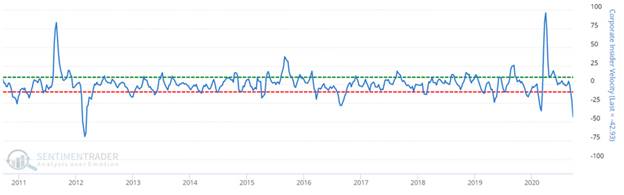
Topley’s Top 10 – August 20, 2020

1. Hottest Momentum ETF in U.S. is QMOM

(Alpha Architects)  https://alphaarchitect.com/

QMOM +26% vs. MTUM +15.5% vs. SPY +5%

www.yahoofinance.com

Concentrated MO MO  50 Holdings

https://etfdb.com/etf/QMOM/#holdings

2. Five Year Inflation Expectations Well Off Bottom

Markets were paying close attention to minutes from the Fed’s recent meeting due later in the day for any hints on what the Fed could announce in September – Some investors speculated the Fed will adopt an average inflation target, which would seek to push inflation above 2% for some time.

The $20 trillion U.S. Treasury market is giving the Federal Reserve a thumbs-up for its efforts to revive inflation after the coronavirus pandemic threatened to inflict a damaging bout of deflation on the U.S. economy – The best measure of that is inflation-adjusted interest rates on 10-year Treasury bonds, which have plunged well below zero as nominal yields held fairly steady. Other signs of success include rising expectations for future prices among U.S. households

Dave Lutz at Jones Trading

3. Utilities Dividend Vs. 10 Year at 25 Year High.

Liz Ann Sonders-Schwabhttps://twitter.com/LizAnnSonders

Utilities Still Well Below Highs

www.stockcharts.com

4. I Agree with Ben Carlson…The Chart Almost Looks Fake….TSLA

https://twitter.com/awealthofcs/status/1296100869998616582/photo/1

5. Gold at Historically High Levels in Real (Inflation Adjusted) Terms

Larry Swedroe

As you can see in the following table, the recent rally in gold has it trading at historically high levels in real terms.

How important is the real price of gold in terms of future returns? In their 2015 study “ The Golden Dilemma,” Claude Erb and Campbell Harvey found that “the real price of gold was a more important driver of future nominal and real gold returns than the realized rate of inflation.” With that in mind, is now a good time to buy gold? Erb, Harvey, and Tadas Viskanta, authors of the August 2020 paper “ Gold, the Golden Constant, COVID-19, ‘Massive Passives’ and Déjà Vu,” analyzed the historical evidence to help investors determine the answer to that question.

Now Might Not Be A Good Time To Buy Gold  https://seekingalpha.com/article/4369361-now-might-not-be-good-time-to-buy-gold

6. Millennials Not Going for Big Oil Careers

By Rebecca Elliott-WSJ

https://www.wsj.com/articles/oil-industry-frets-about-recruiting-its-next-generation-of-workers-11597763882?mod=itp_wsj&ru=yahoo

7. Number of Patents Issued Since 1999 Has Doubled.

Jim OShaughnessy

8. Lots of Good News on Housing Starts But We Are Seeing Spike in Mortgage Delinquencies.

Adam Tooze, @adam_tooze

Mortgage delinquencies spiked in the second quarter. As the unemployment crisis deepens, will the surge continue? Data from the invaluable

@SoberLook, https://thedailyshot.com/2020/08/18/the-ongoing-shift-to-suburbia-in-search-of-home-office-and-classroom/

https://twitter.com/adam_tooze/status/1295757939018358784/photo/1

9.Your Mortgage Refinance Could Cost Thousands More Thanks To New Fee

Natalie Campisi, Forbes Staff

Refinancing is set to get more expensive this fall. A new fee, known as the “adverse market refinance fee” (Fannie Mae) or the “market condition credit fee” (Freddie Mac), will be assessed to most refinance mortgage loans sold to Fannie Mae and Freddie Mac starting Sept. 1. The fee is a flat 0.5% or 50 basis points of the total loan amount, adding hundreds or even thousands of dollars to the cost of a refinance.

The new fee comes at a time when mortgage rates are falling to record-breaking lows and refinance activity is on the rise. Mortgage refinance activity last week was up by 9% from the prior week and was 47% higher than the same time last year, according to the Mortgage Bankers Association’s (MBA) Weekly Mortgage Applications Survey for the week ending Aug. 7, 2020.

The reason for the fee is to offset higher risk due to a shaky economy, both Fannie Mae and Freddie Mac said in bulletins issued Wednesday night. Most refinances, including cash-out refinances, would be subject to the fee. 

“As a result of risk management and loss forecasting precipitated by COVID-19 related economic and market uncertainty, we are introducing a new Market Condition Credit Fee in Price,” according to a statement by Freddie Mac.

New Fee Runs Counter to Fed’s Efforts to Keep Costs Down

For a borrower refinancing a $350,000 mortgage, the fee would tack on an additional $1,750. For someone with twice that mortgage, the fee would add $3,500 on a $700,000 refinance.

PROMOTED

Grads of Life BRANDVOICE | Paid Program

5 Ways Employers Can Support Black Employees: A Young Leader’s Advice

For some, this fee is counterproductive to efforts the Federal Reserve has made since the start of the pandemic to encourage lending activity while making loans affordable by keeping mortgage interest rates low.

“The housing market has been able to withstand many of the most severe effects of the COVID-19 pandemic,” MBA President Bob Broeksmit said in a statement. “The recent refinance activity has not only helped homeowners lower their monthly payments, but it is also reducing risk to the (government-sponsored enterprises) and taxpayers. At a time when the Federal Reserve is purchasing $40 billion in agency (mortgage-backed securities) per month to help reduce financing costs for mortgage borrowers to support the broader economy, this action raises those costs and undermines the Federal Reserve’s policy.”

Fee Also Applies to Most Specialty Loan Refinance Programs 

Both Fannie Mae and Freddie Mac have loan programs designed to help a wide variety of borrowers in need. These programs have caps on the total amount of fees that can be assessed, however, the new adverse market refinance fee would apply to all of these programs, regardless of the cap:

·         Fannie Mae’s HomeReady refinance program is designed for borrowers facing financial challenges, and its high loan-to-value (LTV) refinance program offers a chance for borrowers making on-time payments to refinance their mortgages even if their LTV exceeds the maximum for standard cash-out refinances. 

·         Freddie Mac’s Home Possible mortgage refinance program is for low-income homeowners, and its Enhanced Relief Refinance mortgage program was created for borrowers who can’t refinance because of a drop in property values. 

The only loans that are exempt from the new fee are home loans that qualify for single-closing interim construction financing and permanent financing, which is one mortgage for borrowers who are building new homes. This end-to-end loan covers buying the land, through the construction phase into the permanent home loan.

What You Should Do If You Want to Refinance

Despite the new fee, some borrowers will still be able to save money on their monthly mortgage payments, as well as the total interest paid on their loans, by refinancing. Mortgage rates are currently tracking below 3%, which puts nearly 18 million people in line to save money by refinancing, according to Black Knight, a mortgage technology, data and analytics provider.

Along with the new fee announced on Wednesday, there are closing costs that should be factored into your decision. Typically, these costs are about 2% to 3% of your total loan amount. Closing costs usually include title and insurance fees, appraisals, application fees and, in some areas, attorney fees. 

Other things to consider before you refinance is whether you plan on moving. If you’re going to sell your home within a few years, you likely won’t save enough money refinancing to make up for the amount you spend in closing fees. 

Finally, make sure your credit score is high enough to snag the interest rate you need to save money. Although many lenders are advertising sub-3% rates on 30- and 15-year mortgage refinances, usually only borrowers with above average credit scores (in the 700 and above range) will qualify.

Follow me on Twitter or LinkedIn. Send me a secure tip. 

Natalie Campisi

https://www.forbes.com/sites/tmobile/2020/08/13/mobility-with-a-conscience-how-seattle-goodwill-gives-marginalized-communities-hope-in-a-pandemic

10. Ten habits of bad management

 Image from Shutterstock.com

200

Jan 282019by Andre de WaalPrint This Article

If you’re looking to run a high-performance organization, you need to be able to be able to recognize the signs of bad management. If low-performing managers are not dealt with, an organization will never be able to become excellent. Here are ten habits to look out for that no organization should put up with:

Bad managers clean up the mess of their predecessors – even when there is no mess.

When appointed in a new position, the bad manager claims that the predecessor has made such a big mess of the department that it will take at least one year, if not more, to get everything in order, and of course the bad manager cannot possibly work yet on achieving the departmental targets this year…maybe next year too.

Bad managers are always busy, busy, busy

They are involved in many, many projects; in fact, they’re so busy that there isn’t enough time to work on regular tasks! And because these projects are vital for the success of the organization (or so they say), bad managers cannot possibly be expected to work on their departmental targets. They will get to that when their other projects are finished…which they never are.

Bad managers know how to play the goals game

They know that departmental goals should be loose, with lots of slack, which means the targets will be very easy to achieve. Bad managers will never get optimal results from their departments; but that doesn’t matter to them, bad managers would rather have low performance than run the risk of punishment for falling short of ambitious targets.

Bad managers only manage from a distance

Bad managers love to use performance indicators because these make it possible to practice hands-off management. This in turn makes it easy for bad managers to avoid the day to day department activities altogether. And of course, if anything goes wrong, they can dodge accountability: they weren’t there, after all!

Bad managers always blame somebody else

Bad managers have a host of excuses at their disposal when they don’t achieve departmental targets. They blame the management reports because these do not accurately reflect performance; their own reports show that they did achieve the targets.

Bad managers blame the outside world: the economy was going down, it has rained too much, it hasn’t rained enough, whatever – but that is the reason everything was going against the department and therefore it was just impossible to achieve the targets! Next year, they say, will be better. They blame the weakest colleague, it was his or her fault the department floundered. So the organization first needs to hire someone new before they can be expected to work on achieving their targets.

Bad managers make lengthy, impressive plans

When writing up the latest game plan, bad managers know that expansive, wordy, and complex plans always impress top management because it gives the impression that they are on top of their game and have thought of everything.

They also know that you can bury all kinds of assumptions and preconditions in these verbose plans, which function as safeguards when top management starts complaining that goals have not been achieved (“Well, you knew that could happen, we put it on page 237, section 3, line 5 …”).

An additional advantage is that employees will not read nor understand these, so it will take a lot of time before the department can actually start working on realizing the plan, if ever.

Bad managers only communicate in one way

Bad managers are all capable of holding an open forum for employees to voice concerns, questions, and suggestions. This sounds like the mark of a good manager, right? However, the bad manager only feigns interest in employee feedback, and won’t actually act on what he or she hears. Instead, bad managers stick to their own plans. If people complain, the bad manager will use open forums against the participants, claiming that any incompetency is the fault of everyone.

Bad managers only have eyes for the shareholder

Bad managers know who butters their bread: the shareholder. Therefore, bad managers work diligently on satisfying these shareholders, even it this works to the detriment of the organization’s long-term interests.

Bad managers are real Machiavellians

They have Machiavelli’s book, The Prince from 1513 on their bedside table and turn to it often for advice on how to practice effective “divide and conquer” strategies: manipulating colleagues, employees and bosses. As a result, the targeted members in the organization become preoccupied with guarding their backs instead of focusing on growing the department.

Bad managers have an exit strategy

When the organization is on the verge of holding a bad manager accountable for his or her (in)actions, the bad manager moves on to another organization. In fact, the bad manager had plotted his or her exit strategy for a long time, and always has a fall-back organization where he could flee.

It goes without saying that these ten habits don’t exist in HPOs! But as most organizations are not HPO yet, it is good for you to be able to recognize the signs of bad management. This way you can deal with these ‘bad managers’ quickly…which is, after all, also a characteristic of a HPO manag

https://www.management-issues.com/opinion/6398/ten-habits-of-bad-management/

Disclosure

Lansing Street Advisors is a registered investment adviser with the State of Pennsylvania..
To the extent that content includes references to securities, those references do not constitute an offer or solicitation to buy, sell or hold such security as information is provided for educational purposes only. Articles should not be considered investment advice and the information contain within should not be relied upon in assessing whether or not to invest in any securities or asset classes mentioned. Articles have been prepared without regard to the individual financial circumstances and objectives of persons who receive it. Securities discussed may not be suitable for all investors. Please keep in mind that a company’s past financial performance, including the performance of its share price, does not guarantee future results.
Material compiled by Lansing Street Advisors is based on publicly available data at the time of compilation. Lansing Street Advisors makes no warranties or representation of any kind relating to the accuracy, completeness or timeliness of the data and shall not have liability for any damages of any kind relating to the use such data.
Material for market review represents an assessment of the market environment at a specific point in time and is not intended to be a forecast of future events, or a guarantee of future results.
Indices that may be included herein are unmanaged indices and one cannot directly invest in an index. Index returns do not reflect the impact of any management fees, transaction costs or expenses. The index information included herein is for illustrative purposes only.
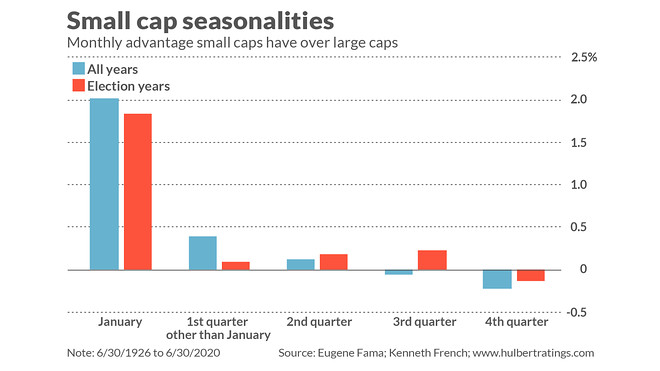
Topley’s Top 10 – August 17, 2020

1. Russell 1000 Value is a Short of Technology Sector.

The Big (Tech) Short

In the Great War, there are many battlefronts. Investors furiously debate the role of low interest rates, outdated accounting rules, and passive flows on value investing. Rather than get caught up in an academic discussion, let’s look at the companies you actually get when you buy a value portfolio. Exhibit 4 shows the sector composition of Russell 1000 Value and Growth.

Value investors are making an epic 34.7% short bet against the technology sector. Moreover, this bet is more than fully explained by their underweight to the FAANG+M companies. Value has a meager 1.4% position in FAANG+M compared to Growth’s 39.4%. Not only are value investors short tech, but they are short Big Tech. And in a big way.

Exhibit 4

Russell 1000 Value vs. Growth Exposures

Continue reading →

Topley’s Top 10 – August 12, 2020

1. 88% of Apple’s Trillion Valuation Has Been Generated Since Tim Cook Took Charge.

Tim Cook: The Apple CEO has built a cordial relationship with President Trump, despite a number of touchy issues, mostly involving Apple’s presence in China. Since Cook succeeded Steve Jobs as CEO in August 2011, Apple shares have rallied 750%. In other words, about 88% of Apple’s valuation has been generated with Cook in charge.

https://www.barrons.com/articles/apples-is-nearly-worth-2-trillion-should-you-sell-the-stock-51596846734?mod=past_editions

Continue reading →

Topley’s Top 10 – July 31, 2020

1. Ecommerce–10 Years Growth in 3 Months

And new data from consulting firm McKinsey shows in the US market, the slice of the retail pie comprised of online sales has climbed from around 15 per cent to more than 30 per cent.

“If you’re feeling whiplash, it might be the 10 years forward we just jumped in 90 days’ time,” McKinsey said.

US ecommerce penetration. Pic: McKinsey
https://www.mckinsey.com/business-functions/strategy-and-corporate-finance/our-insights/five-fifty-the-quickening#

2. Fifth Worse GDP Quarter Ever and Big Tech Books $200B in Sales.

Official quarterly data on US real GDP goes back to 1947, and today’s -32.9% annualised decline for real Q2 is the worst over this period. However, we can splice together a longer series back a century and find that five quarters have been worse than that reported today. **

These occurred in the immediate post-WWII economy, during the early 1930s depression and the associated double dip in 1937-38, and also in the ‘forgotten’ depression of 1920-21.

So, the US is not quite in unprecedented economic times. Many other countries are closer to this though. As you’ll see on page 20-22 of my new monthly chart book (link here) this will likely be the worst year for the UK economy for 310 years. For most of the G7, 2020 will be the worst peacetime year for the economy on record. Again, the US is less severe. On our estimates, 2020 will be the 9th worst year since 1790 and the 6th worst year since 1900. See the chart book for more.

** We have quarterly nominal US GDP data back to 1920 and for this chart have inflation adjusted this series. There is also a real GNP series from the NBER calculated between 1921-1939. The results are broadly similar to our calculations, but we have used ours to avoid splicing multiple series together.

3. Amazon is clobbering Walmart in consumer spending, according to debit-card transactions

Looking at the week of Oct. 6, 2019, Amazon is cruising along with about 18% higher spend than the previous year. For that same period, Walmart is down by 5%.

Amazon is clobbering Walmart in consumer spending, according to debit-card transactions

https://www.marketwatch.com/story/amazon-is-clobbering-walmart-in-consumer-spending-according-to-debit-card-transactions-2020-07-29?mod=home-page

4. Huge Down GDP Print But….Bullish Earnings Season So Far

Thu, Jul 30, 2020 At our Earnings Explorer tool available to clients on our website, we provide a real-time look at beat rates for both EPS and sales.  Below is a snapshot from the website showing both the EPS and sales beat rates for US companies reporting earnings on a rolling 3-month basis.  Currently, 64.61% of companies have exceeded consensus analyst EPS estimates over the last three months, while 63.75% of companies have beaten consensus sales estimates over the same time frame.

In looking at the chart, you can see a big spike in the EPS beat rate over the last few weeks.  Since earnings season began on July 13th, nearly 80% of companies have posted stronger than expected EPS numbers.  That’s a huge beat rate and suggests that analysts were too bearish on Q2 numbers heading into July.  The revenue beat rate held up much better than EPS beats throughout the first half of 2020, but it too is on the upswing this season.

We also monitor how share prices are reacting to earnings reports.  So far this earnings season, the average stock that has reported Q2 numbers has gained 1.31% on its earnings reaction day.  That compares to a historical average one-day change of just 0.06% on earnings reaction days.  As shown below, stocks that have beaten EPS estimates this season have gained 2.2% on earnings reaction days, while companies that have missed EPS estimates have fallen 1.89%.  It’s rare to see beats gaining more than misses decline, but that’s what is happening this season.  Click here to view Bespoke’s premium membership options for our best research available.

https://www.bespokepremium.com/interactive/posts/think-big-blog/bullish-earnings-season-so-far

5. Nasdaq 100 Fastest 91 Day Rally in 20 Years.

https://www.bloomberg.com/news/articles/2020-07-30/nasdaq-s-4-trillion-rally-poised-to-heat-up-on-earnings-sweep?cmpid=socialflow-twitter-business&utm_content=business&utm_source=twitter&utm_campaign=socialflow-organic&utm_medium=social&sref=GGda9y2L

6. Global Gold Supply Chain.

Visual Capitalist

How COVID-19 Shutdowns Impact the Gold Supply Chain

Chains are only as strong as their weakest link—and recent COVID-19 shutdowns have affected every link in the gold supply chain, from producers to end-users.

Increased investor demand for gold coupled with a constrained supply has led to high prices and a bullish market, which has been operating despite these pressures on the supply chain.

Today’s infographic comes to us from Sprott Physical Bullion Trust and it outlines the gold supply chain and the impacts COVID shutdowns have had on the gold market.

The Ripple Effect: Stalling a Supply Chain

Disruptions to the gold supply chain have rippled all the way from the mine to the investor:

1. Production
Some gold mines halted production due to the high-risk to COVID-19 exposure, reducing the supply of gold. In many nations, operations had to shut down as a result of COVID-19 based legal restrictions.

2. Delivery
Strict travel regulations restricted the shipment of gold and increased the costs of delivery as less air routes were available and medical supplies were prioritized.

3. Refinery
Refineries depend on gold production for input. A reduction in incoming gold and the suspension of labor work shortened the supply of refined gold.

4. Metal Traders
Towards the other end of the gold supply chain, traders have faced both constrained supply and increased cost of delivery. These increased costs have translated over to end-users.

5. The End Users
Higher demand, lower supply, and increased costs have resulted in higher prices for buyers of gold.

7. Canceled College Sports Games Put Millions on the Line for ESPN …College Football $800m in Advertising.

College football accounted for about $793 million in advertising at ESPN, ABC, and their related networks, estimates Standard Media Index, which tracks advertising spending. That’s almost four times as much as their closest rival, Fox-

https://www.bloomberg.com/news/articles/2020-07-30/espn-could-lose-millions-with-college-sports-in-coronavirus-flux?sref=GGda9y2L

8. Mumbai’s slums test lockdown logic-57% of People Sampled in Mumbai Slum Have Coronavirus Antibodies.

Una Galani

MUMBAI (Reuters Breakingviews) – Just maybe, India’s financial capital can start to look beyond its Covid-19 lockdown. An antibody testing study has found that a whopping 57% of people sampled in densely populated slum areas of Mumbai had coronavirus antibodies. Some 40% of the city’s 20 million or so residents live in similar settings, where toilets and water supply are often shared and social distancing is impossible. The result tests the logic of the city’s strict lockdown.

The study is credible, with municipal authorities partnering with the respected Tata Institute of Fundamental Research and others. The randomised sample of nearly 7,000 covers folks from three areas of the city. It’s evidence that crowding speeds transmission and that low-income groups are more vulnerable to infection. Just 16% of people sampled in more affluent parts of the same three areas of Mumbai were found to have the antibodies. 

Encouragingly, the study suggests an infection mortality rate of between 0.05% and 0.01% based on official death numbers – that’s low and would remain so, relative to many other estimates, even if the numerator is under-reported.

The findings will support politicians as they tweak policies that have reduced Mumbai to a shadow of itself. The din of rush hour traffic is no more, offices mostly sit empty, street-food vendors have disappeared and restaurants closed to diners. Public transport is curtailed, and residents are subject to a 9 p.m. curfew. Most restrictions have been in place for four months, making India’s lockdown one of the world’s strictest.

The extreme shutdown may have initially avoided worse pressure on an under-resourced health system. But the new study suggests the measures are now impoverishing more than protecting the poor. Armies of daily-wage earners have been left dependent on food rations. With so many of them infected, Mumbai might consider loosening restrictions, enabling more people to return carefully to work.

That might, of course, increase the risk of infection for wealthier groups where lifestyle diseases are more common in Mumbai, underlining how important local factors are in managing Covid-19. And one study, however well structured, can’t provide all the answers for a given city, either. But this one does raise the possibility that if any community in the world has achieved something like herd immunity, it may be the residents of Mumbai’s slums.https://www.reuters.com/article/us-health-coronavirus-breakingviews/breakingviews-mumbais-slums-test-lockdown-logic-idUSKCN24V09Z

9. For Amazon Anti-Trust…It’s All  About Treatment of 3rd Party Sellers.

Jeff Bezos’s antitrust grilling was a reminder of Amazon’s power over its sellers

Jeff Bezos was calm and polite in his first congressional appearance. But he did nothing to quiet a huge concern.

By Jason Del Rey@DelRey  Jul 29, 2020, 10:09pm EDT

Share this story

Amazon CEO Jeff Bezos testifies remotely before the House Judiciary Subcommittee on Antitrust, Commercial and Administrative Law hearing on “Online Platforms and Market Power” on July 29, 2020. Graeme Jennings/AFP via Getty Images

The world’s richest man, Jeff Bezos, testified before US Congress members for the first time on Wednesday, but he said little to assuage one of their biggest concerns: that Amazon’s grip on online retail gives it the power to make or break small merchants on a whim.

Bezos, along with the CEOs of Apple, Google, and Facebook, appeared via videoconference before a bipartisan group of 15 US House members who have been investigating the four tech giants over the last year. The stated goal of this antitrust subcommittee’s investigation has been to document whether these corporate titans abuse their power in industries ranging from retail to social networking, and to evaluate whether the country’s antitrust laws are modern enough to guard against such abuses.

“Their ability to dictate terms, call the shots, upend entire sectors, and inspire fear represent the powers of a private government,” Rep. David Cicilline (D-RI), the chair of the subcommittee, said in his opening remarks at what was a five-hour-plus hearing.

For Bezos, much of the questioning from lawmakers focused on how Amazon competes against, and profits from, the 1.7 million small and mid-sized merchants who help stock Amazon’s digital shelves. Amazon boasts that 60 percent of its retail sales now come courtesy of these sellers rather than from Amazon stocking and reselling goods itself.

But some Amazon sellers have complained over the years that as Amazon’s market share in US online commerce has increased — to about 40 percent today, which is about seven times more than the next competitor — the company has squeezed and otherwise harmed them in new and different ways because they have no viable online alternatives.

According to Cicilline, Amazon sellers have told the subcommittee that “[Amazon has] never been a great partner, but you have to work with them.”

One concern has been the data Amazon uses from its own merchants to help inform what products to develop under its own private-label brands, such as Amazon Basics. In April, the Wall Street Journal published a report stating that Amazon employees have used data from individual sellers to help Amazon decide which private-label products to pursue. That contradicts what a top Amazon lawyer, Nate Sutton, told Congress earlier this year when he said that Amazon’s policy is to only use data on a product when there are at least two sellers selling it.

On Wednesday, Bezos told Rep. Pramila Jayapal (D-WA), who represents Amazon’s hometown of Seattle, that the company’s investigation into violations of the policy outlined in the Journal report was ongoing. “I’m not satisfied that we have gotten to the bottom of it, and we’ll keep looking at it,” he said.

https://www.vox.com/recode/2020/7/29/21346584/jeff-bezos-amazon-antitrust-hearing-congressional-testimony-power-to-make-or-break-small-merchants


Found at The Big Picture https://ritholtz.com/2020/07/10-thursday-am-reads-298/

10. Change Your Perspective to Create More Happiness

Steps to a more positive outlook

Lynn TaylorTame Your Terrible Office Tyrant

With the arrival of a new decade, many people are thinking about making changes toward creating greater happiness in their lives. But how many people truly make sweeping transformations in a year? One way to overcome this trap, especially for overachievers, is to set smaller, more attainable goals.

Resistance to Change

Change of any kind is a challenge, as inertia is the easiest path. Why does it seem so hard to make a shift? Neuroscience researcher Joe Esperanza says, “We’ve in fact conditioned ourselves to believe all sorts of things that aren’t necessarily true—and many of these things are having a negative impact on our health and happiness.” He says we’re addicted to our beliefs and emotions of our past — and we often see our beliefs as truths, not as ideas we can change.

Nevertheless, the mind believes what you tell it. That being the case, you might as well direct it to something spectacular. You have the ability to mitigate negatives and encourage more positive outcomes. Yes, you can redirect your thoughts, beliefs, and expectations, creating a different reality. Your perspectives can be managed, better.

A Case in Point: The Overachiever

Let’s take the example of the overachiever. If you’re like many, you strive to get ahead all the time, be it at work, home, or in your personal life. You may be striving for that promotion, want to organize your apartment, lose 10 pounds, or reach a fitness goal. But somehow that relaxation point of achievement is elusive because you haven’t yet trained your mind on how to shut it off. You’re constantly going, constantly falling into the same routine of setting big, nearly impossible goals.

Aim to Do Less

What if one of your New Year’s Resolutions were to modify your goals into half or one-third? Setting smaller, achievable objectives, even on a daily or weekly basis, can bring you an enormous sense of contentment and achievement—versus life-changing goals that are mentally and physically exhausting.

Remember when you were a kid? Did you ever play “opposite day,” being a contrarian? It may be time to resist your normal habits and dare I say, strive for less—as that will likely yield much more. Why? Because the old way is likely causing you to be overwhelmed. At the end of the day, you wish you had just set out to do two or three items on your never-ending to-do list, not 10.

This may be about one goal that in itself takes an army to complete adequately. You may have trouble delegating some tasks, be torn about the priorities—or have other obstacles that keep you stuck.

Whatever the reason, be kind to yourself and take some concrete steps toward change:

  • Visualize what you want.  Envision the “2.0 you,” whether it’s a more organized person, more financially secure, a top salesperson, individual with a great work/life balance, nature lover, or whatever lifestyle you seek. Picture all the spoils that come with it. Make a vision board, or post images on your computer.
  • Make a slow and steady change. If we could wave a wand and have our dreams come to fruition instantly, that would be nice, but sudden change is often fleeting. Steady and thoughtful always prevails. Remember the Aesop’s fable, “The Tortoise and The Hare”?
  • Focus your thoughts. You have complete power over what you choose to think about. Be clear and consistent with thoughts of what you want out of life—and know what you don’t want. If you find you’re having negative thoughts, flip them to positive. Whether you’re dealing with a challenging boss, preparing for a job interview or starting a project, first set your thoughts on a positive outcome. Without direction or focus, thoughts are like paddling in a river flowing upstream—you go nowhere. With an undeterred focus, you allow goals to become concrete realities.
  • Learn some habit changing techniques. The words and images you use also create your reality. Modify them to work for you. When someone asks you how you are, do you say, “Fine” or “Great?” “Fine” has little energy while the word “Great” exudes power. Being disingenuous is not the goal, but a little positive self-training is useful and empowering! Use powerful words, such as “excited,” “wonderful,” or “fun.” Write down your feelings in a journal, and if negativity has crept in, change your language. Gratitude and appreciation with a healthy dose of self-love are keys to maintaining a positive, happy attitude toward life.
  • Self-correct. Be willing to fail. The most successful people had big dreams and didn’t let failures stop them along the way. They used these experiences as building blocks and naysayers never stopped them. Successful people rethink and adjust their sails. If one job, business or relationship isn’t working, revise or reset.  Life is about adjustment and learning—and comfort zones are overrated.

One of my favorite popular quotes about change is, “If you want something you have never had, you must be willing to do something you have never done.” How will you bring meaningful change into your life—differently—in this new decade of opportunity?https://www.psychologytoday.com/us/blog/tame-your-terrible-office-tyrant/202002/change-your-perspective-create-more-happiness?collection=1148006

Disclosure

Lansing Street Advisors is a registered investment adviser with the State of Pennsylvania..
To the extent that content includes references to securities, those references do not constitute an offer or solicitation to buy, sell or hold such security as information is provided for educational purposes only. Articles should not be considered investment advice and the information contain within should not be relied upon in assessing whether or not to invest in any securities or asset classes mentioned. Articles have been prepared without regard to the individual financial circumstances and objectives of persons who receive it. Securities discussed may not be suitable for all investors. Please keep in mind that a company’s past financial performance, including the performance of its share price, does not guarantee future results.
Material compiled by Lansing Street Advisors is based on publicly available data at the time of compilation. Lansing Street Advisors makes no warranties or representation of any kind relating to the accuracy, completeness or timeliness of the data and shall not have liability for any damages of any kind relating to the use such data.
Material for market review represents an assessment of the market environment at a specific point in time and is not intended to be a forecast of future events, or a guarantee of future results.
Indices that may be included herein are unmanaged indices and one cannot directly invest in an index. Index returns do not reflect the impact of any management fees, transaction costs or expenses. The index information included herein is for illustrative purposes only.
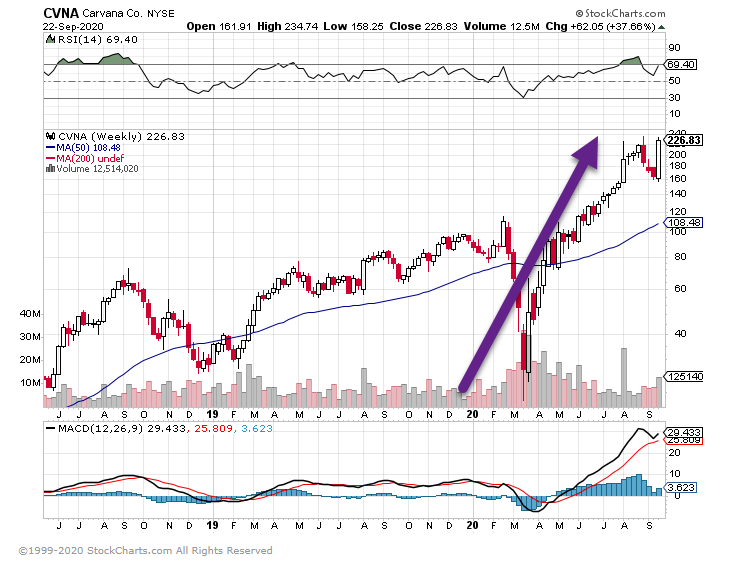
Topley’s Top 10 – July 30, 2020

1. Forget FAAANG….Overstock.Com +750% YTD.

OSTK Bottomed at $2.75…..$62 Last

www.stockcharts.com

2. Kodak Spikes 2200% in 2 Days as 62,000 Robinhood Traders Swarm the Stock.

Business Insider.

More than 63,000 Robinhood traders piled into Kodak shares during its 2,100% rally–Ben Winck

https://markets.businessinsider.com/news/stocks/kodak-stock-price-rally-leads-robinhood-investors-buy-robintrack-retail-2020-7-1029447131#

3. Number of Robinhood User Positions in S&P 500 Stocks.

https://www.linkedin.com/in/nicholas-lampone-9277986/

4. Velocity of Returns Great Financial Crisis vs. Corona Rally.

www.dorseywright.com

5. Another Insider Selling/Sentiment Chart.

The Daily Shot-WSJ

https://blogs.wsj.com/dailyshot/2020/07/27/the-daily-shot-factors-behind-the-record-setting-rally-in-gold/

6. 17-23% of Bitcoins Lost Forever???

Just as gold bars are lost at sea or $100 bills can burn, bitcoins can disappear from the Internet forever. When all 21 million bitcoins are mined by the year 2040, the actual amount available to trade or spend will be significantly lower.

According to new research from Chainalysis, a digital forensics firm that studies the bitcoin blockchain, 3.79 million bitcoins are already gone for good based on a high estimate—and 2.78 million based on a low one. Those numbers imply 17% to 23% of existing bitcoins, which are today worth around $8,500 each, are lost.

Exclusive: Nearly 4 Million Bitcoins Lost Forever, New Study Says BY JEFF JOHN ROBERTS AND NICOLAS RAPP

https://fortune.com/2017/11/25/lost-bitcoins/

7. Another Sentiment Indicator Hits Record Highs

Macro Charts

@MacroCharts

$NDX Daily Sentiment. The 50d reached Top 2.5% most overbought in history (20 years) and the highest since 2011. See the break below its 50d, similar to Feb 2018, May 2019, Jan 2020. The 50d has also turned down. If history repeats, this could be finished, or very close.

8. Millennial Home Ownership Spike.

Odeta Kushi

@odetakushi

Big jump in the homeownership rate today, mostly driven by younger households. We saw a spike in the number of owners, and a decline in the number of renters. This is the highest rate of homeownership since 2008.

9. A Third of Jobs Lost During Pandemic Have Returned.

https://www.washingtonpost.com/business/2020/07/16/9-charts-that-show-good-bad-alarming-this-early-economic-recovery/

10. Reading On Paper

I’m staring at a pile of paper on my desk that is my stack of things I found on the Internet that I want to read.

It’s a bit ironic to write this on a blog, but if I come across something on my computer or phone that is longer than a page or two, I print it out and read it on paper.

I have found that when I read on a computer screen or phone, I tend to skim. That’s fine for a short email or a short blog post (as this will be).

But it is not great for an eight page blog post, a white paper on a new crypto project, or a memo from one of my colleagues or portfolio companies.

When I read on paper, I often will use a pen to underline or mark-up the document. I find that leads to better comprehension and retention of the concepts.

I’ve noticed that our children, all of whom are in the mid to late 20s, also read books in paper form and mark them up when reading them. So while reading on paper may be a generational thing, I believe it is also a valuable technique for all ages and all generations.

Found at Abnormal Returns Blog www.abnormalreturns.com

Disclosure

Lansing Street Advisors is a registered investment adviser with the State of Pennsylvania..
To the extent that content includes references to securities, those references do not constitute an offer or solicitation to buy, sell or hold such security as information is provided for educational purposes only. Articles should not be considered investment advice and the information contain within should not be relied upon in assessing whether or not to invest in any securities or asset classes mentioned. Articles have been prepared without regard to the individual financial circumstances and objectives of persons who receive it. Securities discussed may not be suitable for all investors. Please keep in mind that a company’s past financial performance, including the performance of its share price, does not guarantee future results.
Material compiled by Lansing Street Advisors is based on publicly available data at the time of compilation. Lansing Street Advisors makes no warranties or representation of any kind relating to the accuracy, completeness or timeliness of the data and shall not have liability for any damages of any kind relating to the use such data.
Material for market review represents an assessment of the market environment at a specific point in time and is not intended to be a forecast of future events, or a guarantee of future results.
Indices that may be included herein are unmanaged indices and one cannot directly invest in an index. Index returns do not reflect the impact of any management fees, transaction costs or expenses. The index information included herein is for illustrative purposes only.
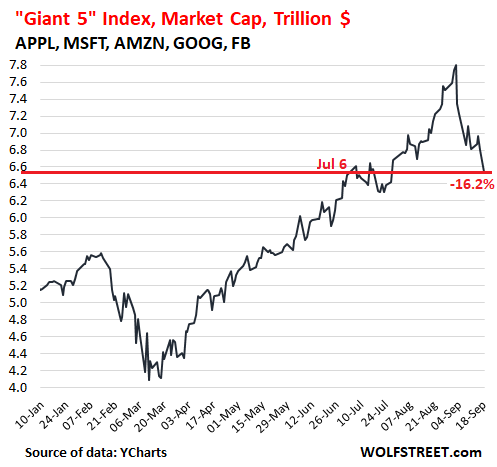
Topley’s Top 10 – July 28, 2020

Story of the Day…..Art Samberg (Pequot Capital Management), Lee Cooperman (Omega Family Office) and Mario Gabelli (Gabelli Asset Management) car pooled together to Columbia MBA.

Art Samberg Obituary….He (Arthur Samberg) carpooled to classes with Lee Cooperman and Mario Gabelli, who also became prominent investors.

Arthur Samberg Built Hedge-Fund Giant With Tech Savvy–Electrician’s son made huge profits in 1990s but closed firm amid insider-trading probe

https://www.wsj.com/articles/arthur-samberg-built-hedge-fund-giant-with-tech-savvy-11595524007

1. Insider Selling Spiking.

Red Flag?  Insider Sales are ramping.

Continue reading →

Topley’s Top 10 – July 27, 2020

1.Read of the Weekend…The Rescues Ruining Capitalism.

WSJ By Ruchir Sharma

Modern society looks increasingly to government for protection from major crises, whether recessions, public-health disasters or, as today, a painful combination of both. Such rescues have their place, and few would deny that the Covid-19 pandemic called for dramatic intervention. But there is a downside to this reflex to intervene, which has become more automatic over the past four decades. Our growing intolerance for economic risk and loss is undermining the natural resilience of capitalism and now threatens its very survival.

The world economy went into this pandemic vulnerable to another financial crisis precisely because it had already become so fragile, so heavily dependent on constant government help. Governments have offered increasingly easy credit and generous bailouts not only to soften the impact of every crisis since the 1980s but also to try to boost growth during the good times.

Continue reading →

Topley’s Top 10 – July 24, 2020

1. Put/Call Ratio at Extreme Levels.

Seeking Alpha

Put. Call. Ratio. Thanks to @ThinkTankCharts for an update on one of our favorite charts – the equity put-call ratio on the S&P 500. This is a red flag if there ever was one. The indicator is back at its June 8 level – beyond extreme. Traders are holding considerably more calls than puts right now, indicative of a frothy market with little concern for downside protection. Corrective price moves can happen fast, and capitulation may come quicker.

ThinkTankCharts provides nice context here – major market bottoms are noted when the put-call ratio spikes, but you can also see when the ratio bottomed as the SPX peaked earlier this year. The June 8 spike down is also evident. Is it different this time? There does not appear to by any good reason why it should be different now.

Bottom line: The bells and whistles should be going off when investors see this chart. It is a huge short-term risk flag being waved. Sticking with the components/theme of this chart, maybe now is the time to consider picking up a little insurance by way of put options to mitigate the risk.

Continue reading →

Topley’s Top 10 – July 23, 2020

1. Valuations…The List of Companies Trading at 10x Sales is Growing

Advisor Perspectives-20/20 In 2020

“Earnings per share” have been heavily manipulated over the last decade through a variety of gimmicks from “cookie jarring reserves,” to massive “share buybacks.” However, “revenue” is a different matter.

Unfortunately, investors are vastly overpaying for sales as well. Scott McNeely discussed the irrationality of paying 10x sales for a company, then CEO of Sun Microsystems, in 1999 in a Bloomberg interview. To wit:

“At 10-times revenues, to give you a 10-year payback, I have to pay you 100% of revenues for 10-straight years in dividends. That assumes I can get that by my shareholders. It also assumes I have zero cost of goods sold, which is very hard for a computer company.

That assumes zero expenses, which is hard with 39,000 employees. That assumes I pay no taxes, which is very hard. And that expects you pay no taxes on your dividends, which is kind of illegal. And that assumes with zero R&D for the next 10-years, I can maintain the current revenue run rate.

Now, having done that, would any of you like to buy my stock at $64? Do you realize how ridiculous those underlying assumptions are? You don’t need any transparency. You don’t need any footnotes.

What were you thinking?”

Many of the most popular “growth” stocks fit this insanity.

Value Is Dead. Long Live Value Investing–by Lance Roberts, Michael Lebowitz of Real Investment Advice, 7/20/20

https://www.advisorperspectives.com/commentaries/2020/07/20/value-is-dead-long-live-value-investing

2. Top 10 Companies with Biggest Losses Per Employee

The team at Tipalti analysed data from the Fortune 500 list for some of the biggest companies in the world, and divided each company’s annual profits and revenue by their number of employees, to reveal the losses or profits, and revenue per employee.

The top ten companies making the biggest losses per employee are:

Other brands making huge losses per employee that you may recognise include:

  • CenturyLink – $-123,973 loss per employee
  • Wayfair – $-57,969 loss per employee
  • Tesla – $-17,952 loss per employee

The research also looked at the companies making the biggest profits per employee.

The top ten companies making the biggest profits per employee are: 

UBER, TESLA AND WAYFAIR ARE LOSING THOUSANDS IN PROFIT PER EMPLOYEE

3. Nasdaq Volume Explosion.

Nicholas Lampone• 1stPrincipal & Director of Trading at Dalzell Trading2h • 2 hours ago

Nasdaq trading volume is “off the charts” this year. (Chart courtesy of The Wall Street Journal) Covid lockdowns, no sports and free online trading, along with a massive sell off and rally. #trading #stocks

https://www.linkedin.com/in/nicholas-lampone-9277986/

4. Excess Reserves of Depository Institutions Banks Building Up Cash Reserves

https://fred.stlouisfed.org/series/EXCSRESNS

5. 490 0f 500 S&P Stocks Have Gone Nowhere Since April

Zero Hedge https://www.zerohedge.com/

6. Corporate Insiders Turn Sellers.

7. TikTok Usage Skyrocketing.

The numbers show surging demand for TikTok’s pure-play short-video platform. Sensor Tower data shows that downloads of the app have soared past its competitors over the last three quarters as more and more Americans take to TikTok as the perfect escape for turbulent times. In another milestone, Netflix added TikTok to its short list of competitors for the first time in its letter to investors last week, saying the app’s growth was “astounding.”

TikTok Is Most Popular

The short-video app’s downloads per quarter has soared past Big Tech

Source: Sensor Tower

TikTok Ban Would Leave a Giant Social-Media Hole–The widely used short-video app, owned by Chinese company Bytedance, is under threat by the Trump administration. Here’s what’s at stake.   

https://www.bloomberg.com/opinion/articles/2020-07-22/tiktok-ban-would-leave-hole-instagram-youtube-can-t-easily-fill?srnd=premium&sref=GGda9y2L

8. Here’s Who Pockets the Savings From Payroll Tax Holiday.

https://www.cnbc.com/2020/07/22/these-people-would-benefit-the-most-from-a-payroll-tax-holiday.html?__source=twitter%7Cmain&__source=twitter%7Cmain

9. Harvard scientists say adopting these 5 habits in middle-age can add years to your life

Jennifer Fabiano

Harvard researchers have previously outlined healthy habits for increasing an individual’s overall life expectancy, but new research shows that implementing these habits at age 50 can also reduce a person’s risk for chronic disease later in life. In a new study, researchers at Harvard T.H. Chan School of Public Health expanded on the 2018 study that established five habits in middle health that can boost life expectancy.

This follow-up study, which was published in BMJ, suggests that implementing these five habits into your life can increase your likelihood of enjoying extra years of overall good health.

5 habits to have in middle-age to ward off disease later in life

By now you are probably wondering what those five healthy habits are. Listed below are the five practices you should begin in middle-age to ward off chronic disease later in life:

  1. Healthy eating.
  2. Maintaining a healthy weight.
  3. Exercising regularly.
  4. Limiting alcohol consumption.
  5. Not smoking.

These habits are measured in the following ways:

  1. A “healthy diet” was determined as a high score on the Alternate Healthy Eating Index. You can get started by practicing clean eating. 
  2. A “healthy weight” is determined by having a body mass index between 18.5 and 24.9 kg/m2.
  3. “Regular exercise” means that an individual exercised a minimum of 30 minutes a day of moderate to vigorous activity. 
  4. Moderate alcohol consumption means an individual consumes one or fewer servings per day for women and two or fewer servings per day for men.
  5. Not smoking means that individuals refrain from smoking in their daily lives.

“Previous studies have found that following a healthy lifestyle improves overall life expectancy and reduces risk of chronic diseases such as diabetes, cardiovascular disease, and cancer, but few studies have looked at the effects of lifestyle factors on life expectancy free from such diseases,” says lead author Yanping Li, senior research scientist in the Department of Nutrition at the university, in a statement. “This study provides strong evidence that following a healthy lifestyle can substantially extend the years a person lives disease-free.”

How many more years of disease-free living do these habits gain you?

The researchers used data from two prior studies, which allowed them to look at data form 73,196 won over 34 years and 38,366 men over 28 years. Like many health matters, the results were different for women and men.

The women who practiced none of the five healthy habits at age 50 lived only 23.7 years free of diabetes,  cardiovascular diseases, and cancer. The women who did practice either four or five of these healthy habits lived 34.4 more years free of these chronic diseases. This data suggests that there is a potential gain of nearly 11 healthy years for women who maintained these habits in middle age.

Men saw slightly less benefit from practicing these healthy habits. The men who did not practice any of these habits at age 50 could expect to live 23.5 years free of chronic disease, while men who did practice health habits lived an average of 31.1 healthier years, which is a potential gain of almost eight disease-free years.

Which of these healthy habits matter the most?

The researchers found that smoking and obesity most negatively affected long-term health outcomes. Individuals who were obese or were heavy smokers had the lowest disease-free life expectancy.

Jennifer Fabiano is an SEO reporter at Ladders.

More:According to ScienceAdviceDietExercise

https://www.theladders.com/career-advice/harvard-scientists-say-adopting-these-5-habits-in-middle-age-can-add-years-to-your-life

10. Five Major Pitfalls That Stop Entrepreneurs by Year 2

By Joshua Stowers, StaffApril 8, 2020

CherriesJD / Getty Images

  • New businesses often fail when entrepreneurs don’t have the resources or knowledge to properly execute their ideas.
  • No one likes to fail, but if you do, use the valuable experience you gained to lead your next endeavor to success.
  • Entrepreneurs tend to fail right before peaking in the business cycle. The peak usually comes after a pitfall, which is where many entrepreneurs lose momentum. 

The fear of failure haunts many small business owners. Not only is the road to entrepreneurship often filled with unexpected detours and potholes, but maintaining a high level of creativity and motivation while navigating these roadblocks can be a nail-biting process. 

Any successful business venture needs working capital, a sustainable business model and a good understanding of market trends. But what causes a business to fail when you are checking all of those boxes? The answer might depend on how much money your business has or how quickly you can overcome your fear of failure. 

What constitutes entrepreneur failure?

You need a lot more than a great idea to be a successful entrepreneur. Even if you have a brilliant idea for a business, your venture is likely to fail if you don’t have the resources or knowledge to execute it properly. Insufficient marketing, a lackluster business plan or even the wrong legal structure can prevent your business from thriving. 

The reasons why many entrepreneurs fail early are endless, some being unique to the business owner. The key is to define what “failure” means to you and your business, according to Bill Demas, CEO of Conviva. 

“At some level, almost all entrepreneurs fail,” Demas told Business News Daily. “But at the same time, there is a notion that an entrepreneur can’t fail because failure is part of the learning experience, and from those experiences, the entrepreneur builds a business with a higher likelihood of success.” 

Demas said it’s better to learn from others’ failures than your own. But if you’ve already experienced a business failure, you should examine the reasons why your startup failed and apply that knowledge to your next venture. 

When you’re thinking about how to start a business, one of the most important things to consider is how you will fund your startup. Without working capital, you’ll have difficulty bringing any business idea to life and meeting your overall company goals. This means finding money to start your company – such as through crowdfunding, pitching your idea to potential investors or peer-to-peer lending – and then managing cash flow properly once your business starts generating revenue. 

If your startup has no money, failure is likely to be the ultimate result, said Cheryl Roberts, owner of Lexie Jordan Jewelry. 

“Let’s face it – even if you started your business as a mission with no money focus, you still need money to further your mission,” she said. “So, the definition of failure as an entrepreneur is failing to make enough money to further your business.” 

While generating money is an integral part of entrepreneurship, it’s not the be-all and end-all of success for business owners. Let’s say you’ve defined what failure means to your company and raised the necessary funding – what else could cause your business to fail? 

Fear of failure is normal for entrepreneurs; it’s how you maintain interest in your business and motivation in the face of your fears that matters most. Entrepreneurs typically fail not because their businesses fail, but because they lose interest and give up when they don’t see the anticipated results after working for a while, according to Hassan Alnassir, founder and owner of the toy company Premium Joy. 

“You need something to motivate you to keep going despite any defeat you feel inside while building your business,” Alnassir said. “A simple way to get motivated consistently and avoid failing as an entrepreneur is to keep an inspiring photo in front of you at all times while working. I personally keep a photo of my little child on the computer desk to push me forward and remain motivated while working on my business.” 

Do entrepreneurs always benefit from a business failure experience?

Many entrepreneurs do benefit from business failure. As an entrepreneur, you gain knowledge that most people don’t have because you took a significant risk and saw how it played out. 

Failures might seem career-ending at first, but if you think of failing as a learning opportunity, it can be beneficial to your future business ventures. It’s all about your mindset and ability to quickly move forward, according to Georgette Pascale, founder of Pascale Communications. 

“The truth is entrepreneurs have to have thick skin, take the blow of their misstep, and know there will eventually be a benefit from this experience,” Pascale said. “They’ll learn something new and learn not to repeat mistakes again. Most importantly, this experience should be taken in stride, and plans must be made to move onward quickly.” 

In fact, many successful entrepreneurs failed at least once and came back with the wisdom to succeed, such as Steve Jobs, Bill Gates and Ariana Huffington. [Read related article: Starting Over: How to Move on When Your Business Fails] 

When in the business cycle do most entrepreneurs tend to fail?

Entrepreneurs tend to fail right before peaking in the business cycle. The peak usually comes after a pitfall, which is when many entrepreneurs lose momentum. If you can make it through the recovery process after a major pitfall, expansion is often on the horizon. 

The U.S. Bureau of Labor Statistics’ Current Employment Statistics program helps identify the key cyclical phases with the CES peak-trough tables. These phases mark the beginning of periods of positive or negative growth in your company’s life cycle. Each phase usually fluctuates monthly, depending on your product or service. 

While the exact point when an entrepreneur is at risk of failure varies, most fail after they’ve been in business for a year or two, according to Andrew Gunderman, CEO of Vyra. 

“This is because things get much more real around this time,” he said. “You’re likely bringing on new employees, which means increased costs. When it’s just you and the founders and you’re not taking on salary, it’s easy because you can pivot on a dime.” 

Gunderman says having to pay employees makes it harder to pivot, and the cost of having those employees can put you in a position in which there’s no way out. This can lead to early bankruptcy. 

Five major pitfalls that stop entrepreneurs by year two

Below are the five major reasons why entrepreneurs fail by their second year in business, according to Amanda Kendall, owner of Elevating Profits. 

1. Cash flow

When starting a business, entrepreneurs are usually focused on the next sale and the next client. They often don’t think about the long term or plan for the future. Cash flow can make or break a business. A business without profits can survive for years, but a business without cash flow will fail within months. Planning for how to maintain positive cash flow can get your business through the lulls that are bound to happen.

2. ‘I have to do it all’ syndrome

Entrepreneurs wear multiple hats when they start a business. Sometimes they forget that, in order to grow, they must pass some (if not most) of those hats to other people along the way. This mentality of “I can do it all, faster and better” sinks many entrepreneurs. Learn to exit roles, and have a plan of what that looks like. Who fills that role as you exit it? What does that free you up to do now? What is the next role you will exit? 

3. Sales and marketing

Entrepreneurs often think that all their friends and family will buy from them when they start out. Sadly, this is often not the case. You need to have a strategy for sales and marketing. Know who your ideal client is, and then go teach them why they need your service or product. If you wait for the sales to just come in, you will be waiting a long time. 

4. Underpricing

Entrepreneurs want to be competitive in the market, so they price themselves under the competition to gain more clients. This results in lots of hours for little to no profits. When an entrepreneur does not plan out their pricing intentionally, they are offering a service that costs them money to fulfill. Pricing for profitability is essential, yet too rarely done. 

5. No big vision

When entrepreneurs start their business, they know what they want to do, who they want to help and why, but they don’t plan out what that will look like in three to 15 years or what the final exit plan is. An exit strategy gives you a solid map to follow for the entire life of your business. Without it, you are on a road trip wearing a blindfold. 

Tips that could keep an entrepreneur from failing

The best way to successfully launch your startup is to establish short-term and long-term goals. Having top-notch operational capabilities – including good management, financial planning and a solid work-life balance – can help your company make it beyond its second year. Here are seven tips to help you keep your business running past the two-year mark. 

  1. Surround yourself with the right people. People who believe in you can provide great support and advice. This can help you stay focused on the big picture of your business, no matter what pitfalls come your way. 
  2. Keep up to date with your industry. It’s crucial to continue your research and gather as much knowledge as possible about your market, because the business landscape can change quickly. You need to look ahead so you can improve your products or services to stay on trend and in demand. 
  3. Plan for continuous growth. Manasi Gangan, founder and CEO of Nested Bean, says planning for continuous growth helps keep entrepreneurs from failing. You can plan for continuous growth by creating inflection points through an ongoing cycle of product innovation, then channel diversification and, finally, geographic diversification. You must create these inflection points when things are good and you’re growing, not when the plateau hits. 
  4. Share your vision. Share your vision by hiring a diverse team with entrepreneurial spirit. You should hire people who share your vision and believe in you and your ideas. 
  5. Inspire others. Foster a culture of learning and a productive mentality until it becomes the norm for your team. You should create smaller goals and benchmarks to keep your team motivated and on course. 
  6. Create a culture of learning, iterating and automating processes. A big factor in building a successful business is swinging for the fences and trying new things until you find something that works for you. 
  7. Stay motivated. Take your long-term, overarching goals and break them down into smaller tasks and goals. Then, when you have wins, celebrate them! This makes the big goals seem less daunting and more easily achievable. [Read related article: 101 Reasons Being an Entrepreneur Rocks]

https://www.businessnewsdaily.com/15677-pitfalls-that-stop-entrepreneurs.html

Lansing Street Advisors is a registered investment adviser with the State of Pennsylvania..
To the extent that content includes references to securities, those references do not constitute an offer or solicitation to buy, sell or hold such security as information is provided for educational purposes only. Articles should not be considered investment advice and the information contain within should not be relied upon in assessing whether or not to invest in any securities or asset classes mentioned. Articles have been prepared without regard to the individual financial circumstances and objectives of persons who receive it. Securities discussed may not be suitable for all investors. Please keep in mind that a company’s past financial performance, including the performance of its share price, does not guarantee future results.
Material compiled by Lansing Street Advisors is based on publically available data at the time of compilation. Lansing Street Advisors makes no warranties or representation of any kind relating to the accuracy, completeness or timeliness of the data and shall not have liability for any damages of any kind relating to the use such data.
Material for market review represents an assessment of the market environment at a specific point in time and is not intended to be a forecast of future events, or a guarantee of future results.
Indices that may be included herein are unmanaged indices and one cannot directly invest in an index. Index returns do not reflect the impact of any management fees, transaction costs or expenses. The index information included herein is for illustrative purposes only.

Topley’s Top 10 – July 16, 2020

1. Fund Flows Still Favor Bonds Over Stocks.

Fund Flows Favor Bonds Over Stocks, but Returns May Not Follow

Posted by lplresearch After pulling back in the first quarter of 2020, flows into bond mutual funds and exchange-traded funds (ETFs) dominated stocks in the second quarter. As shown in the LPL Chart of the Day, the second quarter is consistent with recent history, as bond flows have topped stock flows in 15 of 18 quarters going back to the start of 2016.  “While there may be some natural explanations for bond flows, there is also concern that bond enthusiasm has moved toward an extreme after a multi-decade bull run,” said LPL Chief Market Strategist Ryan Detrick.

https://lplresearch.com/2020/07/14/fund-flows-favor-bonds-over-stocks-but-returns-may-not-follow/

2. Another Way of Looking at Growth vs. Value….Outperformance Surpasses 1999 on Percentage Basis.

American Funds

-Greetings from 2030: Growth investing for the next decade=Anne-Marie Peterson is an equity portfolio manager with 24 years of experience. She also covers U.S. retail as an investment analyst. She earned a bachelor’s in economics from the University of California, Irvine, and is a CFA charterholder.

https://www.capitalgroup.com/advisor/insights/articles/growth-investing-next-decade.html

3. 74% of Fund Managers Thing Tech Trade “Most Crowded”…..Highest in Survey History.

The chart–BofA’s July Global Fund Manager shows that investors have gone all in on U.S. tech stocks. Some 74% of those surveyed think that is the most “crowded trade,” the highest reading in the survey’s history. Here is that chart:

This strategist says investors are in the ‘forest of make believe’ when it comes to growth stocks

https://www.marketwatch.com/story/this-strategist-says-investors-are-in-the-forest-of-make-believe-when-it-comes-to-growth-stocks-2020-07-14?mod=home-pag


4. New Home Applications Hit Record –XHB Homebuilder ETF Breaks Out

XHB -Homebuilder ETF

www.stockcharts.com

New-Home Applications Hit a Record in June

Feverpitched/Dreamstime.com

It isn’t just existing homes flying off the lots. In another positive sign for demand through the summer home buying season, the volume of mortgage applications to purchase a new home in June soared 54.1% compared with the same month in 2019, according to the Mortgage Bankers Association’s June Builder Application Survey. 

On a year over year basis, that increase is the highest in the eight-year history of the monthly index, which measures buyers’ interest in purchasing a new home by tracking the application volume from home builders’ mortgage subsidiaries, according to the MBA.

The survey is the latest sign that the coronavirus’s shock to the housing market postponed a historic spring home buying season instead of canceling it entirely. New-home applications this June rose 20% from May levels, an anomaly compared with previous years when the survey registered decreasing or flat volume in June compared with May. 

New Homes WantedApplications to purchase a new home rose sharply in June, which is typically whenhome buying levels off.Source: Mortgage Bankers AssocationNote: Builder Application Survey Market Index, not seasonally adjusted

2020201920172018Jan.JuneDec.01002003002017xAprilx174.82

“The new home purchase market continues to recover,” said Joel Kan, MBA’s associate vice president of economic and industry forecasting, in a press release. “MBA estimates that new home sales in June increased 15 percent to a seasonally adjusted pace of 774,000 units – which would be the strongest level of activity since January 2020.”

Yet Another Sign of a Housing Recovery: New-Home Applications Hit a Record in June

https://www.barrons.com/articles/yet-another-sign-of-a-housing-recovery-new-home-applications-hit-a-record-in-june-51594760240?mod=hp_LEADSUPP_3

5. Work from Home ETF—WFH.

https://seekingalpha.com/symbol/WFH

https://www.direxion.com/product/direxion-work-from-home-etf?keyword=wfh%20etf&gclid=EAIaIQobChMIm4T46_rO6gIVjLbICh3H7AKMEAAYASAAEgLnlfD_BwE

6. Capital Markets Revenue Hit Highest Levels Since 2015

This chart from S&P shows capital markets revenue at larger investment banks already surging above $40 billion in the first quarter, the highest level in five years.

Capital markets fees are key

The credit-rating firm also charted how JPMorgan and Citigroup have lead their peers in capital markets revenue in most years since 2010

Major banks are hauling in ‘big fees’ from debt and equity underwriting during the coronavirus crisis

https://www.marketwatch.com/story/major-banks-are-hauling-in-big-fees-from-debt-and-equity-underwriting-during-the-coronavirus-crisis-2020-07-14?mod=home-page

7. Everyone is Commenting on Stocks Being Traded on Robinhood…..Here are the Top ETFs for The New Day Traders.

Robinhood’s Favorite ETFs

On June 4, we pulled Robinhood’s top 20 most popular ETFs, listed in the table below, and were able to identify a few investment trends of our own:

TickerFundExpense RatioAUM ($M)YTD flows ($M)Robinhood Popularity Rank# of Holders
USOUnited States Oil Fund LP0.79%4,950.006,530.0841171,789
UCOProShares Ultra Bloomberg Crude Oil ETF0.95%1,6002,84445143,150
VOOVanguard S&P 500 ETF0.03%141,020.0015,941.0056110,494
GUSHDirexion Daily S&P Oil & Gas Exp. & Prod. Bull 2X Shares1.17%379.42424.8958109,594
SPYSPDR S&P 500 ETF Trust0.09%269,600.00-26,248.956695,671
SPHDInvesco S&P 500 High Dividend Low Volatility ETF0.30%2,590.00-316.558774,993
VTIVanguard Total Stock Market ETF0.03%142,050.0010,162.9211160,033
MJETFMG Alternative Harvest ETF0.75%589.5822.1914045,397
JNUGDirexion Daily Junior Gold Miners Index Bull 2X Shares1.12%660.80240.9214543,046
VYMVanguard High Dividend Yield ETF0.06%26,260.00145.1215838,841
JETSUS Global Jets ETF0.60%1,040.00946.7019232,230
QQQInvesco QQQ Trust0.20%109,120.0010,405.6919831,201
UGAZVelocityShares 3X Long Natural Gas ETN1.65%521.67566.4223126,989
JDSTDirexion Daily Junior Gold Miners Index Bear 2X Shares1.10%75.59-11.9023526,319
SPYDSPDR Portfolio S&P 500 High Dividend ETF0.07%1,870.00336.7324025,828
BOTZGlobal X Robotics & Artificial Intelligence ETF0.68%1,470.00-94.3924624,994
TQQQProShares UltraPro QQQ0.95%5,970.001,545.1727022,252
TVIXVelocityShares Daily 2x VIX Short-Term ETN1.65%1,040.00-1,492.2727122,104
SPXLDirexion Daily S&P 500 Bull 3X Shares1.01%1,520.00606.6427321,755
GLDSPDR Gold Trust0.40%63,460.0012,925.3227521,697
DFENDirexion Daily Aerospace & Defense Bull 3X Shares0.99%160.36124.4028220,878

Sources: Robintrack, ETF.com; data as of June 4, 2020

Robinhood Traders Love A Good Story

https://www.etf.com/sections/features-and-news/robinhoods-favorite-etfs?nopaging=1

8. Robinhood “Revolutionized Brokerage Industry”  LOL

“Robinhood has made the financial markets accessible to the masses and, in turn, revolutionized the decades-old brokerage industry,” Andrew Reed, a partner at Sequoia, said after last month’s fund-raising.

LOL LOL LOL Total Comedy…..”Revolutionized Decades Old Brokerage Industry”    Oh yeah…It’s new and revolutionary to get a new generation to believe in day trading…..It’s only been around since the buttonwood tree.  Seriously WTF is this guy thinking at Sequoia-.)

Average account size $4500 whipping around options…Yikes.

Total Payments From High-Frequency Trading Firms 

What retail brokers make from selling customer orders, per dollar in the the average account.  

Robinhood Has Lured Young Traders, Sometimes With Devastating Results

Its users buy and sell the riskiest financial products and do so more frequently than customers at other retail brokerage firms, but their inexperience can lead to staggering losses.

9. Gun Sales—June– Background Checks for Firearms Up 136% Year Over Year.

WSJ -Record Number of Americans Buy Guns Gun sales began rising to unusual highs in March, as coronavirus cases began surging in the U.S. and government-ordered lockdowns led to the highest unemployment levels since the Great Depression. The Federal Bureau of Investigation processed 7.8 million background checks for gun purchases from March to June, according to National Shooting Sports Foundation, a firearms industry trade group.

In June, background checks for firearms were up 136%, compared to a year earlier, according to the trade group, which gives the best proxy for gun sales. Background checks in June for civilians seeking a license to carry were the highest since the FBI began conducting checks 20 years ago. By Julie Wernau and Zusha Elinson

https://www.wsj.com/articles/record-numbers-of-americans-try-to-buy-guns-11594719000?mod=itp_wsj&ru=yahoo

10. 31 SMALL STEPS TO UPGRADE YOUR LIFE AND BE BULLETPROOF

By: TEAM ASPREY Affiliate Disclosure & Health Claims

  • Here’s the secret to transforming your diet, fitness, and mindset: Make small, positive changes that build up over time.
  • When you upgrade your biology, you’re biohacking your way to a better life. That’s what being Bulletproof is all about.
  • Below, you’ll find 31 steps to becoming a stronger, more resilient, more powerful you. Adopt one of the principles, or adopt them all.
  • Use the hashtag #IamBulletproof on Instagram, Facebook, and Twitter so we can follow along on your journey.

Read Full Explanations at Dave Asprey Blog

Disclaimer

Lansing Street Advisors is a registered investment adviser with the State of Pennsylvania..
To the extent that content includes references to securities, those references do not constitute an offer or solicitation to buy, sell or hold such security as information is provided for educational purposes only. Articles should not be considered investment advice and the information contain within should not be relied upon in assessing whether or not to invest in any securities or asset classes mentioned. Articles have been prepared without regard to the individual financial circumstances and objectives of persons who receive it. Securities discussed may not be suitable for all investors. Please keep in mind that a company’s past financial performance, including the performance of its share price, does not guarantee future results.
Material compiled by Lansing Street Advisors is based on publically available data at the time of compilation. Lansing Street Advisors makes no warranties or representation of any kind relating to the accuracy, completeness or timeliness of the data and shall not have liability for any damages of any kind relating to the use such data.
Material for market review represents an assessment of the market environment at a specific point in time and is not intended to be a forecast of future events, or a guarantee of future results.
Indices that may be included herein are unmanaged indices and one cannot directly invest in an index. Index returns do not reflect the impact of any management fees, transaction costs or expenses. The index information included herein is for illustrative purposes only

Topley’s Top 10 – July 15, 2020

1. Two Most Valuable Companies Ever to Choose SPAC IPO—Nikola and DraftKings.

WSJ-Twenty companies have used SPAC transactions to go public so far this year. Two of them, Nikola and DraftKings, are the most valuable companies ever to choose the SPAC route over a traditional IPO, according to Kristi Marvin, founder of SPACInsider.com, a website that tracks the sector. By Alexander Osipovich

Continue reading →

Topley’s Top 10 – July 13, 2020

1. The Difference in Tech Companies Over 200 Day Moving Average and S&P Companies Over 200 Day Moving Average at All-Time Highs

SentimenTrader notes This rally is ALL tech. While 76% of NASDAQ 100 members are above their 200 dma, less than 40% of S&P members are above their 200 dma. Tech is trying to lift up the index, other stocks aren’t participating. This has pushed the gap in breadth to an all-time high

Dave Lutz at Jones Trading.

Continue reading →

Topley’s Top 10 – June 29, 2020

1. Nasdaq and Russell 2000 Spread Highest Since 2000

Bespoke Investment Group–Nasdaq – Russell Spread Pulling the Rubber Band Tight

The Nasdaq has been outperforming every other US-based equity index over the last year, and nowhere has the disparity been wider than with small caps.  The chart below compares the performance of the Nasdaq and Russell 2000 over the last 12 months.  While the performance disparity is wide now, through last summer, the two indices were tracking each other nearly step for step.  Then last fall, the Nasdaq started to steadily pull ahead before really separating itself in the bounce off the March lows. Just to illustrate how wide the gap between the two indices has become, over the last six months, the Nasdaq is up 11.9% compared to a decline of 15.8% for the Russell 2000.  That’s wide!

Continue reading →

Topley’s Top 10 – June 24, 2020

1. What Happens After A Stock Reaches 10 Largest Stocks in U.S.

Future expectations are already in the price

Investors should remember that any expectations about the future operational performance of a firm are already reflected in its current price. While positive developments for the company that exceed current expectations may lead to further appreciation of its stock price, those unexpected changes are not predictable.

To this point, charting the performance of stocks following the year they joined the list of the ten largest firms shows decidedly less stratospheric results. On average, these stocks outperformed the market by an annualised 0.7% in the subsequent three-year period. Over five- and ten-year periods, these stocks underperformed the market on average.

SHOULD A TOP-HEAVY STOCK MARKET WORRY US?

Continue reading →

Topley’s Top 10 – June 23, 2020

1. Nasdaq, Tech, Growth Keep Going

With Technology rallying and once again outperforming to start the new trading week, we wanted to note that the sector’s weighting in the S&P 500 has pushed above 27% recently up to 27.2%.  That’s nearly twice as big as the next biggest sector in the S&P — Health Care — at 14.5%.  Just three other sectors have weightings above 10%, and they’re all just only slightly above the 10% mark — Communication Services, Consumer Discretionary, and Financials.  We’d note that Amazon (AMZN) makes up about a quarter of the Consumer Discretionary sector’s 10.8% weighting in the S&P, and while it is technically a retailer, between its web services division, and strong technology platform, you could argue that its just as much a Technology stock as it is Consumer Discretionary.

Industrials and Consumer Staples have seen their weightings dip below 8%, and the four smallest sectors each have weightings of just 2-3%.

At the moment, Tech’s 27.2% weighting in the S&P is larger than the weightings of the six smallest sectors combined.

Continue reading →

Topley’s Top 10 – June 22, 2020

1. Personal Savings Rate Spikes to 33%

U.S. savings rate hits record 33% as coronavirus causes Americans to stockpile cash, curb spending

Maggie Fitzgerald@mkmfitzgerald

Key Points

  • The personal savings rate hit a historic 33% in April, the U.S. Bureau of Economic Analysis said Friday.
  • “There is a tremendous uncertainty and virus fear that is lingering and that is restraining people’s desire to go out and spend as they normally would,” said Gregory Daco, chief U.S. economist at Oxford Economics. 
  • With the U.S. consumer accounting for more two-thirds of the economy, the economic recovery depends on whether the increase in savings is a result of shutdowns or structural changes in consumer habits, analysts said. 
  • The increase in savings came as spending declined by a record 13.6% for the month.
Continue reading →

Topley’s Top 10 – June 17, 2020

1. Record 78% of Investors Say Market in Overvalued.

Dave Lutz Jones Trading

Pain trade is still up: Record net 78% of investors say stock market is “overvalued.” Most since start of the series in 1998.   On the market rally, 37% say it’s a bull market while 53% say it’s a bear market rally

Among surveyed investors, 18% expect a V-shaped recovery and 64% expect a U- or W-shaped bounce – Second wave of Covid-19 remains biggest tail risk

Continue reading →

Topley’s Top 10 – June 16, 2020

1. Is This The Most Volatile Year Ever?

Not yet but it’s getting close.  This year has 3 of the worst 25 losses and 2 of the 25 biggest gains for the S&P 500 since 1928:

And the number of large daily moves is massive:

Read Full Story

https://awealthofcommonsense.com/2020/06/is-this-the-most-volatile-year-ever/

Found at Abnormal Returns Blog www.abnormalreturns.com

2. US National Debt Spiked by $1 trillion in 5 weeks to $26 trillion. Fed monetized 65%. Business debts spike to high heaven.

By Wolf Richter for WOLF STREET.

Trillions are now whooshing by at a breath-taking pace. The US gross national debt – the total of all Treasury securities outstanding – jumped by $1 trillion over the past five weeks, from May 4 through June 8, and by $2.5 trillion for the 11 weeks since March 23.

The total US national debt outstanding has reached $26 trillion, according to the Treasury Department. I’ve been fretting about this debt on my site since 2011. In recent years, I innocently added a green upward arrow with “Debt out the wazoo” to my gross-national-debt charts, unaware that this tongue-in-cheek label would turn into a factual, data-based technical term:

Wow, That Was Fast: Debt Out the Wazoo

by Wolf Richter • Jun 12, 2020 • 222 Comments https://wolfstreet.com/2020/06/12/wow-thats-fast-debt-out-the-wazoo/

3. This Always Ends Badly…..Retail Investors Favorite Trading Stocks Outperforming.

The Goldman analysts report that much of the outperformance by individual investors occurred in the middle of May, as upbeat data on declines in the spread of the deadly pandemic and less-bad economic reports encouraged bargain hunting in cyclicals, including small-capitalization stocks, and shares of companies that are economically sensitive and would therefore benefit from signs of improvement in the business climate.

Such stocks were “quickly embraced by value-seeking retail investors, and now make up a large portion of our retail basket,” Goldman researchers wrote (see attached chart).

A portfolio of stocks being bought by mom-and-pop investors is trouncing Wall Street pros — here’s what they’re buying-Mark DeCambre

https://www.marketwatch.com/story/a-portfolio-of-stocks-being-bought-by-mom-and-pop-investors-is-trouncing-wall-st-pros-heres-what-theyre-buying-2020-06-15?mod=home-page

4. Value Outperformance Lasted One Week

Stone’s Weekly Market Guide – Week of June 15, 2020 Bill Stone

Chart of the Week: After a few weeks of outperformance, value went back to underperforming growth last week. For simplicity of explanation, this analysis uses the Russell indexes but other methodologies would have directionally the same results. Short-term, this poor performance is understandable since value stocks generally have more leverage to economic outcomes and more debt. The underperformance of value also holds since the February market peak with value fairing worse on the downside along with growth recently exceeding its February peak (see chart). Despite value being a factor that has led to long-term outperformance, the value has historically been subject to long periods of underperformance as the price of admittance to superior gains. Aside from some brief respites, value (+14.2% annualized) has underperformed growth (+19.2% annualized) by a wide margin since the global financial crisis bottom in March 2009.This differential means $100 became about $632 in growth versus $345 in value. Despite the grim performance comparison, the valuation differential between the two styles argues for at least a more balanced allocation between the two currently rather than focusing only on growth stocks. For those interested in more details, AQR recently wrote some excellent pieces about value underperformance linked here.

https://www.stoneinvestmentpartners.com/post/stone-s-weekly-market-guide-week-of-june-15-2020

5. Fed Doesn’t Really Need to Buy Corporate Bonds

—Brian Chappatta

Fed Doesn’t Really Need to Buy Corporate Bonds

(Bloomberg Opinion) — The Federal Reserve realizes that it doesn’t have to buy U.S. corporate bonds, right?

I ask this question only somewhat in jest. In a surprise move, the central bank announced Monday that it would start to buy individual company bonds under its $250 billion Secondary Market Corporate Credit Facility, specifically by following a diversified index of U.S. corporate bonds created expressly for its program. “This index is made up of all the bonds in the secondary market that have been issued by U.S. companies that satisfy the facility’s minimum rating, maximum maturity and other criteria,” the Fed said in a statement. Notably, issuers of bonds acquired through this program don’t need to provide certifications, unlike the stipulations for individual debt purchases. 

It’s not immediately clear why this is necessary, nor how this will impact markets any differently than the facility’s current purchases of exchange-traded funds. So far, the secondary-market vehicle has bought about $5.5 billion of ETFs. As my Bloomberg Opinion colleague Tim Duy quipped on Twitter, it’s as if policy makers said “we want to expand beyond ETFs, so we will purchase individual bonds such that we mimic an ETF.”

Predictably, the largest investment-grade bond ETF, ticker LQD, surged in the wake of the announcement to its biggest intraday gain since April 9. That was the day the Fed changed the parameters of its credit facilities to allow for purchases of high-yield ETFs and debt from fallen angels that were investment grade as of March 22.

The most surprising part of this is there is virtually no evidence that the corporate-bond market needs this kind of intervention — it has been working nearly flawlessly for months. Sure, the credit ratings of several brand-name companies have been lowered since Covid-19 started to spread across America in March. Some even fell into junk, like Ford Motor Corp., Kraft Heinz Co. and Macy’s Inc. For countless others, their business model has radically changed for at least the next several months, if not years.

And yet the average yield demanded by investors for investment grade debt fell last week to just 2.23%

https://finance.yahoo.com/news/fed-doesn-t-really-buy-194612619.html

6. Where is Electricity Generated?

EIA’s Electric Power Monthly – May 2020 Edition with data for March

by ISLANDBOY posted on 06/02/2020

The EIA released the latest edition of their Electric Power Monthly on May 26th, with data for March 2020. The table above shows the percentage contribution of the main fuel sources to two decimal places for the last two months and the year 2020 to date.

The Table immediately above shows the absolute amounts of electricity generated in gigawatt-hours by the main sources for the last two months and the year to date. In March the absolute amount of electricity generated decreased slightly, joining the years 2015 and 2016 as the only years since 2013 that did not see a slight increase in electricity production between February and March. Coal and Natural Gas between them, fueled 56.95% of US electricity generation in March. The contribution of zero carbon and carbon neutral sources increased from 41.55% in February to 41.99% in March. The percentage contribution from Natural Gas in March edged back above 40% at 40.41%, increasing from 39.76% in February.

PEAK OIL BARREL http://peakoilbarrel.com/eias-electric-power-monthly-may-2020-edition-with-data-for-march/#more-27081

7. Student Loans are 44.8% of the FED’s Total Assets

But back to our quiz. Student loans may be a liability on the consumer balance sheet, but they constitute an asset for Uncle Sam. Just how big? It’s about 44.8 percent of the total Federal assets. This is 10.8 times larger than the 4.2 percent for the Total Mortgages outstanding and 3.6 times the size of Taxes Receivable at 12.5 percent.

The 44.8 percent referenced is below its peak. Here is a look at how this metric has changed since 1995.

The Fed’s Financial Accounts: What Is Uncle Sam’s Largest Asset?-by Jill Mislinski, 6/12/20

https://www.advisorperspectives.com/dshort/commentaries/2020/06/12/the-fed-s-financial-accounts-what-is-uncle-sam-s-largest-asset

8. Change in Employment April to May 2020

John Burns Real Estate

https://www.linkedin.com/in/johnburns7/

9. Remote Work is Here to Stay

How People and Companies Feel About Working Remotely–Nick Routley

10. 4 Signs That Will Instantly Identify Someone with Remarkable Leadership Skills

The way to create effective working teams starts here.

BY MARCEL SCHWANTES, FOUNDER AND CHIEF HUMAN OFFICER, LEADERSHIP FROM THE CORE@MARCELSCHWANTES

Getty Images

Now more than ever, companies need to create cultures centered on employees. Strong cultures create effective working teams that attract top talent, while weak cultures can quickly lead to burnout or employees heading for the exit.

Companies facing these high stakes are eager to create a place where employees want to go to work. But they can struggle to find the right person to own culture. Who will invest in leading their organization’s unique blend of people and purpose?

Latane Conant, CMO of 6sense, an account engagement platform, sees the tie between a company delivering great customer experiences and having great employee experiences. She has made it her mission to develop an employee-centered community unified by a common purpose.

Conant shared with me four key perspectives on how leaders can build meaningful company cultures:

1. Build trust through transparency

Companies need trust to create a productive community and culture, which derives from honesty and openness. While leaders may be forthcoming with each other, Conant says that transparency should be extended throughout the organization.

Conant advises executives to create a clear and transparent vision and detailed plans, and then revisit the company strategy regularly.

Conant also says marketing teams and its senior leaders must embrace and champion strategic transformation. “Marketing has to evangelize new strategies and set the tone for everybody else,” she said. “They have to wear it proudly, nail the pitch to their coworkers and be the cheerleaders your company needs to make the transformation work.”

2. Prioritize connection

In companies, connection happens constantly, and Conant says good cultures prioritize communication and connection. To foster healthy connections, she recommends shoutouts and public feedback recognizing employees working the strategic plan. She is also a firm believer in the all-hands meeting.

“Do not skip your all-hands meeting! It should be treated as a sacred space, where your employees gather to talk about what matters most,” Conant said. “Once you start blowing off the meeting or rescheduling it constantly, you lose your chance to keep everyone focused on the company’s strategic plan and vision.”

3. Lead by example

While leaders work to agree on company direction, Conant says they should also gather feedback on how teams perceive their leadership. Like the all-hands meeting, she encourages leaders to conduct at least biweekly one-on-one meetings with employees to have two-way conversations and help employees achieve their own career goals.

Conant also believes leaders show trust by providing examples of their own experiences — both successes and failures — when they talk with employees. While it’s scary to start, she says leaders who model the openness they preach will find it happening organically within their teams.

4. Have more fun

Conant encourages leaders to ask their employees what they enjoy doing, then incorporate fun into the day job. Make work a place people want to be — beyond perks like a snack-filled fridge.

Conant is also using data to evaluate her office’s “Fun Factor.” Her team deploys a biweekly survey asking how much fun employees had. She reviews the results and determines what changes to make to bring more fun into the job.

Most importantly, she says, leaders have to model fun. “If leaders want their employees to take part in trivia nights or karaoke, then they have to get up and sing along, too.”

Whether it’s championing the strategic plan, creating open and collaborative spaces or having fun, intentional planning and commitments to community help companies create a place employees want to be.

MAR 13, 2020

Like this column? Sign up to subscribe to email alerts and you’ll never miss a post.

The opinions expressed here by Inc.com columnists are their own, not those of Inc.com.

https://www.inc.com/mbvans/contest.html?cid=sf01003

Disclaimer

Lansing Street Advisors is a registered investment adviser with the State of Pennsylvania..
To the extent that content includes references to securities, those references do not constitute an offer or solicitation to buy, sell or hold such security as information is provided for educational purposes only. Articles should not be considered investment advice and the information contain within should not be relied upon in assessing whether or not to invest in any securities or asset classes mentioned. Articles have been prepared without regard to the individual financial circumstances and objectives of persons who receive it. Securities discussed may not be suitable for all investors. Please keep in mind that a company’s past financial performance, including the performance of its share price, does not guarantee future results.
Material compiled by Lansing Street Advisors is based on publically available data at the time of compilation. Lansing Street Advisors makes no warranties or representation of any kind relating to the accuracy, completeness or timeliness of the data and shall not have liability for any damages of any kind relating to the use such data.
Material for market review represents an assessment of the market environment at a specific point in time and is not intended to be a forecast of future events, or a guarantee of future results.
Indices that may be included herein are unmanaged indices and one cannot directly invest in an index. Index returns do not reflect the impact of any management fees, transaction costs or expenses. The index information included herein is for illustrative purposes only

Topley’s Top 10 – June 15, 2020

1. SMH Semiconductor Chart Hits New Highs…. Bi-Partisan Legislation Passes Congress of the Creating Helpful Incentives to Produce Semiconductors for America Act (CHIPS for America Act)

SMH-Semiconductor ETF

www.stockcharts.com

CHIPS for America Act Would Strengthen U.S. Semiconductor Manufacturing, Innovation

Wednesday, Jun 10, 2020, 4:58pm

by Semiconductor Industry Association


New bipartisan legislation, introduced in the Senate by Sens. Cornyn (R-Texas), Warner (D-Va.), Risch (R-Idaho), Sinema (D-Ariz.), and Rubio (R-Fla.) and in the House by Reps. Matsui (D-Calif.) and McCaul (R-Texas), would counter competing nations’ massive government incentives and strengthen U.S. economy, national security

WASHINGTON—June 10, 2020—The Semiconductor Industry Association (SIA) today applauded the introduction in Congress of the Creating Helpful Incentives to Produce Semiconductors for America Act (CHIPS for America Act), bipartisan legislation that would invest tens of billions of dollars in semiconductor manufacturing incentives and research initiatives over the next 5-10 years to strengthen and sustain American leadership in chip technology, which is essential to our country’s economy and national security. The bill was introduced today by Sens. John Cornyn (R-Texas), Mark Warner (D-Va.), Jim Risch (R-Idaho), Kyrsten Sinema (D-Ariz.), and Marco Rubio (R-Fla.) in the Senate, and a House version is slated to be introduced Thursday by Reps. Michael McCaul (R-Texas) and Doris Matsui (D-Calif.).

“Semiconductors were invented in America and U.S. companies still lead the world in chip technology today, but as a result of substantial government investments from global competitors, the U.S today accounts for only 12 percent of global semiconductor manufacturing capacity,” said Keith Jackson, President, CEO, and Director of ON Semiconductor and 2020 SIA chair. “The CHIPS for America Act would help our country rise to this challenge, invest in semiconductor manufacturing and research, and remain the world leader in chip technology, which is strategically important to our economy and national security. We applaud the bipartisan group of leaders in Congress for introducing this bill and urge Congress to pass bipartisan legislation that strengthens U.S. semiconductor manufacturing and research.”

The U.S. currently maintains a stable chip manufacturing footprint, but the trend lines are concerning. There are commercial fabs in 18 states, and semiconductors rank as our nation’s fifth-largest export. However, significant semiconductor manufacturing incentives have been put in place by other countries, and U.S. semiconductor manufacturing growth lags behind these countries due largely to a lack of federal incentives.

The CHIPS for America Act includes a range of federal investments to advance U.S. semiconductor manufacturing, including $10 billion for a new federal grant program that would incentivize new domestic semiconductor manufacturing facilities. The bill also includes a refundable investment tax credit for the purchase of new semiconductor manufacturing equipment and other facility investments.

Research is critical to advancing semiconductor innovation in the U.S. American semiconductor design and manufacturing companies invest approximately one-fifth of revenue in R&D, almost $40 billion in 2019, representing the second-highest rate of research investment of any industry. Federal government investment in semiconductor research, however, is only a small fraction of total semiconductor R&D in the U.S. and has been relatively flat as a share of GDP for many years. Meanwhile, China and others are increasing their government research investments.

The CHIPS for America Act would make significant federal investments at the Department of Defense, the National Science Foundation, and the Department of Energy to promote semiconductor research and drive chip technology breakthroughs. The bill would establish a National Semiconductor Technology Center to conduct research and prototyping of advanced chips, as well as create a center on advanced semiconductor packaging. These investments are needed to enable U.S. companies to maintain their technological edge in semiconductor materials, process technology, architectures, designs, and applications.

“As global competitors invest big to attract advanced semiconductor manufacturing to their shores, the U.S. must get in the game and make our country a more competitive place to produce this strategically important technology,” said John Neuffer, President and CEO of the Semiconductor Industry Association. “We commend the bipartisan original cosponsors in both the Senate and House for their leadership in introducing this bold, timely legislation and urge Congress to move forward on a bipartisan basis to strengthen the bill and bolster domestic semiconductor manufacturing and research.”

2. Robotics Movement into Restaurant Business Will Be Fast Forwarded.

FORBES –Bon Appétit! Robotic Restaurants Are The Future-Naveen JoshiContributorCOGNITIVE WORLD

https://www.forbes.com/sites/cognitiveworld/2020/02/03/bon-apptit-robotic-restaurants-are-the-future/#575ca8d22136

ROBO ETF Chart Hit New Highs in Rally.

www.stockcharts.com

3. Electric Dominating Global Auto Maker Market Cap-Bespoke

In today’s Chart of the Day, we detailed Tesla’s (TSLA) rise above $1,000 and what other stocks like Google (GOOGL) and Amazon (AMZN) have looked like when they first crossed $1,000.  With TSLA reaching these kinds of levels, it also now has a record share of the total market cap of global automobile makers. Including the electric car company with the other 20 companies in the S&P Global 1200 Automobile Index, TSLA accounts for just over 22% of the total market cap.  That is the second-largest of any company behind only Toyota whose $210.69 bn (USD-adjusted) accounts for 24.43%.  As we have detailed in the past, TSLA’s market cap is now significantly larger than other US automobile producers like Ford (F), General Motors (GM), and Harley Davidson (HOG). In fact, it is now more than double the market caps of those companies combined! The rest of the world’s automobile companies including Japanese names like Honda and German names like BMW and Daimler (Mercedes) account for 69.58% of the total market cap.

Although TSLA accounts for a massive share of world automaker’s market cap, it still makes up for a very small share of these companies’ total revenues.  In fact, its $24.58 bn in sales in 2019 only accounted for 1.29% of all these companies’ total revenues. Albeit it is a high growth name, that leaves it with one of the higher valuations on a P/S and P/B basis. A similar dynamic can be seen for other high-end brands like Italian brand Ferrari and German brand Porsche.  The same can be said for another electric vehicle stock that has received a large amount of headline attention recently, Nikola (NKLA). NKLA likewise is another name with a fairly large disparity between its sales and share of market cap.  Another high growth name and recent IPO, Nikola actually had no revenues in 2019 but is valued at $23.46 bn or 2.56% of total market cap. That is more than some other major global brands like Hyundai, Suzuki, and Subaru to name a few.   Click here to view Bespoke’s premium membership options for our best research available.

https://www.bespokepremium.com/interactive/posts/think-big-blog/electric-dominating-global-auto-maker-market-cap

4. Robin Hood Added 3m Users in 2020 …Average Age 31

https://www.cbinsights.com/research/personal-finance-apps-strategies/

5. Market Sentiment Measures Hit Highs

Dave Lutz at Jones Trading.

6. Used Car Glut

Zerohedge

But at the same time, used car prices have been tanking. Over the last few months we detailed how used car prices were set to cripple what little interest in new cars remains, how dealers are scrambling to desperately offer incentives and how ships full of vehicles are being turned away at port cities due to a lack of space and inventory glut.

Today, we want to take a look at where the used car price plunge – which continues to put pressure on the industry – is having the biggest impact. A new report from CoPilot, a car shopping app, looks at the recent drop in used car prices in the U.S.

Research firm Manheim has indicated that wholesale prices dropped as much as 11% in April, but also that this price drop hasn’t fully hit the retail market yet. The report predicts that since “dealers have largely avoided purchasing new inventory in recent weeks, they aren’t in a rush to cut prices as a way to move their existing inventory.” 

Where Used Car Prices Are Crashing The Most In The USby Tyler Durden

https://www.zerohedge.com/personal-finance/where-used-car-prices-are-crashing-most-us

7. FAANG Stocks Making Acquisitions in Crisis…Top 25 R&D Public Companies Listed

The Economy Is Reeling. The Tech Giants Spy Opportunity.

Many companies are retreating. But Amazon, Apple, Facebook, Google and Microsoft are placing bets to get even bigger.

PWC

The 2018 Global Innovation 1000 study

The Global Innovation 1000 study analyses spending at the world’s 1000 largest publicly listed corporate R&D spenders.  The interactive data tool below lists the Top 25 largest corporate R&D spenders from the years 2012-2018 worldwide. You can use the tool to filter by year, company name, country, and industry group to view R&D expenditures, Revenue, and R&D intensity (R&D expenditure as a percentage of Revenue). In order to see the complete list of Top 1000 corporate R&D spenders from the years 2012-2018 see the “Download the Data” section. Click here for the methodology.

https://www.strategyand.pwc.com/gx/en/insights/innovation1000.html#VisualTabs1

8. Covid Age Penalty Graph  WSJ

About 80% of Americans who have died of Covid-19 are older than 65, and the median age is 80. A review by Stanford medical professor John Ioannidis last month found that individuals under age 65 accounted for 4.8% to 9.3% of all Covid-19 deaths in 10 European countries and 7.8% to 23.9% in 12 U.S. locations.

The Covid Age Penalty-New patient data offers a guide to opening while protecting seniors.By The Editorial Board

https://www.wsj.com/articles/the-covid-age-penalty-11592003287

9. Budget beer and spiked seltzer dominated during the pandemic

By Jordan Valinsky, CNN Business

Updated 6:46 AM ET, Wed June 10, 2020

New York (CNN Business)Nearly three months after Covid-19 upended daily life, one thing is becoming increasingly clear: Americans are dealing with coronavirus by drinking. A lot.

Since March 7, alcohol sales have grown nearly 27%, according to Nielsen. Two big winners are domestic beers and spiked seltzer, with the former being practically on life support just a year ago.

Customers have been turning away from domestic brews, instead preferring pricier imports, such as Corona, appropriately, and lower-calorie alternatives like White Claw or even straight-up liquor, particularly tequila. But the affordability and larger pack sizes have helped sales of domestic brands, such as Busch Light, Miller Lite and Natural Light, surge higher.

Budget beer has boomed for two reasons: price and familiarity, according to Daniel Blake, vice president of US value brands at Anheuser-Busch. He believes shoppers were in a “stock up” mode as people sheltered in place and had to limit their trips. People were also buying “larger and more trusted brands with an emphasis on affordability,” he told CNN Business.

Blake oversees marketing for Busch Light and Natural Light. Both beer brands have created viral promotions, including Busch Light’s dog adoption campaign that gave 500 people a three months’ supply of beer. Sales have risen since mid-March because they both “bring fun into [buyers’] lives and also do good.”

He said that the beer brands aren’t changing their marketing and are launching new products to sustain growth. For example, Busch Light is adding a limited-time apple-flavored beer in July. Natural Light is rolling out a variety pack of its Natty Light Seltzer brand with a new strawberry-kiwi flavor.

Natty Light Seltzer launched last summer and he said sales “exceeded our expectations.” Anheuser-Busch (BUD) has a number of spiked seltzer brands as it tries to dethrone White Claw and Truly from the top two spots — both combined have a market share of 77%. The remaining top three brands — Bud Light Seltzer, Corona Seltzer and Smirnoff — make up a combined 16% of sales, according to Nielsen.

The category is keeping its monster-growth pace, leading to several brands launching new spiked seltzers at a dizzying clip. Last month, Anheuser-Busch launched Social Club Seltzer, a premium seltzer with cocktail flavors, like an Old Fashioned.

Seltzers have racked up nearly $1 billion in sales from March 7 to May 30, according to Nielsen. In comparison, spiked seltzer sales totaled $1.5 billion in all of 2019. That makes it an enviable category for large and small alcohol companies to dip their toes into, even if competition keeps tightening.

“Within the hugely successful and growing hard seltzer segment, new and ‘old’ brands alike can succeed even if their market share is relatively small or declining, because the total pool of sales of hard seltzer within US retail is growing at such a high rate,” Danelle Kosmal, VP of Beverage Alcohol at Nielsen, told CNN Business.

“As such, with new launch after new launch, manufacturers may lose market share but continue growing their sales,” she added.

https://www.cnn.com/2020/06/09/business/budget-beer-spiked-seltzer-sales-coronavirus/index.html

10. 9 Secrets to Living a Happy, Fulfilling Life

Dr. Mercola (of the Mercola Video Library) interviewed three centurions for this very information, and many other people have as well. Quite a few of us (more now than ever) have relatives or know someone who is 100 or over.


One lady I know is 104 is full of sassy attitude and enjoys talking to people and sharing her wealth of wisdom. From my conversations with her and the interviews, here’s what we discovered about the secrets to living a happy and fulfilling life.

1. Happiness comes from what we do

At 100 years old, or older, people don’t seem to sit around and smile about the things they accumulated in life.  Rather, it’s more about their life experiences. Happy memories can go a long ways toward happiness later on!

One man over 100 years old said he did all he wanted to do. Now he wants to be helpful and keep going.

“I have so many beautiful memories,” said a woman over 100. “I got to do all the things I wanted to.”

That tells us to jump in and live life – remember that it’s about really living and making memories with people we love.

Science backs this up as well. We know people derive more happiness that is long-term from experiences such as vacations rather than from possessions.

2. Happiness comes from a positive attitude and optimism

People over 100 seem to remember life through rose tinted glasses, making it sound like an adventure even through hard times, like war.

“I’ve always been lucky,” says one centurion despite living through 2 great wars!

She also talked about how “everything makes me happy. I love talking to people… going shopping.”

Common advice from people who are doing well at 100 is to “Decide to be content.” Others say, “Don’t chase happiness. Just be satisfied.”

Deciding life is good changes our perception and makes life better, and apparently it helps you live much longer!

3. Happiness comes from living in the NOW

Age is only a number. You live for the day and keep going.

This is wisdom from someone with a very long past-but they enjoy the present.

The past is the past; we can’t change it. But we can rob ourselves of our present happiness and good emotional health by hanging onto old regrets, grudges, and pain.

To experience the ultimate feelings of inner calm and living in the now, I highly recommend that you follow this link to 7 Minute Mindfulness…

You’ll gain inner peace, happiness and feel ‘uncluttered’ in your life.

4. Love and Partnership is critical for long life

Centurions often talk about their “good” marriage, all their happy memories, and all their good times together. It’s another area where they might be applying rose-tinted glasses, but it’s apparent that they got emotional support and felt like they have a life partner.

They also say that people today give up too easily these days-so there was hard work involved, but at the end of their life that part isn’t really important anymore.

“Being happily married and happy in general is the remedy for all illness.”

We don’t have studies on how marriage or long-term relationships affect life span, but you don’t have to be a scientist to take note: centurions all speak about their decades long marriage with a smile on their face.

Even people who have been widowed for a few decades say they have many, many warm memories about their married life, and that still makes them happy.

5. Eat natural, real food to feel good and live long

Many people who are 100 say they feel strong and like they’re 69 or 79. These are the people who stay active physically and mentally, and have a lot to share with other people.

Many people over 100 talk about eating fresh food that they grew themselves.

And older people will tell you over and over: eat in moderation!

6. Learn to adapt for a better and longer life

“Life goes on regardless” is a common theme. People who live well into old age understand that there is hardship in life but they know life goes on and they must too.

If you live 7, 8, 9, 10 or more decades, you’re going to see a lot of change.

People who adapt and change with the times do better. It’s part of having a positive attitude-they’re excited for new opportunities instead of fearing change.

7. Help others

Helping others is one way to build relationships and connections, and it makes you feel great.

It’s another common theme among people who live to be over 100.

Being kind and helping others gives you a sense of purpose too, and it fights depression and anxiety. Not only that, it’s a way of staying active and productive after you retire.

It’s a win-win for everyone involved, and being older and retired can mean having more time for volunteering.

8. Always keep learning!

Older people will advise to get a good education to help you go far in life, and science has shown that people with a Bachelor’s degree actually do live about a decade longer than people who don’t have one. (From the U.S. Centers for Disease an Control Prevention)

Older people will tell you to keep learning all through life, both in and out of school.

Be curious-it makes life more interesting and fun. And it helps you stay engaged with life and the changing technology and times. That helps you adapt too.

9. Practice mindfulness

People over 100 tend to live in the moment as it comes, rather than worrying about plans, regrets, and getting caught up in pressure and worry.

They cherish special time with family and friends, the colours and smell of a new flower in spring, or the feel of the grass on their feet.

When life is enjoyed in the moment, it’s just better…

…And people who live in the moment more tend to live longer, happier lives!

For the ULTIMATE experience of mindfulness, I highly recommend that you check out 7 Minute Mindfulness.

This method will make your mind as calm as water…

I’m talking about a method that will allow you to sink into relaxation, and feel abundantly positive and happy within minutes…

It will fill your life with joy and satisfaction…

And teach you how to easily defeat any life problems that you may be facing.

And it only takes 7 minutes!

Actively practicing mindfulness is one of the best things you can do for yourself.

When we disconnect from the mental chatter (the past, future, worry, expectations and judgements), we are able to approach life with greater perspective – we tend to see the opportunities, instead of carrying around the weight of worry and mental baggage.

There’s a wealth of research on the long term and short term health benefits of mindfulness, including boosting your immune system, Preventing cellular aging, and reducing the likelihood of age-related diseases. (UCLA)

If you’d like disconnect from the mental chatter but don’t have time for long drawn out meditation, then try 7 Minute Mindfulness.

In just 7 minutes you can release the stress that builds up, wipe away the mental chatter, and relax your mind and body… so you can enjoy a long and prosperous life!

Originally published at anxiety-gone.com.

Follow us here and subscribe here for all the latest news on how you can keep Thriving.

Stay up to date or catch-up on all our podcasts with Arianna Huffington here.

— Published on December 27, 2018

https://thriveglobal.com10.

PM Images/Getty Images

By Greg Thurston, Creator of 7 Minute Mindfulness 

Watching videos of centurions, you start to see a theme – they all seem content.  That might be shocking to younger people, especially anyone who fears old age. Perhaps we fear missing out on opportunities in life, and worry that we’ll find ourselves too old to do things we enjoy or maybe we’re just so stuck in the moment that we fail to see the light at the end of the tunnel. We set out to discover the secrets to life and interviewing people 100 years of age and older. What they share may surprise /stories/powerful-life-lessons-from-100-year-olds/

Disclaimer

Lansing Street Advisors is a registered investment adviser with the State of Pennsylvania..
To the extent that content includes references to securities, those references do not constitute an offer or solicitation to buy, sell or hold such security as information is provided for educational purposes only. Articles should not be considered investment advice and the information contain within should not be relied upon in assessing whether or not to invest in any securities or asset classes mentioned. Articles have been prepared without regard to the individual financial circumstances and objectives of persons who receive it. Securities discussed may not be suitable for all investors. Please keep in mind that a company’s past financial performance, including the performance of its share price, does not guarantee future results.
Material compiled by Lansing Street Advisors is based on publically available data at the time of compilation. Lansing Street Advisors makes no warranties or representation of any kind relating to the accuracy, completeness or timeliness of the data and shall not have liability for any damages of any kind relating to the use such data.
Material for market review represents an assessment of the market environment at a specific point in time and is not intended to be a forecast of future events, or a guarantee of future results.
Indices that may be included herein are unmanaged indices and one cannot directly invest in an index. Index returns do not reflect the impact of any management fees, transaction costs or expenses. The index information included herein is for illustrative purposes only

Topley’s Top 10 – June 12, 2020

Friends,

I apologize for almost a month of missed blog posts but I have launched a new firm Lansing Street Advisors.  The blog suffered in the short-term transition but we are planning a comeback that is stronger than ever.  Please enjoy today’s post and the daily should be back in your inbox starting Monday but most important there is much more to come around Lansing Street Advisors.   Thanks for reading and hope your families are healthy.

Matt

1. The Monopolies of Our Time…The Super 6 Stocks

Jeff Gudlach DoubleLine.

Take these six stocks out of the market and the USA has returns similar to the rest of the world over the last five years! That’s the story of the stock market in a nutshell.

 #doubleline #gundlach #investing #wealthmanagement #fang #faang #covid19 #covid #stocks

David DeWitt, CFP DeWitt Capital Management, Author & Expert in MLPs Dtdewitt@dewittcm.com 610.975.4435

2. Josh Brown Ten reasons the “second wave” hasn’t spooked the markets (yet)

Posted June 11, 2020 by Joshua M Brown

In the state of Texas, hospitalizations for the virus are up 42% since Memorial Day. The state of Arizona just issued a warning that they’re getting close to full capacity in their hospitals. Many states that have reopened are experiencing surges of cases and deaths, along similar trajectories of the spikes seen in the early days for New York, New Jersey, California, Michigan, etc.

And while this uptick in cases hits dozens of states, the S&P 500 grinds ever higher, led by the now-expected large cap growth rally. This is also being accompanied by a surge in corporate credit enthusiasm along with a three-ring circus of speculative feats, penny stock freak shows and momentum magic acts.

Why isn’t the market spooked by what some are describing as the virus’s “second wave”?

I have a few reasons I’ve listed. I may not know much about virology, epidemiology or public health, but I know a lot about people and investor attitudes, so here is my best attempt to understand it:

1. We did this already. It’s easy to scare investors. It’s harder to keep them scared. There’s a lot of regret from investors who sold toward the bottom as stocks recovered right in their faces just weeks later. There is an unwillingness to have the same thing happen again, to the same people, so the hesitance to swing back to cash on virus headlines is high. The White House has stopped talking about this subject. Let’s assume half of the investor class takes its cues from the President because of party affiliation and decides to ignore it too. Maybe more than half.

2. The Fed is literally telling us, in word and in deed, that they believe the best way to satisfy their dual mandate of price stability and full employment is to continue to purchase tens of billions worth of securities every month, from corporate bonds to Treasurys. They are not going away. They are saying they are not going away. The message has gotten through. And as they buy low risk assets from the holders, those holders turn around and put that cash into higher risk assets. The Fed takes your place in the money markets while you run off and join Ringling Brothers.

3. We are better equipped to handle new cases. Think about how much medical professionals, EMTs, nurses, doctors and hospitals have learned since February. There’s no way we’ll be as overwhelmed on a patient by patient basis as we were in New York this winter. Right?

4. Nursing homes. Everyone I talk to points out the statistic of how many of the deaths occurred in nursing homes versus outside of them. The last person to relay a stat to me said 30%. The person before that said 25%. Who knows what data they’re quoting, from what date and from what place? It’s just what they believe – that infections among the most vulnerable populations made the virus look much more deadly than it is. I know this is very controversial, and I’m not saying it’s true – I think this is just what people feel now. So they are less afraid for their lives, and acting that way with their investment portfolios.

5. Gains embolden us. This is a fact. We are less afraid, as an investor class, when it seems like money is growing on trees. That’s what 50% rebounds in large, well-known stocks will do. That’s what “the best 50-day period for US stocks ever” will do. Money attracts money.

6. It’s global. Stock markets around the world are rallying as central banks around the world do some version of what the Federal Reserve has done. European stimulus and even policy change have gone further than ever. Italy is selling a new class of sovereign bonds to its citizens that include a coupon linked to the future GDP growth of the country’s economy (they’re called Futura, nice). Chinese stocks are on fire, German stocks are up 20% in a month, etc.

7. Casino! Popular sports commentators (and their legions of followers) have pivoted to playing the stock market in the absence of games to bet on. We haven’t seen this much excitement from retail investors in 20 years. I was there last time, there are a lot of similarities but valuations are more reasonable and there are way less IPOs dumping new shares on us now. New brokerage account openings are skyrocketing. Fidelity is running ads on active trader subreddits. Barstool’s Dave Portnoy has introduced perhaps hundreds of thousands of young men to the game they never knew they could love. This may not be moving the $1.5 trillion market cap for Apple, but it is definitely influencing the prices of smaller stocks and more speculative ETFs. We’ll see if this phenomenon persists as the NBA gets started in July and the NFL season approaches.

UPDATED!!! Including this chart from my pal Jon Krinsky – Nasdaq trading volumes have exploded!

8. Treatments and vaccines. Stock market participants tend to be optimists. I can’t know for sure, but I would guess two thirds of them believe that, between J&J, Moderna, Astra Zeneca and the hundreds of other trials taking place, something big is coming in the vaccine space. Enthusiasm for improved treatments is probably running on a parallel course.

9. Masks. They cost nothing and they work. In metropolitan areas around the country, people are wearing them. Takeout from restaurants, counters retrofitted with plexiglass and clear acrylic shields, delivery – we may not have the “old economy” but the new post-virus economy features businesses scratching and clawing their way back, which I love to see. Investors have decided that life will go on in the towns they live in, so why wouldn’t they invest accordingly?

10. Statistics. You can make a statistic say whatever you want, depending on when you start counting from. A lot of the data we’re seeing – in both corporate earnings reports and the overall economy – is coming off the bottom. Some of the percentage gains, for things like housing and airport traffic, are almost cartoonishly outsized. A Harvard economics professor remarked recently that Trump will have some of the best economic growth data in history to run on this summer because we are rebounding off of such low levels from the spring. You can fool a lot of people this way, and investors can always be relied upon to fool themselves.

Anyway, that’s what I think is going on. What do you think? Tell me here.

3. European Countries Not Showing “Second Wave”


DAVE LUTZ at Jones Trading

“It’s not a second wave, they never really got rid of the first wave,” says Dr. Scott Gottlieb on outbreaks in Arizona, Texas, South Carolina and North Carolina.  There has been little evidence of a “Second Wave” in European countries that unlocked before the USA.

4. Tesla Valuation Close to Toyota….Tesla Produced 103,000 Vehicles vs. Toyota 2.4 Million….Nikola Electronic Truck Maker Skyrockets.

Electric truck maker Nikola looks like Tesla 2.0 — except even riskier…Formed thru a Reverse Merger ….Zero Trucks Sold.

  • By Russ Mitchell Los Angeles Times (TNS)

A week before Nikola, the electric truck start-up, debuted its shares on the public market, it was time to spin up the hype machine. For some reason its founder and chief executive, Trevor Milton, wanted to talk about how much he loves Tesla.

You’d think he’d count Tesla as a rival, if not an enemy. Each aims to capture the market for long-haul diesel trucks. Each seeks to claim the mantle of brilliant inventor Nikola Tesla, who helped bring electricity to the masses by championing alternating current technology. Whenever the subject comes up, Tesla Chief Executive Elon Musk dumps on Nikola’s core technology, electric fuel cells, deemed by Musk as irredeemably inferior to Tesla’s own lithium ion battery power systems. “Fool cells,” he calls them.

But here was Milton, blowing kisses. “There are probably no bigger fans around the world than Nikola employees. Look at our parking lot. Teslas all over the place,” he said.

“We’re huge fans and the reason is this: Tesla paved the way for EVs” while traditional car companies “talked trash on them all day, every day. But they got it done.”

It’s easy to see why Milton, 38, might want to bill his company as the second coming of Tesla. Nikola’s position is similar to Tesla’s when the electric-car maker started out in the early 2000s: a renegade start-up promoting untried technology to push internal combustion incumbents out of the driver’s seat.

Like Tesla, Nikola also must raise loads of money to fund operations and capital expenses from investors willing to bear year after year of losses.

It’s worked for Tesla: Look at its jaw-dropping stock price. The company has never earned an annual profit, its growth rate is slowing and a viral plague has pushed the world economy into deep recession. Yet Tesla investors remain so optimistic they’ve pushed the stock to almost $900, giving the company a market capitalization of about $162 billion. If you were Milton, wouldn’t you want in on that kind of action?

Both Milton and Musk have become billionaires thanks to new investment dollars flowing into their companies, not on company profits. Nikola’s revenue is negligible, a few hundred thousand dollars a year from engineering contracts. Since its founding in 2015, it has lost a cumulative $188.5 million. Whereas Tesla had debuted a car before its IPO in 2010, the low-production Roadster, Nikola has yet to sell a single truck.

Glory days may lie ahead, but the only trucks either company has to show are prototypes. Both have announced ambitious timelines while raising money and then let the schedules slip. Nikola claims $10 billion worth of “orders” for 14,000 semi trucks, but government filings make clear that those are more like expressions of interest, cancelable, with no deposit money required. Musk says there’s strong demand for the Tesla Semi, but he hasn’t released any order or reservation numbers at all. He also has claimed advances in battery technology that will allow its big-rig haulers to travel 500 miles between charges, but hasn’t yet demonstrated such performance in real life.

Another parallel: Milton and Musk have both been criticized for the way they’ve advanced their own interests during the COVID-19 crisis. Musk restarted production at its Fremont assembly plant May 11, defying orders from the Alameda County public health department.

Milton, meanwhile, was taken to task on CNBC for initially declining requests to return $4 million in federal Paycheck Protection Program forgivable loans meant to help small businesses. This, despite $85 million cash in Nikola’s bank account as of the end of 2019, and with a go-public deal in the works to provide Nikola with $735 million in new capital.

About that deal, consummated Thursday: It was financed by a complicated financial arrangement that avoided a traditional initial public offering, or IPO. Basically, a shell company was created and listed on Nasdaq. That company bought Nikola and folded it into the shell in what’s known as a reverse merger, raising the company’s valuation to $12 billion, up from $3 billion just last fall.

https://www.northwestgeorgianews.com/associated_press/business/electric-truck-maker-nikola-looks-like-tesla-2-0-except-even-riskier/article_04ba1816-9abc-5c77-bb58-8603a5f843d4.html

$10 to $93

www.stockcharts.com

5. Easy Money Fuels Debt That Fuels Speculation.

John Burns Real Estate https://www.linkedin.com/in/johnburns7/

6. U.S. Citizens Negative Views on China Are Widespread Across Demographic Groups and Parties.

7. Digitization of daily life is here to stay…U.S. Mobile Payments Well Behind China and India.

From Capital Group American Funds –Digitization of daily life is here to stay

Some of the recent demand activity reflects an amplification of already established trends. Cloud demand, for example, was sky-high before the COVID-19 outbreak. But the events of 2020 have kicked that theme into overdrive. In the stay-at-home era, e-commerce, mobile payments and video streaming services have soared in popularity, occasionally pushing the limits of technology. While the levels of online activity are likely to moderate, the pandemic could be a catalyst for even stronger e-commerce growth in the years ahead.

“The response to the COVID-19 crisis — keeping everyone at home — has accelerated this powerful trend of digitizing the world,” explains Capital Group portfolio manager Mark Casey, Co-President of Fundamental Investors®.

“Services that were already useful have in some cases become almost essential. Many people felt compelled to try grocery delivery for the first time, for example, and subscriptions to Netflix skyrocketed.”

There’s also room to advance, Casey adds. While e-commerce has grown in popularity, it still represents only about 11% of U.S. retail sales last year, and mobile payments stood at similarly low levels. “Given where we are now in the consumer-technology space, the growth potential is truly exciting.”

U.S. Midyear Outlook: From recession to recovery

https://www.capitalgroup.com/advisor/insights/articles/us-midyear-outlook-2020.html

8. The Shutdowns Reveal Big Possibilities for Small-Format Bottles

By Roger Morris

Among the many ways the novel coronavirus outbreak has affected the wine and hospitality industries is the rejuvenation of the 375-milliliter bottle of wine. Easily shippable for virtual tastings and a sensible substitute for by-the-glass service, the small-format bottle is especially suited to pandemic life.

“Most people don’t want to open three or four [standard] bottles of wine at home to do a traditional tasting, so the half bottles have been a very nice alternative,” says Laura Kirk Lee, vice president of sales and marketing for Knights Bridge Winery. “We find that our guests enjoy the opened bottles with dinner after the virtual tasting.”

Rachel Martin, vintner/owner of Oceano Wines, sent half-bottles of her Chardonnay along with recipes and videos as “care packages” to members of The Supper Club in Los Angeles, San Francisco and Austin. “In St Louis, I hosted an Oceano virtual tasting block party where we sent a couple of cases of half bottles to residents, and they distributed them to their friends and family,” she says.

Frank Pagliaro, owner of Frank’s Wine in Wilmington, Delaware, increased his selection of half bottles by 60% to accommodate virtual tastings. Suzie Kukaj-Curovic, director of public relations for Freixenet Mionetto USA, says smaller-format sales have increased, though modestly, at less than 10%.

Will this enthusiasm continue once customers regain greater access to winery tasting rooms and in-store retail tastings?

“We had started offering virtual tastings before Covid-19 because we wanted to stay connected,” says James Blanchard of Blanchard Family Wines. “We’ve been selling a lot of 375s, and I think our virtual tastings will continue for some time.”

Other wineries express similar sentiments about continuing online tastings even after tasting rooms reopen. At a recent webinar sponsored by Silicon Valley Bank, winery consultant Paul Leary emphasized the importance for producers to maintain contacts forged during the pandemic. “The worst thing we can do is to go back to our old ways,” he says. “You now have the opportunity to go directly into the customers’ dining rooms.”

Wines in cans, another 375-ml option, have also grown in popularity during the shutdown. It raises the issue of whether some wineries will see half bottles as a suitable alternative for consumers.

“The question is whether the consumer trend will trade down to value over premium wines, like the previous recession, and what will premium wines do [to] make up sales—reduce price or seek alternate packaging in 375 ml,” says Todd Nelson, director of marketing for Winesellers, Ltd. “I don’t know if this kind of trend to smaller formats will translate very much for the high-end premium.”

Rob McMillan, EVP for the Silicon Valley Bank Wine Division, points out that sales of half-bottles increased 20% in 2019 while standard 750-ml bottles declined slightly. This growth trend continued into the first quarter of 2020. In his annual report, McMillan gave another reason for increased interest in premium 375-ml bottles.

“As boomers retire, they will join millennials as frugal consumers and change their consumption and spending,” he says. “But as any wine lover will tell you, it’s hard to drink good wine and go backward to lesser-quality wine.”

It is still too early for most restaurants, many of which have pivoted to takeout and delivery sales, to reorder wines of any size. Nevertheless, wineries have begun to order additional half bottles for upcoming bottling runs. “We are getting more requests than normal for 375-ml bottles,” says TJ Hauser, president of Hauser Packaging. “It’s too early to tell if wineries are using them as a stopgap for virtual tastings or whether 375s will become a more permanent trend in the industry.”

Jason Haas, Tablas Creek Vineyard partner and general manager, has decided to give the format a second look.

“Before the pandemic, we saw a sustained decrease in the interest in half-bottles, to the point that we’ve been considering eliminating them,” he says. “But for virtual tastings, they’re really ideal. It’s definitely opened up new connection possibilities with our customers, but will people still want to do virtual tastings once they can visit wineries again? Right now, we’re in a holding pattern.”

Instead of eliminating the format, Haas says Tablas Creek will be reordering the same numbers of half-bottles for the next bottling period in case the resurrected interest becomes permanent.

9. A Single Session of Exercise Alters 9,815 Molecules in Our Blood

The types of molecules also ranged widely, with some involved in fueling and metabolism, others in immune response, tissue repair or appetite. And within those categories, molecular levels coursed and changed during the hour. Molecules likely to increase inflammation surged early, then dropped, for instance, replaced by others likely to help reduce inflammation.

“It was like a symphony,” says Michael Snyder, the chair of the genetics department at Stanford University and senior author of the study. “First you have the brass section coming in, then the strings, then all the sections joining in.”

Interestingly, though, different people’s blood followed different orchestrations. Those who showed signs of insulin resistance, a driver of diabetes, for instance, tended to show smaller increases in some of the molecules related to healthy blood sugar control and higher increases in molecules involved in inflammation, suggesting that they were somewhat resistant to the general, beneficial effects of exercise. The levels of other molecules ranged considerably in people, depending on their current aerobic fitness.

Over all, the researchers were taken aback by the magnitude of the changes in people’s molecular profiles after exercise, Dr. Snyder says. “I had thought, it’s only about nine minutes of exercise, how much is going to change? A lot, as it turns out.”

This study was small, though, and looked at a single session of aerobic exercise, so cannot tell us anything about the longer-term molecular effects of continued training or of how, precisely, changes in molecular levels subsequently alter health. It also did not include young volunteers under 40.

Dr. Snyder and his colleagues are planning follow-up experiments with more volunteers and sustained exercise programs. They hope to establish whether certain molecular responses to exercise might distinguish people who would benefit from emphasizing resistance exercise over endurance training and whether specific molecular profiles indicate who has higher or lower aerobic endurance. This information could allow physicians and researchers to check fitness with a simple blood draw instead of a treadmill stress test.

10. Harvard researcher says the most emotionally intelligent people have these 12 traits. Which do you have?

Daniel Goleman, Contributor@DANIELGOLEMANEI

What makes someone great at their job? Having knowledge, smarts and vision, to be sure. But what really distinguishes the world’s most successful leaders is emotional intelligence — or the ability to identify and monitor emotions (of their own and of others).

Companies today are increasingly looking through the lens of emotional intelligence when hiring, promoting and developing their employees. Years of studies show that the more emotional intelligence someone has, the better their performance.

What most people fail to realize, though, is that mastering emotional intelligence doesn’t come naturally. Tom, for example, considers himself an emotionally intelligent person. He’s a well-liked manager who is kind, respectful, nice to be around and sensitive to the needs of others.

And yet, he often wonders, I have all the qualities of emotional intelligence, so why do I still feel stuck in my career?

This is a common trap: Tom is defining emotional intelligence too narrowly. By focusing on his sociability and likability, he loses sight of all other essential emotional intelligence traits he may be lacking — ones that can make him a stronger, more effective leader.

After spending 25 years writing books and fostering research on this topic, I’ve found that emotional intelligence is comprised of four domains. And nested within these domains are 12 core competencies.

(Click here to enlarge chart)

Don’t shortchange your development by assuming that emotional intelligence is all about being sweet and chipper. By reviewing the competencies below and doing an honest assessment of your strengths and weaknesses, you can better identify where there’s room to grow.

1. Self-awareness

Self-awareness is the capacity to tune into your own emotions. It allows you to know what you are feeling and why, as well as how those feelings help or hurt what you’re trying to do.

Do you have the core competency of self-awareness?

  • Emotional self-awareness: You understand your own strengths and limitations; you operate from competence and know when to rely on someone else on the team. You also have clarity on your values and sense of purpose, which allows you to be more decisive when setting a course of action. 

Developing the skills:

Every moment is an opportunity to practice self-awareness. One of the biggest keys is to acknowledge your weaknesses. If you’re struggling with something at work, for example, be honest about the skills you need to work on in order to succeed.

Be conscious of the situations and events in your life, too. During times of frustration, pinpoint the root and cause of your frustration. Think about any signals that accompany how you feel in that moment. 

2. Self-management

Self-management is the ability to keep disruptive emotions and impulses under control. This is a powerful skill for leaders, especially during a crisis — because will people look to them for reassurance, and if their leader is calm, they can be, too.

What core competencies of self-management do you have?

  • Emotional self-control: You stay calm under pressure and recover quickly from upsets. You know how to balance your feelings for the good of yourself and others, or for the good of a given task, mission or vision.
  • Adaptability: This shows up as agility in the face of change and uncertainty. You’re able to find new ways of dealing with fast-morphing challenges and can balance multiple demands at once.
  • Achievement orientation: You strive to meet or exceed a standard of excellence. You genuinely appreciate feedback on your performance, and are constantly seeking ways to do things better.
  • Positive outlook: You see the good in people, situations and events. This is an incredibly valuable competency, as it can build resilience and set the stage for innovation and opportunity.

Developing the skills:

During moments of distress, do not brood or panic. Take a deep breath and check in with your emotions. Instead of blowing up at people, let them know what’s wrong and offer some solutions.

Accept that there will always be sudden changes and challenges in life. Try to understand the context of the given situation and adjust your strategy or priorities based on what is most important at the time.

3. Social awareness 

Social awareness indicates accuracy in reading and interpreting other people’s emotions, often through non-verbal cues.  Socially aware leaders are able to relate to many different types of people, listen attentively and communicate effectively.

What core competencies of social awareness do you have?

  • Empathy: You pay full attention to the other person and take time to understand what they are saying and how they are feeling. You always try to put yourself in other people’s shoes in a meaningful way.
  • Organizational awareness:  You can easily read the emotional currents and dynamics within a group or organization. You can sometimes even predict how someone on your team or leaders of a company you do business with might react to certain situations, allowing you to approach situations strategically.

Developing the skills:

First and foremost, social awareness requires good listening skills. Do not talk over someone else or try to hijack the agenda. Ask questions and invite others to do the same.

Challenging your prejudices and discovering commonalities is also key. Practice putting yourself in other people’s shoes. When we do this, we are often more sensitive to what that person is experiencing and are less likely to tease, judge or bully them. 

4. Relationship management

Relationship management is an interpersonal skill set that allows one to act in ways that motivate, inspire and harmonize with others, while also maintaining important relationships.

Which core competencies of relationship management do you have?

  • Influence: You’re a natural leader who can gather support from others with relative ease, creating a group that is engaged, mobilized and ready to execute the tasks at hand. 
  • Coach and mentor: You foster the long-term learning by giving feedback and support. You put your points into persuasive and clear ways so that people are motivated as well as clear about expectations.
  • Conflict management: You’re comfortable dealing with disagreements between multiple sides and can bring simmering disputes into the open and find win-win solutions. 
  • Teamwork: You interact well as a group member and can work with others. You participate actively, share responsibility and rewards, and contribute to the capability of your team as a whole. 
  • Inspirational leadership: You inspire and guide others towards the overall vision. You always get the job done and bring out your team’s best qualities along the way. 

Developing the skills:

If you’re a constantly negative person, you’ll have a very difficult time managing long-term relationships. Instead of focusing on “the worst that can happen,” try to see yourself as an agent of positive change. 

Don’t be afraid to go against the grain of conventional norms or take risks, either. These kinds of people ultimately leave the people they work with feeling inspired, motivated and connected.

Daniel Goleman is a psychologist and best-selling author of “Emotional Intelligence” and “Social Intelligence.” His latest book is “What Makes a Leader: Why Emotional Intelligence Matters.” Daniel received his PhD in psychology and personality development from Harvard University. His work has appeared in The New York Times and Harvard Business Review. Follow him on Twitter @DanielGolemanEI.

https://www.cnbc.com/2020/06/09/harvard-psychology-researcher-biggest-traits-of-emotional-intelligence-do-you-have-them.html

Disclaimer

Lansing Street Advisors is a registered investment adviser with the State of Pennsylvania..
To the extent that content includes references to securities, those references do not constitute an offer or solicitation to buy, sell or hold such security as information is provided for educational purposes only. Articles should not be considered investment advice and the information contain within should not be relied upon in assessing whether or not to invest in any securities or asset classes mentioned. Articles have been prepared without regard to the individual financial circumstances and objectives of persons who receive it. Securities discussed may not be suitable for all investors. Please keep in mind that a company’s past financial performance, including the performance of its share price, does not guarantee future results.
Material compiled by Lansing Street Advisors is based on publically available data at the time of compilation. Lansing Street Advisors makes no warranties or representation of any kind relating to the accuracy, completeness or timeliness of the data and shall not have liability for any damages of any kind relating to the use such data.
Material for market review represents an assessment of the market environment at a specific point in time and is not intended to be a forecast of future events, or a guarantee of future results.
Indices that may be included herein are unmanaged indices and one cannot directly invest in an index. Index returns do not reflect the impact of any management fees, transaction costs or expenses. The index information included herein is for illustrative purposes only

Topley’s Top Ten – May 19, 2020

1.Gold ETFs Take in More Money Than 2009 Crisis…$14.5B in Less Than 5 Months.

www.stockcharts.com

Gold ETFs Luring Record Amounts of Cash Despite Risk-Asset RallyBy Claire Ballentine and Justina Vasquez

Funds take in $14.5 billion on inflation, stock pullback fears

·        Money continues to pour in as equities regain 30% from lows

https://www.bloomberg.com/news/articles/2020-05-11/gold-etfs-luring-record-amounts-of-cash-despite-risk-asset-rally

Continue reading →

Topley’s Top Ten – May 14, 2020

1.Sector and Industry Returns Since 2/19/20

Bespoke-Some Stocks Moving Above February Highs

Wed, May 13, 2020

In last night’s Closer, we noted that as of yesterday’s close, the S&P 500 (SPY) sat over 15% away from its 2/19 all time high. But as for the index’s individual stocks, about 12.4% have retaken their 2/19 levels.  As shown in the chart below, Health Care sector stocks on average are the closest at 5.29% below their levels on 2/19.  Consumer Staples are the only other stocks that are less than 10% away from those levels on an average basis.  Conversely, Energy, Financials, and Real Estate have the furthest to go, all down around 30% or more.

Meanwhile taking a look across industries, there is only one group of stocks that’s currently above its 2/19 levels on an average basis: Pharmaceuticals, Biotechnology, & Life Sciences.  While stocks of that industry have pushed above by 1.2% on average, the other groups are not even close with the next closest to doing so being Food & Staples Retailing at 7.6% below 2/19 levels. In addition to Food & Staples Retailing, Food, Beverage, & Tobacco, and Health Care Equipment & Services are the only others that are even within 10% away.  On the other end of the spectrum, Banks, Energy, and Consumer Durables  & Apparel are down the most.

https://www.bespokepremium.com/interactive/posts/think-big-blog/some-stocks-moving-above-february-highs

Continue reading →

Topley’s Top Ten – May 7, 2020

1.S&P Forward P/E Multiple Above 20

It is difficult to think about the E in the P/E ratio when the economy is shut down and half of blue-chip companies don’t want to provide guidance on full-year earnings because of all the uncertainty. The Fed probably doesn’t worry much about if the forward multiple is 18, 20, or 25, their clear goal is to support markets at least as long as we are in lockdown and maybe until the unemployment rate has moved into the single digits again. With this backdrop the chart below isn’t particularly helpful if one wants to understand if stocks are going up or down from here. For more see also here and here, and also here.

———————————————–

Let us know if you would like to add a colleague to this distribution list.

Torsten Sløk, Ph.D.
Chief Economist
Managing Director
Deutsche Bank Securities

Continue reading →

Topley’s Top Ten – May 6, 2020

1.The Buffet Indicator Up to Date Q1 2020.

The Latest Data-With the Q1 GDP Advance Estimate, we now have an updated look at the popular “Buffett Indicator” — the ratio of corporate equities to GDP. The current reading is 156.3%, up from 156.0% the previous quarter.

Advisor Perspectives

https://www.advisorperspectives.com/articles/2020/05/05/billionaire-sam-zell-sees-economy-permanently-scarred-by-pandemic

Continue reading →

Topley’s Top Ten – April 30, 2020

1.Sector ETF Changes Since 2/19 Highs.

Bespoke

This morning, we highlighted the recent performance of sector ETFs noting how Health Care has led the way higher rising the furthest above its 50-DMA.  Consumer Discretionary (XLY), Technology (XLK), Materials (XLB), Communication Services (XLC), and Consumer Staples (XLP) each had also risen above their 50-DMAs.  Given their outperformance, as shown in the table below, headed into today these were the sectors closest to their levels on the S&P 500’s last all time high on February 19th.  The Health Care ETF (XLV) actually headed into today less than 2% away from its 2/19 levels and XLP was also under 10% away.

https://www.bespokepremium.com/interactive/posts/think-big-blog/outperformers-underperform

Continue reading →

Topley’s Top Ten – April 6, 2020

1.First Quarter Letter.

The Black Swan Has Landed–April 1, 2020–Matt Topley

First Quarter Letter 2020–FOREVER IN BLUE JEANS

Money talks
But it doesn’t sing and dance and it don’t walk
And long as I can have you here with me
I’d much rather be forever in blue jeans

Honey’s sweet
But it isn’t nothing’ next to baby’s treat
And if you’d pardon me, I’d like to say
We’d do okay forever in blue jeans

Neil Diamond https://www.azlyrics.com/lyrics/neildiamond/foreverinbluejeans.html

Introduction

Money talks but it can’t sing, it can’t dance and it can’t walk. Pop star, Neil Diamond, understood this long before the coronavirus put our lives on hold. But the plan the Fed and Congress put in place to rain money everywhere will hopefully allow us to sing, dance and walk until this crisis is over. 

First, my thoughts and prayers go out to everyone impacted by the pandemic, especially patients and all the brave medical personnel on the front lines. In this new reality, it may seem like working from home in blue jeans is going to last forever; it won’t. We’ll eventually get back to normal, but I believe Congress won’t be able to bail out corporations as easily today as it did with banks, airlines and cruise lines during the 2008-09 global financial crisis. It is my opinion that taxpayers and voters won’t put up with airlines spending 96 percent of their free cash flow on stock buybacks and they won’t tolerate helping “American” cruise lines stay afloat, when those companies—domiciled offshore– pay almost no U.S. taxes.

When we got through the global financial crisis in 2009, I was emotionally exhausted. But I consoled myself with the fact that it would be at least a quarter of a century before we’d have to live through volatility like that again. But here we are, barely a decade later, and it’s déjà vu all over again. Just a few weeks ago, we had a perfect storm of plummeting stocks, plunging oil prices and rock bottom interest rates all at the same time. This perfect storm caused the worst liquidity crisis since 2008.  At one point there was a bid/offer spread of 100 basis points on U.S. Treasuries, leaving the rest of the bond market frozen. An entire frightening week went by in which no corporation could borrow money in the credit markets.

Meanwhile, the stock market saw the fastest 30 percent drop in history. In fact, it was only the fourth time in 75 years that a conservative 60/40 portfolio was down 20 percent. Not only that, but the stock market volatility index (aka the VIX) reached a high of 82.69 breaking the previous record set in 2008

A record month for records

Consider this: During one two-week stretch in March, the Dow Jones Industrial Average experienced its best single day since 1933  as well as its two worst since days since the Black Monday crash of 1987.

According to Dorsey Wright research, the Dow registered 10 separate days in March 2020 that ranked among the largest single-day moves since 1985. The Dow had five of its 20 best single day returns in March 2020 as well as five of its 20 worst single-day returns. To put these extremes into perspective, we have seen only two days since 2009 that ranked in the 20 best or 20 worst days since 1985 – December 26, 2018 when the Dow gained 4.98% and August 8, 2011 when the index lost 5.55%. No other month since 1985 has had nearly as many eye-popping single-day moves as March 2020 did.

I know it’s hard to fathom, but in March, we surpassed the crashes of 1929 and 1987 with the fastest 30 percent correction ever. Even during the Internet bubble of 2000, it took over 250 days for the market to lose 20 percent–it took just 22 days during the March madness of 2020.

Click to Read Full Letter

Continue reading →

Topley’s Top Ten – March 30, 2020

1.The 60/40-60% Stock and 40% Bond Portfolio Down -20% for Only the 4th Time in 75 Years.

Michael Santoli@MICHAELSANTOLI

The traditional retirement portfolio of stocks and bonds is down 20% for only the fourth time since WWII Michael Santoli@MICHAELSANTOLI

https://www.cnbc.com/2020/03/28/the-traditional-6040-retirement-portfolio-of-stocks-and-bonds-loses-20percent-for-only-the-fourth-time.html

VBINX-Vanguard 60/40 Index…Above 2018 Sell-Off Lows

www.stockcharts.com

Continue reading →

Topley’s Top Ten – March 27, 2020

1.Volatility-In the Last 2 Weeks the Dow Jones its Best Day Since 1933 and its 2 Worse Days Since 1987 Crash.

Within the last two weeks, the Dow Jones Industrial Average DJIA has experienced its best day since 1933, which came two days ago on March 24 when the index gained 11.37%, as well as its two worst days since the Black Monday crash of 1987, which came on March 12 and March 16 when the Dow notched single-day losses of -9.99% and -12.93%, respectively. This month, DJIA has had 10 days which rank in the largest one-day moves since 1985, as it has had five of its 20 best and five of its 20 worst one-day returns. To put this into perspective, since 2009 we have had only two days that ranked in the 20 best or 20 worst – December 26, 2018 when DJIA gained 4.98% and August 8, 2011 when the index lost -5.55%. No other month since 1985 has had nearly as many of the largest one day moves as March 2020 – October 2008 and October 1987 tie for second which each month owning five. While the sheer number of large moves this month has been unprecedented in recent history, as you can see in the table below, it is not unusual to have these extreme days come in close proximity.

Nasdaq Dorsey Wright  https://www.nasdaq.com/solutions/nasdaq-dorsey-wright-stock-market-equity-investment-research-company

Continue reading →