
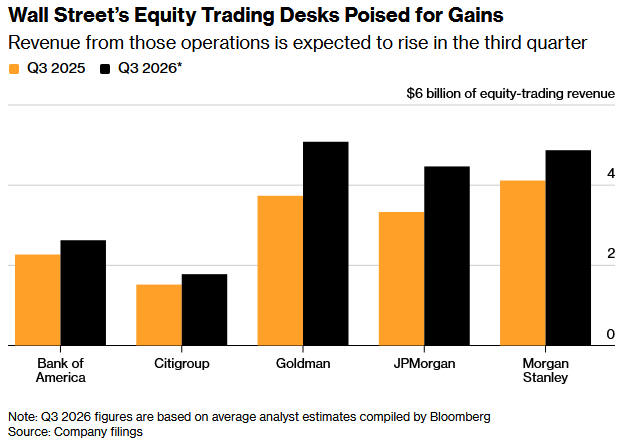
1. Investment Banks Reporting This Week….Trading Desk Projected Gains
Bloomberg
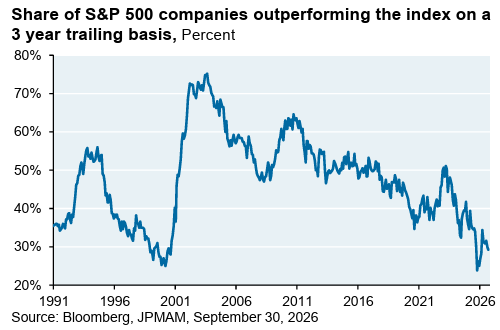
2. Share of S&P Companies Outperforming the Index Hit Internet Bubble Levels
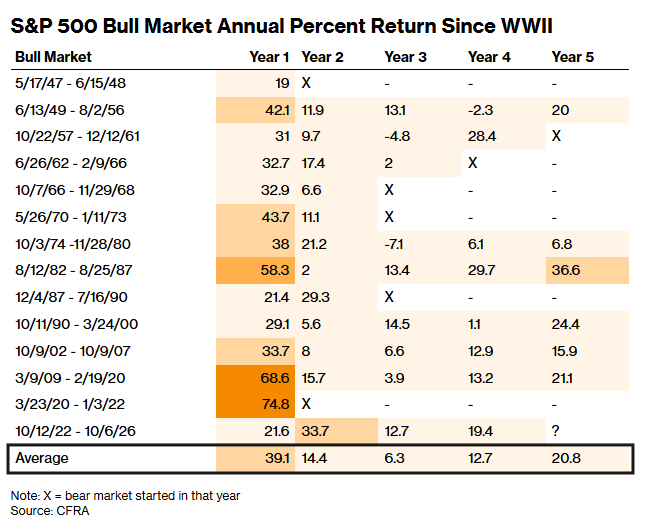
3. 2026 Bull Market vs. History
At 117%, the advance in the S&P 500 since 2022 is the third-largest for bull markets at their fourth anniversary, according to CFRA data going back 1947. And when the rally extended to a fifth year, the average gain was 21%, the data shows.
Zack Goldberg Jefferies
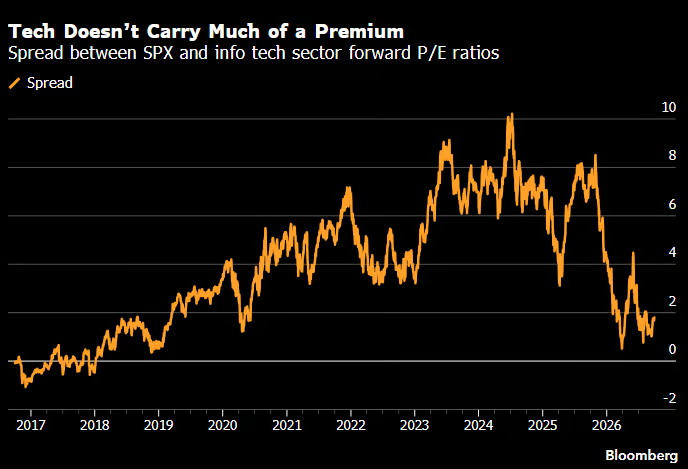
4. Tech Stocks Not Much of a Premium Over S&P
The chart below from Tatiana Darie, a macro strategist at Bloomberg, illustrates the point.
She told me on Full Signal that the spread between the S&P 500 and information technology sector’s forward P/E ratios has fallen to levels last seen at the start of the pandemic.
Phil Rosen
5. Latin America Post Big Move in Brazil….Still Cheapest P/E Region
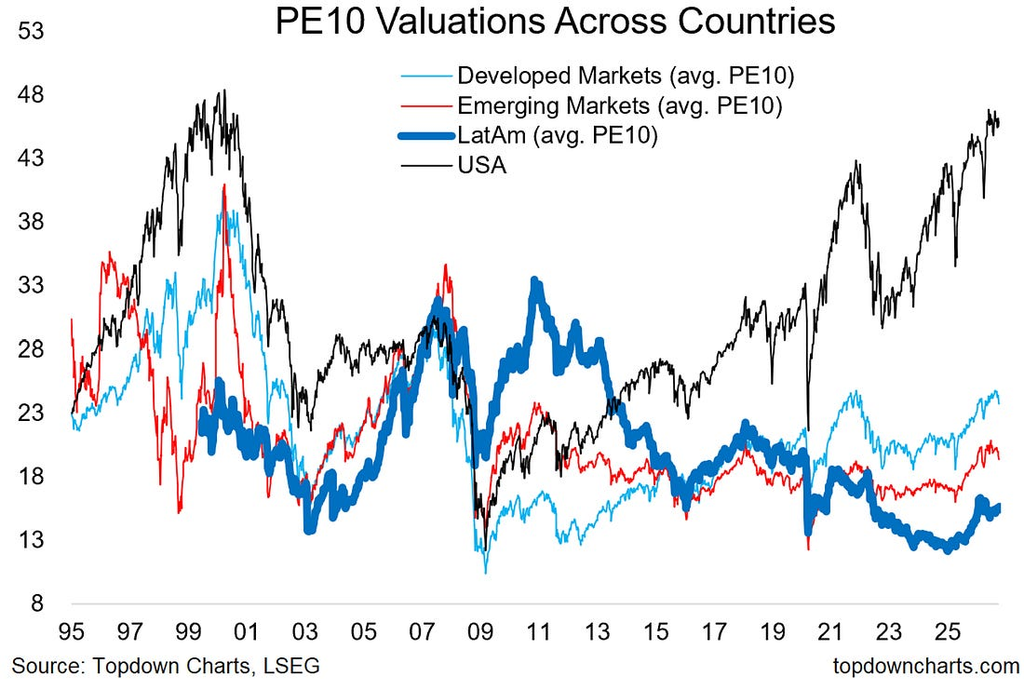
Topdown Charts
6. Worst Performing Stocks Year to Date
Worst Performing S&P 500 Stocks YTD
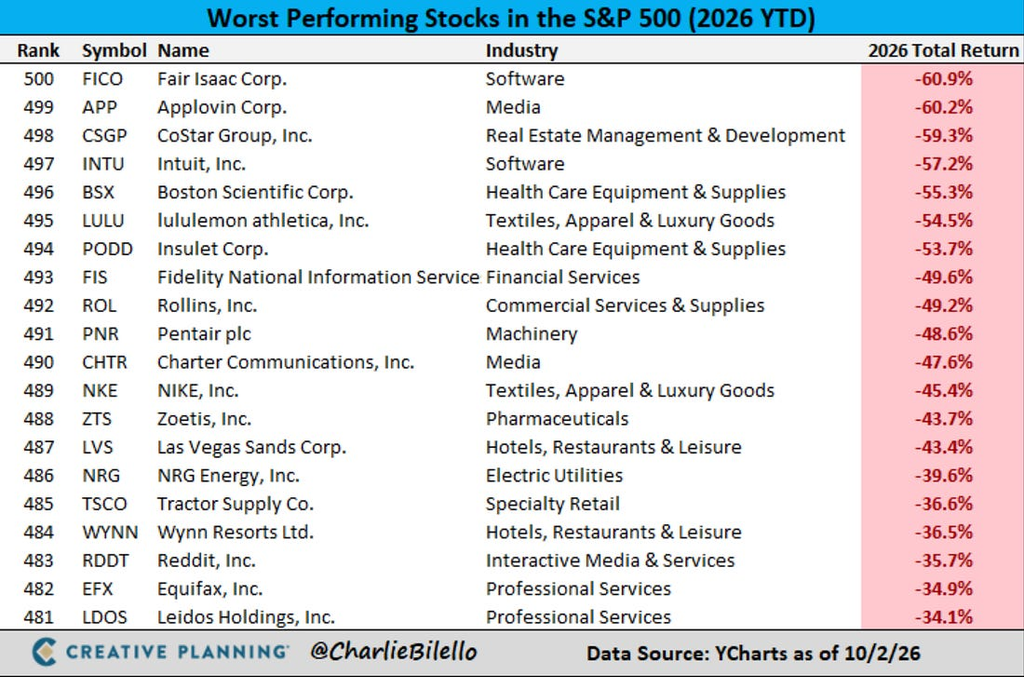
Charlie Bilello
7. China Offering Lucrative Research Grants to Researchers But None Are Coming
In Race With U.S., China Struggles to Recruit Foreign A.I. Researchers-NYT
China’s booming artificial intelligence sector has given local researchers good reason to remain in the country, but it has yet to lure overseas scientists despite a government push.
Chinese A.I. companies like Deepseek and Moonshot have made a name for themselves internationally. But China still struggles to recruit foreign researchers.Credit…Jade Gao/Agence France-Presse — Getty Images
By Zeyi Yang
As the United States and China vie for A.I. dominance, the Trump administration has made it more difficult for companies to hire foreign researchers, while China has made recruiting the world’s best scientists a national priority.
Over the past two years, China has flung open its doors to international researchers, introducing a visa for scientists and offering lucrative research grants.
Despite those efforts, foreigners are not coming.
Worse still for China’s ambitions, the number of Chinese scientists working in the United States has risen rather than declined, according to a new study about global A.I. research.
For every 30 Chinese researchers in the United States working on artificial intelligence in 2025, only one in China made the opposite journey, according to the study, conducted by the Carnegie Endowment for International Peace, a think tank.
“Despite U.S.-China tensions, the number of Chinese-origin researchers working in the U.S. actually rose by four percentage points rather than declined” compared with three years ago, said Damien Ma, who led the study.
https://www.nytimes.com/2026/10/06/science/china-ai-research-recruitment.html
8. Saudi Departures Yesterday from King Khalid Airport–1
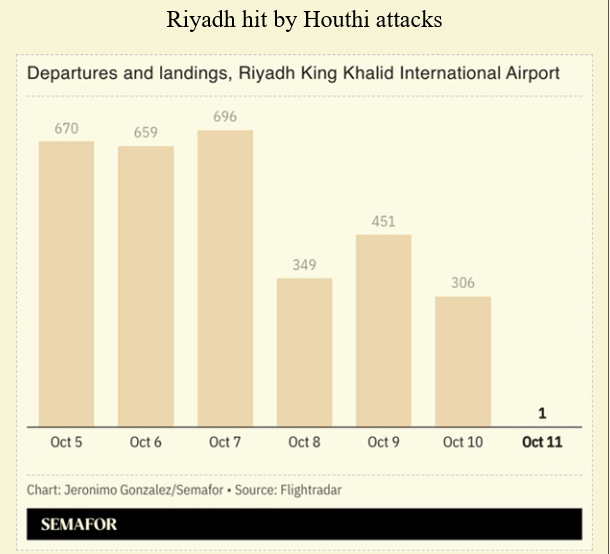
Semafor
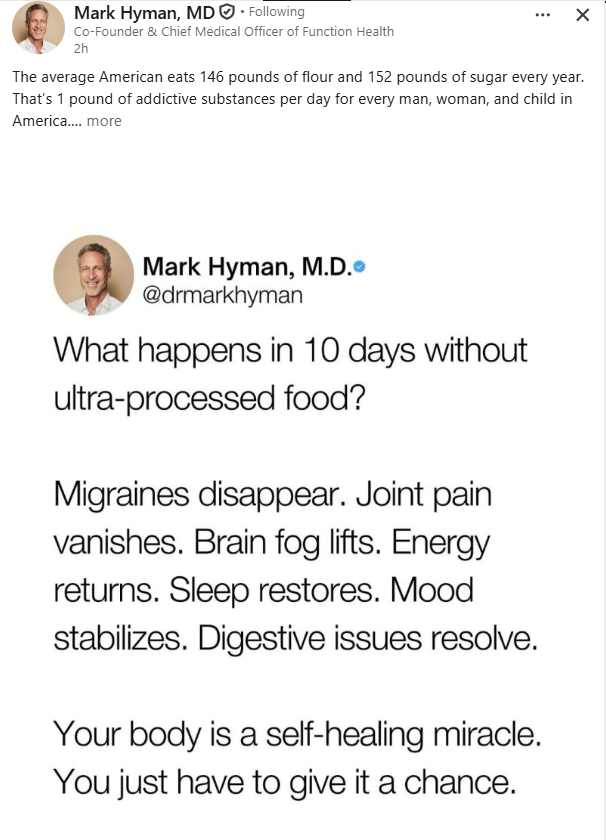
9. Mark Hyman Ultra Processed Food
The habits that matter most for skin longevity
I asked Dr. Mamina for the highest-value things you can do. Here’s her list:
- Protect your skin from the sun. UV radiation is the number one outside factor in skin aging. Wear sunscreen, limit time outdoors between 10 a.m. and 2 p.m., and use hats and UPF clothing. You still want morning light for vitamin D and your circadian rhythm. Just avoid baking for hours.
- Don’t smoke. Studies of identical twins show a dramatic difference in the twin who smokes and spends time in the sun.
- Cut back on sugar. Sugar binds to collagen and forms advanced glycation end products, or AGEs, which make collagen brittle.
- Eat the rainbow. Colorful foods rich in vitamin C, polyphenols, and carotenoids help fight oxidative stress.
- Sleep and manage stress. Poor sleep and circadian disruption accelerate aging.
- Exercise. Movement supports collagen production.
- Build a simple topical routine. Start with a cleanser, moisturizer, and sunscreen. Then add vitamin C in the morning and a retinoid at night. Peptides and growth factors come after that.
She’s also on team collagen. Collagen peptides don’t go straight to your skin, but they send signals that help your body build better collagen. They work best once sleep, sun protection, stress, and strength training are already dialed in
https://www.linkedin.com/in/drhyman
10. 5 Factors That Decide Whether AI Recommends Your Business
These strategies make sure your brand appears where customers are looking for recommendations.
BY JENNIFER BERSON, FOUNDER @JENERATIONPR
Open ChatGPT or Claude and ask either one to recommend the best company in your category. Then read the answer.
If you’re not in it, you already know the feeling. You have happy customers, a good website, and maybe even some great media features. But the tool your buyers now turn to for recommendations doesn’t seem to know you exist.
Here’s what changed. AI search tools are becoming the new front door of the internet. People don’t “Google” things the way they used to, sifting through pages of links to find the one that’s relevant. They ask, get an answer with recommendations, and decide.
Quince Wants to Follow Amazon’s Playbook. Its Platform Could Transform It Into a Tech Giant.
AI tools pull those answers from third-party, trusted, credible sources. Not your ads or your social posts, but the stories a journalist chose to write because it was interesting and credible.
The umbrella term for all of this is generative engine optimization, or GEO. Think “the new SEO.” If it helps, picture it like a recipe: press coverage is the protein, but you still need the rest of the ingredients.
Here are the five layers that help AI models decide which brands to recommend:
1. Earned media
AI tools treat editorial coverage in high-authority outlets the way we used to treat word of mouth: as credible information. A journalist chose to write about you, and that carries weight no ad or social post can replicate.
Your coverage should hit three things: recent, relevant, and reputable.
Ask yourself: How much coverage have you landed in the last 12 months? Is it tiny blogs, or real mid-tier and top-tier outlets? And when you show up, are you quoted as an expert or just named in passing? Those aren’t the same value to an AI answer engine.
2. Digital footprint consistency
This one trips people up more than you’d expect. Your website calls you a wellness entrepreneur. Your LinkedIn says certified nutritionist and speaker. Your press bio says nutrition expert and author. None of those are wrong, but to an AI model trying to build a clear picture of you, it’s confusing.
Think of it like everyone reading from the same one-page bio. When your story is told the same way across your website, LinkedIn, press, and social, AI can describe you confidently. When it’s inconsistent, AI gets tentative, and a tentative model doesn’t recommend you.
Your tone can shift from platform to platform, but your positioning can’t. Keep your bio and byline consistent everywhere you show up.
3. Reviews and community presence
AI reads Reddit, forum threads, Google reviews, and it’s checking whether what the media says about you matches what regular people say in their own words.
Land a great feature but let your Google reviews go stale, and that’s fighting your messaging. The fix isn’t glamorous: Ask new customers for reviews so the old ones get diluted and pushed down.
4. Topical authority
How Clear Communication Helps Employees Navigate Change
Ask ChatGPT to provide a list of the top gut health experts. It surfaces the people cited repeatedly, across multiple sources, on that exact topic.
This is what we’ve always called thought leadership. What’s new is that it’s now measurable.
So, pick your thing. One brand I work with makes breast pumps, and their entire promise is more milk in less time. It’s the tagline, the blog positioning, and most of their press coverage. AI has started recommending them that way when breastfeeding moms ask for the most powerful pump.
The test: If AI read everything published about you, would it land on a clear sense of what you’re known for, or a muddy picture of someone featured 10 different ways?
5. Freshness and structure
AI favors recent information. If your last press hit was two years ago and your blog’s been quiet for three, AI isn’t seeing you.
Structure gets technical, but you don’t need to become a developer. Just know AI reads your website differently than people do. It wants clear, direct language that answers real questions. A beautiful site full of vague brand-speak is harder to parse than a plain one.
“We empower visionaries to unlock their potential” tells AI nothing. Say who you help, how, and why you’re qualified.
Why you can’t wait for the analytics
Someone asks ChatGPT for the best moisturizer for dry skin, gets a recommendation, makes up their mind. Then they close the window, Google the brand name, and buy. Your analytics logs that as “direct traffic” or “branded search.” Nobody sees the AI in the middle of it. The industry calls this dark search, dark AI, and the attribution gap.
Pew Research Center found that once a Google AI summary appears, people click a search result only eight percent of the time (down from the standard 15 percent) and click a link inside the summary just one percent of the time. The answer is now the search term.
So set a baseline this week. Block half an hour and run an AI visibility audit on your brand with these five steps:
- Open an AI tool you want to appear in and ask the questions your customers would.
- Ask the models what it says about you.
- Screenshot what comes up.
- Note anything inaccurate, missing, or surprising.
- Work the five layers.
The effort you put in now builds groundwork you can’t see yet. Document your baseline now, so you can prove the movement later.
Get 1 Smart Business Story delivered straight to your inbox when you subscribe to Inc.’s free daily newsletter.