Category Archives: Quarterly

Topley’s Top 10 – May 03, 2022

1. Since 1976…First Time Ever Both Stocks and Bonds -10%

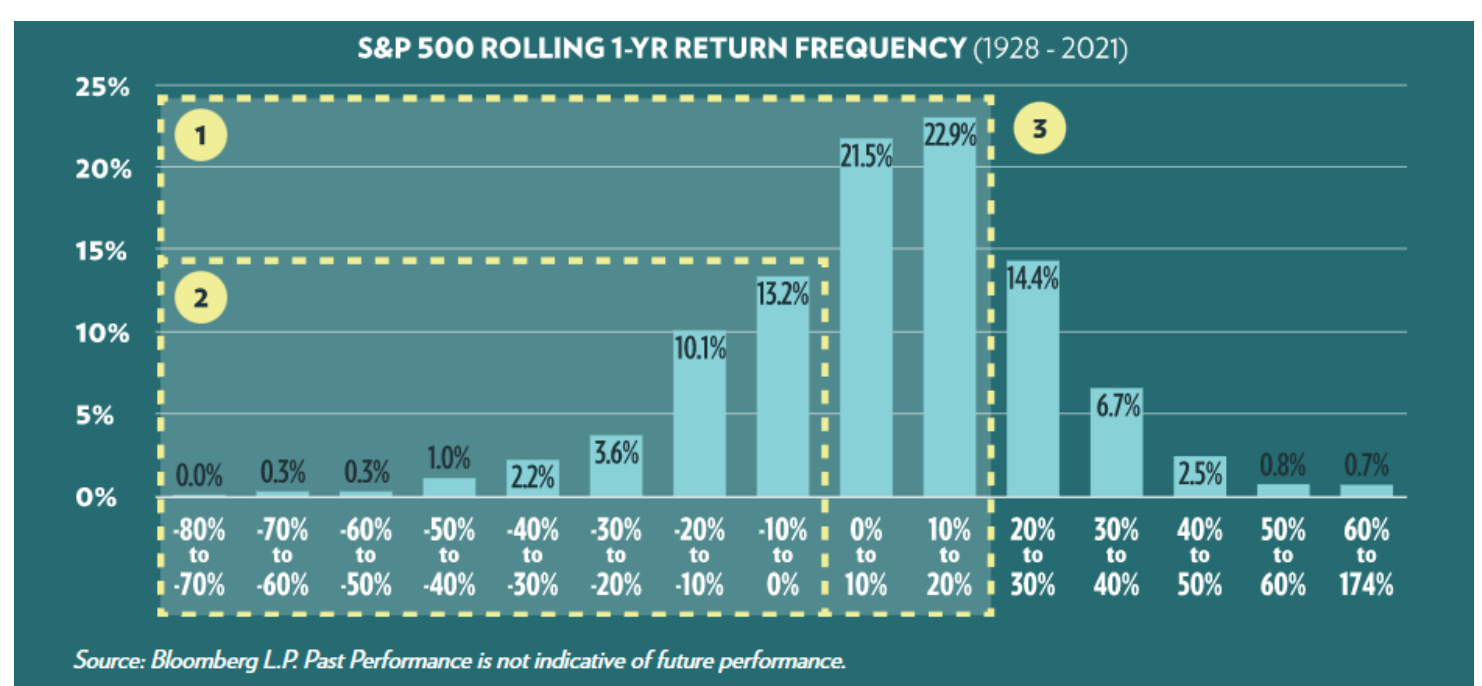
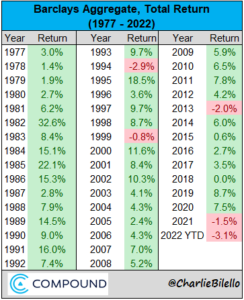
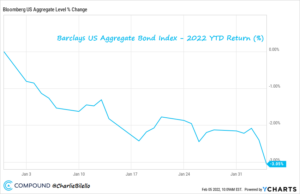
@Charlie Bilello-With data going back to 1976, this is the first time ever that both stocks and bonds are in a >10% drawdown at the same time. The S&P 500 is in a 13% drawdown while bonds are 11% below their 2020 high. (note: using monthly total return data)


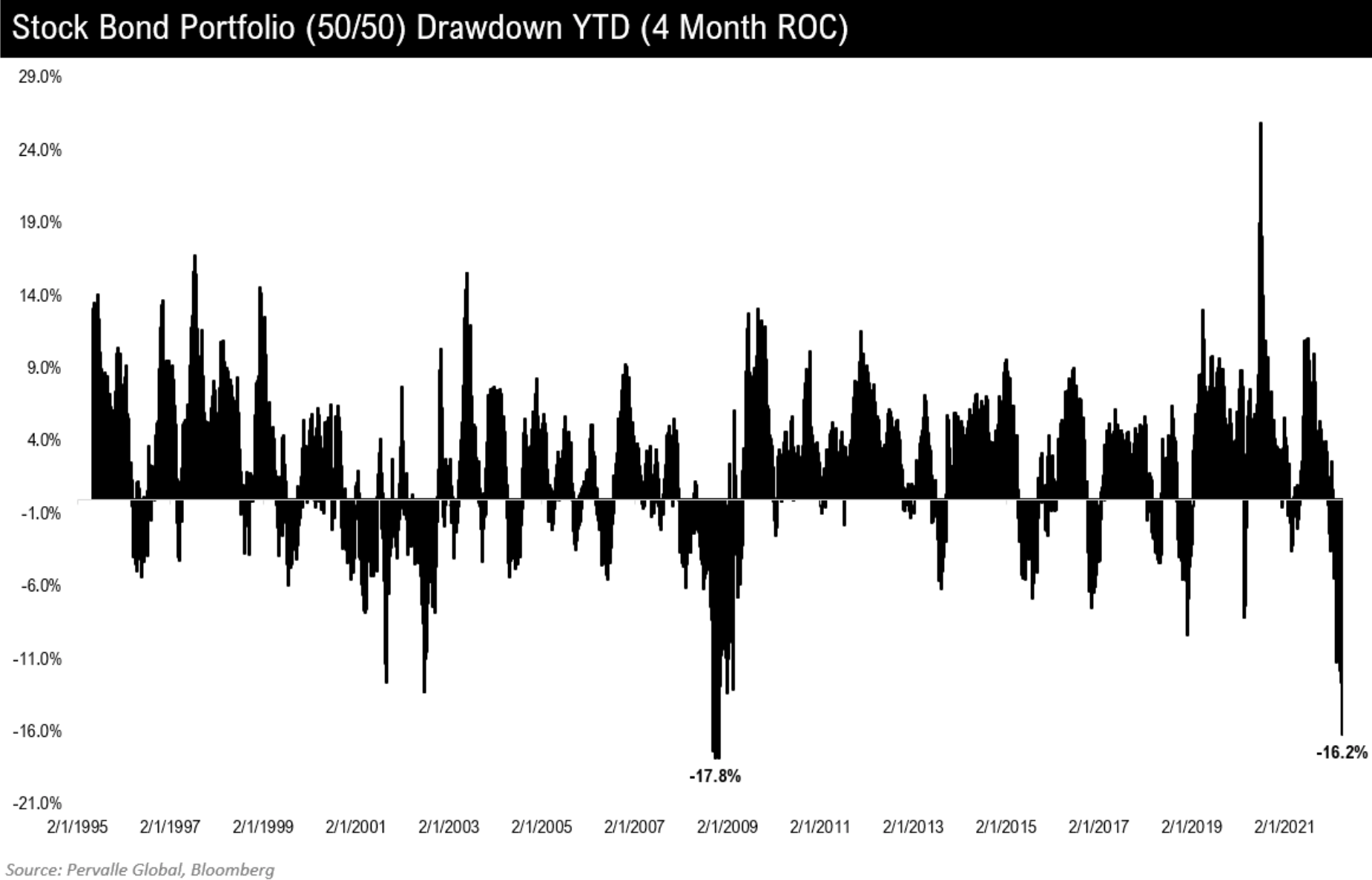
2. 50/50 Portfolio Drawdown Almost Equal to 2008

https://twitter.com/TeddyVallee


3. Since 2000 S&P Only Outperformed 60/40 by 60 Basis Points….Since 2010 S&P has Outperformed 60/40 by 120%

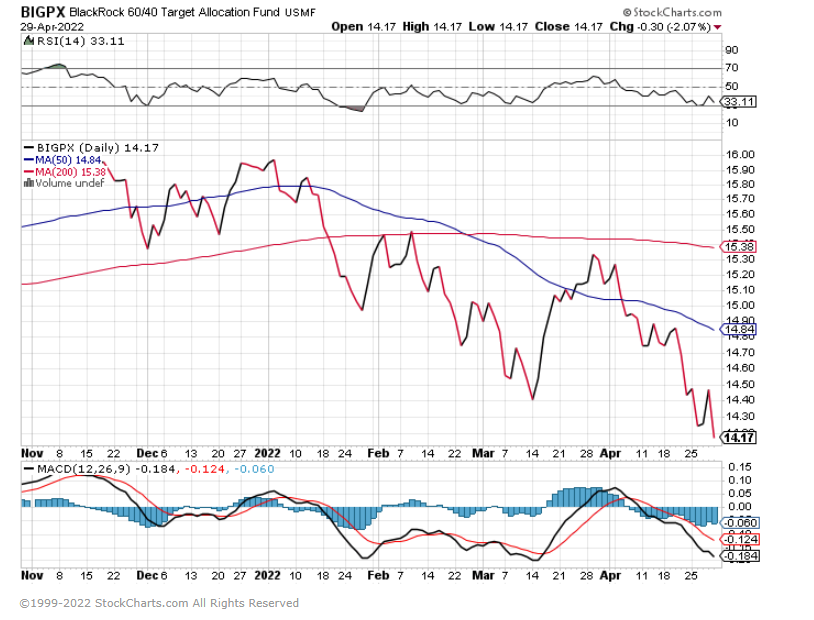
Since The beginning of 2010, the DWA 60/40 Bond Index (DWA.TR) has underperformed the total return of the S&P 500 (TR.SPXX by more than 120% or 4% per year on an annualized basis (through 4/28). However, from the beginning of 2000, there’s a much smaller spread – with the S&P leading the 60/40 portfolio by a little under 60 basis points on an annualized basis – the point being that the picture can change a lot depending on the time periods. www,dorseywright.com

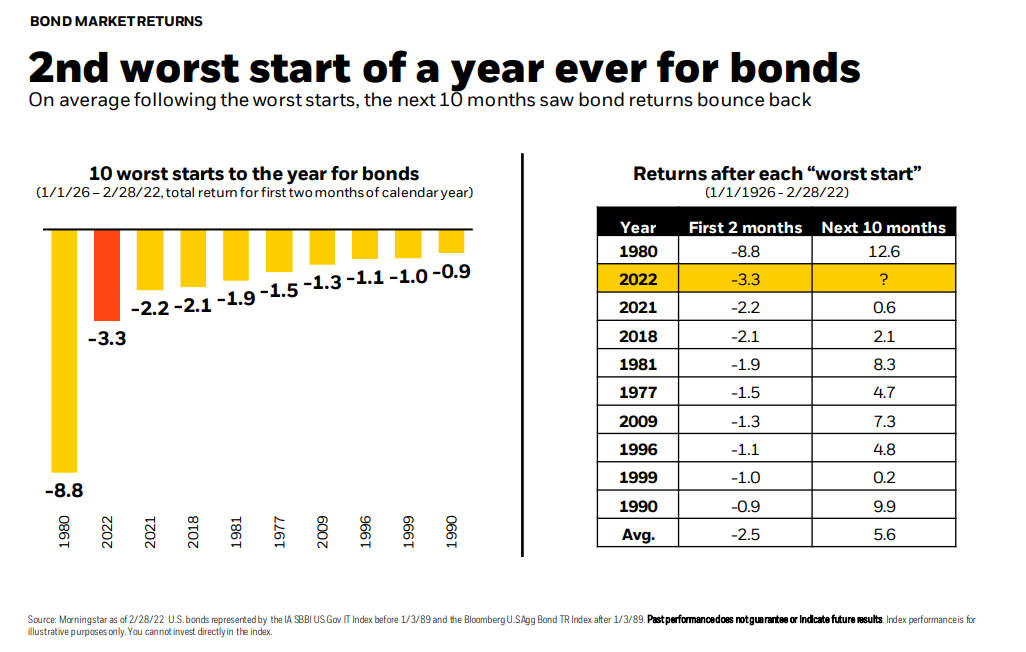
Blackrock 60/40

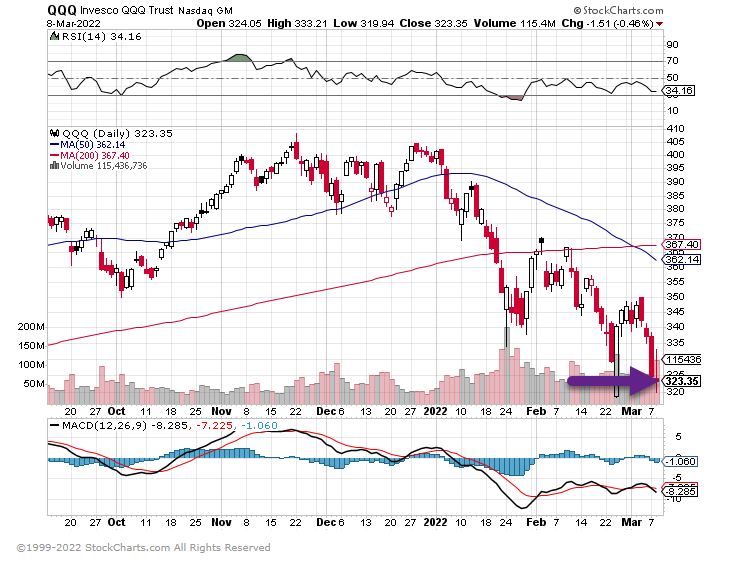
www.stockcharts.com


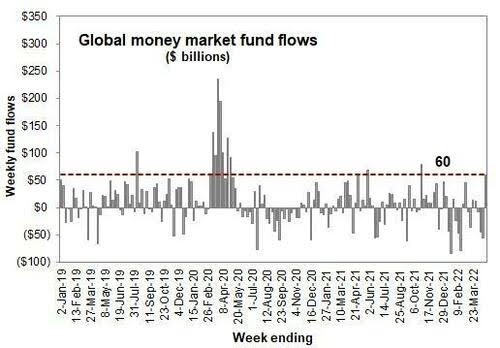
4. Money Market Funds See Biggest Inflows Since Covid.

Money Market Inflows Logged a massive +$60B inflows last week, which was the largest weekly inflow since Covid 2020 (and typically another fear gauge).

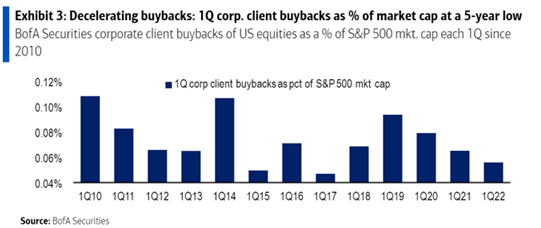
From Zerohedge Buyback Blackout Period Is Over, And 10 More Reasons Why Goldman Calls The End Of The Market Carnage | ZeroHedge


5. What Happens After Historic Bad Months?

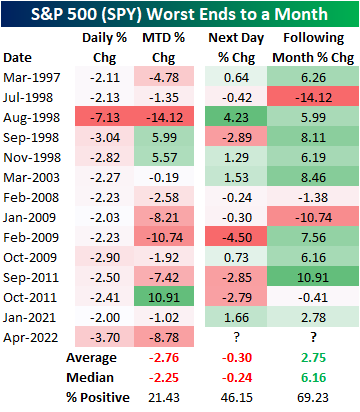
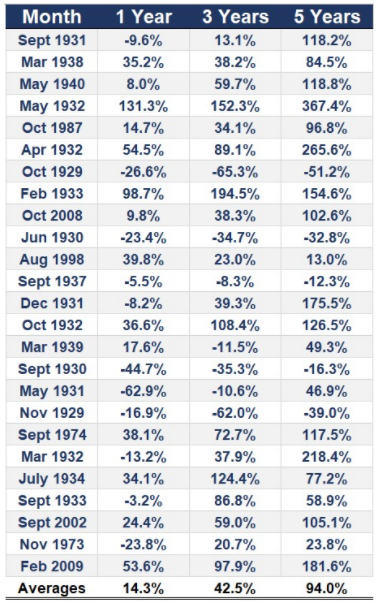
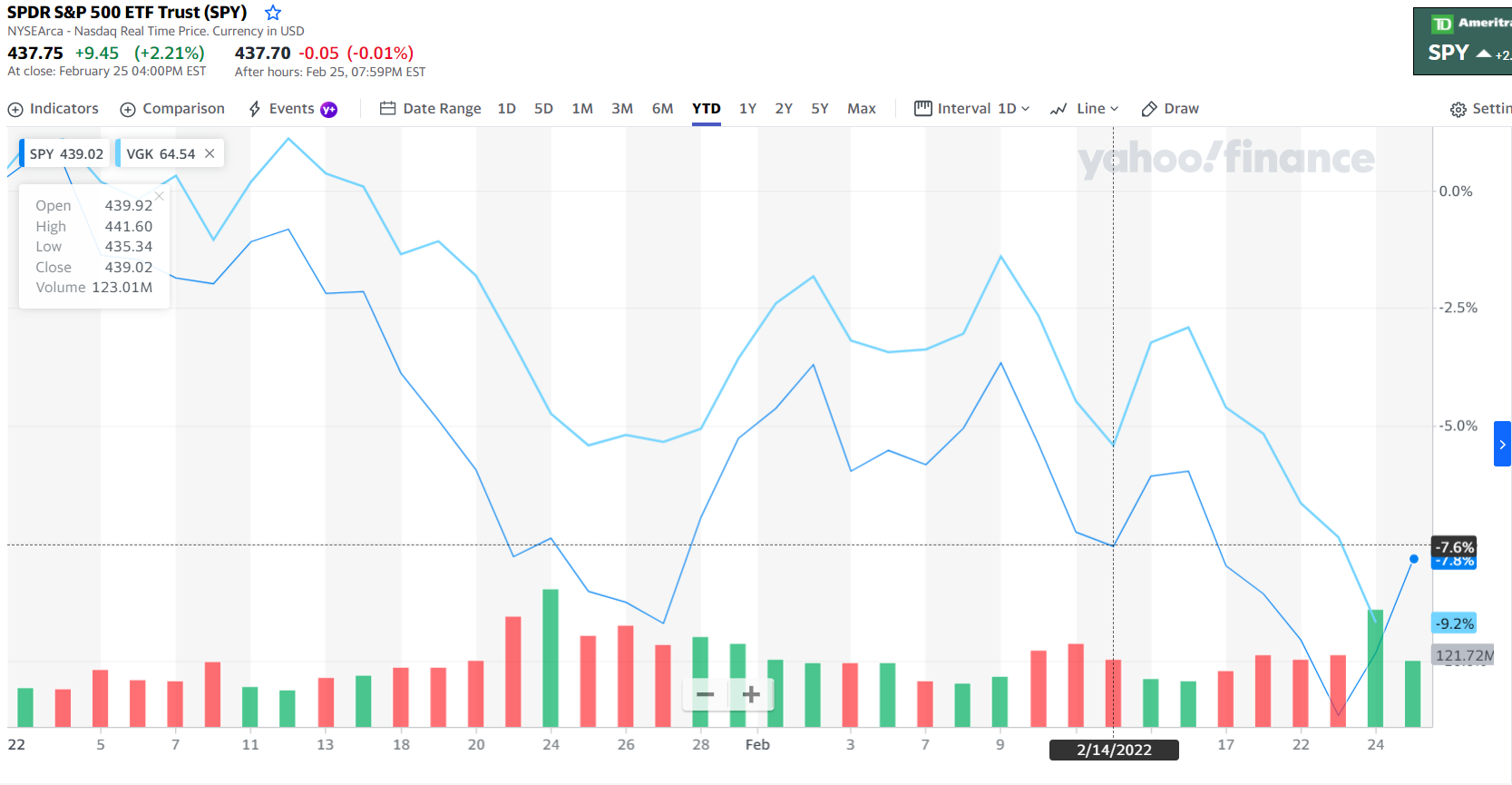
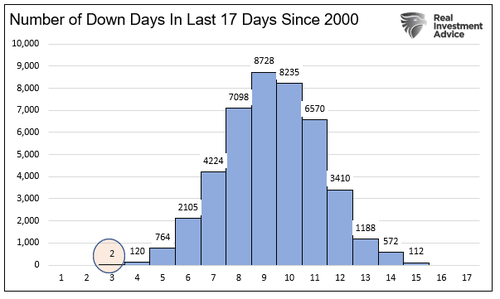
Bespoke Investment Group-Historic End to a Down Month-It was a rough finish to the month of April. Not only did the S&P 500 (SPY) finish the month with an 8.78% decline month to date, the biggest one-month decline since March 2020, but the last trading day of the month was one for the record books. Since SPY began trading in 1993, the only bigger drop on the final trading day of the month was in August 1998. Back then it was a much larger 7.13% decline.

In the table below, we show all months since 1993 that SPY declined at least 2% on the last trading day of a month. Behind April, the next worst final day of a month and the only other month with an over 3% decline was September 1998, but back then, SPY had still managed to finish up MTD.  Finishing up MTD has been the exception rather than the rule of these occurrences, though, as November 1998 and October 2011 were the only other times that SPY fell over 2% on the last trading day of the month but still finished with a MTD gain.

As for where the S&P 500 has typically gone from there, the first trading day of the new month has only seen a move higher 46% of the time as the index has averaged a 30 bps decline. For the full month, though, performance is generally more positive with an average gain of 2.75% and positive returns almost 70% of the time.

https://www.bespokepremium.com/interactive/research/think-big-blog/


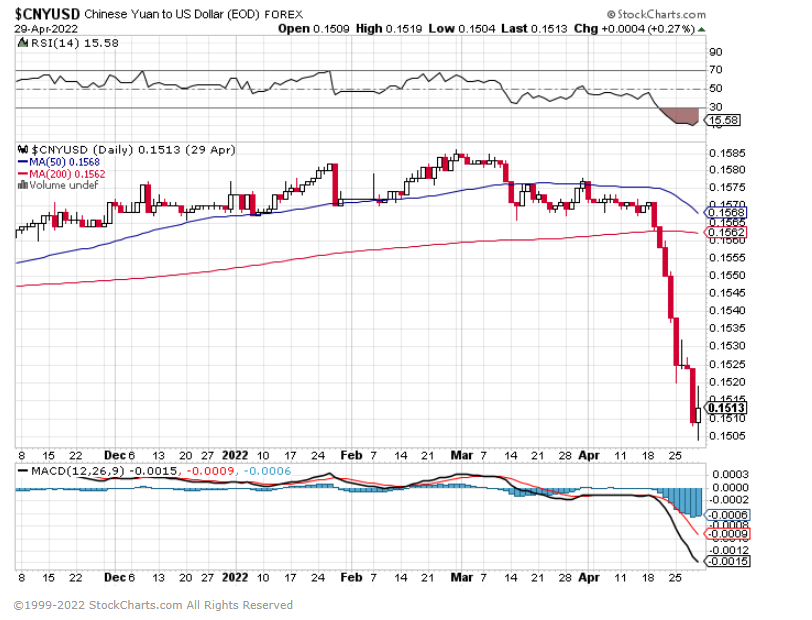
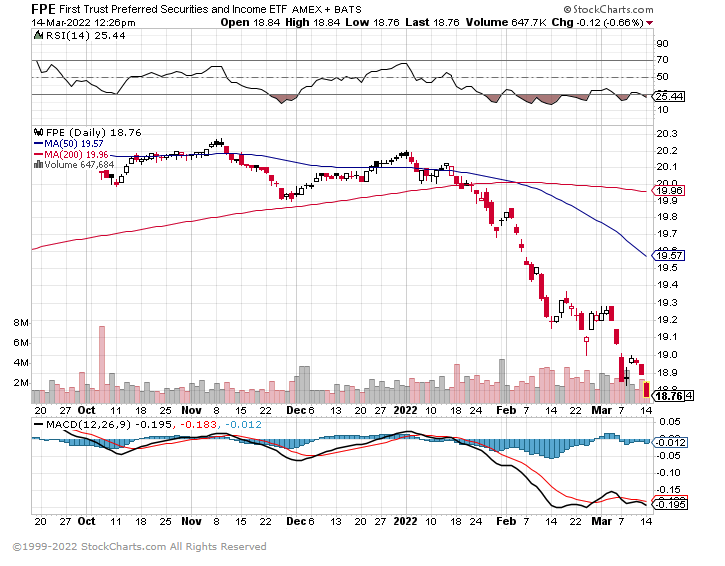
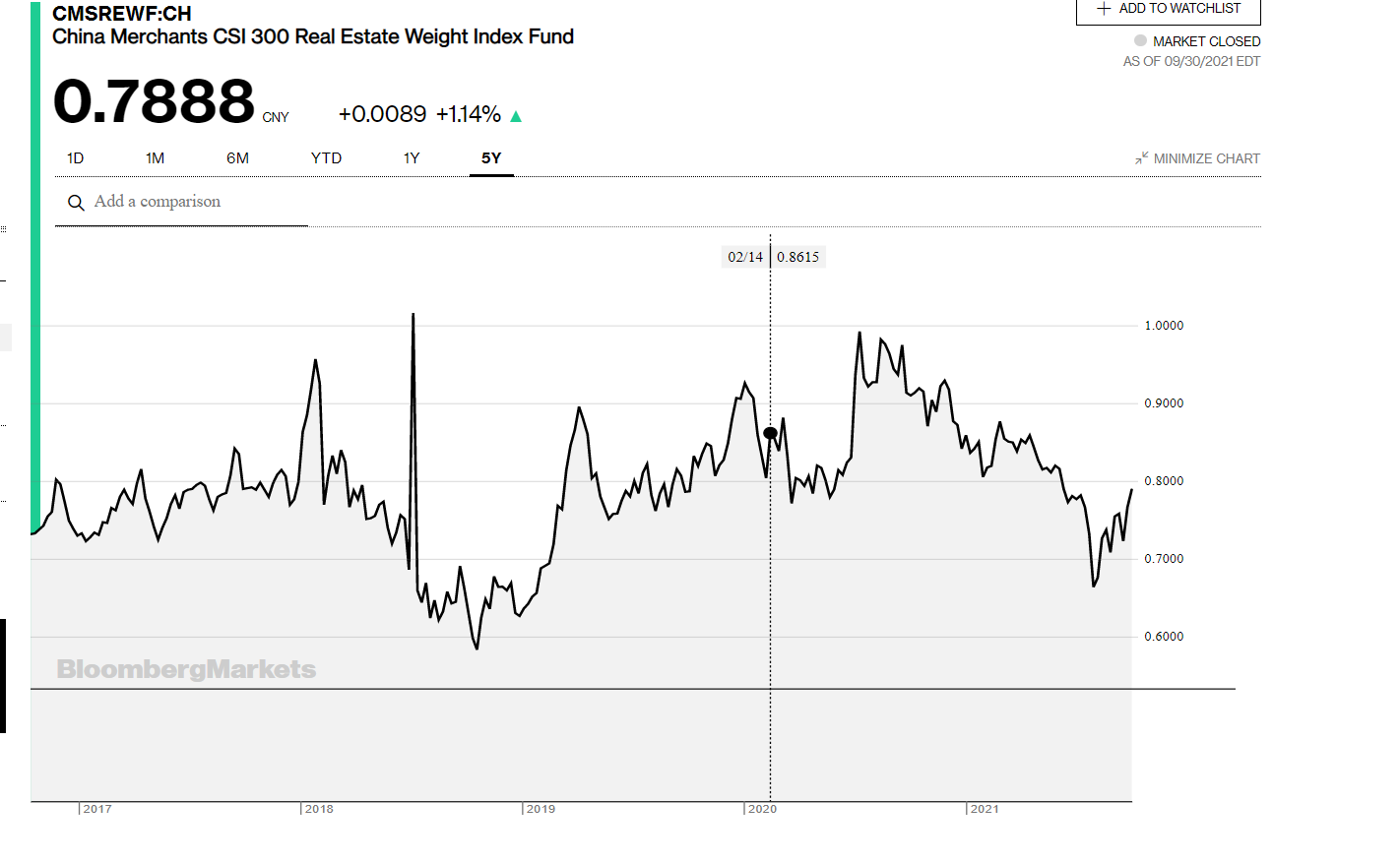
6. Yuan to U.S. Dollar Chart

Judging by this chart Yuan is not a candidate to overcome dollar as reserve currency

www.stockcharts.com


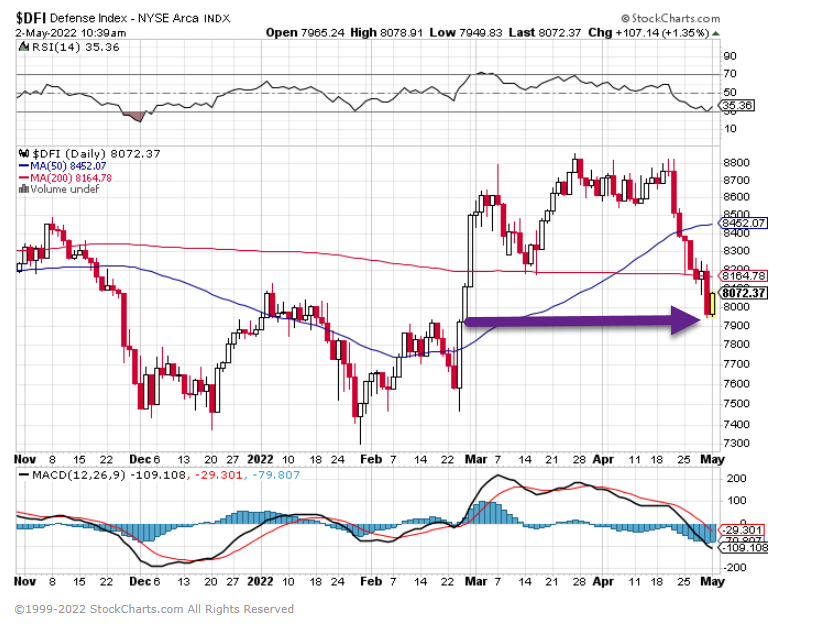
7. NYSE Defense Index Falling Back Toward Pre-Ukraine Invasion Levels.

www.stockcharts.com


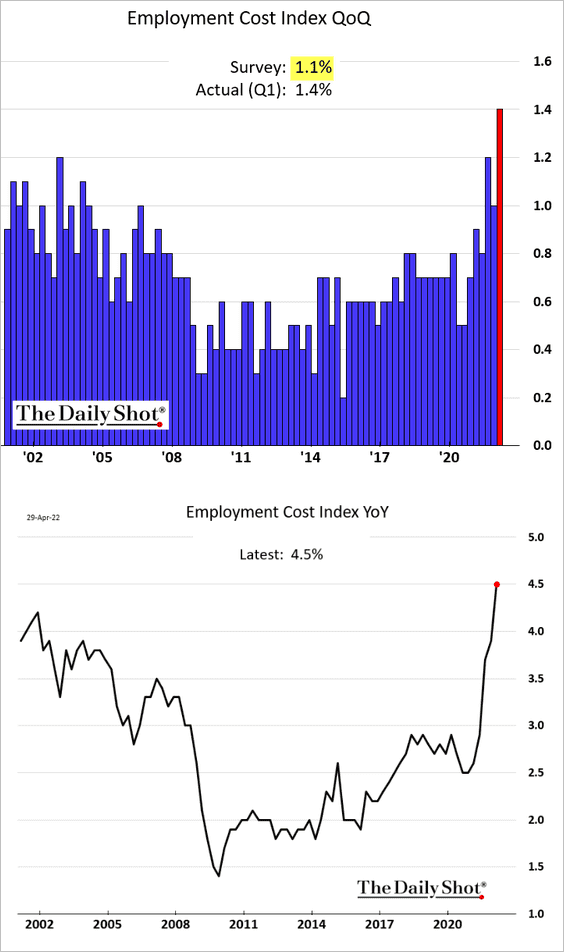
8. Employment Cost Index Well Above Forecasts.

The United States: The employment cost index came in well above forecasts, spooking the markets. The concern has been a wage-price spiral.

Source: Daily Shot

 https://dailyshotbrief.com/the-daily-shot-brief-may-2nd-2022/


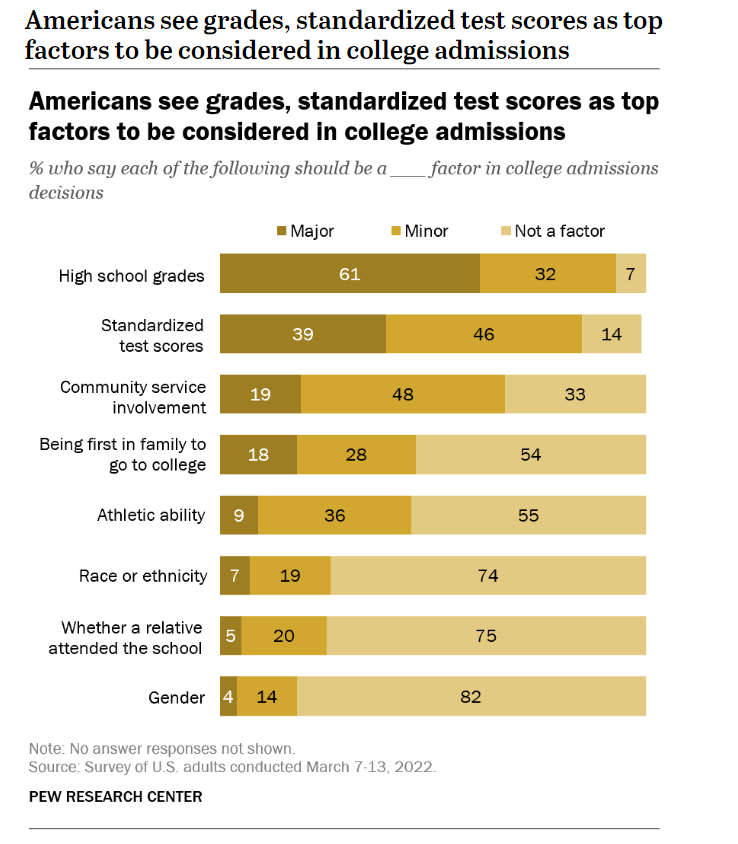
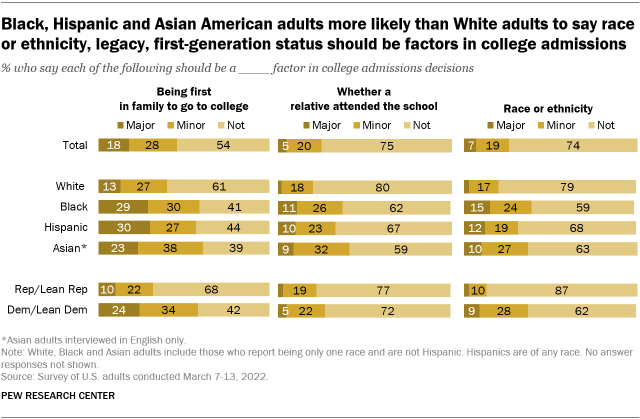
9. Americans Opinion on Grades and Standardized Test Scores-Pew Research

Grades and test scores seen as top factors for college admissions in U.S. | Pew Research Center


10. Study finds seven hours of sleep to be optimal from middle-age onwards

By Nick Lavars

VIEW 1 IMAGES

We know sleep to be an essential ingredient for a healthy brain, but scientists continue to explore what a good night’s rest looks like at different stages of life, and how it can impact on our vulnerability to cognitive decline. A wide-ranging new study involving almost half a million subjects has provided compelling new insights, suggesting seven hours of sleep per night to be best for brain health during middle and old age.

While good sleeping habits are known to be beneficial for everything from reducing our risk of cancer and heart failure to maintaining a healthy body weight, recently we’ve seen scientists shine a light on its relationship with Alzheimer’s and dementia.This includes studies finding an increased risk through disruptions to key sleep phases, short sleep durations and excessive daytime napping. On the more positive side of things, scientists have identified genes in “elite sleepers” that may lead to treatments for these types of neurodegenerative diseases.

This new research, carried out by scientists at the University of Cambridge and China’s Fudan University, involved the analysis of almost 500,000 adults between the ages of 38 and 73. This included survey data on sleeping patterns, mental health and wellbeing, along with cognitive testing. Brain imaging and genetic data was available for almost 40,000 subjects.

This enabled the scientists to tease out new insights around sleeping habits in middle and old age, and brain health. Building on findings from one 2018 study, the analysis found that both too little and too much sleep had negative effects, affecting visual attention, memory, problem-solving and processing speed. This also increased symptoms of depression, anxiety and worse overall wellbeing.

Seven hours of sleep was the amount the scientists concluded to be optimal for brain health, saying that sleeping too much or too little may be a risk factor for age-related cognitive decline. The findings also add further weight to an idea we saw explored through an interesting 2020 study that linked disturbances to slow-wave “deep” sleep and Alzheimer’s.

Previous research in animals and humans has shown that this type of fragmented sleep can can increase the accumulation of toxic proteins associated with Alzheimer’s disease. Further, slow-wave deep sleep is an important brain function that clears away waste products and toxic proteins. That 2020 research suggested that fragmented sleep could be an effective way to predict those at risk of developing neurodegenerative disease.

“Getting a good night’s sleep is important at all stages of life, but particularly as we age,” said Professor Barbara Sahakian from the University of Cambridge. “Finding ways to improve sleep for older people could be crucial to helping them maintain good mental health and wellbeing and avoiding cognitive decline, particularly for patients with psychiatric disorders and dementias.”

The research was published in the journal Nature Aging. 

Source: University of Cambridge  https://newatlas.com/health-wellbeing/study-seven-hours-sleep-optimal-middle-age/

Found at Abnormal Returns www.abnormalreturns.com

Topley’s Top 10 – May 02, 2022

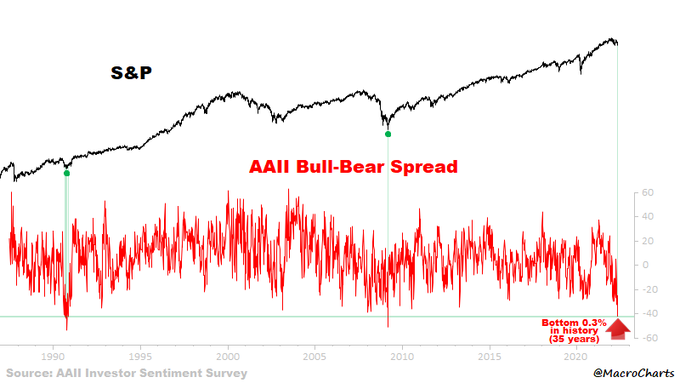
1. In 35 Years…Investor Sentiment has Only Gotten this Low 5 Other Times.

@MacroCharts

-Four during the 1990 Recession trough / Inflation peak.

-One at the exact bottom in March 2009.”

From Real Vision Newsletter  https://www.realvision.com/blog/


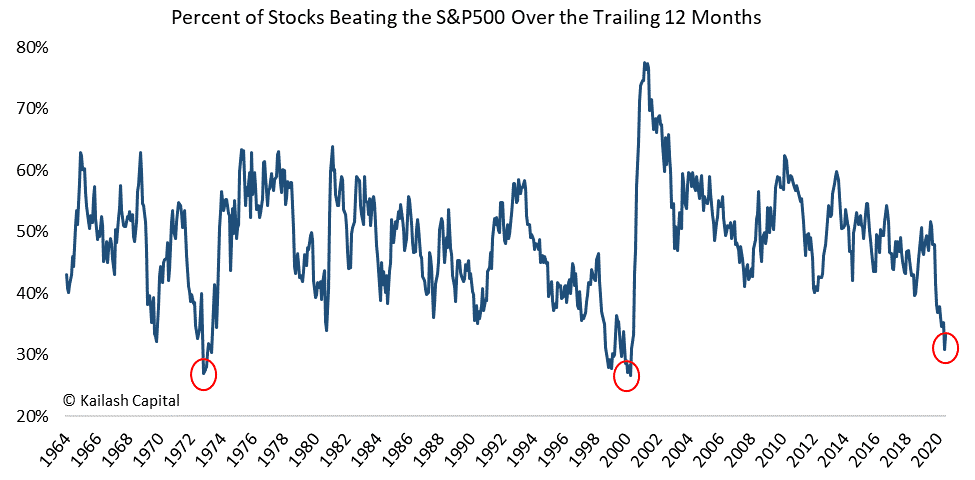
2. Percentage of Stocks Beating the S&P Hitting 2000 Bubble Low Levels.

From Kailash Concepts

https://twitter.com/KailashConcepts


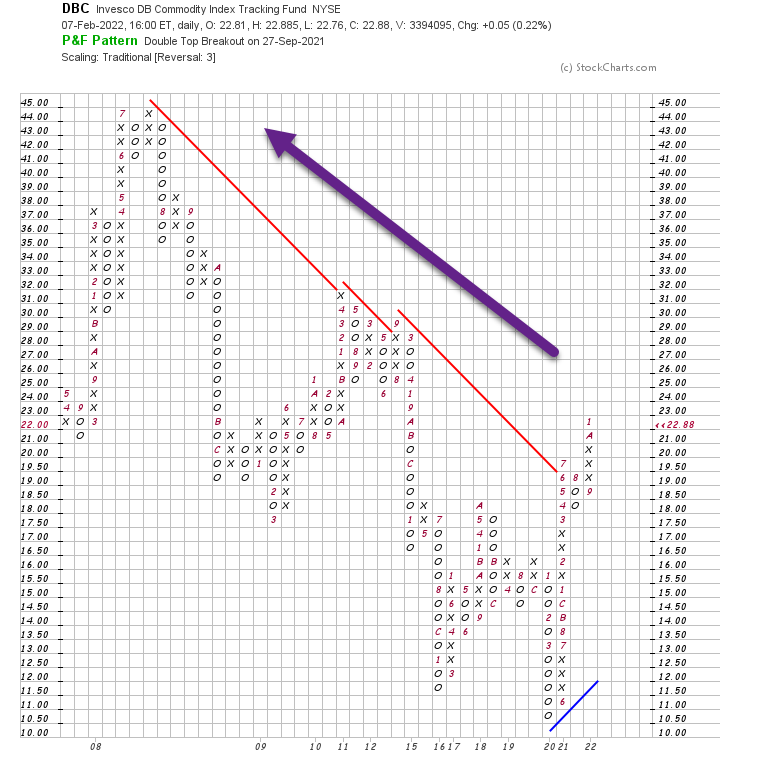
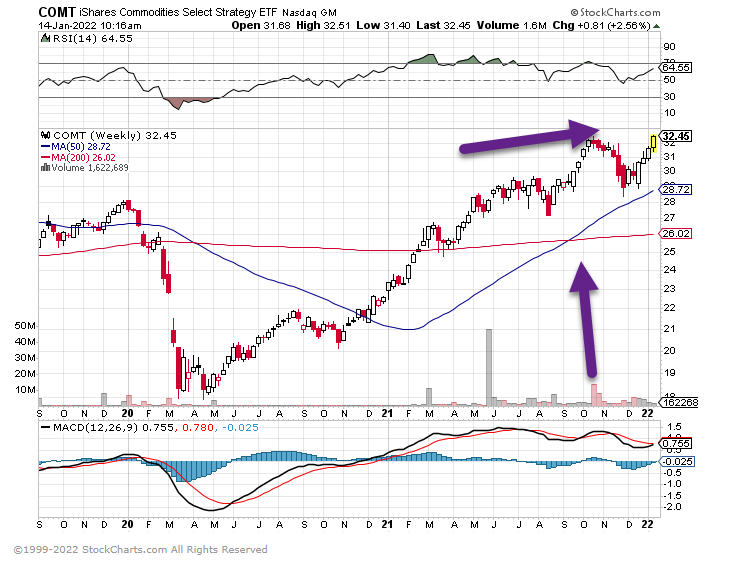
3. Commodities Chart Forming a Technical Triangle….Increased Probability of Violent Break One Way or the Other.

www.stockcharts.com


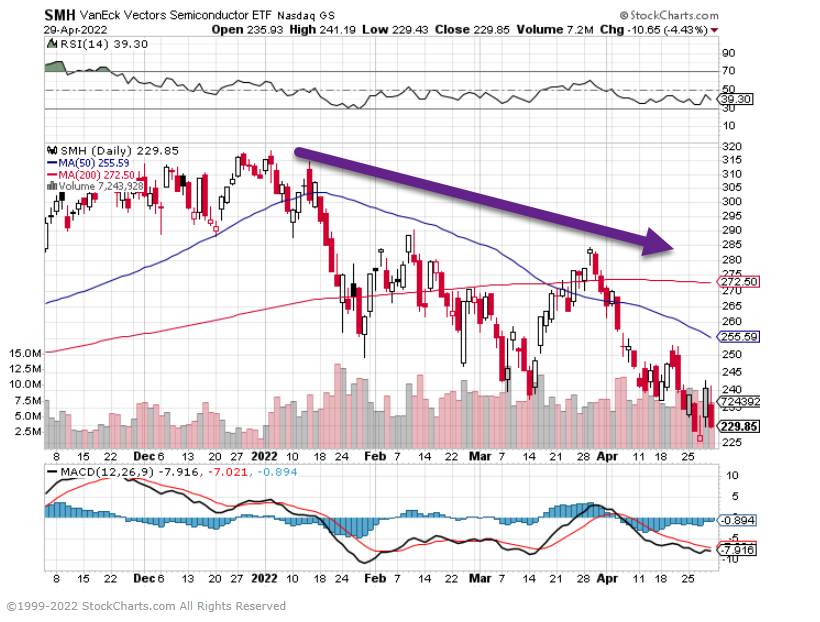
4. Semiconductors ETF -27% Correction from Highs

www.stockcharts.com


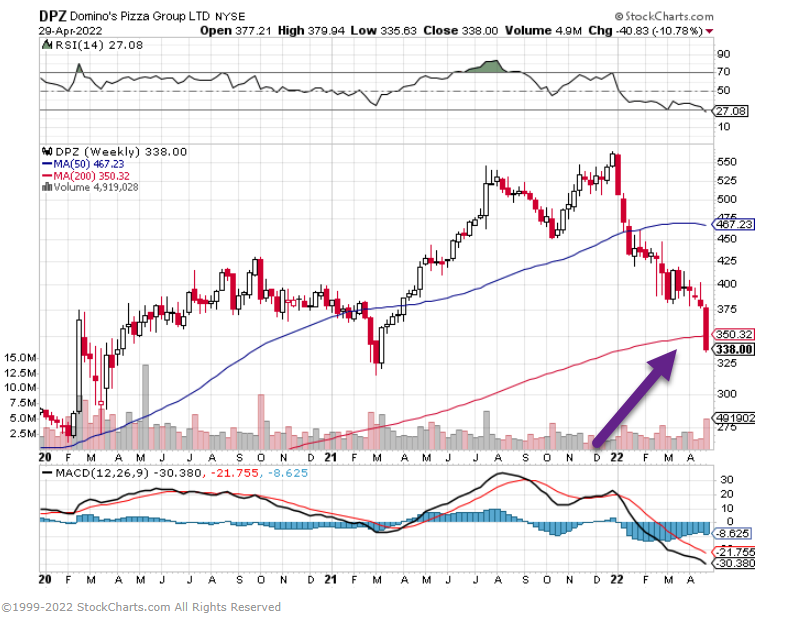
5. Covid Superstar Stock Dominos Pizza -40% Correction from Highs

DPZ Closes below its 200 day moving average on long-term weekly chart

www.stockcharts.com


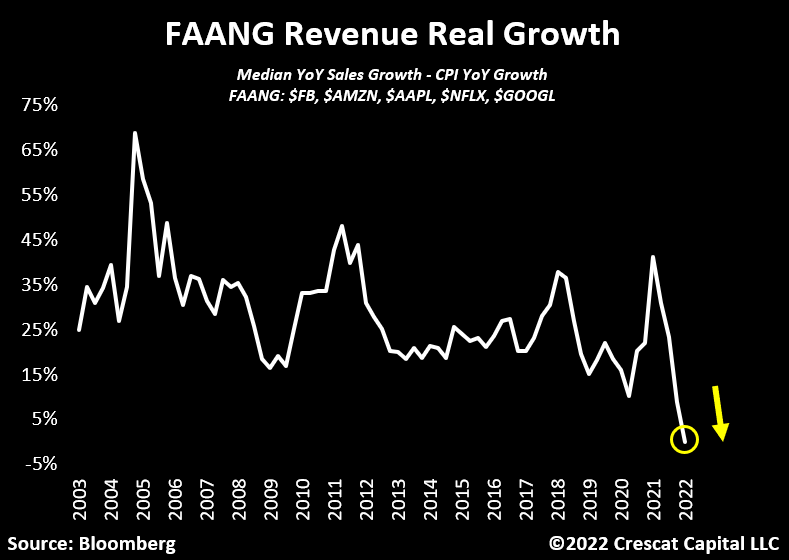
6. FAANG stocks just reported 0% real revenue growth for the first time in 20 years

Otavio (Tavi) Costa

@TaviCosta

https://twitter.com/TaviCosta


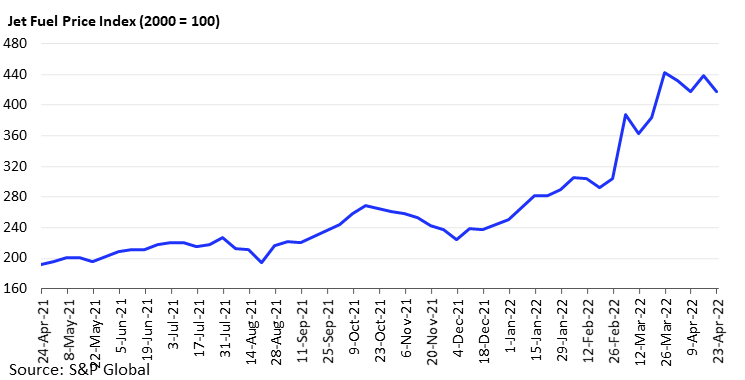
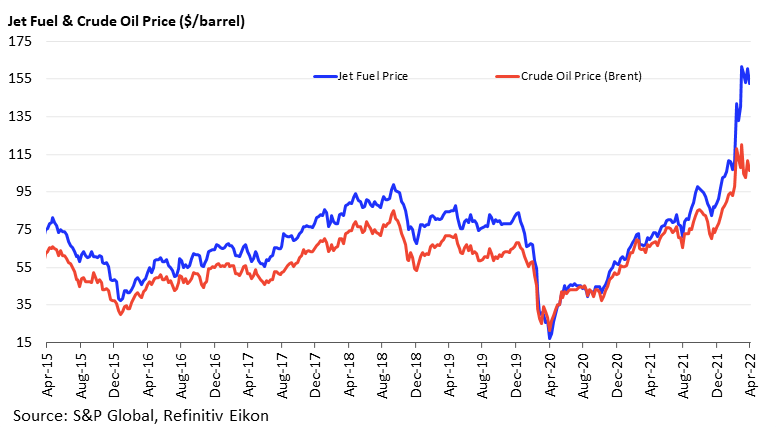
7. Jet Fuel Prices +140% Year Over Year

IATA Jet Fuel Monitor

https://www.iata.org/en/publications/economics/fuel-monitor/


8. Reversion to the Mean in Real World Retail?

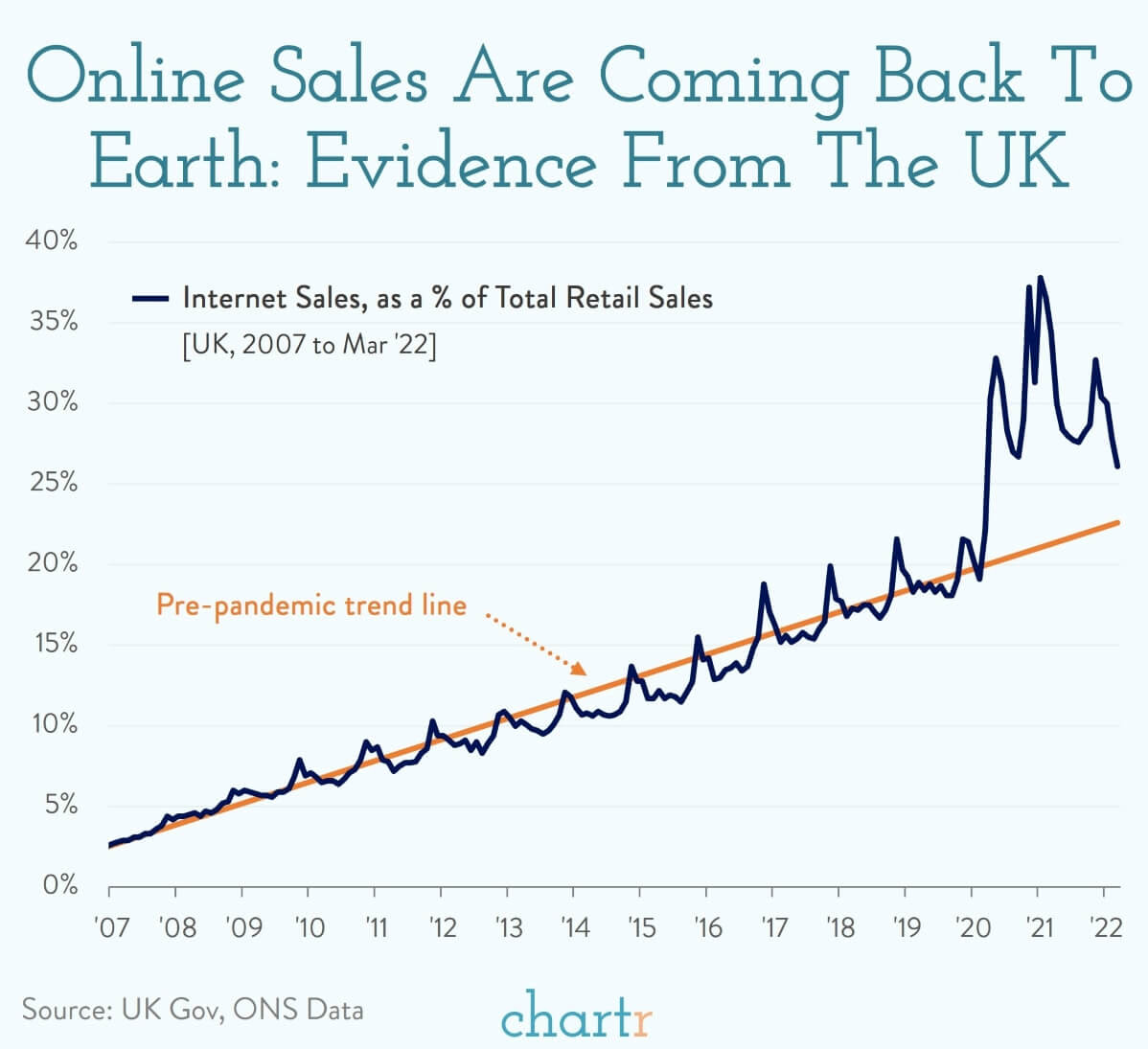
Real world retail-Few companies benefited from the pandemic as much as Amazon. Online sales soared and many wondered whether brick and mortar retail would recover.  Well, it has.For a company that’s been used to growing at 20%, 30% or even 40% over the last few years, yesterday’s update was something of a shock: Amazon’s e-commerce sales dropped by 3% and the company reported its first loss for 7 years.

Evidence from the UK

If you happen to have a keen eye on UK retail sales (who doesn’t?) you might have seen this phenomenon coming. The UK has monthly data on internet sales as a % of total retail — and it’s showed an interesting trend recently.

After years of gently trending higher, online sales shot to more than 35% of total UK retail sales during the pandemic, where many experts expected them to stay, as we adopted new habits permanently.

But in recent months online sales have pulled back. In fact, if you draw the trend line on the data pre-pandemic then online sales are not far off where they might have ended up anyway, had the pandemic never happened in a glorious alternative timeline. The quarterly data in the US shows a similar trend. Maybe we don’t want to buy everything online after all.

www.chartr.com


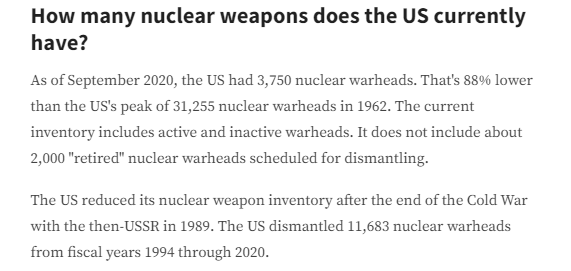
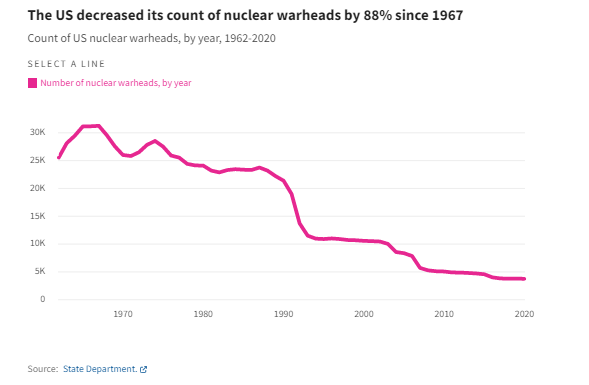
9. The U.S. Decreased Nuclear Warheads by 88% Since 1967

USAfACTS.ORG

How many nuclear weapons does the US have? – USAFacts


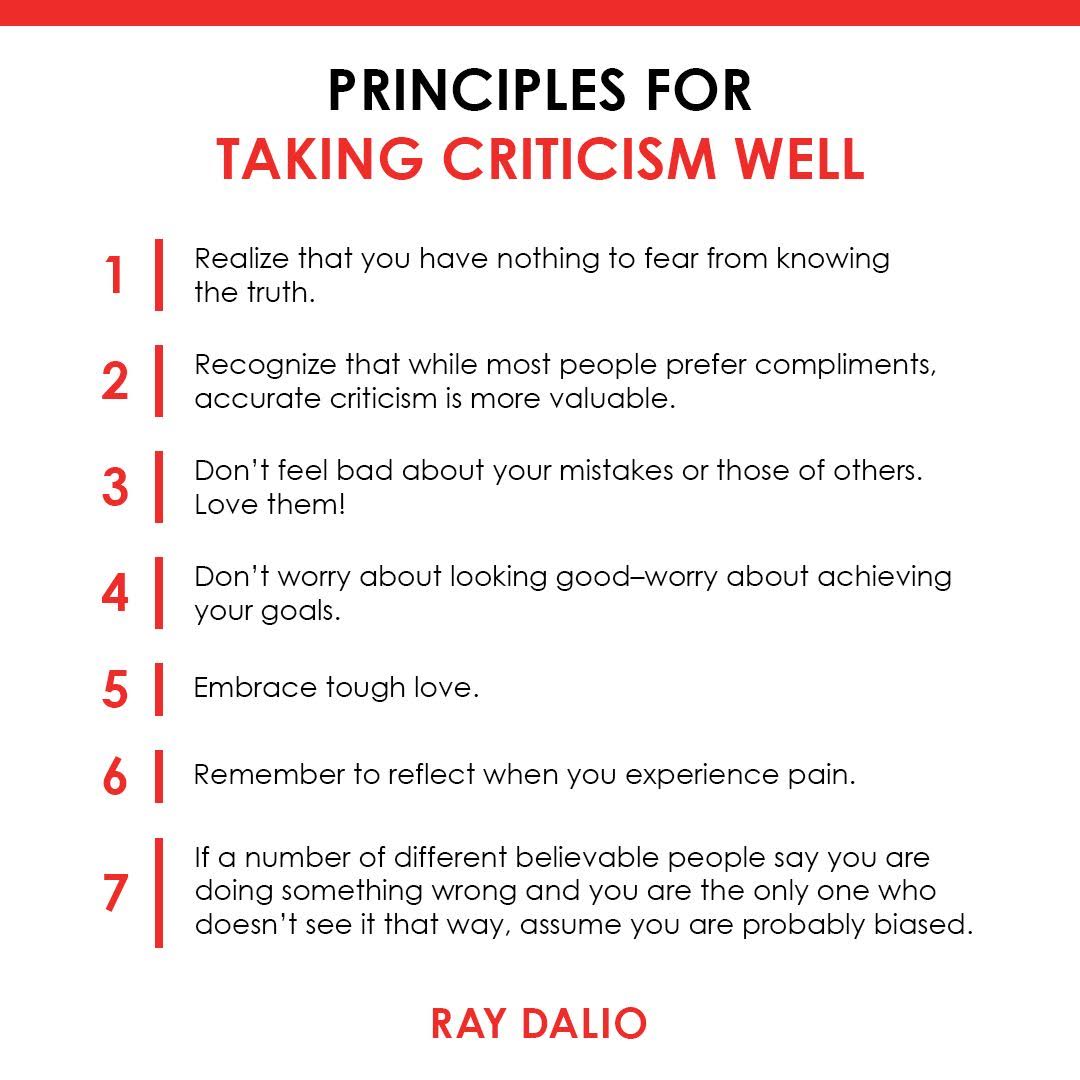
10. Ray Dalio-Taking Criticism Well

https://twitter.com/RayDalio

Topley’s Top 10 – April 29, 2022

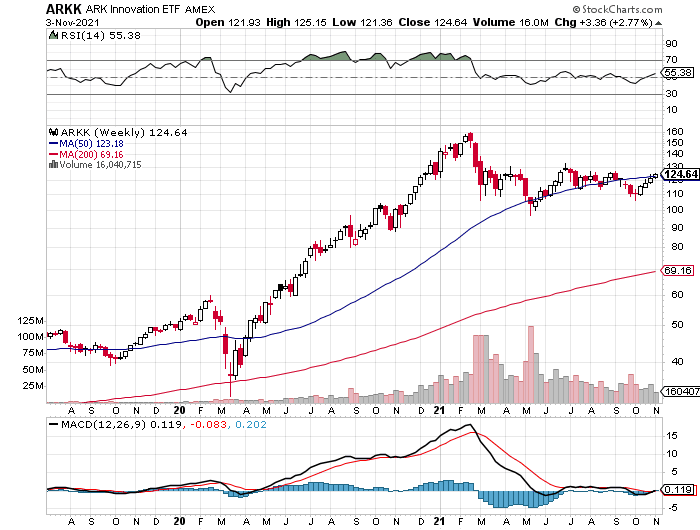
1. ARKK Fund -50% YTD…But $900m in Inflows???

Ben Johnson, CFA

@MstarETFUS

I’m still trying to wrap my mind around the fact that $ARKK is down ~50% YTD but has pulled in $908 million in net new money.

https://twitter.com/MsartETFUS


2. Amazon Operating Margin by Segment-Zerohedge Chart

North American and Europe Negative


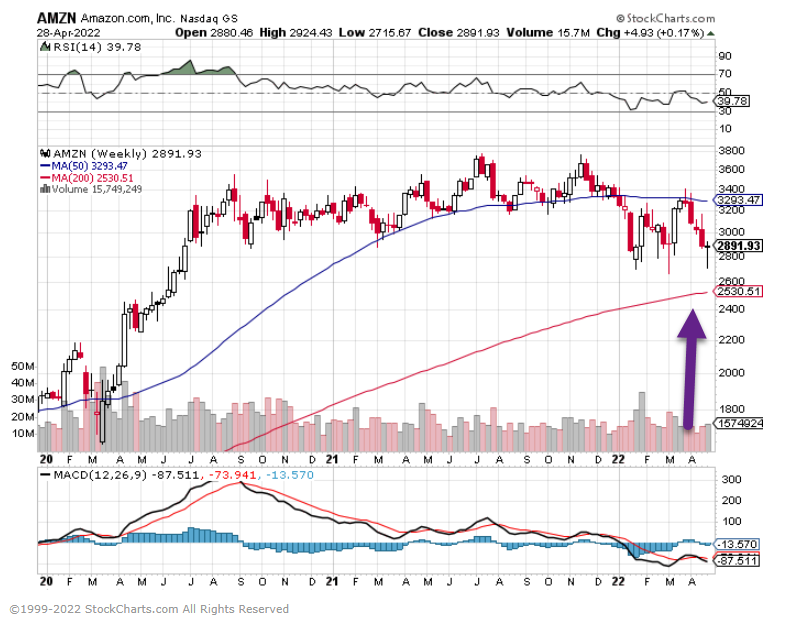
3. 200day Moving Average on AMZN Long-Term Weekly Chart $2530

www.stockcharts.com


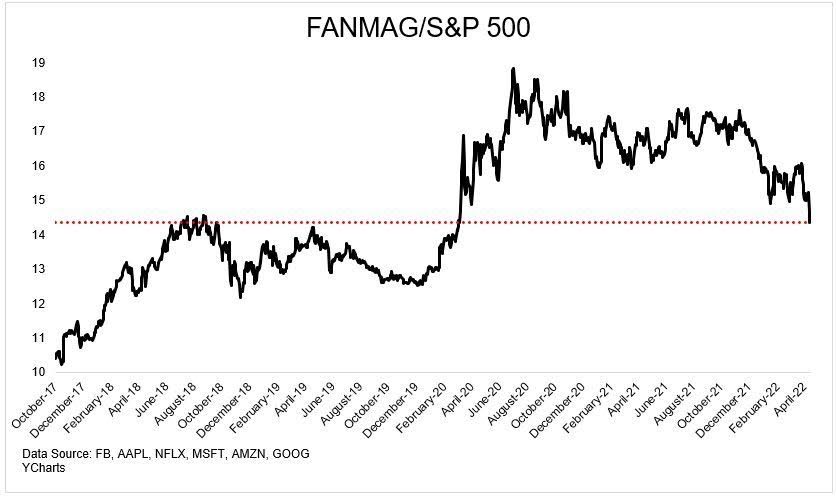
4. FANMAG Now Even with the S&P for Last 5 Years

Josh Brown Blog Reformed Broker

https://www.linkedin.com/in/joshua-brown-96a5569b/


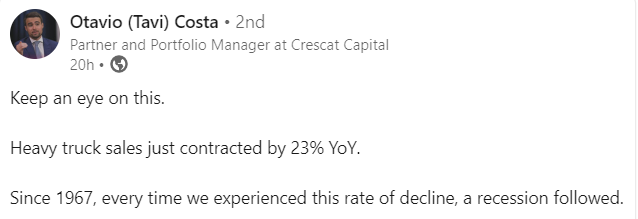
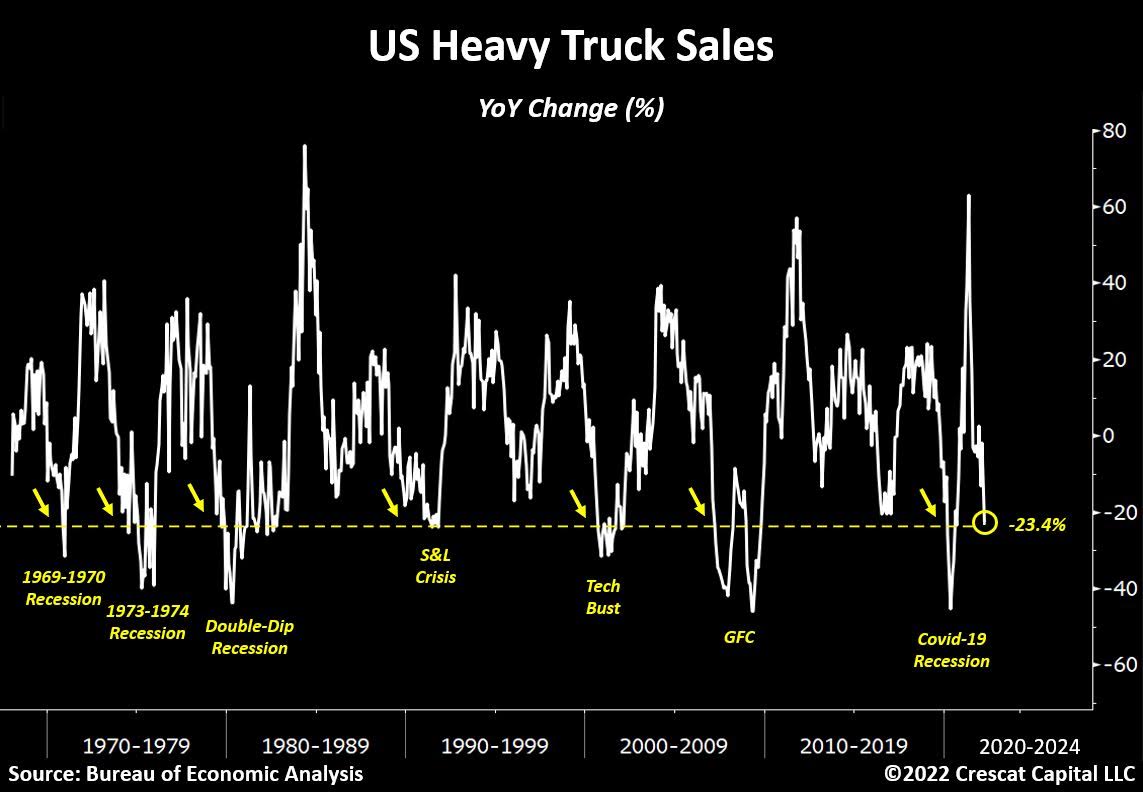
5. Heavy Trucks Sales -23%

https://www.linkedin.com/in/otavio-tavi-costa-76368628/


6. CNBC-Elon Musk will be the most indebted CEO in America if the Twitter deal goes through

Robert Frank@ROBTFRANK

KEY POINTS

·         Two-thirds of Elon Musk’s financing for the $44 billion deal to take Twitter private will have to come out of his own pocket. He has a net worth of about $250 billion.

·         Yet because much of his wealth is tied up in Tesla stock, Musk will have to sell millions of his shares and pledge millions more to raise the necessary cash.

·         According to research firm Audit Analytics, Musk has more than $90 billion of shares pledged for loans.

·         That makes him the largest stock-debtor in dollar terms among executives and directors, far surpassing second-ranked Larry Ellison, according to ISS Corporate Solutions.

The world’s richest person could soon add another title to his name – America’s most leveraged CEO.

Two-thirds of Elon Musk’s financing for the $44 billion deal to take Twitter private will have to come out of his own pocket. That pocket is deep. He has a net worth of about $250 billion.

Yet because his wealth is tied up in Tesla stock, along with equity in his SpaceX and The Boring Co., Musk will have to sell millions of his shares and pledge millions more to raise the necessary cash.

https://www.cnbc.com/2022/04/28/elon-musk-will-be-most-indebted-ceo-in-america-if-twitter-deal-closes.html

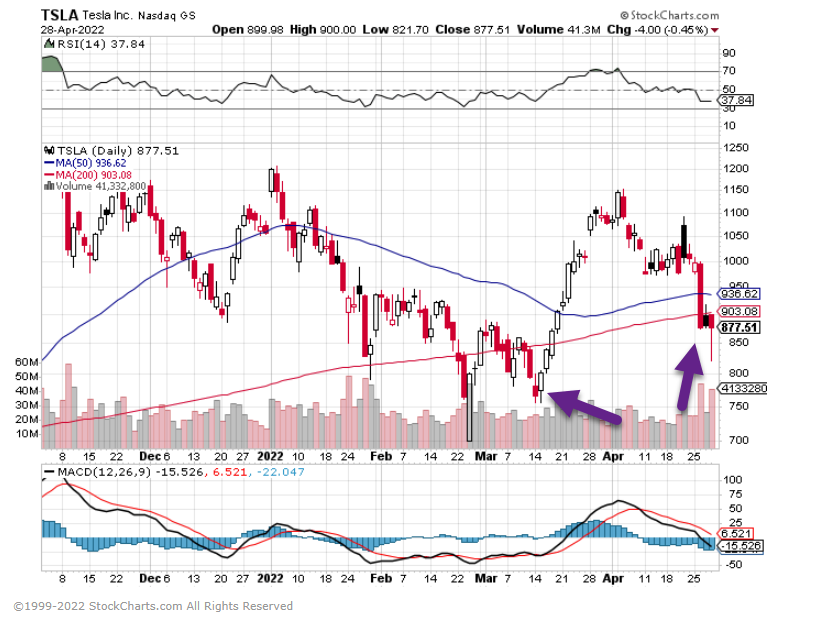
Tesla closes below 200 day moving average for 3rd time since February


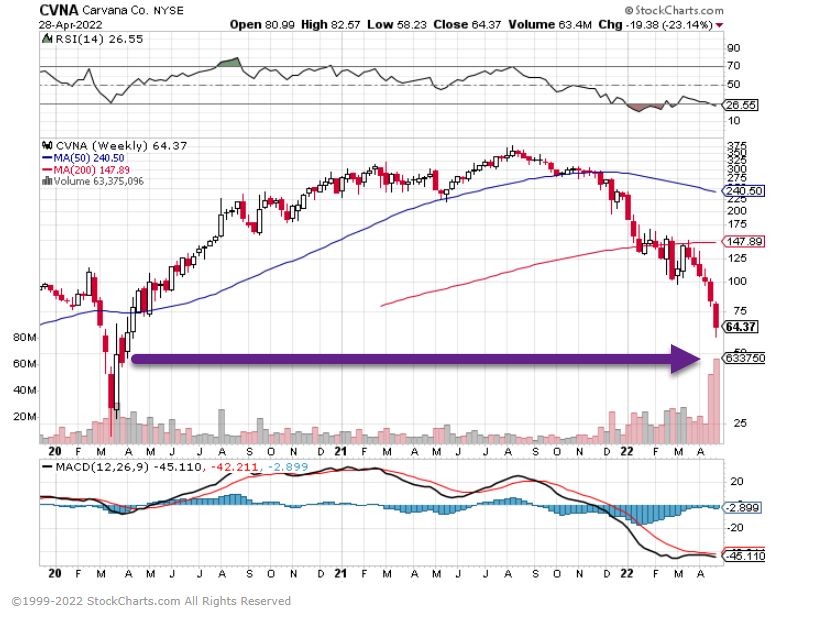
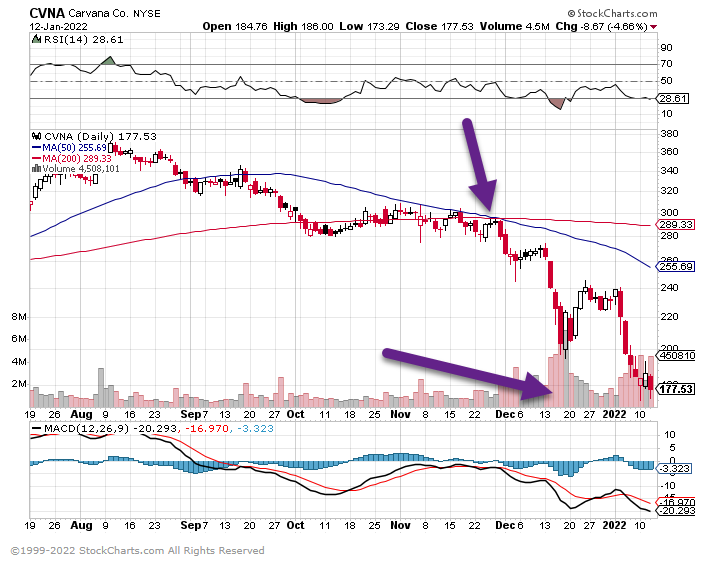
7. Another Covid Superstar Stock Close to Full Round Trip….CVNA-Carvana.

www.stockcharts.com


8. Metaverse ETFs Up to Six

ETF.com Overview Of Metaverse Themed ETFs In The US –Aniket Ullal

There are currently six ETFs that provide exposure to the Metaverse theme. There is also an ETF that focuses on console gaming (ETMG Video Game Tech ETF) as well as multiple decentralized finance (DeFi)- and blockchain-focused ETFs. Since those are more specialized or have a slightly different investment objective than the metaverse-themed ETFs, they have been excluded from this analysis.

The first metaverse ETF (METV) in the U.S. launched in mid-2021. Since then, five other similarly themed ETFs have launched in the U.S. They range in expense ratio from 0.39% to 0.75%. Table 1 summarizes these six metaverse-themed ETFs:

https://www.etf.com/sections/blog/metaverse-etfs-rapidly-growing-universe


9. Loan to Value in Residential Housing is at Record Lows….The Opposite of 2008 Crisis

Looking towards the housing market, the current loan-to-value ratio is relatively low, unlike during the subprime housing crisis.

Source: BCA Research

The Daily Shot Blog https://dailyshotbrief.com/the-daily-shot-brief-april-28th-2022/


10. 13 Things the Most Confident People Don’t Do

Barbara Markway Ph.D.

Self-confident people know what they value and what they want. They share common habits and thought patterns that help them achieve their goals. Here are 13 things self-confident people don’t do, so you can be one of them.

1. They don’t believe they are worth less than others.

One of the fundamental beliefs underlying confidence is, “My worth as a person is equal to everyone else’s.” That doesn’t mean you don’t have to work for what you want, and it certainly doesn’t mean that life divides up its rewards evenly. But it does mean you have the same right as anyone else to stand up for yourself, pursue your dreams, enjoy your life, and make a difference in the way that’s most meaningful to you.

2. They don’t fear self-doubt.

Confident people realize that not all self-doubt is a bad thing. Sometimes fear is a signal that you haven’t prepared enough for the big presentation, the recital, or the interview. Practicing what you plan to say and do will give your mind something to fall back on when the pressure is high. The voice of self-doubt may also be saying you need to get more information, move in a different direction, or take a break.

3. They don’t hesitate too much.

The flip side of #2 is that once you’ve put in the hours of practice, you should be able to take action without obsessing over what might go wrong.

4. They don’t wait for the “big” move.

When you envision a confident person, you might think of someone who takes big, bold actions, like running for office or making a marriage proposal on the Jumbotron. But there can be boldness and bravery in small steps. Those incremental changes build on themselves, both through your own feelings of accomplishment and reinforcement from others.

5. They don’t confuse confidence with arrogance.

Some people fear confidence, because they don’t want to start stepping on other people’s toes, taking up too much space, or just plain being a jerk. But confidence isn’t the same as arrogance or narcissism. In fact, when you feel confident in yourself, you often become less self-absorbed. When you stop worrying so much about how you’re coming across, you can pay more attention to those around you.

6. They don’t fear feedback or conflict.

A confident person can accept helpful feedback and act on it without getting defensive. When your sense of self-worth is no longer on the table, you can handle criticism or even outright rejection without allowing it to break you. By the same token, confidence doesn’t mean you mow other people down when a conflict arises. It’s possible to speak your mind with conviction and still make room to listen to someone else’s point of view and even reach a compromise.

article continues after advertisement

7. They don’t fear failure.

Confidence doesn’t mean you won’t fail. It doesn’t mean you’re always smiling or that you never experience anxiety or self-doubt (see #2). Instead, it means you know you can handle those feelings and push through them to conquer the next challenge.

8. They don’t have to make things perfect.

Perfectionism is a form of faulty thinking that contributes to low self-confidence. If you believe you have to have something all figured out before you take action, those thoughts can keep you from doing the things you value.

9. They don’t believe everything they see in ads.

Many advertisements are designed to make you feel lacking. Companies that want to sell you products usually start by making you feel bad about yourself, often by introducing a “problem” with your body that you would never have noticed otherwise.

10. They don’t believe everything they see on social media.

This point is closely tied to #9. It’s easy to believe that everyone around you has the perfect marriage, a dream career, and supermodel looks to boot. But remember that what people post online is heavily curated and edited. Everyone has bad days, self-doubt, and physical imperfections. They just don’t trot them out on Facebook!

11. They don’t avoid trying new things.

As you keep pushing yourself to try new things, you’ll start to truly understand how failure and mistakes lead to growth. An acceptance that failure is part of life will start to take root. Paradoxically, by being more willing to fail, you’ll actually succeed more — because you’re not waiting for everything to be 100 percent perfect before you act. Taking more shots will mean making more of them.

12. They don’t focus on themselves.

It might seem counterintuitive, but when you have more self-confidence, you’re less focused on yourself. We’ve all been guilty of walking into a room and thinking, “They’re all looking at me. They all think I look dumpy and that every word I say is incredibly stupid!” The truth is, people are wrapped up in their own thoughts and worries. When you get out of your own head, you’ll be able to genuinely engage with others.

article continues after advertisement

13. They don’t let others determine their goals.

No one can tell you what is most important to you. Sure, our culture will say that having a better job, a bigger house, and a fancier car is what we need to make us happy. It takes a lot of strength and conviction to not just go along with societal expectations. Self-confidence doesn’t always look like the “big” move. It can be the confidence to say, “No, this opportunity is not right for me at this time.”

Adapted from The Self-Confidence Workbook: A Guide to Overcoming Self-Doubt and Improving Self-Esteem. Copyright © 2018 by Barbara Markway and Celia Ampel.

https://www.psychologytoday.com/us/blog/shyness-is-nice/201809/13-things-the-most-confident-people-dont-do

Topley’s Top 10 – April 28, 2022

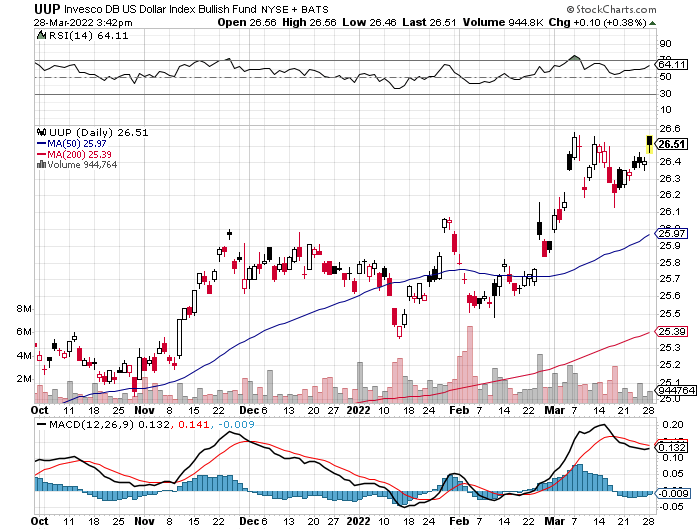
1. War, Stock Corrections, Bond Bear, Record U.S. Government Debt, Covid, etc. etc…..U.S. Dollar Still King Currency.

U.S. Dollar Approaching 2020 Pre-Covid Highs…..50day going thru 200day to upside

www.stockcharts.com


2. Diesal Fuel Futures Settle at Record High

Massive exports and strong domestic consumption are helping to drain distillate stockpiles in the U.S., which have fallen to the lowest level since 2008. The shortage is most acute on the East Coast, where inventories have dropped to the lowest level since 1996. Fuelmakers on the Gulf Coast have been operating at their highest rates for this time of year in more than a decade and are still unable to rebuild stockpiles. Rising shipments to Latin America and Europe have left the main fuel pipeline supplying the East Coast underused.

Shifting trading patterns also contributed to spiking prices. Liquidity has fallen in recent months in futures and physical markets, exacerbating volatility in both. While futures traders exited hedges, physical traders ditched storage tanks as holding onto products became a losing proposition, leaving a thinner cushion for supply crunches and price swings.

Chunzi Xu–https://www.bloomberg.com/news/articles/2022-04-26/u-s-diesel-futures-settle-at-record-high-as-shortage-deepens?cmpid=socialflow-twitter-business&utm_medium=social&utm_campaign=socialflow-organic&utm_source=twitter&utm_content=business&sref=GGda9y2L


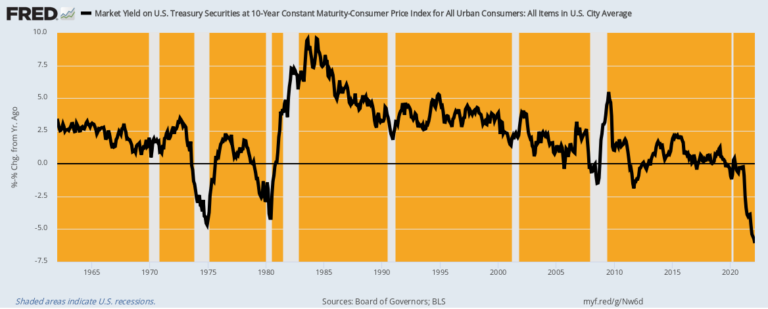
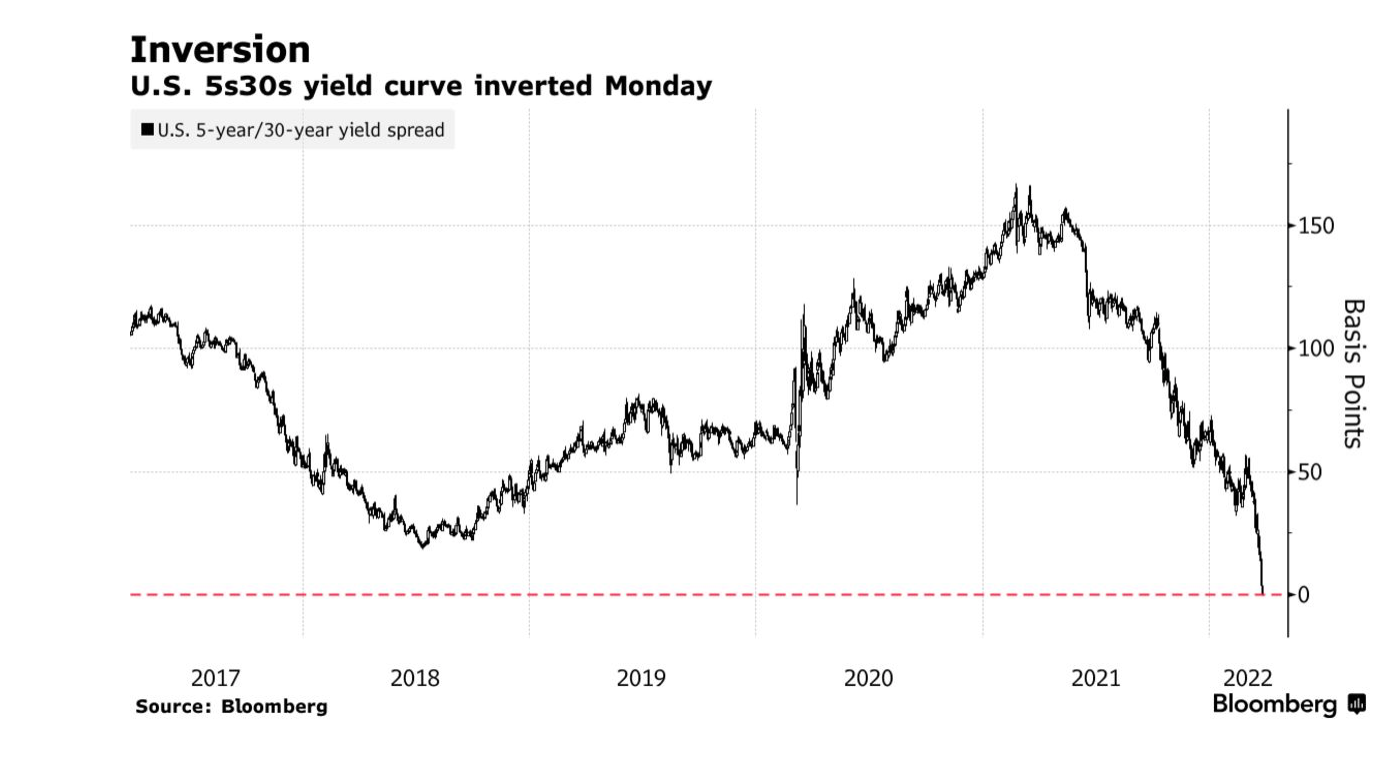
3. 10 Year Treasury is 4 Standard Deviations Above 52 Week Moving Average

Lance Roberts, the chief investment strategist of RIA Advisors—Busy Chart but see the downtrend channel in middle….Technically speaking, he adds, the yield on the 10-year Treasury TMUBMUSD10Y, 2.794% is now 4 standard deviations above its 52-week moving average, and near the top of the long-term downtrend channel from 1980.

https://www.marketwatch.com/story/the-bond-market-has-crashed-why-one-strategist-says-embrace-the-pain-and-get-back-in-11651056414?mod=home-page


4. Another Mid-Term Election Chart

LPL Research..Strong Bounces Historically Off Lows

https://i0.wp.com/lplresearch.com/wp-content/uploads/2022/04/Blog-4.27.22.png?ssl=1


5. Apple Revenue Breakdown-Visual Capitalist

How Do Big Tech Giants Make Their Billions? (visualcapitalist.com)


6. Breaking Euro Reliance on Russian Gas Down by Country

From Dave Lutz at Jones Trading

Four European gas buyers have already paid for supplies in rubles as President Vladimir Putin demanded.


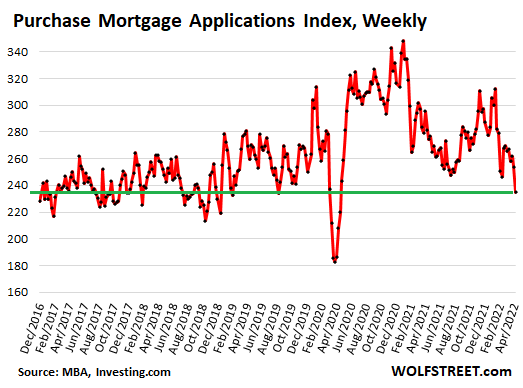
7. Mortgage Volume Trades Back to Mean…Higher Rates and No Inventory.

Wolf Street “The drop in purchase applications was evident across all loan types,” the MBA’s report said. “Prospective homebuyers have pulled back this spring, as they continue to face limited options of homes for sale along with higher costs from increasing mortgage rates and prices. The recent decrease in purchase applications is an indication of potential weakness in home sales in the coming months.”

https://wolfstreet.com/2022/04/27/mortgage-volume-gets-crushed-by-spiking-interest-rates-what-it-means-for-future-home-sales-and-consumer-spending/


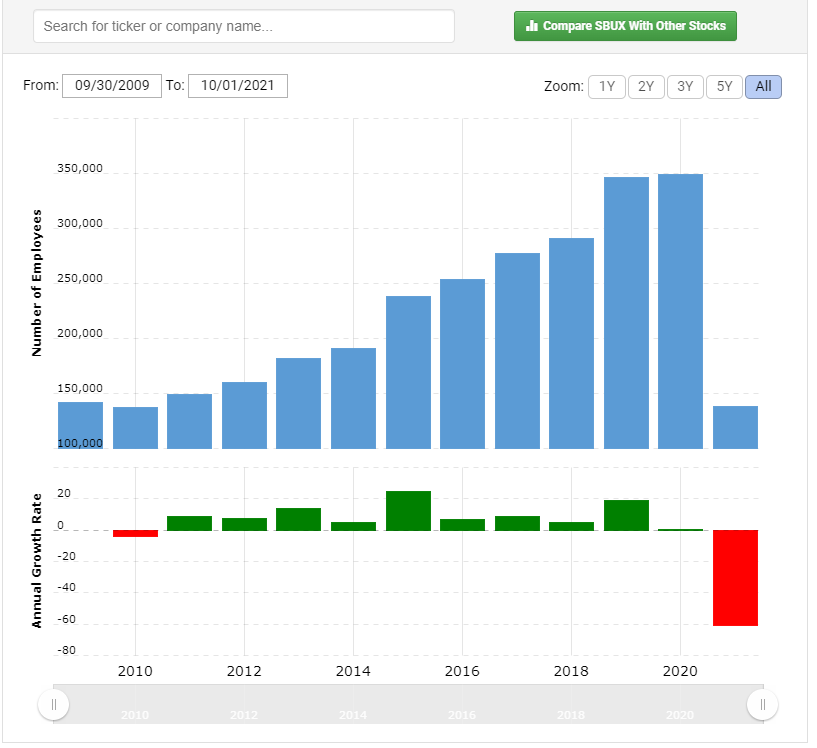
8. 70% of Starbucks Employees at Company Less Than One Year

Huge growth in Starbucks employees but heavy turnover.

Macrotrends

https://www.macrotrends.net/stocks/charts/SBUX/starbucks/number-of-employees


9. Don’t Forget Elon Musk’s Other Company Valued at $6B

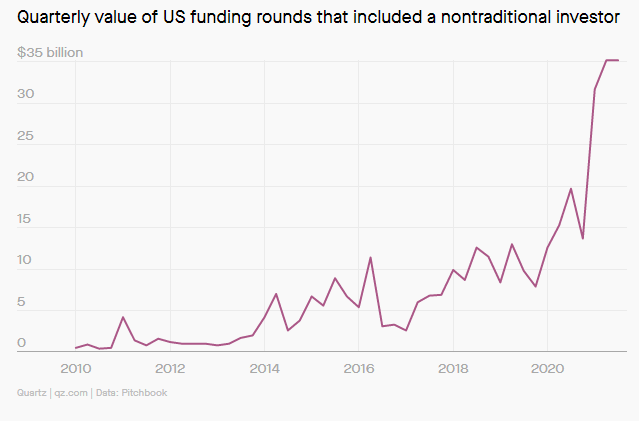
Boring Company raises additional $675 million as investors chuck money into holes in the ground

Elon Musk’s tunnel company is now valued at nearly $6 billion

By James Vincent  Apr 21, 2022, 5:18am EDT

The Boring Company has raised a new round of funding worth $675 million, with Elon Musk’s grand plan to “solve traffic” with tunnels now valued at $5.675 billion.

In a blog post announcing the news, the company reiterated its goals and achievements so far, drawing particular attention to its “next generation” of Prufrock tunnel-boring machines (TBMs).

“Unlike traditional TBMs which require upwards of a dozen or more people to operate, Prufrock is designed to be capable of operating completely remotely and autonomously via computerized systems and requires zero people in the tunnel to operate,” said the company. “The current iteration of Prufrock, called Prufrock-2, is designed to mine at up to 1 mile/week, meaning a tunnel the length of the Las Vegas strip (approximately 4 miles) can be completed in a month.”

So far, The Boring Company has built just two operational 0.8-mile tunnels underneath the Las Vegas Convention Center, as well as 1.1-mile test tunnel in Hawthorne, California. The company has been pitching its services far and wide, and although many projects have run aground, authorities in Las Vegas last year approved the construction of a 29-mile tunnel system containing 51 stations.

The planned Las Vegas tunnel system, dubbed the Vegas Loop. Image: The Boring Company

The Boring Company describes its tunnels as a “public transportation system that resembles an underground highway” but — more succinctly and accurately — as “Teslas in tunnels.” Originally, Musk said the company’s tunnels would use autonomous sleds to carry cars and specially-designed pods at speeds of up 150mph to transport pedestrians and cyclists. So far, they’re currently limited to electric vehicles (Teslas) driven by human employees at around 50mph and carrying ticketed passengers.

The company’s Las Vegas tunnels have been open for a few years now, and first-hand impressions have been mixed to say the least. When everything goes to plan, the company’s tunnels let cars pass through them at sedate speeds. But when they’re busy they also create their own traffic jams — the very problem they’re intended to solve.

Investors, though, don’t necessarily care whether or not founders like Musk ultimately follow through on their hyperbole, only that the companies they run attract enough customers and revenue to pay back their own investments. And Musk has proved, time and time again, that’s he’s very good at pushing up share prices and valuations. For the meantime, that means The Boring Company has a lot of tunnels left to dig.

Boring Company raises additional $675 million as investors chuck money into holes in the ground – The Verge


10. Portfolio PAIN Isn’t A Four Letter Word

Posted April 20, 2022 by Anthony Isola

Pleasures are to be avoided if they result in greater pain, and pain is to be welcomed if it results in greater pleasure. –  Epicurus

Pleasurable investing is an oxymoron. Good luck adopting buying high and selling low into your investment policy.

The human body’s reactions to pain provide sound investing advice.

Our default state is Homeostasis. Balancing pleasure and pain is never-ending. After a Dopamine overdose, the body brings order to the crime scene. Examples include crashing after a sugar high and head-splitting hangovers after alcohol overindulgence.

We’re a Dopamine Nation.


This chart measures the percentage dopamine increase of a rat trapped in a box when exposed to various substances.

Anna Lembke drops knowledge in her ground-breaking book, Dopamine Nation. She compares food, sex, drug, and technology addiction to a pendulum. When the pendulum is overweight pleasure, pain gremlins jump onto the other side, throwing things back into balance. Pain overcompensates, leading to the need for more Dopamine to maintain Homeostasis. Addiction creates massive pain.

What happens if we reverse engineer pain and pleasure?

Dr. Lembke states: Pressing on the pain side of the balance can lead to its opposite – pleasure. Unlike pressing on the pleasure side, the Dopamine that comes from pain is indirect and potentially more enduring. 

Pleasure gremlins jump on after the initial pain creating longer-lasting pleasure; intermittent exposure to pain makes us less vulnerable.

Cold showers and baths are initially painful. Our bodies eventually numb themselves to the exposure.

According to Dr. Lembke: Dopamine rose gradually and steadily throughout the cold bath and remained elevated for an hour afterward. 

Exercise is the ultimate example.

Exercise is immediately toxic to cells, leading to increased temperature, noxious oxidants, and oxygen and glucose deprivation.

Then this happens.

Exercise increases many of the neurotransmitters involved in positive mood regulation: Dopamine, serotonin,…..Exercise contributes to the birth of new neurons and even reduces the likelihood of using and getting addicted to drugs.

Acupuncture falls under this category. Minor pain prevents larger doses from asserting their will.

What does this have to do with investing?

It scientifically backs the old saying regarding the markets; If it feels good, you’re probably doing something wrong.

Selling your stocks in a crisis creates a momentary dopamine rush. While temporarily pleasing, the long-term market gremlins hop onto the pain side of the pendulum. Your portfolio and wealth may never recover from the extended period of suffering they unleash on your wealth and psyche.

Balancing the agony and ecstasy of the markets isn’t easy.

Investors must embrace the pain when markets fall precipitously. Short-term torture eventually morphs into self-correcting market homeostasis producing sustainable pleasure.

Credit cards offer a dopamine rush. The temporary pleasure of purchasing disposable goods doesn’t compensate for the long-term destructive effects of minimum payments attached to a 20% interest rate. The momentary disappointment of walking out of the store empty-handed is justified if you don’t have the funds to pay in full.

Phil Pearlman more than gets it.

And we live in a world where comfort is so accessible that seduction is almost unfair.

We have air conditioning in the summer, heat in the winter, a fridge stocked with food and drink, and if we don’t, we can order anything from our couch and have it sent to us in minutes or overnight in dry ice via Federal Express.

I thought about this just this morning as I adjusted the heat function on my car seat.

All of this comfort is not good.

Regarding investing and life, PAIN isn’t a four-letter word.

Source: Dopamine Nation by Anna Lembke M.D.

https://tonyisola.com/2022/04/portfolio-pain-isnt-a-four-letter-word/

From Abnormal Returns Blog www.abnormalreturns.com

Topley’s Top 10 – April 27, 2022

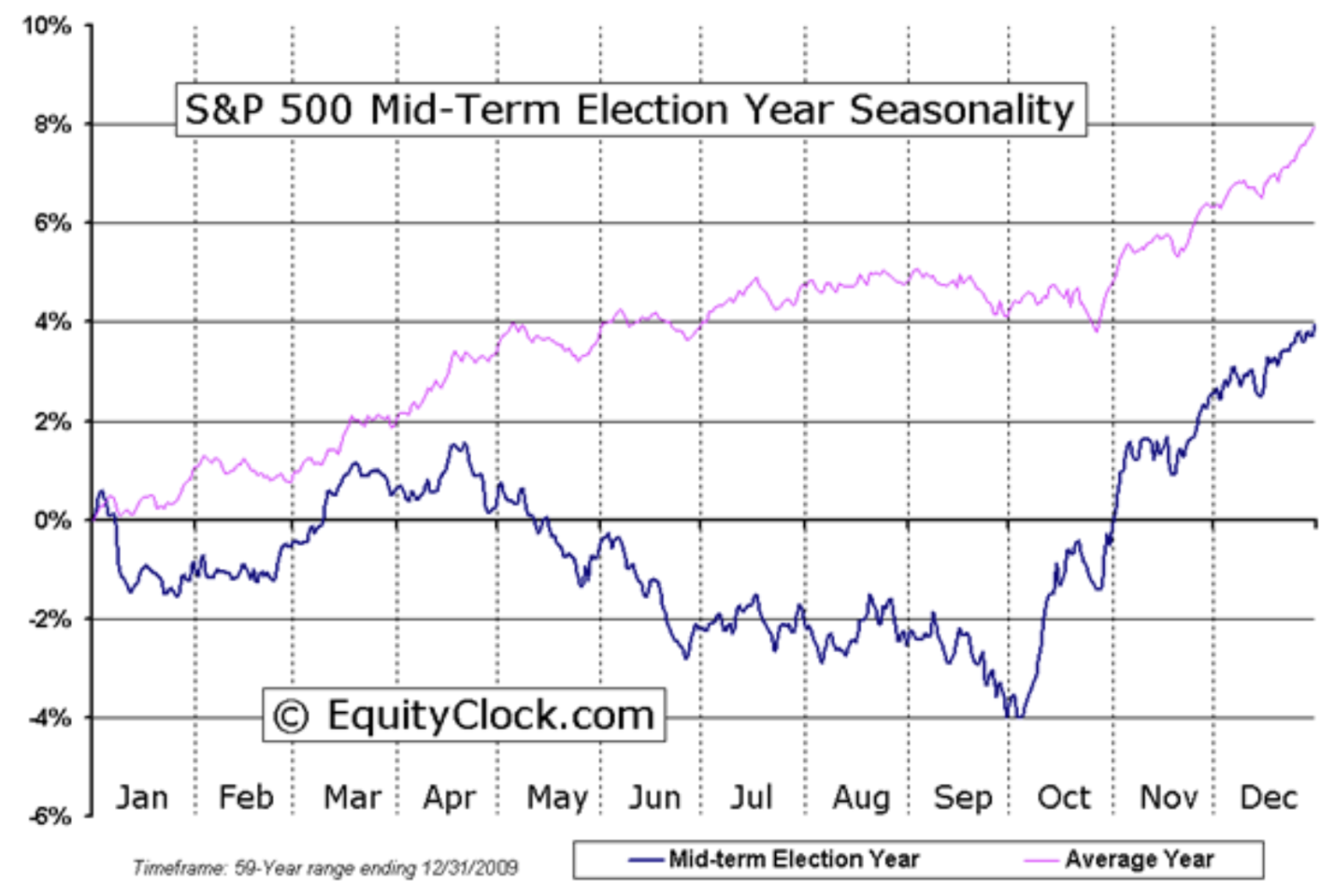
1. Mid-Term Election Year Seasonality vs. Normal Seasonality

Callum Thomas Chart Storm

Source: @EquityClock via @HumbleStudent

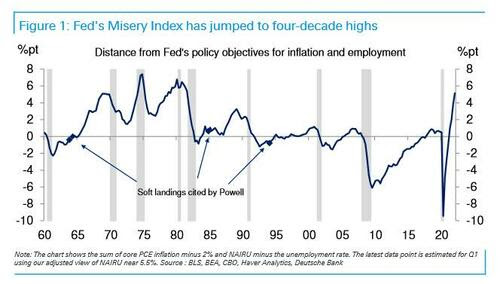
2. Misery Index Inflation Plus Unemployment Hits Highest Levels Since 1970s

Fed’s “misery index,” given its similarity to the national misery index, which is simply the sum of inflation and unemployment.

https://www.zerohedge.com/economics/lone-bank-doubles-down-its-doomsday-call-says-recession-will-be-worse-expected

3. 79% of Earnings Reports Beat So Far

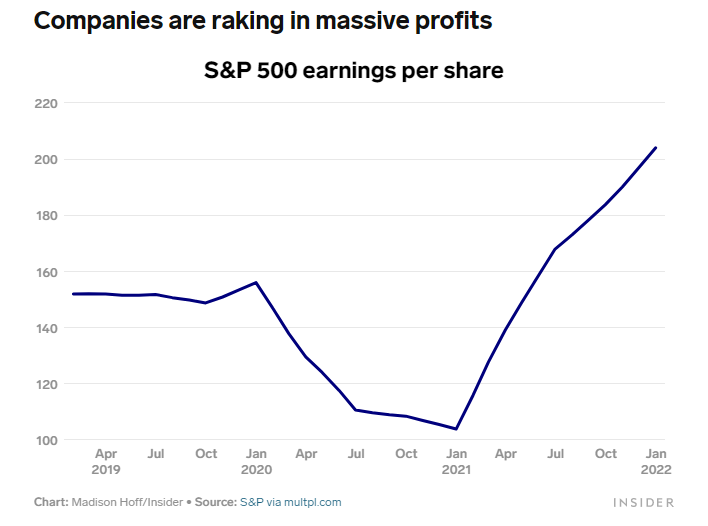
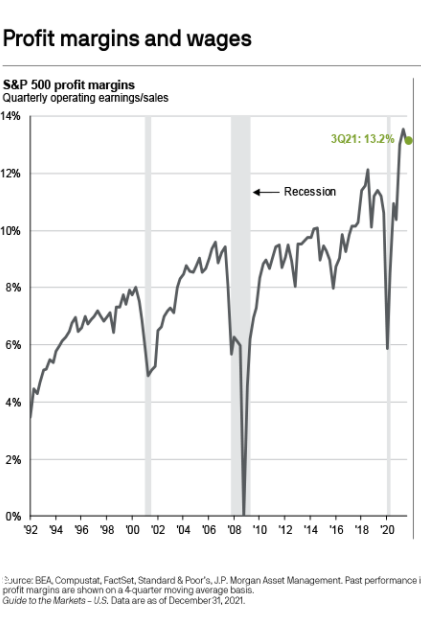
Business Insider-Companies are raking in massive profits-The massive spending seen throughout the recovery has also buoyed the measure that Wall Street cares about the most: corporate earnings.

About a fifth of S&P 500 companies have reported first-quarter earnings so far, and the results show little sign of a weakening economy. Seventy-nine percent of companies that have reported their latest figures beat earnings-per-share forecasts, and 69% reported stronger-than-expected revenues, according to FactSet.

More broadly, companies are raking in much bigger profits than they did before the pandemic. S&P 500 earnings per share hit a record $204 at the end of 2021, up more than a third from pre-crisis levels. If first-quarter reports continue to beat forecasts, that figure will climb to even loftier all-time highs.

Ben Winck and Madison Hoff

https://www.businessinsider.com/recession-outlook-unlikely-three-charts-show-economic-recovery-going-strong-2022-4#companies-are-raking-in-massive-profits-3

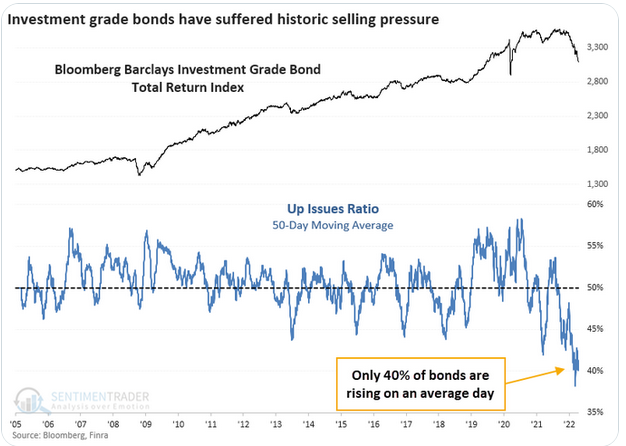
4. Investment Grade Bonds…Percent of Bonds Rising on an Average Day 25 Year Low

Investment-grade bonds have hit a 17-year low, and are performing worse than even junk bonds. Normally this would signal a buying opportunity, but it’s not so simple, SentimentTrader notes. Bond traders will have less time to report transactions if Gary Gensler gets his way. The SEC chief wants to shrink the current 15-minute window, potentially to one minute, and let authorities investigate trading protocols, fees paid and the spread to Treasuries when the trade is agreed.

Abnormal Returns Blog www.abnormalreturns.com

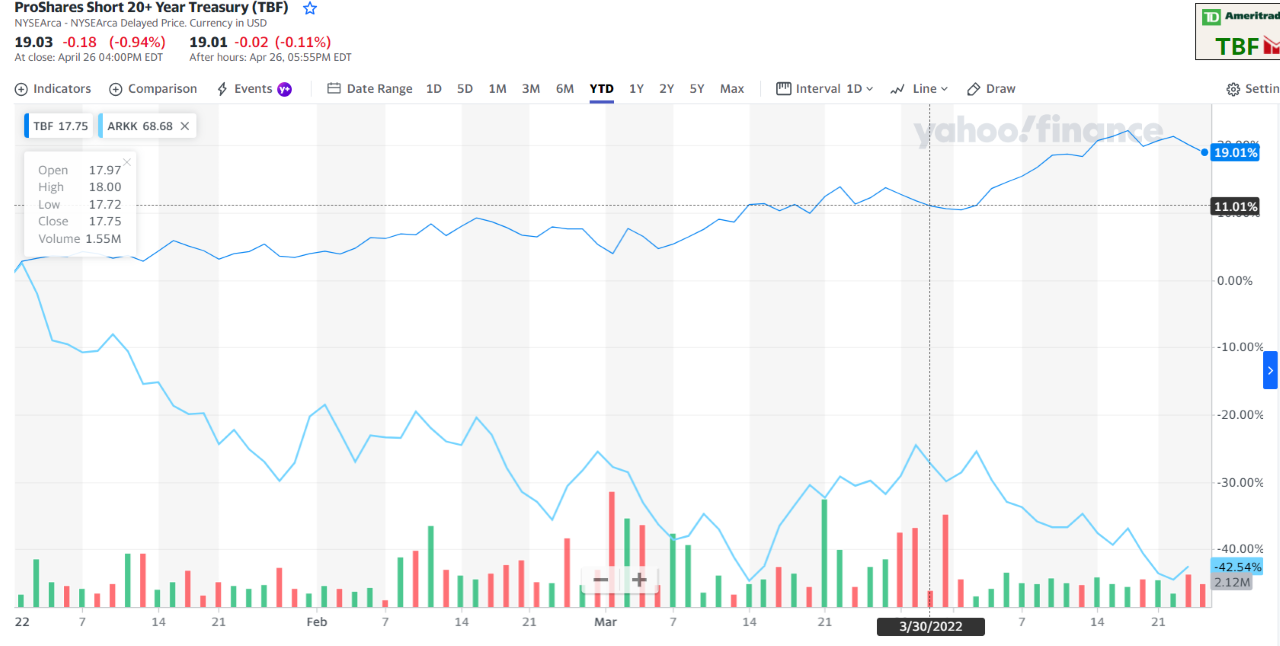
5. TBF Short Bonds ETF +19% vs. ARKK ETF -42%

www.yahoofinance.com

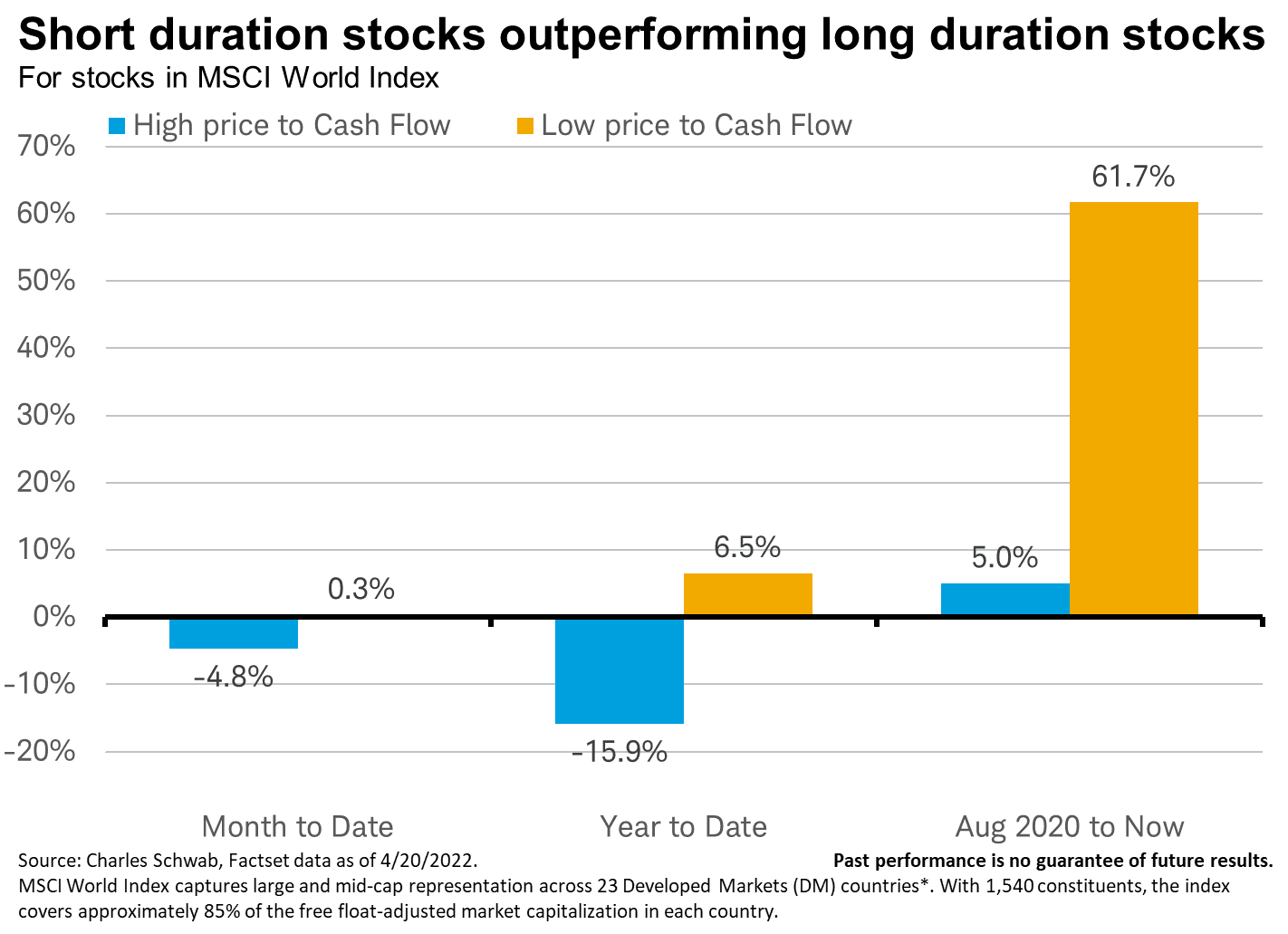
6. Low Price to Cash Flow Stocks Huge Outperformance Since First Sell Off

Jeffrey Kleintop Short duration stocks (low price to cash flow) continue to outperform in markets around the world, as they have since interest rates began to rise in August 2020.

https://twitter.com/JeffreyKleintop

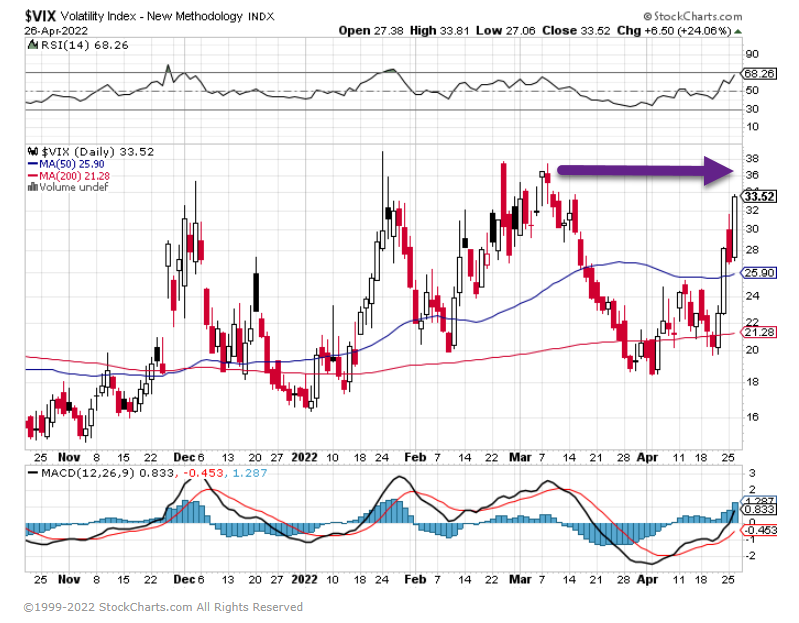
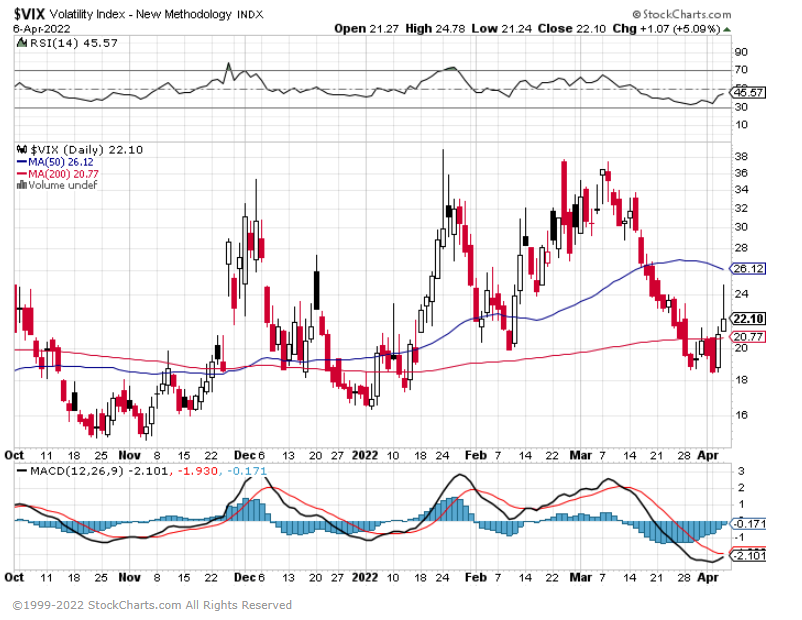
7. Volatility VIX Index Did Not Make New High Yet

www.stockcharts.com

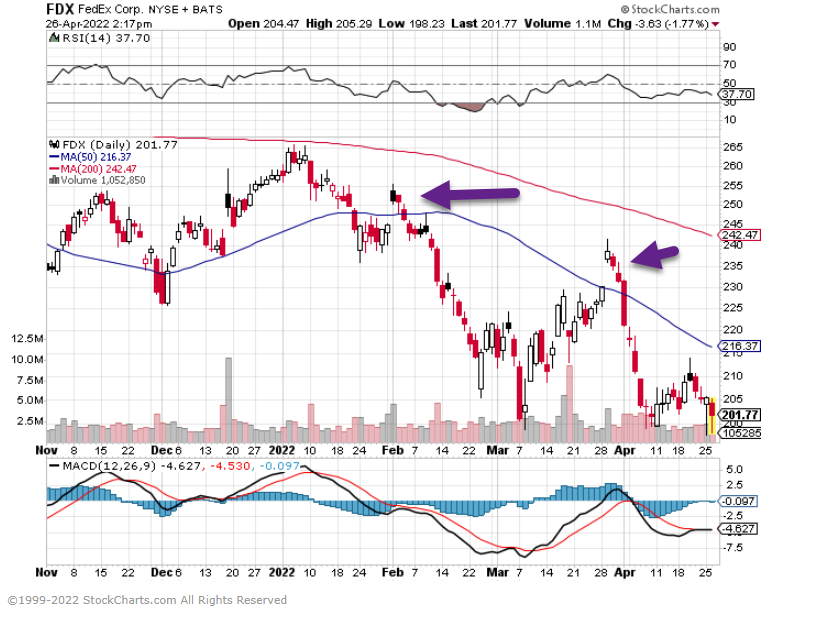
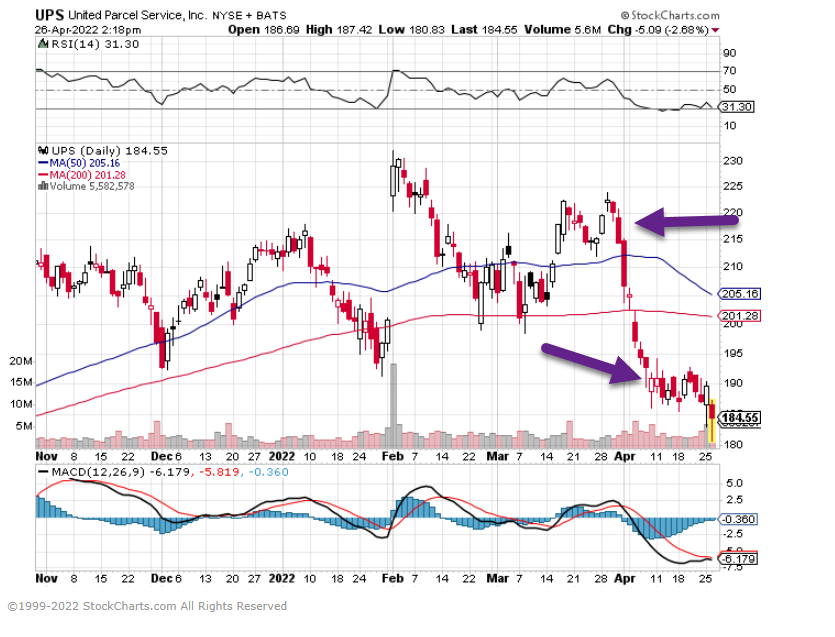
8. FedEx and UPS both Make New Lows

Not sure if these are good economic indicators of slowdown but…..FDX lower highs and UPS lower highs

www.stockcharts.com

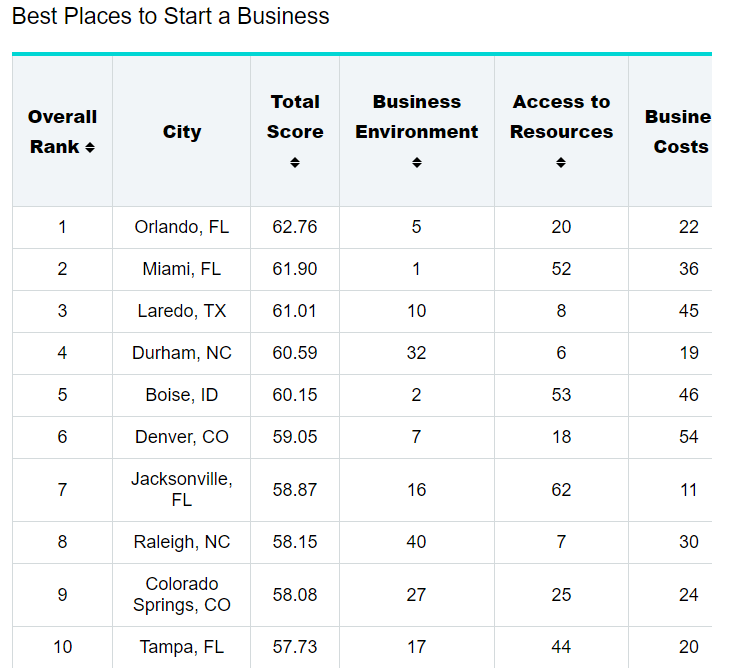
9. 2022 Best Cities to Start Business

WalletHub

Jason Kiernan 2022’s Best Large Cities to Start a Business (wallethub.com)

10. The Mindful Seven with Tristan Ahumada

By Rae Fitzgerald | April 15, 2022 | 0

How do you inspire an unmotivated son? You send him on a treasure hunt, of course! In a special solo episode, Brilliant Thoughts’ host Tristan Ahumada recounts a parable that forever changed his perspective on life, teaching him seven powerful lessons in the process.

The story centers around a very wise man who, despite his efforts, can’t seem to motivate his son to take charge of his life. The father ends up sending his son on a faux treasure hunt that takes him far away from their village. After a two-year journey the son returns home, and instead of being upset with his father for lying about the treasure, he thanks him for the many lessons and life experiences he had along the way.

The son explains that as he traveled toward the treasure, he was thrown into many new situations, expanding his awareness; however, he missed a lot of opportunities for reflection. On the journey home, he was able to be more present, able to notice the changing seasons and fellow travelers around him in a way he hadn’t before.

There’s a lot to glean from this parable, but to Ahumada, it is essentially a story about mindfulness. After reflecting on the most important takeaways, he organized them into a list of helpful suggestions called “the mindful seven.”

1. Monitor your self-talk.

Self-talk is the conversation you have with yourself, your internal monologue. It’s an important voice to be aware of because it reflects your mindset. If you’re telling yourself things like “that was stupid,” “everyone’s against me,” or “I can’t take it anymore,” you will unconsciously act those realities out in order to prove yourself right.

“It’s that self-talk, whether it’s positive or negative, that determines how we live our life and how we show up on a daily basis,” explains Ahumada. “Because what we continually tell ourselves is what we project, what we focus on.”

Family, friends and colleagues tend to know when you’re experiencing inner turmoil; they instinctively stay away. That’s because we create our lives from the inside out, so when negativity bubbles up to the surface, it’s an indication that it runs much deeper. If you want to be more mindful in general, you have to start by noticing the way you talk to yourself.

2. Think about how you use the spoken word.

The words that you use, and the tonality in which you use them, matters. Even more than self-talk, the way we approach the spoken language has a tremendous impact on the people around us. It can be used to communicate and uplift or to tear down. To Ahumada, the key is to make a habit of talking about the good things going on in your life rather than complaining by default.

“Now I’m not saying hey, look at toxic positivity where everything looks amazing,” says Ahumada. “We’re talking about you deciding what to focus on in your day.”

We all experience fear, anger and sadness—it’s part of being human. We are all subject to situations outside of our control. However, Ahumada wants us to remember that we can control how we choose to respond to those situations, as well as the things we focus on. Choosing not to dwell on things outside of your control begins to encourage the mindset of abundance.

3. Make time for daily reflection.

Intentional contemplation is the key to becoming aware of what’s really happening in your life. Making time for daily reflection will allow you to shift from a fixed mindset, which is quick to accept defeat and reject criticism, into a growth mindset, which embraces challenges and sees effort as the path to mastery. You won’t know which one you’re using unless you take time to reflect on your day.

“All it takes is five minutes at the end of the day to look back and think, ‘How did I treat people?’” says Ahumada. “And that’s where you begin to change right through that reflection, that’s key; that’s where growth happens.”

4. Always be learning and unlearning.

If you want to grow, it’s not enough to just gather new information; you need to constantly be challenging your assumptions about what you know to be true or right. To Ahumada, exposure to more people, whether in person or on the internet, is the best way to do that.

“There are so many things like this podcast, YouTube videos, audio, books that create the environment that you want to live in,” he says. “Surround yourself with those people that can help your mindset grow.”

5. Practice the things you’re afraid to do.

If there’s something you’ve been wanting to do but are afraid to get started, that’s a pretty good sign you need to be working your way up to it. Growth doesn’t arise out of comfortable, certain situations; it happens when we test ourselves, challenge perspectives and conquer fear.

Working through something uncomfortable helps challenge the limiting beliefs that are holding you back. It doesn’t happen when you just do it once, though; it’s essential to be constantly practicing whatever you’re trying to improve, whether it’s self-talk, reflection or something totally different. Just like you should always be learning and unlearning, you should always be practicing the new lessons to solidify them into habit.

6. Prioritize the big three.

Especially in Western culture, people tend to think about the mind and body as separate, almost distinct entities. Ahumada says that it’s all you—your mind, body, spirit and emotions. These aspects of personhood are actually inextricably connected and constantly affecting each other. Together, they comprise the self, which should be everyone’s number one priority.

Number two of the big three is family, which Ahumada recognizes looks different to everyone. It could be your pets, your parents, your siblings, your friends, your partner or whoever else brings goodness into your life. Part of being human is having and maintaining relationships because other people have a profound effect on your well-being.

After self and family, Ahumada says you need to be taking care of your business, whatever that looks like. It could be a side hustle, writing a book or a steady job; the type of business isn’t important, only that you make it a priority.

7. Follow a routine.

You have the power to design and implement a routine for self-betterment. Following a routine is the practice of making mindfulness a habit, and it ties the previous six together seamlessly. A disciplined routine doesn’t just create freedom, but also greater awareness, which is ultimately what mindfulness is all about: noticing thoughts, actions, feelings and sensations.

“Scientists don’t fully understand the brain, it’s so complicated, and they’re not even close to figuring it out,” says Ahumada. “The one thing they do know, though, is that you can change habits, is that you can change yourself by changing what you input.”

At the end of the day, you’re the only person in charge of your growth. The good news is that you can do it—you are totally capable of navigating your own ship, especially when you embrace the mindful seven.

Rae Fitzgerald https://www.success.com/the-mindful-seven-with-tristan-ahumada/

Topley’s Top 10 – April 26, 2022

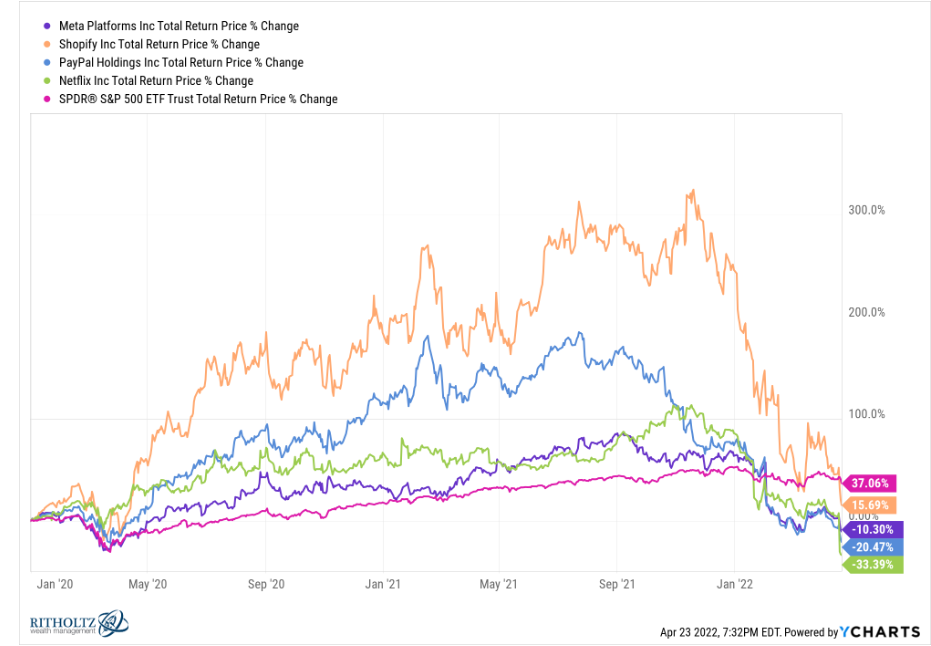
1. FB, SHOP, PAYPAL, NFLX All Now Underperforming S&P Since Pandemic.

Ben Carlson-A Wealth of Common Sense-Surprisingly, each of these stocks is now underperforming the S&P 500 since the per-pandemic days at the start of 2020:

https://awealthofcommonsense.com/2022/04/what-does-the-bond-market-rout-mean-for-the-stock-market/


2. What has Market Priced in Regarding FED Rate Raises?

Jim Bianco-As of Friday’s close, the market had 14 rate hikes priced in for the entire cycle. This includes 50 – 75 – 50 over the next three meetings. Or, a 2.00% – 2.25% funds rate on July 27.

(19) Jim Bianco biancoresearch.eth (@biancoresearch) / Twitter


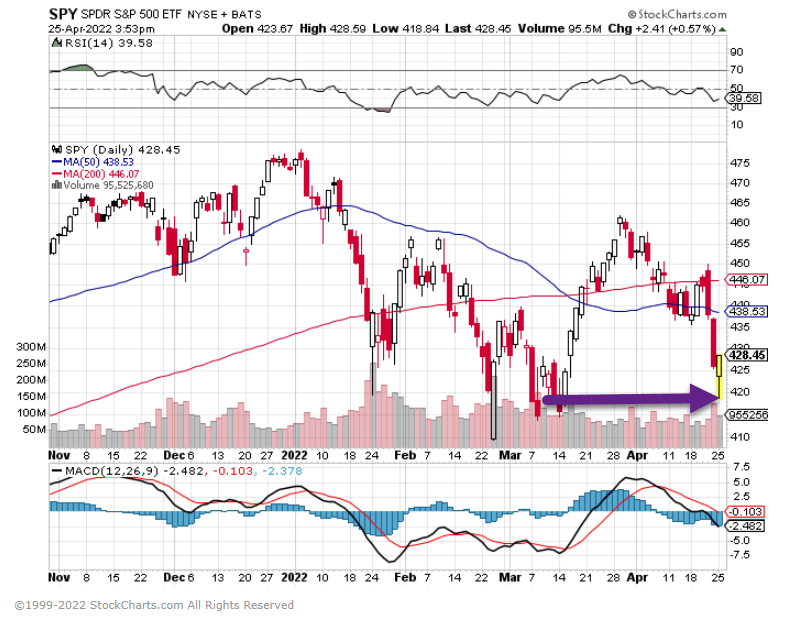
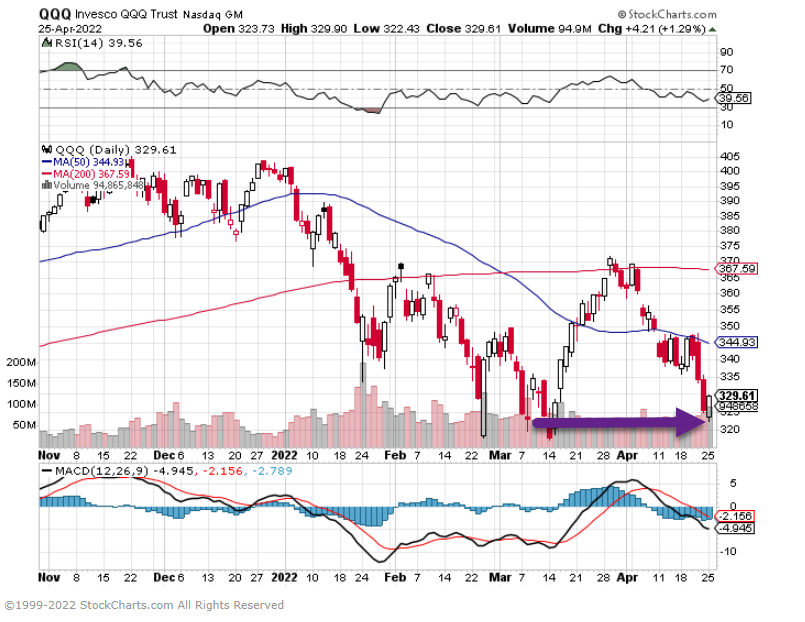
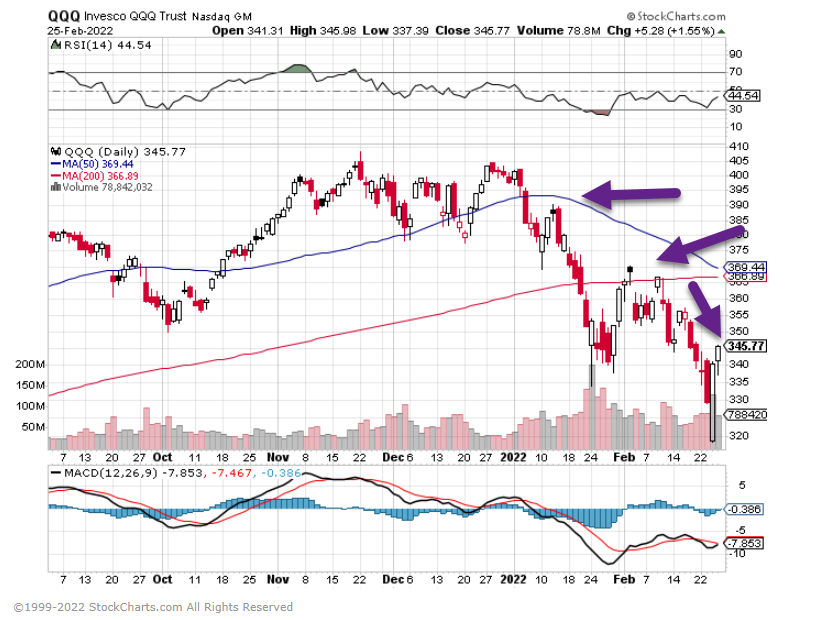
3. S&P and Nasdaq Officially Testing YTD Previous Lows

S&P Testing Lows

QQQ Testing Lows

www.stockcharts.com


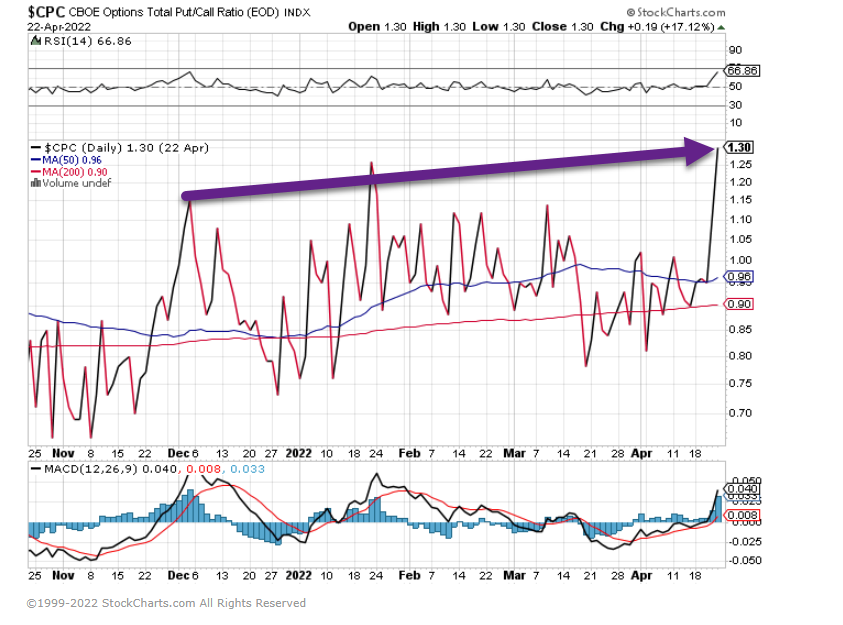
4. Put/Call Ratio Spikes to 2020 Sell Off Levels.

The Put/Call Ratio is an indicator that shows put volume relative to call volume. Put options are used to hedge against market weakness or bet on a decline. Call options are used to hedge against market strength or bet on an advance. The Put/Call Ratio is above 1 when put volume exceeds call volume and below 1 when call volume exceeds put volume. Typically, this indicator is used to gauge market sentiment. Sentiment is deemed excessively bearish when the Put/Call Ratio is trading at relatively high levels and excessively bullish when at relatively low levels. Chartists can apply moving averages and other indicators to smooth the data and derive signals.

A Put/Call Ratio at its upper extremities would show excessive bearishness because put volume would be significantly higher than call volume. Excessive bearishness would argue for optimism and the possibility of a bullish reversal.  www.stockcharts.com

Put/Call Ratio Chart

www.stockcharts.com

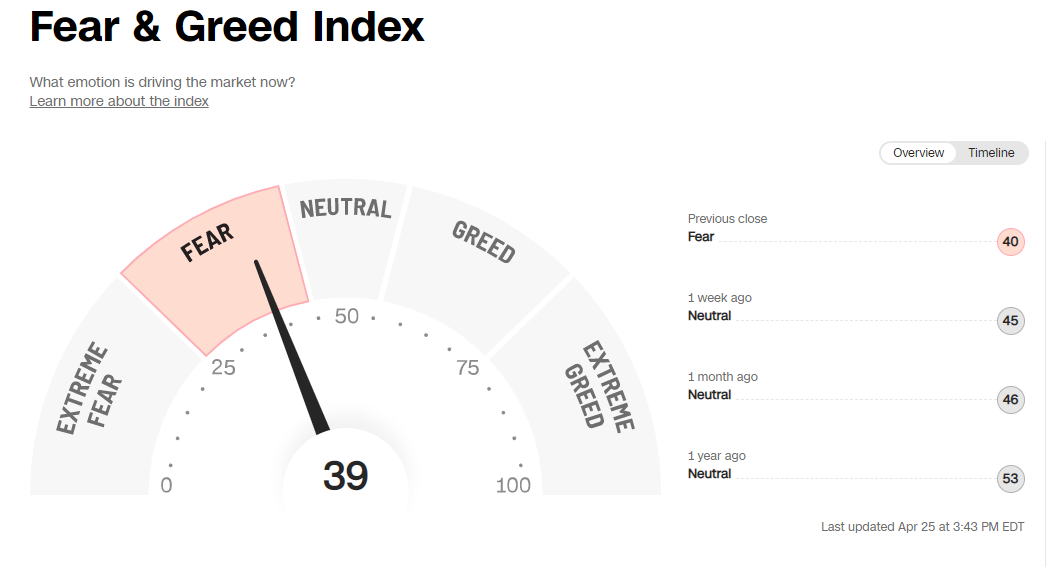
CNN Fear and Greed Index

https://www.cnn.com/markets/fear-and-greed


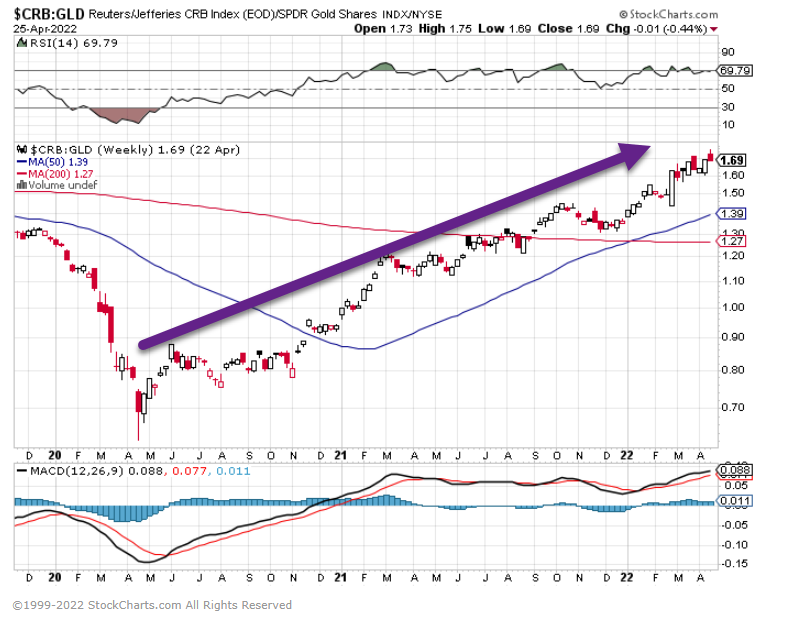
5. The Broad Commodities Index vs. Gold

This Chart shows the broad commodities index vs. gold since inflation really took hold….Gold lagging energy, food, etc.

www.stockcharts.com


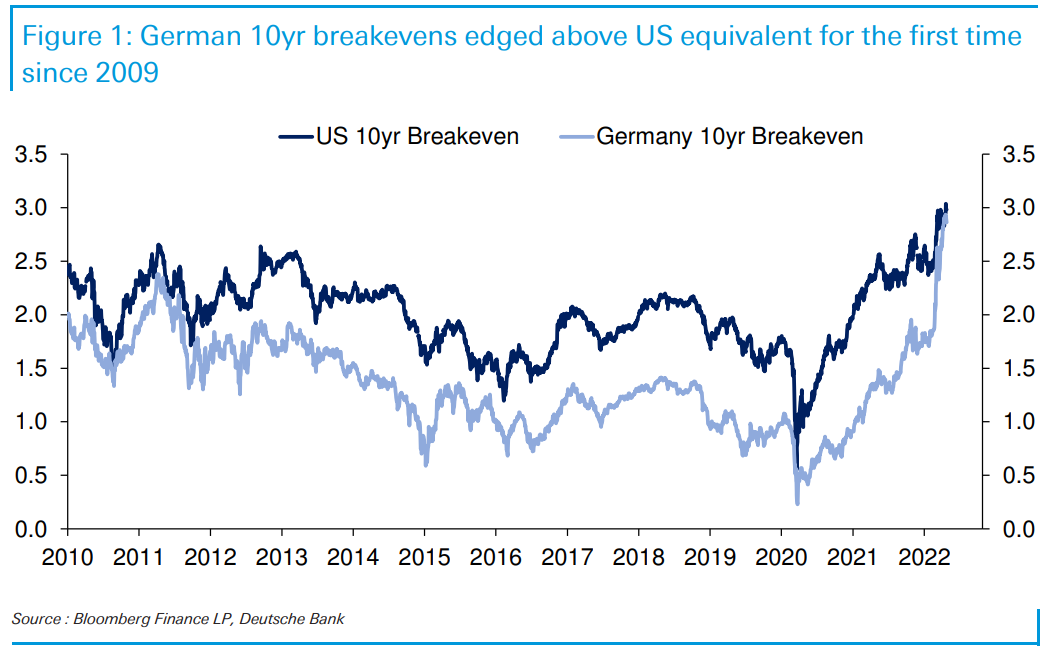
6. Euro Inflation…German 10 Year Inflation Break-Evens Rise Above U.S. for First Time Since 2009

Jim Reid DB-We have just launched our latest monthly survey, which has lots of questions on inflation, rates, potential policy errors in either direction, and a terminal state WFH question to compare to those we compiled early in the pandemic. The survey will likely stay open until Wednesday lunchtime BST. It’s anonymous, and you can skip any question you don’t want to answer. As always, I’d appreciate all support in filling it in. The link is here.

Over the last week or so, German 10yr breakevens briefly edged above their US equivalent for the first time since 2009. For most of the last decade the differential has been between +50 to +100bps in favour of the US with the peak only just over a year ago at +116bps.

So it’s been a remarkable turnaround and had you said 12 months ago that German inflation would average more than the US over the next decade, you would have been looked at quite strangely.

Clearly, much of the move has been energy related with Europe’s energy costs more at risk over the next few years than the US’s. Speaking to DB’s Francis Yared, he confirms the energy story, especially in the near term, as European 2yr inflation swaps also edged above the US equivalent last week. However, if we look at the 5yr5yr inflation swap differential between the two regions there is still a c.25bps higher rate in the US than in Europe. However, the differential is close to the narrowest its been outside of the GFC period.

In our survey, there is a recurring question about your long-term inflation expectations in the US and Europe, so it’ll be interesting to see if you believe the converging trend is justified or not.


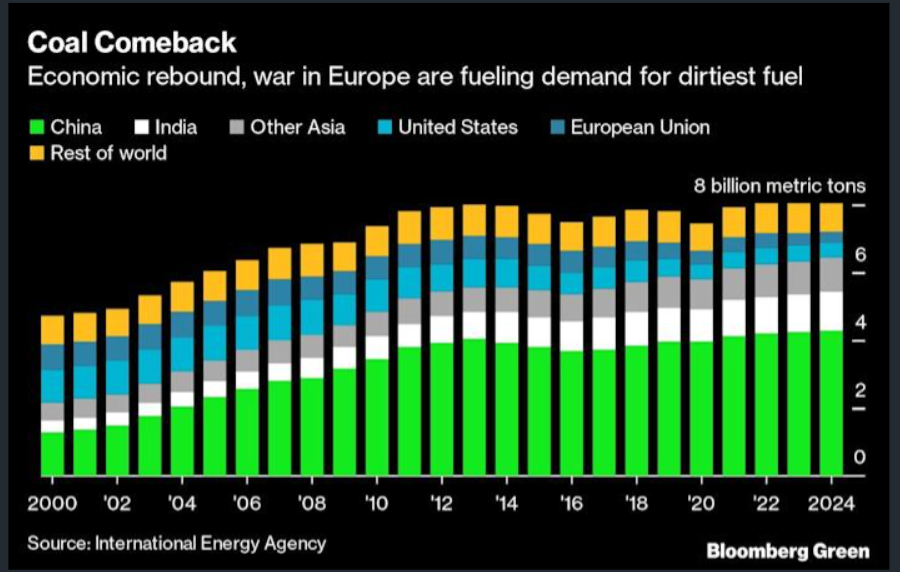
7. Net Net Coal Still Much Higher Usage in Last 25 Years….Flat for 15 Years but Not Down.

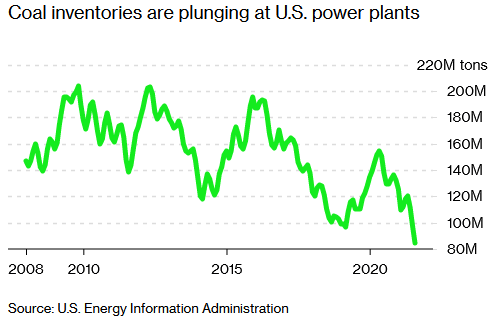
Bloomberg-In 2021, the world generated more electricity from coal than ever before, with an increase of 9% from the previous year, according to the International Energy Agency. For 2022, total coal consumption — for generating power, making steel and other industrial uses — is expected to rise by almost 2% to a record of just above 8 billion metric tons and remain there through at least 2024.

“All evidence indicates a widening gap between political ambitions and targets on one side and the realities of the current energy system on the other,” the IEA said, estimating that carbon-dioxide emissions from coal in 2024 will be at least 3 billion tons higher than in a scenario reaching net-zero by 2050.

Russia’s War Is Turbocharging the World’s Addiction to Coal-Will Wade and Stephen Stapczynski https://www.yahoo.com/now/russia-war-turbocharging-world-addiction-040103763.html


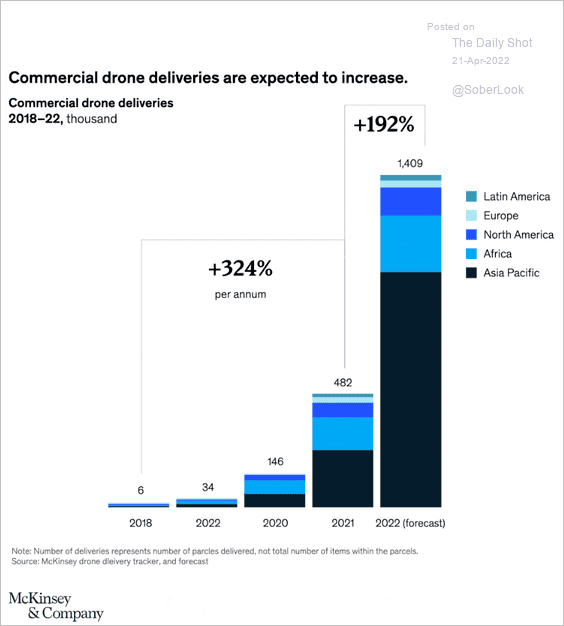
8. Commercial Drone Deliveries Growth-The Daily Shot Blog

Source: McKinsey & Company  Read full article

https://dailyshotbrief.com/the-daily-shot-brief-april-21st-2022/


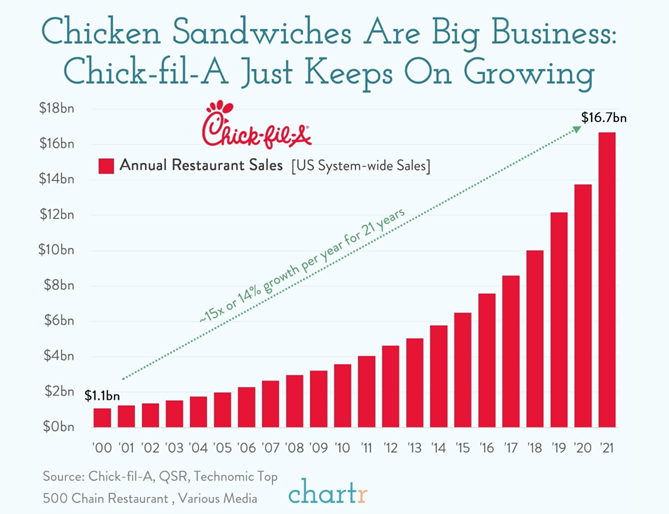
9. Chick-Fil-A Annual Sales Growth

Chicken sandwiches are big business
America loves Chick-fil-A.  This week the fast food company disclosed that it had sold more than $16.7 billion worth of food across its restaurants in 2021, up more than 20% on last year’s haul of $13.7bn — putting Chick-fil-A near the very top of the fast food food chain, behind only the golden arches and Starbucks in terms of US sales.
Closed on SundaysA typical Chick-fil-A (outside of a mall location), turns over more than $8 million a year (source), which is a staggering amount on its own — and more than any other major fast food chain — but gets even more staggering when you remember that those sales are crammed into just 6 days a week. As tradition has long dictated at Chick-fil-A, all of its restaurants are closed on Sundays.
So why is Chick-fil-A doing so well?The obvious answer is… delicious food. But the business model deserves some credit too. Chick-fil-A has a fairly unique franchise system — the company typically only lets owners own one franchise location (as opposed to multiple). In theory that could have limited the company’s growth, but it also means Chick-fil-A franchisees are laser focused on their one store. The stellar sales numbers suggest it can’t have hurt too much.

www.chartr.com


10. 5 Reasons Creativity Gets Crushed at Work

Our creative spirit in the workplace can be affected by constant criticism-–Anthony D. Fredericks Ed.D.

KEY POINTS

  • New ideas in the workplace are frequently “shot down” by negative criticism.
  • There are five major reasons why colleagues reject new ideas.
  • Many people protect their “corporate standing” by rejecting new ideas.


Let’s say you’ve got a great new idea, an idea that will transform your department into a dynamic new entity within the company. Profits will soar, people will be happy, and, of course, you’ll get a substantial raise. You bring this new idea to the weekly department meeting and announce it to all your colleagues. There is stunned silence. But, finally, from somewhere in the back of the room, somebody raises their voice and says something like, “That’s got to be the most ridiculous idea I’ve ever heard! It’ll never work!”

You’ve effectively been shot down. You’ve been hit between the eyes with a verbal bullet and your idea, for all intents and purposes, has been killed on the spot. It probably wouldn’t surprise you to know that many of us are assailed by these verbal put-downs regularly. That negativity frequently infests our workplaces where criticism is not only condoned but is often the modus operandi of an organization.

Some people are masters at tamping down new ideas. These are the naysayers—those folks who challenge every new idea as though it was a bad idea. They’ll say “no” at the drop of a hat. In many cases, it’s the result of our natural resistance to change. Change is something new and thus change is scary. Cro-Magnons may have been reluctant to hike over a mountain ridge because they didn’t know what (or who) they’d meet on the other side. They had established a comfort zone on one side of the mountain and venturing into a new environment probably meant a new set of survival skills. “Let’s play it safe,” “Let’s not take that chance,” they may have said. “No” is safe, and “yes” holds the possibility of unknown dangers, new fears, and lots of uncertainties.

Modern humans often have the same set of apprehensions—living their lives in fear. “Stay with what’s comfortable; what’s known,” they say to themselves (and others). Consequently, they want to wrap others into that comfort zone—imposing their will on colleagues who may wish to venture outside that zone and see what’s “on the other side of the mountain.”

Why Ideas Are Crushed

Why do some people feel compelled to say “no” to every new idea? Let’s take a look at a few reasons.

First, it’s a control issue. For example, when you tell someone her idea is no good, you exert a measure of control over her. Those we refer to as “control freaks” are often the ones who want to trample our energy and enthusiasm. It wasn’t their idea, so it can be controlled by saying it was a bad idea. They maintain their control by rejecting our ideas.

Second, there is a region of the human brain known as the amygdala, which serves as an automatic alarm system whenever there is danger (or the possibility of danger). Many psychologists believe this is the brain’s default position—that is, if something new and unusual appears in front of us, we have a natural tendency to picture it as harmful or dangerous. As a result, we will either protect ourselves or flee from the potential danger. In evolutionary terms, this is how prehistoric humans survived a harsh and often unpredictable environment. In modern terms, this means that new ideas are often viewed as dangerous ideas. And, if an idea is dangerous, then it must be squelched.

article continues after advertisement

Third, some people are more comfortable being pessimistic. They see the glass as half-empty, they view the world as a negative environment, they always see the “bad” in a situation, and they always want others to know of their dissatisfaction with the way things are. When someone shares a positive idea, they seek to counter it with a negative reaction. These folks are reactionaries rather than visionaries. They are most comfortable in maintaining the edges of “the box.” As you might imagine, these are individuals who frequently solicit collegial approval. Thus, if someone doesn’t tell them they’re doing a good job (regularly), they certainly aren’t going to celebrate the ideas of others.

Fourth, some people are locked into a “fixed mindset.” They are incapable of embracing new ideas just as they are incapable of embracing change. They resist change in themselves, just as much as they resist change in others or in an organization. For them, change is difficult to fathom—it’s an intimidating proposition. It’s a journey into new territory and for some, that’s both frightening and worrisome. They are content right where they are, so why do things differently? Why venture into the unknown when the “known” is very comfortable just as it is?

Fifth, and perhaps most important, naysayers get attention when they say something that goes against the grain. They are recognized (often for the wrong reasons) for a gibe, a put-down, a taunt, a sneer, or an insult. The spotlight is (temporarily) on them. They are the center of attention. Moreover, they get a reaction—sometimes a negative reaction—but for a moment, all eyes are on them. They’ve inserted their thoughts and (re)claimed their space.

So, how common are those negative comments? According to one report, it appears as though negative reactions to new ideas are on the rise. The researchers interviewed over 3,000 U.S. business leaders about behaviors in the workplace. The results showed that 53 percent of the respondents have seen an increase in “criticism,” 48 percent have seen an increase in “dismissing others’ ideas,” and 36 percent have seen an increase in “hostility” or “disparaging others.”

Are your new ideas crushed by colleagues?

https://www.psychologytoday.com/us/blog/creative-insights/202204/5-reasons-creativity-gets-crushed-work

Topley’s Top 10 – April 25, 2022

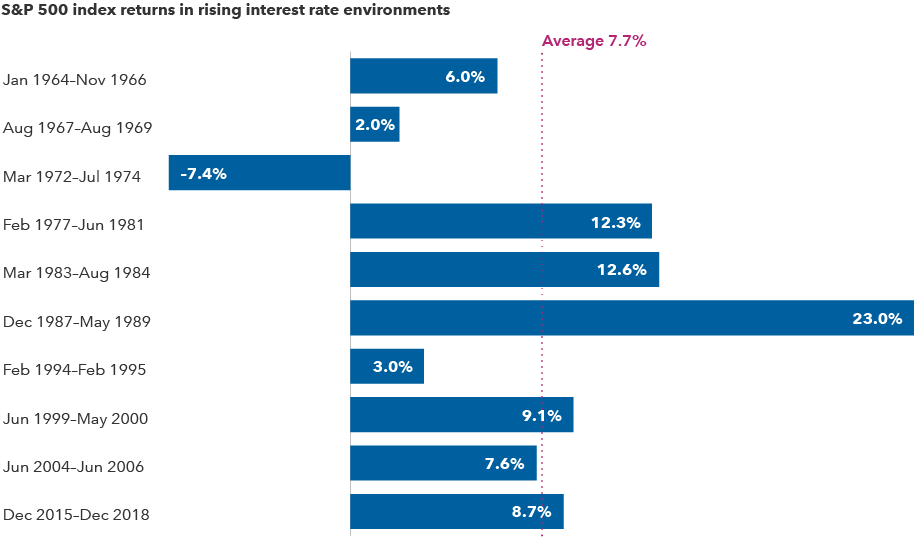
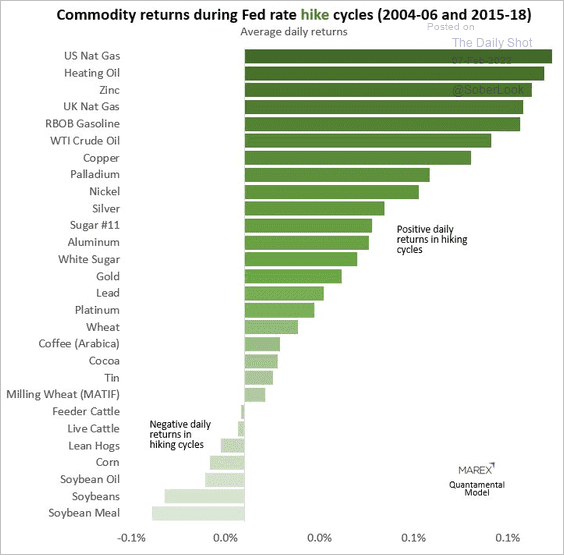
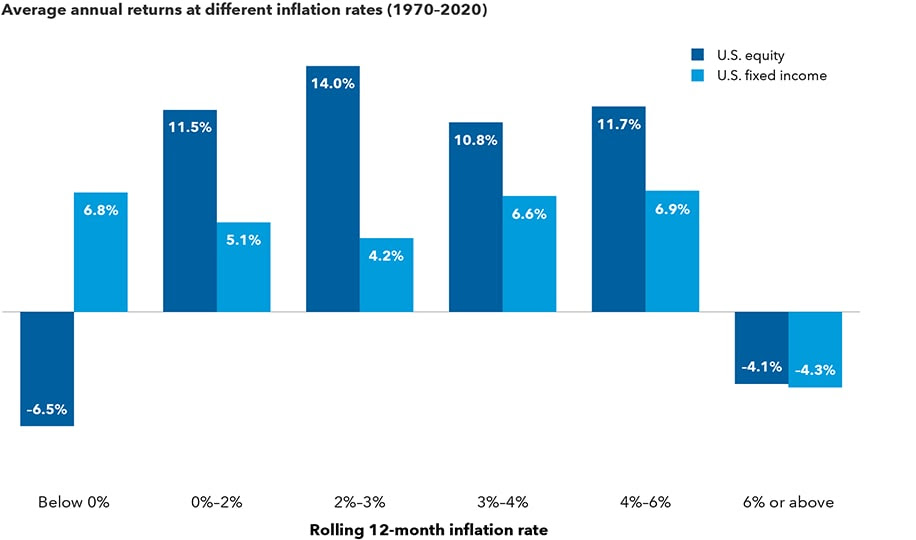
 1. Capital Group U.S. stocks generally have done well during past rising rate periods.

Capital Group U.S. stocks generally have done well during past rising rate periods

Sources: Capital Group, Refinitiv Datastream, Standard & Poor’s, U.S. Federal Reserve. S&P 500 returns represent annualized total returns.

Is the era of easy money coming to an end? | Capital Group


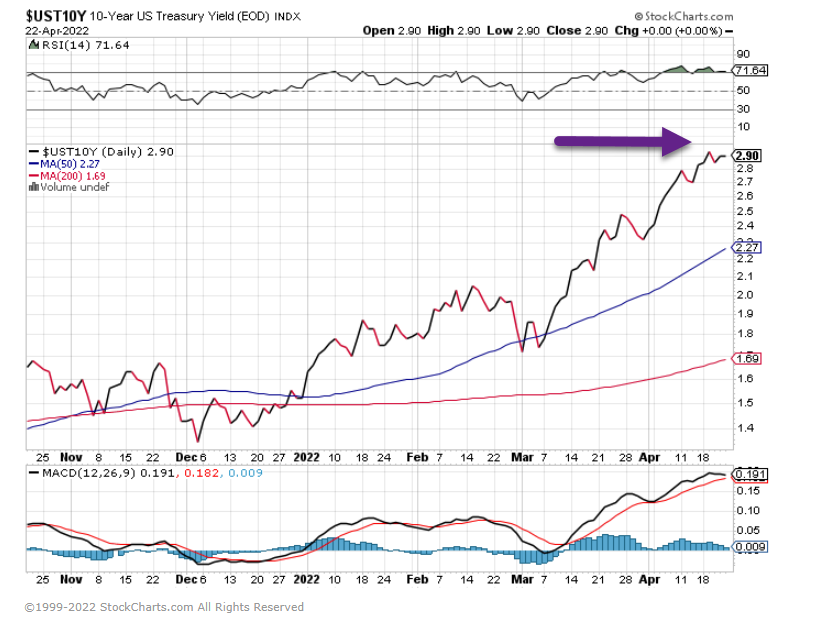
2. Ten-Year Treasury Approaching 3%….

Barrons-Since 1950, when this yield has been below 3%, stocks have done fine. But they’ve fared worse when it was higher (and still worse when it topped 4%). When the yield was under 3%, equities’ annualized monthly returns averaged 21.9%, versus 10.0% when yields were higher, according to Paulsen’s research. In addition, volatility was lower (13.5% versus 14.6%), while monthly losses were less frequent (occurring 27.6% of the time, versus 38.2%). More to the point, there was only one bear market when the yield was below 3% during the period studied, but 10 when it was over that level.

A Key Bond Yield Nears 3%. By  Randall W. Forsyth https://www.barrons.com/articles/a-key-bond-yield-nears-3-its-a-bad-omen-for-stocks-51650644233?mod=past_editions

www.stockcharts.com


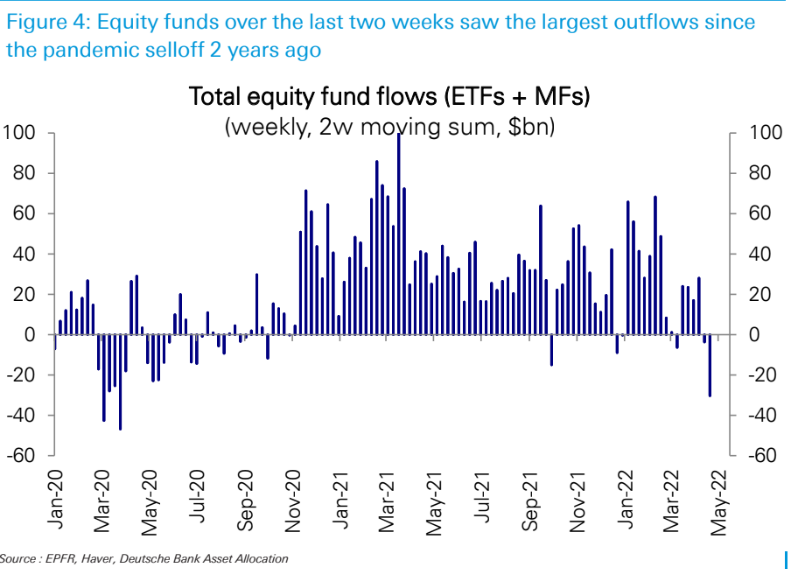
3. U.S. Equities $30B in Outflows in 2 Weeks

Bank of America U.S. equity funds have recorded $30 billion of outflows over past two weeks, the largest since March 2020 market crash -Deutsche Bank


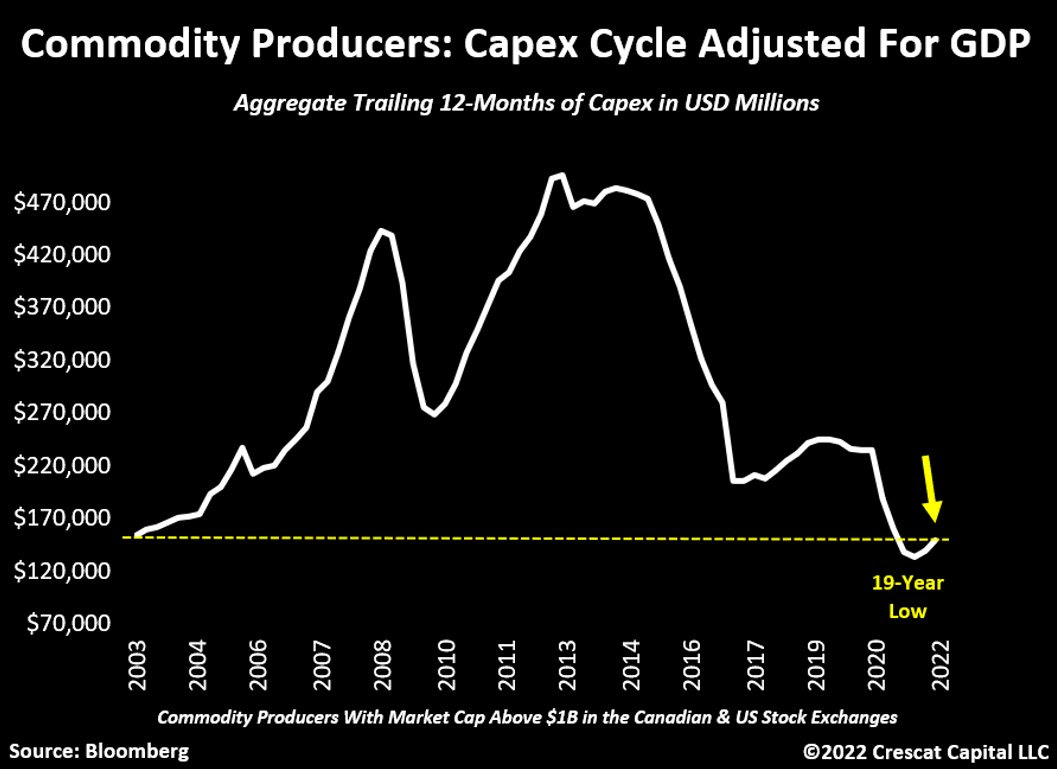
4. Inflation Adjusted Capex of Commodity Stocks at 20 Year Low

Otavio (Tavi) Costa

@TaviCosta https://twitter.com/TaviCosta


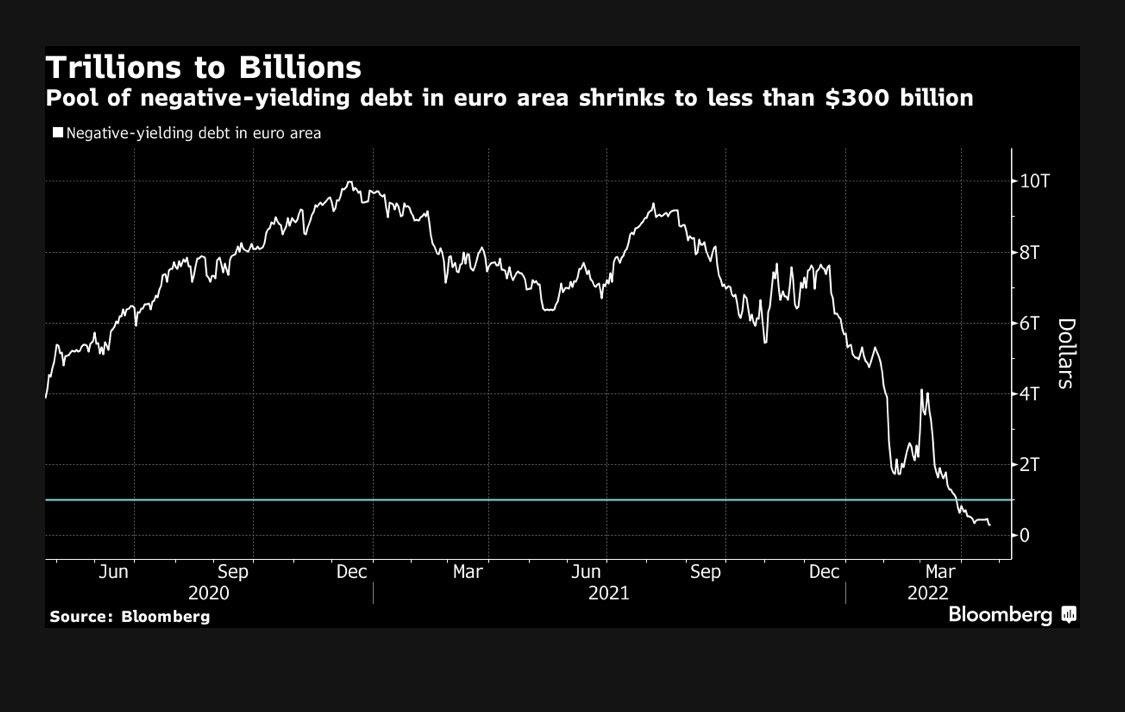
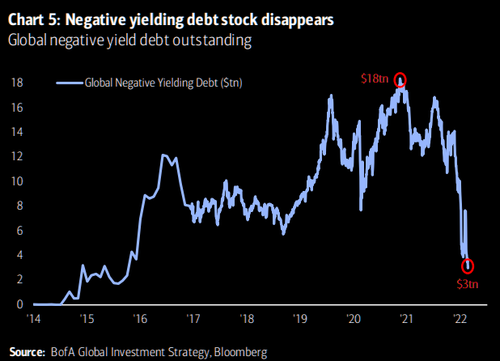
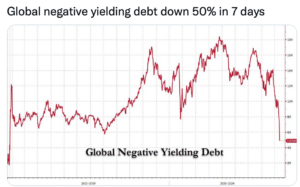
5. Not Many Historical Charts Dive from $10 Trillion to $300B….Pool of Negative Debt in Europe


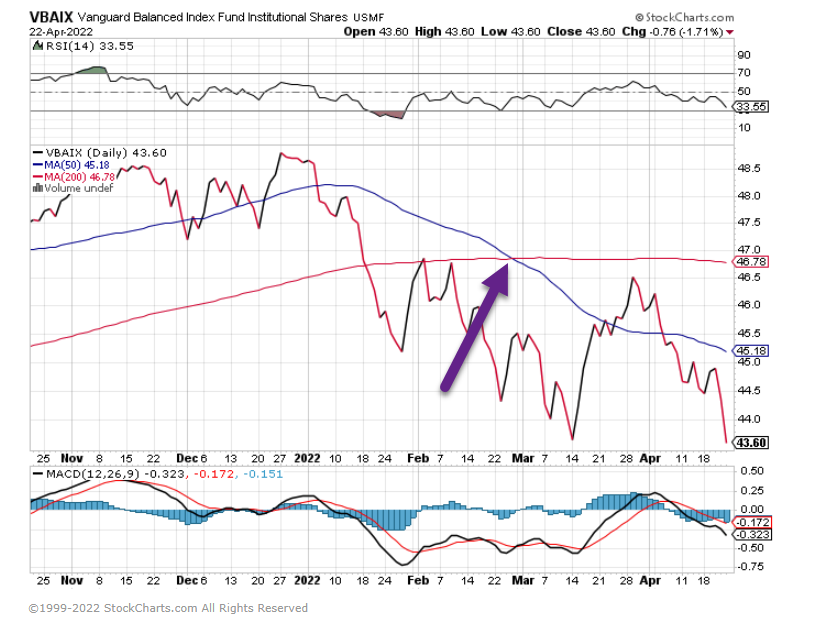
6. With Bonds/Stocks Selling Off Together….Vanguard 60/40 Portfolio -9% YTD.

50day went thru 200day to downside back in Feb.


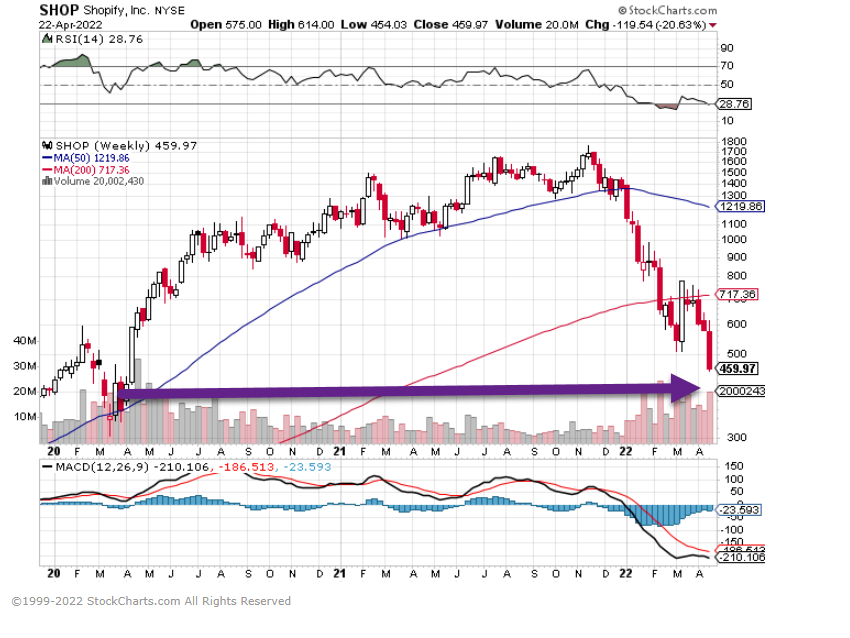
7. Shopify -70% ….About to Hit Covid Crisis Lows

www.stockcharts.com


8. Consumers Unhappy but Still Buying

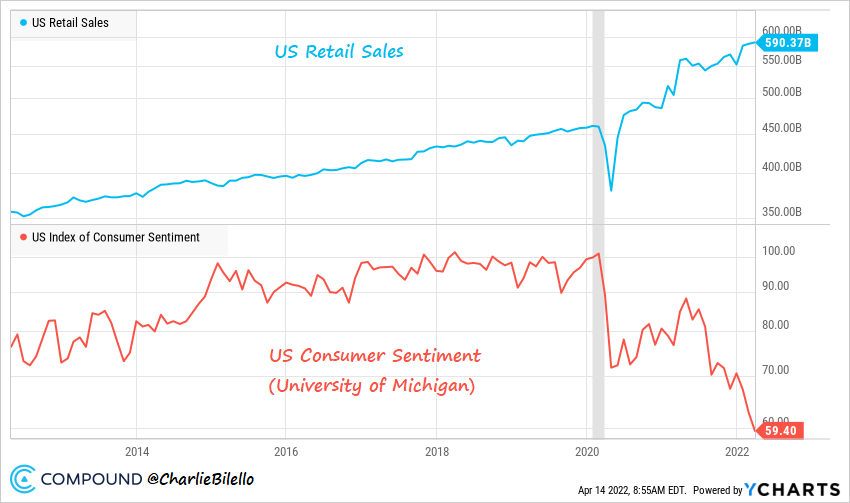
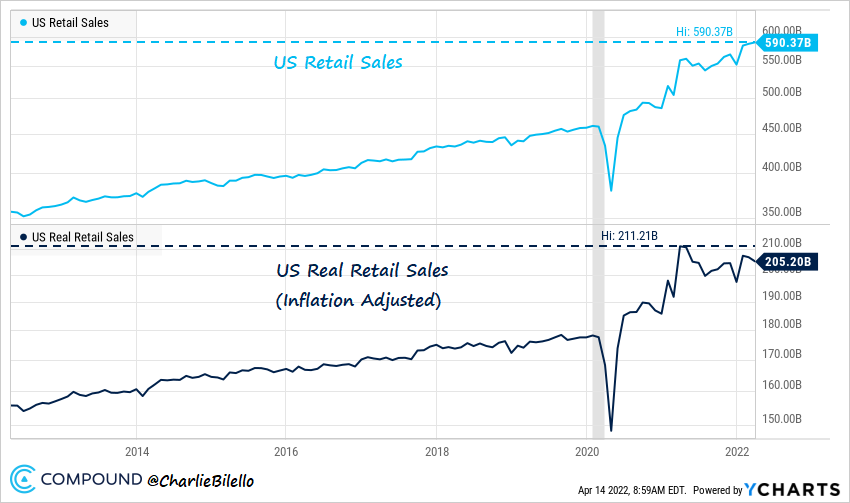
@Charlie BilelloUS Retail Sales hit another new high last month while Consumer Sentiment fell to its lowest level in over a decade. Translation: Americans are not happy about rising prices but they’re still spending money.

Part of the rise in retail sales is simply due to higher prices as inflation-adjusted sales peaked last April. But real retail sales are still 15% higher than pre-covid levels. So demand remains strong irrespective of inflation and is likely due to the strength of the consumer balance sheet.


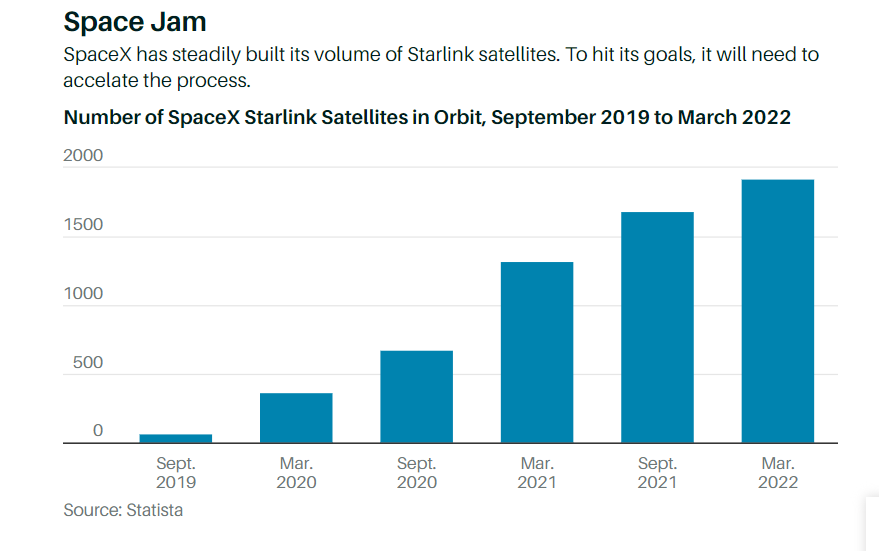
9. Space X Zero to Almost 2000 Satellites Since 2019

Barrons Starlink Could Be the Key to a $100 Billion Valuation for Elon Musk’s SpaceX By Al RootFollow https://www.barrons.com/articles/elon-musk-spacex-starlink-51650672885?mod=past_editions


10. How to Think: The Skill You’ve Never Been Taught

Farnam Street Blog https://fs.blog/

How to Think: The Skill You’ve Never Been Taught

No skill is more valuable and harder to come by than the ability to critically think through problems. Schools don’t teach you a method of thinking. Thinking is one of those things that can be learned but can’t be taught.

When it comes to thinking the mind has an optimal way to be operated. When operated correctly you’ll find yourself with plenty of free time. When operated incorrectly, most of your time will be consumed correcting mistakes.

Good decisions create time, bad ones consume it. Good initial decisions pay dividends for years, allowing abundant free time and low stress. Poor decisions, on the other hand, consume time, increase anxiety, and drain us of energy.

But how can we learn how to think?

For the answer we turn to Solitude and Leadership, a lecture given by William Deresiewicz. The entire essay is worth reading (and re-reading).

Learning How To Think

Let’s start with how you don’t learn to think. A study by a team of researchers at Stanford came out a couple of months ago. The investigators wanted to figure out how today’s college students were able to multitask so much more effectively than adults. How do they manage to do it, the researchers asked? The answer, they discovered—and this is by no means what they expected—is that they don’t. The enhanced cognitive abilities the investigators expected to find, the mental faculties that enable people to multitask effectively, were simply not there. In other words, people do not multitask effectively. And here’s the really surprising finding: the more people multitask, the worse they are, not just at other mental abilities, but at multitasking itself.

One thing that made the study different from others is that the researchers didn’t test people’s cognitive functions while they were multitasking. They separated the subject group into high multitaskers and low multitaskers and used a different set of tests to measure the kinds of cognitive abilities involved in multitasking. They found that in every case the high multitaskers scored worse. They were worse at distinguishing between relevant and irrelevant information and ignoring the latter. In other words, they were more distractible. They were worse at what you might call “mental filing”: keeping information in the right conceptual boxes and being able to retrieve it quickly. In other words, their minds were more disorganized. And they were even worse at the very thing that defines multitasking itself: switching between tasks.

Multitasking, in short, is not only not thinking, it impairs your ability to think. Thinking means concentrating on one thing long enough to develop an idea about it. Not learning other people’s ideas, or memorizing a body of information, however much those may sometimes be useful. Developing your own ideas. In short, thinking for yourself. You simply cannot do that in bursts of 20 seconds at a time, constantly interrupted by Facebook messages or Twitter tweets, or fiddling with your iPod, or watching something on YouTube.

I find for myself that my first thought is never my best thought. My first thought is always someone else’s; it’s always what I’ve already heard about the subject, always the conventional wisdom. It’s only by concentrating, sticking to the question, being patient, letting all the parts of my mind come into play, that I arrive at an original idea. By giving my brain a chance to make associations, draw connections, take me by surprise. And often even that idea doesn’t turn out to be very good. I need time to think about it, too, to make mistakes and recognize them, to make false starts and correct them, to outlast my impulses, to defeat my desire to declare the job done and move on to the next thing.

I used to have students who bragged to me about how fast they wrote their papers. I would tell them that the great German novelist Thomas Mann said that a writer is someone for whom writing is more difficult than it is for other people. The best writers write much more slowly than everyone else, and the better they are, the slower they write. James Joyce wrote Ulysses, the greatest novel of the 20th century, at the rate of about a hundred words a day—half the length of the selection I read you earlier from Heart of Darkness—for seven years. T. S. Eliot, one of the greatest poets our country has ever produced, wrote about 150 pages of poetry over the course of his entire 25-year career. That’s half a page a month. So it is with any other form of thought. You do your best thinking by slowing down and concentrating.

Improving Thinking

The best way to improve your ability to think is to actually spend time thinking.

Your decisions do the talking for your thinking.

You can’t simply take a few minutes here and there, get the gist of the problem, and expect to make good decisions.

“It’s only by concentrating, sticking to the question, being patient, letting all the parts of my mind come into play, that I arrive at an original idea. By giving my brain a chance to make associations, draw connections, take me by surprise”

— William Deresiewicz

One heuristic to tell how good someone is at making decisions is by how much time they have. The busiest people are often the ones who make the worst decisions. Busy people spend a lot of time correcting poor decisions. And because they’re so busy correcting past decisions, they don’t have time to make good decisions.

Good decision makers understand a simple truth: you can’t make good decisions without good thinking and good thinking requires time.

Good decisions make the future easier, giving you more time and less stress.

If you want to think better, schedule time to think and hone your understanding of the problem.

Topley’s Top 10 – April 21, 2022

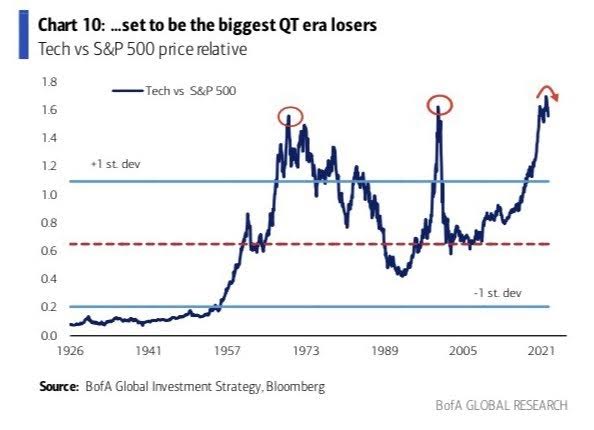
1. Tech vs. S&P Relative Price

Callum Thomas Chart Storm

https://chartstorm.substack.com/p/weekly-s-and-p500-chartstorm-17-april?s=r

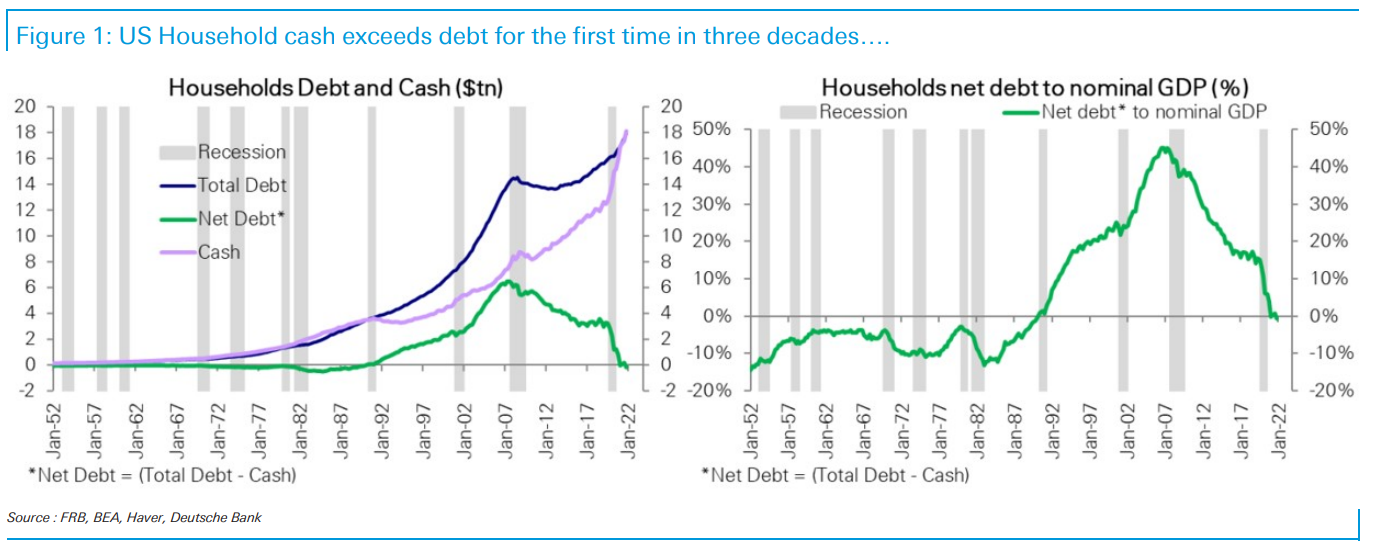
2. U.S. Households in Best Shape 30 Years

Jim Reid-Deutsche Bank

FW: DB CoTD: US Households in best shape in 30 years… but does it matter?

Back in December I published “When the Fed hikes.. what happens next?” (link here) but while I was on holiday our equity strategists Binky Chadha and Parag Thatte published a much more comprehensive look at what happens to equities, sectors of the equity market, sectors of the economy, and many other things during hiking cycles. See it here.

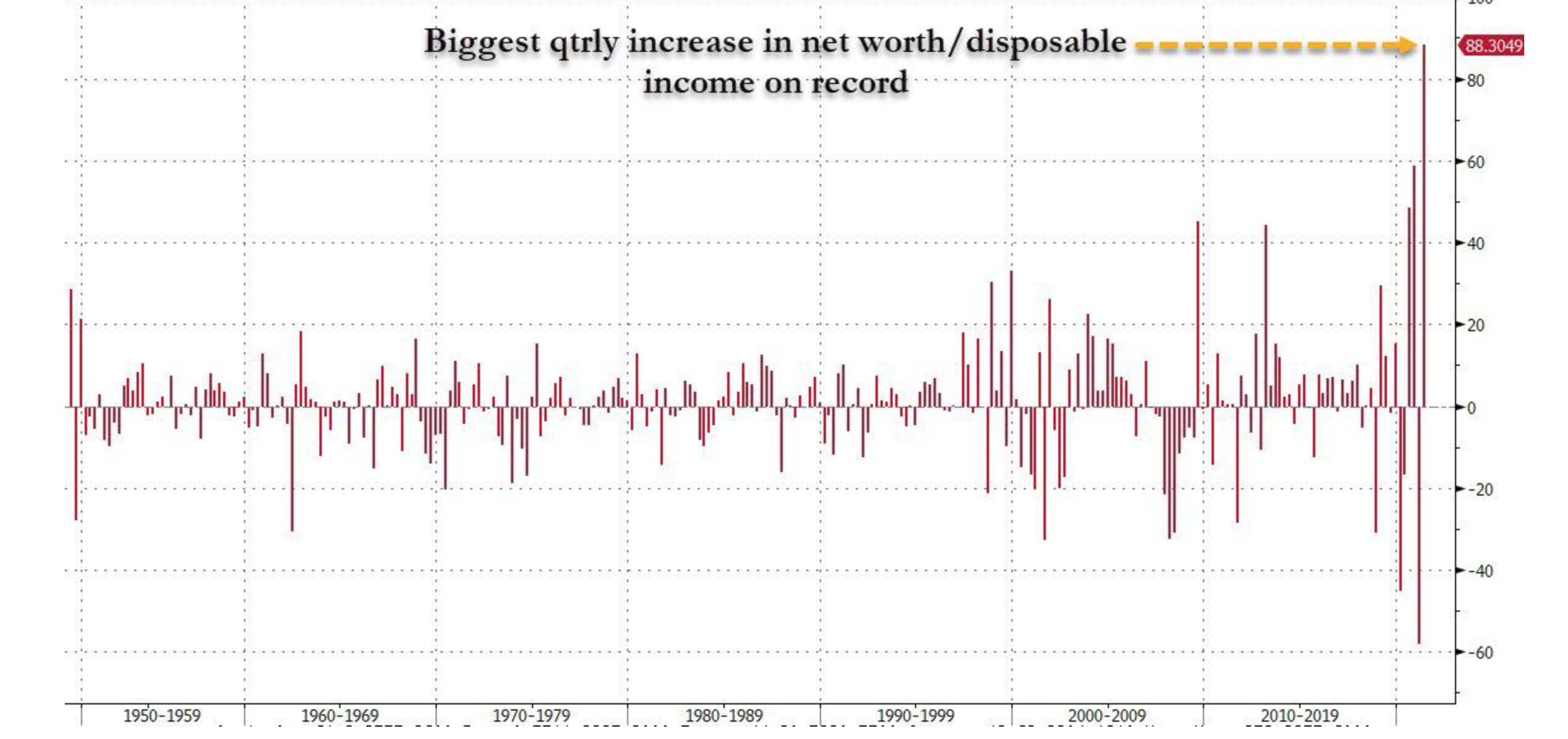
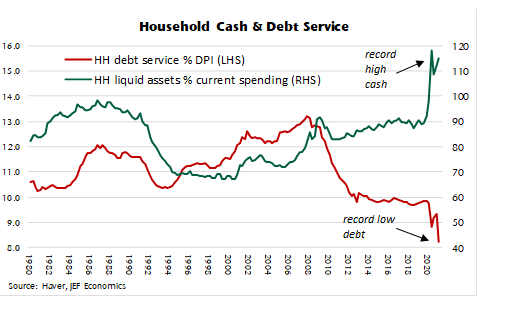
Amongst a plethora of interesting graphs, one highlight was that showing US household’s cash now exceeds debt for the first time in three decades with net debt collapsing to zero. Clearly there will be distributional biases here but in aggregate the fiscal transfers from the pandemic have put US consumers in a decent balance sheet position. What can we conclude from this? Two things perhaps.

  1. The Fed may have to hike even more aggressively to slow consumer demand and curb price rises given their healthy balance sheets.
  2. While negative net debt is a sign of comfort, we had seven recessions between the early 1950s and early 1980s when it was also negative.

So all clear for a while perhaps with policy so accommodative, but a reminder that we think a hard landing will ultimately be unavoidable by late ‘23 / early ‘24 after an aggressive series of Fed hikes over the next 18 months.

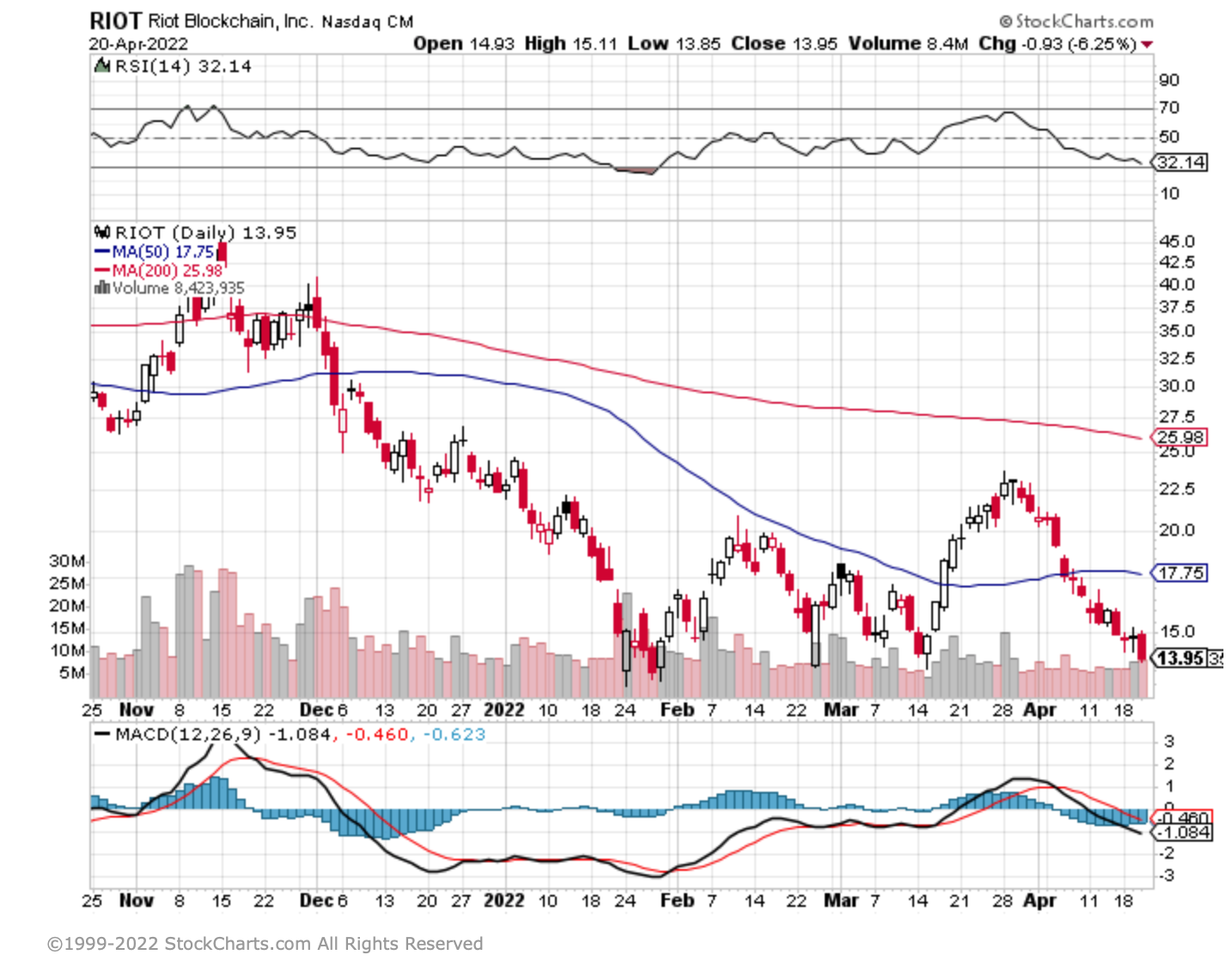
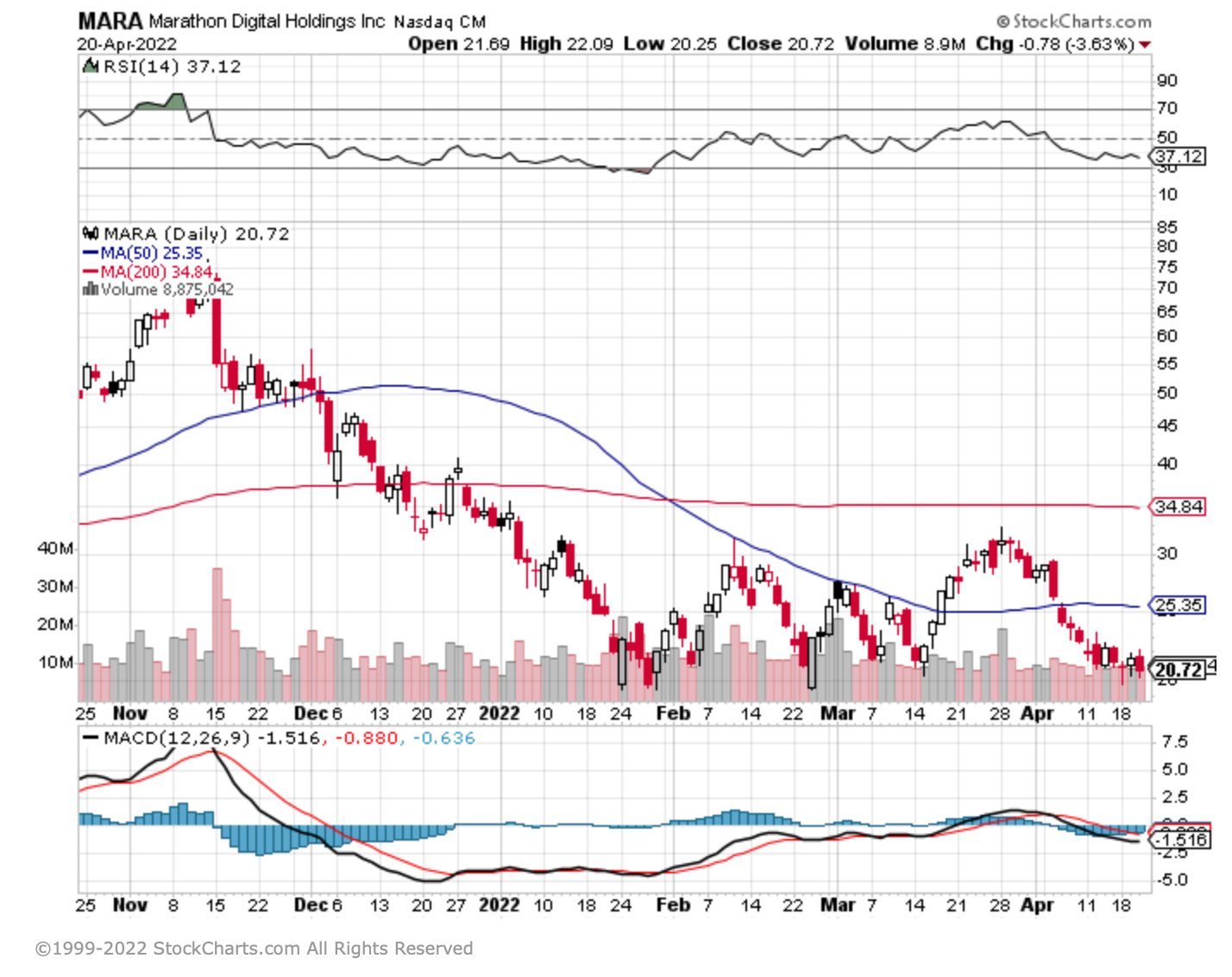
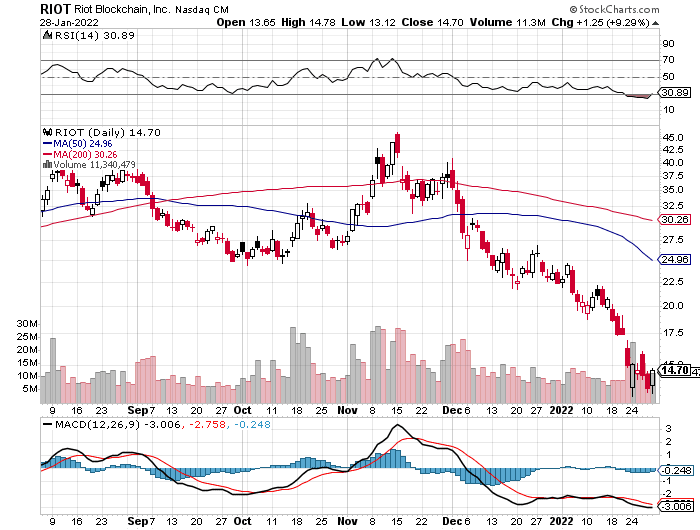
3. Crypto Stocks Riot and Mara Testing Lows for the 4th Time in 2022

www.stockcharts.com

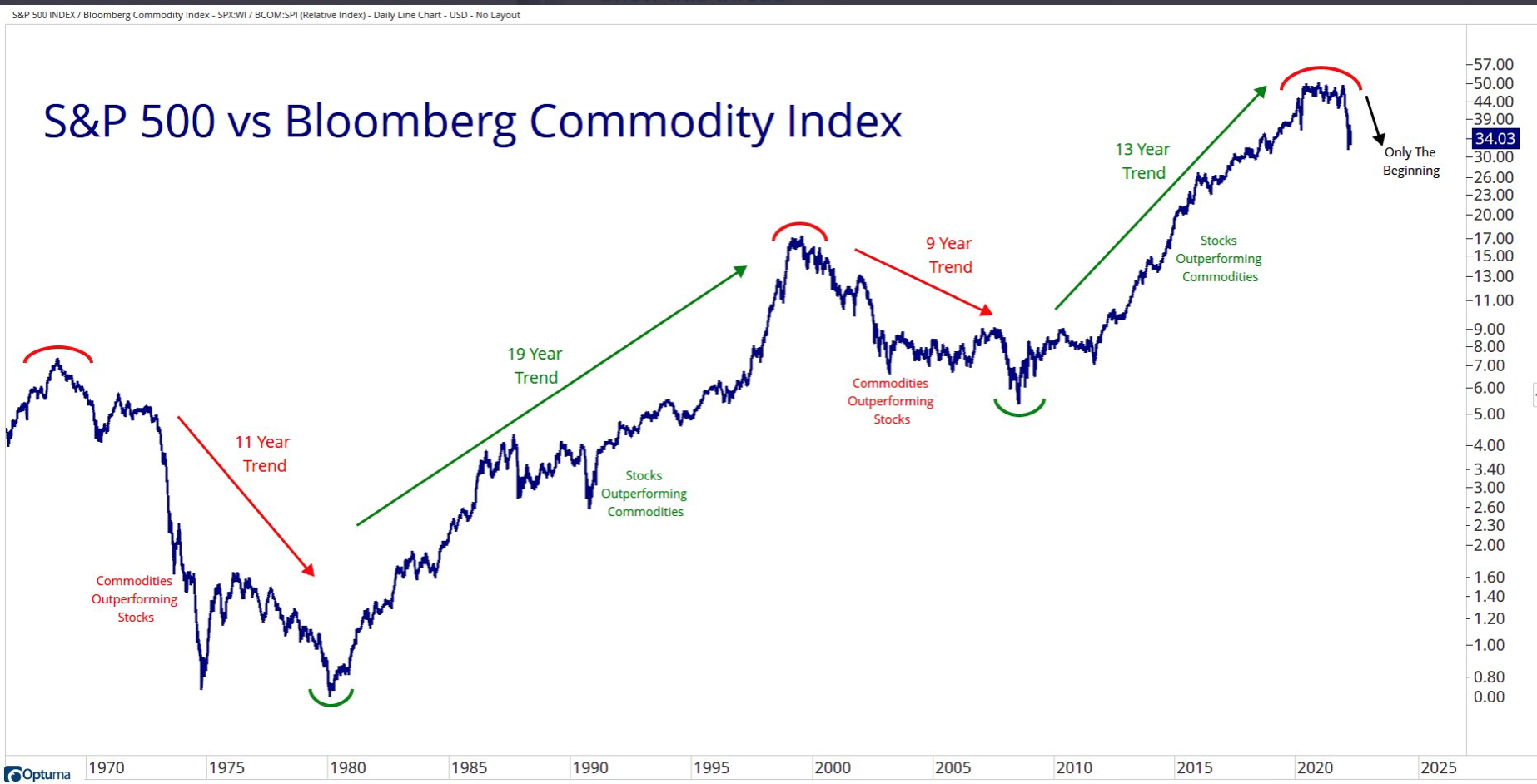
4. Stocks vs. Commodities History

Jeremy Schwartz WisdomTree

@JeremyDSchwartz

https://twitter.com/JeremyDSchwartz

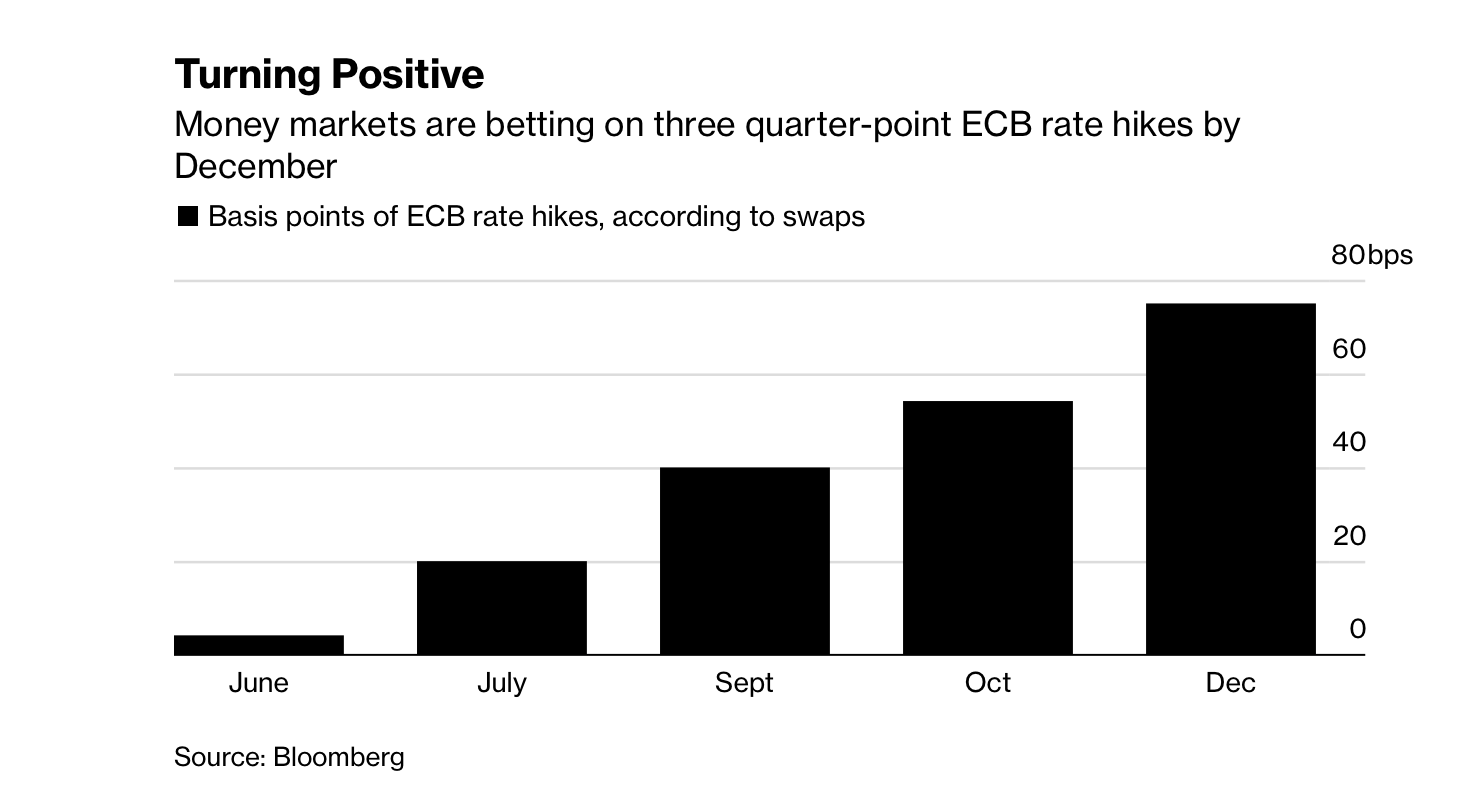
5. ECB Rate Hikes This Year

Bloomberg

https://www.bloomberg.com/news/articles/2022-04-21/pace-of-ecb-rate-path-jolts-markets-with-july-hike-on-radar?cmpid=socialflow-twitter-business&utm_medium=social&utm_campaign=socialflow-organic&utm_content=business&utm_source=twitter&sref=GGda9y2L

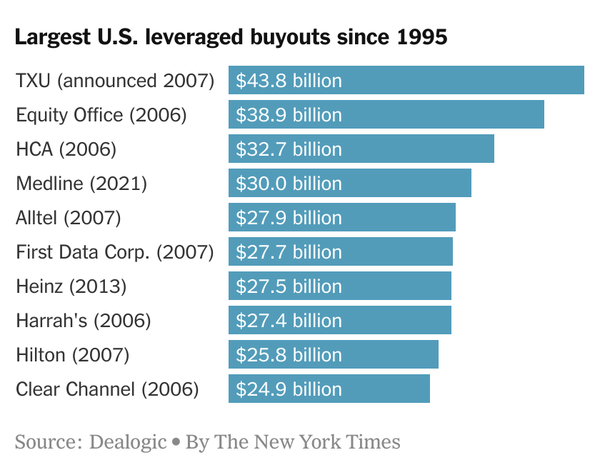
6. Debt and Twitter

NYT Deal Book-Andrew Sorkin

A debt-heavy deal for Twitter would be the largest leveraged buyout in decades. But Twitter isn’t the sort of company that can take on a lot of debt. It produces about $1 billion in operating earnings per year, and analysts say it could handle about $20 billion in additional debt on its balance sheet. If Musk’s bid stays above $40 billion, that leaves a lot of equity for him to scrounge up.

https://www.nytimes.com/2022/04/20/business/dealbook/mask-mandates-airlines.html

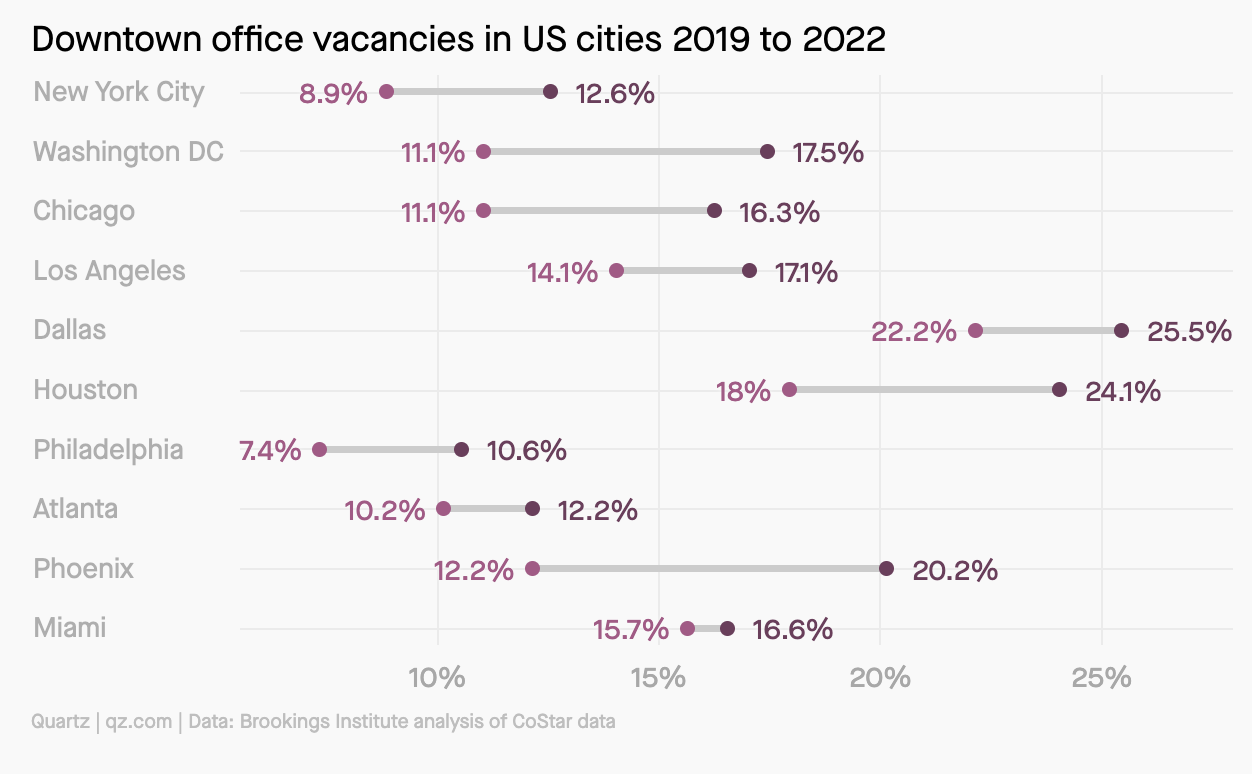
7. Downtown Office Vacancies

Barry Ritholtz Blog

https://ritholtz.com/2022/04/10-tuesday-am-reads-377/

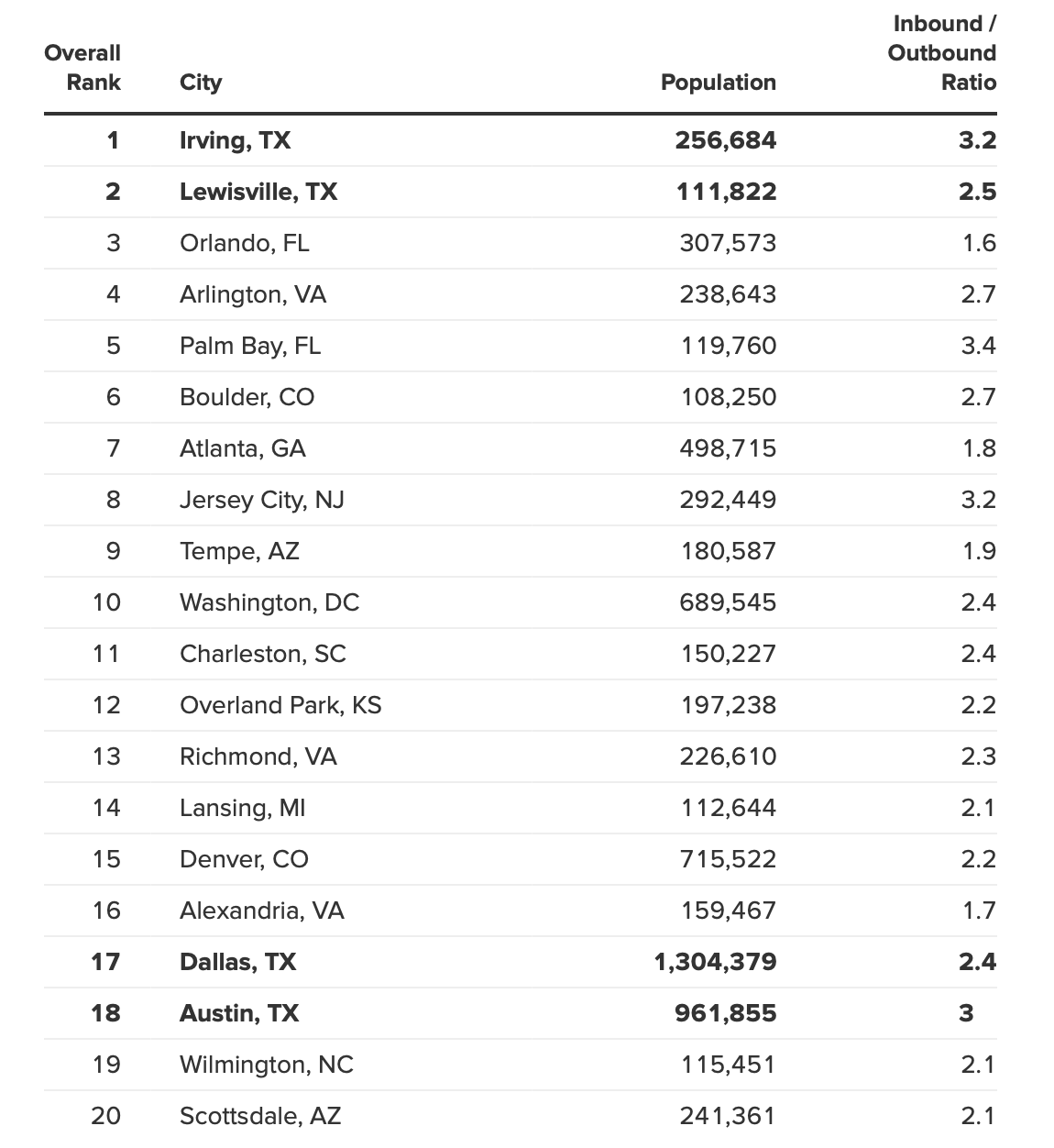
8. 20 Most Popular Cities for Renters 2021

Gabriel Cortés@GABECORTES

https://grow.acorns.com/us-cities-renters-moved-to-most-in-2021/

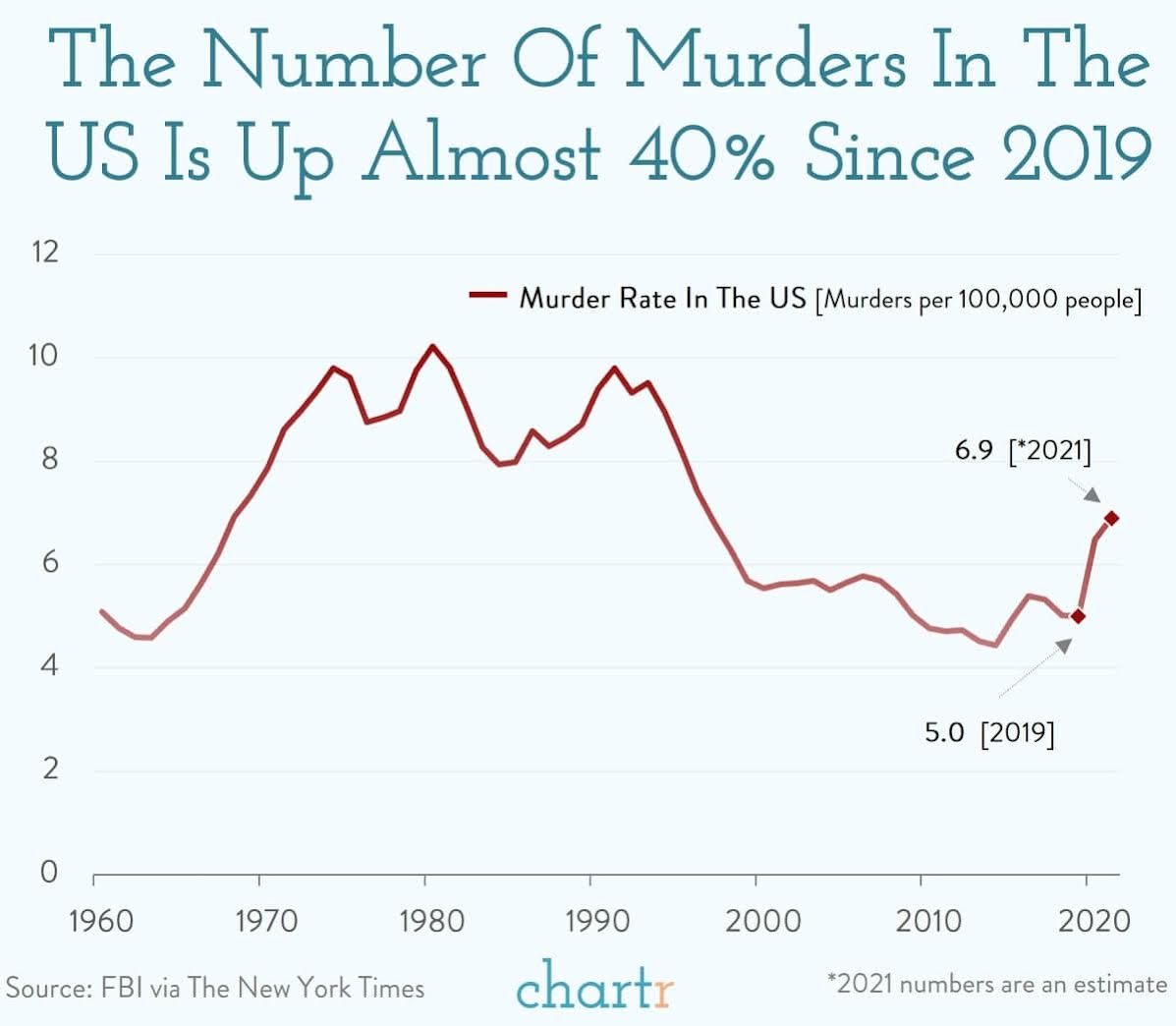
9. The Number of Murders in U.S. Up 40% Since 2019


Violence in America

Last week’s violent shooting in Brooklyn as well as recent killings in New Orleans and three mass shootings over Easter weekend are the latest tragic examples of a nationwide uptick in killings in the US over the last 3 years.

Preliminary estimates for 2021 show the murder rate in the US hitting 6.9 per 100,000 people, up 38% on the numbers for 2019.

Coming up with reasons why violent crime might be rising isn’t hard. Since 2019 we’ve had a global pandemic, lockdowns, high profile police killings, civil unrest, intense economic uncertainty, a fraught election, and now rising inflation on essential goods. Those things, and others, seem to be taking their toll.

www.chartr.com

10. 9 signs your coworker has narcissistic traits

Amy Morin

23 hours ago

  • Amy Morin is a psychotherapist, author, and host of The Verywell Mind Podcast.
  • She says there are certain signs to look for if you think a coworker has narcissistic tendencies.
  • People with these traits may brag excessively, act jealous, or respond negatively to feedback.

We likely all exhibit some narcissistic tendencies sometimes. But there may be one coworker in the office who shows those tendencies more often than not.

That’s not to say they have a diagnosable mental illness, like narcissistic personality disorder. But their inflated sense of self may still cause problems at times, at least for those around them.

Here are nine signs your coworker has narcissistic tendencies.

1. They exaggerate their achievements

A colleague with narcissistic tendencies won’t just brag, they’ll embellish. You might hear things like, “I saved the whole company last year” or “Everyone always asks me for help because I’m the only one who knows how to make things happen around here.”

While they may come across like they’re full of themselves, they’re most likely hiding deep-rooted insecurities about not being good enough. The one thing they are confident about, however, is that you’ll believe their stories about how great they are.

2. They love to be the center of attention

They don’t want to hear your opinions or your stories. Instead, they want to use meetings and conversations to share about their favorite topic — themselves.

They might brag for a while, tell long-winded stories about themselves, or do things to get a laugh. Ultimately, they just want to ensure all the attention is on them.

3. They respond to feedback with aggression

Their delicate sense of self depends on being held in high regard so they can’t tolerate hearing anything unfavorable about themselves.

Their go-to defense mechanism is likely aggression. They may respond to criticism by yelling, making threats, or hurling insults. They’ll be desperate to prove the person providing the feedback is incompetent and inadequate.

4. They take advantage of their colleagues

People with narcissistic tendencies are often quite charming. They use flattery and short-lived kindness to convince people to do their work for them.

They may even play the role of the victim by offering sob stories that tug on their coworker’s heartstrings. Then, they prey on their sympathy by convincing coworkers to do favors for them.

5. They blame other people for their mistakes

They don’t want to look as if they don’t know what they’re doing, so if they make a mistake, they’ll be quick to blame other people, often in a degrading manner.

When they can’t blame specific people, they might blame the company for holding them back. The slow internet, impossible software, and lack of office space can all be blamed for any missteps.

6. They have trouble managing their emotions

While they may act aggressively on purpose sometimes, there may be other times when they genuinely struggle to manage their emotions. They’re likely to have a hard time handling frustration, anxiety, and other uncomfortable feelings.

When they can’t control their feelings, they may be quick to try to control the environment and the people in it. They may insist that everything be how they want it and that others accommodate their needs.

7. They believe they’re more special than everyone else

They fully expect to get special treatment from everyone around them. They may demand the biggest office or insist they be exempt from meetings.

Their exaggerated sense of self-importance is likely to wear thin on most people pretty fast, but there may be a few people who believe they should be revered.

8. They’re envious of other people

A coworker with narcissistic tendencies won’t be cheering anyone else on. In fact, they’re likely to resent anyone who gets recognition.

You might hear them say things like, “Well, she only got promoted because she flirts with the boss” or “He only closed that deal because I’d already laid the groundwork.”

9. They’re preoccupied with beauty, success, or brilliance

They often feel the need to be the best in all areas of life and may view life as a competition they have to win.

They may seek validation by insisting other people repeatedly tell them that they look young for their age or they may want everyone in the office to know their new love interest won a beauty contest. They’re focused on making sure they won’t be outdone by anyone in any area of their lives.

How to respond to narcissistic tendencies

A coworker with narcissistic tendencies loves attention, even if it’s negative. So while you can’t control their behavior, you can control how you respond. Ignoring their attempts to prove they’re the best might be the healthiest thing you can do for yourself and for them.

Topley’s Top 10 – April 20, 2022

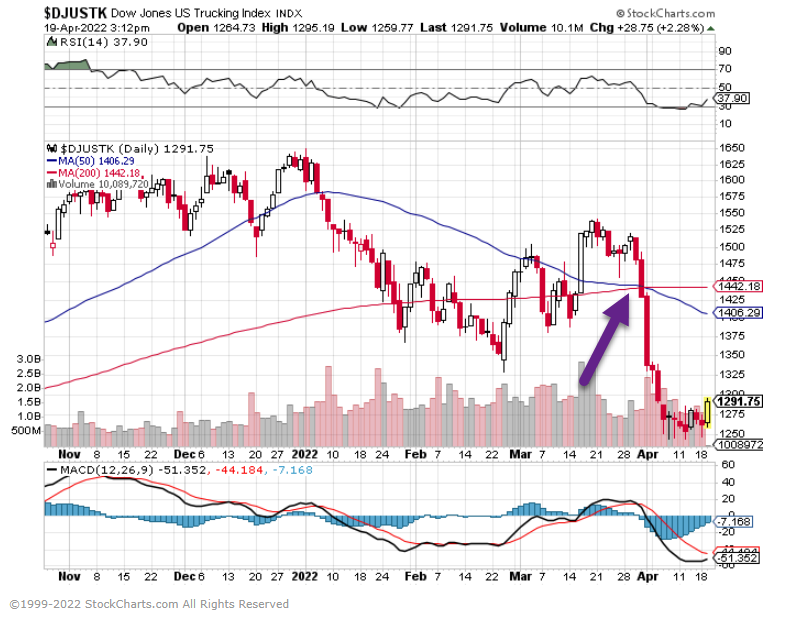
1. Trucking Index -24% Correction.

www.stockcharts.com


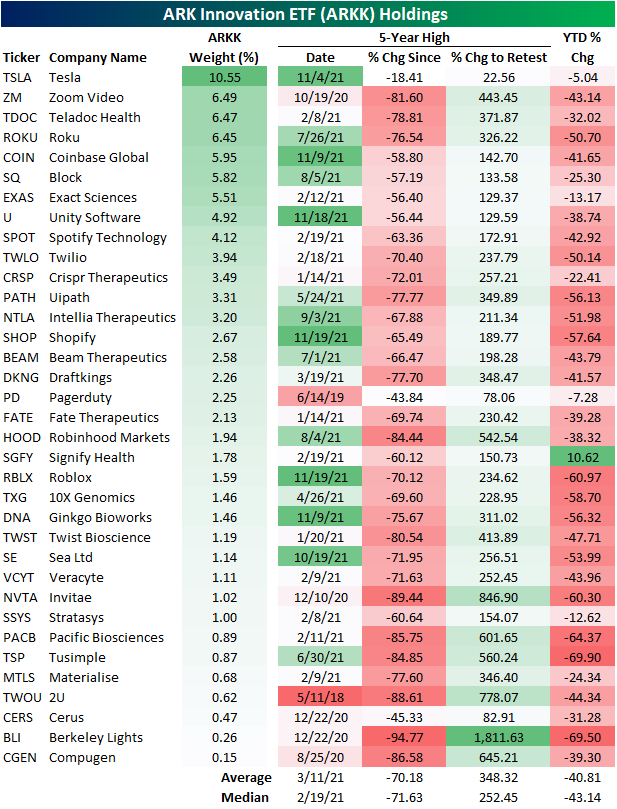
2. ARKK—Average Stock in ETF Needs 348% Rally to Get Back to Prior Highs

Bespoke Investment Group–With the average ARKK stock down 70% from its 5-year high, it’s going to take a huge rally in the “growth” space to get back to prior levels.  As shown at the bottom of the table, the average stock in the ETF now needs to rally 348% to get back to prior highs!

https://www.bespokepremium.com/interactive/posts/think-big-blog/average-ark-innovation-arkk-stock-down-70-from-5-year-high


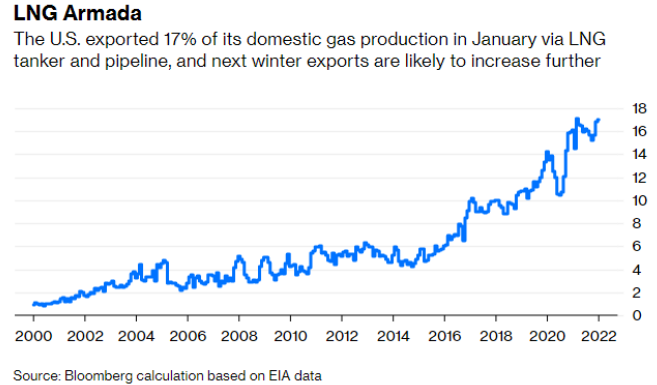
3. U.S. Exported 17% of Domestic Gas Production in January

Dave Lutz at Jones Trading-US natural gas prices have jumped to a 13-year high as America exports a record share of its domestic output – For President Biden, that’s a success as the US helps Europe to replace Russian gas, but also his next energy headache


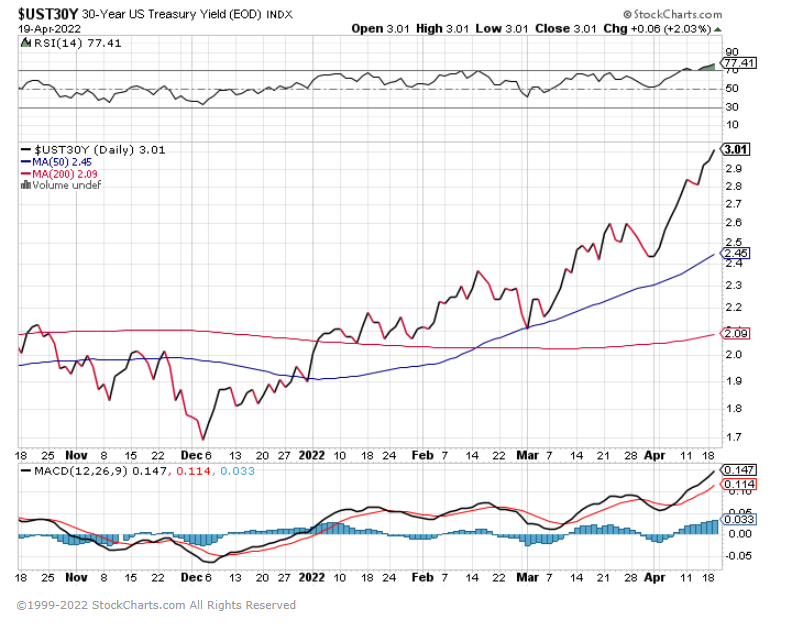
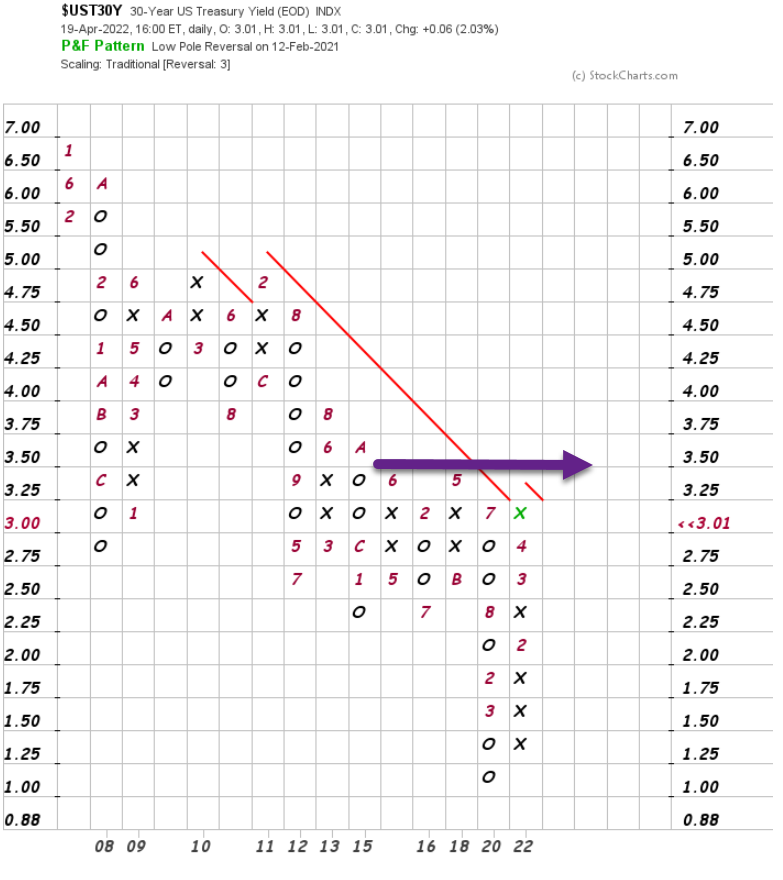
4. U.S. 30 Year Treasury Closes Above 3%

Hitting 7-Year Highs

www.stockcharts.com


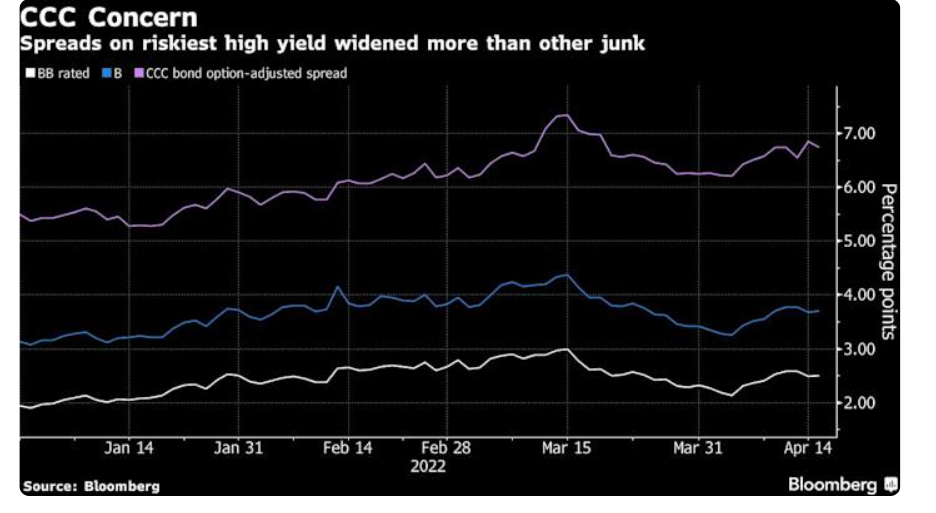
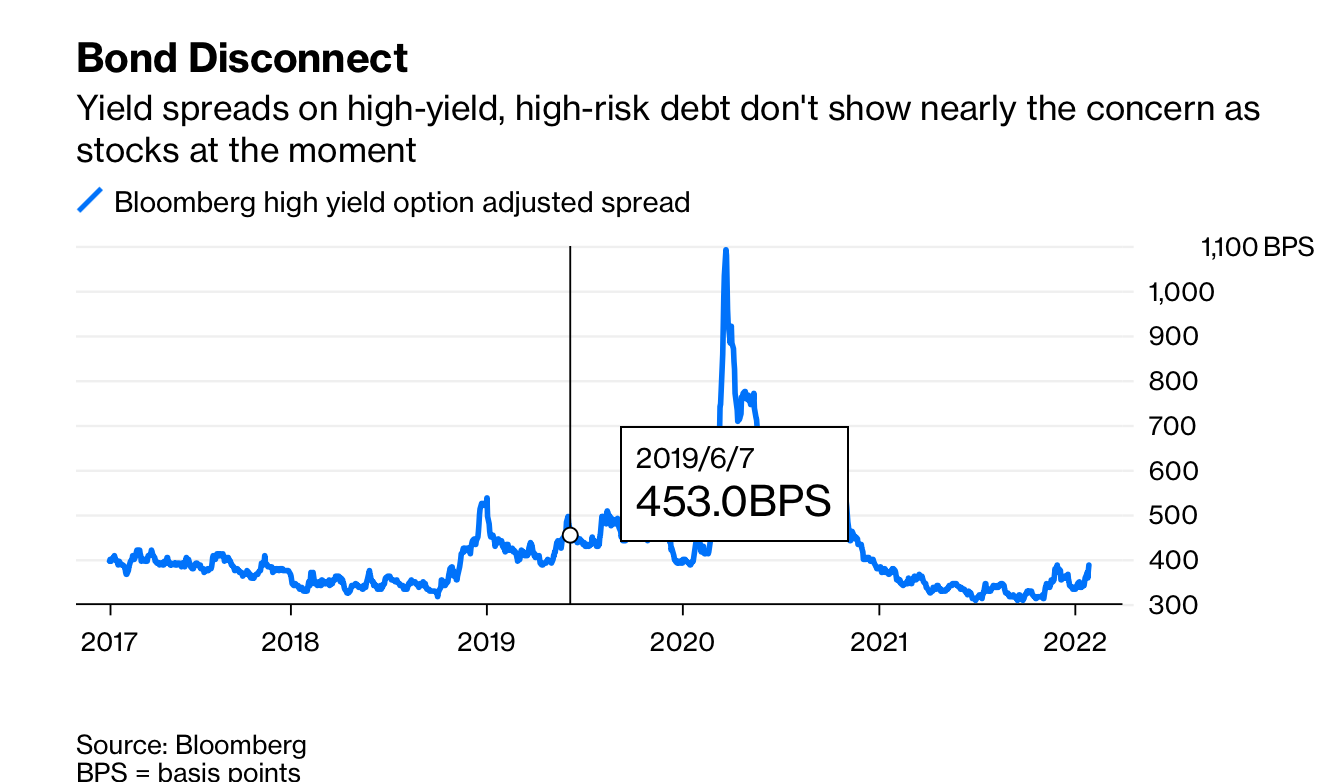
5. Spreads in CCC Bonds have Widened 125 Basis Points this Year….50 bps. This Week.

Bloomberg-Spreads on CCC-rated debt — bonds most at risk for a default should the economy falter — have widened 125 basis points this year, compared to 57 basis points for BB rated debt and 69 basis points on average for all junk bonds, according to data compiled by Bloomberg..

Junk deals in the primary market are showing signs of trouble as well. A group of banks led by JPMorgan Chase and Co. and Citigroup Inc. last week struggled to offload over $2 billion of junk debt to help finance the buyout of Oldcastle BuildingEnvelope Inc. The company’s unsecured bond sale — rated in the CCC tier — priced at a steep discount.

Yahoo Finance https://finance.yahoo.com/news/junkiest-junk-bonds-flash-warning-183836509.html


6. The EV Supply Chain is a Problem

Morningbrew-EVs really wishing they had Chucky powers

Photo Illustration: Dianna “Mick” McDougall, Photos: Getty Images, Rivian Forums

The EV battery shortage is about to hurt more than pinching your finger in a car door.

RJ Scaringe, CEO of EV startup Rivian, told reporters on a tour of the company’s Illinois plant last week that the recent semiconductor shortage hampering the auto industry is just a “small appetizer to what we are about to feel on battery cells over the next two decades.” And with EV manufacturers’ lofty production goals, every part of the supply chain is struggling to keep up.

The biggest hiccup starts at the very beginning

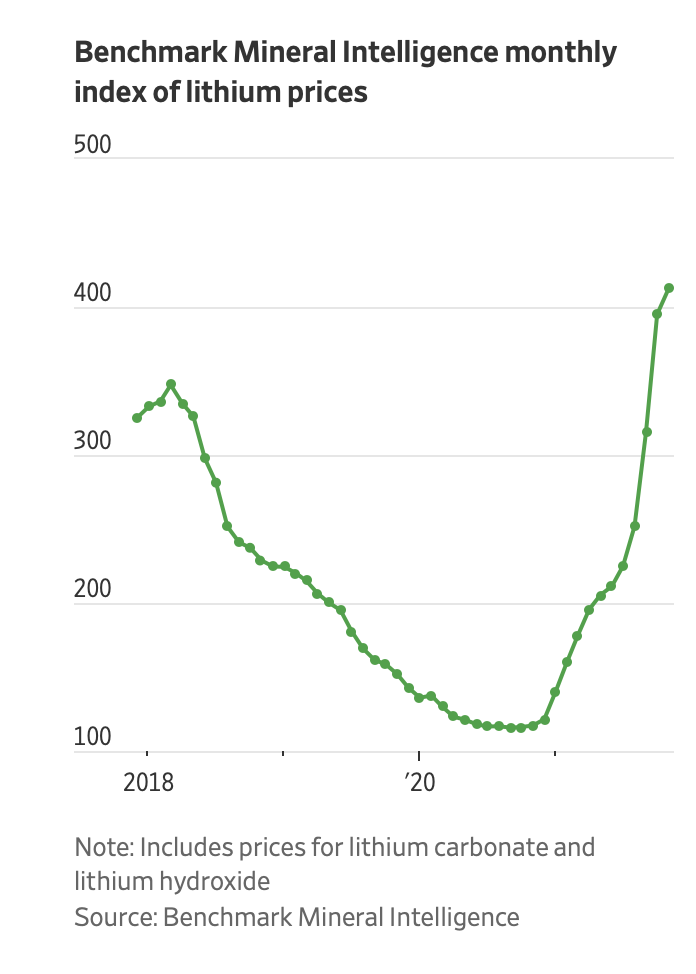
We’re talking raw materials. 80% of the cost of a lithium-ion battery comes from raw materials including lithium (duh), cobalt, and nickel. But as companies scramble to snag those supplies, prices have skyrocketed. The price of lithium alone has gone up over 480% in the last year, according to Benchmark Mineral Intelligence.

  • Tesla CEO Elon Musk said lithium battery prices were so “insane” he might just get into mining himself. You and us both, buddy.
  • And because lithium-ion batteries account for at least 30% of the cost of an EV, higher battery prices are translating to higher prices for consumers. Both Rivian and Tesla have hiked prices recently, saying expensive raw materials are partly to blame.

And those materials are not Made in the USA

In 2020, the US imported over half of its supply of 46 minerals and all its supply of 17, according to the US Geological Survey. One of the biggest suppliers is China—the world leader in lithium-ion battery manufacturing—which has a history of restricting trade for political reasons.

That’s enough to spook the White House, which considers the EV supply chain to be a national security issue. Last month, President Biden invoked the Defense Production Act, which gives the government access to $750 million to invest in domestic mining operations for critical raw materials needed by battery manufacturers. But it could take up to a decade to see new US mining projects or battery plants.

Zoom out: President Biden’s goal is for half of all new cars sold by 2030 to be electric. But given the shortage of materials, that’s like asking MasterChef contestants to make a meal with two footballs and a single noodle. According to Rivian’s Scaringe, “90% to 95% of the supply chain does not exist.”—MM

Want more EV news? We’ve got an entire newsletter focused on emerging technologies. Subscribe here.

https://www.morningbrew.com/daily

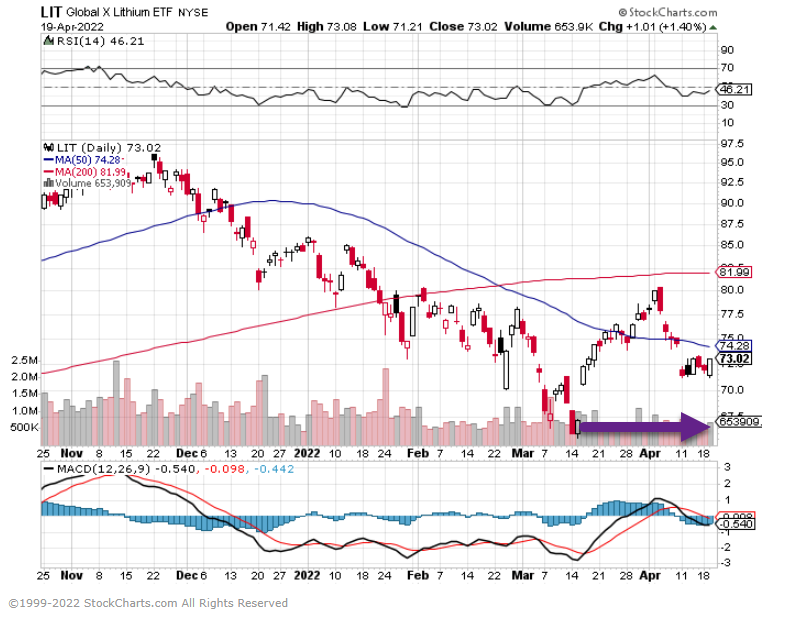
LIT-Lithium ETF

www.stockcharts.com


7. The US is building more homes than it has in 16 years and it could finally be the break buyers need

Business Insider A construction worker works on a new house being built in a suburb located north of Toronto. Mark Blinch/Reuters

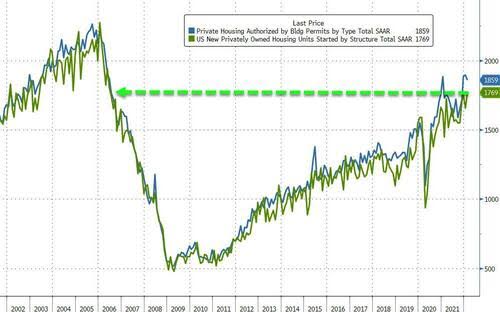
  • Housing starts rose to an annual rate of 1.79 million in March, the Commerce Department said.
  • That beat the median forecast for a pace of 1.75 million and marked the fastest construction since 2006.

Homebuyers, rejoice. Contractors are picking up some of the extraordinary slack in the housing market.

US housing starts unexpectedly rose in March to a seasonally adjusted annual rate of 1.79 million units, the Commerce Department announced Tuesday morning. Economists surveyed by Bloomberg expected starts to fall slightly to a pace of 1.75 million. The March rate marks the fastest since 2006 and a second consecutive monthly improvement.

The jump was fueled by faster construction of multifamily units. The category saw annual construction leap to an annual pace of 574,000 units from the prior month’s reading of 534,000 units. Single-family construction slowed, though still showed the second-fastest pace of construction since March 2021.

Building permits — seen as a helpful forward indicator for residential construction — rose slightly to an annual rate of 1.87 million, according to the report. That similarly beat forecasts that called for a decline to a 1.83 million-permit pace.

The uptick is a welcome sign for Americans struggling to buy a home in the supply-starved market. Home prices surged at breakneck speed early in the pandemic as strong demand quickly pulled nationwide inventory to record lows. Bidding wars on the few homes still available boosted prices even higher. The S&P Case-Shiller Home Price Index — which tracks prices nationwide — rose 19.2% in the year through January, landing just below last year’s record highs and well above the home inflation seen before the market bubble burst in the late 2000s.

The acceleration in home construction is the latest signal the market is on the mend. While the reading is somewhat volatile and the pace of construction could quickly reverse course, the increase hints builders are rushing to meet demand.

The Tuesday report signals a rosy outlook for homebuilders, but firms still see trouble ahead. The National Association of Home Builders’ measure of contractor confidence fell to 77 from 79 in April, the organization said Monday, reflecting a fourth straight monthly decline. Builders cited weakening sales traffic and lingering supply-chain issues for their soured moods. The market now faces an “inflection point,” with sky-high housing costs starting to dent demand just as inventory is on the rise, Robert Dietz, chief economist at NAHB, said in a statement.

Builders will want to move fast before buying activity slows. Mortgage rates have soared roughly 2 percentage points since the end of 2021 as the Federal Reserve has begun raising broad interest rates in an effort to slow sky-high inflation.

That marks one of the fastest mortgage rate rebounds in history. It’s “only a matter of time” before soaring rates bite into housing demand and quickly cool the market, Doug Duncan, chief economist at Fannie Mae, said Tuesday. Still, order backlogs, strong profits for homebuilders, and the lack of existing supply should keep construction “resilient” in the near term, he added.

Rising mortgage rates will almost surely slow the construction boom later in the year as contractors aim to keep the supply-demand balance in their favor. But the March building data suggests supply is bouncing back, and that the homebuying nightmares of the past year might not be so common through 2022.

https://www.businessinsider.com/housing-starts-march-home-construction-real-estate-market-supply-recovering-2022-4


8. Russia seizes eastern Ukraine city of Kreminna, official says

Axios Ivana Saric

Axios on facebook

Axios on twitter

Axios on linkedin

Axios on emailThe Russian military has seized the city of Kreminna in eastern Ukraine and forced Ukrainian troops out of the town, the governor of the Luhansk region said at a briefing Tuesday, per Reuters.

Why it matters: Kreminna appears to be the first city Russian forces have taken since they launched a new offensive in the Donbas region Monday — a development that marked the start of a second phase of the war centered on a battle for territory in eastern Ukraine.

What they’re saying: Russian forces entered Kreminna after launching an attack “from all sides” to take control of the city, according to Gov. Serhiy Gaidai.

  • “Our defenders had to withdraw. They have entrenched themselves in new positions and continue to fight the Russian army,” he added.
  • “It is impossible to calculate the number of dead among the civilian population,” he added. “We have official statistics — about 200 dead — but in reality there are many more.”
  • Gaidai did not specify how long it took Russian forces to establish control of the city, or the length of the period in which the death toll was incurred, per Reuters.

The big picture: Heavy shelling was reported Monday alongside nearly the entirety of the 300-mile frontline in eastern Ukraine, including the Kharkiv, Donetsk and Luhansk regions, according to Oleksiy Danilov, the secretary of Ukraine’s National Security and Defense Council.

Ukrainian President Volodymyr Zelensky on Sunday stressed the importance of the battle of Donbas, which he said could “influence the course of the whole war.”

Data: Institute for the Study of War; Map: Jared Whalen/Axios


9. Top Ranked Universities for Producing Start-Up Founders

Pitchbook

https://pitchbook.com/news/articles/2021-pitchbook-university-rankings-top-50-colleges-founders


10. One Way to Create Good Habits that Actually Stick

Psychology Today Why you should use situational cues when planning for the future.– Mark Travers Ph.D.


KEY POINTS

  • Research suggests that thinking about performing a certain behavior in a certain situation, and mentally linking the two, can create new habits.
  • Strategically linking an intention to a situation can help people remember that intention.
  • People high on the personality dimension of conscientiousness are particularly good at executing this type of if-then thinking.


A new study published in PLOS ONE explains how one can make long-term behavioral changes by using ‘if-then’ action planning instead of relying purely on motivation or willpower.

“Habits result from repeated past experiences of executing a specific behavior in a particular situation,” says psychologist Torsten Martiny-Huenger from UiT The Arctic University of Norway. “An open question, however, is how novel behaviors become habits. We do not have the prior experiences that make them habitual. So, how are they formed?”

The researchers hypothesized that people create new habits by thinking about performing a certain behavior in a certain situation — in other words, by creating stimulus-response links in thought.

According to Martiny-Huenger, people usually take one of three approaches when executing an action intended for the future. Here’s an example:

Suppose you agree to do a friend a favor — for example, sending a web address that you have as a bookmark on your home computer. You can’t access the bookmark right away. How are you able to complete the task some hours later? Here are three possibilities:

1.   The first approach is to verbally repeat it to yourself continuously (i.e., keep it active in working memory). However, given the many demands of our daily life, it is unlikely that we can remain focused in such a way for a prolonged amount of time.

2.   Researchers in prospective memory provide another possible mechanism. They suggest that such an intention (sending the bookmark later) activates a monitoring process that we are only minimally aware of. However, it is hard to test whether a subconscious monitoring process exists or not.

3.   The third alternative depends on the brain’s ability to form associative links. The intention to send the web address may be linked to a situational cue. For example, while reading emails on your home computer, the friend may be referred to in one of the emails (situational cue). This cue then triggers the recollection of having to send the bookmark.

The authors found evidence to suggest that the third possibility is the primary method through which memories are prompted and new habits are formed. Furthermore, they suggest this method can be used strategically by people to improve memory and habit formation.

For example, when receiving the web address request, one can think repeatedly, “the next time I start my home computer, I’ll first send my friend the web address.” Instead of relying on some coincidence to remind one about the intention, one can strategically link the intention to a situation.

article continues after advertisement

“Research indicates that making such if-then plans — which are nothing more than verbal situation-response links — facilitate remembering,” explains Martiny-Huenger.

The researchers also found that people high on the personality dimension of conscientiousness were particularly good at executing this type of if-then thinking. This is not terribly surprising, according to Martiny-Huenger, as conscientiousness is characterized by habitual planning behaviors like making lists and using a calendar.

“Our interpretation of this result is that thinking in a situation-response format is one of the cognitive procedures that conscientious people are habitually doing,” says Martiny-Huenger. “This intuitive use of a beneficial strategy contributes to being more successful in day-to-day self-regulation.”

From a practical perspective, when dealing with behaviors we cannot execute right away, the authors advise people to rely less on motivation and willpower and more on associative cues.

“The practical advice is to link the intended behavior to situational cues that provide good opportunities to initiate them,” says Martiny-Huenger. “When you want to get a little more physically active, for instance, then repeatedly think to yourself, ‘When I’m waiting in front of the elevator, I’ll turn around and use the stairs.’ Such if-then planning is not magic and it will not lead to successfully implementing the intended behavior every time, but it will increase the likelihood of completing them.”

https://www.psychologytoday.com/us/blog/social-instincts/202204/one-way-create-good-habits-actually-stick?collection=1174449

Topley’s Top 10 – April 13, 2022

1. The Last 14 Years 91% Correlation Between Fed’s Balance Sheet and S&P

Fed has started process of unraveling the balance sheet

Barrons-All of Fed Choir Finally Is Singing From the Same Anti-Inflation HymnalRandall W. ForsythFollow  https://www.barrons.com/articles/federal-reserve-inflation-rate-hikes-51649460331?mod=past_editions


2. Software ETF Still -27% from Highs.

Software ETF multiple rallies in last 3 months have failed

www.stockcharts.com


3. Contra Indicator? The Share of Investors Expecting the Economy to Deteriorate is the Highest Ever

From Dave Lutz at Jones Trading–GLOOMY– Global growth optimism has sunk to an all-time low, with recession fears surging in the world’s investment community, according to the latest BofA fund manager survey – Fund managers expect the Fed to hike seven times this year, up from four times in last month’s survey, and the tightening cycle to end in April 2023.  Investors are very long cash, commodities, healthcare and energy, and materials while they shun bonds, discretionary and euro-area stocks  The share of investors expecting the economy to deteriorate is the highest ever, according to the April survey. Stagflation expectations jumped to the highest since August 2008, while monetary risk increased to a historic high, BofA strategists said, after surveying 292 panelists with $833 billion in assets under management in the first week of April.


4. Commodities in a Sideways Holding Pattern

Commodities sideways on possible recessions and China lock-down

www.stockcharts.com


5. Crypto not Holding Up to “Digital Gold” Title…..Bitcoin 90day Correlation to Nasdaq 100 Hits New High

The Daily Shot Blog Cryptocurrency: In the crypto-sphere, Bitcoin’s 90-day correlation with the Nasdaq 100 reached a new high, which comes as Bitcoin fell through the bottom end of its 50-day moving average.

Source: CoinDesk, Koylin  Read full article

https://dailyshotbrief.com/the-daily-shot-brief-april-12th-2022/


6. Inflation-Car and Meat Prices can Revert to the Mean without Recession

LPL Research


7. Housing Holds Up Well During Inflation and Rising Rates

Ben Carlson Blog-Plus housing has held up well historically when mortgage rates rise, especially during periods of high inflation:

https://awealthofcommonsense.com/2022/04/is-the-fed-is-making-a-mistake/


8. This US airport has reclaimed its title as the world’s busiest-CNN

Marnie Hunter, CNN

US airports dominated the passenger traffic rankings in 2021, with eight of the top 10 in the United States.

World’s top 10 busiest airports for passenger traffic in 2021

1. Atlanta (ATL): 75.7 million passengers, up 76% from 2020

2. Dallas/Fort Worth (DFW): 62.5 million passengers, up 59% from 2020

3. Denver (DEN): 58.8 million passengers, up 74% from 2020

4. Chicago O’Hare (ORD): 54 million passengers, up 75% from 2020

5. Los Angeles (LAX): 48 million passengers, up 67% from 2020

6. Charlotte (CLT): 43.3 million passengers, up 59% from 2020

7. Orlando (MCO): 40.4 million passengers, up 87% from 2020

8. Guangzhou (CAN): 40.3 million passengers, down 8% from 2020

9. Chengdu (CTU): 40.1 million passengers, down 1.5% from 2020

10. Las Vegas (LAS): 39.8 million passengers, up 79% from 2020

World’s busiest airports in 2021: Atlanta reclaims title | CNN Travel


9. Carjackings in Chicago +204% 2019 to 2021

Carjackings rose only 34 percent in Chicago from 2010 to 2019 but skyrocketed 204 percent from 2019 to 1,836 in 2021.

https://www.zerohedge.com/political/stunning-rise-chicago-carjackings-leaves-lawmakers-scrambling


10. How to Increase Your Self-Control

Barriers to patience and ways of overcoming them.

Posted April 12, 2022 |  Reviewed by Ekua Hagan

THE BASICS

KEY POINTS

  • Two barriers to waiting for “larger-later rewards” (rather than “smaller-sooner rewards”) are the lack of ability and the lack of desire to wait.
  • Techniques to increase the ability to wait include distraction, reframing, putting oneself in a positive mood, and using reminders.
  • Techniques that strengthen the desire to wait include exaggerating a delayed reward’s value and waiting before choosing.

Suppose you are told you can have either two marshmallows now or four later. Which do you choose? (Or replace “marshmallows” with a more attractive reward, like “a million dollars!”). No matter what the reward, the choice is between a smaller-sooner reward and a larger-later one.

So, how to decide? More generally, how do you decide whether to obtain what you desire presently or make sacrifices for something better in the future—like saving for retirement, or for a nice vacation, car, or home?

The answer depends on both your ability and desire to exercise self-control, argues a recent paper by Roberts and Fishbach, published in the April issue of Trends in Cognitive Sciences.

The paper, which reviews research on how to increase both the ability to wait and the desire to wait, is summarized below.

Increasing the ability to wait

To increase the ability to wait and improve patience, you need to make it easier to be patient. How? Here are some suggestions:

1.   Distract yourself. If you are sitting by the phone waiting for a call, for example, turn on the TV, listen to music, or find other ways of entertaining and distracting yourself.

2.   Do not make big decisions in a need state (e.g., feeling thirsty, exhausted, in pain). For instance, do not shop for food when hungry or respond to a critical email when tired. Otherwise, you may find it very difficult to resist whatever is immediately rewarding (e.g., buying junk food, sending a vicious response to the critical email).

3.   Pre-commit to being patient. In other words, long before you are faced with temptations, make the decision to wait for the larger-later reward.

4.   Use reminders for the steps you must take to receive the larger reward. Without reminders and a plan, it becomes tempting to choose an immediate option just to have closure (e.g., doing your Christmas shopping now just to cross it off the list instead of waiting and buying better gifts when the desired items go on sale).

5.   Put yourself in a positive mood. Research shows it is easier to be patient when you are happy than sad.

6.   Reframe the thing you are waiting for in a way that reduces its emotional appeal. While waiting for, say, hot chocolate, reframe it as a black liquid—not a hot, sweet, creamy, and rich drink.

article continues after advertisement

Increasing the desire to wait

To improve patience by increasing the desire to wait, find ways to make waiting worth it. How? Consider these:

1.   Wait before making a choice (“wait-to-choose technique”). For instance, looking over a restaurant menu at home may increase your appreciation for dishes that usually take longer to prepare (i.e. larger-later reward). Note, the wait-to-choose technique differs from Number 3 in the previous section; specifically, the current strategy introduces extra time before, not after, one has made a choice.

2.   Increase your level of certainty and trust, the belief that you will receive the larger reward if you are patient. This is important because as the wait becomes longer, uncertainty naturally increases.

3.   Improve the personal connection to your future self—the self who will benefit from your patience (be it in 10 days or 10 years). A stronger psychological connection to this future self increases motivation to, say, study hard and finish college or save money for retirement.

4.   Change how the options are framed, so the delayed outcome appears more valuable. For example, another way of saying you could have “$10 now or $20 later” is to say you could have “$10 now and $0 later, or $0 now and $20 later.” When options are framed in the second way, people are often more willing to wait.

Concluding thoughts on the importance of self-control and patience

Willpower and self-control are associated with a variety of positive outcomes, such as improved health, better relationships, and greater success in achieving goals.

It is usually assumed the ability to self-control is what matters the most in making good decisions—in choosing between a smaller-sooner and a larger-later reward. We assume: If people can wait, they will.

In reality, however, it is difficult to be patient if the waited-for-object is not considered valuable or desired.

The difference between desire and ability to self-control is important because so often in life we are faced with difficult choices between a smaller-sooner and a larger-later reward. Some examples are:

·  Choosing a medical treatment that works immediately but is less effective overall, or an intervention that may take longer to work but is more effective.

·  Getting a low-paying job now, or focusing on your studies for the next few years to get a better job after you graduate.

·  Going on your usual summer vacation next week, or saving money for a couple of years to go on your dream vacation and travel the world.

Regardless of the options you are faced with, to increase patience, you must analyze the situation and find what is preventing you from exercising self-control.

The research reviewed showed self-control and patience may require, in some situations, the ability to wait, and in others, the desire to wait. And as we discussed, there are techniques to improve self-control in both situations.

In summary, if you cannot wait, this means self-control is difficult. So, make it easier by using the six techniques listed above, such as distraction or reframing.

If you can but do not want to, then waiting does not appear to be worth it. Solution? Make waiting more rewarding by using one of the four strategies described, like using the wait-to-choose technique or increasing your certainty about eventually receiving the reward.

https://www.psychologytoday.com/us/blog/finding-new-home/202204/how-increase-your-self-control

Topley’s Top 10 – April 12, 2022

1. U.S. Bonds Vs. Inflation

The Worst Quarter in Years for Bond Fund Investors Had Few Bright CornersBy Evie LiuFollow https://www.barrons.com/articles/bond-funds-worst-quarter-51649428107?mod=past_editions


2. Inflation Adjusted Yield on 10 Year Treasury Breaks thru 1975 and 1980 Lows

Remember all those charts on record negative yielding debt….$18T to $3T

https://cms.zerohedge.com/s3/files/inline-images/2-3-768×309.png?itok=mWOTtlCx


3. Spread between 2 Year Treasury and S&P Dividend Yield is now the widest it has been in fourteen years since the Financial Crisis

Corporate Profits After Tax Hit Record

Bespoke Investment Group BABY’s Back-Since mid to late-2019 when interest rates really started to fall, the dividend yield on the S&P 500 consistently provided a higher yield than the two-year US Treasury.  With a higher payout plus the potential for price appreciation, equities looked more attractive to many investors. The period from the Financial Crisis through 2017 also saw a similar setup where the S&P 500’s dividend yield was higher than the yield on the 2-year, but before the Financial Crisis and the FOMC’s zero-interest-rate policy, it was extremely uncommon for the S&P 500 to yield more than the two-year Treasury.  This year has caused a tidal shift in the balance of power in yield between the S&P 500 and the two-year Treasury.  As the Fed came to the conclusion that inflation wasn’t as transitory as originally thought and found itself behind the inflation curve, it shifted from a much more accommodative stance to one that was more biased towards tightening, and that shift resulted in one of the most rapid increases in two-year Treasury yields in decades.  In the process of this spike in rates, back in February, the yield on the two-year rose back above the dividend yield of the S&P 500 for the first time since 2019.

As Treasury yields have continued to spike, the premium in yield of two-year Treasuries relative to the dividend yield of the S&P 500 reached an important milestone last Friday (4/8).  As shown in the chart below, the spread between their yields widened out to 110 basis points (bps), taking out the high of 108 bps from 2018.  At these levels, the spread between the two is now the widest it has been in fourteen years since the Financial Crisis.  It started with long-term Treasury yields, but as the overall trend in rates has been higher, most of the Treasury yield curve is now yielding more than the S&P 500.  For years now, investors have had a TINA (There Is No Alternative) relationship with the stock market, but as interest rates have shot higher, TINA is taking a backseat to BABY (Bonds Are Better Yielders).

https://www.bespokepremium.com/interactive/posts/think-big-blog/babys-back


4. High Yield ETF-After Sell Off Back to Yielding 5%

www.stockcharts.com


5. Long-Term Chart of Pro Shares Short 20 Year Treasury …..Big Rally but it was at $52 Post GFC


6. The U.S. Attracted Chinese IPOs by Offering Insiders More Favorable Rules than U.S. Based Management

WSJ-Executives and other major shareholders at American companies have to disclose their trades within two days in a filing that is posted on the Securities and Exchange Commission’s website and freely available to investors. That may deter bad behavior: Nobody wants the investor or media scrutiny that comes along with share sales that may, in retrospect, appear perfectly timed, the researchers say.

\But in the early 1990s, in part to entice foreign companies to list on U.S. exchanges, regulators exempted their executives and major shareholders from that rule. Instead, their trades are reported on paper forms and mailed to the SEC’s headquarters in Washington, where they are stored in filing cabinets for three months—technically available to curious investors with time on their hands, but effectively shielded from view.

By Liz HoffmanFollow andTom McGintyFollow https://www.wsj.com/articles/chinese-executives-sell-at-the-right-time-avoiding-billions-in-losses-11649164573#:~:text=Chinese%20corporate%20insiders%20have%20avoided,academic%20analysis%20of%20securities%20filings.

https://www.financialmirror.com/2021/08/04/chinese-ipos-raised-12-5-bln-in-1h-2021-more-than-all-2020/


7. Tech Insider Selling 2021


8. Stock Splits Add Very Little but Performance has been Impressive Post Event

Stock Splits Actually Work—Just Not for the Reason Everyone ThinksBy Nicholas JasinskiFollow https://www.barrons.com/articles/stock-splits-2022-51649455281?mod=past_editions


9. Food Inflation

Chartr-Global food prices have just hit a new high, as the food price index from the UN Food and Agricultural Organization rose 12.6% in a single month to notch its highest ever recorded level.

Food prices were rising before Russia’s invasion of Ukraine, and the disruption has only compounded the problem as both countries are a key source of supply in a number of food markets. Between them Russia and Ukraine account for around 30% of global wheat exports, and 20% of global maize, while Ukraine is also the world’s biggest supplier of sunflower seed oil.

All told the supply disruptions have meant the sharpest rises in global cereal and cooking oil prices, with both indices rising 17% and 23% respectively in the last month. The price rises are expected to hit poorest countries hardest, where food makes up a larger proportion of individual spending.

www.chartr.com


10. 30% of Workers Hitting Peak Hours at 10pm vs. 9am

The Atlantic-Apparently Last week, Microsoft published a study that offers an eerie reflection of my working life. Traditionally, the researchers said, white-collar workers—or “knowledge workers,” in the modern parlance—have had two productivity peaks in their workday: just before lunch and just after lunch. But since the pandemic, a third and smaller bump of work has emerged in the late evening. Microsoft’s researchers refer to this phenomenon as the “triple peak day.”

A new study shows some workers experience a third productivity peak late in the evening (Microsoft)

For the new study, workers allowed Microsoft to track their “keyboard events”—a funny euphemism for sending emails or engaging with productivity applications on a work computer. While most people didn’t show a third mountain of work in the evening, 30 percent did. They were working almost as much at 10 p.m. as they were at 8 a.m.  This Is What Happens When There Are Too Many Meetings-Why a 9-to-10 is the new 9-to-5 By Derek Thompson https://www.theatlantic.com/newsletters/archive/2022/04/triple-peak-day-work-from-home/629457/

Topley’s Top 10 – April 11, 2022

1. Corporate Profits After Tax Hit Record

Peak?

Philip Van Dorn Marketwatch

https://www.marketwatch.com/story/heres-how-you-can-play-it-safe-with-your-investments-as-interest-rates-rise-11649350072?mod=home-page


2. First Quarter ETF Winners and Losers

https://www.nasdaq.com/solutions/nasdaq-dorsey-wright


3. Natural Gas About to Break Out of a 15 Year Sideways Box

www.stockcharts.com


4. 10 Year Real Yield Still Negative but Highest Since March 2020

https://www.bloomberg.com/news/articles/2022-04-06/stocks-set-to-decline-on-fed-fallout-crude-lower-markets-wrap?sref=GGda9y2L


5. Two Defensive Sectors Big Pharma and Utilities Start Outperforming Transports

When defensive sectors start outperforming economically linked sectors like transports, it can sometimes point to a slowdown.  This chart show PPH Big Pharma ETF vs. Dow Transports.

Another defensive sector Utilities outperforming Dow Transports

www.stockcharts.com


6. Vanguard Consumer Spending ETF VCR…50 day thru 200 day to downside…

VCR-bounced back to 200 day and reversed back down….This will be tell on how inflation affecting consumers.

www.stockcharts.com


7. Small Cap Tech vs. S&P

Callum ThomasBig Trouble in Small Tech:  Seems small cap tech stocks are struggling to keep up. For that matter, small caps in general have been a picture of weakness, and tech still seems vulnerable. I would call this breakdown here a red flag.

Source:  @adaptiv         https://www.linkedin.com/pulse/weekly-sp500-chartstorm-10-april-2022-callum-thomas/?trk=eml-email_series_follow_newsletter_01-hero-1-title_link&midToken=AQFjhnSMpoKQvw&fromEmail=fromEmail&ut=3v3v3jedfgxac1


8. Top 10 Stocks by Market Cap Make Up 25% of the Entire U.S. Market

Steve Blumenthal CMG Wealth How About the Top 10 Stocks?-The top ten stocks make up 31.4% of the value of the S&P 500 Index, 25% of the entire U.S. stock market, and ~ 14% of the entire value of the global stock market.

Rhymes, indeed.

https://www.cmgwealth.com/ri/on-my-radar-signup/


9. China 1980 vs. 2020….See Urbanization.

Capital Group 40 years of explosive growth

Sources: Capital Group, CEIC Data, IMF, The World Bank. *Data for number of private enterprises as of 1988 and 2018. RMB represent Chinese renminbi.

China’s manufacturing engine climbs the value chain

Source: Capital Group, based on reports from Euromonitor, SNE Research and company filings. Data is as of May 2021 and reflects approximate figures.

https://www.capitalgroup.com/advisor/insights/articles/investment-lessons-40-years-china.html?sfid=1988901890&cid=80722185&et_cid=80722185&cgsrc=SFMC&alias=D-btn-LP-6-A1cta-Advisor


10. You Are Perfectly Suited To Be Yourself

I don’t know if you have noticed, but most of our dilemmas begin with some type of ignorance or deception. Have you ever been told that if you set your mind to it you could achieve anything? That’s a lie. For a long time, I believed it. This is the lie that creates the great psychological fault line in the development of young men and women in our society. And once the fault line is there, it’s only a matter of time before the earthquake. Looking back on my childhood, I have identified one consistent and repetitive untruth that I was told. My brothers were misled in the same way, as were my friends.


The people who told us this lie thought they were helping us. They wanted only to encourage us. On the surface, it seemed like the good and noble thing to do, but the damage that was being done was below the surface. The lie has several versions: “You can do anything you set your mind to” and “You can be whatever you want to be as long as you work harder than anyone else” and “You can have anything if you want it bad enough.”


At first I was young, and young people tend to believe people who are older and have some kind of authority over them—parents, teachers, coaches, older brothers and sisters, even babysitters. So at first I believed the lie. I set my mind to things and failed. I wanted things badly and failed.


And with these failures came feelings of inadequacy and self-loathing, feelings that as a young man I was too proud to talk to anyone about, so I could only bounce them around inside myself without any hope of figuring them out. In the years since, I have seen this same phenomenon in my brothers and friends, and now I see it in the young people I work with in high schools and colleges. They apply themselves with all the strength of their will and the focus of desire, and they come up short.


Self-doubt begins to plague them. They review the steps they took. They seem sure that they “set their mind to it” as they had been encouraged to do. They did the best they could, but still they failed. They followed those golden maxims set out for them by their teachers, parents, coaches, mentors, professors, and employers… and still they fell short. Sometimes we fail at things because we are simply not well suited to them. But we are seldom told such things when we are young, and our minds are like sponges. People keep telling us that we can do anything if we set our minds to it. These maxims are so absolute and so often reinforced that when we follow them and fail, we are left with only one conclusion: There must be something wrong with me. Here begins the great wrestle with self-doubt, insecurity, inadequacy, and self-loathing. Many of us struggle with these feelings our whole lives, consciously or subconsciously. Most of us struggle with them semiconsciously. We know that they are there, that they are affecting us, but we don’t know what to do with them or about them. These feelings affect our relationships, the way we progress professionally, the way we manage our time, the way we plan for the future, and the way we dream or don’t dream. If the lie is that you can do anything you set your mind to, then what is the truth? Some would say cynically, “You can’t do anything you set your mind to.” But they too would be wrong. The truth is this: We are capable of extraordinary things, but each of us is different. Our unique abilities make us better suited for some things than for others. What does that mean to you? It means that you can’t do any- thing you set your mind to and that that doesn’t make you bad or deficient—just human. It is finding the things that you are better suited for that is one of the great adventures of this life and the source of a great deal of happiness. You cannot do anything you set your mind to. If you are four feet tall, you are not well suited to become the next legendary basketball player. But you are still perfectly suited to be yourself. The real question is this: What are you well suited to achieve and become? Matthew Kelly From Perfectly Yourself Click Here to get your copyhttps://www.matthewkelly.com/post/they-lied-to-you

Topley’s Top 10 – April 07, 2022

1. Global Bonds Slump to a Discount for First Time Since 2008

Finbarr Flynn

(Bloomberg) — A gauge of global bonds dropped below a key fixed-income watermark after Federal Reserve Governor Lael Brainard signaled a quicker-than-expected rundown of the central bank’s debt holdings.

The Bloomberg Global Aggregate Index fell below a measure of so-called par value Tuesday, with its price falling to 99.9 — under the key 100 level at which bonds are often sold to investors. It’s the first time since 2008 that the gauge has traded at a discount to face value.

Global investors have fled the bond market this year, as skyrocketing inflation forced many central banks to accelerate plans for rate hikes to try and cap rising prices. The index — which contains government and corporate debt — has fallen 7.4% so far this year — a drop in market value of some $4.6 trillion, according to data compiled by Bloomberg.

Brainard called the task of reducing inflation pressures “paramount” and said the Fed will raise interest rates steadily while starting balance sheet reduction as soon as next month.

Stock, Credit Markets Too Calm Ahead of Fed QT, Funds Say

Treasuries extended a slump Wednesday, pushing the benchmark 10-year yield past 2.6% to the highest since 2019.

https://finance.yahoo.com/news/global-bonds-slump-discount-first-065315087.html


2. U.S. Stock Buybacks Drop to Lowest in 5 Years

From Dave Lutz at Jones Trading-U.S. stock buybacks dropped to the lowest in five years in the first quarter, providing evidence of a reversal in the multi-decade bullish trend for equities, according to BofA – While buybacks typically slow at the end of each quarter ahead of the earnings season, spending by S&P 500 firms on share repurchases as a percentage of market capitalization fell to its lowest since the first quarter of 2017


3. U.S. vs. Rest of World…Valuation Spread Historical Event

This is the U.S. divided by the rest of the world …2 std. deviation event…Double 1999 bubble.

Courtesy of Animal Spirits Podcast  https://theirrelevantinvestor.com/2022/04/06/animal-spirits-long-global-short-usa/


4. U.S. Households Net Worth Relative to Consumption Straight Up…Cushion for Recession Watch.

For now, strong household balance sheets are expected to be a tailwind for spending.

Source: Gavekal Research

The Daily Shot https://dailyshotbrief.com/the-daily-shot-brief-april-6th-2022/


5. Crude Pulls Back Toward Major Support


6. Chinese Executives Sell at the Right Time, Avoiding Billions in Losses

WSJ–Consider a trade in Alibaba Group Holding Ltd. BABA -2.99% stock in 2020. In October of that year, Alibaba’s payments affiliate, Ant Group Co., was preparing for its initial public offering, a move that would have likely increased the value of Alibaba’s one-third stake.

Then Alibaba’s founder, Jack Ma, criticized Chinese regulators in a speech that infuriated government leaders, who scuttled the listing. Alibaba shares fell 8% on the New York Stock Exchange the day the announcement was made, Nov. 3, 2020.

Chinese tech stocks popular among U.S. investors have tumbled amid the country’s regulatory crackdown on technology firms. WSJ explains some of the new risks investors face when buying shares of companies like Didi or Tencent. Photo Composite: Michelle Inez Simon

The day before that announcement, an entity controlled by an Alibaba insider sold $150 million of Alibaba stock, according to filings. It isn’t known exactly who controls the entity, Sky Scraper Enterprises Ltd., but whoever it is was one of the company’s best-paid executives in recent years and had been granted huge swaths of stock as compensation, the Financial Times previously reported. The sale avoided hundreds of millions of dollars of losses when the stock dropped on news of the scuttled IPO.

The filing said the trade was made under a Rule 10b5-1 trading plan that was adopted two months earlier. Such plans are supposed to be adopted when an insider doesn’t have nonpublic information that might affect the stock price, and executives can’t direct stock sales after it is in place. A spokeswoman for Alibaba said the company’s plans require a period of up to 60 days before trading can begin.

How’s That October 2020 Insider Sale Look…Top tick $300

Chinese Executives Sell at the Right Time, Avoiding Billions in Losses – By Liz HoffmanFollowTom McGintyFollow

https://www.wsj.com/articles/chinese-executives-sell-at-the-right-time-avoiding-billions-in-losses-11649164573?mod=itp_wsj&ru=yahoo


7. Volatility Index Non-Event Around Fed Speak


8. Carnival records busiest week in company history

Ihsaan Fanusie—Carnival Cruise Line (CCL) recorded its biggest booking week in company history last week as demand for luxury cruises continues to skyrocket.

The company announced that 22 of its 23 ships are back in operation now after many of the ships were out of operation following the pandemic. With covid hospitalizations decreasing and the 7-day moving average for new cases on the decline in the US, consumers feel more comfortable embarking on cruises.

“So where we are right now is in almost a transition period where it continues to come down,” Director of the National Institute of Allergy and Infectious Diseases Dr. Anthony Fauci told Yahoo Finance Live last week. “The CDC has pulled back on some of the recommendations for indoor masking. And yet, in the next week or two, we will see soon whether we are going to see an increase.”

The Centers for Disease Control (CDC) updated its guidelines for cruise travel on March 30, removing the “Cruise Ship Travel Health Notice” that it has uploaded on its website following a spread of COVID-19 variants across the world. Back in January, the CDC had given cruise ships a Level 4 warning, the highest level possible.

Carnival wasn’t the only cruise line to record significant bookings increases. Virgin Voyages, the cruise line operating under the parent conglomerate Virgin Group, also experienced higher demand after the CDC announcement.

“There’s incredible pent-up demand,” McAlpin, the president as well as chief executive of Richard Branson’s cruise line, told Yahoo Finance in an interview. “We are starting to see it. Bookings are up significantly, 125% over just January levels. Last week, we had a record booking week and we are gonna surpass that this week.”

Ihsaan Fanusie is a writer at Yahoo Finance. Follow him on Twitter @IFanusie.

https://finance.yahoo.com/news/carnival-records-busiest-week-in-company-history-210654882.html


9. The Richest People in the World.

https://www/visualcapitalist.com/richest-people-in-the-world-2022/


10. To Be a More Decisive, Persuasive, and Effective Boss, Science Says First Take a Look at the Clock

Research shows sleep affects leadership decision making, engagement, and behavior. Here’s why you should get a good night’s rest — and what to do when you haven’t gotten enough.

BY JEFF HADEN, CONTRIBUTING EDITOR, INC.@JEFF_HADEN

Even though he was our boss, for the first two hours of each day we only glimpsed Rudy from a distance when he shuffled back and forth from his office to the break room coffee machine. If we called him — even if we paged him — he wouldn’t answer.

By around 10 a.m., he was a different person. Upbeat. Encouraging. Chatty. Eager to solve job scheduling or materials bottlenecks that could affect our productivity.

Then, by late afternoon, he became yet another person. Instead of chatting, he barked orders. Instead of solving actual problems, he yelled about nonexistent ones. Whether we needed his help or not, we did our best to avoid him.

Hold that thought.

It’s easy to assume that some people are good leaders and others are not. But the reality is more nuanced. Sometimes you’re a great leader. You’re empathetic. Insightful. Collaborative. Decisive.

Other times, you’re less effective.

Why? According to research, sleep plays a major role in your effectiveness. A 2015 study published in Academy of Management found that bosses who don’t get a good night’s sleep are less likely to make good decisions the next day. So, for example, less likely to foster engagement and collaboration with, and among, their teams the next day.

And they are also more likely to be abusive (which the researchers define as “hostile verbal and nonverbal behavior”) towards their employees the next day.

As the researchers write:

Emerging evidence suggests that leaders might be more (or less) abusive on some days than on others…abusive supervisory behavior varied more within supervisors than it did between supervisors.

Why does sleep deprivation have such an impact on leadership performance? For one thing, tired people tend to make poorer decisions. 

But the researchers speculate the real culprit is ego depletion: Since self-control draws on a limited pool of mental resources that can be used up, when your energy is low, so is your self-control. Which means you’re less likely to have the inner “oomph” required to be the kind of leader you want to be.

Which makes you less patient. Less tolerant. Less collaborative. More likely to make snap decisions — and to snap at people, even if your version of “snapping” is only a nonverbal eye roll.

Rudy? He was chronically sleep-deprived. He needed four cups of coffee and a couple hours of quiet time to face the day, and us. But by the afternoon, no amount of coffee — or “I really want to be a good leader” willpower — could overcome his fatigue.

The solution, of course, is to always get a good night’s sleep.

But like most solutions, that isn’t always possible. So what should you do when you haven’t gotten a good night’s sleep? According to the researchers, don’t just try to power through.

Instead, adapt to the fact — and it is a fact — that lower levels of physical and mental energy can impact your leadership performance. If you can, put off major decisions. Force yourself to take a beat and think — instead of just reacting — before making smaller decisions. Recognize that fatigue naturally decreases your tolerance for frustration, and save potentially difficult or confrontational conversations with employees — if the issue or problem can be put off — for the next day.

And don’t answer emails that require deep thought, or nuance, or fine judgment late at night. Save them for the next morning when you’re fresh.

The key is to remember that no one is able, no matter how hard they may try, to always be the exceptional leader they aspire to be — especially when they’re tired.

So do your best to ensure you are at your best.

And when you’re not, to adjust accordingly.

https://www.inc.com/video/how-you-can-strengthen-your-problem-solving-skills-to-better-grow-your-business.html?cid=sf01003


Topley’s Top 10 – April 04, 2022

1. High Yield Stock Index Trading at Discount

Barrons-Start with common dividends. Five years ago, the S&P 500 index traded at 18 times forward earnings, and the index’s high-yield stocks went for about the same price. Now, investors can pay 20 times this year’s earnings for the S&P index, or 13 times for its high-yielders. One fund that tracks them is the SPDR Portfolio S&P 500 High Dividend exchange-traded fund (SPYD). It yields 3.8%.

https://www.barrons.com/articles/stocks-yields-51648852945?mod=past_editions

www.stockcharts.com

2. Price to Book Valuations Vs. Historical

Top Down Charts Blog-Price to Book Valuations: S&P 500 price to book ratios still at eye watering levels.

Correction barely put a dent in valuations: Upper Quartile of industries are trading at price to book ratios *higher* than that seen during the dot com bubble, and this is despite a (minor) reset. Even the Lower Quartile is at the upper end of the range, and last but not least: the Median is well above that ever seen in recent history.

Source: Chart of the Week – Vertiginous Valuations

3. JP Morgan Valuation Update March 31

https://am.jpmorgan.com/us/en/asset-management/adv/insights/market-insights/guide-to-the-markets/?gclid=EAIaIQobChMIuIaHyJX69gIVDAaICR0y0A0wEAAYASABEgI8uPD_BwE&gclsrc=aw.ds

4. Lithium Prices +441% in One Year

The February reading for the lithium price index, which is tied to the global weighted average price for lithium carbonate and hydroxide—two primary lithium chemicals—stood at 869.2, up 88% so far this year, and up by a whopping 441% from the same time a year ago, according to data from Benchmark Mineral Intelligence. By Myra P. Saefong

https://www.barrons.com/articles/ev-demand-lithium-prices-51648710901?mod=past_editions

https://tradingeconomics.com/commodity/lithium

5. Intermediete Term Momentum Positive…Nasdaq Had 10% Rally in 10 Trading Sessions

Bloomberg-Last week, 80% of the roughly 2,000 constituents of the NYSE Composite Index — which spans all common stocks listed on the New York Stock Exchange — traded above their 20-day averages. That’s happened 56 times in the last decade, and over the subsequent 100 days after these occurrences, the gauge climbed an average 6%, according to data compiled by Bloomberg.

The technology-heavy Nasdaq 100 index is also flashing some positive signals. In mid-March, it rallied more than 10% over four trading sessions. Four-day gains of at least 10% are rare, occurring 12 times in the last two decades, according to data compiled by Bloomberg. Over the subsequent 100 days, the index returned an average of 8%.

Tech Jump

6. Bitcoin Now Outperforming S&P YTD

Cryptocurrency: Bitcoin is outperforming the S&P 500 so far this year but has lagged gold.

Although, altcoins outperformed bitcoin in March, indicating a stronger appetite for risk among crypto traders.

From The Daily Shot Blog https://dailyshotbrief.com/the-daily-shot-brief-april-1st-2022/

7. Rise in Average Monthly Mortgage Payments

NYT- In February, according to the Mortgage Bankers Association, the median monthly payment on a new mortgage application in America jumped more than 8 percent in just one month. That spike points to an entirely new and unpredictable phase in what has been a jaw-dropping housing market.

By Emily Badger and Quoctrung Bui https://www.nytimes.com/2022/03/31/upshot/home-prices-mortgage-rates.html

8. Inflation Huge Negative for Consumer Sentiment

Found at Zerohedge

https://www.zerohedge.com/markets/bear-traps-not-about-2s10s-there-far-far-more-going-we-see-20-30-near-term-downside

9. U.S. Military Spending vs Other Top Countries

Source: Visual Capitalist

From Barry Ritholtz Blog https://ritholtz.com/2022/04/weekend-reads-510/

10. 10 Lessons from Great Businesses

After publishing over half a million words on some of the world’s most innovative businesses, these are the 10 lessons I come back to again and again. You’ll find tactics from Stripe, FTX, Tiger Global, OpenSea, and other exceptional organizations.

Actionable insights

If you only have a couple of minutes to spare, here are ten lessons from great businesses that investors, operators, and founders should know.

  1. Be a painfully persistent recruiter (Stripe)
  2. Maximize deep work time (Levels)
  3. Obsess over your customer (Coupang)
  4. Align the incentives (AngelList)
  5. Think like a nation-state (Terra)
  6. Invest in soft-power (FTX)
  7. Preserve optionality (OpenSea)
  8. Intensify your advantages (Tiger Global)
  9. Find your counter-positioning (Telegram)
  10. Proactively reinvent yourself (Many)

https://www.readthegeneralist.com/briefing/10-lessons

Topley’s Top 10 – March 31, 2022

1. Stocks Have Gained in April 15 of Past 16 Years

LPL Research

https://Iplresearch.com/2022/03/30/here-comes-the-best-month-of-the-year/


2. Emerging Markets Closed Below 200day Moving Average on Long-Term Weekly Chart

www.stockcharts.com


3. Chief Investment Officer Survey

CNBC

Maggie Fitzgerald@MKMFITZGERALDPatricia Martell@HTTPS://WWW.LINKEDIN.COM/IN/PATRICIA-MARTELL-CNBC/@PATRICIAMARTELL https://www.cnbc.com/2022/03/30/investors-believe-its-time-to-buy-high-dividend-stocks-cnbc-survey-shows.html


4. Investment Grade Debt Biggest Dollar Decline Ever

Advisor Perspectives-The slump marked the biggest total return loss for high-grade bonds since Lehman Brothers’ collapse, and the worst junk performance since the start of the pandemic. The U.S. investment grade market alone saw about $440 billion in market value erased and is on track for the biggest three-month slump since 1980.

Global Corporate Bonds Lost $1 Trillion, and Risks Are Risingby Tasos Vossos, Hannah Benjamin, Jack Pitcher, 3/30/22 https://www.advisorperspectives.com/articles/2022/03/30/global-corporate-bonds-lost-1-trillion-and-risks-are-rising


5. Yield Curve Inversions and SPX Returns

Posted on March 30, 2022 by Rob Hanna

There has been a lot of talk recently about yield curve inversions and whether that means a recession is on the way, and how soon? And if there is a recession, will there also be a bear market? I decided to forget about economic forecast and just look at how the SPX did after a curve inversion. I looked at both the 2yr/10yr and the 3mo/10yr combinations. For the study I used Norgate Data, and looked back as far as my database went, which was 1976 for the 2yr rate and 1981 for the 3mo. Results can be found below.

Note that 21 trading days is approximately 1 month. So 42 days is two months, 126 days is 6 months, 252 days is a year…you get it.

Not many instances to build out a case here. Some good and some bad numbers. More bullish than bearish. Overall, the initial inversion does not seem to be a great timing signal. Academics can argue and tv talking heads can blather about potential consequences, but traders should probably look to better timing devices to make their market judgements. I don’t see myself factoring this into any trading decisions.

Want research like this delivered directly to your inbox on a timely basis? Sign up for the Quantifiable Edges Email List.

https://quantifiableedges.com/yield-curve-inversions-and-spx-returns/


6. Two Week Short Squeeze?

Zerohedge

https://www.zerohedge.com/markets/bonds-bullion-black-gold-bid-putin-sparks-stock-skid


7. Walmart Owns Most of Supermarkets in Mexico

VisualCapitalist-Mexico’s Relationship with Walmart-When it comes to supermarkets in Mexico, no single company comes close to matching the reach of Walmart. Also the world’s largest company by revenue, Walmart has over 2,700 stores in the country, including chains it owns such as Sam’s Club and Bodega Aurrera. The latter is both the largest supermarket within the Walmart category, and also the most popular in Mexico.

https://www.visualcapitalist.com/cp/walmart-owns-most-of-the-supermarkets-in-mexico/


8. Fertilizer Prices Huge Rally but Only Back to Pre-Covid Levels

Barrons

How Putin’s War Made These 3 Fertilizer Producers Hot Stocks-By Craig Mellow https://www.barrons.com/articles/putin-russia-ukraine-natural-gas-fertilizer-51648254668?mod=past_editions


9. U.S. population in multigenerational households quadrupled since 1971

Pew Research

For many, multigenerational living has practical reasons and emotional results

U.S. population in multigenerational households quadrupled since 1971 | Pew Research Center


10. Principles For Making the Right Decision

https://www.linkedin.com/in/raydalio/

Topley’s Top 10 – March 30, 2022

1. ”Real” Rates Not Near Recession Levels.

Dave Lutz at Jones Trading-“Real rates are staying very accommodative, which tends to go against the recession trade. They averaged +200bp at the time of past curve inversions, vs current negative. One doesn’t tend to have a recession from the starting point of outright negative real rates“ – JPMorgan


2. Platinum and Palladium Big Corrections

Platinum -17% Correction

Palladium -40% Correction

www.stockcharts.com


3. Brazil Stock Market +35% Year to Date

EWZ Brazil ETF-20% Move Up in 10 Days…50day thru 200day to upside


4. Software as Services (SaaS) Worldwide End-User Spending

Many of the fastest-growing companies within the technology sector over the past few years have implemented the Software-as-a-Service (SaaS) software licensing model, which allows users to access the software through a subscription-based internet platform instead of downloading programs. This business model makes software easier to scale, as there are fewer barriers to entry for new customers. The recurring revenue generated by subscription-based services also makes SaaS companies more attractive to potential investors. The past few years have seen a rapid appreciation in the value of many of these companies, with the seemingly endless availability of capital that was partially the result of massive global economic stimulus after the pandemic-induced decline. Many SaaS companies also benefited from the work-from-home investment theme, as internet-based platforms allowed for easier transitions between working environments.

https://www.nasdaq.com/solutions/nasdaq-dorsey-wright


5. Exports Via LNG Exceed Pipeline for First Time in 2021

Exports via LNG (red line) in 2021 exceeded pipeline exports (purple line) for the first time:

US Natural Gas Production and LNG Exports amid Urgent Demand for LNG from Europeby Wolf Richter  https://wolfstreet.com/2022/03/28/us-natural-gas-production-and-lng-exports-amid-urgent-demand-for-lng-from-europe-wheres-it-going-to-come-from/


6. Best Performing Commodity ETFs this Year

Best Performing Commodity ETFs Of The Year (ex. leveraged/inverse)

Fund

Ticker

YTD Rtn

iPath Series B Bloomberg Nickel Subindex Total Return ETN

JJN

72.8%

ELEMENTS Rogers International Commodity Index

RJN

60.2%

United States Brent Oil Fund LP

BNO

58.5%

iPath Series B Bloomberg Energy Subindex Total Return ETN

JJE

57.5%

United States Natural Gas Fund

UNG

56.0%

iPath Series B Bloomberg Natural Gas Subindex Total Return ETN

GAZ

54.8%

United States 12 Month Natural Gas Fund

UNL

50.9%

iPath GSCI Total Return Index ETN

GSP

50.6%

iPath Pure Beta Crude Oil ETN

OIL

50.2%

United States Oil Fund

USO

48.5%

United States Gasoline Fund

UGA

47.6%

GS Connect S&P GSCI Enhanced Commodity Total Return Strategy Index ETN

GSCE

47.3%

Proshares Trust-Proshares K-1 Free Crude Oil Strategy ETF

OILK

43.7%

Teucrium Wheat Fund

WEAT

43.6%

Invesco DB Energy Fund

DBE

43.2%

iShares S&P GSCI Commodity Indexed Trust

GSG

42.5%

United States 12 Month Oil Fund

USL

41.4%

iShares GSCI Commodity Dynamic

COMT

38.0%

ETRACS Bloomberg Commodity Index Total Return ETN Series B

DJCB

35.2%

iPath Bloomberg Commodity Index Total Return ETN

DJP

3

https://www.etf.com/sections/features-and-news/best-performing-commodity-etfs-year


7. $18 Trillion Increase in Household Net Worth 2021

The Free Money Effect-The significant increase in US home prices (Case Shiller National Index up 19%) combined with a roaring stock market (S&P 500 up 29%) lead to an $18.2 trillion increase in US Household Net Worth during 2021. This was the third consecutive year of record highs, an unfathomable outcome when the pandemic first hit in early 2020.

https://twitter.com/charliebilello?ref_src=twsrc%5Egoogle%7Ctwcamp%5Eserp%7Ctwgr%5Eauthor


8. Where Do Homeowners Stay in Their Homes the Longest?

Across the nation, people are staying in their homes for less time than they did even a year ago.

By Michael Kolomatsky

With about half the number of homes available on the market as there were two years ago, many frustrated buyers are wondering when more owners will be ready to sell. A new study by Redfin shows that it may be starting to happen — although homeowners are still staying in their homes much longer than they did a decade ago.

The study found that U.S. homeowner tenure dipped a bit in November 2021, when the typical homeowner had spent 13.2 years in their home — down from 13.5 years in November 2020, and the first drop in tenure length since 2012, when the average was 10.1 years. The recent dip may be the result of owners cashing in on high prices, and by the scores of remote workers opting to relocate during the pandemic.

But it’s unclear if the market is really at a turning point. In some areas, homes are being held far longer than the national average. In the Los Angeles market, homes have typically sold every 18 years, the longest homeowner tenure in the country; in fact, seven California locales are among the top 20 in which people stay put longest.

One reason could be a misunderstanding of the state’s Proposition 13. Under the law, property taxes are kept low for homeowners for as long as they stay in the home, and only rise again when they sell it, reflecting its higher value. Fearful their next purchase will come with much higher taxes, a growing population of older Californians has stayed in place, Redfin suggests. But changes to the law now allow those seniors to transfer their lower tax rate to a new home. When this is more widely understood, California homeowner tenure could slide.

Redfin’s study shows that Midwest cities — Chicago, St. Louis and Detroit among them — saw the greatest increases in tenure, while popular destinations like Las Vegas, Atlanta and Tampa, Fla., saw the greatest decreases. This week’s chart, based on the study, shows where people stay put the longest, as well as the local median sale prices.

Where Homeowners Stay Longest

Source: Redfin

By The New York Times

For weekly email updates on residential real estate news, sign up here. Follow us on Twitter: @nytrealestate.

A version of this article appears in print on March 27, 2022, Se

https://www.nytimes.com/2022/03/24/realestate/where-do-homeowners-stay-in-their-homes-the-longest.html


9. PPP Fraud…Estimates Between $70-80B

The Biggest Fraud in American History-NBC News By Ken Dilanian and Laura Strickler

They bought Lamborghinis, Ferraris and Bentleys.

And Teslas, of course. Lots of Teslas.

Many who participated in what prosecutors are calling the largest fraud in U.S. history — the theft of hundreds of billions of dollars in taxpayer money intended to help those harmed by the coronavirus pandemic — couldn’t resist purchasing luxury automobiles. Also mansions, private jet flights and swanky vacations.

They came into their riches by participating in what experts say is the theft of as much as $80 billion — or about 10 percent — of the $800 billion handed out in a Covid relief plan known as the Paycheck Protection Program, or PPP. That’s on top of the $90 billion to $400 billion believed to have been stolen from the $900 billion Covid unemployment relief program — at least half taken by international fraudsters — as NBC News reported last year. And another $80 billion potentially pilfered from a separate Covid disaster relief program.

The prevalence of Covid relief fraud has been known for some time, but the enormous scope and its disturbing implications are only now becoming clear.

said Mustafa Qadiri, 38, of Irvine, Calif., used money from the Paycheck Protection Program to buy three cars that cost six figures apiece, including this 2011 Ferrari 458 Italia.U.S. Attorney’s Office, Los Angeles

Even if the highest estimates are inflated, the total fraud in all Covid relief funds amounts to a mind-boggling sum of taxpayer money that could rival the $579 billion in federal funds included in President Joe Biden’s massive 10-year infrastructure spending plan, according to prosecutors, government watchdogs and private experts who are trying to plug the leaks.

“Nothing like this has ever happened before,” said Matthew Schneider, a former U.S. attorney from Michigan who is now with Honigman LLP. “It is the biggest fraud in a generation.”

Most of the losses are considered unrecoverable, but there is still a chance to stanch the bleeding, because federal officials say $600 billion is still waiting to go out the door. The Biden administration imposed new verification rules last year that administration officials say appear to have made a difference in curbing fraud. But they acknowledge that programs in 2020 sacrificed security for speed, needlessly.

Justice Department Inspector General Michael Horowitz, who oversees Covid relief spending, told “NBC Nightly News” anchor Lester Holt in an exclusive interview that Covid relief programs were structured in ways that made them ripe for plunder.

“The Small Business Administration, in sending that money out, basically said to people, ‘Apply and sign and tell us that you’re really entitled to the money,’” said Horowitz, the chair of the Pandemic Response Accountability Committee. “And, of course, for fraudsters, that’s an invitation. … What didn’t happen was even minimal checks to make sure that the money was getting to the right people at the right time.”

The criminal methodology varied depending on the program. The epic swindle of Covid unemployment relief has been carried out by individual criminals or organized crime groups using stolen identities to claim jobless benefits from state workforce agencies disbursing federal funds. Each identity could be worth up to $30,000 in benefits, Horowitz said.

The looting of the Paycheck Protection Program worked differently — and it could be far more lucrative. The program authorized banks and other financial institutions to make government-backed loans to businesses, loans that were to be forgiven if the companies spent the money on business expenses. Nearly 10 million such loans have already been forgiven. Many of the loans-turned-grants were for millions of dollars, public records show.

Experts say millions of borrowers inflated their numbers of employees or created companies out of whole cloth. For much of 2020, lenders did little to verify the applications, prosecutors and experts say, in part because Congress required the Small Business Administration, or SBA, which ran the program, to issue explicit guidance that in the interest of getting the money out fast, lenders “will be held harmless for borrowers’ failure to comply with program criteria.” The Government Accountability Office warned of fraud risk, but the program continued under that rule.

“The government spent approximately $800 billion and provided 21 million loans to individuals,” said Haywood Talcove, the CEO for government at LexisNexis Risk Solutions, which works with the government to verify identities.

No one is sure exactly how much was stolen. An academic paper released last year estimated at least $76 billion in potential fraud, and the authors said that was conservative.

The SBA’s inspector general has identified $78.1 billion in potentially fraudulent Economic Injury Disaster Loans, another Covid relief program for businesses. The Secret Service has its own estimate: $100 billion.

‘Biggest fraud in a generation’: The looting of the Covid relief program known as PPP (nbcnews.com)


10. The Psychology of Jury Selection

How jurors are vetted by psychologists. Lori Kinsella J.D., PsyD.

The study of forensic psychology involves the application of clinical specialties, research and experimentation in psychology to the legal arena. (1).

One of the most observable and public intersections of law and psychology is in jury selection and jury consulting. Lawyers hire private jury consulting firms to help them examine potential jurors for trials in both criminal and civil matters. Jury consultants are usually psychologists and sociologists who specialize in interviewing, examining and analyzing potential jurors to determine how a jury is likely to react to parties and their claims.

Psychological Examinations of Jurors

The psychological examination of a jury pool, a process called voir dire, is often done by the lawyers and judge in most cases. In some cases, jury consultants are hired by lawyers in high profile or complex litigation. The basic purpose of voir dire is to determine if any particular potential juror has biases which may prejudice his or her decisions as a juror. The questions for the jurors are designed to reveal if a juror would be fair and impartial. The jurors may be personally interviewed or they may be asked to complete juror questionnaires which are analyzed by psychologists (jury consultants) who assign ratings to inform the lawyers on which potential jurors are likely to be fair and which are not. The questions can examine a juror’s potential racial or religious bias, personal experiences, socio-economic status, personal history and outlook and many other factors.

In both civil and criminal cases, attorneys on both sides of the docket probe prospective jurors. Will that juror be more likely to align with one side of the case? Are they bias, prejudice, emotional, religious, liberal or conservative? Even body language and television viewing habits of jurors translates into more data to be factored in the jury selection process to weed out the ‘wrong’ type of juror.

Digital Investigations of Jurors

According to the American Bar Association lawyers and jury consultants now have a digital treasure trove of private information about any potential juror because 74 percent of all Americans have social networking profiles and Twitter processes over half a billion tweets per day (2). Social networking sites like Facebook have become a part of jury selection in the digital age. Lawyers can learn almost anything about jurors including their taste in movies, music, politics, education, hobbies and likes and dislikes. This type of digital inquiry has not been prohibited by law as of the date of this writing. However, the in depth digital investigation of potential jurors may eventually be prohibited as an invasion of privacy. For now, all potential jurors can be subjected to digital investigations.

Jurors Favor Attractive Defendants

A study investigating the biases of juries in criminal cases concluded that the attractiveness of a defendant can play a role in jury decisions on convictions and sentence recommendations. In this study (3), the jurors who participated were divided into two categories. Those who process information through their emotional filters and personal experiences and those who process information through objective and rational-based filters. The jurors who emotionally processed information were found to give lighter sentences to physically attractive defendants and harsher sentences and convictions to unattractive defendants. The study supports the conclusion that among the research participants, juror bias against unattractive defendants resulted in harsher conviction and sentencing outcomes.

Conclusion

The psychology of jury selection is complex because it involves the investigation of a potential juror’s mind and how they process information, their biases, personal experiences and histories, digital thumbprint, age, race, and many other factors. Finding a fair and impartial juror without prejudice is difficult. It involves the probing of minds and hearts. We are all entitled to be judged in a courtroom by a jury of our peers. This means it would be patently unfair to impanel a jury of all one race and gender to judge a defendant of a different race and gender. There are inherent biases presumed in such a case. Even when a jury is composed of a diverse group of men and women, the unseen psychological prejudices they may harbor, such as being bias against an unattractive defendant, are difficult to assess.

Our legal system relies on the good faith and genuine belief of jurors to be fair and impartial as well as the jury selection process to weed out bias and prejudice. In the end, lawyers on both sides of any case are entitled to examine a jury pool and weed out undesirables, this process works overall, with the help of expert psychologists who are skilled in assessment and analysis of a fair and impartial mind. The confluence of psychology and the law in the jury selection process has proven benefits to eliminate unfair bias and implement fair and impartial jury verdicts.

https://www.psychologytoday.com/us/blog/forensic-files/202203/the-psychology-jury-selection

Topley’s Top 10 – March 29, 2022

1. U.S. Treasury Yield Breaking Above Downtrend Going Back to Mid-1980’s

Jim Reid Deutsche Bank

Today’s chart is one I’ve seen many times over the last several years, showing the downward trend channel in 10yr US Treasury yields since the mid-1980s.

As we breach the top of the trend line, will we be able to officially retire it soon or will we bounce back down into the long-term channel?

Clearly such a channel can’t go on forever unless you’re of the opinion that we will consistently see negative nominal US yields in the latter part of this decade. So the near 40-year trendline will almost certainly have to end in the next few years regardless, but the recent spike in yields raises the prospect of it doing so imminently.

For this, much will depend on inflation and the Fed’s reaction to it. As I wrote in my EMR this morning, given just how far the Fed is behind the curve it’s fair to say that if the post-GFC cycle could be erased from people’s memory banks, then I think markets might be pricing 300-400bps of hikes this year. However the fact that the last decade was so moribund from an activity and inflation point of view means that markets still refuse to believe the Fed can get very far in this cycle. The market is collectively anchored to the trends of the last cycle. However remember that before the FOMC 9 months ago in June 2021 the Fed and the market were hardly pricing in any rate moves until 2024, and only 3 hikes for 2022 as recently as the start of this year. Overall there has been a constant misunderstanding of this cycle which is totally different to the last. Clearly this view is changing but the c.240bps of total hikes now priced in for 2022 still isn’t a huge year of tightening historically.


2. Two Year Treasury Yields Surge….5s to 30s Invert

Bloomberg-Yields on two-year Treasuries surged as much as 14 basis points to 2.41% to lead increases across the curve, as traders priced in two full percentage points of Fed increases over the remainder of this year. Yields on five-year notes rose above those on 30-year bonds, suggesting some investors anticipate an economic downturn and perhaps even a recession.

Global Bond Rout Deepens on Fear Rate Hikes Will Stoke Recession-By

Anchalee Worrachate and

Garfield Clinton Reynolds

https://www.bloomberg.com/news/articles/2022-03-27/global-bond-rout-sends-australian-yields-to-highest-since-2014?srnd=premium&sref=GGda9y2L


3. As Rates Rise…U.S. Dollar Gets Stronger..

www.stockcharts.com


4. 5 Years in a Row and 7 of Last 10 Years…Venture Capital Leads Returns Among Alternative Investments


5. Record Quarter for Commodities

Commodities: It’s been quite a quarter for commodities.

Source: BofA Global Research; @MikeZaccardi

From the Daily Shot Blog https://dailyshotbrief.com/the-daily-shot-brief-march-28th-2022/


6. S&P Rolling One-Year Frequency of Returns

From Michael Batnick Irrelevant Investor Blog

https://theirrelevantinvestor.com/2022/03/28/talk-your-book-protecting-the-downside/


7. Emerging Market Bonds Worst Start in 26 Years

www.stockcharts.com


8. Streaming vs. Cable

Barrons

Barrons By

Nicholas Jasinski  https://www.barrons.com/articles/netflix-stock-disney-paramount-streaming-51648171934?mod=past_editions’


9. Top Home Price Gains by State

From The  Campbell Real Estate Timing Letter


10. I leave 30% of my day unscheduled, and it’s done wonders for my creativity and focus. Here’s how it works.

  • Michael Thompson is a writer and leadership and communication strategist.
  • He blocks off two hours each day to take a walk, do a hobby, or network with peers. 
  • Leaving 30% of his workday unscheduled has improved his creativity and focus, he says.

Get a daily selection of our top stories based on your reading preferences.

By clicking ‘Sign up’, you agree to receive marketing emails from Insider as well as other partner offers and accept ourTerms of Service and Privacy Policy.

For decades, Dan Sullivan, founder of popular business coaching program “The Strategic Coach,” says he’s taken off 155 days a year entirely from work. 

On the 210 days he does work, he says his main strategy to stay focused on the right tasks is to leave 30% of his day unscheduled. Creating this window each day allows time to focus on growth through new opportunities and ideas, rather than spending 100% of your day on your current workload, Sullivan says.

When I first came across this advice three years ago, like a lot of things that sound nice in principle, I thought it wasn’t possible. At the time, my wife was commuting to her office an hour away from home and I was struggling to juggle our two young kids with my own work. I thought for sure leaving roughly two hours unscheduled would hamper my productivity, but I was wrong.

By sticking to Sullivan’s advice and scheduling my free time first, within three months I’d made the turn from an aspiring creative to a decently paid one, despite being a relative newbie to the online writing and coaching world. Here’s what following the 30% rule helps me accomplish.

1. I can create more ‘Eureka’ moments

It’s not a coincidence that a lot of people come up with their best ideas outside of the office. More often than not, the key to getting my ideas to connect is giving them room to breathe. Since adopting the 30% rule, every day from 12 p.m. to 2 p.m. I shut down my computer and do just that. I use this window to get outside of the house for a midday walk or run, spend time studying Spanish, go grocery shopping, or simply allow myself to zone out.

By creating this space, I’ve been able to come up with a steady stream of ideas for bi-weekly articles over the last three years. I can’t count the number of times I’ve thought of the perfect one-liner for a client’s project or untied a mental knot while out for a midday walk. When I get back to work at 2 p.m., I feel refreshed and ready to bring the same level of focus to my afternoons as I do my mornings.

2.  I have time to tend to my network

In addition to getting out of the house, I also use this unscheduled time to reach out to new people or catch up with old friends. This may sound basic, but it saved me financially when COVID-19 came on the scene. Like a lot of people, I lost half of my work contracts overnight. But thanks to my proactive habit of reaching out to people and maintaining good connections, people in my network passed along new opportunities which helped me replace what was canceled.

Prior to implementing the 30% rule, I had a tendency to view networking as an “if time allows” activity. Proactively carving out time to stay in contact with people opened my eyes very quickly to the reality that strong networks are much easier to maintain when done consistently. We all know the importance of networking — often, the opportunities we’re given are a direct reflection of the company we keep.

It doesn’t have to be a constant back and forth — maintaining your network can be as simple as sending a quick email or leaving a short voicemail letting someone know you’re thinking about them.

3. I’ve improved my ability to prioritize

Having a million things running through your mind is the fastest way to sabotage your primary goals.

Treating my unscheduled time as close to non-negotiable as possible — combined with the time-restraint strategy of less time to work — forced me to really think about which tasks truly move my work forward and helped me weed out those that don’t.

One of the ways I do this is by following Sullivan’s advice of capping my daily to-do list at three tasks. Every evening, before wrapping up work, I take 10 minutes to map out my to-dos for the following day and then I write them down on individual note cards. This allows me to start each morning with clarity. Seeing the stack of completed tasks also reminds me that even on days when I feel like I’m not doing enough, I absolutely am.

How to get the 30% rule to work for you

The key to making the 30% rule work is breaking out your calendar at the end of each week  and proactively scheduling time for yourself for the upcoming week first  —  before getting bombarded with requests from other people.

I’m at my best when working in three-hour time blocks and for the entirety of 2022, I have a two-hour break in the middle of the day written into my old-school calendar above my desk so it’s visible. If you work better in shorter time blocks, try carving out four 30-minute increments of space throughout your day and use it to change up your environment as much as possible by moving to a different room to work on a hobby, taking a walk outside, etc.

Following the 30% rule isn’t always easy —  there are days of course when either my kids or client deadlines bite into this time. But that’s the best part — since I already built “open” time into my schedule, I don’t have to stress or work late if I occasionally get thrown off course.

If you’re an entrepreneur or you’re working remotely and don’t have to be glued to your PC all day, give the 30% rule a shot. If you’re back in the office and working a 9-to-5, propose it to your manager or team — having schedule flexibility has been shown to increase job satisfaction and reduce work-related stress.

It took me a long time to learn that always being ‘on’ truly is the enemy of productivity. Now that I’ve experienced the benefits of scheduling downtime first, the idea of working more to accomplish less isn’t nearly as enticing as stepping away to allow the dots to better connect.

Michael Thompson is a communication strategist who assists individuals and organizations to grow their influence in the new world through the power of words. To learn more about his work, visit here and receive a free 12-step guide to become a more memorable storyteller and persuasive writer.

https://www.businessinsider.com/30-rule-unscheduled-time-improve-creativity-focus-at-work-2022-3

Topley’s Top 10 – March 28, 2022

1. Commodities Historical vs. S&P

Capital Group
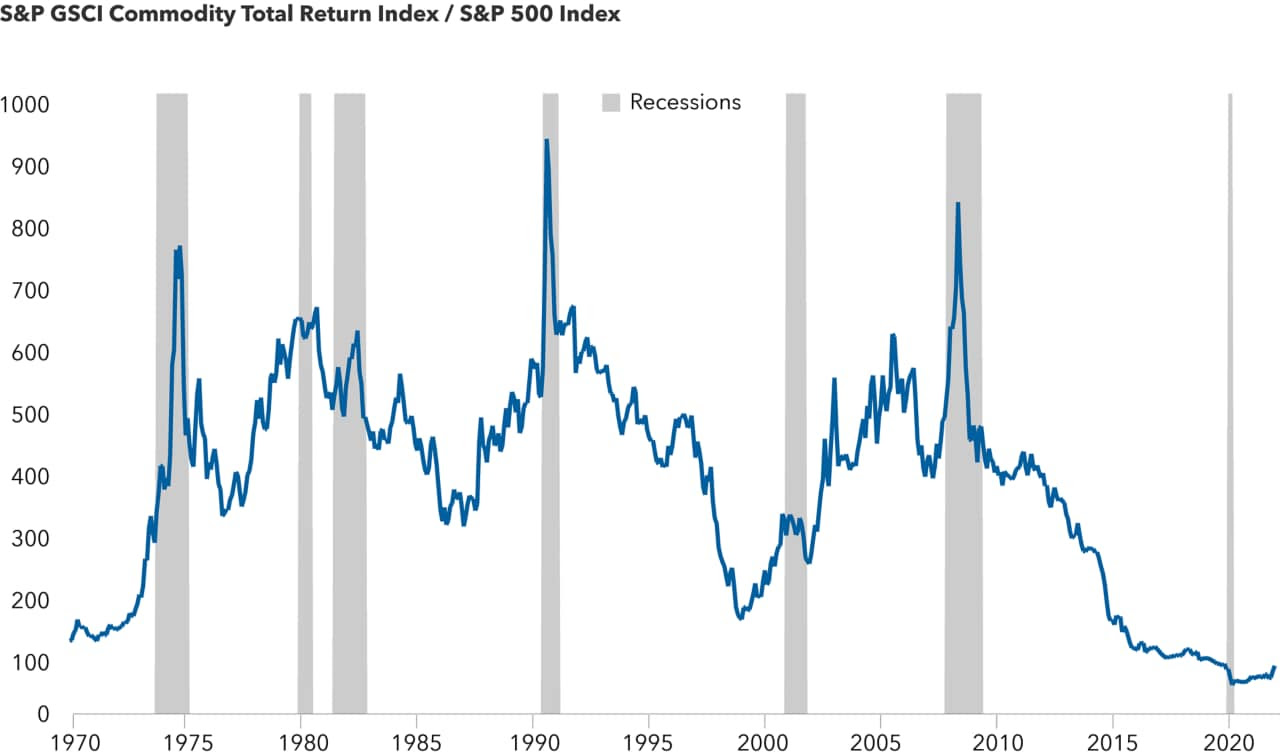
https://www.capitalgroup.com/advisor/insights/articles/is-spike-commodity-prices-sustainable.html?sfid=1988901890&cid=80693875&et_cid=80693875&cgsrc=SFMC&alias=D-btn-LP-6-A1cta-Advisor


2. Where to Allocate in Case of Stagflation

Living with Stagflation: So you’ve decided to move on with your life and just “live with stagflation”. Here’s what history says about where to allocate…(n.b. past performance does not necessarily = future, etc)
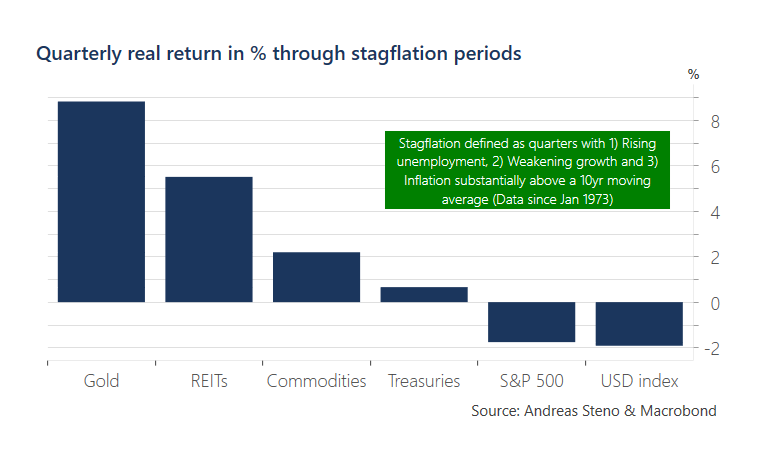
Source: @AndreasSteno

From Callum Thomas Topdown Charts

https://www.topdowncharts.com/chartstorm


3. Household Allocation to Equities Historically Points to Tops in S&P

From Steve Blumenthal CMG Wealth   https://www.cmgwealth.com/ri-category/on-my-radar/


4. Industrial Sector Margins ..Rails Highest
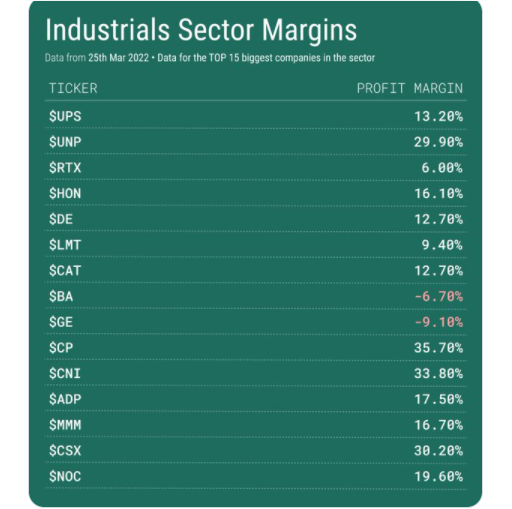
(20) Stef ⚡️ (@dyankov91) / Twitter


5. Russia 35% of World Uranium
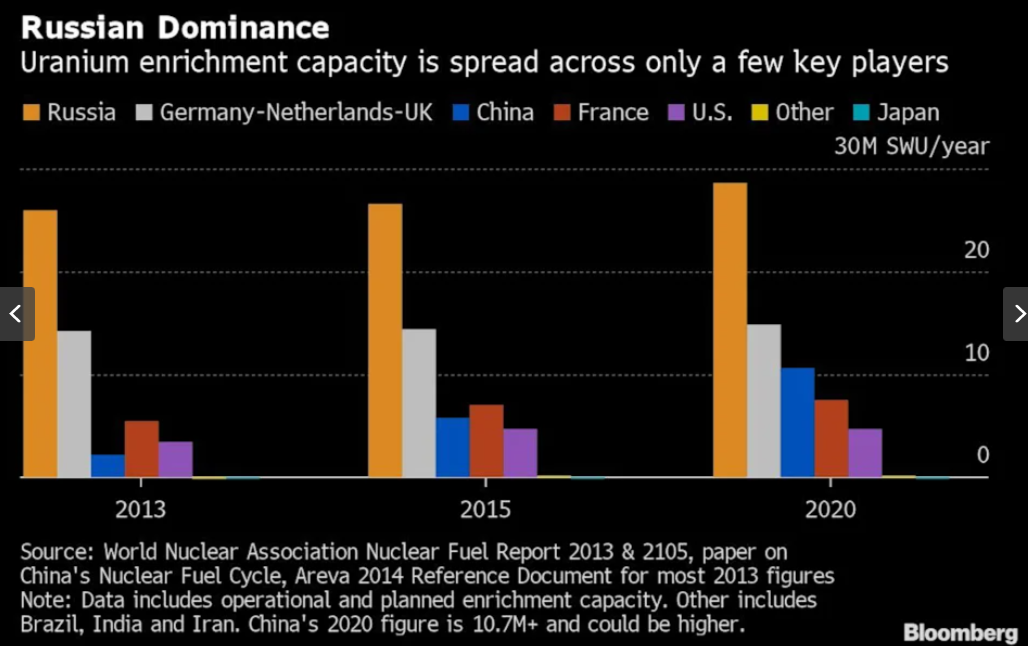

6. Country Performance Since Covid Low
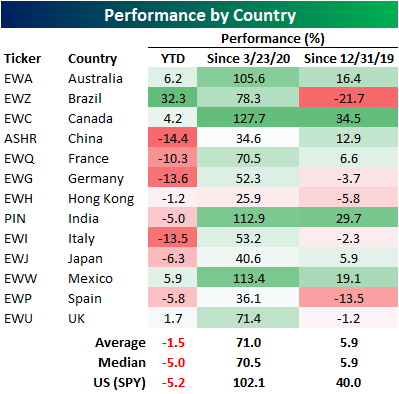
https://www.bespokepremium.com/interactive/posts/think-big-blog/country-performance-since-covid-low


7. RV Shipment Data Highest Ever

Zerohedge-New RV shipment data from the RV Industry Association’s (RVIA) February 2022 survey of manufacturers revealed demand for this time of year is at some of the highest levels ever.

RVIA said total RV shipments last month topped 53,722 units, an increase of 11.3% compared to the 48,286 units shipped during the same month last year. RV shipments jumped 13.6% through February versus the same point last year with 107,012 wholesale shipments.
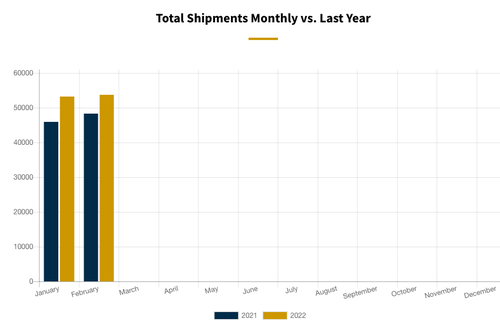
https://www.zerohedge.com/markets/rv-shipments-soar-record-time-year


8. Nearly half the country requires no permit to carry a concealed weapon — and it’s a growing trend

Source: Washington Post From Barry Ritholtz Blog https://ritholtz.com/2022/03/sunday-reads-266/


9. Contemporary Art Has Outperformed Stocks for 25 Years
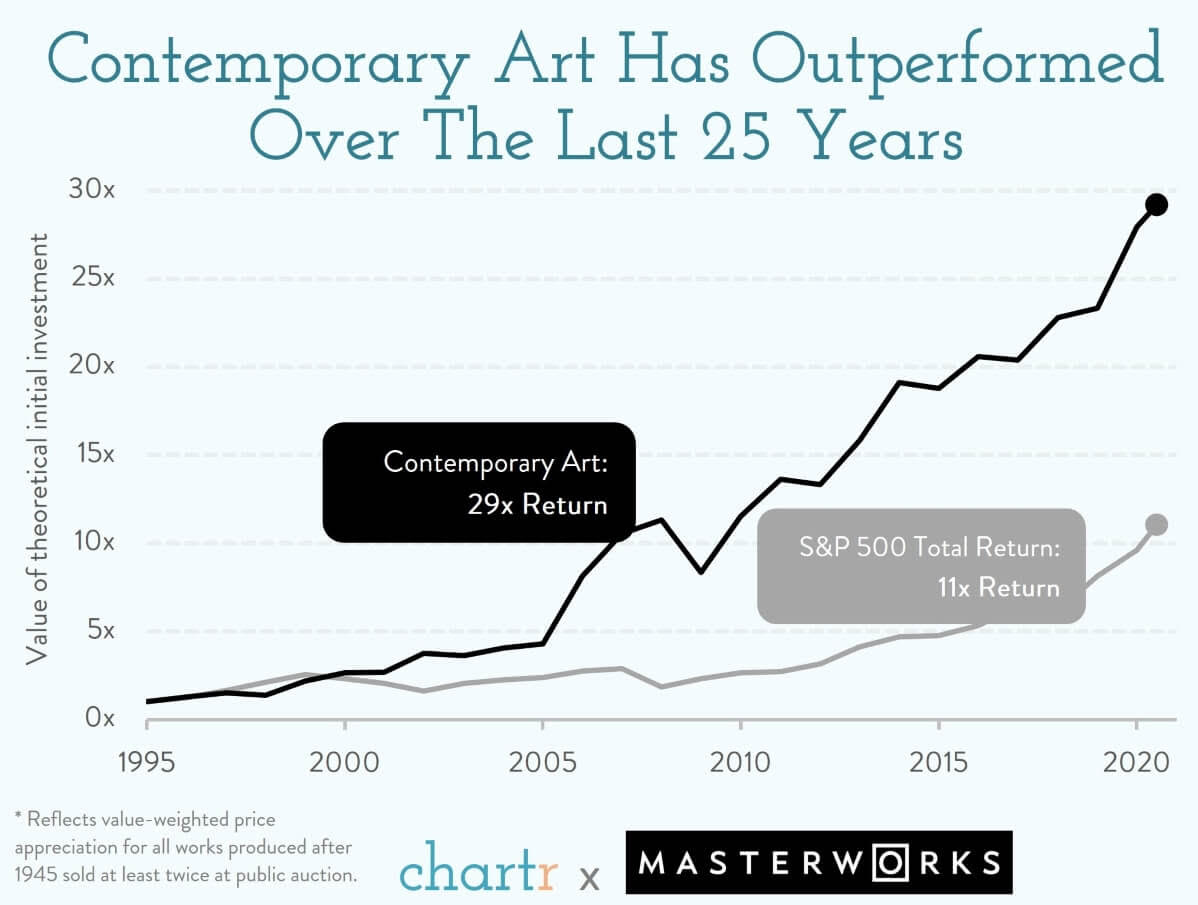
In the 993 days since starting this newsletter, we’ve seen thousands of charts about investing. But few struck us like this one above.

When you see numbers like this, it’s easy to see why billionaires and hedge fund managers battle for paintings in auction houses across the globe.

Going once, going twice…

The heavyweights might duke it out for $100 million+ pieces, but you can harness the compounding magic of art with Masterworks for much less. This revolutionary platform lets you invest in art by legends like Picasso, Warhol, and Rothko—even if your last name isn’t Bezos.

Here’s their track record since 2019:

  • George Condo’s “Staring into Space”: +31.7% net IRR (2020-22)
  • Banksy’s “Mona Lisa”: +32% net IRR (2019-20)
  • Albert Oehlen’s “Doppelbild”: +33.8% net IRR (2020-21)

No wonder JP Morgan called art a “powerful financial asset.” With over 375,000 investors already signed up, demand is high — but Chartr Subscribers skip the waitlist.*

www.chartr.com


10. How to Become Truly Confident

By Jordan Harbinger | October 13, 2020 | 4 

Confidence is one of those game-changing qualities—like rapport, empathy and courage—that is both incredibly valuable and highly elusive. As soon as we “try” to be confident, we’ve already failed. As soon as we “act” more confident, we’re already pretending. Telling someone to “be more confident” is like telling someone to be taller. That’d be nice, but how?

The answer to that question requires a new approach to confidence—one that goes beyond the “fake it till you make it!” mentality, and moves toward something more authentic, more grounded and more holistic.

We need to get clear on what true confidence really looks like, so we can understand how it works, how to cultivate it and how to rediscover it when it wanes.

Most importantly, we need to approach confidence not as a fixed quality to be attained, but as a dynamic process to be engaged in throughout our lives—a process my team and I have been developing for more than 15 years, most recently through our live-training company, Six-Minute Networking.

So let’s start at the beginning and get a good handle on what confidence really is.

What Is Confidence, Exactly?

We might not always have a firm grasp of textbook confidence, but we know it when we see it. We know it because we feel it, and we know what it feels like to be around it. Which is one reason the definition of confidence can be so hard to pin down. Confidence is really an experience—both of ourselves and of other people.

We also know when we don’t feel it. In the presence of an insecure person—or, even more telling, a person pretending to be confident—we not only notice their lack of confidence, but also their shaky attempts to compensate for it.

Interestingly, when we’re in the company of an unconfident person, we often tend to feel unconfident ourselves. We struggle to organically connect, we begin second-guessing our words and choices, and we notice ourselves feeling uneasy, uncertain and unengaged.

Which is pretty fascinating if you think about it.

Confidence—and a lack of it—is one of those rare characteristics that is infectious. Lead with true confidence, and you’ll inspire it in other people. Betray a lack of confidence, however, and you’ll expose a similar lack in them. If you’ve ever spent time with a confident stranger at a cocktail party, or tried to bond with an insecure manager in a job interview, then you know how radically different these two qualities can make you feel.

But as we know, confidence is also a quality that can be affected, projected or faked. Deep insecurity can masquerade as confidence, as we often see with embattled politicians and troubled CEOs, struggling loved ones and nervous first dates. And experts continue to tell us that confidence can be “hacked,” “acquired” and “learned” if we just commit to talking, acting or looking a certain way.

Our confidence can also appear quite strong, only to crumble in the face of struggle, criticism or failure. In those moments, it seems like confidence is nothing more than a fleeting feeling, a passing belief in our own power, a temporary reprieve between periods of self-doubt.

So what is true confidence, really?

To put it simply, true confidence is a feeling of self-assurance that is grounded in an authentic experience of our own ability, perspective and sufficiency.

It’s a stable connection to the fact that we can do what we want to do, feel how we want to feel, and be who we want to be in this world.

It’s also a sense that we are enough—that we aren’t lacking in some fundamental sense that prevents us from navigating the world in a healthy, positive, productive way.

All of which, of course, are qualities we aspire to have. Confidence is an integral part of human psychology. With it, we feel engaged, purposeful, inspired. Without it, we feel rudderless, wary, fearful. Consciously or unconsciously, we know how important confidence really is.

Still, you probably know relatively unconfident people who manage to get ahead in life. You might believe that your own confidence is secondary to the quality of your work, your relationships and your overall personality. You might even suspect that confidence isn’t a quality to be trusted, given that it can be affected, inherited or “turned on” at a moment’s notice.

So it’s worth asking…

Why Does Confidence Matter?

It’s an excellent question. And while it might seem painfully obvious to those who are already interested in working at it, confidence actually does matter—for four key reasons.

1. Confidence is an amplifier of quality and success.

Contrary to the view of many self-help experts, confidence is not a proxy for quality, depth or character. It should not be an end in and of itself, and it will never compensate for good old-fashioned hard work. Even the most confident people need to be confident about something—themselves, their work, their identities—and confidence divorced from content will always fall apart sooner or later.

Instead, we think about true confidence as an essential part of our character and work.

It’s a layer to everything we do, say and put out into the world, from our work to our relationships, our opinions to our decisions. Confidence acts as fuel on the fire of whatever we touch. We still need a good fire—we will always need to do the work—but without the fuel, the fire can only grow so large. Look at any massive and consistent success—from Jay-Z to the iPad, Honey Nut Cheerios to Tesla, Michael Jordan to Walmart—and you’ll find a sense of confidence at its core.

Interestingly, many high performers resist this view of confidence. They believe that if their work is strong enough, if their skills are advanced enough, or if their personalities are likable enough, they won’t need confidence. They believe, in other words, that their strengths will speak for themselves. Which is true, of course. The question is: how well?

Ironically, it’s some of the most talented people in the world who dismiss the importance of confidence. In my experience—based on hundreds of interviews with top performers and years of coaching clients, corporations and the military—it’s precisely their talent that makes them so skeptical. How impressive would their work really be if it depended on something as vague as self-assurance? How would they feel about their talent if their success ultimately depended on personality?

These are worrying questions for people who have been trained their whole lives to value their skills and performance above all else.

But it’s not the case that these people completely lack confidence. What they have is contextual confidence. Within the narrow context of their specialty or world—coding, writing, statistical analysis, business development, team meetings—they actually do enjoy a certain degree of confidence. It’s a critical type of confidence that comes with time, dedication and expertise.

Outside of that context, however, they waver. They don’t have the kind of generalized confidence that infuses everything they do, in and around their work: the way they present their deliverables, the way they engage with different types of colleagues and partners, the way they navigate their careers in the bigger picture, and so on.

That lack of generalized confidence tends to make them double down on the areas in which they do feel confident. And so they remain in their secure confidence bubbles, focusing on the silos and tasks and roles where they feel most competent, which guarantees that they won’t tackle new skills and situations that would expose their lack of generalized confidence.

Nate, an immensely talented network architect at a cloud security company, recently attended our live training program. After years of exceptional work with little recognition and no major promotions, he decided it was finally time to seek some additional help.

Once he completed the training on relationship building, self-analysis and practical exercises, he told me why he had been dreading the process so much. He knew, subconsciously, that he had a profound weakness in his general confidence and that the better he became in his technical role, the less he wanted to work through any perceived deficiencies in his personality.

But the transformation was worth it. He entered the program as a quiet, self-effacing, generally avoidant personality with a gift for engineering. He left the program as an excited, gregarious, curious personality with a demonstrable passion for it.

A few months later, I received an email from Nate with a life update. After six weeks back at the office, his managers began visibly responding to his work in team meetings. Though it was always strong, they suddenly seemed to take notice of his contributions—no doubt because of the way he was now presenting it. Soon after, his colleagues also mentioned a change—not just in his technical role, but in his personal style, his excitement and his approachability. He was promoted to manager of his team ahead of a major rollout, which also helped secure two other job offers from competing companies.

As if by magic, Nate’s professional life had completely turned around. But it wasn’t magic. Just a couple months earlier, he had plateaued professionally by focusing exclusively on his deliverables. The moment he began working on himself, he created the exciting opportunities he always wanted. He had invested in confidence, which amplified his excellent work.

Stories like Nate’s are a reminder that confidence can be consciously cultivated. More importantly, they’re evidence that confidence matters. And it matters most when it’s developed in conjunction with hard work and meaningful substance.

Whether we like it or not, the quality of our work alone will never get us where we want to go. But when that quality links up with true confidence, our work takes on a new caliber and begins to resonate with people in a much more powerful way.

2. Confidence is essential to influence and leadership.

As we just saw, the success of our professional lives depends on both what we do and how we do it.

What we do is a matter of technical skill. How we do it is a function of confidence.

One of the most important aspects of that how is our degree of influence and the quality of our leadership. The impact we have on our work products, the control we exert in our organizations and the influence we have on our partners all require true confidence. These confidence-based skills are what separate technicians from managers, employees from leaders, and artisans from artists.

Selby, a producer at a major radio station, recently came to our program to work specifically on these skills. As she told us on her first day, she was a deeply shy person who was remarkable at her job. She spent her days booking celebrity guests, only to experience crippling anxiety when they arrived at the station. She loved her colleagues, but was devastated to learn that they regularly farmed out work to her knowing that she was incapable of saying no. And she hadn’t risen up through the ranks of the station, despite four years of consistently great work behind the scenes.

After graduating from the program, Selby went back to work. She continued the exercises we gave her and used them to improve her interactions with the high-profile people she met. With a handle on her fear of setting boundaries, she began telling her colleagues what she would and wouldn’t do and watched as the station’s productivity skyrocketed. As a result of these (and many other) tools and mindsets, she was promoted to manager of the entire station six months later. A year after that, she was given her own show.

The difference in Selby’s performance was not a function of talent or discipline. She didn’t become smarter, more skilled or more committed. She became connected to her confidence. And that confidence opened a window into a suite of skills—from delegation to politics, leadership to conversational banter—that had eluded her for years.

3. Confidence isn’t just about style. It’s also about substance.

Selby’s story is also a reminder that confidence and substance are intimately connected. While a lack of confidence in a typical person is always challenging, a lack of confidence in a truly capable person can be crippling.

Why?

Because an incongruence between the quality of your work and your level of confidence can actually amplify the deficiency.

Your work might perform well, but by succeeding, it will end up highlighting your insecurity even further. At the same time, your partners and colleagues will expect a degree of confidence that reflects how strong your work is and will be all the more disappointed when they find it missing.

Once people sense that gap, they’ll often begin to doubt whether the work is as strong as it first seemed. That, in turn, can make you doubt your judgment about your own work, creating a dangerous feedback loop. Insecurity will give rise to new feelings of doubt, fear and confusion, which will eventually creep into your choices. Your strong contextual confidence will begin to erode, and your weaker generalized confidence will start to infect it.

So these two types of confidence are actually closely related. As much as we want to believe otherwise, we can’t succeed without having both types of confidence, which are essential to creating and capitalizing on your work.

4. Confidence protects us.

In an increasingly complex and competitive world, confidence is one of the greatest weapons we can develop. At the same time, a lack of confidence is also one of our greatest vulnerabilities because it broadcasts to the world how susceptible we really are.

As we’re about to explore in more depth, confidence manifests in a number of highly visible ways: our body language, vocal tonality, verbal cues and micro-decisions. No matter how hard we try, we can’t really hide how we feel about ourselves. We broadcast our weaknesses wherever we go.

We wear our lack of confidence like a badge, and that badge unconsciously tells the world how to treat us.

Unfortunately, there will always be a segment of the population ready to capitalize on those weaknesses. In some cases, that vulnerability will invite trouble in relatively minor ways: a shifty cab driver offering us a ride off the meter, a gifted insurance salesman upselling us to a higher premium, a narcissistic friend dominating our time and energy. In other cases, that weakness will get us into deeper trouble: a predatory lender locking us into a dangerous loan, a manipulative family member controlling our happiness and resources, a power-hungry manager exploiting us in the workplace. Of course, the possibilities can get even more troubling.

If you take a moment to think back, you can probably remember a time you were taken advantage of in a moment of low confidence. That wasn’t an accident. It was your degree of confidence at the time that exposed you to that situation, and it was your relationship to your confidence that determined how well you handled it.

The outcome of that experience might have taught you a lesson and increased your confidence in the future. Or it might have confirmed what you subconsciously believe about yourself and left you vulnerable to a similar scenario down the road.

So in addition to enhancing our work and character, confidence also helps protect us, physically and emotionally. That’s why working on it matters so much. We aren’t just talking about style and appearances. We’re talking fundamentally about who we are, how we present ourselves in the world, and how the world will treat us in return.

Now that we have a handle on why confidence matters, let’s explore some practical principles and techniques for achieving it.

How Do I Become More Confident?

As we’ve discussed, confidence is a tough quality to pin down. Because it’s more of a dynamic experience than a static trait, it can be a difficult concept to teach.

In our experience, the best way to build confidence is to isolate the elements that comprise it—the behaviors, characteristics and mindsets that create true self-assurance. Then, we can put those pieces together in a way that creates true, lasting, generalized confidence.

Starting with…

1. Nonverbal communication.

As we just touched upon, confidence is expressed most profoundly through our bodies. No matter how well we speak, the way we feel about ourselves will always manifest in our posture, our gait, our hand movements and our facial features.

And because these cues are nonverbal—bypassing the more intellectual language centers in our brains—other people pick up on them viscerally and quickly. They receive a vivid snapshot of our inner confidence the moment we walk into a room.

If we enter a room standing up straight with our shoulders back, chins up and eyes engaged, then others will viscerally perceive us as confident. If we enter with our shoulders hunched, brows furrowed, and eyes shifty or staring at the floor, then they’ll viscerally perceive us as unconfident (if they notice us at all). And they make this judgment in microseconds—just as we do of them.

That’s why body language is such an important part of strong first impressions. We have to remember that people’s impressions are made when they see us, not when we first interact with them. Since we can’t control when that happens, we can’t just turn our confidence on when we think we need it. We need to internalize and embody it at every moment, so it becomes part of our observable presence wherever we go.

To do that, we recommend the doorway drill, a simple technique that will force you to check your body language whenever you walk through a door. The exercise is simple: Every time you approach a doorway, take a moment to stand up straight, pull your shoulders back, uncross your arms, and look up and ahead. These are the signals of positive body language, and they both reflect and reinforce confidence.

To help form that habit, we often tell our students to place post-it notes at eye level in their doorways at home and in the office. Every time they see a post-it, they remember that it’s a reminder to check their body language. After a week or two, the post-its become unnecessary. The visual cue creates a habit that lives in their bodies, and they automatically begin checking their body language whenever they walk through any doorway out in the world.

While body language might seem superficial—it is, after all, about how confidence appears on the “outside”—it’s actually very profound. Because while confidence informs body language, body language also has a powerful effect on building confidence. If we carry ourselves confidently, we teach our bodies to experience confidence. And the more confident we become, the more we reinforce the behavior to carry ourselves that way out in the world.

This is one of the beauties of body language work: Addressing the symptoms of confidence can actually influence the causes of it.

So commit to strong, positive body language and make a conscious effort to form habits that make your nonverbal communication automatic. Notice the body language that signals confidence in people you meet and consider internalizing those choices in yourself.

Most importantly, notice how your nonverbal communication changes the way you feel in social situations and how it changes the way other people feel about you. You’d be amazed how much of confidence depends on the things we don’t say.

2. Vocal tonality.

After body language, our voice is the most powerful organ of our confidence. Vocal tonality—which includes not just the physical quality of our voice, but our pitch, articulation, syntax, volume and intention—expresses and reinforces our innermost sense of self.

Vocal tonality is notoriously difficult to teach in an article, but we can touch on some key techniques for improving this dimension of confidence so that we can use it to enhance our self-assurance.

Speak in statements, not questions.

While you’re probably no stranger to the high rising terminal—also known as “upspeak,” or the tendency to end sentences with a rising pitch intonation, as if asking a question—you might not know how much of a role intonation plays in our confidence, both perceived and actual.

When we express statements as questions (“Hi, my name is Steven?”; “I’m applying for the content manager role in marketing?”; “I’ve been working here three years?”), we subtly communicate the doubt, uncertainty and informational disparity implied by a question. As a growing body of research now shows, upspeak can significantly diminish our hireability, compromise our chances for promotion, and affect the way people perceive our power and authority—which is unfortunate, since many of us adopt it out of politeness and a desire to be understood.

One of the best ways to smooth out the high rising terminal is to do a simple visualization exercise. Imagine a sentence as a hill, rising from the earth, peaking and then sloping back down. When we engage in upspeak, we stop at the top of that hill, leaving ourselves and the audience in a subtle state of uncertainty. As you speak, impose the image of the hill on your sentence and commit to coming back down the other side of the slope. That will help your audience rest in the declarative finish that communicates confidence and further increase your confidence the more you speak.

Articulate and enunciate.

The way we treat our words—literally, as they form in our mouth—is a signal and a function of confidence. To increase our confidence in conversation, we should also commit to articulating and enunciating our words more emphatically. When we do, we communicate confidence to the people around us. We also teach our bodies to become more confident the more we speak.

A helpful exercise here is to take a champagne cork (which is larger than a standard cork), place it in your mouth, and read a passage from a book with strong dramatic flair. Because you’ll be forced to work overtime as the cork resists your efforts, your mouth will become super articulate. On an emotional level, enunciating strongly will force you to commit to your words—to take them more seriously—which is, of course, a hallmark of confidence.

Avoid the use of filler words.

Filler words such as “like,” “um” and “so” also play a major role in confidence. And while we don’t believe you need to remove them entirely in order to be taken seriously—these words can actually make your speech friendlier, more colloquial and more organic if used properly—filler words tend to undermine our authority when they become a crutch.

In many cases, we use filler words to patch silences in conversation. (“So… yeah, I mean, what do think about the new, uh… the new project?”) We often do this because we’re subconsciously afraid that if we hand the reins over to the person we’re speaking with, we’ll lose control of the conversation or be responsible for any gaps. But as we know, confidence means trusting that our words and presence are enough to be compelling. It also means trusting that the other person can and should help carry a conversation. When we remove these types of filler words in conversation, we stop subtly buttressing our unconfident speech, and we signal to the other person that we trust in their confidence, too.

Of course, we also use filler words to qualify our speech. (“Well, I just feel that, like, there’s a better way to, you know, present this, uh, deliverable, so…”) Sometimes we do this strategically, but more often we do this subconsciously, which has a similar effect on our confidence—and the way people perceive it—as upspeak does. In a professional setting, filler words can have major implications in team meetings, salary negotiations and conflict resolution.

A helpful exercise to weed out filler words is to record yourself in conversation. You can use the voice memo app on your phone (or any old-school recording device) to record a meeting or your side of a conversation on the phone. Listen to the recording for a few minutes every day for a week and notice how often filler words creep into your everyday speech.

I then recommend going a step further and exporting the file to an audio editor (Audacity is an excellent free app) and editing out all of the filler words that pop up. While it might seem a bit obsessive, it’s actually one of the greatest ways to analyze your speech. I only noticed my own dependence on filler words after spending hours editing out the “ums” and “so’s” on my podcast, The Jordan Harbinger Show. Once I realized how much of a crutch these words had become, I caught myself before I used them and found my confidence growing exponentially.

With body language and vocal tonality under our belts, let’s turn now to the more profound psychological underpinnings of confidence.

3. Authentic vulnerability.

As much as experts argue that confidence can be affected, that kind of superficial confidence—built on acquired body language, forced vocal tonality, rehearsed social scripts, and so on—will never create true confidence because it will never be authentic.

Authenticity, at its core, is the quality of being fully yourself. Being authentic means being emotionally honest, clear about your experience of the world and free of pretense. It means responding organically to every moment of life—the positive and the negative—and not feeling the need to unnecessarily “pretend” about your feelings, beliefs or experiences in any way.

In everyday language, we call this quality being “real.” And when we meet someone “real,” we feel that we’re in the presence of something exceptional. The reason, of course, is that we’re in the presence of true confidence. We feel that we’re meeting ourselves—that is, our best selves.

Authenticity transforms normal insecurity into grounded confidence. While faked confidence hides insecurity, weakness and self-doubt, true authenticity owns and acknowledges these less pleasant experiences in a way that ultimately enhances our sense of self.

It’s a strange paradox. It’s also a very useful one.

But to acknowledge these parts of ourselves requires more than just authenticity. It requires vulnerability. It requires us to open up and be exposed—to be seen—as the people we really are.

When authenticity and vulnerability link up—when we become organically and honestly open to sharing our true experiences, even when those experiences make us seem insecure—they actually create true confidence.

Why?

In short, because honesty and openness are the raw stuff of true confidence.

By allowing people to see who we really are, we stop offering a proxy version of ourselves to hide the aspects of our personalities we’d rather not show. And by embracing who we really are, we also relinquish control over how other people might perceive us—which, if you think about it, is a classic hallmark of insecurity.

In other words, we don’t become confident by never feeling insecure. We become confident by dropping the need to hide our insecurity in the first place.

It took me years to realize that we don’t need to always feel confident to be confident. And we don’t need to act confident to appear confident. All we need to do is respond authentically to our experiences, and share those experiences—in the appropriate amounts, in appropriate ways, in appropriate contexts—even (and, ironically enough, especially!) when they reveal our lack of confidence. Despite what we’ve been told, vulnerability isn’t weakness—it’s true strength.

This is a principle that the world’s greatest athletes, most successful entrepreneurs and most prolific artists understand: the alchemical power of authentic vulnerability. As Kobe Bryant famously said, “I have self-doubt. I have insecurity. I have fear of failure … We all have self-doubt. You don’t deny it, but you also don’t capitulate to it. You embrace it.”

By embracing it, Bryant managed to authentically acknowledge and vulnerably admit to his insecurity, self-doubt and fear of failure, which only enhanced his grounded sense of self.

That possibility is open to every single one of us.

A few weeks ago, I was invited to a dinner party for a bunch of broadcasters and media folks. The room was filled with smart, talented, ambitious people, and none of us knew one another. At dinner, I was seated next to a quiet guy who didn’t say much at first. As we often do in these cases, I assumed that he either wasn’t very friendly or was struggling with his social confidence. After a few minutes of conversation, however, he said something that took me by surprise.

“I’m kind of nervous to be around all these new people,” he confessed with a shy smile. “I’m used to producing my show alone in my house, and I really didn’t feel like going out tonight, but I forced myself to come and make some new friends.”

In an instant, my entire perception of this person had changed.

He was still exhibiting the same unconfident behaviors, but by unabashedly owning and sharing them, he shifted my perception from “unfriendly” to “human,” from “nervously unconfident” to “authentically vulnerable.” What he did, really, was offer me a window into his experience, and that experience was deeply honest.

That gave me permission to tell him that that I was a little overwhelmed, too, and just like that, we were bonding over our shared experience of the evening. He ended up being my favorite person at that dinner party, and we’re still good friends to this day.

So as you move through your life, make a conscious effort to commit to authentic vulnerability. At the same time, avoid the trap of inauthentic vulnerability—such as oversharing, strategic revelations and inappropriately personal stories—which are really just another way of simulating confidence.

Notice what this mindset does to your sense of self. Notice how confidence and insecurity are totally compatible, as long as you drop the impulse to self-protect.

Most importantly, notice that you cannot be confident without acknowledging your true experience moment to moment. That is a profound inner shift that goes deeper than superficial behaviors. It’s precisely the raw stuff of trust, rapport and relationship building—key skills that thrive on authentic confidence.

4. A process-oriented mindset.

By now you might have noticed an underlying theme in our approach to confidence.

Whereas popular self-help usually treats confidence as a static, goal-oriented, binary quality—basically, you either have it or you don’t—true confidence is, in fact, a process. It ebbs and flows. It accelerates and decelerates. It takes hits and has to recover. And it’s always evolving over the course of our lives as we take on new situations, challenges and goals.

Thinking about confidence as a process, rather than an end in and of itself, opens us up to a much healthier relationship to our own self-esteem.

We no longer believe that we must be confident one hundred percent of the time in order to be effective. We stop beating ourselves up for having moments of confusion, insecurity or self-doubt, which are perfectly normal parts of a healthy ego. And we don’t buy into the notion that if we just look or act or behave a certain way, confidence will magically appear.

Most importantly, we avoid falling into the trap of thinking we can develop “unshakable confidence.”

Unshakable confidence is a myth, and when you see it, you can bet that there’s some insecurity being protected beneath the surface. Confidence that can be shaken isn’t insecurity or weakness; it’s a sign that you can work through setbacks, criticism and growth. Which, if you think about it, is the whole point of having confidence in the first place!

Process-oriented confidence is the opposite of the “fake it till you make it” philosophy.

While the “fake it till you make it” approach suggests we should pretend our way toward true confidence, the process-oriented approach suggests we should become our way toward true confidence.

And while “faking it” does play a small role in confidence—for example, inviting confidence into your body using the nonverbal communication and vocal tonality exercises we mentioned earlier—it will never build true confidence. One way or another, simulating confidence will always create new problems.

It’s worth discussing a few of the most common, so we understand the risks of inauthentic confidence.

For one thing, faking it till we make it creates an inauthentic self—the supposedly “confident” person— which creates a division between the person you really are and the person you’re pretending to be. At best, we become two insecure people: the true self desperate for confidence, and the false self grasping at confidence in order to hide the true self.

As a result, that false self creates new feelings of fraudulence and self-doubt that will, sooner or later, betray you when you need your confidence the most. (This, in a nutshell, is impostor syndrome.) Eventually, one of two things will happen. Either your false self will break down, revealing the unaddressed insecurities lurking beneath. Or it will grow stronger and stronger, moving you further and further away from a healthy and secure sense of self.

The entire act of faking confidence will also become exhausting, confusing and alienating, as keeping up appearances becomes your primary objective. The fear of being exposed as less than confident will only grow. That in turn will make you double down on faking it in order to protect the false self, which will further increase the cost of being exposed—a truly vicious cycle.

For all these reasons, we at Six-Minute Networking don’t advocate for the “fake it till you make it” approach. Instead of acquiring confidence by building a new self, we prefer to work with our students to develop confidence by being their true selves. We then give them exercises, principles and mindsets that help them develop more and more authentic confidence. Anything else is a short-term fix, an unreliable hack and a recipe for even deeper insecurity.

A process-oriented approach means letting go of the impulse to pretend that we’re confident when we’re not. It also means accepting that our confidence will take hits from time to time. If we authentically acknowledge when our confidence takes a hit, then we put ourselves in a position to rediscover it—not by faking our way back into confidence, but by doing the work required to rebuild it. In practical terms, that means putting time into our craft, investing in new skills, repairing relationships, sticking with difficult goals, and—most importantly—being patient as our confidence steadily evolves.

That’s the stuff of true and authentic confidence. That’s how we can work on confidence without compromising our identities and values. That’s how we survive when our confidence takes a hit, and how we can actually enhance our self-assurance when we struggle. That’s how we become truly confident, by committing to the life-changing process of simply being ourselves.

https://www.success.com/the-art-of-true-confidence/

Jordan Harbinger

Articles

Jordan Harbinger hosts The Jordan Harbinger Show, where he deconstructs the playbooks of the most successful people on earth and shares their strategies, perspectives and insights with the rest of us. He’s also the co-founder of Six-Minute Networking, a training company that offers workshops on nonverbal communication, persuasion and influence to corporate and military organizations.

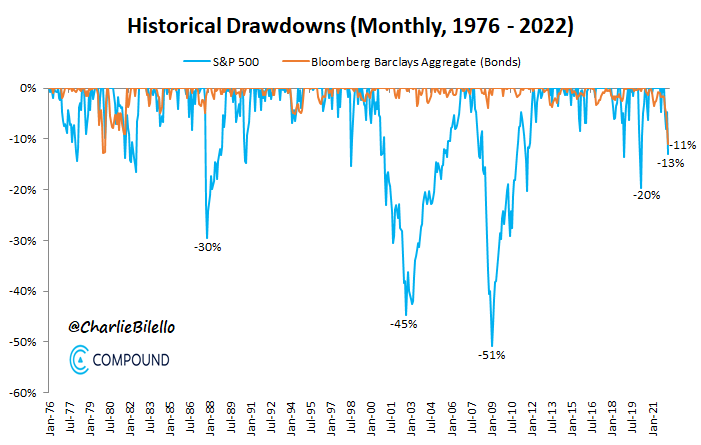
Topley’s Top 10 – March 22, 2022

1. S&P Gains Last Week are Historically Bullish Going Forward

From Dave Lutz at Jones Trading

History was made last week, LPL notes – For only the 5th time ever, the S&P 500 gained at least 1% for 4 consecutive days.  This rare occurrence is also quite bullish, as a year later it has been up more than 20% every single time with an average gain of 28.0%.


2. Index Performance After 15 Worst Starts to Calendar Year

https://www.nasdaq.com/solutions/nasdaq-dorsey-wright


3. China Internet Stock Crash 3x Faster than 1999 U.S. Tech Bubble

@Charlie Bilello After its peak in March 2000, the Nasdaq composite fell 78% to its low in October 2002. That took 31 months. From its high in February 2021 to its low last week, the China Internet ETF $KWEB fell 79% in just 13 months.

​Powered by YCharts​

The rapid decline pushed valuation multiples down across the board, with Alibaba ($BABA) trading at the same price to sales ratio (1.6x) as Campbell Soup ($CPB).


4. German PPI (inflation) 26.5%

Jim Reid-Deutsche Bank

German PPI came out this morning at a 25.9% YoY level. Using long-term data spliced from various sources, this is the highest since the aftermath of WWII and on par with the highest peacetime levels on record. This time last year it was still just under 2%!

Although energy makes up just over the half of the total, even PPI ex-Energy is now at 12.4% YoY. For context in the 1970s, overall PPI didn’t get above 15% YoY.

One of the most fascinating accounts of the 1970s I read around this time last year was that of the Fed by ex-staffer and famous economist Stephen Roach. When energy spiked, the Chair Arthur Burns asked his staffers to devise an ex-energy inflation series and was comforted that this measure showed inflation was more contained. His view was that this energy spike had nothing to do with monetary policy. But soon he had to ask for another basket to be created ex food and energy. Again he was relatively calm at the lack of inflation elsewhere and believed food price rises were more to do with an El Nino. This stripping out continued until less than a third of the basket was left and eventually the Fed had to admit that inflation was broad based as even this stripped-out inflation series was in double digits.

So maybe there is little the Fed and the ECB can do about energy costs, but it’s worth remembering that the real central bank rates in both regions are massively negative and at their lowest post-WWII in the former, and clearly the lowest (by a long, long way) on record for the ECB. So are they pouring fuel on a fire?


5. Food Price Index hit record high in February, UN agency reports

Nominal and Real Terms New Highs

Global food prices reached an all-time high in February, the Food and Agriculture Organization (FAO) reported on Friday.

The Food Price Index, which tracks the international prices of a items such as vegetable oils and dairy products, averaged 140.7 points last month, or nearly four per cent up from January.

This is also 24.1 per cent over the level a year earlier and 3.1 points higher than in February 2011.

Factors behind food inflation 

“Concerns over crop conditions and adequate export availabilities explain only a part of the current global food price increases. A much bigger push for food price inflation comes from outside food production, particularly the energy, fertilizer and feed sectors,” said FAO economist Upali Galketi Aratchilage.

“All these factors tend to squeeze profit margins of food producers, discouraging them from investing and expanding production.”

As the Food Price Index measures average prices over the month, the February reading only partly incorporates market effects stemming from the conflict in Ukraine.

Rise in demand 

The overall rise last month was driven by an 8.5 per cent increase in the FAO Vegetable Oils Price Index, a new record high.

This was mostly due to sustained global import demand, which coincided with a few supply-side factors, such as lower soybean production prospects in South America.

The Dairy Price Index averaged 6.4 per cent higher in February than January, supported by lower-than-expected milk supplies in Western Europe and Oceania, as well as persistent import demand, especially from North Asia and the Middle East.

Last month, the Cereal Price Index increased 3.0 per cent over January. Contributing factors  included rising quotations for maize and other coarse grains, caused by continued concerns over crop conditions in South America, uncertainty about maize exports from Ukraine, and rising wheat export prices.

Strong global import demand contributed to the 1.1 per cent rise in the Meat Price Index. Other factors included tight supplies of slaughter-ready cattle in Brazil and a high demand for herd rebuilding in Australia.

The FAO Sugar Price Index declined by nearly two per cent amid favourable production prospects in India, Thailand and other major exporters, as well as improved growing conditions in Brazil.

Cereal forecast

FAO has also published a preliminary forecast that shows worldwide cereal output is on course to increase to 790 million tonnes this year.

Anticipated high yields and extensive planting in North America and Asia, should offset a likely slight decrease in the European Union and the adverse impact of drought conditions on crops in some of the North African countries.

The agency has updated its forecast for world cereal production in 2021, which is now pegged at 2,796 million tonnes, a 0.7 percent increase from the year before.

The forecast for world trade in cereals was also raised to 484 million tonnes, up nearly one per cent from the 2020/2021 level. The forecast does not assume potential impacts from the conflict in Ukraine, and FAO is closely monitoring the developments and will assess impacts in due course.

Fears for food security 

Relatedly, the head of the International Fund for Agricultural Development (IFAD) has highlighted how the crisis in Ukraine could impact global food security. 

IFAD President Gilbert F. Houngbo said continuation of the conflict, which is already a tragedy for those directly involved, will be catastrophic for the entire world, particularly for people already struggling to feed their families.

He warned that the fighting could limit the world’s supply of staple crops like wheat, corn and sunflower oil, resulting in skyrocketing food prices and hunger. This could jeopardize global food security and heighten geopolitical tensions.

“This area of the Black Sea plays a major role in the global food system, exporting at least 12 percent of the food calories traded in the world,” said Mr. Houngbo.

“Forty percent of wheat and corn exports from Ukraine go to the Middle East and Africa, which are already grappling with hunger issues, and where further food shortages or price increases could stoke social unrest.”

https://news.un.org/en/story/2022/03/1113332#:~:text=The%20Food%20Price%20Index%2C%20which,per%20cent%20up%20from%20January.&text=This%20is%20also%2024.1%20per,higher%20than%20in%20February%202011.


6. Corn and Wheat ETFs


7. Farm Equipment Stocks

Deere New Highs  after 1 year sideways

CAT still below May 21 highs

www.stockcharts.com


8. Utilities Stocks Break Out to New Highs

This chart shows strength of utilities vs. AGG (bond index)

www.stockcharts.com


9. Manhattan’s Third-Largest Hotel To Sell At Staggering Loss

ZEROHEDGE BY TYLER DURDEN By Ciara Long of BisNow.com,

One of the largest hotels in New York City will trade at a massive loss, an ominous sign for the owners of Manhattan’s big hospitality properties.

Sheraton New York Times Square Hotel

Host Hotels & Resorts has agreed to sell its Sheraton New York Times Square hotel for $365M, Real Estate Alert reported, less than half the $738M it paid for the 1,780-room property in 2006.

Host, the largest U.S. hotel real estate investment trust, is under contract to sell the property to MCR Hotels, one of the most active buyers of New York City hotel properties since the onset of the pandemic. The sale is the city’s largest hospitality trade in over two years. The 51-story hotel is New York City’s third-largest by room count.

Host was struggling to sell the property at the price it purchased the hotel for long before the pandemic, asking for $550M in 2018, according to REA. In 2020, Host admitted that the Times Square Sheraton’s value had sunk even lower, to $495M.

The Times Square Sheraton sale adds Host to the list of several NYC hotel owners to sell their properties at a discount. Hotels in the city have yet to return to their pre-coronavirus occupancy rates, and the omicron wave in December and January suppressed tourism’s nascent return to NYC.

The hotel’s new owner, MCR, is the fourth-largest hotel owner-operator in the U.S. and has been making aggressive purchases in major cities over the past year, including Marriott, Hilton and Hampton Inn hotel branches across the country. Several of its 2021 purchases were concentrated in Texas, where it bought 11 properties: three in Dallas, three in Houston and five in Fort Worth, according to releases from the company.

But MCR also made two notable NYC purchases in 2021, The Real Deal reports. It joined with Island Capital and Three Wall Capital to acquire the Lexington Hotel at 511 Lexington Ave. for $185M, and it bought the Royalton Hotel at 60 West 37th St. for $42M. Both sales were below the price paid by previous owners.

MCR is also the owner of the Ink 48 Hotel and the High Line Hotel, which were ranked among NYC’s top 20 hotel choices by Condé Nast Traveler’s Readers Choice Awards last year.

= https://www.zerohedge.com/markets/manhattans-third-largest-hotel-sell-staggering-loss


10. The 3 Elements of Trust

by Jack Zenger and Joseph Folkman

Summary.   As a leader, you want the people in your organization to trust you. And with good reason. In our coaching with leaders, we often see that trust is a leading indicator of whether others evaluate them positively or negatively. But how to create that trust, or perhaps…more

As a leader, you want the people in your organization to trust you. And with good reason. In our coaching with leaders, we often see that trust is a leading indicator of whether others evaluate them positively or negatively. But creating that trust or, perhaps more importantly, reestablishing it when you’ve lost it isn’t always that straightforward.

Fortunately, by looking at data from the 360 assessments of 87,000 leaders, we were able to identify three key clusters of items that are often the foundation for trust. We looked for correlations between the trust rating and all other items in the assessment and after selecting the 15 highest correlations, we performed a factor analysis that revealed these three elements. Further analysis showed that the majority of the variability in trust ratings could be explained by these three elements.

The Three Elements of Trust

By understanding the behaviors that underlie trust, leaders are better able to elevate the level of trust that others feel toward them. Here are the three elements.

Positive Relationships. Trust is in part based on the extent to which a leader is able to create positive relationships with other people and groups. To instill trust a leader must:

  • Stay in touch on the issues and concerns of others.
  • Balance results with concern for others.
  • Generate cooperation between others.
  • Resolve conflict with others.
  • Give honest feedback in a helpful way.

Good Judgement/Expertise. Another factor in whether people trust a leader is the extent to which a leader is well-informed and knowledgeable. They must understand the technical aspects of the work as well as have a depth of experience. This means:

  • They use good judgement when making decisions.
  • Others trust their ideas and opinions.
  • Others seek after their opinions.
  • Their knowledge and expertise make an important contribution to achieving results.
  • Can anticipate and respond quickly to problems.

Consistency. The final element of trust is the extent to which leaders walk their talk and do what they say they will do. People rate a leader high in trust if they:

  • Are a role model and set a good example.
  • Walk the talk.
  • Honor commitments and keep promises.
  • Follow through on commitments.
  • Are willing to go above and beyond what needs to be done.

We wanted to understand how these three elements interacted to create the likelihood that people would trust a leader. We created three indices for each element and since we had such a large dataset, we experimented with how performance on each of the dimensions impacted the overall trust score. In our study we found that if a leader scored at or above the 60th percentile on all three factors, their overall trust score was at the 80th percentile.

We compared high scores (above 60th percentile) and low scores (below the 40th percentile) to examine the impact these had on the three elements that enabled trust. Note that these levels are not extremely high or low. Basically, they are 10 percentile points above and below the norm. This is important because it means that being just above average on these skills can have a profound positive effect and, conversely, just being below average can destroy trust.

We also found that level of trust is highly correlated with how people rate a leader’s overall leadership effectiveness. It has the strongest impact on the direct reports’ and peer overall ratings. The manager’s ratings and the engagement ratings were not as highly correlated, but all the differences are statistically significant.

Do You Need All Three Elements of Trust?

We were also curious to know if leaders needed to be skilled in all three elements to generate a high level of trust and whether any one element had the most significant impact on the trust rating. To gauge this, we created an experiment where we separated leaders into high and low levels on each of the three pillars and then measured the level of trust.

Intuitively we thought that consistency would be the most important element. Saying one thing and doing another seems like it would hurt trust the most. While our analysis showed that inconsistency does have a negative impact (trust went down 17 points), it was relationships that had the most substantial impact. When relationships were low and both judgment and consistency were high, trust went down 33 points. This may be because many leaders are seen as occasionally inconsistent. We all intend to do things that don’t get done, but once a relationship is damaged or if it was never formed in the first place, it’s difficult for people to trust.

We often tell people that they don’t need to be perfect to be an excellent leader but when it comes to trust, all three of these elements need to be above average. Remember that, in our analysis, we set the bar fairly low: at the 60th percentile. This is not a brilliant level of performance, barely above average.

We have regularly found in our research that if a leader has a preference for a particular skill, they are more likely to perform better at it. Think about which of these elements of trust you have a stronger preference for – and which you prefer least. Because you need to be above average on each, it is probably worth your time to focus on improving the latter.

https://hbr.org/2019/02/the-3-elements-of-trust?utm_medium=social&utm_campaign=hbr&utm_source=LinkedIn&tpcc=orgsocial_edit

Topley’s Top 10 – March 18, 2022

1. Over the Last 8 Years Global Central Banks Bought $260B Gold vs. $60B Treasuries

In a podcast with Grant Williams, Gromen said that over the last eight years, global central banks have bought about $260 billion worth of gold, compared to $60 billion in Treasurys. “So there’s been this very slow, but steady and recently accelerating move toward the away from this dollar system that broke in 2005, through 2008 to this system that looks a lot like what was proposed by [John Maynard] Keynes 80 years ago,” he says.

www.marketwatch.com

This chart is showing gold vs. 10 year U.S. treasury….Gold clear break-out of 2 year sideways channel.

www.stockcharts.com


2. The Russian Ruble Under Putin.

James Eagle  https://www.linkedin.com/in/jameseagle/


3. The High Yield Bond Default Rate Plummeted to Lows

Does this signal the start of the next distressed cycle? No one knows. What we do know is that a record amount of non-investment-grade debt is outstanding in the U.S. – over $3 trillion at the end of 2021 (see Figure 5). So there are plenty of leveraged companies out there that are only one idiosyncratic event away from being an actionable target for special situations investors. And in an imperfect world, that’s something you can count on happening over and over and over again.

Figure 5: U.S. Leveraged Debt Outstanding Has Ballooned

Source: S&P Global Leveraged Commentary & Data

Oakmark Research

The Roundup: Top Takeaways From Oaktree’s Quarterly Letters – 1Q2022 (oaktreecapital.com)


4. 30 Year Mortgage Averaging 4% Nationally

www.stockcharts.com


5. Coffee -17% Correction in one month


6. Gas Production from American Shale Already at New Record


7. Annual Venture Capital Funding Shatters All Records…..100+ Unicorn Births Every Quarter

https://www.cbinsights.com/research-new-normal-in-venture?utm_source=linkedin&utm_medium=paid&utm_campaign=marketing_linkedin-retargeting_2022-02&utm_content=venture-persona&li_fat_id=162b6558-85f3-469c-8bc9-c67862048b5c


8. Housing Supply is Coming…Housing Starts Hit 16 Year High

This pushed Housing Starts to their highest SAAR since June 2006 as Permits pulls back from similar highs…

Source: Bloomberg   from zerohedge  https://www.zerohedge.com/personal-finance/us-housing-starts-surged-16-year-high-feb


9. Poland Mobilizes Overnight to Take in 2m Refugees

Warsaw rolls out the red carpet for refugees

Nearly 3 million Ukrainians have fled the country since Russian forces invaded. Most of them—roughly 1.8 million—have arrived in neighboring Poland, and as many as 300,000 have settled in the capital, Warsaw.

  • For context, it’s as if the entire city of Pittsburgh moved to Warsaw in just three weeks.

They’ve received a hero’s welcome. The city’s government, businesses, and citizens mobilized remarkably fast and have opened 22 shelters in the city, enrolled nearly 2,800 Ukrainian children into its school system, donated food, and coordinated volunteer counselors and translators.

Still, Warsaw and the rest of Poland are bursting at the seams, and they won’t be able to sustain what has become the fastest-growing refugee crisis in Europe since World War II on their own. Some services in bigger Polish cities are reaching capacity and officials are asking organizations like the UN to help spread out incoming Ukrainians.

  • “The West has to wake up and send a strong signal that they [refugees] are welcome, not only in Poland and Romania and Slovakia, but everywhere,” Warsaw Mayor Rafał Trzaskowski told CBS.

Big picture: Some aid workers have highlighted the difference in treatment for the current refugees with those who’ve previously arrived in Europe from Middle Eastern and African countries.—MM


https://www.morningbrew.com/daily


10. Luck and Executive Function–How belief in being lucky can have everyday benefits.

KEY POINTS

  • Belief in oneself as lucky can have consequences for self-efficacy.
  • Beliefs in oneself as unlucky can have consequences for the way we use our problem solving abilities.
  • The question now might be which came first: seeing oneself as unlucky, or executive dysfunction?

There is a difference between the way luck is defined in the laboratory and the way we talk about it in everyday life. Many of us see luck as an individual characteristic we each possess, part of the set of characteristics that makes each of us unique. One of the most interesting results to come out of the psychology labs that have been investigating luck is a change in the assessment of the consequences of believing in luck.

It used to be that social and cognitive psychology saw belief in luck as a characteristic of people who had an external locus of control, and that external locus of control was associated with poorer mental health (depression, anxiety, and helplessness). Externally located people believed that what happened to them was the result of some force outside of their own abilities. This led to the idea that believing in luck was unhealthy because it requires that you see yourself as unable to control or influence what goes on around you.

Recent research is changing this view of luck and luckiness. Seeing luck as a characteristic of your “self,” as something that makes you unique in the world, may actually be beneficial. Research has shown that believing that you are a lucky person may be an indicator of good mental health because it is associated with a personal characteristic whose power is often overlooked—hope.

Liza Day and John Maltby have been studying our belief in luck and what it might be doing for us. In 2005, they conducted two studies that examined the relationship between believing in good luck, optimism, and hope. They first asked a very large set of undergraduates to take a series of paper-and-pencil tests that measured these three characteristics. They found that the stronger the belief in hope was, the more optimistic the person was, and the more they believed that their goals could and would be achieved. They also tended to feel confident that they would be able to find a way around any obstacles that might appear along the route toward achieving their goal. Hope, in particular, turned out to be the best predictor of how much the students believed in luck.

Then they asked another set of students to think about a real and important life goal, and to then rate how confident they were that they would be able to achieve that goal, how hopeful they were, and how much they thought luck might be necessary in achieving that goal. Their results showed that belief in good luck was particularly important when we’re coming up with a plan to achieve a goal.

article continues after advertisement

Seeing luck as a personal characteristic was associated with hope, optimism, and generally good mental health. So, does seeing yourself as unlucky have the opposite set of consequences? Do you also see yourself as hopeless, pessimistic, anxious, and depressed?

It turns out that the answer is…not exactly. Maltby et al., hypothesized that believing in your own unluckiness would have consequences for the way executive functions are used. Executive functions are mediated by our frontal lobes and include planning what to do next, coming up with alternatives when our first plan doesn’t work out, organizing what we know, switching from solving a problem in one way to solving it in another, and inhibiting an incorrect response.

Maltby and colleagues measured belief in personal unluckiness, optimism, self-efficacy, belief in the irrational in general, and executive functions. They found that the stronger one’s belief in personal unluckiness was, the weaker one’s belief in self-efficacy and the lower the levels of optimism were. People who saw themselves as unlucky also tended to be introverted, were more likely to hold irrational beliefs in general, were more difficult to get along with, and were less likely to try new things.

They asked their volunteers to take part in a task that tested their ability to switch from one problem-solving strategy to another, an aspect of executive function known as switching. The more unlucky a participant saw him- or herself as being, the worse their ability to switch from a simple task to a complex one.

Then, they asked participants to try their hand at the Stroop task designed to measure another aspect of executive functioning—the ability to suppress or inhibit a response. Participants saw three different kinds of stimuli appear on the screen, in random order. Congruent stimuli (where the word and the color of the ink the word was presented and matched—the word “pink” in pink ink for example), neutral stimuli, and incongruent stimuli (the word “pink” presented in green ink).

For most of us, reading is an automatic behavior, and we do it very well. In the Stroop task, you are asked to report the color of the ink and to ignore the word. This is much harder to do. It takes longer and we make more mistakes because we have to inhibit our natural, over-learned tendency to read the word. That inhibition is an executive function.

article continues after advertisement

The more unlucky people believed themselves to be, the longer they took on this task and the more mistakes they made. Seeing yourself as unlucky apparently made it even harder to suppress the reading response.

Maltby et al., went on to measure several other aspects of executive function and their relationship to believing oneself to be unlucky and concluded that people who saw unluckiness as a personal characteristic didn’t do well on these executive function tasks.

Seeing oneself as unlucky didn’t directly lead to depression and anxiety, but it was paired with a tendency toward executive dysfunction. The question now might be which came first: seeing oneself as unlucky, or executive dysfunction?

Barbara Blatchley Ph.D.  https://www.psychologytoday.com/us/blog/what-are-the-chances/202109/luck-and-executive-function?collection=1172589

Topley’s Top 10 – March 16, 2022

1. Stocks After a Bad Quarter and Bad Month ..What Happens?

Wealth of Common Sense Blog

After Bad Quarter

After Bad Month

Some Thoughts on Bear Marketsby Ben Carlson  Some Thoughts on Bear Markets (awealthofcommonsense.com)


2. Data Spanning 82 Rate Hike Cycles Forward Returns Following Rate Hikes


3. VIX—11th Consecutive Days Over 30

From Dave Lutz Jones Trading–Yesterday was the 11th consecutive day the VIX will close >30.  LPL notes Eventually it’ll close <30 and when it does, that could be a good sign. Here are the longest streaks ever and what happened next for stocks. Down a year later only once.


4. Emerging Markets ETF….Right Back to 20 Year Sideways Box

www.stockcharts.com


5. Seven Fed Rate Hikes for 2022 are now Fully Priced in…….

United States: Seven Fed rate hikes for 2022 are now fully priced in. The chart below shows the futures market’s expectations for rate increases (in addition to the 25 bps hike this month).

Source: The Daily Shot

https://dailyshotbrief.com/the-daily-shot-brief-march-15th-2022/


6. TIPS vs. AGG YTD

In a big inflation year TIPS still negative returns but outperforming bond index….Chart is showing TIPS vs. AGG (bond index)


7. HACK ETF….Cyber Security

HACK ETF -23% Correction from Highs

www.stockcharts.com

Top Holdings ETF.COM

https://www.etf.com/HACK#overview


8. WSJ-Saudi Arabia Considers Accepting Yuan Instead of Dollars for Chinese Oil Sales

Talks between Riyadh and Beijing have accelerated as the Saudi unhappiness grows with Washington

By Summer Said Followin Dubai and Stephen Kalin Follow

Saudi Arabia is in active talks with Beijing to price some of its oil sales to China in yuan, people familiar with the matter said, a move that would dent the U.S. dollar’s dominance of the global petroleum market and mark another shift by the world’s top crude exporter toward Asia.

The talks with China over yuan-priced oil contracts have been off and on for six years but have accelerated this year as the Saudis have grown increasingly unhappy with decades-old U.S. security commitments to defend the kingdom, the people said.

The Saudis are angry over the U.S.’s lack of support for their intervention in the Yemen civil war, and over the Biden administration’s attempt to strike a deal with Iran over its nuclear program. Saudi officials have said they were shocked by the precipitous U.S. withdrawal from Afghanistan last year.

China buys more than 25% of the oil that Saudi Arabia exports. If priced in yuan, those sales would boost the standing of China’s currency. The Saudis are also considering including yuan-denominated futures contracts, known as the petroyuan, in the pricing model of Saudi Arabian Oil Co. , known as Aramco.

Surge in Oil Prices Could Drive Inflation : Surge in Oil Prices Could Drive Inflation Even Higher

Russia’s attack on Ukraine helped push the price of oil to over $100 a barrel for the first time since 2014. Here’s how rising oil costs could further boost inflation across the U.S. economy. Photo illustration: Todd Johnson

It would be a profound shift for Saudi Arabia to price even some of its roughly 6.2 million barrels of day of crude exports in anything other than dollars. The majority of global oil sales—around 80%—are done in dollars, and the Saudis have traded oil exclusively in dollars since 1974, in a deal with the Nixon administration that included security guarantees for the kingdom.

https://www.wsj.com/articles/saudi-arabia-considers-accepting-yuan-instead-of-dollars-for-chinese-oil-sales-11647351541

Saudi Aramaco Chart…Sideways in 2021 spikes this year

https://www.google.com/search?q=aramaco+stock&rlz=1C1CHBF_enUS898US898&oq=aramaco+stock&aqs=chrome..69i57j0i10i433j0i10l4j69i60l2.3033j1j7&sourceid=chrome&ie=UTF-8


9. Senate passes bill to make Daylight Saving Time permanent

The Senate passed a measure that would make Daylight Savings Time permanent across the U.S.

Why it matters: If the legislation clears the House and is signed into law by President Biden, it will mean Americans will no longer have to change their clocks twice a year.

The details: The bill—the Sunshine Protection Act co-sponsored by Sen. Sheldon Whitehouse (D-R.I.) and Sen. Marco Rubio (R-Fla.)—was passed by unanimous consent.

  • It would make Daylight Savings time permanent in 2023.

The big picture: Health groups have called for an end to the seasonal shifting of clocks, a ritual first adopted in the U.S. more than a century ago.

  • At a house hearing last week, health experts cited sleep deprivation and health problems as negative effects associated with changing clocks.
  • Nearly two-thirds of Americans want to stop changing their clocks, according to a 2021 Economist/YouGov poll.

What they’re saying: “No more dark afternoons in the winter. No more losing an hour of sleep every spring. We want more sunshine during our most productive waking hours,” Sen. Patty Murray (D-Wa.) said on the Senate floor after the passage of the bill.

But, but, but: In the 1970s — the last time Congress made Daylight Savings Time permanent — the decision was reversed in less than a year after the early morning darkness proved dangerous for school children and public sentiment changed.

What’s next: Rep. Vern Buchanan (R-Fla.) will be leading a letter to Speaker Pelosi calling for immediate House passage of his bill, the Sunshine Protection Act, Axios has learned.

https://www.axios.com/daylight-saving-time-bill-senate-e391d97a-1a88-40eb-a42f-f8eb30f32136.html


10. Lessons From the Rise and Fall of ARK

By Jack Forehand, CFA, CFP® (@practicalquant) —

Fundamental value investors like me tend to get jealous when a new growth investor comes on the scene and generates huge returns. We go through various stages of denial as we watch their returns far exceed our own. We point out the overvaluation of their holdings. We predict that there is no way the returns can continue. And then we cap it all off by breaking out the word “bubble” to describe the holdings in their portfolio.

Two things are typically true of this process we go through. First, we are typically correct in the long run, as no investor can sustain 30%+ returns forever. But we are also almost always very early in making these calls, and a large portion of the growth manager’s returns come after people like me are saying the returns just can’t possibly continue.

In the same way this process played out with the Janus Twenty fund back in the day, it also played out in recent years with ARK. But if you think I will be taking some sort of victory lap in this article, you would be mistaken. Even after ARK’s flagship ETF has fallen 65%, its returns still exceed the returns of many value guys, myself included. So no victory lap is warranted. But I do think there are some lessons all of us can learn from what happened here that we can apply to our own investing.

Here are the five main lessons I have taken from the rise and fall of ARK.

[1] Valuation is Not a Short-Term Timing Tool

It was easy to look at the valuations across ARK’s portfolio throughout its rise and to use words like “ridiculous” and “unsustainable”. And by any traditional valuation standards, they were those things. But one of the biggest lessons I have learned in investing is that valuation is useless as a short-term timing tool. There is no level of overvaluation that tells us anything about the returns of a stock, or a fund, over the next year, or even the next two.

But that doesn’t mean we can just throw valuation completely out the window.

[2] Valuation Does Matter – Eventually

While valuation might not help us in the short-term, it is much more useful when it comes to predicting long-term expected returns. At one point, the ARK Innovation ETF’s portfolio had a median Price/Sales over 20. If you look at the long-term returns of a basket of those types of stocks, the word bad doesn’t do justice to how terrible it is. That doesn’t mean there won’t be stocks that will do well within that basket (we will get to that in a minute), but on average, ultra-high valuation stocks are not a good long-term investment

[3] A Great Company is Not Necessarily a Great Stock

Take a look at this chart.

If I told you this is a chart of a business that has performed very well in the 20+ year period the chart covers, you would likely tell me I am crazy. How could that happen with a stock that was flat for 20 years?

I don’t know if you guessed the company, but this is a chart of Cisco Systems. Over the period covered by this chart, Cisco has grown its sales and earnings substantially.

So why did the stock go down?

It is all about expectations. We recently had Michael Mauboussin on our podcast to discuss his book “Expectations Investing: Reading Stock Prices for Better Returns” (which he co-wrote with Al Rappaport). The idea they present in the book provides us with the answer as to why we could see a chart like the one above for a company that performed well. The answer is that the expectations that were embedded in Cisco’s stock price in 2000 were so high that even the very strong performance of its business since then was not enough to meet them. There are many similar examples of this idea throughout history.

There is a very real possibility that some of the companies within ARK’s portfolio will end up being great companies. But there is also a possibility that it won’t matter for investors who bought the fund at the valuations it traded at in the beginning of 2021 because the embedded expectations were just too great.

But that doesn’t mean that the story of Ark has been written yet and the ending will have to be a bad one.

And this leads to my next point.

[4] Growth Investing is About the Few, Not the Many

I mentioned earlier that growth stocks as a whole don’t perform well. But that is only half the story. The other half is that the best individual performers in the market typically come from the growth group. Growth investing is a process of finding diamonds in the rough. Amazon and Google, for example, are two stocks that have had massive runs, but have spent the vast majority of those runs living inside the expensive bucket.

With a focused fund like ARK, if one or two of those diamonds are in their portfolio and they can hold on to them, it can easily make up for all the other names that don’t do well. So even though many value guys like me want to write ARK off, the story hasn’t been completely written yet.

And this brings me to my final point.

[5] A Strategy is Only as Good as an Investors’ Ability to Stick With It

One of the things that has impressed me about ARK’s shareholder base during this 50%+ decline is that for the most part they haven’t sold. The fund has had outflows, but they are nothing like what you would expect for this level of decline.

If the ARK story has a positive ending eventually, whether that ending is also a good one for its shareholders will be a function of their ability to sit through these major drawdowns. And doing that is complicated by the fact that there is a good chance the ending won’t be a good one. As we sit here today, there is certainly a chance ARK will never recover its current losses and the fund will be a poor investment going forward. Value guys like me will tell you that chance is a pretty good one. But if we are wrong about that, it will be the ability of the ARK shareholder to endure that wild ride that will allow them to tell us I told you so.

The Future of ARK

However this story ends, I can promise you that the ending will look obvious to those on one side or the other in hindsight. If ARK goes on to suffer more major losses, value guys like me will talk about how we saw it coming all along. If not, the other side will wonder how we couldn’t have seen how obvious the growth potential of ARK’s portfolio companies were. But either way, I think there are timeless lessons all of us can take from this – even if those lessons are coming from a disgruntled value guy.


Jack Forehand is Co-Founder and President at Validea Capital. He is also a partner at Validea.com and co-authored “The Guru Investor: How to Beat the Market Using History’s Best Investment Strategies”. Jack holds the Chartered Financial Analyst designation from the CFA Institute. Follow him on Twitter at @practicalquant.

https://blog.validea.com/lessons-from-the-rise-and-fall-of-ark/

Found at Abnormal Returns Blog  www.abnormalreturns.com

Topley’s Top 10 – March 15, 2022

1. Yield Curve Watch…Yield Curve Inversion is the Most Respected Indicator of Recession

Curve Flattening Toward Inversion

ByNikos Chrysoloras, Jess Menton, and Thyagaraju Adinarayan https://www.bloomberg.com/news/articles/2022-03-12/recession-risks-are-piling-up-and-investors-need-to-get-ready?sref=GGda9y2L


2. Commodity ETF…..COMT -15% Correction

www.stockcharts.com


3. In 2 Year Period…Gasoline Futures Hit All-Time Low and All-Time High

@Charlie Bilello  There Is No Impossible in Markets

Two years ago the entire world was shutting down and Gasoline futures hit an all-time low.

Last week, they spiked to an all-time high, surpassing the previous high from 2008. If someone told you this would happen two years ago, you would have said that was impossible. But as we have learned time an again: there is no impossible in markets.

With gasoline futures hitting new highs, it wasn’t long before prices at pump would follow. By the end of the week, the average price of gasoline in the US had hit $4.33, surging past the prior high of $4.11 from 2008.


4. Canada by far the Leading Supplier of U.S. Oil

From Dave Lutz at Jones Trading

We also have IEA, OPEC Monthly Market Reports and OpEx for April Crude this week


5. Euro Stock Sales Much Worse than Covid Crash

European Equity Exodus:  European equities (understandably given direct geopolitical risk, not to mention indirect/direct economic + financial spillover risk) have been *heavily* sold… much much worse than during the pandemic panic.

Source: @MikeZaccardi

https://www.linkedin.com/pulse/weekly-sp500-chartstorm-13-march-2022-callum-thomas/?trk=eml-email_series_follow_newsletter_01-hero-1-title_link&midToken=AQFjhnSMpoKQvw&fromEmail=fromEmail&ut=0hFzdcGG6pVW81


6. Chinese Tech Stocks Full Dot-Com Crash

Jim Bianco Research

Chinese Small Cap ETF Hitting Covid Levels.

www.stockcharts.com


7. Corporate Bond Funds Seeing Double Digit Losses

Investment Grade Bond ETF….LQD -10.5% from highs

FPE Preferred ETF -9%

www.stockcharts.com


8. Coinbase Breaks to New Lows …Down Double Bitcoin ETF

Coinbase -35% YTD vs. BITO (Bitcoin ETF) -15%

www.yahoofinance.com


9. Rental Nation….Affordability of U.S. Homes Hits New Lows

Affordability of New Homes in U.S. Resumes Decline in 2022

Source: Political Calculations

From Barry Ritholtz Blog https://ritholtz.com/2022/03/10-monday-am-reads-341/


10. What is the West?

GEOPOLITICS -Morningbrew   What is ‘The West’?


When reading about the war in Ukraine, you’ve probably come across the term “the West” to describe the coalition of governments opposing Putin’s invasion. But what does the West actually mean?

For an answer, let’s get an assist from the brilliant Russia scholar Stephen Kotkin. In an interview with the New Yorker published this weekend, Kotkin gave his definition of the West, and it’s certainly better than anything we could come up with:

“The West is a series of institutions and values. The West is not a geographical place. Russia is European, but not Western. Japan is Western, but not European. ‘Western’ means rule of law, democracy, private property, open markets, respect for the individual, diversity, pluralism of opinion, and all the other freedoms that we enjoy, which we sometimes take for granted. We sometimes forget where they came from. But that’s what the West is. And that West, which we expanded in the nineties, in my view properly, through the expansion of the European Union and NATO, is revived now, and it has stood up to Vladimir Putin in a way that neither he nor Xi Jinping expected.”

The entire interview is packed with insights on the current situation.

https://www.morningbrew.com/daily

America the generous: U.S. leads globe in giving

Axios on facebookAxios on twitterAxios on linkedinAxios on email

From Axios Finish Line, here’s a stat to savor: America was the world’s most generous country this past decade, according to the Charities Aid Foundation’s World Giving Index, which surveyed 1.3 million people in 125 countries.

  • Not only do we give money, but 72% of Americans help strangers and 42% of us volunteer.
  • We grew more generous during the pandemic: 2020 and 2021 donations each topped 2019.

Why it matters: This cuts across religion, region and age, with nearly 60% of Americans giving money last year. Average donation: $574.

Trend to watch: There’s a big surge in people setting up Facebook and TikTok fundraisers in lieu of birthday presents. You might roll your eyes at the exhibitionist dimension of public giving … but it beats the alternative.

  • Facebook says birthday fundraisers bring in hundreds of millions of dollars a year. Top beneficiaries include St. Jude Children’s Research Hospital, the Alzheimer’s Association, the American Cancer Society and No Kid Hungry.
  • Try it.

An even newer, real-time wave to surf: Booking an Airbnb stay in Ukraine — not to visit but as a way to send money to a family in need.

  • Last week, 61,000 nights were booked at Airbnbs in Kyiv and other cities — 34,000 of them by Americans.
  • Try it.

Tip to go: Be careful when giving. These four sites, all recommended by the Federal Trade Commission, let you verify whether a charity is reputable:

And remember, if you want a deduction, you can make sure the charity qualifies by hitting the IRS Tax Exempt Organization Search.

Editor’s note: This story originally published on March 8.

https://www.axios.com/america-charitable-giving-stats-ukraine-0764185a-164a-4dde-a8b0-c6bbc09f83ea.html

Axios on facebookAxios on twitterAxios on linkedinAxios on email

Topley’s Top 10 – March 14, 2022

1. Capitalism vs. Communism…5 Year S&P +76% vs. Russia -76% (closed)

TikTokers enlist. The White House has briefed the most influential TikTok stars on the war in Ukraine so they can be better informed when talking about the conflict to their millions of followers, the WaPo reports. Over in Russia, the government is paying Russian TikTok influencers to post pro-Kremlin narratives about the war, according to Vice.

Brittney Griner-Considering the acquittal rate in Russia is less than 1%, it could require some high-level political wrangling. But so far, US officials said they’re trying to stick to strictly legal channels.

https://www.morningbrew.com/daily

www.yahoofinance.com


2. AGG-Bond Index About to Close Below 200 Day Moving Average.

AGG sitting on 200day long-term weekly chart


3. Streaming Wars Slammed Stocks…

NFLX -51% and breaks to new lows

ROKU -72%

IQ -90% Netflix of China

www.stockcharts.com


4. Streaming Listening

SPOT -58%

TME -90%

www.stockcharts.com


5. Follow Up to my Russian Economic Summaries Last Week…Capital Group Adds Some More Clarity.

Capital Group 

Exposure to Russia looms large for Europe, less so for the world

Sources: Capital Group, IMF World Economic Outlook, MSCI, RIMES. As of December 31, 2021. GDP figures are annual. “Emerging and developing Europe” includes Albania, Belarus, Bosnia and Herzegovina, Bulgaria, Croatia, Hungary, Kosovo, Moldova, Montenegro, North Macedonia, Poland, Romania, Russia, Serbia, Turkey and Ukraine. Exposure to equity indexes reflects the percentage of index market value represented by Russian companies within listed indexes.

https://www.capitalgroup.com/advisor/insights/articles/investment-impacts-war-ukraine.html?sfid=1988901890&cid=80683121&et_cid=80683121&cgsrc=SFMC&alias=A-btn-LP-2-CISynCTA


6. Europe Stopped Producing Natural Gas and Russia Filled the Gap

WSJ Editorial Board.

https://www.wsj.com/articles/a-lesson-in-energy-masochism-europe-natural-gas-russia-vladimir-putin-11646170129


7. Midterm Election Years History

From Dave Lutz at Jones Trading…Midterm years see an average peak to trough correction of 17.1% – 12.4% so far this year feels uncomfortable, but need to remember this is normal in midterm years.  The good news is a year later stocks are up more than 30%, LPL notes


8. Vanguard REIT Index…50day thru 200day to Downside.


9. NFTs Became a $40 billion Market in 2021….Ethereum Dominates NFT Transaction Volume

Financial Times

According to the Financial Times, while only a niche group of crypto enthusiasts were aware of NFTs in 2020, the landscape quickly exploded in 2021. By the end of 2021, almost $41 billion was spent on NFTs, according to global data.

A research analyst, Mason Nystrom, said a major reason for the NFT market growth was the demand buyers had to purchase art that aligned with their “digital identities”.

List of NFT Stats click link

https://findstack.com/nft-statistics/

https://delphidigital.io/


10. Why Always Being Busy Negatively Affects Your Self-Development

ByDan Western 

More and more often people are finding themselves busier than they can handle;

And this, far from being something which is treated as worrying, is actually seen as favourable. It’s almost a badge of honour to be able to say to people that you have been too busy to eat/sleep/have a social life/be a human being.

Too many people are falling into the trap of thinking that being busy to the exclusion of everything else in their lives is a good thing.

We are now becoming more and more aware of how bad it actually is; and research is being done into how to combat it and ensure that everybody takes some time for themselves. Rather than being busy all the time and finally burning out at the end of it all.

Why Always Being Busy Can Be Bad for Self Development

Being busy and stressed all the time isn’t good for your body or your mind – it can have negative effects on your life and your health in particular.

This article will look at the ways in which being busy can be detrimental to you overall.

1. Creativity Killer

You might think that this should be obvious – being too busy can kill creativity.

Researchers who carried out a simple word association test: found that the people who were busier and had more on their minds were less creative in their answers than people who were at their leisure.

It was found, more specifically, that people who had more to remember had their replies stripped back to the most statistically common answers. Whereas people who had very little to remember were able to come up with less stereotypical responses.

This was not a function of them having less time than was necessary for the task. Even with plenty of time, the group with lots to remember still could not progress beyond the simplistic answers they gave.

This effect is what many people have found in the real world as well as in the lab; and understanding what it has done and is doing to our creativity is vitally important for changing things.

Having too much on your mind is something which can blunt creativity; and so stop you from either advancing or expanding on your current career. If you want to continue to move forward and see where your path can take you, losing your creativity can be devastating.

2. Wrong Priorities

If you are too busy, it can actively keep you from moving forward with your life. I have been experiencing this myself recently. Actively being kept from moving forward with my plans and my life in general.

Creativity needs some mental head-space for it to really thrive. If you are too busy, it can keep you from looking at other possibilities and other thoughts; and keep you on one particular path rather than trying to diversify and see what really works for you.

Being so busy that your creativity is stifled is what can lead you to prioritise the wrong things, something which can be bad overall.

When you are too busy to think, you can be too busy to truly see what is going on; and sometimes that means you can miss things that you would not otherwise miss: other creative opportunities, other jobs which will push you beyond what you are doing now.

3. No Time to Track Progress

Being busy can stifle you by keeping you from seeing where you are. Many people, especially as they get older and more established in their careers; have a particular way they want their career to go. And they have specific milestones set that they want to look out for, to help them get there.

Being too busy can keep you from tracking your progress, and therefore can keep you from truly advancing in your aspirations.

Ideally, every step you take in your career should be focused on how it can help you proceed to the next stage. Even if you are planning on staying at that level for a while. if you are too busy, you can feel unable to truly think beyond what you are doing; and about how to reach the next part of your plan.

This can mean you end up stuck in one particular level for a long time. Perhaps even so long that the opportunities you were going to take advantage of, have gone completely by the time you get around to them.

4. You Aren’t Working to your Potential

When you are very busy, you will find that you are simply moving from one task to the next; there is usually very little thought put into each individual work-piece, because there is simply no time to put the effort in.

When people are busy, they don’t have the time to add any extra flair to their work that creativity might otherwise give.

Being too busy means that you are focused on getting as much work done as possible. But that does not mean that the work being done is your best work. You are at your best when you can actually take the time to breathe, and to look over your work at your leisure.

Not only will that help you improve generally; it’s easier to see mistakes when you aren’t rushing. You will find that you are able to bring so much more to the table when you aren’t rushing.

5. You Put Your Health in Danger

Working this hard is bad for your health. It is bad for everything else, but particularly for your health. If you work this hard, you will find yourself cutting back on sleep, proper food, and a proper social life.

Having no space to stretch your creative muscles, or to go on to other things, is detrimental overall; because you have sacrificed food and sleep for stress and overwork which is ultimately in the service of very little.

Sub-par work is all that most people have to show for their efforts after a long period of overwork.

Summary

This article has not covered all of the effects of overwork. But it has covered enough to hopefully make people think twice before they willingly accept being in a position of having too much work to comfortably do; while also having to sacrifice every semblance of a normal life to get everything done.

Too much work is bad for creativity especially, as there is no room for anybody to think beyond what is absolutely necessary for their work.

https://wealthygorilla.com/why-always-being-busy-negative/

Topley’s Top 10 – March 10, 2022

1. History of U.S. Consumer Spending on Energy

Dave Lutz Jones Trading


2. Russia Minimal Impact on U.S. Economy and 1.5% of Emerging Market Index

LPL Research

https://iplresearch.com/2022/03/03/economically-and-financially-russia-doesnt-matter-as-much-as-you-might-think/


3. Visual Guide to European Memberships

A Visual Guide to Europe’s Member States- Anshool Deshmukh

https://www.visualcapitalist.com/a-visual-guide-to-europes-member-states/


4. Percentage Who Have Confidence Putin Will “do the right thing”…..

Pew Research  Greece and Singapore 55%???

https://www.pewresearch.org/fact-tank/2021/06/14/few-across-17-advances-economies-have-confidence-in-putin/ft_21-06-10_viewsofputin_01/


5. McDonalds $50m a Month from Russian Sales.

MCD -16% from Highs

www.stockcharts.com


6. Stitch Fix –Covid Favorite Long Name….-86% from Highs

www.stockcharts.com


7. Gasoline Drops -10% in One Day….After 15 Year Breakout on Chart

-10% Intra-day yesterday

15 Year Breakout Before Yesterday Sell Off

www.stockcharts.com


8. Job Openings Double Number of Unemployed Americans.

https://cms.zerohedge.com/s3/files/inline-images/job%20openings%20vs%20workers_0.jpg?itok=IWjvoZr2


9. The Russian Ware and Crypto by Morningbrew

The Russia-Ukraine war is a critical moment for crypto

From funding the Ukrainian military to aiding its citizens, crypto is raising questions about the possibilities of borderless currency.

ByStephanie Forshee

On February 26, Ukraine’s official Twitter account announced that the country was accepting donations in the form of bitcoin, ethereum, and the stablecoin tether. Days later, it added polkadot and dogecoin to the mix.

More than 100,000 crypto asset donations worth more than $59 million were sent to Ukraine between February 24 and the morning of March 7, according to blockchain analytics firm Elliptic. It marks an unprecedented moment as cryptocurrency, largely decentralized from government-run banks or government imposed restrictions, bypasses financial institutions and moves directly to the Ukrainian government, as well as its civilians. And crypto, which is viewed by some to be one of the most efficient ways to get funds directly to Ukrainians, could become a bigger part of the conversation moving forward as Russian troops continue to advance to Kyiv.

Ukraine has disbursed $15 million of its total cryptocurrency donations to purchase military gear, including weapons, bulletproof vests, and medical supplies, Bloomberg reports. While the Ukrainian government’s crypto fund is reserved for its military, other funds have been launched to help civilians evacuate and to get food and gas to them. One such fund is the “private fund” of Kuna founder Michael Chobanian. Kunda helped Ukraine officials set up crypto wallets for donations.

NFTs have also played a small role. UkraineDAO, backed by a member of the Russian artist collective Pussy Riot, launched an NFT of the Ukrainian flag that raised about $6.7 million, and Vice Prime Minister of Ukraine Mykhailo Fedorov tweeted on Thursday that Ukraine would accept NFTs to help financially support its armed forces.


In Russia, the economy has tanked as the United States and its European allies have set limits of their own—from blocking much of Russia’s access to the SWIFT bank messaging network to rolling out boycotts of Russian vodka. Meanwhile, the value of the ruble has plummeted, and citizens have rushed to ATMs to retrieve any cash they can get their hands on. That’s where the unregulated nature of crypto could prove to be a problem.

US legislators, including Senator Elizabeth Warren (D-MA), and European lawmakers have expressed concerns that Russia could skirt sanctions using the largely unregulated forms of payment. “Cryptocurrencies risk undermining sanctions against Russia, allowing Putin and his cronies to evade economic pain,” Warren tweeted on Monday. “US financial regulators need to take this threat seriously and increase their scrutiny of digital assets.”

Warren, along with three other Democratic US senators—Sherrod Brown (OH), Mark Warner (VA), and Jack Reed (RI)—sent a letter to US Treasury Secretary Janet Yellen on March 2, asking her to explain how the Treasury intends to enforce sanctions compliance by the cryptocurrency industry, “given the need to ensure the efficacy and integrity of our sanctions program against Russia and other adversaries.” (They have asked her to respond by March 23.)

A number of crypto exchanges have pledged to comply with US sanctions but will not cut off individual Russian users, even after Fedorov asked them to freeze all Russian accounts in order to put even more domestic pressure on the country. Binance CEO Changpeng Zhao told BBC Radio his company is not backing down on its stance that it will not cut off Russians’ access to crypto. While Zhao said Binance is monitoring activity among political leaders using the crypto exchange to fund war efforts, it wants to make itself available to Russian civilians caught up in the war.

“We are not political, we are against war,” Zhao said, “but we are here to help the people.” His sentiments were echoed by spokespeople for Coinbase and other major crypto exchanges.

And judging by early metrics, Russians are exchanging their rubles for crypto, raising questions about whether or not the borderless currency could unwillingly fuel Russia’s aggression. Motherboard reported that tether, which is based on the value of the US dollar, was particularly popular with Russians. The tether/ruble trading volume broke records on March 1 with $34.94 million.

This is a seismic shift in the way war-torn countries can access funds from around the globe. Alex Gladstein, chief strategy officer of the Human Rights Foundation, a nonprofit group based in New York, told Morning Brew that the crypto-focused fundraising efforts by Ukraine are not only “geopolitically fascinating” but also “completely revolutionary.”

Ukraine’s people are struggling to access traditional money, creating “a logistical nightmare with regard to banking,” Gladstein said. He thinks the “parallel system” that bitcoin and other cryptocurrencies offer “is hugely helpful.”

He said, “People are starting to realize why [some turn to] bitcoin.”

The Russia-Ukraine war is a critical moment for crypto (morningbrew.com)


10. Contrarian Edge Vitaliy Katsenelson Grew Up in Russia

Vitaliy N. Katsenelson

https://contrarianedge.com/

Dear Matt, Feel free to share it with your friends. -Vitaliy

Drawing is by my brother, Alex Katsenelson. Prints available on ArtistUSA.com.


This is part 3 of my ongoing series on the Russian war with Ukraine. You can read part 1 here and part 2 here (available in English as well as a Russian translation). Part 4 is forthcoming.
To everyone that suggested a charity helping embattled Ukraine: thank you. This country needs all the help it can get. You can find the list of charities here, as well as at the bottom of this email.
There is a good chance I will be coming to Houston and Dallas on or near March 14/15. We’d like to organize a reader get-together around then in either or both cities. If you’re close by and would like to attend, please email Barbara at pa@imausa.com.


War in Ukraine: Part 3 – The Future of Russia


“Putin cannot bring the Soviet Union back together, but he can bring back breadlines.”

–Ian Bremmer


Sanctions will likely have a very significant impact on the Russian economy. Unlike previous (2014) sanctions, which were toothless and slow to have an impact, these went straight for the jugular of the Russian financial system, possibly crippling it overnight. The Russian central bank had to raise rates to 20%, banks stopped giving out loans, and the ruble collapsed. The Russian economy is likely going to be engulfed in inflation, the magnitude of which it has not seen since the early 1990s. Russia has been cut off from the West overnight. Russia has turned into a toxic pollutant on corporate ESG checklists. Even Coca-Cola is leaving Russia.

The thinking in the West is that the Russian people will revolt against their dictatorial ruler, and this will bring an end to the war. In addition, the sanctions should in theory deprive Russia of the economic oxygen it needs for Putin to be able strengthen the Russian military and put an excruciatingly high price tag on future wars.

Will sanctions bring an end to Putin?

Sanctions have a checkered history. They didn’t get rid of Castro in Cuba or the Kims in North Korea. It took more than a decade for sanctions against South Africa in the 1980s to bear fruit. Sanctions in the past have been an effective stick that was turned into a carrot when both sides came to the negotiating table.

But the world has never seen sanctions like this. Ironically, these sanctions may give Putin even more power.

How?

To control the masses, Putin tells them what to think. How does he manage that?

In 2014, I was perplexed by how the Russian people could possibly support and not be outraged by Russia’s invasion of Eastern Ukraine. But I live in Denver, and I read mostly U.S. and European newspapers. I wanted to see what was going on in Russia and Ukraine from the Russian perspective, so I went on a seven-day news diet: I watched only Russian TV – Channel One Russia, the state-owned broadcaster, which I hadn’t seen in more than 20 years – and read Pravda, the Russian newspaper whose name means “truth.” I wrote a lengthy article on this topic – you can read it here. An excerpt:

In my misspent youth, I took a marketing class at the University of Colorado. I remember very little from that class except this: For your message to be remembered, a consumer has to hear it at least six times. Putin’s propaganda folks must have taken the same class, because Russian citizens get to hear how great their president is at least six times a day.

We Americans look at Putin and see an evil KGB guy who roams around the country without a shirt on. Russians are shown a very different picture. They see a hard-working president who cares deeply about them. Every news program dedicates at least one fifth of its airtime to showcasing Putin’s greatness, not in your face but in subtle ways. A typical clip would have him meeting with a cabinet minister. The minister would give his report, and Putin, looking very serious indeed, would lecture the minister on what needs to be done. Putin is always candid, direct and tough with his ministers. [In Part 1 of this series I discussed how Russians love their leaders to death. Russian TV is an unending informercial for Putin. Russians get huge helpings of Putin-love for breakfast, lunch and dinner.]

I’ve listened to a few of Putin’s speeches, and I have to admit that his oratory skills are excellent, of J.F.K. or Reagan caliber. He doesn’t give a speech; he talks. His language is accessible and full of zingers. He is very calm and logical. [I’ve heard that isolation during the pandemic had an impact on him and he lost some of his eloquence over the last few years.]

I have to confess, it is hard not to develop a lot of self-doubt about your previously held views when you watch Russian TV for a week. But then you have to remind yourself that Putin’s Russia doesn’t have a free press. The free press that briefly existed after the Soviet Union collapsed is gone – Putin killed it. The government controls most TV channels, radio and newspapers. What Russians see on TV, read in print, and listen to on the radio is direct propaganda from the Kremlin.

Before I go further, let’s visit the definition of propaganda with the help of the Oxford English Dictionary: “The systematic dissemination of information, especially in a biased or misleading way, in order to promote a political cause or point of view.”

I always thought of the Internet as an unstoppable democratic force that would always let the truth slip out through the cracks in even the most determined wall of propaganda. I was wrong. After watching Russian TV, you would not want to read the Western press, because you’d be convinced it was lying. More important, Russian TV is so potent that you would not even want to watch anything else, because you would be convinced that you were in possession of indisputable facts.

Russia’s propaganda works by forcing your right brain (the emotional one) to overpower your left brain (the logical one), while clogging all your logical filters.

I know exactly what I am going to hear back from some of my fellow Americans. They are going to say: Don’t you think Americans are brainwashed by Fox News, MSNBC, CNN, and other news outlets? There is no question in my mind that American news is more biased today than ever before. But there is a difference between bias and what is happening in Russia. At least by watching different news outlets and reading different newspapers, Americans can triangulate to the truth.

Most importantly, the US government doesn’t tell networks what to say. The editor of The Washington Post doesn’t have to worry about a trumped-up charge if he writes a scathing article about Biden. In Russia there is only one media voice and that is the voice of the government. All other voices were silenced by the government. The government has zero accountability. Think of Watergate, Irangate, and other “gates” scandals – they could never happen in today’s Russia.

I never appreciated the free press as much as I do now. The free press shines a light on government actions. It provides a much needed feedback loop between government and the public.

Over the last few days things have gotten tremendously worse on this front. Russia passed a new law: If you call this war with Ukraine a war, not a “special operation” or publish any views that contradict stories put out by the Ministry of Defense (i.e., create “fake news”) you can get up to 15 years in prison. Providing assistance to foreign organizations that oppose the war (sorry, “special operation”) with Ukraine will be considered treason, which may result in up to 20 years in prison. Needless to say, most independent local and foreign news organization immediately closed their doors. Since the invasion, Facebook, Twitter, and other social media have also been blocked in Russia. In other words, Russia turned into China overnight.

Today, cognitive dissonance between reality and what the government says rose to a comical level. A day after the Russian government passed the aforementioned laws, Putin gave a speech, where he said (I am loosely translating):

In Russia, our people are expressing their views about what they like or don’t like about the situation in Ukraine. But there, in Ukraine, those who express the same opinions as the liberal part of our citizenry are grabbed from the street and shot. They are just simply shooting them. In Russia, our liberals are protesting. In Ukraine they just kill them without due process.

Remember, this speech was given just a day after he passed a law that you can get up to 15 years in prison for calling a war a war.

Here is another example of how official Russian news has little resemblance to reality. I went to Pravda, clicked on the first article I saw, and read: “The Ministry of Defense has repeatedly stated that no missile, artillery, or air strikes are carried out by Russian forces on the cities of Ukraine; and the civilian population will not suffer during the operation, since its purpose is solely to disable the military infrastructure.”

Ruins of apartment buildings that have been destroyed by Russia artillery are figments of our imagination. Who do you want to believe, the Russian Ministry of Defense or your lying eyes?

Here is another example: a message on Instagram by a Ukrainian young man:

My dad works as a security guard in a monastery near Nizhny Novgorod [Russia]. He is a deeply religious person and congratulates me on all church holidays. Yesterday I wondered why my father did not call (the war is the same) and called him [my]self.

I told in detail about what was happening – my father replied that this was nonsense, there was no war, and the Russians were saving us from the Nazis, who were making human shields out of civilians.

I could not believe when I read this. I wanted to see if it was true on my own. I was already in a WhatsApp group chat with my classmates with whom I went to middle school in Russia. This is what they told me: Russia was forced into this war. It is getting rid of neo-Nazis in Ukraine. The Russian Army is liberating Donbas and Lugansk from Ukrainian genocide. Their admiration for Putin was at a new high. (The stories I read that Putin’s popularity is hitting new heights seem to be true.) At the end of the conversation, I was convinced that they are brainwashed, and they were convinced that I am brainwashed.

We had no common reality to stand on. None. We all agreed that we don’t want people to die on either side. They were convinced that the civilians who are dying in Ukrainian cities are killed not by Russian artillery and rockets but by neo-Nazis and Banderovtsi (Ukranian nationalists) shooting and bombing their own people. (The war in Donbass and Lugansk and neo-Nazis are a very important topic that I’ll have to discuss separately, hopefully in the next part.)

These folks I went to school with, played in the snow with, and even had crushes on a couple of them. They are kind, good people, but Putin’s TV has completely zombified them. As one of my friends said, they have Russian TV on their brains. (Of course, there is another possibility: that I am zombified and am completely oblivious to that fact.)

People in Russia are brainwashed beyond what any Westerner can possibly imagine. They live in their own version of the Truman Show, in an alternate reality that is deeply divorced from the world outside their dome. This point is paramount: Control of the media allows Putin to completely deform and carefully craft his version of the truth. And this is why I am worried that sanctions may not be as effective as we hope.

I heard from my junior high school friends a line that I’ve seen in other places: “We are in the middle of a war. We have to finish that war.” This war has further solidified Putin’s position. He presents the sanctions as the West’s aggression against Russia. It seems that zombified Russians have given him a blank check on the pain they are willing to endure and the lives of their kids they are willing to lose. This may change as the body count continues to climb and parents realize that their children who today are not picking up the phone are lying dead in the fields of Ukraine, and that sanctions from the West will continue to inflict tremendous pain on the Russian economy.

This brings me to the next point. Russia’s next chapter looks very dark.

Not everyone is zombified in Russia. A few of my school friends reached out to me privately and expressed their disgust with the war. They did not want to voice their opinions in public. Even when we talked on WhatsApp, despite WhatsApp’s claim of end-to-end encryption, they were still concerned that they might be listened to. These are not a paranoid people, but people who know the ugly Russian history and who are acutely aware that the punishment the newly passed laws carry punishment for being labeled an “enemy of the state” or a “collaborator with the enemy” (yours truly) is 15 years rotting in prison.

Let’s zoom in for a second on Russia’s dark history. Until the late 1980s, Joseph Stalin was a Soviet hero who led the Soviet Union in defeating the Nazis. You could often see Stalin’s portrait hanging in classrooms right next to Lenin’s. My father told me that when Stalin died in 1953 the whole country cried, including him (he was 20). It was one of the saddest days of his life.

After perestroika and glasnost in the late 1980s, we were shocked to learn that the evilness of Stalin, the father figure we admired so much, was fully on par with Hitler’s. Stalin killed 20 million people, while 27 million people died in WWII. (I don’t claim to know the validity of the precision of either number. It’s irrelevant; both men killed millions of people). Stalin also eliminated the leadership of the Soviet Army, which made Soviet losses in WWII greater.

The Stalin regime was oppressive. If you were called an “enemy of the people” there was no due process; you were guilty and you were either shot or sent to a gulag, where you’d die from inhuman working conditions and hunger. In fact, a lot of magnificent Soviet infrastructure was built by slave labor (“enemies of the people”).

Today, Putin’s government is rewriting history. Stalin is back in vogue again. He is glorified as a leader who united the country, and you start seeing new statues of him popping up across Russia. In 2014 Russia passed a law that prohibits criticism of Soviet activities during WWII (and thus of Stalin).

Putin wants Russians to forget their history so he can repeat it.

I vividly remember my mom’s terrified face in the early 1980s when a guest at our dining table or my father said something that was not supportive of government policy. If it leaked to authorities, my parents would not have gone to the gulag, but they could have lost their jobs. I never thought I’d see fear of criticizing the government again in Russia. But it’s back. This is why my friends who don’t have a TV in their heads were afraid and did not want to speak up in my classmate WhatsApp group.

In less than two weeks since the beginning of the Ukraine war, with the passing of the new laws, Russia made an enormous leap back towards 1937 and an oppressive Stalin-like regime. While Ukraine, thanks to Russia, went back to 1941, as women and children started dying from artillery and rocket bombings.

The situation in Russia will get worse. Mothers will realize they have lost their children in Ukraine, and sanctions will cause enormous unemployment, breadlines, and maybe even hunger. People will start speaking up more – and the Stalin-era oppression will likely come back in full swing. The country will suddenly be swarming with “enemies of the state” and gulags will be back in vogue again.

There is talk in the media that the oligarchs and upper echelons of the government may revolt against Putin. If you are thinking about this, so is Putin. I don’t know what probability to put on this; I don’t think anyone knows. Whatever you think that probability is, I’d reduce it by half.

In the meantime, though, this war is lasting longer and going worse than Putin expected. Putin has the time to continue the war, because Russians are either brainwashed and supporting the war or being arrested the second they voice their displeasure with the war. My biggest concern, since there is no feedback loop by which to accomplish the goal of “freeing the Ukrainian government from drug addicts and Nazis” (I kid you not, Putin’s words) and basically replacing the Ukrainian government, Putin will resort to the strategy he employed to win the war in Chechnya – he leveled Chechnya’s cities.

A silver lining here is that it is usually the young people who don’t “have a TV in their heads,” as they watch less Russian TV, spend more time on social media (I never thought I’d be thankful for social media), and are more aware of what is going in the West (no, NATO was not about to invade Russia). The army is full of young people, and maybe Russian soldiers will continue to surrender or, even better, become the source of dissent.

Unfortunately, to my shock, this war is more popular in Russia than I ever thought it would be. Maybe by the time you read this it will already be over, but I doubt it. Putin is under little pressure to conclude it, and, as my middle school friends said, “The war has already started; we have to finish it.”

The thinking part of the populace, who understand what is going on and are against the war, are going out onto the streets and protesting or are too afraid to do so. As of this writing, more than 2,000 peaceful anti-war demonstrators have been arrested. Any appearance, even a pretense, that Russia is a democracy is gone. The mask is off.

Post Script:

As I was working on this article, though it is about Russia and Ukraine, I realized how lucky we are in the US. With all our problems we still have a fully functioning democracy. We have a free press. It is biased, but it is free. Without a free press we will have tyranny. I really did not appreciate that as much as I do now.

Also, I realized the beauty of our federal system. Russia is almost destined to oscillate between democracy and authoritarian control. It is very large country with a very diverse population that has different value systems and cultures. When you try to govern it from the top, you quickly discover that you have little control. In the early 2000s, at Putin’s request, Russia switched from locally elected governors to Putin-appointed governors, consolidating power not at the state level but at the top, with Putin. Putin’s argument was that local governors were corrupt. In truth however, the only way to govern Russia and preserve democracy is to have a US-like system. The federal government provides basic services –defense, interstate police (FBI), the legal system, etc. The majority of decisions are made on the local and state levels, based on the needs and values of those entities.

My Russian school friends and I were reminiscing about our school years. We started asking, “Where is this person? What happened to that one?” Sadly, we discovered that close to 15-20% of our class has died. None of them were even 50 years old. Most died under 40 from alcoholism. The demographic crisis is real in Russia. There are fewer people alive in Russia than when Putin took office 22 years ago.

Next: I’ll discuss neo Nazis in Ukraine.


List of Ukraine Charities:


Topley’s Top 10 – March 09, 2022

1. Worst Start for Stocks and Bonds ….What Happens Next?

Blackrock

Blackrock https://www.blackrock.com/us/individual/insights/blackrock-investment-institute/weekly-commentary


2. QQQ -20% Revisit Previous Low

QQQ Right on Previous Low


3. Gold Close to Break Out.

GLD Gold ETF About to Top Covid Highs

Silver Still Well Below Highs

www.stockcharts.com


4. Gold ETF Inflows Have Not Hit Extreme Levels.

Jeff Degraff

It may feel like $GLD is a pile-on beneficiary, but the ETF flows over the last 65-days have not reached the extreme levels of panic buying that historically give us pause. #gold

https://www.linkedin.com/in/jeffrey-degraaf-cmt-cfa/


5. Nickel Futures and EV Cars

The price of nickel futures that had spiked by 73% on Monday at the London Metals Exchange in a short squeeze whose squeezed party hadn’t been identified at the time spiked by another 100% on Tuesday intraday on the LME to over $100,000 per metric ton, when the LME halted trading at a price of $81,051.

Now details emerged as to who got short-squeezed: Chinese tycoon Xiang Guangda, chairman and founder of the world’s largest nickel producer, closely-held Tsingshan Holding Group, according to Bloomberg. Xiang, forced by margin calls from his company’s broker in China, closed out part of the short position in nickel futures, and this is the result:

https://wolfstreet.com/2022/03/08/nickel-futures-spike-ridiculously-trading-halted-in-short-squeeze-on-chinese-tycoon-facing-billions-in-losses/

CNBC-Nickel’s price surge could threaten automakers’ ambitious electric-vehicle plans

John Rosevear@JOHN__ROSEVEAR

KEY POINTS

·         Russia is a key supplier of nickel. Prices have surged since its invasion of Ukraine.

·         Nickel is a critical ingredient in the lithium-ion batteries used in most electric vehicles.

·         Automakers – and investors – will have to rethink EV plans if nickel supplies are constrained.

The price of nickel is surging as investors take stock of the new global reality: Russia, a key supplier of the metal, is now facing extensive sanctions following its invasion of Ukraine.

In an unusual step, the London Metal Exchange suspended nickel trading on Tuesday morning after three-month contract prices more than doubled to over $100,000 per ton.

Nickel is a critical ingredient in the lithium-ion battery cells used in most electric vehicles sold in – and planned for – the U.S. market. Its abrupt price surge has analysts and investors raising hard questions about automakers’ ambitious electric-vehicle programs.

Morgan Stanley auto analyst Adam Jonas has been among the loudest voices raising concerns. In a note published Monday, he said: “As of this writing, nickel is up 67.2% just today, representing around a $1,000 increase in the input cost of an average EV in the U.S.”

Jonas wrote that investors should reduce their expectations for automakers’ earnings, and for electric-vehicle sales penetration over the next few years, as nickel’s abrupt price surge could undermine the ambitious EV plans put forth by global automakers including General Motors and Ford Motor.

Why nickel is important to EV batteries

Lithium-ion battery cells have three layers:

  • a cathode that contains lithium mixed with nickel and other minerals such as cobalt, manganese or aluminum
  • an anode, made of carbon graphite and sometimes silicon
  • a separator made of a porous polymer

There’s also a liquid electrolyte, generally made from lithium salt that is dissolved in a solvent.

When the battery cell is charged, lithium ions are driven from the cathode to the anode. As the cell is discharged, the ions move back to the cathode, releasing energy.

In recent years, automakers have discovered that adding more nickel to the cathode can boost a battery’s energy density, which translates into more range per pound of batteries.

Older lithium-ion batteries used cathodes that were about one-third nickel. But in recent years, automakers have increased the percentage of nickel in cathodes to boost the batteries’ energy density and increase vehicle range. Most are now using cathodes that contain at least 60% nickel.

Some use even more, in part to reduce or eliminate cobalt, and in part to increase density for premium applications: The cathodes in cells that Korean battery giant LG Chem supplies to Tesla are 90% nickel, for instance.

https://www.cnbc.com/2022/03/08/nickel-price-surge-could-threaten-automakers-ev-plans.html


6. Coinbase Right on Previous Low

Coinbase is following Bitcoin almost exactly …acting as spot ETF for Bitcoin

www.stockcharts.com


7. Commodities Still Cheap Vs. Stocks …

Jim Reid Deutsche Bank-Staying with commodities, in our first CoTD of the new decade (depending on your view of the calendar) in January 2021, we discussed the “Trade of the Decade?” (link here) where we showed that commodities were the cheapest they’d ever been to the S&P 500. Our view on commodities has always been that they have long periods of poor performance punctuated by exceptional returns, usually around inflationary periods, and also around conflicts which are clearly very unpredictable.

14 months on and commodities still look ‘cheap’ but not at the extreme cheap levels they were. Will we ever get back to a point where commodities are as expensive versus equities as they were in the 1970s and even around 2008? I would still say commodities are relatively cheap to financial assets but it’s quite clear that in the short term we could move rapidly in either direction given the conflict in Ukraine.

For a look at how poor long-term returns are in commodities see our annual long-term study here. Page 43 shows you that in the 150 years up to last summer the real return of oil, wheat, and copper was -0.42%, -1.12% and -0.56% per annum. The S&P 500 over the same period was +6.57% p.a. (albeit including dividends). So reiterating what I said earlier, commodities have been extremely cheap recently but through history they tend to see sporadic periods of exceptional performance and then long periods where they struggle to keep up with inflation and without the cushion of a dividend stream.


8. Small Business Owners Biggest Problem Inflation

Bespoke Investment Group

https://www.bespokepremium.com/interactive/posts/think-big-blog/the-little-guy-eying-inflation


9. Multifamily Borrowing Closes 2021 on Strong Note; Record Year Anticipated in 2022

By Jamie Woodwell Multifamily lending alone is forecast to rise to $493 billion in 2022, according to MBA’s latest report.

$ in billions

The fourth quarter of 2021 saw a remarkable increase in multifamily borrowing and lending.

Loan originations were 79 percent higher in the final three months of the year compared to fourth-quarter 2020, and increased 44 percent from the third quarter of 2021. This is according to the Mortgage Bankers Association’s (MBA) Quarterly Survey of Commercial/Multifamily Mortgage Bankers Originations.

Lending volumes are closely tied to the values of the underlying properties. In 2021 those values rose by more than 20 percent, and those increases will fuel further demand for mortgage debt in the coming years. Continued increases in property incomes, especially for multifamily properties, and stability in the ways investors value those incomes, should also support solid demand for mortgage capital, even in the face of modest increases in interest rates.

Increases in originations for other property types led the overall jump in lending volumes when compared to the fourth quarter of 2020. While the year-over-year gains for multifamily properties were smaller, 35 percent is still very strong.

2021 was a remarkable year and MBA expects 2022 to continue that momentum. Total mortgage borrowing and lending is expected to break $1 trillion for the first time in 2022, a 13 percent increase from 2021’s estimated volume of $900 billion.

Multifamily lending alone is forecast to rise to $493 billion in 2022, a new record and a 5 percent increase that surpasses last year’s record total of $470 billion.


Jamie Woodwell is the Mortgage Bankers Association’s vice president of commercial real estate research.

https://www.multihousingnews.com/multifamily-borrowing-closes-2021-on-strong-note-record-year-anticipated-in-2022/


10. 8 Signs to Immediately Recognize Someone With the Gift of Leadership

In ‘Servant Leadership in Action,’ best-selling author Raj Sisodia details the rare qualities of great leaders.

BY MARCEL SCHWANTES, FOUNDER AND CHIEF HUMAN OFFICER, LEADERSHIP FROM THE CORE@MARCELSCHWANTES

In Servant Leadership in Action, a collection of essays from 44 renowned servant leadership experts, Raj Sisodia, co-founder of the Conscious Capitalism movement and best-selling author, details the qualities of great leaders using the fitting acronym “Selfless”:

  • Strength
  • Enthusiasm
  • Love
  • Flexibility
  • Long-term orientation
  • Emotional intelligence
  • Systems intelligence
  • Spiritual intelligence

Sisodia says the Selfless approach to “conscious leadership“ reflects a blend of mature masculine and mature feminine qualities. He writes, “Too many leaders today manifest only immature hypermasculine qualities such as domination, aggression, hypercompetitiveness, winning at all costs, etc. They view every leadership challenge through the lens of war — a mindset that is at best win-lose, and usually lose-lose.”

Without further ado, here’s how Sisodia defines each letter of the acronym.

Strength

The strength of conscious leaders is resolute and unshakable in standing up to those who get in the way of their convictions. They are confident without being arrogant, and “draw on the strengths of their teams without depleting the power of those teams.” Strength, writes Sisodia, is exercised as “power with, not power over, those they seek to lead.”

Enthusiasm

Because of their commitment to moral authority, integrity, and a higher purpose, conscious leaders generate great energy and enthusiasm, not to be confused with the social traits of extroverted and gregarious people. “When you’re aligned with your purpose, you can’t help but be enthusiastic,” writes Sisodia. “That is hard to fake if you don’t have it.”

Love

The opposite of love is fear, and when fear permeates an organization, it stifles creativity and innovation. Love here is actionable and noble: creating psychological safety, connecting with employees, and caring for their well-being, and not just managing their work performance.

Flexibility

Leaders must be agile, adaptable, open, and able to switch modes and make swift changes while taking into consideration all the moving parts of the business. Sisodia offers up a great metaphor: “Conscious leaders are like golfers with a full set of clubs; they know how to select and implement the right approach for each situation.”

Long-Term Orientation

This is leading with an eye toward the future, beyond your tenure with the company, and even beyond even your lifetime. Conscious leaders gauge success by what happens to their businesses after they’re long gone. They ensure that the business will continue to operate wth the high principles and purpose it was founded on, a century from now.

Emotional Intelligence

Emotional intelligence (EQ) is a force to be reckoned with when it shows up with self-awareness (understanding oneself) and empathy (the ability to feel and understand what others are feeling) in day-to-day interactions and decision-making. Research, however, paints a different picture. “The higher the position in the organization, the lower the level of EQ, with the CEO typically having the lowest level,” writes Sisodia.

Systems Intelligence

Systems intelligence is thinking systemically about how each part of the business interrelates within the context of the larger organization. Conscious leaders “understand the roots of problems and how the problems relate to organizational design and culture,” writes Sisodia.

Spiritual Intelligence

This is the moral intelligence with which conscious leaders access their deeper meanings, values, purposes and higher motivations. It’s where the ability to distinguish between right and wrong, and right from left, comes from. It’s discerning at our core when things are beginning to go off track from our intended purpose. From this intelligence, we exercise our goodness, truth, beauty, and compassion.

https://www.inc.com/kevin-j-ryan/5g-small-business-karen-kerrigan.html?cid=sf01003

Topley’s Top 10 – March 08, 2022

1. Mega-Cap Tech/FAANG+…Widening Underperformance.

The group that investors thought would lead forever rolling over at rapid rate

Equities: US mega-caps continue to widen their underperformance.

Source: The Daily Shot

https://dailyshotbrief.com/the-daily-shot-brief-march-7th-2022/


2. Nasdaq Stocks Trading Above 200 Day Moving Average…50day about to go thru 200day to downside

www.stockcharts.com


3. Most Popular Hedge Fund Positions Getting Smashed

https://theirrelevantinvestor.com/2020/03/05/animal-spirits-the-financial-rails-of-the-future/


4. Biggest One Week Move Ever in Thomson Reuters Commodity Index

Jim Reid

The week has started with a major increase in oil on the back of weekend comments from US Secretary of State Blinken raising the prospect of banning Russian crude imports. This follows the biggest week on record for our Commodity index (+13.4%) as our CoTD shows, eclipsing anything seen in the 1970s.

This is only the 7th day of March but at the time of writing (9am London time) here are the moves so far this month for a selection of commodities. UK Nat Gas +218%, Wheat +46%, Palladium +36%, WTI +30%, Brent +26%, Nickel +20%, Iron Ore +14%, Aluminium +14%, Copper 13%. By the time you read this, prices will probably change and gas in particular continues to trade in phenomenal intra-day ranges.

Before today’s move the rolling 3-month move in this overall commodity index was at +35.9%, just below the highest ever which was the +41.9% seen in the three months to August 11th 1973. We could easily beat this if markets continue to trade as they are.

So it’s going to be increasingly hard to ignore the comparisons to the 1970s as the commodity price action is increasingly resembling this. While oil hasn’t spiked by as much as in the 1970s (it more than tripled during the first oil shock from late1973), gas has increased by a much greater amount than at any point in history (see last week’s CoTD here) and the broader pace of the commodity rally is in many cases now beyond that seen in the 1970s.

For a recap a reminder that we published “Comparing the 2020s with the 1970s” (link here) and a “Back to the 1970s?” (link here) chart book back in October.


5. Ukraine War….GDP Hits to Eurozone and UK 2022-2024

Spike up in commodities has GDP forecasts globally dropping fast.


6. The Bond Volatility Index MOVE Hits 10 Year Highs

The MOVE Index is a well-recognized measure of U.S. interest rate volatility that tracks the movement in U.S. Treasury yield volatility implied by current prices of one-month over-the-counter options on 2-year, 5-year, 10-year and 30-year Treasuries. 

https://www.tradingview.com/symbols/TVC-MOVE/


7. Airlines Now Face Gas Prices…-38% from Recent Highs.

Business Insider The surge in oil prices on the back of war in Ukraine is pointing to potential 22% downside for airline stocks, Barclays says

Carla Mozée 

  • Airline stocks could drop another 22% with oil prices soaring, Barclays said in a note Monday. 
  • The S&P 500 Airlines Index had lost more than 15% after Russia’s invasion of Ukraine and fell further on Monday. 
  • Brent crude futures briefly climbed near $140 a barrel on Monday. 

Airline stocks are at risk to fall further as oil prices spike following Russia’s invasion of Ukraine, with Barclays seeing the potential for a key industry index to drop by more than 20%. 

Oil in recent days has kicked up to prices not seen since the 2008 global financial crisis, a move that in turn has pressured stocks in the airline sector. The S&P 500 Airline Index fell 11% during Monday’s session after having lost 15% through Friday from February 25, the day after Moscow attacked Ukraine. Russia is the world’s second-largest oil producer. 

Airline stocks had been “relatively insensitive” to rising oil prices until the invasion began nearly two weeks ago, said Barclays Monday. Brent crude, the international benchmark, on Monday briefly approaching $140 a barrel, and West Texas Intermediate crude reached past $130 a barrel. Prices for fossil fuels have gained roughly 60% so far this year. 

Economists at Barclays estimate that surging energy prices will not stop the strength of the ongoing economic recovery in the US. But “our airlines analysts warn against the difficulty of airline companies matching higher fuel costs with higher fares,” wrote Maneesh S. Deshpande, head of US equity derivatives strategy at Barclays, in a research note. 

“If the 1990 oil price shock is any guide, airlines could fall an additional 20% from current levels,” he wrote, referring to the shock that stemmed from Iraq’s invasion of its neighbor Kuwait in August 1990.

From peak to bottom on June 6 through August 23, 1990, airline stocks as measured by the S&P 500 Airlines Index fell 37.6%, compared with the S&P 500’s 15.9% decline. 

“In comparison, airlines are currently 21% below their Feb-22 peak (vs the S&P -6.5%), implying a potential additional drop of 22% based on the above analysis,” said Deshpande in the note.

Russia accounts for around 8% of global oil supply. The US and its Western allies were discussing potential bans on Russian oil imports, reports said Monday, though some European leaders played down a potential embargo. Meanwhile, many traders have shunned Russian oil in the wake of the invasion.

https://markets.businessinsider.com/news/stocks/oil-prices-airline-stocks-russia-ukraine-invasion-war-commodities-travel-2022-3


8. China Bonds and Stocks Seeing Major Outflows.

China Sees Record Bond-Market Retreat by Foreign Investors

Ye Xie https://finance.yahoo.com/news/china-sees-record-bond-market-192105507.html

Large Cap Chinese Stocks Break to New Lows Breaking Covid 2020 Levels

www.stockcharts.com


9. Follow Up to Yesterday’s Comments on Euro Banks

UBS Has $200 Million Exposure to Russian Assets in Loans to Rich ByMarion Halftermeyer

Want the lowdown on European markets? In your inbox before the open, every day. Sign up here.

UBS Group AG has about $200 million exposure to Russian assets that were used as collateral in loans to clients at its wealth unit.

The Swiss bank also identified “a small number” of wealth management clients who have been sanctioned in response to Russia’s invasion of Ukraine, it said in its annual report, published Monday. Those clients had less than $10 million in total loans outstanding as of March 3.

“We are working to implement sanctions imposed by Switzerland, the U.S., the EU, the UK and others,” Chief Executive Officer Ralph Hamers and Chairman Axel Weber said in the report.

https://www.bloomberg.com/news/articles/2022-03-07/ubs-has-200-million-exposure-to-russian-assets-in-loans-to-rich?srnd=premium&sref=GGda9y2L

UBS -30% from highs

www.stockcharts.com


10. 3 Psychological Nutrients Workers Need

Keys to improving worker engagement, commitment, performance, and mental health.

Ryan Jenkins CSP

KEY POINTS

  • Psychologists have identified the three human psychological needs necessary for optimal human functioning.
  • The universal and innate psychological nutrients are competency, autonomy, and relatedness.
  • When all three psychological nutrients are satisfied, workers experience improved passion, engagement, and commitment.

When faced with a nutrient deficiency, people seek to replenish those nutrients. When we are physically malnourished, we find sustenance. The same holds true mentally.

Psychologists Edward Deci and Richard Ryan have identified the three human psychological needs necessary for optimal human functioning. The universal and innate psychological nutrients are competency, autonomy, and relatedness. Satisfaction of these basic needs promotes mental health and intrinsic motivation, which drives engagement and higher performance at work.

A deficiency in any of these three psychological nutrients can cause workers to look elsewhere to get nourishment. When all three psychological nutrients are satisfied, workers experience the highest-quality motivation that fuels passion, engagement, and commitment. Might these psychological nutrients hold the key for reversing the Great Resignation?

Psychological Nutrient #1: Autonomy

Autonomy is the agency to do things on your terms. It’s the freedom from external constraints on behavior. Autonomy does not mean to be independent of others but, rather, constitutes a feeling of overall psychological liberty and freedom of internal will. When a person is autonomously motivated, their performance, wellness, and engagement are heightened rather than if a person is told what to do.

Autonomy is the opposite of micromanagement. Workers feel empowered when they have choices and when they are trusted to make the right decisions. Increasing someone’s options and choices has been proven to increase their intrinsic motivation.

Workers who have clear direction and the freedom to act on their own accord with the ability to take direct action satisfy their need for the psychological nutrient of autonomy.

What will workers say if they quit due to an autonomy deficiency?

  • Their manager was too hands-on or micromanaged them.
  • They want more independence.
  • They want a better work–life balance.
  • They want more career paths.
  • They are conflicted about workplace policy.

How much autonomy does your team have to think and act on their own terms?

Psychological Nutrient #2: Competence

Competence is the need to feel capable. Competence occurs when someone is able to effectively meet the demands of their environment. Competency evokes feelings that someone is good at something.

When workers feel competent, they feel what they do is effective and masterful and can contribute to accomplishing worthwhile goals. Relevant feedback and expressing strong beliefs in the capabilities of others is key for satisfying the need for the psychological nutrient of competence.

article continues after advertisement

What will workers say if they quit due to a competence deficiency?

  • They need more of a challenge.
  • They feel uninspired.
  • They want to feel valued.
  • They feel that they have a lack of job growth or career advancement.
  • They need more feedback.
  • They want more recognition.
  • They have vague goals or no direction.
  • They want a clearer company vision.

Does your team feel competent in that they have the right skills and tools to contribute?

Psychological Nutrient #3: Relatedness

Relatedness is the need to feel involved with others. Relatedness is shorthand for being connected to colleagues, friends, family, and community. Humans have an innate need to belong. It is important to both make a contribution to the group and to feel cared for by the group.

Workers who are personally and emotionally connected to their colleagues and manager satisfy their need for the psychological nutrient of relatedness.

Relatedness is perhaps the most crucial psychological nutrient because high-quality relationships are able to provide individuals with a bond to another person while simultaneously reinforcing their needs for autonomy and competence.

What will workers say if they quit due to a relatedness deficiency?

  • They are seeking a better management relationship.
  • They have poor relationships with coworkers.
  • They are looking to live somewhere else.
  • Their company culture isn’t a good fit.

How connected does your team feel to one another?

Looking for a way to measure how disconnected your team is and gain custom solutions for improving your team’s connections? Check out the Team Connection Assessment here. It’s empirically validated to measure the strength and quality of connections teams have with their teammates, manager, and the work itself.

https://www.psychologytoday.com/us/blog/the-case-connection/202203/3-psychological-nutrients-workers-need

Topley’s Top 10 – March 02, 2022

1. Crude Up 75% One Year …Hits 2014 Resistance Levels

Wolf Street

This chart shows how fast production was ramped up until the price collapsed in mid-2014, which caused some slow-down in production as oil and gas companies filed for bankruptcy one after the other. But then production began to surge again in the fall of 2016 after the price bounced off the bottom of $26 a barrel. And by September 2018, the price began to collapse again as production surged from record to record:

Now the industry is in no hurry to increase production. The survivors are finally making money at these prices, and they have no interest in pushing down the price again.

Crude Oil WTI Spikes: The Storm Today after the Calm Yesterday–by Wolf Richter  https://wolfstreet.com/2022/03/01/crude-oil-wti-spikes-the-storm-on-tuesday-after-the-calm-on-monday/


2. Russian Sanctions Being Offset by $100 Oil

WSJ By Jon Sindreu Follow-It is hard to conceive a complete collapse of Russia’s economy as long as it can keep selling its oil at almost $100 a barrel.   Ever since invading Crimea in 2014, Moscow has sought to reduce its foreign dependency. Imports have been partly replaced by domestic products, the Russian central bank has beefed up its reserve pot, linkages with foreign banks have been reduced and a Russian alternative to Swift has been developed.

Central Bank Squeeze Lacks Energy to Cripple Russia’s Economy https://www.wsj.com/articles/central-bank-squeeze-lacks-energy-to-cripple-russias-economy-11646062881?mod=itp_wsj&ru=yahoo


3. Five-Year Break Even Rates Turn Back Up Above Fed Target Rate

FRED Charts

https://fred.stlouisfed.org/series/T10YIE

Chance of 50bps Fed Raise Falling Fast …Dave Lutz Jones Trading..Fed’s meeting in 15 days. Market expectations around the size of the coming hike have dropped and are currently BELOW a full 25-bps move.


4. Visual of Modern Day Geopolitical Crisis Events…Keeping in Mind Ukraine Could Be Bigger than All of Them

Capital Group

Robert Lind-Capital Group  https://www.capitalgroup.com/advisor/insights/articles/russia-ukraine-conflict-threatens-global-economy.html?sfid=1988901890&cid=80670215&et_cid=80670215&cgsrc=SFMC&alias=A-btn-LP-2-CISynCTA


5. PayPal -70% from Highs

www.stockcharts.com


6. Hedging of Taiwan ETF Soars Plus $65m in Outflows but Chart Holds Up

Hedging of Taiwan ETF Soars Amid Russia’s Ukraine Invasion-BloombergMaria Elena Vizcaino

The put-to-call ratio on the largest exchange-traded fund that buys Taiwanese equities — or the amount of outstanding bearish options contracts relative to bullish ones — has jumped to the highest since November. That signals traders are concerned about the island’s stocks, which may suffer if China uses Russia’s invasion of Ukraine as a distraction to ramp up tensions with Taiwan.

“Investors are worried China might invade Taiwan,” said Lu Yu, a money manager at Allianz Global Investors in San Diego. “I feel like it’s a spillover effect. I don’t think it’s likely right now.”

READ: Ukraine Invasion Unnerves Global Funds Bracing for Taiwan Risk

U.S. Commander of Pacific Air Forces General Kenneth S. Wilsbach said two weeks ago his country was concerned that China will take advantage of the tensions between Russia and Ukraine and “try to do something” in the Indo-Pacific region. Still, Taiwan’s president played down concerns that the conflict in Europe could trigger a similar crisis in Asia.

https://finance.yahoo.com/news/hedging-taiwan-etf-surges-wake-180911777.html

EWT Chart Sideways for One Year

www.stockcharts.com


7. This Chart is a Few Years Old but Gives Good Idea on German Military Reduction

https://www.statista.com/chart/13077/the-german-military-is-woefully-unprepared-for-action/


8. NFT sales hit $565 million over the past week. These were the 5 best-selling digital collections.

Business Insider

Matthew Fox 

Jan 26, 2022, 10:39 AM

–NFT sales had a breakthrough year in 2021, with total sales volume surging to $14 billion.

  • The NFT market is dominated by a handful of standout leaders due to their popularity and rarity. 
  • These are the five best-selling digital collectibles that helped drive $555 million in NFT sales over the past week. 

The cryptocurrency boom over the past few years has helped propel a newer market to record heights: digital collectibles known as NFTs. 

In fact, 2021 was a breakthrough year for NFTs, with total sales volume topping $14 billion as artists, investors, and entrepreneurs descend upon the nascent Web3 space. 

NFTs, or non-fungible tokens, are unique, irreplaceable, mostly digital items that users buy and sell online.

NFTs use blockchain technology to keep a digital record of ownership, similar to cryptocurrencies. They were first launched on ethereum, the same blockchain that supports the cryptocurrency ether, and most NFTs can still only be purchased using ether.

Despite the ongoing sell-off in cryptocurrencies, NFT sales have held up relatively well. In the past week alone, sales of NFTs hit $565 million, according to data from NonFungible.com.

With NFT sales soaring, these are the five best-selling NFT collections over the past week, according to NonFungible.

5. FLUF World

7-Day Sales Volume: $7.9 million
Number of Sales: 670
Highest Sale Price: $99,742

OpenSea

Explainer:“FLUFs have been programmatically generated from 270 attributes across 14 categories to be entirely unique by at least three degrees of separation. This also excludes their expression, dance, scene, and soundtrack. FLUFs are stored as ERC721 tokens on the Ethereum blockchain.”

4. Doodles

7-Day Sales Volume: $9.3 million
Number of Sales: 318
Highest Sale Price: $214,666

OpenSea

Explainer: “Doodles come in a joyful range of colors, traits, and sizes with a collection size of 10,000. Doodles are a funky bunch that like to role play or transmogrify themselves into delicious treats. Holding a Doodle allows you to participate in coordinating the Doodles Community Treasury.”

3. The Sandbox

7-Day Sales Volume: $9.9 million
Number of Sales: 910
Highest Sale Price: $84,553

A snapshot from The Sandbox virtual metaverse The Sandbox

Explainer: “The Sandbox is a community-driven UGC-voxel platform where users own their LAND and host their creative magic.”

2. CryptoPunks

7-Day Sales Volume: $35.3 million
Number of Sales: 183
Highest Sale Price: $951,844

CryptoPunks Rokas Tenys

Explainer: “10,000 unique collectible characters with proof of ownership stored on the Ethereum blockchain. The project that inspired the modern CryptoArt movement.”

1. Bored Ape Yacht Club

7-Day Sales Volume: $75.8 million
Number of Sales: 916
Highest Sale Price: $834,938

This Bored Ape is just one of the NFTs auctioned at Sotheby’s recently. Sotheby’s

Explainer: “BAYC is a collection of 10,000 Bored Ape NFTs — unique digital collectibles living on the Ethereum blockchain. Your Bored Ape doubles as your Yacht Club membership card, and grants access to members-only benefits.”

The 5 Best-Selling NFT Collections of Last Week Include Doodles, FLUF (businessinsider.com)


9. 75% Of People Who Bought a Home During Pandemic Have Regrets

From Barry Ritholtz Blog

75% of people who bought a home during the pandemic have regrets: Here’s why

Source: Grow  https://ritholtz.com/2022/03/10-tuesday-am-reads-370/


10. Feeling Fatigued and Burned Out? Inflammation May Be Playing a Role

Srini Pillay M.D.

Are you wondering why you feel fatigued all the time?

KEY POINTS

  • A recent study showed that fatigue associated with the COVID-19 pandemic may be due to brain inflammation.
  • The inflammation was probably attributable to immune mechanisms that were activated because of social isolation.
  • Approaching your doctor is the first thing to do, but other tips to reduce inflammation and improve cognition include socializing and exercise.


Nearly three in five U.S. adult workers surveyed in 20211 by the American Psychological Association reported negative impacts of work-related stress, including a lack of interest, motivation, energy, and effort. Employees also reported experiencing cognitive weariness (36 percent), emotional exhaustion (32 percent), and physical fatigue (44 percent). Somehow, the pandemic-related burnout has felt different,2 and people can’t quite account for why they feel this way. A doctor even wrote about how it might have permanently changed him.3 And, until recently, there was no information clear enough to point to a possible reason, until this study from Massachusetts General Hospital in collaboration with King’s College London, The Maudsley NIHR Maudsley Biomedical Research Centre, and other collaborators.4

Study Comparing Brains Before and During Pandemic Lockdowns

This study compared 57 pre-pandemic and 15 pandemic data sets from individuals originally enrolled as control subjects for various completed or ongoing research studies available, with a confirmed negative test for severe acute respiratory syndrome coronavirus 2 (SARS-CoV-2) antibodies. The investigators used a combination of brain-imaging modalities as well as blood samples to investigate whether there were any differences in the brains of healthy people before and during the pandemic after the lockdowns.

The study found that healthy individuals examined after the enforcement of the lockdown had elevated brain levels of two independent neuroinflammatory markers (the 18 kDa translocator protein, TSPO, and myoinositol) compared to pre-lockdown participants. And participants endorsing higher symptom burden showed higher TSPO signal in the hippocampus (mood alteration, mental fatigue), intraparietal sulcus, and precuneus (physical fatigue), compared to those reporting little or no symptoms. This implied that inflammation in these regions may have accounted for their mental and physical fatigue and mood alterations. This study provided preliminary signals that the lockdown had the effect of increasing brain inflammation, and this was probably due to immune mechanisms that were activated because of social isolation.

Prior studies would support this hypothesis. One study illustrated that adverse social experiences (social isolation, perceived social threat) may induce inflammatory responses while suppressing antiviral immunity, whereas positive experiences of social connection may reduce inflammation and bolster antiviral responses.5 Social isolation has also been associated with impaired memory6 and immune dysfunction in other studies.7 And studies have also demonstrated that social isolation could increase immune markers such as IL-6,8 and it could also increase microglial cell activity in the brain as part of this inflammatory response.9,10 Called sterile neuroinflammation, these changes resemble changes caused by infections, and they are correlated with fatigue and anxiety.11,12

What You Can Do

Aside from checking in with your primary care physician to clarify what is happening, there are a few things that you may try to help to get yourself out of his fatigued state:

1.   Socializing: The pandemic might have left you feeling somewhat isolated, but also perhaps pleased that you don’t have to interact with people. This may have left you smugly on your own, and you may even think you prefer this. However, to the extent that you can safely socialize, it could help to be around other people. A large number of studies have shown that social isolation impacts your life negatively in a variety of ways.13

2.   Diet: In her book, This Is Your Brain on Food,14 Harvard psychiatrist Dr. Uma Naidoo explains that neuroinflammation is a real thing. She recommends anti-inflammatory and fiber-rich foods. Spices like turmeric with black pepper can help, and she refers to how helpful it can be to eat vegetables that are the colors of the rainbow, such as peppers, tomatoes, and leafy greens. Take this idea to your doctor to personalize your diet for you.

3.   Nature-based imagery: Studies have shown that viewing nature15,16 can have beneficial effects on the brain. We have demonstrated17 that people can feel clearer and focus better with less anxiety and emotional distress just 10 minutes after viewing nature in virtual reality, and we have also found that people are less fixated on worry.18 Both studies have been accepted by peer-reviewed journals and will be published soon.

4.   Physical exercise: Physical exercise can improve the neuroimmune response19 and can be anti-inflammatory.20 Work with your doctor to determine what routine is best for you.

Social isolation could lead to brain inflammation. But there are things that you can start doing today about this, so why not begin now?

https://www.psychologytoday.com/us/blog/debunking-myths-the-mind/202203/feeling-fatigued-and-burned-out-inflammation-may-be-playing

Topley’s Top 10 – March 01, 2022

Regarding Ukraine Situation

Malcolm Gladwell David vs Goliath Stat-  “1/3 of wars in history won by the smaller weaker force. Guerrilla or unconventional forces win 63% of time”

https://www.amazon.com/David-Goliath-Underdogs-Misfits-Battling/dp/0316204374/ref=sr_1_3?crid=38XOCO3WVUFYI&keywords=malcolm+gladwell+books&qid=1646064979&sprefix=malcolm+gladwell+books%2Caps%2C64&sr=8-3

 Both won several world heavyweight boxing championships, known for smooth footwork and fierce jabs. One never faced a knockdown in the ring. The other was undefeated for a decade.

Now, after Hall of Fame boxing careers, Vitali Klitschko and Wladimir Klitschko are again on the world stage, united in Ukraine’s fight against Russia’s invasion.

https://www.latimes.com/world-nation/story/2022-02-25/two-ukrainian-brothers-former-world-boxing-champions-take-up-arms-against-russian-invaders

 Former Miss Ukraine Joins Fight Against Russia

https://www.ndtv.com/offbeat/former-miss-ukraine-anastasia-lenna-joins-fight-against-russia-2794430


1. Markets Rally on the Invasion

Irrelevant Investor-Michael Batnick

https://theirrelevantinvestor.com/2022/02/23/animal-spirits-the-craziest-housing-market-ever/


2. Stock Market History Post 10-15% Corrections.

https://i0.wp.com/lplresearch.com/wp-content/uploads/2022/02/2.24.22-Blog-Chart-4.png?ssl=1


3. Summary of Russian Produced Commodities

The chart-Here’s a refresher chart from Goldman on the commodities that Russia produces:

https://www.marketwatch.com/story/these-are-the-most-important-s-p-500-and-nasdaq-levels-to-watch-right-now-says-this-strategist-11646049790?mod=home-page


4. Russian Market Holds Covid Lows…..Ukraine Biggest Trading Partner in European Union and China More Dependent on Ukraine than Russia.

NY Times Friedman–Then think about this: Thanks to rapid globalization, the E.U. is already Ukraine’s biggest trading partner — not Russia. In 2012, Russia was the destination for 25.7 percent of Ukrainian exports, compared with 24.9 percent going to the E.U. Just six years later, after Russia’s brutal seizure of Crimea and support of separatist rebels in eastern Ukraine and Ukraine’s forging of closer ties with the E.U. economically and politically, “Russia’s share of Ukrainian exports had fallen to only 7.7 percent, while the E.U.’s share shot up to 42.6 percent,” according to a recent analysis published by Bruegel.org.

But Xi is nobody’s fool. Here are a couple of other interesting facts from the wired world: First, China’s economy is more dependent on Ukraine than Russia’s. According to Reuters, “China leapfrogged Russia to become Ukraine’s biggest single trading partner in 2019, with overall trade totaling $18.98 billion last year, a nearly 80 percent jump from 2013. … China became the largest importer of Ukrainian barley in the 2020-21 marketing year,” and about 30 percent of all of China’s corn imports last year came from farms in Ukraine.

Second, China overtook the United States as the European Union’s biggest trading partner in 2020, and Beijing cannot afford for the E.U. to be embroiled in conflict with an increasingly aggressive Russia and unstable Putin. China’s stability depends — and the legitimacy of the ruling Communist Party rests — on Xi’s ability to sustain and grow his already massive middle class. And that depends on a stable and growing world economy.

https://www.nytimes.com/2022/02/25/opinion/putin-russia-ukraine.html

Russian Stock Market ETF-RSX ….Holds Covid Lows for Now


5. Russia Invasion of Ukraine May Have Changed Military Spending for a Long Time

Jim Reid Deutsche Bank

As I mentioned in my EMR this morning, it seems the geopolitical tectonic plates shifted this weekend. Perhaps the most significant was German Chancellor Scholz’s announcement that from 2024 Germany will spend at least 2% of GDP on defence each year. The first CoTD shows that their average between 2011-2020 was 1.2%. While the amounts here aren’t game changers, the turn in sentiment towards defence is and its one likely to be followed by other countries as they face up to the new world order.

The second chart shows a time series of this for a smaller selection of countries. Defence spending has fallen consistently in the post-WWII world and over the last 20 years has been comfortably below 2% for many countries.

Interestingly, as recently as the mid-1980s, the UK spent roughly the same on defence, education and health. For perspective this year they are expected to spend £60bn on defence, £124bn on education and £230bn on health.

So while we are unlikely to see a return to defence spending levels seen in the past, the last week’s events are likely to mark a turning point.


6. Russia Ruble a Non-Factor in Global Currencies


7. New York City Prime Properties Held by Russian Oligarchs

Mark Elliott

@markmobility

https://twitter.com/markmobility


8. Value Performance Over Growth Highest in a Decade.

The Daily Shot Blog Equities: It’s been over a decade since we saw this level of growth factor underperformance vs. value (over a 3-month period).

Source: S&P Global Market Intelligence

https://dailyshotbrief.com/the-daily-shot-brief-february-25th-2022/


9. The U.S. Needs 1.55m Homes Per Year for Next 10 Years

John Burns Real Estate -Chris Porter updated the 10 year housing demand calc we did in our book 6 years ago.
We need to average 1.55 mil homes /year over 10 years, up from 1.37 mil in the oversupply situation in 2016.
1.7 million undersupply is at normal affordability, which is not the case today.

https://www.linkedin.com/in/johnburns7/


10. If You Want to Fix Burnout, You First Have to Understand Its 6 Main Causes

Fixing burnout is way more complicated than just longer vacations and taking up yoga.

BY JESSICA STILLMAN, CONTRIBUTOR, INC.COM@ENTRYLEVELREBEL

It will probably come as no surprise to you that every time pollsters ask people how they’re feeling about work at the moment, they hear the same thing. People are really, really burnt out. In response to one recent survey by HR tech company Workhuman, 41 percent of respondents claimed to have burnt out in just the last few months. Another survey by The Hartford found an overall burnout rate of 61 percent. I could go on (and on and on). 

But while the fact that a huge number of workers are feeling burnt out after nearly two years of pandemic mayhem may be glaringly obvious, the exact reasons why so many are suffering are much less well understood, according to Jennifer Moss, the author of a new book entitled The Burnout Epidemic. 

Employers often think battling burnout is just about offering more vacation time or more generous perks. But Moss insists in the book that “burnout is a complex constellation of poor workplace practices and policies, antiquated institutional legacies, roles and personalities at higher risk, and system, societal issues that have been unchanged, plaguing us for too long.” 

In short, burnout is complicated. And if you want to effectively address the problem, you have to take a long, hard look at the underlying issues driving it. A recent Greater Good Science Center article covering Moss’s book helpfully laid out six of the biggest problems. 

1. Excessive workload

No shock here. Overwork is a huge contributor to burnout, and WHO data shows excessively long hours lead to more than half a million deaths a year. Fixing the problem is mostly in the hands of employers, according to Moss, who suggests companies “identify low-priority goals for their employees” so they can better manage their workloads, “provide more support when needs change suddenly,” and consider implementing a four-day workweek, among other measures. 

2. Perceived lack of control 

“Studies show that autonomy at work is important for well-being, and being micromanaged is particularly de-motivating to employees. Yet many employers fall back on watching their employees’ every move, controlling their work schedule, or punishing them for missteps,” notes Greater Good. Offering employees more choice over where, when, and how to work can be an incredibly effective way to battle burnout if you suspect a lack of autonomy is a contributing factor. 

3. Lack of recognition 

This isn’t just about paying people what they’re worth, though that’s essential if you want to avoid burning out your people, but also about ensuring that employees know their contributions are seen and valued. Rather than stir envy and unhealthy competition by handing out rewards to only top contributors, Moss suggests “gratitude from top leadership and peer-to-peer gratitude.”

4. Poor relationships 

Knowing and liking your colleagues as whole, real people is a strong predictor of happiness at work, while a lack of social connection at work is a predictor for burnout. That’s why Moss recommends employers “give people spaces where they can connect with colleagues around non-work-related topics,” as well as “encouraging volunteerism and building more inclusive cultures.”

5. Lack of fairness 

Again, it’s no shock that feeling unfairly treated really ticks people off and saps their motivation for work. Bosses will never be able to eliminate every perceived slight and grievance, but they can provide mechanisms to report and resolve these issues. Being ruthless about rooting out bias and discrimination is, of course, also essential.

6. Values mismatch 

As Harvard professor Arthur Brooks has pointed out, the best job for you is the job that matches your values. The opposite is also true. The jobs that are most likely to cause burnout are the ones where we feel in conflict with our deepest commitments. Depending on the particulars of the situation, fixing this issue can involve either hiring people whose values better align with the company’s mission or having the company actually stand up for the values it says it believes in. (Or from the employee’s perspective, thinking about how to ditch your ethically dubious employer.) 

Every case of burnout is unique, with its own collection of causes both personal and professional. But Moss’s list of common contributing factors is a starting point for both bosses and employees to ponder the real roots of feelings of exhaustion, so they can battle back against the current burnout epidemic.

OCT 12, 2021

The opinions expressed here by Inc.com columnists are their own, not those of Inc.com.

https://www.inc.com/jessica-stillman/leadership-jennifer-moss-burnout-epidemic.html?cid=sf01003

Topley’s Top 10 – February 28, 2022

1. The Markets for Now Making Lower Highs.

Stock markets need to break pattern of making lower highs….3 in play right now

QQQ—same pattern

www.stockcharts.com


2. Bitcoin -47% Correction High to Low….But Held Lows Twice in Last Month


3. KWEB Chinese Internet ETF -67% from Highs…Breaks to new lows.

Chinese Internet Stock ETF–50day just breaking thru 200day to the downside….BABA had mediocre earnings pushing stock and ETF to new lows

www.stockcharts.com


4. SPACS—105 SPACS from 2021 Yet to Find a Target Company

Barrons-A little more than half, or 58%, of those SPACs have found and closed acquisitions, an analysis by Barron’s has found. That means that 105 SPACs, including 33 that have deals pending and 72 that have yet to find a target, haven’t been able to complete a merger.

SPACs become wildly popular during the second half of 2020—the 247 SPACs that went public that year was, at the time, the most ever. That record was toppled in 2021 when 613 blank-check companies began trading, according to Dealogic.

SPACs Are Scrambling to Find Mergers. What That Means for Investors.-By Luisa Beltran Foo w https://www.barrons.com/articles/spacs-mergers-51645665116?mod=past_edition

https://www.barrons.com/articles/spacs-mergers-51645665116?mod=past_editions


5. Moderna Stock -65% Correction….They hold 13x more cash than pre-covid when stock traded at $20

www.stockcharts.com


6. After Russian Invasion of Ukraine…Europe (VGK) Still Outperforming S&P Year to Date

SPY -9.2% vs. VGK Vanguard Europe -7.6%

www.yahoofinance.com


7. Aluminum and Nickel Spike to New Highs on Huge Exposure to Russia/Ukraine

JJU Aluminum ETF

JJN-Nickel Index

www.stockcharts.com


8. Americans are No Longer Moving Every 6 Years….Percent of Americans Moving Hits New Lows

https://www.vox.com/22939038/rents-rising-home-prices-americans-moving-residential-stagnation-stuck-mobility-freedom


9. Ukrainian Opinion of Russia Changed Dramatically After Crimea

One interesting chart we’ve seen, originally in the NYTimes, was of Ukrainian public opinion towards Russia. As shown above, before Russia’s annexation of Crimea — the peninsula in the south — Ukrainian public opinion towards Russia was overwhelmingly positive.

Respondents to surveys from the Kyiv International Institute of Sociology showed that more than 80% of Ukrainians polled had mostly positive views towards Russia. After the annexation that figure dropped dramatically, and hadn’t recovered even prior to Russia’s latest invasion.

Regional variation

Not every region of Ukraine feels the same. Residents of western Ukraine are a lot less likely to have a positive view of Russia (21% of respondents) than their counterparts in the east — where 53% had a positive view.

www.chartr.com

Putin’s attack on Ukraine echoes Hitler’s takeover of Czechoslovakia

Michael Ruane – Yesterday 1:15 PM

By 1939, parts of Czechoslovakia had already been carved off and taken over by Nazi Germany, which claimed that millions of ethnic Germans were being persecuted there.

The previous September, European powers, seeking to avoid war, had acquiesced and done nothing.

But six months later, German troops were massed on the Czech border, as Nazi leader Adolf Hitler railed and threatened the country with destruction.


On March 15, 1939, the sickly Czech president, Emil Hacha, was in Hitler’s study surrounded by the Führer’s henchmen.

“Hitler was at his most intimidating,” historian Ian Kershaw wrote in his 2000 biography of the Nazi leader. “He launched into a violent tirade against the Czechs.” The Nazis needed to take over Czechoslovakia to protect Germany. Hacha must agree or his country would be immediately attacked and Prague, its capital, bombed.

Hacha fainted, according to Kershaw, but was revived and gave in to Hitler’s demand. German troops marched in a few hours later. Hitler said it was the happiest day of his life.

Russia strikes Ukraine from multiple directions; Biden vows ‘consequences’

Russia’s Vladimir Putin did not bother to speak with Ukraine’s president, Volodymyr Zelensky, before launching his assault Thursday. But some observers see brutal similarities to Hitler’s seizure of Czechoslovakia just before World War II.

“This is all truly dictated by our national interests and dictated by care for the future of our country,” Kremlin spokesman Dmitry Peskov said Thursday after the Russian assault began.

Putin on Monday claimed pro-Russian residents of Ukraine faced “genocide.”

“The killing of civilians … the abuse of people, including children, women and the elderly, continues unabated,” he said. “There is no end in sight.”

“Neanderthal and aggressive nationalism and neo-Nazism … have been elevated in Ukraine to the rank of national policy,” he said. “How much longer can one put up with this?”

In March 1938, during the run-up to World War II, Hitler had first engineered the Nazi takeover of Austria, which already had strong pro-Nazi sympathies.

Seven months later, he was plotting the seizure of part of Czechoslovakia, claiming that ethnic Germans in the Sudeten regions bordering eastern Germany were being mistreated.

“I must also declare before the German people that in the Sudeten German problem my patience is now at an end,” Hitler said on Sept. 26, 1938. Czechoslovakia must “give the Germans their freedom, or we will get this freedom for ourselves.”

Four days later, during the famous Munich conference — now known as the centerpiece of the “appeasement” of the Nazis — Great Britain, France and Italy agreed to the handover of the Sudeten region to Germany, hoping it would prevent further aggression.

“It is the last territorial claim which I have to make in Europe,” Hitler said. Within six months, he took the rest of Czechoslovakia, and on Sept. 1, 1939, he attacked Poland, starting World War II.

https://www.msn.com/en-us/news/world/putin-e2-80-99s-attack-on-ukraine-echoes-hitler-e2-80-99s-takeover-of-czechoslovakia/ar-AAUgcx9?ocid=uxbndlbing


10. Patience is not Passive

Farnum Street

“Patience is not passive, on the contrary, it is concentrated strength.” ― Bruce Lee

People wait in different ways. Some are passive. Others are active. These two approaches are as different as the results they yield.

Passive patience is waiting for the world to give you the thing you want. A lot of people live their life with passive patience. Rather than go after the promotion at work they expect it to fall in their lap. Rather than go after the love of their life, they sit back and expect to be courted. Rather than chase their dreams, they wait for just the right opening that always seems around the corner but never comes. These people have the wrong kind of patience.

Active patience is different. Active patience demands action and intention, even while waiting for results. Active patience means not only applying for the promotion but taking your time to build the skills you need to put yourself in the best position to succeed. Active patience means starting the business, writing the book, going after the love of your life.

Active patience puts you in the best position to get what you want. There is almost always an action you can take to improve the odds.

Active in the moment but patient with the results.

Active patience.

(Share this Tiny Thought on Twitter)

https://fs.blog/brain-food/february-27-2022/

Topley’s Top 10 – February 22, 2022

1. Political and Geopolitical Events Impact on S&P 500

Zerohedge

2. Updated Trailing and Forward Price to Earnings Ratios

FactSet

The trailing 12-month P/E ratio for $SPX of 21.8 is below the 5-year average (23.1) and above the 10-year average (20.0). https://bit.ly/3sQM7aR

The forward 12-month P/E ratio for $SPX of 19.2 is above the 5-year average (18.6) and the 10-year average (16.7). https://bit.ly/3sQM7aR

https://twitter.com/FactSet

3. Reaction to Earnings Surprise by Sector Thru Friday

Nasdaq Dorsey Wright https://www.nasdaq.com/solutions/nasdaq-dorsey-wright

4. European Financials Outperforming

Michael Gayed Lead Lag Report ….Banks in U.S. have Outperformed since last year….Euro financials also adding sizeable alpha this year

https://www.leadlagreport.com/

EUFN Ishares Euro Financials close to breaking out of 11 year sideways move

www.stockcharts.com

5. Russia Stock ETF -30% Correction from Highs.

Russian ETF Hit $14 during Covid then rallied to $33 as energy prices rose…$23 last

www.stockcharts.com

6. Top 10 Companies with Exposure to Russia/Ukraine

The Daily Shot Blog

7. Emerging Markets After Sucking Wind for Years…Start 2022 Beating U.S. Stocks and Bonds.

LPL Research-Asset Class Returns Thru Friday

https://lplresearch.com/2022/02/18/weekly-market-performance-the-fed-and-ukraine-influence-this-weeks-markets/

8. Metaverse Jump in Mentions on Corporate Transcripts

Blackrock Blog-A giant leap into the metaverse
Momentum of ‘metaverse’ mentions in company transcripts vs. other themes

Reid Menge https://www.blackrock.com/us/individual/insights/metaverse-investing-in-the-future

9. The Economics of Food Delivery

CHARTR -Indeed, many of the restaurants on aggregator platforms may actually be losing money (70c) on an average order. Drivers are making ~$9 per order including tip before considering their own expenses, and the platforms are generally squeezing out just a 3-4% contribution margin.

Some of these numbers come from the National Restaurant Association and may tell a slightly different story to DoorDash’s own analysis, but the fact remains that despite ~10 years of rapid growth, food delivery profits are hard to find. Add to the mix the new and fiercely competitive ultra-fast grocery delivery market, and things get even murkier still.

Please sir, I want some more

With trends like larger average orders, more users to optimize multi-order trips, better technology, more in-app advertising and higher market concentration, these numbers are going to keep evolving — but how any improvement in economics is shared between stakeholders remains to be seen.

If there’s a local spot you’d like to support (it is Friday after all), your best bet is probably still to go to the restaurant direct.

Move fast and break even

US delivery behemoth DoorDash reported their full year 2021 results on Wednesday, shaking off some doubts that food delivery demand would slow amidst re-opening with 369 million orders coming through the platform in the final quarter of last year.

That number was ahead of expectations, and sent DoorDash’s share price higher, but it still wasn’t enough for the company to make a net profit, instead notching a $155m loss.

That’s not a surprise to anyone familiar with the industry. Some great research from our friends at McKinsey suggests the economics of food delivery are still challenging for everyone involved – delivery companies, drivers and restaurants.

www.chartr.com

10. 34 Things You Need to Give Up to Be Successful

INC…BY BENJAMIN HARDY, PH.D., CONTRIBUTOR, INC.COM@BENJAMINPHARDY

1. Wasting five minutes.

When you have five minutes of down time, how do you spend that time? Most people use it as an excuse to rest or laze.

By lazing for five five-minute breaks each day, we waste 25 minutes daily. That’s 9,125 minutes per year (25 X 365). Sadly, my guess is we’re wasting far more time than that.

I was once told by my ninth-grade English teacher that if I read every time I had a break?–?even if the break was just for a minute or two?–?that I’d get a lot more reading done than expected. She was right. Every time I finished my work early, or had a spare moment, I’d pick up a book and read.

How 4 Top Performers Maintain Their Mental and Physical Wellbeing How we spend our periodic five-minute breaks is a determining factor in what we achieve in our lives. Every little bit adds up.Why can we justify wasting so much time?

2. Not valuing one dollar.

I was recently in Wal-Mart with my mother-in-law buying a few groceries. While we were in the check-out line, I pointed an item out to her I thought was interesting (I honestly can’t remember what it was anymore).

What stuck out to me is that she said, “One dollar. That’s a lot of money!”

Why this surprised me is that my in-laws are not short of money. Actually, this happened while we were on a family trip (30-plus people) at Disney World?–?the whole thing being paid for by them.

Understanding the value of one dollar is the same as coming to appreciate the value of time. To thoughtlessly spend one dollar may not seem like a big deal, but it actually is. That frivolous spending compounded over a long enough time could be millions. It also reflects a lack of care about the details, which is where the true art and value lies.

Additionally, most millionaires are self-made, 80 percent being first-generation rich, and 75 percent being self-employed. Not getting paid hourly challenges you to take more responsibility for every minute and every dollar. Consequently, a great majority of millionaires are extremely frugal with?–?or at least highly mindful? of–?their money.

3. Believing success will make you happy.

“One of the enemies of happiness is adaptation,” says Thomas Gilovich, a Cornell psychologist who has studied the relationship between money and happiness for more than two decades.

“We buy things to make us happy, and we succeed. But only for a while. New things are exciting to us at first, but then we adapt to them,” Gilovich further states.

Actually, savoring the anticipation or idea of a desired outcome is generally more satisfying than the outcome itself. Once we get what we want?–?whether that’s wealth, health, or excellent relationships?–?we adapt and the excitement fades. Often, the experiences we’re seeking end up being underwhelming and even disappointing.

I love watching this phenomenon in our foster kids. They feel like they need a certain toy or the universe will explode. Their whole world revolves around getting this one thing. Yet once we buy the toy for them, it’s not long before the joy fades and they want something else.

Until you appreciate what you currently have, more won’t make your life better.

4. Believing you’re not up for the challenge.

Just as we deceive ourselves into believing something will make us happier than it will, we also deceive ourselves into believing something will be harder than it will.

The longer you procrastinate or avoid doing something, the more painful (in your head) it becomes. However, once you take action, the discomfort is far less severe than you imagined. Even to extremely difficult things, humans adapt.

I recently sat on a plane with a lady who has 17 kids. Yes, you read that correctly. After having eight of her own, she and her husband felt inspired to foster four siblings, whom they later adopted. A few years later, they took on another five foster siblings, whom they also adopted.

Of course, the initial shock to the system impacted her entire family. But they’re handling it. And believe it or not, you could handle it too, if you had to.

The problem with dread and fear is that it holds people back from taking on big challenges. What you will find, no matter how big or small the challenge, is that you will adapt to it.

When you consciously adapt to enormous stress, you evolve.

5. Pursuing “happiness.”

There is no way to happiness?–?happiness is the way. ?–?Thich Nhat Hanh

Most people believe they must:

  • first have something (e.g., money, time, or love)
  • before they can do something (e.g., travel the world, write a book, start a business, or have a romantic relationship),
  • that will ultimately allow them to be something (e.g., happy, peaceful, content, motivated, or in love).

Paradoxically, this “have?-?do?-?be” paradigm must actually be reversed for you to experience happiness, success, or anything else you desire:

  • First, be whatever it is you want to be (e.g., happy, compassionate, peaceful, wise, or loving);
  • then, you can start doing things from this space of being; and
  • almost immediately, what you are doing will bring you the things you want to have.

You attract what you are. If you want the things happy people have, you must be happy to get those things. If you want things wealthy people have, you must be and live wealthy to have those things.

Results translate from attitudes and behaviors. Not the other ways around.

6. Undervaluing what you have.

In an interview at the annual Genius Network Event in 2013, Tim Ferriss was asked, “With all of your various roles, do you ever get stressed out? Do you ever feel like you’ve taken on too much?”

Ferriss responded:

Of course I get stressed out. If anyone says they don’t get stressed out, they’re lying. But one thing that mitigates that is taking time each morning to declare and focus on the fact that “I have enough.” I have enough. I don’t need to worry about responding to every email each day. If they get mad, that’s their problem.

Ferriss was later asked during the same interview:

Having read The 4-Hour Workweek, I got the impression that Tim Ferriss doesn’t care about money. You talked about how you travel the world without spending any money. Talk about the balance and ability to let go of caring about making money.

Ferriss responded:

It’s totally OK to have lots of nice things. If it is addiction to wealth, like in Fight Club, “the things you own end up owning you,” and it becomes a surrogate for things like long-term health and happiness?–?connection?–?then it becomes a disease state. But if you can have nice things, and not fear having them taken away, then it’s a good thing. Because money is a really valuable tool.

If you appreciate what you already have, then more will be a good thing in your life. If you feel the need to have more to compensate for something missing in your life, you’ll always be left wanting no matter how much you acquire or achieve.

7. Downplaying your current position.

It’s easy to talk about how hard our lives are. It’s easy to talk about how unfair life is, and to believe that we got the short-end of the stick.

But does this kind of talking really help anyone?

When we judge our situation as worse than someone else’s, we are ignorantly and incorrectly saying, “You’ve got it easy. You’re not like me. Success should come easy to you, because you haven’t had to deal with what I’ve gone through.”

This paradigm has formally become known as the victim mentality, and it generally leads to feelings of entitlement.

The world owes you nothing. Life isn’t meant to be fair. However, the world has also given you everything you need. The truth is, you have every advantage in the world to succeed. And by believing this in your bones, you’ll feel an enormous weight of responsibility to yourself and the world.

You’ve been put in a perfect position to succeed. Everything in the universe has brought you to this point so you can now shine and change the world. The world is your oyster. Your natural state is to thrive. All you have to do is show up.

8. Compartmentalizing your life.

Human beings are holistic. When you change a part of any system you simultaneously change the whole. You can’t change a part without fundamentally changing everything.

Every pebble of thought?–?no matter how inconsequential?–?creates endless ripples of consequence. This idea, coined the butterfly effect by Edward Lorenz, came from the metaphorical example of a hurricane being influenced by minor signals, such as the flapping of the wings of a distant butterfly, several weeks earlier. Little things become big things.

When one area of your life is out of alignment, every area of your life suffers. You can’t compartmentalize a working system. Although it’s easy to push certain areas?–?like your health and relationships?–?to the side, you unwittingly infect your whole life. Eventually and always, the essentials you avoid will catch up to your detriment.

Conversely, when you improve one area of your life, all other areas are positively influenced. As James Allen wrote in As a Man Thinketh, “When a man makes his thoughts pure, he no longer desires impure food.”

We are holistic systems.

Humanity as a whole is the same way. Everything you do effects the whole world, for better or worse. So I invite you to ask:

Am I part of the cure? Or am I part of the disease? ?–?Coldplay

9. Competing with other people.

All failed companies are the same: They failed to escape competition. ?–?Peter Thiel

Competition is extremely costly to maximum product reach and wealth creation. It becomes a battle of who can slightly out-do the other for cheaper and cheaper. It’s a race to the bottom for all parties involved.

Instead of trying to compete with other people or businesses, it’s better to do something completely novel or to focus on a tightly defined niche. Once you’ve established yourself as an authority on something, you can set your own terms rather than reactively responding to the competition. Thus, you want to monopolize the space in which you create value.

Competing with others leads people to spend every day of their lives pursuing goals that aren’t really their own, but rather what society has deemed important. You could spend your whole life trying to keep up, but will probably have a shallow life. Or, you can define success for yourself based on your own values and detach yourself from the noise.

10. Trying to have it all.

Every decision has opportunity cost. When you choose one thing, you simultaneously don’t choose several others. When people say you can have it all, they are lying. They are almost certainly not practicing what they preach and are trying to sell you on something.

The truth is, you don’t want it all. And even if you did, reality simply doesn’t work that way. For example, I’ve come to terms with the fact that I want my family to be the center of my life. Spending time with my wife and three foster kids is my top priority. As a result, I can’t spend 12 or 15 hours a day working, as some people do. And that’s OK. I’ve made my choice.

And that’s the point. We all need to choose what matters most to us, and own that. If we attempt to be everything, we’ll end up being nothing. Internal conflict is hell.

Although the traditional view of creativity is that it is unstructured and doesn’t follow rules, creativity usually occurs by when you think inside the proverbial box, not outside of it. People flex their creative muscles when they constrain their options rather than broaden them. Hence, the more clearly defined and constraining your life’s objectives, the better, because it allows you to sever everything outside those objectives.

https://www.inc.com/benjamin-p-hardy/34-things-you-need-to-give-up-to-be-successful.html?cid=sf01003&sr_share=facebook

Topley’s Top 10 – February 21, 2022

1.The Ratio of Negative Earnings Guidance is the Worst in a Decade

From Callum Thomas Chart Storm –Earnings Guidance: From boom to gloom. One explainer for this chart is the fact that the pandemic gifted a lot of companies a *one-off* surge/pulling-forward in growth (e.g. zoom, peloton, netflix, etc) — something that could not be repeated. Add to that rising cost pressures and signs of a slip in growth momentum and the picture below begins to seem the obvious outcome.

Source:  @C_Barraud  Callum Thomas https://www.linkedin.com/in/callum-thomas-4990063/


2. Fed Raising Rates in an Expensive Market

Zerohedge –But an even bigger risk to the upcoming tightening cycle, where banks are now rushing to outbid each other on how many rate hikes they think the Fed will let loose before sending the economy into a recession, is that as Bank of America’s Savita Subramanian writes, the “key risk today is that the Fed is tightening into an overvalued market.”

Indeed, the S&P 500 today is more expensive ahead of the first rate hike than any other cycle besides 1999-00 (23x P/E vs. 30 P/E) and everyone remember what happened to the Nasdaq then. Making matters worse, this time the real cost of debt is negative, where in ‘99, the cost of equity was negative. The Fed Funds rate increased by 150bp during that cycle, and the market was up during the hiking, but the S&P peaked in March of 2000, and subsequently declined by 49% over the next 2.5 years

https://www.zerohedge.com/markets/historical-guide-how-stocks-perform-during-tightening-cycles


3. Crude Oil First Weekly Loss in 8 Weeks.

Bespoke –The rally over the past few months has been very consistent for crude oil. In fact, crude oil is on pace for its first weekly loss in eight weeks.  Historically, it has been uncommon for crude oil to rally for such a long span. Since 1983, there have only been five other weekly winning streaks that have also gone on for at least 8 weeks in a row. The most recent of these ended at nine weeks last October.

Below we show the performance of crude oil following each time that it has ended a winning streak of at least 6 weeks, of which there have been 24 since 1983.  Performance following the end of these streaks has been mixed with positive performance around 50% of the time one week, one month, six months, and one year later across these instances.  Three returns, however, have more consistently seen positive returns which have on average been larger than the norm.

https://www.bespokepremium.com/interactive/posts/think-big-blog/crude-oil-snapping-a-historic-winning-streak


4. 10 Year Treasury Yield Now Higher than S&P Dividend Yield

Lawrence C. Strauss Barrons

https://www.barrons.com/articles/rising-treasury-yields-are-diminishing-the-appeal-of-dividend-stocks-51645215301?mod=past_editions


5. Nasdaq Composite Bearish Technical Indicator….50day Crosses Below 200day

Nasdaq is testing previous low…see if it breaks this week

www.stockcharts.com


6. Microcap Stocks -25% Correction from Highs.

Microcap ETF bounce but full correction of 25% top to bottom

IWC Microcap also breaking BLUE uptrend line going back to 2020

www.stockcharts.com


7. Homebuilders Break Previous Lows

Homebuilder ETF breaks October 2021 Lows

Homebuilders breaking an uptrend BLUE line going back to 2020….$69 would be clean break on chart

www.stockcharts.com


8. Housing Battle Between Massive Demand vs. Low Supply …And Now Possible Lack of Affordability (high prices/rising rates)

Home Supply is Finally Coming as Building Permits Hit Highest Levels Since May 2006

@Charlie Bilello The US Housing Boom continues with Building Permits rising to their highest levels since May 2006.

​Powered by YCharts​

Incredibly, the Fed is still stimulating, with holdings of mortgage-backed securities hitting another record high.

Image

​Powered by YCharts​

Incredibly, the Fed is still stimulating, with holdings of mortgage-backed securities hitting another record high.

Image

But this is all set to end in March (QE over, first rate hike), and the markets are quickly adjusting to that new reality. The 30-Year Mortgage rate in the US has moved up to 3.92%, its highest level since May 2019. The problem for home buyers? Housing prices are up 32% since May 2019 with many areas of the country (Phoenix, Tampa, Miami, Las Vegas, San Diego, etc.) up even more. That means affordability for new buyers is falling fast.


9. Here’s How Jeff Bezos Spends His Money

Kate PrinceBusiness  Investing.com

1. Cruising the Aegean Sea

Year Purchased: 2021
Estimated Value: $70 million* (Price of Eos yacht)

Before Jeff Bezos went to space in 2021, he went on a cruise. He was spotted visiting the Greek Islands aboard a super-luxurious yacht. He went on a cruise of the beautiful Aegean Sea, and he was spotted having dinner at Omega3, a cosmopolitan restaurant in Platis Gialos, located on Sifnos, a Cycladic Island.

Advertisement

Bezos wasn’t alone for this cruise. He went sailing with his fellow billionaire businessman, Barry Diller. Diller’s wife is famed fashion designer Diane von Furstenberg. Also along for the trip was Anderson Cooper, a journalist and anchor at CNN. The trio sailed on Eos, one of the world’s largest sailing yachts. Eos is owned by Diller.

Advertisement

2. Dog sledding above the Arctic Circle in Norway

Year Purchased: 2018
Estimated Value: $150-$250*

The Arctic Circle runs straight through the middle of Norway, and it is one of the country’s biggest tourist attractions. Not everyone can afford to travel there, but Jeff Bezos certainly can. The billionaire not only took a vacation there; he also dog-sledded, posting a lot of pictures from his vacation.

Advertisement

above the Arctic Circle in Norway @JeffBezos / Twitter.co

Bezos talked about going dog sledding above the Norwegian Arctic Circle, saying on Twitter that it inspired him to “go to space to save the Earth.” He said that he believes Earth is the solar system’s “best planet,” and we have “no plan B” to save it.

Skip Ad

3. A “robot dog”

Year Purchased: 2018
Estimated Value: $75,000*

Robots of any kind are impressive and worthy of a few thousand dollars, but what about a robot dog? They aren’t quite as easy to cuddle up with at night, but that didn’t stop Boston Dynamics from creating the SpotMini. Jeff was pictured with the new dog in 2018.

Advertisement

Advertisement

It’s thought that Spot costs around $75,000, but what do you get for that price? Apparently, a 55-pound pooch can race around the garden for 90 minutes before needing to be charged up again. Doesn’t sound quite as fun as Fido, does he?

4. Wimbledon Tickets

Year Purchased: 2019
Estimated Value: $1,300 per day*

Jeff Bezos made his public debut with his new girlfriend, Lauren Sanchez, in 2019. He and Sanchez attended the men’s Wimbledon final, which saw a thrilling match between Roger Federer and Novak Djokovic. He and his girlfriend sat right behind the Royal Family during their five-hour viewing of the match.

Wimbledon tickets aren’t cheap, especially if you’re sitting in the front row. Celebrities, from actors to musicians to CEOs, have been seen at the famed tennis match, smiling for the camera. Tickets can cost up to $1,300 a day for the best seats in the house, like the ones Bezos and Sanchez had.

5. 11-Minute Flight to Space

Year Purchased: 2021
Estimated Value: $4.4 billion*

Jeff Bezos described his adventure in his Blue Origin New Shepard capsule, which is autonomous and doesn’t require a pilot, as “the best day ever.” The eleven-minute spaceflight included the billionaire and three crew members, one of which was the oldest person to travel to space and the other the youngest.

The spaceflight cost $4.4 billion. Bezos’ entire flight was eleven minutes, but he only spent three of them actually in space. The flight wasn’t overly risky, as the New Shepard capsule had never had an accident in fifteen spaceflight tests. Blue Origin was founded in 2000, and, twenty-one years later, Bezos saw the fruits of his company’s labor.

6. Wind Farm in Ireland

Year Purchased: 2021-2022
Estimated Value: $23 million*

Jeff Bezos recently stepped down from his position as the head of Amazon to focus on his more pressing interests: space travel and eco-friendly energy generation. He’s attempting to achieve the latter through three wind farms which are located in the remote Irish town of Esk, near Balligree.

The 23-megawatt farms are the first to be built using all-private funding. Bezos commissioned the windfarms in the hopes of using power to offset carbon emissions that Amazon data centers, also located in Ireland, emit. The first of the three wind farms opened in 2021. The other two are expected to become operational by 2022.

7. Four City Blocks in Seattle

Year Purchased: 2012
Estimated Value: Part of the $4 billion Amazon campus*

In order to make the huge Amazon campus that he dreamed of, Jeff had to buy the land first. Incredibly, the Amazon campus in Seattle runs across four whole blocks. That’s an incredibly large area of land that would have cost a fortune to purchase.

It’s not clear just how much Bezos spent on it, but it would have been an eye-watering amount of money. Still, every tech giant needs its state-of-the-art HQ and Amazonwasn’t about to fall behind when everyone else was racing forward.

8. Google

Year Purchased: 1998
Estimated Value: $1.885 trillion*

Google currently has a market cap of nearly $2 trillion, making it one of few companies to achieve this feat. In 1998, things looked a lot differently for Google. The tech company’s headquarters, run by Larry Page and Sergey Brin, were in a garage in Menlo Park, California.

Jeff Bezos saw something in the tiny company, and he invested $250,000 into the venture. The investment in the startup is now up 20,000% today, and Bezos has cashed in on his now 3.3 million shares of stock. These shares are worth over $3 billion today. Bezos’ Google investment is yet another example of how his belief in tiny startups has made him billions.

9. Uber

Year Purchased: 2011
Estimated Value: $76.54 billion*

Though Amazon, as a company, has invested in Uber competitors, Jeff Bezos has his bet on a different horse. The tech billionaire put $3 million into the ride-sharing company, and he watched that investment pay off handsomely. Now, that paltry-seeming $3 million is worth around $400 million.

Bezos was one of the first investors in the app. Benchmark invested $30 million, and the company made $7.9 billion from its early investment. Bezos has an eye for good business opportunities, and he definitely placed the correct bet with this multi-million investment. Even Travis Kalanick, the ousted founder of Uber, made $9 billion from his 8.6% stake.

10. Whole Foods Market

Year Purchased: 2017
Estimated Value: $13.7 billion*

There’s a lot of money to be made in online groceries – and Jeff knows it. He’s been trying to break into the online grocery games since 2007, but despite creating AmazonFresh, it never really became a big player.

Jeff didn’t give up his dream though, and purchased Whole Foods through Amazon for $13.7 billion in 2017. This certainly helped boost Amazon’s position, but it’s still a big work in progress. Buying a trusted brand, Whole Foods, was a smart move on Jeff’s part and could be the key to future success.


https://za.investing.com/magazine/how-jeff-bezos-spends-his-money/?utm_source=Yahoo&utm_medium=cpm&utm_campaign=423353958&origin=yahoo&yp[campaign_id]=423353958&yp[adgroup_id]=9799388008&yp[ad_id]=37697082394&yp[network]=n&yp[device]=c&yp[publisher_id]=FINANCE_US&site_id=finance.yahoo.com&im_dars=1x100_3x102_5x171_7x904&vmcid=p%24g%2co%241c694064-9269-11ec-ba7e-008cfac348d0-7fea37938700%2ct%241645374068660


10. How to Turn Discipline into Consistency

Farnam Street Tiny Thought–One of the most practical life skills that no one talks about is turning discipline into consistency. Discipline will only take you so far. It’s hard to be consistently disciplined. 

Relying on discipline to do what you know you should do requires a lot of effort. But what if you could take that discipline and turn it into something that happens without much effort?

Consider my twelve-year-old son who has about an hour of homework a night with his Grade 7 class. If we relied on discipline to get that homework done, it would be a mess. Sure, some nights it would be easy but other nights it wouldn’t. I can almost hear the excuses now. “Dad, I don’t feel like doing it now. I’ll do it later.” In the end, what he did would depend on how he felt.

Doing things when you feel like doing them won’t get you the results you want. If you don’t feel like doing your job, you get fired. If you give it 50% because you don’t feel like practicing, you sit on the bench while other kids play in the game. If you don’t feel like studying, you get a crappy mark. That’s not to say that feelings are not important — they are — but they’re also a luxury when it comes to doing things.

The most successful people consistently do the thing they’re great at. They do it on easy days and they do it on hard days. They do it when they feel like it and when they don’t. Only what I’ve learned is that they’re not more disciplined than you or I. So how do they do it? The answer is they create a ritual.

The power of rituals can be easy to overlook because they seem so simple. Rituals include habits, systems, and even group traditions.

Once started, rituals are hard to stop. Think of rituals as anything structured that creates inertia. Not all inertia is positive. Your rituals can work for you or against you. And their mechanical neutrality is key to using them to your advantage.

Instead of relying on motivation to do homework, we started a ritual after school. Come home, shower, get a snack, and start your homework. As the days turn to weeks the structure takes hold and becomes the path of least resistance. Now, he consistently does homework every day, even when he doesn’t feel like it. The ritual took over.

What looks like skill is often just consistency. While you can’t snap your fingers and become more talented, you can create your own talent. Consistency creates talent. And you won’t be consistent if you only do things when you feel like it.

When people seem uncommonly disciplined, look for a powerful ritual hiding in plain sight. It’s not that they have more discipline than you or I, but they were able to turn that discipline into consistency with a ritual. Short-term results come from intensity but long-term results come from consistency. Turning intensity into consistency unlocks a powerful asymmetry.

(Share This Tiny Thought on Twitter). 

Explore Your Curiosity

★ “There’s this premise that the success of player depends on ability, which is made up of technical, physical, tactical and phycological aspects, and that this is then multiplied by their availability,” the doctor points out during the interview. “Many players have told me that Arjen Robben could have been close to Cristiano Ronaldo or Lionel Messi in ability, but he didn’t make it because he didn’t have much availability.”

https://fs.blog

Topley’s Top 10 – February 18, 2022

1.One Year…..XLE Energy ETF +50% vs. XBI Biotech -43%

www.yahoofinance.com


2. After underperforming Growth for 11 of the last 15 calendar years, Value leads Growth by 9% in 2022, its best relative start to a year on record.

Joseph Carr Dow Jones 

https://www.linkedin.com/in/joseph-carr-5416907/


3. Copper-Gold Ratio vs. Interest Rates.

Nasdaq Dorsey Wright–Gold’s repeated failures to breakout could likely be stemming, at least in part, to the likelihood of rising real yields given a fading base effect and hawkish stance from the U.S. Federal Reserve. Rising real yields (nominal yield less inflation) typically act as a headwind for precious metals, a topic further detailed in this article.

A tangent technical trend to this conversation is the tightening spread in the copper-gold ratio. Like gold over the past year, copper (HG/) prices have traded between about $4 and $4.80, which has led to a stall out in the copper-gold ratio and an opportunity for interest rates to close the gap. We saw similar behavior in 2012 when the copper-gold ratio flatlined, rates diverged, and then subsequently rebounded. Note that the rebound in rates eventually coincided with an uptick in the copper-gold ratio, so if history rhymes, this could also add skepticism to a sizeable precious metals rally.

https://www.nasdaq.com/solutions/nasdaq-dorsey-wright


4. ”Low Volatility” ETF is Down 2% More than S&P YTD

SPLV Low Volatility ETF vs S&P

www.yahoofinance.com


5. Banks vs. Tech YTD

KRE Regional Bank ETF vs QQQ Tech


6. Fed Balance Sheet Overly with Nasdaq and S&P

Guggenheim

https://www.guggenheiminvestments.com/perspectives/global-cio-outlook/forget-raising-rates-shrink-the-balance-sheet


7. Bond mutual funds have now experienced two consecutive weeks of outflows totaling $30 billion

Advisor Perspectives Bond Funds Lurk as a Challenge to Fed’s Inflation Fight-by Eric Balchunas, 2/16/22

Bond funds are in a bad spot, and it will probably get worse.

A crash to Earth for growth stocks and cryptocurrencies is one thing, but a sharp decline in mainstream bond mutual funds could spell enormous trouble. Signs are emerging of the beginnings of a potential downward spiral in these funds, which could ultimately lead to redemption halts and subsequent panic by retail investors. That could pose the biggest challenge to the Federal Reserve’s plans to tame inflation through rate increases and quantitative tightening.

Bond mutual funds have now experienced two consecutive weeks of outflows totaling $30 billion, with exchange-traded funds adding an additional $10 billion. It may not seem like a big deal — and it isn’t yet — but these funds almost always take in cash, and it doesn’t take long for a little outflow to become a lot. Moreover, the last two times these funds experienced periods of significant outflows, the Fed did or said something dovish to turn it around. Now these outflows may not have been the cause of the central bank’s actions — although they were most likely at least a factor given how these funds manage more than $5 trillion of aging baby boomers’ retirement investments — but they are correlated. At least as of late.

The problem for these funds is they own a bunch of bonds that are going to be worth less if all the new bonds coming out offer higher yields. That’s why the prices of bonds are down and their returns are diminishing. And there’s really nowhere to hide. Corporates, Treasuries, mortgages, long term, short term, international, you name it, they are all red this year. And when bond funds start posting negative returns, money tends to start flowing out.

When they experience outflows, they usually start by dipping into their cash or selling any bond ETFs that they own as liquidity reserves. This is already taking place; the most liquid bond ETFs — HYG, LQD and TLT, for example — are experiencing billions of dollars in outflows already this year. Mom-and-pop investors aren’t selling these ETFs; they are professional money managers. Once they sell all their ETFs and the outflows continue, they will have to sell actual bonds, which will lower prices and result in negative returns, which will spark more outflows which will force them to sell more bonds which will lower prices and their returns. You get the idea. This downward spiral would start to dry up liquidity in the bond market and could ultimately lead to the fund having to halt redemptions. Panic would ensue.

The prospect of halting redemptions — and their much larger size — is why bond mutual funds are arguably a bigger risk to market stability, and the Fed’s hawkish plans, than bond ETFs, which many have pegged as the most serious threat. While ETFs won’t escape misery, they have only a fifth of the assets, and they have the release valve of trading on an exchange. Their shares may trade at a discount to net asset value, but they will trade.

I’m not the only one pointing out this potential problem. Janet Yellen said the same thing a year after the March 2020 crisis in response to questions from Senator Elizabeth Warren:

“I believe it is important to look very carefully at the risks posed by the asset-management industry, including BlackRock and other firms. FSOC began to do that, I believe, in 2016 and 2017, but the risks it focused on were ones having to do with open-end mutual funds that can experience massive withdrawals and be forced to sell off assets that could create fire sales. That is actually a risk we saw materialize last spring in March.”

Had the Fed not stepped in and thrown the kitchen sink at the bond market at that time, it’s entirely likely that some of the country’s biggest mutual funds would have halted their redemptions. They experienced two consecutive weeks of $90 billion outflows. One example is the $143 billion Pimco Income Fund, which declined 13% in the 30 days before the Fed acted. This triggered outflows of about $14 billion. All in all, the fund shrank 18% in a few weeks. How much more of this could the Pimco fund have withstood before it would have needed to halt redemptions? In India, where the central bank didn’t act as aggressively as the Fed did in the U.S., Franklin Templeton halted redemptions on about half a dozen of its active bond funds.

Of course, it’s possible that outflows from bond mutual funds are much more orderly — or even reverse and turn to inflows — and that these funds are able to adapt to the rising rate environment without the downward spiral kicking in. But as the Fed embarks on tightening monetary policy, investors and policy makers need to keep a close eye on which way the money flows and how funds are able to respond.

Bloomberg News provided this article. For more articles like this please visit bloomberg.com.

https://www.advisorperspectives.com/articles/2022/02/16/bond-funds-lurk-as-a-challenge-to-feds-inflation-fight


8. Tesla Falls in Consumer Reports Ranking After Design Changes

Bloomberg-Tesla Inc. sank toward the bottom of Consumer Reports’ newest annual auto brand rankings, weighed down by poorly received design changes and reliability problems.

The electric-car maker placed No. 23 out of 32 brands on the 2021 list, down seven spots from the year before, Consumer Reports said Thursday. Tesla’s Model 3 was also beaten out as the “top pick” for 2022 in the electric-vehicle category by Ford Motor Co.’s Mustang Mach-E.

By Sean O’Kane  https://www.bloomberg.com/news/articles/2022-02-17/tesla-tumbles-in-consumer-reports-ranking-after-design-changes?sref=GGda9y2L


9. Miami becomes least affordable housing market in the US

From Morning Brew https://www.morningbrew.com/daily

Home prices are rising at a faster clip than wages By Katherine Kallergis

(iStock/Illustration by Shea Monahan for The Real Deal)

Miami is the most expensive housing market in the country, surpassing New York, according to a RealtyHop report.

Home prices in Miami have soared during the pandemic, propelled by the migration of out-of-state buyers and renters, many of whom have moved from the Northeast. Wages, meanwhile, have not risen at the same pace.

A household in the city of Miami would have to contribute 78.7 percent of its income toward homeownership costs, according to RealtyHop’s February affordability index. That’s based on a median home price of $589,000 and a projected median household income of $43,401.

Miami has moved higher in the ranking of least affordable cities for housing in recent months, eclipsing Los Angeles in October to take the No. 2 spot.

New York became the second least affordable city in February. A household in New York City would have to spend close to 78 percent of its income on homeownership costs, including mortgage payments and property taxes. That’s based on a median annual household income of $68,259 and median home price of $970,000.

In third-ranking Los Angeles, households can expect to spend 74.2 percent of their annual incomes on housing, based on a median income of $68,733 and a median home price of $925,000.

RealtyHop analyzes homeownership affordability across the country’s 100 most populous cities.

To remain below the threshold for cost-burdened housing, homeowners and renters should spend no more than 30 percent of their income on housing.

“What we’ve been seeing since the pandemic is Miami is the destination for a lot of out-of-state residents,” said RealtyHop data scientist Shane Lee. “These people often bring in more money than [locals].”

Rents have also jumped exponentially. One report found that rents in Miami rose 38 percent, the highest gains nationwide, in 2021.

Much of the local workforce, including those in healthcare, education and first responders, are priced out of homeownership. A Florida Realtors report found that home health care and personal care aides, earning the least out of 17 occupations studied, would need to earn more than three times their median annual salary to purchase a home, and nearly double their salary to rent a one-bedroom unit.

Last year, Miami ranked 16th in the country for cities with the biggest increases in median home asking prices, according to RealtyHop. The median price rose 17 percent in 2021 to $580,000. Austin experienced the biggest increase, up nearly 28 percent to $535,000.

“Miami has become increasingly unaffordable especially for those local residents. They’re the ones who increasingly struggle with homeownership,” Lee said. “It’s the same reason why Austin was the hottest market [in 2021].”

Lee and other experts predict price growth will slow as interest rates rise, but sales will continue to increase.

Miami Most Expensive US Housing Market (therealdeal.com)


10. How One Person Can Change the Conscience of an Organization

by Nicholas W. Eyrich,and Robert E. Quinn,

Summary.   While corporate transformations are almost universally assumed to be top-down processes, in reality, middle managers, and first-line supervisors can make significant change when they have the right mindset. Dr. Tadataka Yamada was one of dozens of executives…more

In December 2000, when Dr. Tadataka Yamada became the new chairman of research and development at Glaxo SmithKline, he was horrified to learn that his company was a complainant in a lawsuit over access to drug therapies for HIV/AIDS patients. GSK was one of 39 pharmaceutical companies charging Nelson Mandela and the government of South Africa with violating price protections and intellectual property rights in their efforts to access lower priced antiretroviral drugs. Close to 25 percent of black South Africans were living with HIV/AIDS and at the time, antiretroviral therapies cost approximately $1000 per month—more than a third of the average South African’s annual salary, putting treatment out of reach for most patients.

Yamada held discussions with his research staff and quickly learned that he was not alone in his opposition to the lawsuit. The team wanted to be a part of the solution to global health issues, not party to a lawsuit preventing such drugs from reaching those in dire need, but they felt they lacked the power to change the company’s direction. Yamada felt differently. In one-on-one meetings with individual board members of GSK, he stressed the company’s moral responsibility to alleviate human suffering and tied it to the long-term success of the company. He stated that GSK can’t make medicines that save lives and then not allow people access to them. He noted the public relations disaster associated with the lawsuit, and set forth a vision, co-created by his team, for how GSK could also become a leader in the fight against TB and malaria, diseases that also were disproportionately impacting third-world populations. The external pressure did not abate, with protests against many drug companies around the world.

In April, 2001, all 39 companies dropped the lawsuit against Nelson Mandela; GSK and others reduced the prices of antiretroviral drugs by 90% or more. Furthermore, under Yamada’s direction, one of GSK’s major laboratories in Tres Cantos, Spain, was converted into a profit-exempt laboratory that focused only on diseases in the developing world, including malaria and tuberculosis. Using his influence, Dr. Yamada also spurred GSK into allocating resources for affordable access to medications and development of future therapies. Subsequently top executives at GSK became leaders in global health issues. Andrew Witty assumed the CEO position at GlaxoSmithKline in 2008 and became one of the leading spokespersons for global health in the pharmaceutical industry. Chris Viehbacher, corporate executive team member at GSK, subsequently became the CEO of Sanofi, and a champion of global health. Both have since partnered with the Gates Foundation on global health initiatives.

Most people would love to be a part of such an amazing turn of events, yet this kind of transformation doesn’t happen very often. While many helped with these efforts, what made it possible for Dr. Yamada to step forward with a steady voice and a sound vision? In several interviews with Dr. Yamada we identified four key mindsets that helped him catalyze this transformation.

The power of one.

A single person with a clarity of conscience and a willingness to speak up can make a difference. Contributing to the greater good is a deep and fundamental human need. When a leader, even a mid-level or lower level leader, skillfully brings a voice and a vision, others will follow and surprising things can happen—even culture change on a large scale. While Yamada did not set out to change a culture, his actions were catalytic and galvanized the organization. As news of the new “not for profit” focus of Tres Cantos spread, many of GSK’s top scientists volunteered to work there. Yamada’s voice spoke for many others, offering a clear path and a vision for a more positive future for all.

The power of sequential skill building.

Prior to GSK, Yamada had a lot of practice with smaller challenges, from caring for the most complex patients in the intensive care unit, to becoming a department head and national leader in his field. Along the way he also led other efforts to change the status quo by actively helping more African Americans and women to join the gastroenterology faculty at the University of Michigan. The lesson is not to underestimate any chance you have, even if small, to hone your skills of challenging the status quo for the greater good. Train your “courage for challenging convention” muscle consistently, so that it’s ready when needed. At GSK, he first invited the input of his team, ultimately resulting in the plan to convert the Tres Cantos laboratory to a “not for profit” disease focus. He did not wait for someone else to speak out first, or for a committee to be formed to study the issue. He had built the skills to quickly recognize the problem, and also to advocate for a better way—a way GSK could become a leader in the fight against diseases that might not be profitable but would help countless individuals in dire need.

The power of sustained focus and determination.

It’s easy to say, “This will take some doing; I’ll think about it later.” Combined with an unconscious “This could be dangerous for my career,” it can be easy for tough challenges to gradually slip from focus. Over time the unacceptable can become the norm, and the energy for change dissipates. But Yamada didn’t accept the unacceptable; his focus and determination were well honed. He emigrated from Japan as a teenager and entered the demanding field of medicine. Along the way he took up marathon running and edited a seminal 3440-page textbook of Gastroenterology, among many other achievements. Attacking challenges was not just an occasional adventure—it’s been a way of being, as well as a highly successful career path. Assuring success of the Tres Cantos lab was not accomplished with a simple signature on a document. The laboratory was initially funded by GSK with the expectation that the researchers would soon obtain external grants so the output from the lab would not have expectations of making a profit for GSK. Partnerships with many organizations and universities were also initiated and sustained to help support this work.

The power of using privilege to support people with less privilege.

While such a mindset is not required for transformation to occur, most would agree that it’s even better, and more rewarding, when transformation also helps those with less privilege. Dr. Yamada, trained over many years in the “patient first” culture of medicine, had a well-honed awareness of the larger change he could bring because of his voice, and a vision for the positive impact GSK could bring to South Africa—and other countries in dire need of low cost, life-saving drugs to treat HIV, TB, and malaria. His team, and ultimately many others at GSK, shared a desire to help those less fortunate. The work done by the Tres Cantos lab continues to impact countless people in poverty suffering from TB, malaria, and many other diseases.

Speaking of the lawsuit that sparked his transformational leadership, Yamada said: “It was obvious we could reduce the price, but beyond that I felt it was really important for the company to make a commitment to making medicines for people where we might not make profit, but where we could have huge medical impact.”

With the support and efforts of many at GSK, this positive vision and pathway for action reverberated across the organization and helped energize a culture shift. The changes catalyzed by Yamada continued after he left GSK in 2006 to become President of the Global Health Program at the Bill and Melinda Gates Foundation. Today GSK is one of the top pharmaceutical companies for global drug access and global health initiatives. In just the past 3 years Tres Cantos researchers have co-authored over 100 scholarly research publications. The laboratory continues to provide independent researchers access to GSK facilities, expertise and resources to advance the understanding of diseases of the developing world.

Yamada was one of dozens of executives we spoke to over the last several years to learn how one can succeed in making positive change in large organizations. In these interviews, we heard accounts that reflect the mindsets Yamada described. In nearly every case we saw the power of one. In one example, a woman in a Fortune 50 company shared her experience in transforming her unit in Brazil. After being promoted to a senior position at headquarters, she saw the need for change, but the politics were more intense, and her previous experience seemed irrelevant. With unwavering focus, she pressed forward and succeeded. In reflecting on her success, she noted that challenging the status quo is a skill that one can develop, and it applies at every level. In another case, a woman in a Fortune 500 company was promoted to oversee a large but failing business line. The eight people who preceded her were all fired. She spent months examining the organization and formulated a strategic plan. It required serious work at the top. Her boss said no. Using all her acquired skills and courage, she led her boss until he was ready to change. The organization turned around.
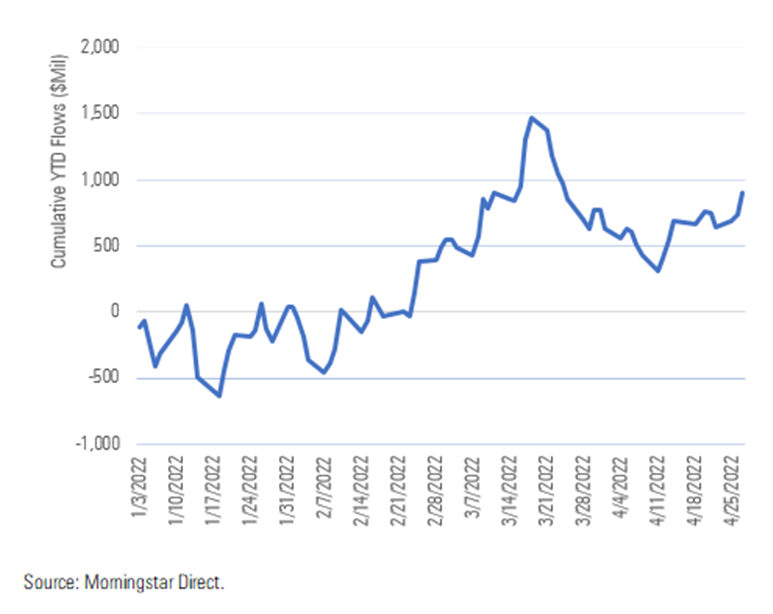
These stories remind us that while corporate transformations are almost universally assumed to be top-down processes, in reality, middle managers, and first-line supervisors can make significant change when they have the right mindset.

https://hbr.org/2019/12/how-one-person-can-change-the-conscience-of-an-organization?utm_medium=social&utm_campaign=hbr&utm_source=LinkedIn&tpcc=orgsocial_edit

Topley’s Top 10 – February 16, 2022

1.Market Now Betting on 7 Rate Hikes.

2.Another Chart that Quietly had -20% Correction…Dow Transports

Transports 18,200 to 14,600 before recent bounce

www.stockcharts.com

3.Small Cap Bounce After -20% Correction

Small Caps bounce 9% off lows but still well below 200 day moving average and 13% from highs

4.History of U.S. Energy Balance Sheet

The United States now produces so much of its own energy from all sources (oil, gas, wind, nuclear, hydro, solar) that it increasingly reduces the net call on imports, and frees up surpluses for export.

Gregor Macdonald  https://twitter.com/GregorMacdonald

5.Value Stocks Perform Better During Decades of High Inflation

Value Stocks Like Higher Inflation by Ben Carlson

I’m not taking a victory lap here because I certainly didn’t expect to see inflation rise to nearly 8%. I wasn’t expecting so many supply chain issues stemming from massive consumer demand.

And that piece wasn’t a macro call as much as it was trying to understand why value stocks had lagged growth stocks so badly in the years leading up to the pandemic.

My takeaway was value stocks needed higher inflation to outperform once again. While not a perfect relationship, value has tended to perform better during decades with above average inflation and perform worse during decades with lower inflation.

Here’s the visual:

https://awealthofcommonsense.com/2022/02/value-stocks-like-higher-inflation/

6.Liquid Alternatives $102.7B Positive Flows 2021

Advisor Perspectives Blog….AUM Jumps in Liquid Alts

All categories increased their Total Net Assets from last year with an overall 33% increase in assets totaling $707.4 billion on December 31, 2021. Real Estate, the largest category, ended the year with $239 billion in assets, up almost 50%.

Weekly flow-gathering was equally impressive. Options Trading, Relative Value Arbitrage, and Derivative Income categories enjoyed positive flows each week in 2021. Flows into Nontraditional Bond and Multistrategy categories were positive for 50 weeks with Event Driven, Equity Market Neutral, and Long-Short Equity Categories positive for 48 weeks. These flows confirm investors’ need for products providing portfolio diversification, performance consistency, alternative sources of income, and an equity hedge.

In aggregate, estimated net flows totaled $102.7 billion in 2021. A positive year after three consecutive years of negative net flows and the strongest positive year since 2013.

Elise Pondel, CFA, AVP, Director of Product Analytics

https://www.calamos.com/blogs/investment-ideas/liquid-alts-in-2021-record-aum-strongest-flows-since-2013-and-performance-to-believe-in/?utm_source=ap&utm_medium=nat_textl&utm_campaign=12522post

7.Top 1% Households by Wealth vs. Bottom 50%

Food for Thought: Portfolio allocations of the top 1% vs. the bottom 50%:

Source: Goldman Sachs; @MikeZaccardi

8.Omnicron Cases -83% vs. Restaurants Recovery Stall

LPL Research

https://lplresearch.com/2022/02/15/what-could-the-end-of-the-omicron-surge-mean-for-inflation/

9.Post Crypto Superbowl…BlockFi $100m Fine

Peter Thiel-backed crypto start-up BlockFi to pay $100 million in settlement with SEC, 32 states

PUBLISHED MON, FEB 14 202212:52 PM ESTUPDATED MON, FEB 14 20227:41 PM EST

Ryan Browne@RYAN_BROWNE_

SHAREShare Article via FacebookShare Article via TwitterShare Article via LinkedInShare Article via Email

KEY POINTS

·         BlockFi has agreed to pay $100 million to the SEC and 32 states to settle charges related to its retail crypto lending product.

·         The service, BlockFi Interest Accounts, let users accrue interest on holdings of bitcoin and other cryptocurrencies.

·         BlockFi says it is now applying to register with the SEC to offer a new crypto savings product called BlockFi Yield.

Cryptocurrency firm BlockFi said Monday it has agreed to pay $100 million to the U.S. Securities and Exchange Commission and several states to settle charges related to its popular crypto lending product.

BlockFi, which is backed by Silicon Valley investor Peter Thiel, touts itself as a banklike platform for crypto users. The company offers a popular savings product that lets clients accrue interest on their digital currency holdings.

BlockFi advertises annual percentage yields as high as 9.25% on its website, much higher than the average savings rates on offer from incumbent financial institutions. The firm says it is able to offer such rates as large institutional investors are willing to pay more to borrow the deposits.

Bitcoin and other digital assets are not regulated, however, and authorities have grown concerned by a lack of oversight for crypto-related services that more closely resemble traditional financial products that are regulated.

The SEC said Monday it had charged BlockFi with failing to register its retail crypto lending product, BlockFi Interest Accounts, and with violating the registration provisions of the Investment Company Act of 1940.

BlockFi agreed to pay the SEC $50 million to settle the charges, without admitting or denying wrongdoing or liability. It will also pay a further $50 million to 32 states over similar charges.

Following the settlement, BlockFi said U.S. customers will no longer be able to open new interest accounts with the firm. Clients can continue receiving interest on their existing holdings, but cannot add new assets to their accounts, the company said.

BlockFi says it is now applying to register with the SEC to offer a new crypto savings product called BlockFi Yield. The company added it intends to eventually move existing U.S. users over to the new service, unless they decide against it. BlockFi said the move provides “regulatory clarity” for the industry.

“From the day we started BlockFi, we have always known that strong engagement with regulators would be critical for the adoption of financial services powered by cryptocurrencies,” BlockFi CEO and founder Zac Prince said in a statement.

“Today’s milestone is yet another example of our pioneering efforts in securing regulatory clarity for the broader industry and our clients, just as we did for our first product — the crypto-backed loan,” he added.

The SEC also issued a warning to other crypto lenders that offer services like BlockFi’s, with Gurbir S. Grewal, director of the agency’s enforcement division, saying they “should take immediate notice of today’s resolution and come into compliance with the federal securities laws.”

The watchdog is reportedly scrutinizing Celsius, Gemini and Voyager Digital as part of an inquiry into crypto lending practices, according to Bloomberg. All three firms said they are cooperating with regulators.

Last year, Coinbase shelved plans to launch its own interest-earning crypto product after the SEC threatened to sue the company. The crypto exchange’s CEO, Brian Armstrong, got into a public spat with the watchdog, accusing it on Twitter of “sketchy behavior.”

Founded in 2017, BlockFi has raised a total of over $500 million in venture funding to date, according to CB Insights data, and was last privately valued at $3 billion.

https://www.cnbc.com/2022/02/14/crypto-start-up-blockfi-to-pay-100m-in-settlement-with-sec-32-states.html?utm_campaign=mb&utm_medium=newsletter&utm_source=morning_brew

10.Warren Buffett: 3 Daily Habits That Separate the Doers From the Dreamers

Don’t just dream about success–act on it with focus and intent.

.

BY MARCEL SCHWANTES, FOUNDER AND CHIEF HUMAN OFFICER, LEADERSHIP FROM THE CORE@MARCELSCHWANTES

Outside of Warren Buffett‘s mastery of investing, you have to agree that his simple life and business lessons are not only the stuff of legends, but also have a profound effect on people.

Some of it is pure common sense, like this slice of wisdom from the Oracle of Omaha:

You only have to do a very few things right in your life so long as you don’t do too many things wrong.

So, if you keep your failures to a minimum (with the full understanding that you must fail in order to succeed) you can achieve a level of success you’ve never imagined by doing a few things right over and over again0002:43

The next question should naturally be: What are some of those things? Well, we should probably consult Buffett on the matter. We may think that we need to devise grandiose strategies from complex ideas, but Buffett himself famously said, “It is not necessary to do extraordinary things to get extraordinary results.”

3 Buffett habits to practice

Some of life’s greatest successes come from the daily habits we practice with commitment and belief. An obstacle on the way to your success may be focusing too much on the results and not enough on the habits that will get you there.

Here are three that Buffett preaches by. They have worked for him. Will they work for you?

1. Surround yourself with the right people

A Buffett put it a few years ago when he spoke with some college students, “You will move in the direction of the people that you associate with. So it’s important to associate with people that are better than yourself.”

As the famous saying goes, we are the average of the five people we spend the most time with. And depending on whom you associate with at work, that can potentially disrupt your thinking, belief system, and how you make decisions.

2. Act swiftly on a decision

Did you ever sit on a decision too long and do nothing when you should’ve acted on it? Buffett calls that “thumb-sucking.” It’s stalling, procrastinating, and avoiding something that may have been your best bet to begin with to reach your goals. We’re all guilty of it.

As with most important decisions in life, do your research thoroughly, get all the information, and then act swiftly on your decision.

3. Invest in yourself

According to Buffett, one of the keys to your success is to go to bed a little smarter each day. By investing in yourself, especially honing your communication skills, Buffett says you will “become worth 50 percent more than you are now.”

If you can’t communicate well in business, Buffett warns, “it’s like winking at a girl in the dark–nothing happens. You can have all the brainpower in the world, but you have to be able to transmit it. And the transmission is communication.”

https://www.inc.com/rebecca-deczynski/misfits-market-grocery-delivery-service-food-deserts.html?cid=sf01003

Topley’s Top 10 – February 15, 2022

1. 2021 More Equity Inflows than Prior 25 Years Combined.

Zerohedge-2021 logged more equity inflows, $913 Billion, than the prior 25 years combined. 2022 is on pace to exceed this number by 45%.

Rubner writes that “in 2009, I officially retired the term “Great Rotation” or the movement of capital out of fixed income into equities, from my weekly emails and IB chat rooms. I switched this portfolio shift into the “Wedge”, which was the movement of capital into bonds and cash, and out of equities.”

https://www.zerohedge.com/markets/money-flowing-stocks-record-pace-goldman-does-not-see-larger-correction-taking-place


2. Nasdaq Price to Sales Ratio…Lower but Still Double 10 Years Ago

@Charlie Bilello The question many are asking is how much lower can valuations go?

If we look at the Nasdaq 100 over the last 10 years, we find that even after the recent correction, the median Price to Sales ratio remains elevated at 6.4x. Ten years ago (in 2012) this multiple stood at 3x.  Powered by YCharts

What was the 10-Year Treasury yield and Fed Funds Rate back in 2012?

Exactly the same as they are today: 2.0% and 0-0.25% respectively.

Which means that a) multiples can certainly go lower and b) sentiment, much more than interest rates, are the primary driver of valuations.


3. Negative Returns Very Uncommon in Diversified Bond Portfolio

SCHWAB


4. S&P …What Matters is the Direction of Earnings Per Share….0.94 Correlation.

From Irrelevant Investor Michael Batnick

https://theirrelevantinvestor.com/2022/02/12/time-to-buy-defense-stocks/


5. Geopolitical Events and Stock Market Reactions

LPL Research

https://www.marketwatch.com/story/what-a-russian-invasion-of-ukraine-would-mean-for-markets-as-white-house-warns-attack-could-come-any-day-now-11644624056?mod=home-page


6. 85% of Russian Natural Gas Goes to Europe.

WSJ-For now, the most likely energy disruption would be to Russia’s exports of natural gas, say analysts. Russia exports around 23 billion cubic feet of gas a day, about 25% of global trade, and 85% of that gas goes to Europe, according to Cowen. In particular, Russia’s flow of natural gas to Europe through a pipeline network in Ukraine could be disrupted during a conflict. The network transports about 4 billion cubic feet a day at full capacity to Europe but is currently flowing at about 50%, according to Cowen.   Approximately half of Russia’s federal budget is tied to oil and gas, according to investment bank Raymond James.

By 

Christopher M. Matthews Follow and Collin Eaton Follow  https://www.wsj.com/articles/why-russian-invasion-peril-is-driving-oil-prices-near-100-11644790004


Science Direct

Fig. 1. Russia’s natural gas production, consumption, and export [analysis based on 1].

Natural gas export occurs via pipeline systems and in the form of LNG. The Russian natural gas export geography for LNG includes Asia Pacific (Japan, South Korea, and Taiwan), Europe, and other countries (including the Middle East and Canada, with minor volumes), and for pipeline gas includes Europe and CIS countries, predominantly Belarus. Besides, Russia imports natural gas from Kazakhstan and Uzbekistan for further re-export [1]. Fig. 2 shows the main destinations of Russian natural gas export in 2018.


https://www.sciencedirect.com/science/article/pii/S2211467X2030064X


7. 30 Year Treasury Yield 2.29% Last….3.5% Level is High Going Back to 2014

30 year treasury yield…50day about to cross above 200day to upside (bullish)

30 Year Yield has been Below 3.5% Level Since 2014

www.stockcharts.com


8. Gold Sideways for 2021…Watch for Breakout

www.stockcharts.com


9. Sun Belt Rents Rise as Population Migrates

Bloomberg-Among the 50 largest metropolitan areas, Tampa ranked No. 1 with a 27% surge in rent in the 12 months through January, according to the Zillow Observed Rent Index. Rents also rose 27% in the Miami area, while they were up 26% in No. 3 Phoenix, the data show. According to LinkedIn data, Sun Belt cities such as Nashville, Tennessee; Austin and Tampa are among the largest per-capita recipients of net job migration. Miami didn’t make LinkedIn’s top 10 overall, but it has proved a popular destination for the emerging crypto economy, and has attracted some high-profile new finance and tech firms. By Jonathan Levin

https://www.bloomberg.com/news/articles/2022-02-14/miami-tampa-post-largest-jump-in-rents-as-sun-belt-prices-soar?srnd=premium&sref=GGda9y2L


However…Inflation including rents is starting to flat Line


10. Why your high-performing employees may be slowly disengaging from work

BY WHITNEY JOHNSON5 MINUTE READ

We are experiencing an extraordinary socioeconomic upheaval the media calls the Great Resignation. Half the American workforce is looking for a new job. (I dislike this label and prefer to call the phenomenon the “Great Aspiration.”) Most people aren’t giving up, despite the significant workplace headwinds of the pandemic. Workers are looking for better work, higher compensation, greater purpose, more flexibility. Individuals want opportunities to grow. They are emboldened to make their own change.

To model human growth and help people see their progress and proactively direct their own growth, I use the so-called S curve to describe learning. Here’s the framework in summary: The base of the curve is the launch point. Growth is slow as competence is gradually acquired. It can be painful and discouraging and requires appropriate management.

As competence increases, we tip into the sweet spot up the steep back of the “S.” Growth is rapid, engagement and productivity are high. Again, well-informed management strategies can extend this valuable phase. The subject of this article is the final stage: mastery at the high end of the “S.” It’s a plateau that becomes a precipice; we’ve exhausted the growth experience available on a curve, and we’re getting bored. This is where an employee who is very, very good at what they do begins to feel they can’t do it anymore. They need a new S curve to climb.

Why is this so?

ADVERTISEMENT

Our enjoyment and engagement in any activity is driven by neuroscientific processes. Our brains are learning machines, with a default setting for growth. When we are learning, our brains are changing. This is called neural plasticity. Brain cells, the neurons, develop cell-to-cell connections called synapses. As we learn, new synapses form between cells not previously connected. Our synapses grow at a rate commensurate with the challenge level in our brains. Mental effort translates into faster growth of the neural network.

Additionally, our brains are continually running predictive models. When something is new to us, our predictions can be uninformed. When we get it wrong, dopamine in the brain drops. It feels bad. When we get what we expect dopamine levels are steady. When our expectations are exceeded, dopamine is released in high doses. Dopamine is a feel-good chemical; it makes us feel delight. We are naturally drawn to seek the dopamine reward of exceeding expectations.

Consider this analogy: In actual mountaineering, the summit is the goal. It’s the high end of that S curve. But stopping for very long at high altitude can be deadly. Elevation above 26,000 feet is considered the death zone. We consume oxygen faster than it can be replaced–a condition called anoxia. In a short time, bodies and brains start to die from oxygen deprivation. Even if supplemental oxygen is available, physical exhaustion and cognitive impairment can lead to serious accidents and death.

Learning—or rather, the brain activity and chemicals associated with learning—is the oxygen of human growth. At the high end of the S curve, where we are in mastery, our actions are automatic, our competence is high, but our brain rewards are low. We’re not getting dopamine doses delivered sufficiently to make us feel the involvement and delight that we once had. Our interest is dying. This results in stagnation, lower productivity, and disengagement. It becomes difficult to force ourselves to do things we do easily and well.

In his book Behavioral and Neural Plasticity, Michael M. Nikoletseas writes that habituation is an organism’s decremented response to environmental stimuli that it experiences repeatedly over time. Habituation leads to a behavioral plateau, where the organism responds minimally, if at all, to events that it has found to be predictable. “If we present a stimulus many times, the organism will either stop responding, or respond minimally at a lower level. Eventually, no matter how many more times we present the stimulus, we do not see any further change. The curve plateaus.” Nikoletseas adds that humans exhibit decremented responses to events that have become too familiar. We produce nothing but a reflexive response—no new learning—which is neural rigidity.

This is why top performing employees are often the biggest flight risk. It’s why the quality of their work may decline. They don’t just want a new job; they need one. Hopefully, informed leaders have the early, open, and regular conversations with their reports that help both manager and employee map this process. The S curve of the learning model provides a common language to facilitate this critical communication. Leaders can have their finger on the pulse of an employee’s perception of their progress, the most important indicator of when retention is going to become a challenge if a new in-house opportunity is not available. Proactive preparation can ensure that valuable human resources know that their growth is a high organizational priority.

The fascinating 2019 study titled The CEO Life Cycle illustrates this process at the highest level of organizations. It describes the pattern of growth, stagnation, and possible regrowth over time. Tracking the year-by-year financial performance of more than 700 S&P chief executives, the study reveals distinct phases of job performance, starting with the “honeymoon” and concluding with the “golden years.”
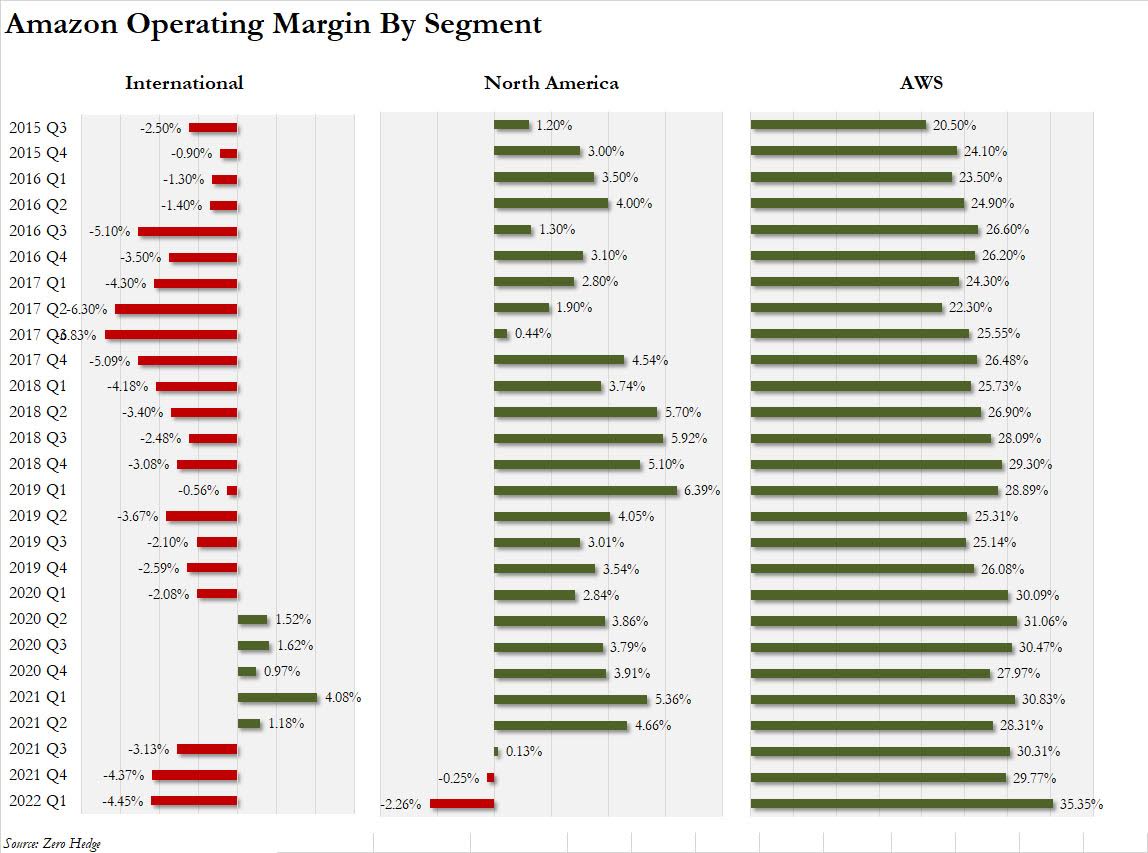
Those who last to year 11, when the golden years typically begin, must first survive the death zone of success. The peak of a CEO’s S curve is around year six. It is “often followed by a time of prolonged stagnation and mediocre results,” according to the report. The plateau is a precipice: Many CEOs quit or are fired. CEOs only reach the golden years if they deliberately and repeatedly reinvent themselves on new curves of learning: “CEOs who survive the complacency trap typically go on to experience some of their best value-creating years.”

Once valuable employees who are in decline can be valuable again. They may just need a new version of the curve to climb.


Whitney Johnson is CEO of the tech-enabled talent development company Disruption Advisors, an Inc. 5000 fastest-growing private company in America and one of the 50 leading business thinkers in the world as named by Thinkers50. She is a frequent lecturer for Harvard Business School’s Corporate Learning and she is the author of Smart Growth: How to Grow Your People to Grow Your Company.

https://www.fastcompany.com/90718635/why-your-high-performing-employees-may-be-slowly-disengaging-from-their-work?partner=inc&cid=sf01003

Topley’s Top 10 – February 14, 2022

1. SuperBowl Bets +78% Year Over Year…4 Years Since Legalization…Gambling Companies Revs +1,000%

Barrons-Bookmakers have always been busy on Super Bowl Sunday, but this year will be a bonanza like never before. Bettors are on track to wager $7.6 billion on the game, up 78% from last year, and it’s not because the office pool is getting bigger.

Legal sports gambling has now spread to 30 states and Washington, D.C.—home to more than 130 million. In the four years that it has been legal, both the amount of money bet on sports and the amount counted as revenue by gambling companies have risen nearly 1,000%, to $57 billion and $4.3 billion, respectively, according to the American Gaming Association, or AGA.

In New Jersey, which led the way in allowing sports betting, $10.9 billion was wagered in 2021. That’s $1,200 for every man, woman, and child in the state.

The $22 Billion Wager: DraftKings and Others Are Reaching for a Piece of the Sports-Gambling Prize By

Avi Salzman Follow

https://www.barrons.com/articles/draftkings-mgm-online-sports-gambling-social-cost-51644628419?mod=past_editions


2. The Most Commodities in Backwardation Since 1997

Commodities: Many commodities are in backwardation amid tight supplies.

Source: Bloomberg Read full article

From The Daily Shot https://dailyshotbrief.com/the-daily-shot-brief-february-10th-2022/


3. Timber eyed as a hedge against rising prices as inflation surges to 40-year highs

“Timber, historically, has been positively correlated with inflation fairly directly,” Joe Sanderson of Domain Timber Advisors told Insider, adding that this makes it a good hedge against the rising prices of goods and services.

Isabelle Lee 

https://markets.businessinsider.com/news/commodities/inflation-hedge-asset-timber-wood-lumber-hike-rates-fed-cpi-2022-2


4. TBF Short Bonds ETF….Rally but Still Well Below 2021 Levels

www.stockcharts.com


5. UBER Made More Money Delivering Food than People

Uber wrapped 2021 with strong revenue growth and greater adjusted profitability

Alex Wilhelm@alex /. Today after the bell, Uber reported its fourth-quarter financial performance. The company saw $25.9 billion in gross platform spend, up 51% compared to its year-ago result, and revenues of $5.78 billion, up 83% compared to Q4 2020. The company also reported GAAP net income of $0.44 per share, though that number did include non-operating items relating to investments.

Analysts had expected the company to report a per-share loss of $0.35 against revenues of $5.34 billion, according to estimates shared by Yahoo Finance. Shares of the American company are up just under 6% in the immediate aftermath of its earnings disclosure.

On a per-segment basis, here’s how Uber’s key business units performed in revenue terms:

Image Credits: Uber

The company’s diversification is in full-force in the above numbers, with ride-hailing posting the slowest growth of Uber’s core unit results, even losing the revenue crown to delivery. However, when it comes to generating heavily adjusted EBITDA, things are rather different:

Image Credits: Uber

Here we can see that Uber’s ride-hailing business remains utterly supreme when it comes to the creation of margin for the company’s corporate operations to charge against. In contrast, delivery and freight-focused operations effectively canceled out one another in the quarter. Still, for Uber, posting positive adjusted EBITDA is a useful indication that its business has matured into something less awash in red ink than it once was, helped in no small part by the company’s delivery work shifting its results into the green.

https://techcrunch.com/2022/02/09/uber-4q-earnings-strong-revenue-growth-greater-adjusted-profitability/?guccounter=1

Found at Chartr  www.chartr.com


6. 285 ETFs Hold TSLA….62.6m Shares

What’s one factor about our current markets that doesn’t get enough attention?

One factor about our current markets that doesn’t get enough attention, in my opinion, is the explosion in the number or ETFs over the past ten years and the huge volume traded there.

Tesla is a holding in over 200 different ETFs – when TSLA stock goes higher all these ETFs need to buy TSLA stock to match its weighting and performance. The same is true when TSLA stock goes lower; all the ETFs need to sell.

This is true of any major ETF held stock: when it goes higher, more funds need to buy it (and need to sell it when its going lower). All this is fine when the markets are functioning normally, but in moments of inefficiency, when liquidity dries up, this can lead to huge volatile moves.

So, blame the algos, blame the ETFs, blame the Fed, but this is how fear and selling in a few of the markets’ mega-caps can quickly cascade into a waterfall.

https://www.zerohedge.com/markets/selling-few-mega-caps-can-quickly-turn-waterfall-former-cboe-floor-trader

www.stockcharts.com


7. 50% of Nasdaq and 45% of Small Cap Russell 2000 -20% from Highs.

Schwab-Liz Ann Sonders–Deteriorating breadth was an issue in 2021 but has become more acute in 2022. For example, more than 40% of the stocks on the Russell 2000 index have experienced a drawdown of a least 20% from a recent peak so far this year. For the Nasdaq index, the total is closer to half. These stealth bear markets are having an effect at the index level, with the Nasdaq recently experiencing a maximum drawdown of 17% from its November 2021 peak and the Russell 2000 down (at its worst point) 21% this year from its November 2021 peak.

Bear markets are getting less stealthy

Source: Charles Schwab, Bloomberg, as of 2/4/2022. Past performance is no guarantee of future results.

https://www.schwab.com/resource-center/insights/content/market-perspective


8. BlackRock Planning to Offer Crypto Trading, Sources Say

Clients would be able to trade crypto through the firm’s Aladdin investment platform, said one of the sources.

By Ian Allison

BlackRock headquarters in New York (Jeenah Moon/Bloomberg via Getty Images)

BlackRock, the world’s largest asset manager, is preparing to offer a cryptocurrency trading service to its investor clients, according to three people with knowledge of the plans.

The New York-based company, which manages over $10 trillion in assets for institutions, plans to enter the cryptocurrency space with “client support trading and then with their own credit facility,” one of the people said. In other words, clients would be able to borrow from BlackRock by pledging crypto assets as collateral.

One of the people said BlackRock will allow its clients – which include public pension schemes, endowments and sovereign wealth funds – to trade cryptocurrency through Aladdin (short for “Asset, Liability, Debt and Derivative Investment Network”), the asset manager’s integrated investment management platform. The timetable for unveiling the service is unclear.

BlackRock declined to comment.

The asset manager may have been telegraphing its intentions as early as June when it began hiring for an Aladdin blockchain strategy lead. These days it’s taken as known that Wall Street banks and large financial institutions are edging into crypto, with the likes of Goldman Sachs, Morgan Stanley and Citi carefully choosing strategies.

Read more: BlackRock Wants a Blockchain Strategy for Aladdin, Its Investments Engine

BlackRock has already sent some positive signals to the market regarding crypto, including trading CME bitcoin futures, as per a filing with the U.S. Securities and Exchange Commission. The company also has plans to launch the iShares Blockchain and Tech ETF, an exchange-traded fund tracking an index composed of companies involved in crypto technologies in the U.S. and abroad.

BlackRock also owns 16.3% of MicroStrategy, whose CEO, Michael Saylor, regularly trumpets news about his firm’s bitcoin holdings.

A second person with knowledge of the plans said BlackRock was “looking to get hands-on with outright crypto” and was “looking at providers in the space.”

A third person referred to a working group of “approximately 20 or so” inside BlackRock that is evaluating crypto, adding, “They see all the flow that everyone else is getting and want to start making some money from this.”

https://www.coindesk.com/business/2022/02/09/blackrock-planning-to-offer-crypto-trading-sources-say/


9. New FDA-approved eye drops could replace reading glasses for millions: “It’s definitely a life changer”

A newly approved eye drop hitting the market on Thursday could change the lives of millions of Americans with age-related blurred near vision, a condition affecting mostly people 40 and older.

Vuity, which was approved by the Food and Drug Administration in October, would potentially replace reading glasses for some of the 128 million Americans who have trouble seeing close-up. The new medicine takes effect in about 15 minutes, with one drop on each eye providing sharper vision for six to 10 hours, according to the company.

Toni Wright, one of the 750 participants in a clinical trial to test the drug, said she liked what she saw.

“It’s definitely a life changer,” Wright told CBS News national correspondent Jericka Duncan.

Before the trial, the only way Wright could see things clearly was by keeping reading glasses everywhere — in her office, bathroom, kitchen and car.

“I was in denial because to me that was a sign of growing older, you know, needing to wear glasses,” she said.

It was in 2019 that her doctor told her about a new eye drop with the potential to correct her vision problems, temporarily. The 54-year-old online retail consultant, who works from her farm in western Pennsylvania, instantly noticed a difference.

“I would not need my readers as much, especially on the computer, where I would always need to have them on,” she said.

Vuity is the first FDA-approved eye drop to treat age-related blurry near vision, also known as presbyopia. The prescription drug utilizes the eye’s natural ability to reduce its pupil size, said Dr. George Waring, the principal investigator for the trial.

“Reducing the pupil size expands the depth of field or the depth of focus, and that allows you to focus at different ranges naturally,” he said.

A 30-day supply of the drug will cost about $80 and works best in people 40 to 55 years old, a Vuity spokesperson said. Side effects detected in the three-month trial included headaches and red eyes, the company said.

“This is something that we anticipate will be well tolerated long term, but this will be evaluated and studied in a formal capacity,” Waring said.

Vuity is by no means a cure-all, and the maker does caution against using the drops when driving at night or performing activities in low-light conditions. The drops are for mild to intermediate cases and are less effective after age 65, as eyes age. Users may also have temporary difficulty in adjusting focus between objects near and far.

As of now, the drug is not covered by insurance. Doctors who spoke with CBS News said it’s unlikely that insurance will ever cover it because it’s not “medically necessary,” as glasses are still a less expensive alternative.

For Wright and millions just like her, the new drug is an easy backup solution — with a clear advantage.

“Just a convenience to have that option of putting the drops in and being able to go,” she said.

https://www.cbsnews.com/news/vuity-eye-drops-presbyopia-reading-glasses-vision-fda-approved/


10. The Power of Regret Found at Abnormal Returns Blog

Daniel Pink is the author seven books about business, work, creativity, and behavior, including the #1 New York Times bestsellers Drive and To Sell Is Human. He is also one of our curators here at the Next Big Idea Club.

Below, Daniel shares 5 key insights from his new book, The Power of Regret: How Looking Backward Moves Us Forward. Listen to the audio version—read by Daniel himself—in the Next Big Idea App.

1. Regret is universal.

“No regrets.” We hear it everywhere—in hit songs, on tattoos, in celebrity interviews. The message booms from every corner of the culture. Forget the past, seize the future, bypass the bitter, savor the sweet. A good life has a singular focus (forward) and an unwavering valence (positive).

This philosophy makes intuitive sense, but there’s just one problem: It’s dead wrong. Regret is not dangerous or abnormal, a deviation from the steady path to happiness; it is healthy and universal, an integral part of being human. Everyone has regrets. In one study from the 1980s, regret was the second most-common emotion expressed in interviews, trailing only love. In 2008, social scientists found that among negative emotions, regret was both the most experienced and the most valued. And in my own survey of nearly 4,500 Americans, 99 percent of people admitted that they do at least occasionally experience this emotion.

Regret is a universal human experience. The only people who don’t have regrets are five-year-olds, people with brain damage and neurodegenerative disorders, and sociopaths.

In other words, the inability to feel regret—in some ways the apotheosis of what the “no regrets” philosophy encourages—isn’t a sign of psychological health. It’s the sign of a grave disorder.

2. Done right, regret makes us better.

Why is regret hard to take and harder to avoid? Why is it so prevalent? Are we all masochists? No. Well, at least not all of us. Instead, we are wired for survival. Regret makes us feelworse, but it can make us do better. Indeed, the way it makes us do better is by making us feel worse. A half-century of research shows that dealing with our regrets properly—not ignoring them, but not wallowing in them either—delivers at least three benefits.

“Regret makes us feel worse, but it can make us dobetter.”

First, it can sharpen our decision-making. In one study, negotiators fared better on subsequent interactions if they considered previous negotiation regrets. Reflecting on prior regrets can help us avoid cognitive biases, like escalation of commitment to a failing course of action.

Second, regret can elevate our performance on a range of tasks. People who regret their performance on problem-solving tasks do better on their next attempts to solve problems. Even hearing about other people’s regrets can change our thinking for the better. People who heard a story about a woman who narrowly missed out on winning a trip to Hawaii because she switched seats scored 10 points higher on the LSAT, the law school admission test.

Third, regret can strengthen our sense of meaning and connectedness. People who think counterfactually about pivotal moments in their lives experience greater meaning than those who think explicitly about the meaning of those events. Likewise, when people consider counterfactual alternatives to life events, they experience higher levels of religious feeling and a deeper sense of purpose than when they simply recount the facts of those events.
This way of thinking can even increase feelings of patriotism and commitment to one’s organization.

In short, regret can make us better by improving our decisions, boosting our performance on problem-solving tasks, and deepening our sense of meaning.

3. To understand what people regret, look beneath the surface.

Beginning with George Gallup in 1949, pollsters and professors have tried to determine what people regret. Do they have career regrets, education regrets, romance regrets, health regrets, family regrets, financial regrets? And since the mid-20th century, their answer has been unsatisfying.

“People seem to express the same four core regrets, irrespective of the domain of their life.”

People regret a lot of stuff. No domain predominates. But I think I figured out the riddle. What’s visible and easy to discover—the realms of life, such as family, school, and work—is far less significant than a hidden architecture of motivation and aspiration that lies beneath it. In analyzing 15,000 regrets from people in 105 countries, I’ve found that people seem to express the same four core regrets, irrespective of the domain of their life.

One is foundation regrets. Many of our education, financial, and health regrets are actually different outward expressions of the same core regret: our failure to be responsible, conscientious, or prudent. Our lives need some basic level of stability.

The second category: boldness regrets. A stable platform for our lives is necessary, but not sufficient. One of the sturdiest findings in academic research and my own is that over time, we are much more likely to regret the chances we didn’t take than the chances we did.

Third: moral regrets. Most of us want to be good people, yet we often face choices that tempt us to take the low road. When we behave poorly or compromise our belief in our own goodness, regret can build and then persist.

Finally, connection regrets. Our actions give our lives direction, but other people give those lives purpose. Many human regrets stem from our failure to recognize and honor this principle. Connection regrets arise anytime we neglect the people who help establish our sense of wholeness. When those relationships fray, disappear, or never develop, we feel an abiding loss.

Foundation regrets, boldness regrets, moral regrets, connection regrets—these are the four core regrets that people express.

“We are much more likely to regret the chances we didn’t take than the chances we did.”

4. Science offers a systematic way to deal with our regrets.

So, what can we do to turn our existing regrets into engines of progress? Science suggests a three-step process.

First, look inward through self-compassion. Self-compassion, pioneered by Kristin Neff at the University of Texas, begins by replacing searing judgment with basic kindness. It doesn’t ignore our screw-ups or neglect our weaknesses; it simply recognizes that being imperfect, making mistakes, and encountering life difficulties is part of the shared human experience. By normalizing negative experiences, we neutralize them. Self-compassion encourages us to treat ourselves with kindness rather than contempt so that we can move on.

Second, express outward through self-disclosure. We’re often skittish about revealing negative information about ourselves to others. But an enormous body of literature makes clear that disclosing our thoughts, feelings, and actions by telling others—or simply writing about them—brings an array of physical, mental, and professional benefits. Disclosing regret lifts the burden, and by converting the blobby, amorphous negative emotion into concrete words, we make the threat less menacing and can begin making sense of what happened.

Third, move forward through self-distancing. When we’re beset by negative emotions, including regret, one response is to immerse ourselves in them, but immersion can catch us in the undertow of rumination. A better, more effective, and longer-lasting approach is to move in the opposite direction—not to plunge in, but to zoom out and gaze upon our situation as a detached observer. Self-distancing helps you analyze and strategize, examine the regret dispassionately, and then extract a lesson from it that can guide your future behavior.

“Self-compassion encourages us to treat ourselves with kindness rather than contempt so that we can move on.”

5. Anticipating our regrets is useful, but this medicine should come with a warning label.

We often think about regret through the rearview mirror, but it’s also well worth our time to consider it through the front windshield.

Anticipating regrets can often work to our advantage. It slows our thinking. It taps our cerebral breaks, allowing us time to gather additional information and to reflect before we decide what to do. Anticipated regret is especially useful in overcoming regrets of inaction. For example, one well-regarded British study showed that people prompted to agree with the simple statement “if I do not exercise at least six times in the next two weeks, I will feel regret” ended up exercising significantly more than people who did not have regret on their minds.

Anticipating our regrets is often useful, but it should come with a warning label. One problem with using anticipated regrets as a decision-making tool is that we’re pretty bad at predicting the intensity and duration of our emotions, and we’re especially inept at predicting regret. Anticipating regret can sometimes steer us away from the best decision and toward the decision that most shields us from regret.

The best advice, then, is not to avoid all regrets, but rather to optimize them. We know that people tend to regret the same four things, so anticipate those regrets. Do everything you can to build your foundation. Take a sensible risk. Do the right thing. Reach out. But for other possible regrets, chill out. Good enough is often good enough.

Our everyday lives consist of hundreds of decisions, some crucial to our well-being, many inconsequential. Understanding that difference can make all the difference. If we know what we truly regret, we know what we truly value. Regret—that maddening, perplexing, and undeniably real emotion—points the way to a life well-lived.

To listen to the audio version read by author Daniel Pink, download the Next Big Idea App today:

https://nextbigideaclub.com/magazine/power-regret-looking-backward-moves-us-forward-bookbite/32395/

Topley’s Top 10 – February 11, 2022

Good Riddance Ben…The Passed Up Dunk that Ended It All

1. Warren Buffett Returns….BRK/B +7% vs. QQQ -10% Year to Date

This chart shows Berkshire vs. QQQ….50day thru 200day to upside

www.stockcharts.com

2.Energy is Back…….6 Months-XLE Energy ETF +40% vs. ARKK -40%

www.yahoofinance.com

3.Tech Stocks vs. Utilities Ratio Eclipsed 20 Year High

Bespoke Investments–The S&P 500 Technology (XLK) to Utilities (XLU) ratio is another interesting sector ratio chart.  This ratio exploded higher during the late 1990s Tech Bubble, but then it plunged from the peak in early 2000 and continued lower right through the Financial Crisis that ended in early 2009.  After hitting 2.5 at the peak of the Dot Com Bubble, the ratio got all the way down to 0.5 at its low.  Just recently, the ratio briefly ticked above 2.5, eclipsing its prior high made more than 20 years ago.  While the Tech sector has struggled over the last couple of months as the prospect of higher interest rates has weighed on growth stocks, this ratio shows that there is still A LOT to unwind if a new secular shift has begun.

https://www.bespokepremium.com/interactive/posts/think-big-blog/sector-and-index-ratios

4.Interest Rates and Inflation….Disconnect Takes Another Leg Up

Morningstar-Even as many in the markets continue to expect inflation to begin heading lower over the course of 2022, bond prices fell after the CPI data, sending yield on the widely-followed U.S. Treasury 10-year note toward 2%, its highest level since July 2019. Short-term bond yields also rose.

https://www.morningstar.com/articles/1078786/7-charts-on-the-big-cpi-rise-fed-rate-hike-outlook

5.Next Watch is Inverted Yield Curve

Zerohedge

The yield curve is collapsing (2s10s)…

And 7s10s briefly inverted…

The last time 5s30s spread was this low, The Fed folded on its policy tightening stance…

https://www.zerohedge.com/economics/rate-hike-odds-spike-after-hottest-cpi-40-years

6.Michael Batnick with a Hard to Believe Chart….You Can’t Buy a Home if You Make $75k-$100k

Irrelevant Investor Blog….

https://theirrelevantinvestor.com/2022/02/09/animal-spirits-inflation-at-disney-world/

7. Crypto M&A volume jumped nearly 5,000% in 2021 with the average deal size tripling in value, PwC says


Fernando Gutierrez-Juarez/picture alliance via Getty Images

  • The total volume of crypto M&A deals skyrocketed nearly 5,000% in 2021, according to PwC.
  • The average transaction size tripled in value from $52.7 million to $179.7 million.
  • PwC also found that deals shifted back to the Americas with 51% of them occurring in the region.

Business Insider…The total volume of cryptocurrency mergers and acquisitions skyrocketed nearly 5,000% in 2021, mirroring the stunning rally in the price of digital assets, according to PwC.

In a report published in early February, the Big Four accounting firm revealed that the number of deals surged by 4,846% in 2021 with the average transaction size tripling in value from $52.7 million to $179.7 million.

This was boosted by a number of blank-check deals worth billions of dollars. The top 10 deals, in fact, were all well above that level, led by Bullish Limited, which was acquired for $8.1 billion.

Top 10 crypto M&A deals in 2021 by deal size PwC Analysis, MergerMarket, Capital IQ, Crunchbase, Pitchbook, CoinDesk, CoinTelegraph

Meanwhile, the total value of crypto fundraising deals leapt 645% to $34.3 billion in 2021, with the average fundraising amount up 143% to $26.3 million. The previous year also saw players tap into the SPAC boom.

Below is a the top five investors by deal count in 2021, according to PwC.

Rank Investor Name Selected Investments
1 AU21 Capital Chainflip, DEIP, Arcana Network, reBaked, Decentral Games
2 Genesis Block Ventures Highstreet, Coin98 Finance, Pyth Network, Calaxy, Dex Lab
3 Genblock Capital NearPad, Biconomy, ClayStack, DexLab, Unbound Finance
4 Coinbase Ventures Chainflip, MobileCoin, CoinDCX, Liquality, Pintu
5 Moonwhale SoldexAI, Beyond Finance, DeepDAO, Chronicle, Panther Protocol

The firm also found that transactions shifted back to the Americas, with 51% of deals occurring in the region, up from the previous year’s 41%.

However, the Europe, Middle East, and Africa region saw total deal value of $25.5 billion, slightly surpassing that of the Americas despite comprising only 33% of the deals globally. The Asia Pacific region garnered 16% of the total deals at $5 billion.

Digital assets exploded in the past year with various cryptos, from bitcoin to dogecoin, hitting their all-time-highs. The market capitalization of the ecosystem even hit $3 trillion at one point in November, roughly the size of the entire UK economy, amid a broader rally. It has since cooled off and now stands at $2 trillion.

Check out: Personal Finance Insider’s picks for best cryptocurrency exchanges

https://markets.businessinsider.com/news/currencies/crypto-merger-acquisition-volume-jumped-nearly-5000-percent-pwc-2022-2

FTX Chief Reminds Congress That 95% of Crypto Volume Is Offshore–Yueqi Yang

(Bloomberg) — Sam Bankman-Fried, the chief executive officer and co-founder of cryptocurrency exchange FTX, said 95% of crypto trading volume occurs offshore and urged for greater regulatory clarity to attract businesses to the U.S.

“Despite the majority of the intellectual property for the digital asset industry originating from the United States, 95% of volume occurs offshore,” Bankman-Fried told members of the Senate Agriculture Committee during a hearing Wednesday on crypto assets. “The majority of assets are not accessible at all from the United States. It would be great to be able to move that liquidity, that business back on shore.”

Bankman-Fried cited the number as he made his requests for clarity of federal oversight over the digital assets industry. He supported expanding the jurisdiction of the Commodity Futures Trading Commission, which currently regulates the crypto derivatives market, to include spot digital commodity transactions. He also suggested the U.S. create a process to allow digital tokens to be registered in the country, and asked for greater clarity over licensing requirements.

The messages are in line with the request of CFTC Chairman Rostin Behnam, who urged lawmakers during the hearing to give his agency more authority and a bigger budget to oversee trading in the fast-growing cryptocurrency market.

The international FTX.com exchange has seen around $15 billion of assets traded daily on the platform this year, which now represents approximately 10% of global volume for crypto trading, according to Bankman-Fried’s testimony.

https://finance.yahoo.com/news/ftx-chief-reminds-congress-95-183325577.html

Russia to Regulate Crypto, Dispelling Fears of Ban–Anna Baydakova, Tracy Wang

Instead of banning cryptocurrencies, the Russian government has decided to regulate them, legitimizing a $2 trillion asset class in the world’s 11th-largest economy.

A document setting the principles for the regulation of cryptocurrencies appeared on the government’s official website on Tuesday night. Notably, the plan has the support of the central bank, which had called for a ban on crypto mining and trading.

This is the second major regulatory cloud to have been lifted from the global crypto market in a month. India last week took a step toward legalization with a tax on digital asset transfers. While it carries a hefty rate (30%), the tax was seen by many as putting the fifth-largest economy on track toward legitimizing crypto.

In Russia (population 144 million), residents own over 12 million cryptocurrency accounts and about 2 trillion rubles ($26.7 billion) worth of crypto, according to the government’s document (PDF in Russian).

https://finance.yahoo.com/news/russia-license-crypto-exchanges-tax-101022637.html

8. U.S. Mortgage Rates Surge to the Highest Level in More than Two Years….4% ?

9.Electric Vehicles Hit 9% of New Cars Sold….Total Cars on Road 6.6m out of 1.4B

CHARTR

Change: fast, but slow

Almost 9% of all new cars sold last year were electric, according to a new report from the International Energy Agency, more than double the 4% that were electric the year before.

That’s a big leap forward in relative terms, but a more modest one in absolute size. The 9% market share figure represents about 6.6 million actual new electric cars, a tiny, tiny fraction of the 1.3-1.4 billion cars that are estimated to be on the road around the world.

Tesla leads, just

The other interesting data point from this report is that Tesla still leads on electric car deliveries, selling 936k cars last year. That’s ahead of VW Group’s 763k and BYD’s 598k (all of which came in China alone).

Recommended reading: The long road to electric cars.

www.chartr.com

10.The 6 Most Passive-Aggressive Email Phrases You Use Without Thinking, According to a Recent Study

An ounce of prevention will keep you from sending the wrong message when you hit ‘Send.’

BY SCOTT MAUTZ, KEYNOTE SPEAKER AND AUTHOR, ‘FIND THE FIRE’ AND ‘MAKE IT MATTER’@SCOTT_MAUTZ

Getty Images

Ahh, the art of the email. I’ve always found it to be a terrible medium for communicating--so much can be misconstrued from an unintentionally curt sentence, a light-hearted capitalization–heck, even an emoji that doesn’t convey your mojo the way you meant.

These are the three biggest problems we create for ourselves with email:

1.     We don’t communicate enough to get the point across (the biggest problem with communication in general is the illusion that it has actually taken place)

2.     We’re not clear enough with the communication

3.     Our communication is taken the wrong way (with irritation or offense)

This last one most often happens when we use terms in email that are, in reality, seen as passive-aggressive by the recipient. A recent 1,000-person study by the email platform GetResponse revealed the top 6 phrases perceived as the most passive-aggressive by the receiver.

I’ll reveal them from the least offensive to the most offensive. You can decide to use this information to help you avoid coming across as passively aggressive, or the opposite, depending on your mood.

6. “Going forward I’d prefer…”

Guess what? Going forward the person who reads this line would prefer you not use it again. The “going forward” part is super passive aggressive because it assumes that what happened in the past didn’t work. The reader reads, “Look, what happened in the past is the past, but you can, and will, correct it in the future.” It’s assumptive and dismissive. Even the “I’d prefer” part is weak; it’s language someone uses when they’re beating around the bush on something.

An alternative (and, again, all alternatives that follow are based on the assumption you actually don’t want to come across passive-aggressive, but if that really is your intent, fire away): The alternative here is a good ol’ fashioned face-to-face conversation. When it comes to behavior changes that need to happen, don’t do it over email. Asking change of someone involves emotions, which are always better handled in person.

5. “According to my records…”

Ugh–so formal and uptight sounding. Is this a cross-examination or an email?

An alternative: “I honestly could have this wrong, but from what I think I know…,” or, “The way I see it is…” Fellow columnist Carmine Gallo wrote a great piece on how Tim Cook uses the power of these 5 words, “The way I see it…”

4. “Any updates on this?”

When I read this, I can’t help but picture the sender standing there by my cubicle, peering over the top of it with arms crossed, feet tapping, and a resting jerk face painted on. Try this test: Say “Any updates on this?” out loud to yourself without sounding snippy. Impossible.

An alternative: “I’m guessing you’re swamped–so, sorry to bug you, but what’s the latest on… It would help to know because…” Being brief in email is key so I’m not preaching verbosity here, but this one requires a bit more couching.

3. “Please let me know if I’ve misunderstood.”

What you’re really saying here is “We both know you’ve got this wrong.” This one is the most disingenuous of the lot because the recipient knows that you do not think you have it wrong in any way, shape, or form.

An alternative: If you actually do suspect you got something wrong, pick up the phone for this one. Misunderstandings tend to get more tangled when not ironed out in person. But if you do use email, consider, “I honestly could have this wrong, but…”

2. “Just a friendly reminder…”

It’s not friendly. You know it and I know it.

An alternative: “I honestly hate when people bug me about something, but I’m forced to be ‘that guy/girl’ here in reminding you that… because…”

1. “As per my last email…”

You may as well say, “You obviously didn’t read my last email, so let me try again, dummy.” This one is just plain rude and smacks of the assumption that the recipient has nothing better to do than to sit around waiting for your email to flow into their inbox like gorgeous salmon swimming upstream.

An alternative: “If you don’t mind my reinforcing a point I made before, only because it’s so important…”

We all get enough emails. No one wants more than they need, nor do they want them peppered with what more or less amounts to sass. You can still get your point across by using alternatives.

So, before you hit send, think of the message you’re sending.

https://www.inc.com/rebecca-deczynski/employee-satisfaction-pulse-surveys-great-resignation-how-to-retain-employees.html?cid=sf01003

Topley’s Top 10 – February 10, 2022

1.Earnings Guidance has Turned Most Negative Since 2009

Liz Ann Sonders Schwab

https://twitter.com/LizAnnSonders


2.S&P Forward P/E Correction So Far….31x to 24x

Bloomberg


3.Commodities Rally…DBC ETF Still Needs to Double to See 2008 Highs

www.stockcharts.com


4.Commodity Returns During Past Rate Hike Cycles.


5.The Leader of Zero Interest Rate Policies Japan Sees Positive 10 Year for First Time Since 2016

Jim Bianco Research–Japan started yield curve control (YCC) in Sept 2016 = 10-yr JGB at 0%. In July 2018 the BoJ widen the “band” for YCC to +/- 20bps Today is the highest yield since YCC began, and the first time the 10-yr JGB has been above to top of their band.

https://twitter.com/biancoresearch


6.Oldie but Goodie Chart Now that Rates are Rising.

But we must unfortunately watch the money losing zombies…Just too many firms out there that are not able to service their debt with yesterday’s low rates. What will happen when they need to refinance? They will need to get their capital structures in place now.

Deutsche Bank

361 CAPITAL BLAINE ROLLINS, CFA HTTPS://SNIPPET.FINANCE/THE-10-BEST-FINANCIAL-BLOGS/


7.”Disruptor” Stocks vs. 2 Yr. Treasury

ARKK vs 2-Yr Treasury Yield

Sumit Roy

https://www.etf.com/sections/features-and-news/high-growth-interest-rate-relationship-weakens


8.80% of Americans 18-34 Said Now was a BAD TIME to Buy a House

From Morning Brew.

REAL ESTATE

Young Americans shun the housing market


More than 80% of Americans ages 18–34 said now was a bad time to buy a house, according to a Fannie Mae survey released yesterday. Their gloomy outlook is shared by the broader population: A record-low proportion of Americans—just 25%—said it was a good time to buy a house right now.

It’s not a good time if you can’t afford it

The median home-sale price reached a record high of $365,000 in January, according to Redfin. That’s a 16% jump from the previous January and a 28% increase from January 2019.

Skyrocketing home prices highlight the severe demand–supply imbalance that emerged in the housing market over the pandemic.

  • Interest in buying homes soared thanks to historically low interest rates and the desire to avoid your trumpet-playing neighbor at all costs.
  • But the supply of available houses has not kept up—not even close. In fact, the 910,000 homes for sale at the end of December was the lowest since the National Association of Realtors began keeping track in 1999.

It all amounted to January being the most competitive month in US housing market history, Redfin said.

But young people are getting squeezed harder than most

Among the reasons why…

  1. The disappearing starter home: The US’ supply of properties 1,400 square feet or smaller (the ones ideal for your first home) has fallen to its lowest level in 50 years. Starter homes accounted for just 7% of construction in 2019, compared to 40% in 1980.
  2. Battle for the suburbs: Home prices are rising the fastest in suburbs with a higher share of children—neighborhoods where millennials are most interested in buying homes.

Big picture: Millennials like to think they’re the main character in every story, but in this case…they actually are. Many of them are about to hit 32, which is the median age of first-time home buyers in the US. Therefore, “As millennials go, so goes the housing market,” said Zillow economist Nicole Bachaud.—NF


https://www.morningbrew.com/daily


9.31M Americans to bet on Super Bowl, gambling group estimates

By WAYNE PARRYyesterday


ATLANTIC CITY, N.J. (AP) — A record 31.5 million Americans plan to bet on this year’s Super Bowl, according to estimates released Tuesday by the gambling industry’s national trade group.

The American Gaming Association forecasts that over $7.6 billion will be wagered on pro football’s championship game set for Sunday.

Both the amount of people planning to bet (up 35% from last year) and the estimated amount of money being bet (up 78% from last year) are new records.

Bettors include people making casual wagers with friends or relatives, entries into office pools, wagers with licensed sportsbooks, and bets placed with illegal bookmakers.

“Americans have never been more interested in legal sports wagering,” said Bill Miller, the group’s president and CEO. “The growth of legal options across the country not only protects fans and the integrity of games and bets, but also puts illegal operators on notice that their time is limited.”

When the Los Angeles Rams and Cincinnati Bengals begin the game Sunday evening in the Rams home stadium, 30 states plus Washington D.C. will offer legal gambling.

Since last year’s game, 45 million additional people will be able to bet on the Super Bowl because their states have legalized sports betting over the past year: Arizona, Connecticut, Louisiana, Maryland, North Carolina, North Dakota, South Dakota, Washington, Wisconsin, and Wyoming.

The association predicted that:

— 18.2 million American adults will place traditional sports wagers online, at a retail sportsbook or with a bookie, up 78% from 2021.

— 18.5 million plan to bet casually with friends or as part of a pool or squares contest, up 23%. The association said there is some overlap among those two groups.

— 76% say it is important for themselves to bet through a legal operator, up 11% from last year.

— 55% plan to bet on the Rams, with 45% backing the Bengals. That contradicts data from numerous individual legal sportsbooks that shows more bets and total money being wagered on Cincinnati thus far.

FanDuel, the official odds provider for The Associated Press, says 59% of spread bets are on Cincinnati to cover the 4-point spread as an underdog. Among moneyline bets that do not involve a points spread, 76% of bets predict the Bengals will win the game outright. Other sportsbooks report similar breakdowns on bets received thus far.

The Super Bowl is also one of the most perilous times of year for people with a gambling problem.

Harry Levant, a public health advocate from Philadelphia and a recovering gambling addict, is an official with the group Stop Predatory Gambling. He said the ongoing wave of sports betting advertising, and numerous incentives to get people to bet, is reminiscent of the tobacco industry’s efforts to get people to smoke and continue to do so.

ADVERTISEMENT

He said legal sports betting is increasing a public health crisis in America involving problem gambling.

“One out of two people struggling with a gambling problem contemplates suicide, and one out of five will attempt suicide,” he said. “I am one of those one out of five.”

Levant said the rapid rise of in-game betting feeds into a compulsive gambler’s desire for more and faster opportunities to bet.

“No longer is gambling limited to who’s going to win the game,” he said. “Now gambling is on every play. Keep them gambling, keep chasing action.”

There is a national help line for people with a gambling problem, or who think they might have one: 1-800-GAMBLER.

___

Follow Wayne Parry on Twitter at @WayneParryAC

https://apnews.com/article/super-bowl-nfl-sports-business-gambling-industry-988b31c7a80f31c3fe79c706415e8cab


10.Some Things I’ve Learned About Money….Daniel Crosby

https://www.linkedin.com/in/danielcrosby/

Topley’s Top 10 – February 07, 2022

1.Global Negative Yielding Debt -50% in 7 Days 40 Year Bond Bull Market Over?

Zerohedge


https://twitter.com/zerohedge

2.2022 has Already Equaled Worst Year Ever for Bonds

The Worst Year for Bonds in History? @Charlie Bilello

Entering this year, 1994 was the worst year ever for the bond market, with a loss of 2.9%.

But in a little over a mh, US Bonds are already down over 3% year-to-date.


3.Energy Prices Approaching Historical Levels that are Negative for Economy

From Michael Arouet

https://twitter.com/MichaelAArouet

4.Nasdaq Cheapest its been in 2 Years. But Still Most Expensive Since 2007

Bloomberg–Valuation doesn’t help greatly at times like this. After such a sharp move, what happens next will depend more on trading or technical factors than any measure of long-term value. This hasn’t stopped one statistic gaining currency, which is that the Nasdaq 100, after its selloff, was at its cheapest in almost two years. This was true, but misleading, as I hope this chart demtrates:

5.Facebook Holds 200day for Now on Long-Term Weekly Chart.. Buybacks History

FB chart last 200day break was Covid lows

1999-2022 StockCharts.com All Rights Reserved

www.stockcharts.com

Facebook huge buybacks in 2021 at highs. low buybacks during 2020 Covid lows

https://ycharts.com/companies/FB/stock_buyback

6.Three Mhs Ending Jan 31st. Nasdaq Emerging Cloud Index -33% vs. S&P -3.5%

Cloud Computing ETF vs. S&P Chart

1999-2022 StockCharts.com All Rights Reserved

www.stockcharts.com

Capital Group

https://www.capitalgroup.com/advisor/insights/articles/cloud-software-turbulence.html?sfid=1988901890&cid=80650654&et_cid=80650654&cgsrc=SFMC&alias=D-btn-LP-6-A1cta-Advisor

7.An electric-plane pioneer has a plan to transform package delivery.

Washington Post-By Steven Zeitchik

 With milli of packages clogging highways, start-ups are asking if there’s a better way. But their plans face some headwinds.

SOUTH BURLINGTON, Vt.  One of the first packages in this country to cross state lines did so in 1913, when a farmer in southwest Iowa sent two dozen eggs 60 miles to a post office in Omaha. Most of them didn’t make it.

Today’s package is likely to traverse hundreds of miles and pass through an elaborate transit system (and arrive intact). But a few entrepreneurs say it could be made far more efficient with an innovation currently in development in this unassuming northwestern Verm suburb.

They are speaking of an airplane, a sleek electric craft that can whisk packages directly between warehouses without the need for runways or the hassle of highways. The plane offers a high-tech solution to a granular problem: a $5 million futuristic machine that can make that new shirt arrive a lot sooner. If it works, our package world, supercharged by the pandemic, would be greener and speedier. But problems ranging from scale to safety to Federal Aviation Administration certification mean plenty of eggs could also get broken along the way.


https://www.washingtonpost.com/technology/2022/01/31/innovati-evtols-electric-planes-packages/

8.Where Rents Bounced Back the Highest

 Michael Kolomatsky

https://www.nytimes.com/2022/02/03/realestate/where-are-rents-rising-the-most.html

9.2022 Set for Record Wedding Year 2.5m

The Wedding Report

https://wedding.report/index.cfm/action/blog/view/post/pid/1606/title/2021_Covid_19_Wedding_Market_Update

10.The Dangers of Wanting to Finish a Task 

Eva M. Krockow Ph.D.–The human desire to finish what you started can have dangerous cequences. 

KEY POINTS

  • Most people experience disproportionate pleasure when completing a task. 
  • This so-called “completion bias” can impair decision-making. 
  • A common cequence is to focus on completing trivial tasks instead of tackling bigger problems. 

At what point does the pursuit of challenging goals turn into a dangerous obsession?

I have been asking myself this question ever since watching the mountaineering documentary “14 Peaks: Nothing is Impossible.” The programme follows Nepalese adventurer Nirmal Purja as he embarks on a wild mission to climb all 14 mountains of 8,000 metres or higher in less than seven mhs. Having no experience of mountaineering apart from the occasional recreational hike, I watched the documentary with fascination. I admired the strength, stamina, and tenacity of Purja and his team as they set out to change history with a daring new world record.

Not long into the programme, however, my admiration began to wane. On a journey that Purja called a mission possible, he fought brutal weather condition and almost lost his life in a 100-metre fall. Pushed for time, he continued despite avalanche warnings and life-threatening storms. He encountered fellow mountaineers dying in his arms and others surviving by the skin of their teeth. Not even his mother;s deteriorating health and subsequent hospitalisation could distract Purja from his all-important mission. He pursued the completion of his task with unrelenting determination, no matter the cost.

The documentary celebrated Purja’s perseverance, suggesting you can achieve anything as long as you persist. However, the more dead mountaineers Purja passed on the way, the more I began to question this message. By the end, his quest appeared dangerous, unnecessary, and plain reckless. While I was relieved to see him survive the difficult journey, I couldn’t help but think that he was lucky to tell the tale.

Why did an able mountaineer put his (and other people’s) lives at risk to complete an uncalled-for goal?

What Is Completion Bias?

Human culture values the completion of tasks. Students wouldn’t receive a certificate if they dropped out of university before sitting their final exams. Athletes would be met with disappointment if they aborted a run close before the finish line. (Also, dare I suggest that you, dear reader, would be frustrated if I had stopped writing this post halfway through?)

The importance of getting things done is deeply engrained in most people’s mindsets. Do you enjoy ticking items off your to-do list, and struggle to abandon tasks once you have started them? This phenomenon is called completion bias. Indeed, it appears that the bias is rooted in neurobiological mechanisms of the brain, with the experience of task completion leading to a release of the pleasurable chemical dopamine.

While completion bias can serve as a powerful motivator that may drive people to overcome difficult obstacles, it is important to beware of its dangerous side effects.

What Are the Dangers of Completion Bias?

What appears to be a useful driver of human behaviour and achievement can have surprisingly detrimental effects on daily decision-making. Examples include:

1.       Avoidance of big tasks: With people constantly striving to get things done, many have a natural preference for focusing on easy tasks whose completion offers quick rewards. Recent studies found that people enjoy being able to tick trivial items off their to-do lists. Examples include sending a quick email or meeting invitation at work. And while it’s nice to keep a tidy inbox, this focus on mundane jobs can easily come our time. Ultimately, it may prevent us from tackling bigger challenges and tasks that really matter. 

2.       Irrational completion of tasks: In some cases, completion bias may go as far as driving people to finish futile endeavours that hold no personal benefits. A study on interactive decision-making found that some people were striving to reach the end of a task even though terminating early would have meant receiving bigger financial rewards. One of the participants explained her reasoning as follows: “My aim is to try and get all the way to the end just to feel like I’ve finished.” 

3.       Disproportionate risk-seeking: Thinking back to the mountaineering example from the beginning, a different danger is the compulsive pursuit of goals at all costs. People may lose sight of the negative cequences entailed in cinuing with a task and categorically reject the possibility of “giving up” or “quitting.” Indeed, this is such a common phenomenon in the context of mountaineering that the obsessive desire to reach the mountain peak has received a term in its own right: “summit fever.”

4.       Losing sight of the journey: “It’s the journey, not the destination.” This famous quote by philosopher Ralph Waldo Emerson highlights another danger of completion bias. An obsession with the final goal may distract from valuable experiences along the journey. Personally, I have to remind myself of this fact when working towards mastering a new yoga pose. By blindly pursuing the final, perfect outcome, it is easy to miss out on the enjoyment of learning experiences along the way.

Can You Harness the Power of Completion Bias?

The human desire to get things done is not inherently problematic as long as we know how to manage it. One way to harness the bias is to learn from the results of behavioural studies and structure your to-do lists more efficiently. Research on task selection in office environments suggests that scheduling a few easy tasks for the beginning of the working day may help to boost motivation for bigger tasks to follow. This strategy may even increase personal satisfaction and overall performance. So why not start your day by getting some quick emails out of the way before moving on to tougher challenges?

If struggling to approach bigger, long-term goals, it may help to break them up. This could involve creating smaller and more manageable sub-tasks. As a result, you’d be able to tick off individual task components throughout your journey towards the larger goal. This is likely to leave you feeling more accomplished and motivated at every step of the challenge.

Finally, it is always worth remembering that abandoning a task does not equate to failure. Often, the deliberate choice to discontinue a mission can be a braver action than pushing through and continuing on a misguided quest.

https://www.psychologytoday.com/us/blog/stretching-theory/202201/the-dangers-wanting-finish-task?collection=1171581

Topley’s Top 10 – February 02, 2022

1. Energy Sector Outperformance vs. S&P in January Widest Ever

2. S&P Companies Have Record Cash and Low Debt Ratios

Bloomberg ByMichael P. Regan Yet help could come from somewhere else. Call it the “CFO put,” as in chief financial officer. Many American corporations, especially the big ones, are in dazzling financial health. S&P 500 companies had about $2.4 trillion in cash and short-term securities on their balance sheets at the end of the third quarter of 2021, compared with $1.6 trillion at the same time in 2019, according to Bloomberg Intelligence. Google parent Alphabet Inc. alone had $142 billion going into its final quarter of 2021. Microsoft Corp. had $131 billion as of its most recent quarterly report; Amazon.com Inc. had $79 billion.

S&P 500 Cash and Equivalents Per Share

Companies also have surprisingly low debt in relation to how much income they are bringing in. The ratio of net debt to Ebitda—or yearly earnings before interest, taxes, depreciation, and amortization—was barely above 1 at the end of 2021 for S&P 500 companies, a record low, according to Bloomberg data dating from 1990. Compare that with a ratio of 4.25 in 2007, before the global financial crisis, and 3.88 in 1999, ahead of the collapse of the dot-com bubble.

S&P 500 Net-Debt-to-Ebitda Ratio

Market Turmoil Is Ultimate Test of What’s Real and What’s Not

https://www.bloomberg.com/news/articles/2022-01-26/is-the-stock-market-crashing-2022-stress-test-has-companies-crypto-scrambling?sref=GGda9y2L

3. American Possible Sanctions on Russia

NYT–American Sanctions on Russia seek to cutoff

  1. foreign lending
  2. sales of sovereign bonds
  3. technologies for critical services
  4. assets of elite citizens
  5. Possible “game over” sanctions on Russian banks…Foreign entities around world would stop doing business with Russian banks

By Michael Crowley and Edward Wong https://www.nytimes.com/2022/01/29/us/politics/russia-sanctions-economy.html

www.stockcharts.com

4. 50 Day Change Russell 1000 Value vs. Growth

Tadas Viskanta

@abnormalreturns

https://buff.ly/3AOUIye

5. Is the Big Rotation Underway?

Callum Thomas-Great Rotation: A great rotation has already been underway for several years – out of old energy and financials and into tech. Big rotations like this can get unwound quickly/disruptively, certainly something to be mindful of.

Source: @t1alpha https://www.linkedin.com/pulse/weekly-sp500-chartstorm-23-january-2022-callum-thomas/?trk=eml-email_series_follow_newsletter_01-hero-1-title_link&midToken=AQFjhnSMpoKQvw&fromEmail=fromEmail&ut=0Y1KTh8yEe3q81

6. Muni Bonds has Worse Month in 30 Years

MUB-Muni Bond ETF

www.stockcharts.com

7. Number of 10% Corrections in the Big 4 Since 2007

Capital Group

Corrections and results from select big tech companies from 2007 to 2021

Sources: Capital Group, Morningstar Direct. As of December 31, 2021. Corrections defined by share price decline of 10% or greater. Based on daily returns from 2007 to 2021.

8. The Share of Stock Trading by ETFs has Remained Constant

As a share of total US stock trading, ETF secondary trading has remained almost constant at 25% since 2011. This despite thousands of new products and trillions more in assets under management (AUM).

What about the primary market activity that occurs when ETF shares are created or redeemed by the associated participants? In this case, the underlying stocks are bought or sold, so there is a direct market impact.

Again, since 2011, as a share of total US stock trading, ETF primary market activity has barely budged. ETFs account for an insignificant 5% of this trading.

Myth-Busting: ETFs Are Eating the Worldby Nicolas Rabener of FactorResearch, https://www.advisorperspectives.com/commentaries/2022/01/28/myth-busting-etfs-are-eating-the-world

9. Crypto-Top 20 Coins 2017 vs. Today….Only 6 on both Lists

PANTERA THEN & NOW :: 2017 RALLY VS. THIS RALLY

Bitcoin peaked in 2017 at $19,783.21. It’s amazing how much everything else has changed since then. This graphic has the top-20 coins at the peak of the 2017 bubble vs. today. Bitcoin is the only constant. Everything else has changed. Only six are in both lists (shown in gold). The majority of coins in the top-20 today didn’t even exist in 2017! They are shown in gray. Fourteen of the previous top-20 fell out – and fell a long way. The average position of those 14 is #90.

The Year Ahead In Crypto | Pantera (panteracapital.com)

10. People Who Use These 7 Key Rules in Conversations Have Very High Emotional Intelligence

Remember: Goals, attention, responses, design, emotions, nonverbal communication, and summations.
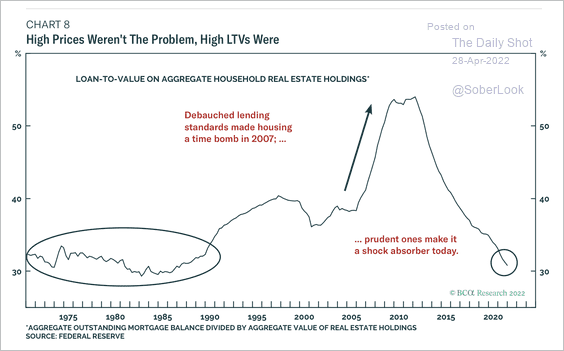
BY BILL MURPHY JR., WWW.BILLMURPHYJR.COM@BILLMURPHYJR

Getty Images

This is a story about communication, emotional intelligence, and how to get what you want in business and in life. If you find it valuable, I hope you’ll also download my free e-book, Improving Emotional Intelligence 2021, which you can find here.

It’s about seven key rules that make for better conversations, based on some compelling research and advice, and the ways that people with high emotional intelligence learn to use them in conversations that matter most.

These are compiled in such a way that you can use a mnemonic device — “GARDENS” — to remember it all: goals, attention, responses, design, emotions, nonverbal communication, and summations.
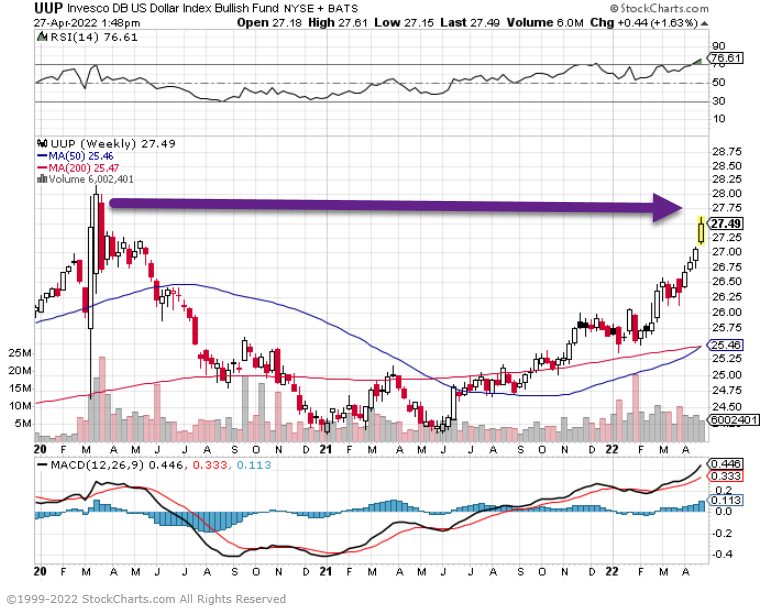
But let’s not get too hung up on these individual words yet; instead, we’ll go through all the rules below.

1. Goals: Think ahead of time about your ideal outcome.

Whether they admit it to themselves or not, everybody has a goal for the outcome of every conversation in which they engage.

  • It might be an important, strategic goal: “My goal is to convince this employee that taking on the new challenge I want her to tackle will be as good for her as it is for the company.”
  • It might be an emotional goal: “I want this prospective hire to walk away with a good feeling about us, even if he doesn’t match the requirements for the specific job we have open right now.” (You never know what the future brings!)
  • Or, it might be a purely defensive goal: “No matter what else happens in this conversation, I do not want to commit to any new obligations for this client.”

Of course, there might be multiple goals.

Let’s use a personal example: “I really want to go out to dinner tonight, but I also don’t want my partner to feel as if she has to say yes, if she would rather do so another night.”

Emotionally intelligent people understand how valuable it is to take a moment before almost any conversation and think through what your goals are, so that the conversational decisions you make don’t lead you away from them unintentionally.

Sometimes it’s helpful even to put things on the table, and communicate them explicitly: “Here’s what I’d like us to decide or do.”

Imagine if everyone in your life were that straightforward.

2. Attention: Stay focused, and also look like you’re focused.

We live in an addled time, a society of short attention spans.

Add to that the fact that we’ve just endured nearly two full years of constant distraction and danger, from the pandemic to the political climate, and I’m confident that entire academic careers will be made studying what we’ve all seen and done.

As Jeni Stolow, an assistant professor at Temple University’s College of Public Health, put it: “It’s this cognitive impairment that the whole world has been going through.”

Thus, people with high emotional intelligence recognize two things when they begin conversations:

  • First, like everyone else on the planet, they need to make an extra effort to focus and pay attention now.
  • Second, also like everyone else on the planet, the people they are talking with likely need added reinforcement that suggests others are actually paying attention to them.

In practical terms, what does this mean? It means blocking out short bits of time for only the conversation you’re having. It means, physically removing other distractions — putting your phone face down on a desk, or shutting your laptop, for example.

It means not multitasking–and during video calls, making your environment appear conducive to one-on-one conversations.
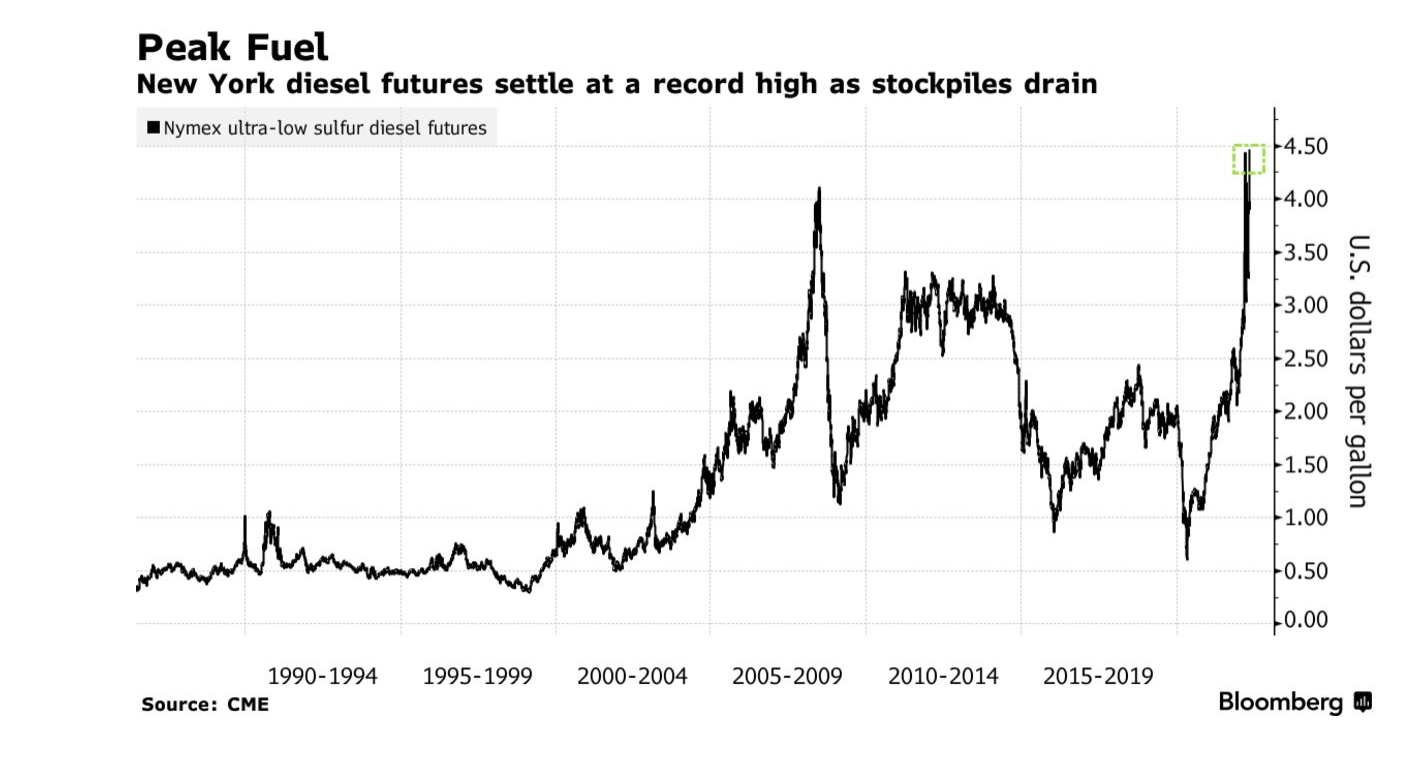
Strive to be focused, but don’t make it look easy; make it obvious to the other people in your important conversations that they, and your discussion, are the only things you are paying attention to.

3. Responses: Think hard about how you look and sound to the other side.

In any exchange during any conversation, there are really only three classes of things you can say: the right thing, the wrong thing, or nothing.

Saying nothing is often awkward, and while sometimes you can use awkwardness to your tactical advantage, emotionally intelligent people understand the power of another option: mirroring back to the other person the things they’ve said to you.

Basically, any statement that begins with something like “So, it sounds as if you are saying …” or “Let me just clarify what I’ve heard, please …” or the like, will probably lead you to mirroring.

Mirroring also has to do with body language. In study after study, researchers have found that salespeople who mimic their customers’ speech and posture sell more products, and that people in negotiations who mirror the other side reach agreements five times as often.

However, an important caveat is to mirror without looking like you’re doing so intentionally, which makes you look fake, and undermines the whole thing. That can be hard, so perhaps the emphasis is to be both authentic and subtle.

“We tend to like people who imitate us, as long as we don’t notice that they’re doing it,” Chris Frith, an emeritus professor of neuropsychology at University College London, told The Wall Street Journal in a report on the phenomenon.

4. Design: Pay attention to the structure, timing, pacing, and length of the discussion.

Here’s a question that almost no two people will answer the same way: How long do you want this conversation to last?

Earlier this year, researchers published the results of a study of 932 one-on-one conversations, after which participants were asked if they thought the conversations had gone on too long, had not been long enough, or had been just right.

Result: Only about 2 percent of conversations ended around the time when both participants wanted them to.

Another study: Across all cultures, according to researchers, the average socially acceptable time for one person to talk in a conversation is roughly two seconds, while the average time between two participants speaking is just 200 milliseconds.

The practical result that emotionally intelligent people take from all of this is to talk a bit less, and to err on the side of brevity. Far better for others to leave most conversations with you feeling as if they’ve had the chance to have their say — and even wishing they’d had even more time to hear you out.

That’s accomplished by paying close attention to the structure and design of your conversations, almost as much as the substance.

5. Emotions: Be aware of and leverage the emotions on both sides.

Emotional intelligence for our purposes is the practiced awareness of how emotions affect your communications and efforts, coupled with strategies that you develop to leverage your emotions and other people’s emotions in order to help you achieve goals.

We should juxtapose this with what emotional intelligence does not mean.

For example, it does not mean stripping all emotion out of a situation, and it also doesn’t always mean striving for empathy and kindness. Those can be positive by-products, but they are not the key goals.

So, how about some examples? Let’s consider an emotion like excitement.

  • You might be able to leverage your excitement to convey to another person that they should also be excited about whatever it is that has you so eager.
  • Or, you might find that your excitement clouds your thinking and that you should be aware of it and tone it back.
  • Likewise, you might realize that excitement on the part of another person in a conversation leads you to reach an agreement more quickly, or simply to get along better.

Step one in these situations is to be aware of the emotion. Step two is to seek control over them. And step three is to think about how you can use them to help reach your ultimate conversational goal.

6. Nonverbal communication: Be aware of and leverage the communication that occurs in nonverbal dimensions.
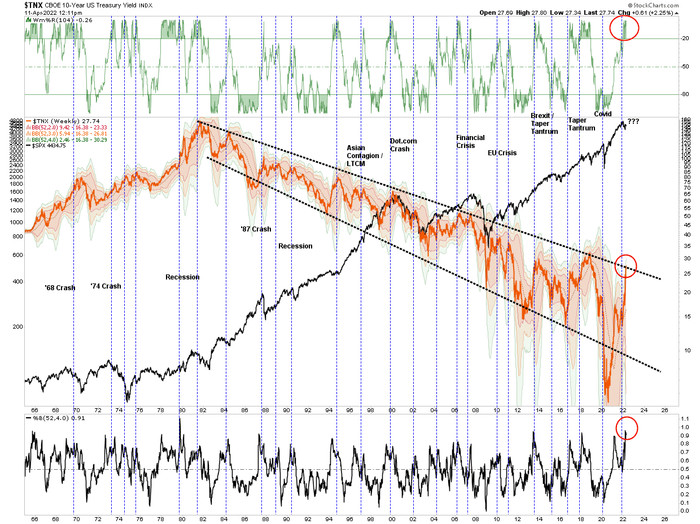
Here’s an exercise. Next time you’re in a serious conversation and you have an important goal, imagine afterward that you had to write a screenplay about the discussion.

This seems daunting, so let me make it easier by letting you skip all the dialogue. Instead, imagine a script that contains only stage directions and descriptions. Example:
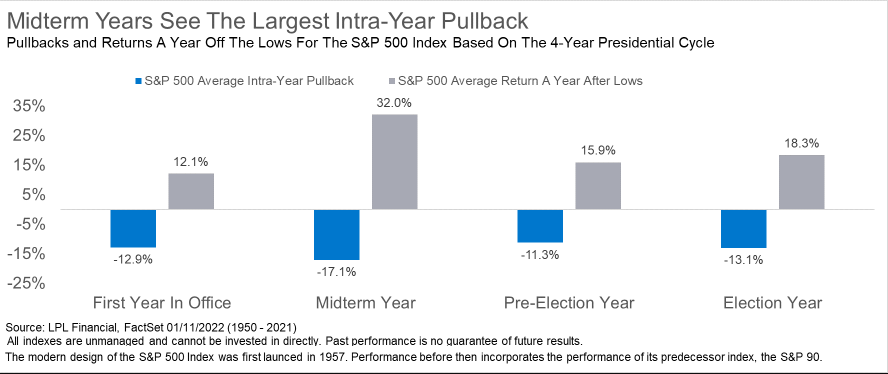
INT. CONFERENCE ROOM — DAY
JANE and JIM sit across from each other at a big table, which is cluttered with papers and leftover coffee cups from the last meeting. Jane rolls her eyes at Jim–she can’t believe they have to be here. Jim suddenly looks worried.

Jim softly begins to speak, but as he does, Jane’s cell phone buzzes. She seems to forget about him as she picks up the phone to see who has called …
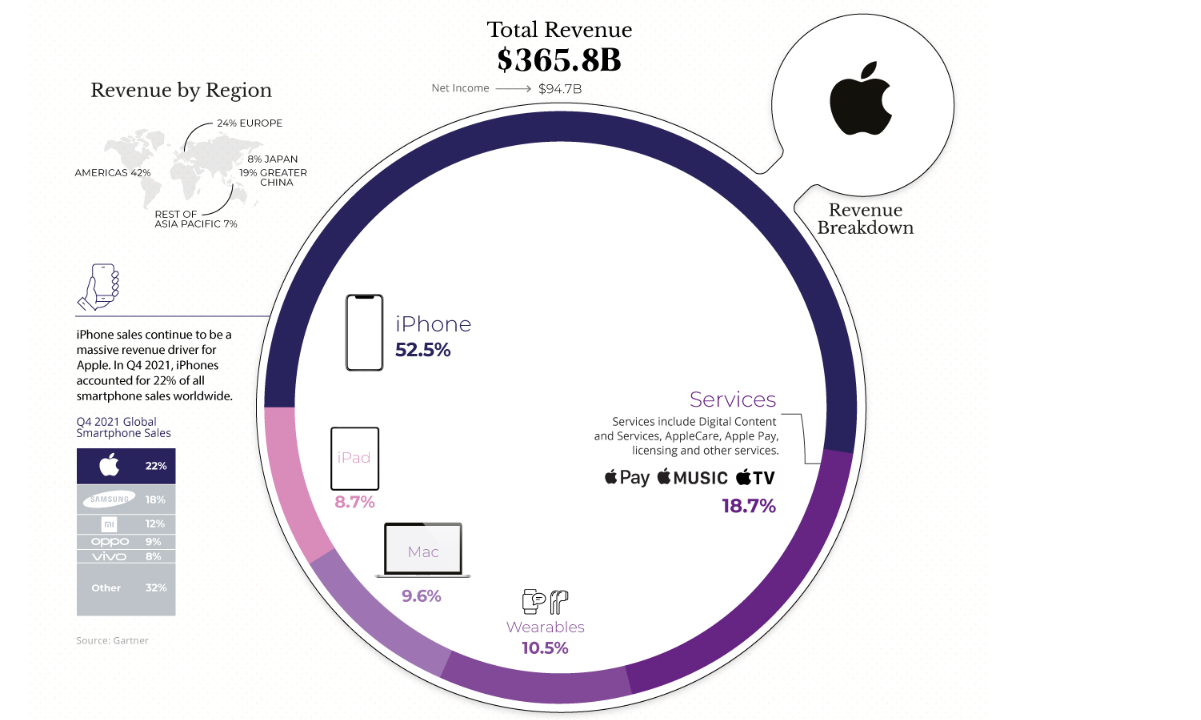
OK, it’s been a long time since I was a screenwriter, but I hope you’ll see the point: A huge percentage of what we communicate comes from things other than the words we use. (One controversial study famously said that only 7 percent of communication is actually verbal.)
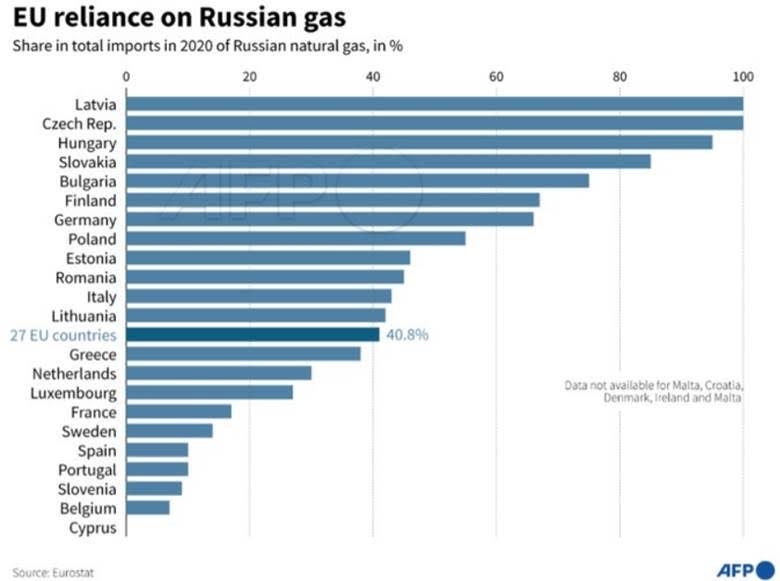
The facial expressions, the fact that Jane and Jim are holding this meeting in a cluttered room, the ease with which Jane is distracted from the conversation — all these things send messages that might or not be consistent with the verbal messages and goals each person wishes to communicate.

Emotionally intelligent people are highly aware of all of this, and they react and adjust accordingly.

7. Summations: Think hard about what you want the other side to remember.

I think there are two nearly universal things we can say about how good conversations end.

First, they involve some sort of summation and next step, or a promise for the future.

  • “We’re all set! We’ll start the project on Monday.”
  • “I don’t think we’ve found agreement here, but I’m happy to talk more tomorrow.”
  • “I had a really nice time. I hope I can call you again.”

Second, they involve a positive articulation of emotion — and most universally, an expression of gratitude.

In fact, an easy trick that the most emotionally intelligent people try to use is to find something to say thank you for toward the end of every conversation, so that the person you’re talking with remembers your gratitude.

Bonus tip on that one: Express gratefulness for something incontrovertible, rather than debatable.

  • In other words, say “Thank you for meeting with me today” or “Thank you for taking the time to talk.”
  • But avoid things like “Thank you for understanding” or “Thank you for coming around to my way of thinking.”

The first examples are gratitude for facts; the second examples are things that the other side might or might not agree with; thus, they can end the conversation with the other person thinking about the disagreement rather than the gratitude.

Don’t forget to break the rules

Pablo Picasso once said: “Learn the rules like a pro, so you can break them like an artist.”

That applies here as well. Even though we’ve organized these conversational rules to be memorable (remember: “GARDENS”), and even though it’s worth reflecting on them, it would be the very rare person with sufficient emotional intelligence to apply them all, all the time.

But, if you’re able remember at least some of them, you’ll likely be amazed at how your subconscious mind works to keep your conversations on track, and more likely to lead to the results you seek.

Let me know how it works for you. And don’t forget the free e-book: Improving Emotional Intelligence 2021, which you can find here.

https://www.inc.com/bill-murphy-jr/people-who-use7-these-key-rulesin-conversationshave-very-high-emotional-intelligence.html?cid=sf01003

Topley’s Top 10 – January 31, 2022

1. The Yield Curve is Flattening Quickly

Barrons-Ben Levisohn Follow

The yield curve is flattening quickly. On Friday, the two-year Treasury yield closed at 1.17%, while the 10-year closed at 1.779%, putting the gap between them at 0.61 of a percentage point. On Dec. 31, that gap was 1.069 points. Since 1955, the yield curve has flattened about 0.8 of a point a year during the first year of a tightening cycle, which would mean the curve would invert sometime in the first half of 2023, says Jim Reid, global head of credit strategy at Deutsche Bank. 

Recessions usually follow in eight to 19 months, which would put the next one in the middle of 2024. If the current market follows the historical path, the current upheaval, though painful, should simply mark a tantrum in risk markets that will pass. “The playbook is consistent with history,” he says.

https://www.barrons.com/articles/when-is-the-next-recession-coming-heres-how-to-time-it-51643417919?mod=past_editions


2. High Yield Bonds Calm During Stock Sell-Off

Bloomberg-Credit market’s reputation as a leading indicator has diminished at a time when even the Federal Reserve is having trouble anticipating where a highly volatile economy is heading. So if the economy experiences a significant slowdown, don’t look to corporate credit to send a signal, even if that part of of the debt market gets caught up in the fallout.

This month has been a good example of this changing dynamic. The U.S. stock market has suffered the worst start to a year since 2009 after waking up to the possibility that the Fed might tighten monetary policy much more than investors thought just a few months ago. And after the Fed’s monetary policy meeting on Wednesday and Chair Jerome Powell’s press conference afterward, money market traders were pricing in almost five rate increases in 2022, with Bank of America Corp. economists led by Ethan Harris seeing the possibility for seven. The S&P 500 Index is down 7% this year and the Nasdaq Composite Index has plunged 12%. 

And yet, the corporate bond market has been relatively calm. Yes, yields have risen substantially along with U.S. Treasury securities, but what we’ve seen this month has not been a 2013-style “taper tantrum.” That is seen in the premium investors demand to compensate against the risk of default. That so-called spread on corporate bonds rated below investment-grade, or junk, have remained below levels reached late last year. Investment-grade rated companies have kicked off the year selling dollar-denominated bonds at a record pace, issuing 10% more such securities this month than a year earlier, according to data compiled by Bloomberg.

https://www.bloomberg.com/opinion/articles/2022-01-30/credit-traders-lack-edge-in-fed-s-new-regime?sref=GGda9y2L


3. Small Cap Value -6% vs. Small Cap Growth -19%

VBR Vanguard Small Cap Value vs. IWM Small Cap Growth YTD

www.yahoofinance.com


4. Warren Buffett Overcomes ARRK…Very 1999 Like Event.

https://www.linkedin.com/in/jameseagle/ James Eagle


5. Break-Even for Crypto Miners 27,000

MARA $85 to $19.50

RIOT $46 to $13

www.stockcharts.com


6. China No Bounce.

China: The stock market selloff continues, …

Source: Daily Shot

… as Hong Kong and international investors pulled capital out.

Source: Daily Shot

 https://dailyshotbrief.com/the-daily-shot-brief-january-28th-2022/


7. Doctors Most Trusted…Politicians Least Trusted

From Barry Ritholtz Blog

https://ritholtz.com/2022/01/eliminate-childhood-vaccinations/


8. Global Defense Spending

www.chartr.com


9. Housing Traditional Response to Surging Interest Rates.

John Burns Real Estate

https://www.linkedin.com/in/johnburns7/


10. Hard work vs. Long work

Seth Blog

Long work is what the lawyer who bills 14 hours a day filling in forms does.

Hard work is what the insightful litigator does when she synthesizes four disparate ideas and comes up with an argument that wins the case–in less than five minutes.

Long work has a storied history. Farmers, hunters, factory workers… Always there was long work required to succeed. For generations, there was a huge benefit that came to those with the stamina and fortitude to do long work.

Hard work is frightening. We shy away from hard work because inherent in hard work is risk. Hard work is hard because you might fail. You can’t fail at long work, you merely show up. You fail at hard work when you don’t make an emotional connection, or when you don’t solve the problem or when you hesitate.

I think it’s worth noting that long work often sets the stage for hard work. If you show up enough and practice enough and learn enough, it’s more likely you will find yourself in a position to do hard work.

It seems, though that no matter how much long work you do, you won’t produce the benefits of hard work unless you are willing to leap.

https://seths.blog/2011/05/hard-work-vs-long-work/

Topley’s Top 10 – January 27, 2022

1. Small Cap Top to Bottom Full -20% Correction

Russell 2000 $240 to $192 yesterday’s low.

www.stockcharts.com

2. Worse First 16 Days for S&P Ever

https://www.bloomberg.com/news/articles/2022-01-24/the-market-has-never-plunged-10-this-fast-to-start-a-year?srnd=premium-europe&amp;sref=ZVajCYcV&sref=GGda9y2L

3. Stocks Average One 10% Correction Per Year

LPL Research

https://lplresearch.com/2022/01/26/all-you-wanted-to-know-about-stock-market-corrections/

4. BUZZ -Chat Room MEME Stock ETF…-35%

Fund Description

VanEck Social Sentiment ETF (BUZZ) seeks to track, as closely as possible, before fees and expenses, the price and yield performance of the BUZZ NextGen AI US Sentiment Leaders Index (BUZZTR), which is intended to track the performance of the 75 large cap U.S. stocks which exhibit the highest degree of positive investor sentiment and bullish perception based on content aggregated from online sources including social media, news articles, blog posts and other alternative datasets. https://www.vaneck.com/us/en/investments/social-sentiment-etf-buzz/

Gamestop -64% correction before bounce last couple days

AMC -72% from highs at low this week

www.stockcharts.com

5. Number of Big Insider Sales Had Record Year 2021

Jonathan Barird–A long-time investment maxim is that it pays to watch the stock transactions of company insiders, for they are in the best position to know the future earnings prospects of their company’s. Indeed, academic studies have confirmed that extremes of insider buying or selling are a useful leading indicator of share prices. Various services exist that provide such data to sophisticated investors. https://www.linkedin.com/in/jonathanbaird88/

6. Bill Ackman Buys NFLX on Pullback Close to Covid Lows.

NFLX pulls back close to March 2020 lows.

www.stockcharts.com

Marketwatch By Jon Swartz

Billionaire hedge fund manager Bill Ackman on Wednesday said his firm has purchased more than 3.1 million shares of Netflix Inc. NFLX, -1.83%, making it a top-20 holder. “The opportunity to acquire Netflix at an attractive valuation emerged when investors reacted negatively to the recent quarter’s subscriber growth and management’s short-term guidance. Netflix’s substantial stock price decline was further exacerbated by recent market volatility,” said Ackman, who is chief executive of Pershing Square Capital Management. He announced the investment on his Twitter account and in a press release. Netflix was not immediately available for comment.

https://www.marketwatch.com/story/bill-ackman-says-his-hedge-fund-just-bought-31-million-shares-of-netflix-2022-01-26?mod=home-page

7. Amazon to launch larger suburban Go stores

By Tonya Garcia

Amazon recently announced a high-tech clothing store in California

Larger-format Amazon Go stores are planned for suburban areas, with the first coming to Washington state

Amazon.com Inc. has announced plans to launch larger-format Go stores in suburban areas, starting with Mill Creek, Wash. in the coming months.

The Mill Creek Go store will cover 6,150 square feet, with the front area of the store spanning 3,240 square feet. The store will be equipped with Just Walk Out technology that allows customers to bypass a checkout line. Food and beverages, including beer and wine, will be available.

Amazon AMZN, 1.57% already has plans to open another Go store following the new format in the Los Angeles area.

The news comes shortly after Amazon announced plans for high-tech clothing store that will launch in Southern California.

And The Wall Street Journal reported last year on plans for larger stores that resemble department stores.

See: Kohl’s soars after takeover offer, but skeptical analysts question the retailer’s real-estate value

“We expect Prime member growth to continue with members spending more across additional categories,” wrote Stifel analysts in an earnings preview.

“Amazon continues to invest in developing and expanding Prime benefits, including Same-Day delivery expansion, video content and gaming. We expect Online Stores
sales growth to continue to decelerate in 4Q as the company compares against Prime Day in 4Q:20.”

Amazon will report fourth-quarter results on Feb. 3, according to the FactSet calendar.

Amazon stock has tumbled 15.8% over the past year while the S&P 500 index SPX, 1.63% has gained 13.2%.

https://www.marketwatch.com/story/amazon-to-launch-larger-suburban-go-stores-11643123478?mod=home-page

8. A Record 559 Newly Scripted TV Shows Hit Last Year

Can’t find something good to watch in the evenings? That’s on you, unfortunately.

According to the latest data from FX Networks, there have never been more new original scripted series, with 559 hitting the small screen last year across cable, streaming services and broadcast TV in the US.

Death by choice

In 2010, there were just 216 new original scripted series, meaning that in just the last decade, your options for viewing have almost tripled (presuming you can access them all, which admittedly is a different question altogether). Overwhelmed by options? You’re probably not alone.

9. Open Table Reservations 2019-2022

Dan Stratemeier

Managing Director

Equities, Event Driven Strategies

10. How to Optimize Your Default Decisions

Here are a few strategies I have found useful when trying to design for default in my life:

Simplicity. It is hard to focus on the signal when you’re constantly surrounded by noise. It is more difficult to eat healthy when your kitchen is filled with junk food. It is more difficult to focus on reading a blog post when you have 10 tabs open in your browser. It is more difficult to accomplish your most important task when you fall into the myth of multitasking. When in doubt, eliminate options.

Visual Cues. In the supermarket, placing items on shelves at eye level makes them more visual and more likely to be purchased. Outside of the supermarket, you can use visual cues like the Paper Clip Method or the Seinfeld Strategy to create an environment that visually nudges your actions in the right direction.

Opt-Out vs. Opt-In. There is a famous organ donation study that revealed how multiple European countries skyrocketed their organ donation rates: they required citizens to opt-out of donating rather than opt-in to donating. You can do something similar in your life by opting your future self into better habits ahead of time. For example, you could schedule your yoga session for next week while you are feeling motivated today. When your workout rolls around, you have to justify opting-out rather than motivating yourself to opt-in.

Designing for default comes down to a very simple premise: shift your environment so that the good behaviors are easier and the bad behaviors are harder.

Designed For You vs. Designed By You

Default choices are not inherently bad, but the entire world was not designed with your goals in mind. In fact, many companies have goals that directly compete with yours (a food company may want you to buy their bag of chips, while you want to lose weight). For this reason, you should be wary of accepting every default as if it is supposed to be the optimal choice.

I have found more success by living a life that I design rather than accepting the standard one that has been handed to me. Question everything. You need to alter, tweak, and shift your environment until it matches what you want out of life.

Yes, the world around you shapes your habits and choices, but there is something important to realize: someone had to shape that world in the first place. Now, that someone can be you.

If you want more practical ideas for breaking bad habits and creating good habits, check out my book Atomic Habits, which will show you how small changes in habits can lead to remarkable results.

https://jamesclear.com/design-default

Topley’s Top 10 – January 25, 2022

1. For Traders….Oversold Short-Term

Technicals still negative intermediete term but short-term  RSI 22 getting well oversold

QQQ-Short -term RSI 22

www.stockcharts.com


2. Plus….Nasdaq Investor Sentiment Lower than Covid

Dave Lutz Jones Trading–Mark Hulbert Noted Friday Nasdaq investor sentiment is worse now than it was in March 2020 – “That’s an extremely aggressive bearish posture.” (Bottom 1.8% of ALL days since 2000) – “Minus 67.2%, which means that the average Nasdaq-focused stock market timer is recommending that clients allocate two-thirds of their equity trading portfolios to going short”


3. History of Rough Starts for the Nasdaq

www.dorseywright.com


4. Crypto Universe Valuations Cut in Half.

@Charlie Bilello


5. This is a Big Year for Crypto Regulation

White House Is Set to Put Itself at Center of U.S. Crypto Policy Jennifer Epstein, Jenny Leonard & Allyson Versprille 04:00 AM IST, 21 Jan 2022 05:09 AM IST, 22 Jan 2022 Save (Bloomberg) — The Biden administration is preparing to release an initial government-wide strategy for digital assets as

Read more at: https://www.bloombergquint.com/business/white-house-is-set-to-put-itself-at-center-of-u-s-crypto-policy
Copyright © BloombergQuint


6. MSTR $1200 to $350…-36% YTD.

MSTR actually hit $2000 back in 2001

www.stockcharts.com


7. Fund Managers Allocation to Commodities the Highest Ever

Commodities: Fund managers are very long commodities.

Source: BofA Global Research

The Daily Shott


9. U.S. Political Party Preferences Shifted Greatly During 2021

BY JEFFREY M. JONES

  • Preferences shifted from nine-point Democratic advantage to five-point GOP edge
  • Average party preferences for all of 2021 similar to past years
  • Largest percentage of U.S. adults identify as political independents

WASHINGTON, D.C. — On average, Americans’ political party preferences in 2021 looked similar to prior years, with slightly more U.S. adults identifying as Democrats or leaning Democratic (46%) than identified as Republicans or leaned Republican (43%).

However, the general stability for the full-year average obscures a dramatic shift over the course of 2021, from a nine-percentage-point Democratic advantage in the first quarter to a rare five-point Republican edge in the fourth quarter.

Line graph. Quarterly averages of U.S. party identification and leaning in 2021. In the first quarter of 2021, 49% of U.S. adults identified as Democrats or leaned Democratic, while 40% identified as Republicans or leaned Republican. In the second quarter, 49% were Democrats or Democratic leaners, and 43% were Republicans and Republican leaners. In the third quarter, 45% were Democrats and Democratic leaners, and were 44% Republicans and Republican leaners. In the fourth quarter, 42% were Democrats and Democratic leaners, and 47% were Republicans and Republican leaners.

These results are based on aggregated data from all U.S. Gallup telephone surveys in 2021, which included interviews with more than 12,000 randomly sampled U.S. adults.

Gallup asks all Americans it interviews whether they identify politically as a Republican, a Democrat or an independent. Independents are then asked whether they lean more toward the Republican or Democratic Party. The combined percentage of party identifiers and leaners gives a measure of the relative strength of the two parties politically.

Both the nine-point Democratic advantage in the first quarter and the five-point Republican edge in the fourth quarter are among the largest Gallup has measured for each party in any quarter since it began regularly measuring party identification and leaning in 1991.

  • The Democratic lead in the first quarter was the largest for the party since the fourth quarter of 2012, when Democrats also had a nine-point advantage. Democrats held larger, double-digit advantages in isolated quarters between 1992 and 1999 and nearly continuously between mid-2006 and early 2009.
  • The GOP has held as much as a five-point advantage in a total of only four quarters since 1991. The Republicans last held a five-point advantage in party identification and leaning in early 1995, after winning control of the House of Representatives for the first time since the 1950s. Republicans had a larger advantage only in the first quarter of 1991, after the U.S. victory in the Persian Gulf War led by then-President George H.W. Bush.

https://news.gallup.com/poll/388781/political-party-preferences-shifted-greatly-during-2021.aspx


10. Quotes on Courage

By Z. Hereford

When it comes to why I so enjoy reading the quotes of others, here is yet another quote to explain why:

“I quote others only the better to express myself.” Montaigne

Please enjoy these quotes on Courage.

The Quotes

It is better to live one day as a lion, than a thousand days as a lamb. Roman Proverb

You don’t develop courage by being happy in your relationships everyday. You develop it by surviving difficult times and challenging adversity. Epicurus

It is curious-curious that physical courage should be so common in the world, and moral courage so rare. Mark Twain

Everyday courage has few witnesses. But yours is no less noble because no drum beats for you and no crowds shout your name. Robert Louis Stevenson

Moral excellence comes about as a result of habit. We become just by doing just acts, temperate by doing temperate acts, brave by doing brave acts. Aristotle

Without courage, wisdom bears no fruit. Baltasar Gracian

He who loses wealth loses much; he who loses a friend loses more; but he that loses his courage loses all. Miguel de Cervantes

Clear thinking requires courage rather than intelligence. Thomas Szasz

We could never learn to be brave and patient if there were only joy in the world. Helen Keller

Courage is going from failure to failure without losing enthusiasm. Winston Churchill

The greatest test of courage on the earth is to bear defeat without losing heart. R. G. Ingersoll

Courage is not defined by those who fought and did not fall, but by those who fought, fell and rose again. Anonymous

Take a chance! All life is a chance. The man who goes farthest is generally the one who is willing to do and dare. Dale Carnegie

Life shrinks and expands in proportion to one’s courage. Anais Nin

One man with courage makes a majority. Andrew Jackson

Courage is not the towering oak that sees storms come and go; it is the fragile blossom that opens in the snow. Alice M. Swaim

Courage is reckoned the greatest of all virtues; because, unless a man has that virtue, he has no security for preserving any other. Samuel Johnson

Sometimes even to live is an act of courage. Lucius Annaeus Seneca

Courage is the power to let go of the familiar. Raymond Lindquist

True courage is not the brutal force of vulgar heroes, but the firm resolve of virtue and reason. Alfred North Whitehead

There is no such thing as bravery; only degrees of fear. John Wainwright

Courage is the fear of being thought a coward. Horace Smith

Have the courage to live. Anyone can die. Robert Cody

We can easily forgive a child who is afraid of the dark; the real tragedy of life is when men are afraid of the light. Plato

Courage is the ladder on which all other virtues mount. Clare Booth Luce

The world is in a constant conspiracy against the brave. It’s the age-old struggle-the roar of the crowd on one side and the voice of your conscience on the other. Douglas MacArthur

It is only through labor and painful effort, by grim energy and resolute courage, that we move on to better things. Theodore Roosevelt

Be courageous! Have faith! Go forward! Thomas Alva Edison

He conquers who endures. Persius

Keep your fears to yourself but share your courage with others. Robert Louis Stevenson

Fear is the father of courage and the mother of safety. Henry H. Tweedy

It takes courage to grow up and turn out to be who you really are. e.e.cummings

The first of all qualities of a general is courage. David McCullough

Courage is nothing less than the power
To overcome danger, misfortune, fear, injustice,
While continuing to affirm inwardly
That life with all its sorrows is good;
That everything is meaningful even if in a sense
Beyond our understanding;

https://www.essentiallifeskills.net/quotesoncourage.html

Topley’s Top 10 – January 24, 2022

1. S&P and Nasdaq Close Below 200 Day Moving Averages.

S&P below 200 day but above October 2021 lows

©1999-2022 StockCharts.com All Rights Reserved

Nasdaq closes well below 200 day and sinks below October 2021 lows

©1999-2022 StockCharts.com All Rights Reserved

www.stockcharts.com

2. FANG Index Closes Below 200 Day…-13.5% from Highs

©1999-2022 StockCharts.com All Rights Reserved

Long-Term Weekly Chart closes below 50day moving average for first time since March 2020

©1999-2022 StockCharts.com All Rights Reserved

www.stockcharts.com

3. Nasdaq -1%+  4 Days in a Row…First Time Since Dot-Com Bust

Nasdaq 100’s Unrelenting Declines Ring a Dot-Com Bust Alarm Bell

Lu Wang(Bloomberg) — Bulls should be glad there were only four days this week instead of five.

To wit, the Nasdaq 100 just did something it hasn’t done since the aftermath of the internet bubble: fall more than 1% in every session of a week. It doesn’t count as a superlative because Monday was a holiday. But for investors caught up in the selloff, it felt like something shifted.

A full week of big down days hasn’t happened since the dot-com bubble burst, first in April 2000 and then in September 2001. Back then, the Nasdaq went on to fall another 28% before the market bottomed roughly a year later.

“If you just look at those two prior instances, right after 9/11 was a brutal market, while the other was the first leg down in the collapse of the tech bubble,” said George Pearkes, a strategist at Bespoke Investment Group. “It’s certainly ominous, isn’t it?”

https://finance.yahoo.com/news/nasdaq-100-unrelenting-drops-ring-214018521.html

4. FANG Stocks Overlay with Central Banks Balance Sheets

Barrons-By

Randall W. Forsyth

This Fed Meeting Is Crucial. Future Rate Hikes Are Just the Start. https://www.barrons.com/articles/stock-market-fed-meeting-rate-hikes-51642784589?mod=past_editions

5. IPO ETF -41% from Highs.

IPO ETF 50 day thru 200 day to the downside on chart

This chart compares IPO ETF to S&P 500 index….The ratio has traded back to Covid 2020 bottom

6. XLE Energy ETF Break-Out.

Energy ETF opposite of broad markets…..50 day thru 200 day to upside…new highs

©1999-2022 StockCharts.com All Rights Reserved

www.stockcharts.com

7. If Bitcoin Gets No Bounce Early this Week….Next Technical Support $30,000

Error! Filename not specified.

1 / 3

BlackRock Plans ‘Blockchain and Tech’ ETF Amid Crypto Meltdown


BlackRock Plans ‘Blockchain and Tech’ ETF Amid Crypto Meltdown

Katie Greifeld

(Bloomberg) — BlackRock Inc. is stepping into the arena of cryptocurrency-flavored exchange-traded funds in the midst of a $1 trillion wipeout.

The iShares Blockchain and Tech ETF would invest in companies involved in the “development, innovation, and utilization of blockchain and crypto technologies,” according to a Friday filing with the U.S. Securities and Exchange Commission. If launched, it would be the first crypto-adjacent fund in the largest ETF issuer’s lineup.

https://finance.yahoo.com/news/blackrock-plans-blockchain-tech-etf-220719372.html

8. China Demographic Destruction Happening in Real Time

The GRID-Surveys reveal some of the reasons behind the decline. To begin with, fewer young people, particularly women, even want to get married. In a recent survey of urban Gen Zers conducted by a research institute affiliated with the Communist Youth League, 44 percent of women said they either didn’t want to get married or weren’t sure if they would. The men and women surveyed cited difficulty finding the right partner and a lack of time and energy as reasons for not wanting to marry.

Meanwhile, many married couples are choosing not to have kids for the same financial reasons that worry Liu. In a survey conducted by the China Youth Daily, millennials cited a lack of child care options and financial pressures as their top reasons for not having a second child.

https://www.grid.news/story/global/2022/01/12/what-happens-when-the-worlds-most-populous-country-starts-to-shrink/

Found at Barry Ritholtz Blog https://ritholtz.com/2022/01/weekend-reads-504/

9. The Top 10 and Bottom 10 States for Rearing Children

NY Times

ttps://www.nytimes.com/2022/01/20/realestate/the-best-place-to-raise-a-family.html

10. 6 reasons knowledge is true power!

I’m sure you’ve come across the famous saying ‘knowledge is power!’. Knowledge is so precious that it enriches you in diverse ways. Read my blog post to find 6 key ways you should take full advantage of this opportunity in life or else you’ll miss out on them!

While I strongly believe that ongoing learning is vital, I also find that knowledge is a true blessing and that it should be accessible easily. Learning can also be fun if you choose what to learn correctly and also find the methods that suit you best. So let’s dive into it.

1. Self-esteem

Your self-esteem, self-respect and self-confidence are all reinforced when you’re well-informed. In many life circumstances, being knowledgeable will give you additional power. It gives you the confidence you need!

2. Self-reliance

When you’re proficient, you have the freedom to make decisions on your own. You’re not dependent on others for guidance. You know that you can stand on your own feet.

3. Informed decisions

When you’ve got a good grasp, you’re more apt to take risks as well! You use your knowledge for your full benefit, so you can take calculated risks. Those with less understanding, are likely to be risk-aversive in life.

4. Learn from experts

While you learn from failures and use them to improve yourself, do learn from the experts as well! They’re the ones who are leaders in their respective fields. You’ll find out what works and what doesn’t, based on their experience and teachings.

5. Learn what’s proven

Find the best practices in your professional industry. Learn how to achieve what you truly want in your personal life. Follow hobby courses and much more… The point is that you can see what works best (from others) and save yourself precious time and money.

6. Success

Last but not least, with the knowledge you’re more likely to succeed. Success means different things to different people. However, set the right life goals for yourself, have an action plan to achieve them and learn the skills that will empower you!

Conclusion

Knowledge is indeed power… You cannot fool or take advantage of someone who is accomplished or has access to information. Make the most of learning experiences to make the most of your life! Do you have any tips to share? Please post a comment below. If you know anyone who could benefit from my blog post, please share it. Thank you!!

Photo/Image courtesy: Canva

https://tipsfromsharvi.com/2019/11/22/knowledge-true-power/

Topley’s Top 10 – January 21, 2022

1. 25 Million New Brokerage Accounts ..Retail Goes All In…

Michael Batnick Points Out the Retail Frenzy …2020 and 2021 Flows Dwarf 2018-2019

https://theirrelevantinvestor.com/2022/01/19/animal-spirits-25-million-new-brokerage-accounts/


2. After Record S&P vs. Emerging Gap in 2021…..Emerging Markets Outperform to Start 2022

Emerging markets at record low fundamental valuations vs. U.S. ….Bounce to start year.

www.stockcharts.com


3. Short-Term Bonds Not So Safe….Inflation Adjusted Yields -6-7%

How Safe Assets Became Investors’ Biggest Risk–ByAllison Schrager  https://www.bloomberg.com/opinion/articles/2022-01-18/how-safe-assets-became-investors-biggest-risk?sref=GGda9y2L


4. Bond Bombs.

AGG…50day thru 200day to downside….gap down on price.

BSV Short-Term Bond Index…


5. TIPS-Inflation Not Helping

TIPS Roll Over

Corporate Investment Grade….50day thru 200day to downside.

www.stockcharts.com


6. Long Gold vs. High Yield?

“Dave Lutz at Jones The biggest ETF tracking junk bonds suffered the third-largest daily outflow in its 15-year history as credit markets sold off amid prospects for higher interest rates. Investors pulled $1.3 billion from HYG Tuesday, the most since February 2020 – It has tested the $85.25 support level 4x in the last month, going to be very key for a hold there.”

This chart shows Gold versus High Yield Bonds reversing in December…Watch for breakout.


7. The only time in its history NFLX has been cash flow positive is when Covid shut down everything. And now it has pulled 5 years of demand forward

Zerohedge

https://twitter.com/zerohedge/status/1484277160026255364/photo/1


8. Brevan Howard “Massive Crypto Push”

Brevan Howard Launches First Digital Assets Fund in ‘Massive’ Crypto Push

The firm’s inaugural crypto strategy started trading earlier this month with a sizeable amount of internal capital

By Michael Bodley/January 18, 2022, 4:00 pm EST

  • The firm’s co-founder, Alan Howard, has made crypto investments with his personal wealth for several years
  • BH Digital, the asset manager’s crypto division, has 25 employees and continues to grow

Hedge fund firm Brevan Howard has launched its first dedicated crypto fund with 10 teams of portfolio managers and bold fundraising aspirations, according to two people familiar with the matter.

The flagship vehicle, BH Digital Multi-Strategy Fund, started trading earlier this month with a sizable amount of internal capital, sources said. The plan is to start broadly raising outside money in the second quarter — and expectations are that fundraising haul would amount to at least several hundred million dollars and perhaps more than $1 billion.

Sources were granted anonymity to discuss sensitive business dealings. A spokesperson for Brevan Howard declined to comment.

The fund is the inaugural vehicle of BH Digital, the new Brevan Howard unit dedicated to the global macro firm’s crypto investments. The division now has 25 employees overall and is scaling. It represents one of the largest — if not the largest — commitments by a legacy asset manager to digital assets.

“Brevan is making an absolutely massive push into crypto,” one source said.

https://blockworks.co/sources-brevan-howard-launches-first-digital-assets-fund-in-massive-crypto-push/


9. Coffee ETF +100% From Dec. 2020

www.stockcharts.com


10. The Do’s and Don’ts of Tough Conversations

By Sarah Clark | September 20, 2017 | 0 

Imagine for a moment that you’re about to sit down with an employee to discuss exciting new changes to your company. Perhaps you’re bubbling with enthusiasm, sure that she’ll feel the same as you. Then you break the news and you’re met with a blank stare, a passive sigh or even an angry rebuttal.

No matter how prepared you might think you are, some conversations just won’t go the way you think they will. But that doesn’t mean you should give up and leave all tough conversations to work themselves out. After all, in an online survey of 1,000 employees, 91 percent said that communication issues drag executives down. The data revealed that most leaders were missing critical opportunities to engage that could position them as more trustworthy to their employees.

As someone who’s been managing others for more than 25 years, I’ve seen the value of honest, open communication between an employee and employer, but I’ve certainly stumbled along the way. Although these communication mishaps aren’t my proudest moments, they’ve taught me valuable lessons as a manager, including how to repair relationships and have more constructive conversations. I’ve picked up on a few important do’s and don’ts on my journey, such as:
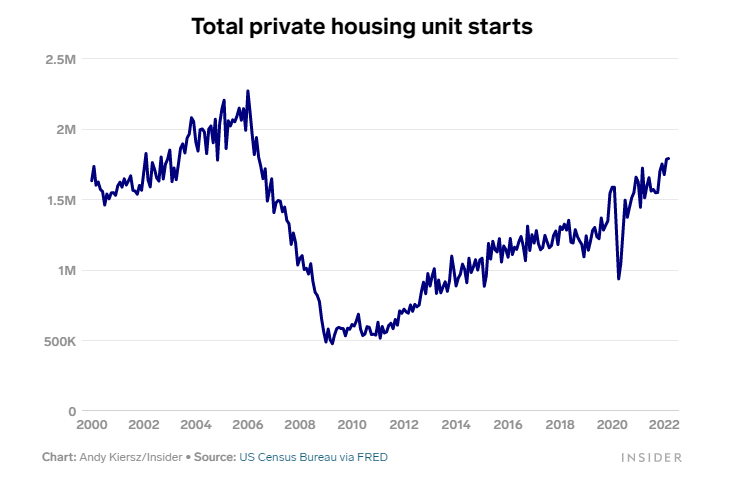
1. Do throw the script away.

Preparing for a tough conversation is imperative to its success. There’s a big difference between jotting down notes and drafting a script, though. The latter won’t do you any good.

“A difficult conversation tends to go best when you think about it as just a normal conversation,” says Holly Weeks, author of Failure to Communicate. Because your counterpart doesn’t know his or her lines, the conversation can become awkward and artificial. For a more natural, productive conversation, opt for a few bullet points to address, and be flexible about the ensuing conversation.

2. Don’t dance around the issue.

It is important for you, as a manager, to be as explicit as possible during difficult conversations. Begin by declaring what you hope to achieve during this meeting and asking the employee to do the same. Then tackle the topic at hand, as well as the thought process behind it.
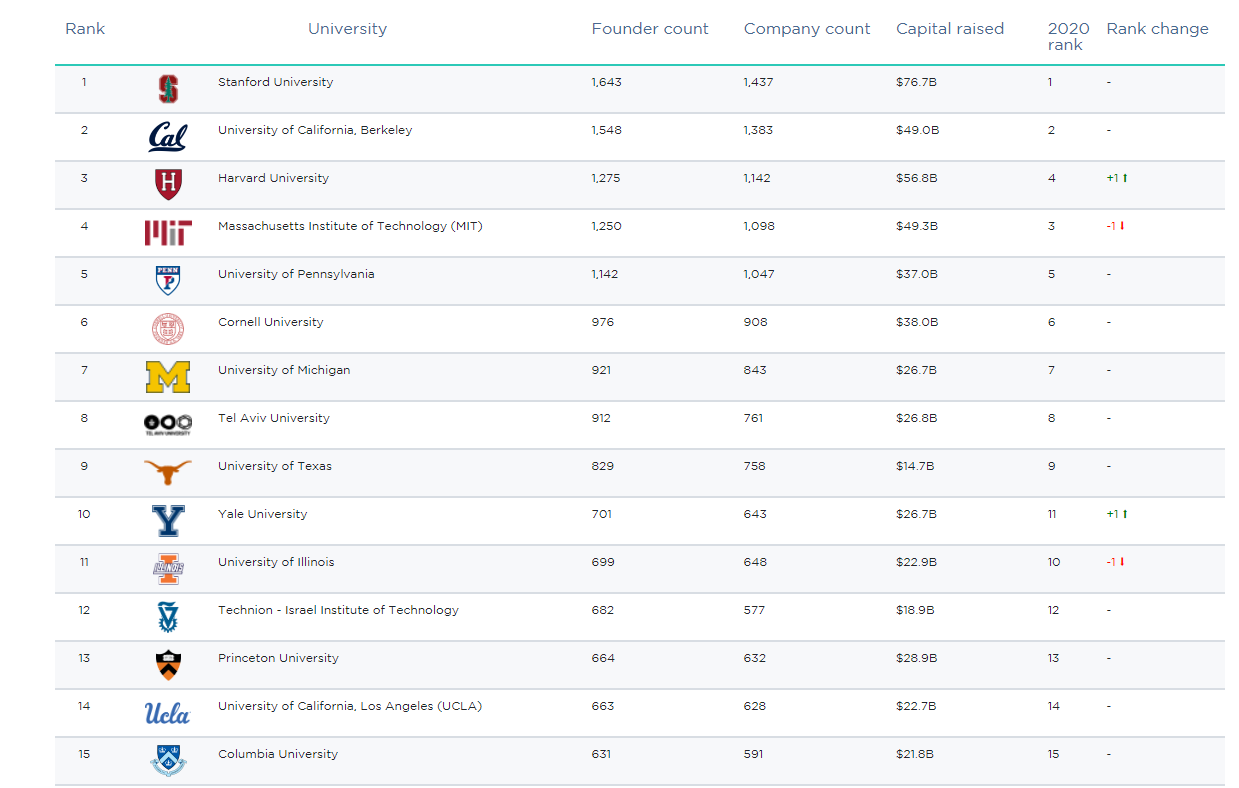
3. Do put yourself in the other person’s shoes.

As humans, we all possess preconceived notions, but holding onto those assumptions during tough conversations is a mistake. For example, a few years ago, I led a team that we needed to restructure. We needed to go much deeper in areas where we were the best and for which we were known as the experts, but this also meant letting go of some things that weren’t as important. So I had to have several conversations with employees on how their roles would shift. One conversation was a huge learning experience for me.

I was so confident in the direction of our group that I failed to explain fully one employee’s role and how it was changing. I assumed she would understand the importance of the shift because she was a senior leader, but I failed to articulate how she fit into the bigger picture specifically. Because of this, she didn’t understand her importance to the company and the value she added.

It takes two people to have a conversation, so consider your counterpart’s perspective. Think through the issue at hand from your point of view. Then reflect on what your employee thinks the issue is. If you can’t answer the second question, ask him or her directly. When you work to empathize with your employee, she’ll be more open to having a productive conversation.

After speaking with my employee about the structural changes, I picked up on her social cues and asked her to tell me about how she was feeling. That’s when I realized I needed to put myself in her shoes. So I explained how shifting some of her workload would actually allow her to dive deeper into her area of expertise. After I did so, she became one of the biggest champions in the department for these changes.

4. Don’t get defensive.

It might be tempting to act defensively or even make yourself the victim during a difficult discussion, but you should avoid both of these tactics at all costs. Deflecting blame or making statements such as, “This is really difficult for me!” or “I feel terrible about this!” during a difficult conversation only makes you appear dismissive of your employee’s needs. Instead, acknowledge your role in the discussion and how you’ll work through the issue in collaboration with your employee.

5. Do show a little compassion.

Difficult conversations might not be pleasant, but compassion helps you deliver difficult news in an honest, fair manner. Ultimately, my restructuring conversation was successful because I responded to the employee’s needs with compassion. Once I understood why she was concerned, I was able to sympathize and respond accordingly. Keep in mind that it’s important to not only respond to employees’ concerns as they crop up, but also to stay ahead of them to reassure your employees that they’re valuable teammates.

Having a tough conversation with your employee is never easy or fun—especially when that employee reacts differently than you’d anticipated. But it’s still important to reflect on these experiences. After a draining conversation, take some time to consider what went well and what did not, as well as what you can do differently in the future. In conjunction with transparency, active listening and the right attitude, self-reflection will help you tackle difficult conversations head-on.

Sarah Clark

https://www.success.com/the-dos-and-donts-of-tough-conversations/

Topley’s Top 10 – January 20, 2022

1. S&P 500 correction now 5.5%, biggest since November 2020.

Jim Bianco Research

https://twitter.com/biancoresearch

2. Small Cap -16% from Highs

IWM small cap 50day going thru 200day to downside on chart

www.stockcharts.com

3. Short-Treasury ETF Only Back to October Highs

TBF ETF hit resistance at October high

4. Here’s what surging bond yields say about S&P 500 returns in next 6 months

William Watts–Marketwatch

“We have found that the current yield as a percentile of its recent range, along with the pace, or rate of change it has shown over the recent path has a big impact on the forward returns” for the S&P 500 SPX, -0.97%, wrote Jeff deGraaf, founder of Renaissance Macro Research, in a Wednesday note (see chart below).

RENAISSANCE MACRO RESEARCH

“The lower the level of rates and the faster the collapse in those rates, the better for stocks out [six months] forward. The higher the level and the faster the surge in rates, the worse the returns for the SPX going out” six months, deGraaf wrote.

With the 10-year yield having broken above resistance at 1.77%, the pace of the advance has pushed RenMac’s yield impact model into its highest historical decile, “and one that pressures forward equity returns historically,” he said, as shown in the bottom third of the chart.

https://www.marketwatch.com/story/heres-the-warning-signal-that-surging-bond-yields-are-sending-stock-market-investors-11642608225?mod=home-page

5. Peloton Insiders Dump Half A Billion Dollars In Stock Before Crash

BY TYLER DURDEN-ZEROHEDGE

Company executives and insiders unloaded $496 million worth of stock in 2021, right before and during the decline that began in early 1Q21. The stock sales mainly were done above $100 and were part of 10b5-1 plans.

Insider selling began as Peloton became a household name during the pandemic as millions of people canceled their gym memberships and bought a bike or treadmill. Growth prospects looked great during the first year of the pandemic as demand was pulled forward. Executives and insiders knew demand would not last forever as shares traded at rich multiples, even at one point trading at $170 per share in early 2021.

https://www.zerohedge.com/markets/peloton-insiders-dump-nearly-half-billion-dollars-stock-crash

PTON $180 to $31

www.stockcharts.com

6. Grayscale Bitcoin and Ethereum Trusts -50% Corrections from Highs

GBTC Bitcoin Trust

ETHE Ethereum Trust

www.stockcharts.com

7. Traders Bet That Oil at $100 Is a Question of When, Not If

Bloomberg Andrew Janes and Serene Cheong

Demand is roaring, with spot market cargoes being snapped up at sharply higher premiums. It’s the same in the product space. Middle-distillate stockpiles at the Asian energy hub of Singapore have fallen to the least since 2013. The world is short of diesel, and even jet fuel — the oil product hit hardest by the pandemic — is coming back strong as long-distance air travel starts to resume. With the exception of a major virus outbreak in China (see below) or a scary new strain emerging, it’s hard to see a demand reversal.

No Supply Buffers

Global crude stockpiles finally fell back to pre-pandemic levels in early-January, according to oil analytics firm Kayrros, with drawdowns led by sharp declines in China and the U.S., where inventories are at the lowest since late-2018. The tightening supply backdrop has pushed oil’s market structure deeper into backwardation, where prompt oil costs more than longer-dated contracts, further reducing the incentive to store crude for later sales.

The market currently has no supply buffers, making it more susceptible to price spikes driven by supply shocks, according to Amrita Sen, chief oil analyst at industry consultant Energy Aspects Ltd. “When you have buffers, small outages like what we have seen over December and January matter a lot less,” she said in a Bloomberg TV interview. “But we don’t have that luxury.”

See also: Dwindling OPEC+ Spare Capacity Sets Oil Up for Sizzling Summer

OPEC+ Struggles to Pump More

OPEC+ has officially been restoring output at the rate of 400,000 barrels a day each month. But in reality, the alliance isn’t managing to get close to that target. African members, in particular, are struggling to ramp up production, with OPEC only adding 90,000 barrels a day in December as a supply boost by Saudi Arabia was offset by losses in Libya and Nigeria. Even Russia, part of the wider alliance, has said it may only be able to deliver about half of its scheduled supply increases over the next six months.

Those supply issues look set to be a major factor pushing oil toward the $100-a-barrel mark. Iran could prove to be a wildcard, however, if the long-running nuclear talks come to fruition and pave the way for a resumption in official crude exports. But the market impact might not be that large, given that a lot of shipments from the Islamic Republic — as well as Venezuela — are already finding their way to China despite American sanctions.

U.S. Shale Response

While U.S. oil output has been increasing it’s still not enough to cool the price rally. Supply from the Permian Basin — American’s most prolific shale patch that spans Texas and New Mexico — rose to a record in December. Low production costs make the Permian the most appealing to drillers eager to cash in on rising prices, but higher overheads in other areas and supply-chain snarls have so far stifled a faster ramp-up in activity.

The number of working oil rigs in the U.S. has climbed back close to 500 from below 200 in the second half of 2020, according to data from Baker Hughes, but is still more than 200 below levels in March of that year. Shares of U.S. energy companies are surging as oil rallies, but the big question — which will be critical in determining if crude gets to three figures — is whether shale drillers will use the extra cash to boost production this year.

https://ca.news.yahoo.com/only-china-virus-outbreak-shale-084115815.html

8. New Business Applications Have Been Unprecedented Since Start of Pandemic

United States: New business applications have been unprecedented since the start of the pandemic.

https://dailyshotbrief.com/the-daily-shot-brief-january-19th-2022/

9. Scientists find potential cure for arthritis pain — by using electricity to regrow cartilage

STORRS, Conn. — A new method of regrowing cartilage by zapping the bone could bring pain relief to millions of people who suffer from arthritis. The technique, which researchers at the University of Connecticut have successfully tested on rabbits, uses small electric shocks to stimulate cartilage growth.

Normally, pads of cartilage cushion these areas, but they can become worn with age or through injury, causing the bones to rub and making everyday activities like walking incredibly painful. Currently, treatments involve replacing damaged cartilage with a healthy piece taken from elsewhere in the patient’s body or from a donor.

However, healthy cartilage is in short supply and removing it from other parts of the body could cause more problems. To address this, scientists have explored ways of getting the body to regrow its own healthy cartilage, but attempts have failed so far.

Now, scientists have discovered the missing ingredient for the cartilage to grow back properly — electricity.

“The regrown cartilage doesn’t behave like native cartilage. It breaks, under the normal stresses of the joint,” says co-author Dr. Thanh Nguyen in a university release.

Building a new ‘scaffold’ for arthritis patients
The researchers designed a “scaffold” — a technique doctors commonly use to repair or reconstruct missing or injured body tissue.

The new scaffold is made of a biodegradable material doctors use to stitch up surgical wounds, called poly-L lactic acid (PLLA). The substance is piezo-electric, meaning it produces a little burst of electricity when squeezed.

This way, when the patient starts walking and the joint moves, the movement generates a weak but steady electrical field, encouraging cells to grow into cartilage.

“Piezoelectricity is a phenomenon that also exists in the human body. Bone, cartilage, collagen, DNA and various proteins have a piezoelectric response. Our approach to healing cartilage is highly clinically translational, and we will look into the related healing mechanism,” says lead author Dr. Yang Liu.

Healthy cartilage started growing back and the test subjects did not need any other ingredients or stem cells, which can cause nasty side-effects. The team recently tested the scaffold in the knee of an injured rabbit, who could then exercise on a treadmill.

“This is a fascinating result, but we need to test this in a larger animal,” Dr. Liu says.

The researchers are hoping to study animals treated with the scaffolding for up to two years to make sure the cartilage is durable. Dr. Liu adds that young animals heal more easily than older ones. If the piezoelectric scaffolding helps older patients heal as well, their invention will truly be a bioengineering breakthrough.

The findings are published in the journal Science Translational Medicine.

South West News Service writer Tom Campbell contributed to this report.

https://www.studyfinds.org/arthritis-pain-regrowing-cartilage/

10. How to Get (and Stay) Focused

Nir Eyal-Psychology Today
Here’s how to make the most out of your time and life.
KEY POINTS

  • Stop focusing on the problem and focus on finding a solution.
  • Learn to indulge in moderation.
  • Understand your triggers in order to get and stay focused.

This post is part 2 of a two-part series. You can read the first article here. Now that you have a clear picture of what causes people to lose focus, it’s time to learn the tools to overcome distraction. The following three tools can be used to help you regain your focus:

Complain Better

Emotional Intelligence 2.0 author, Dr. Travis Bradberry, argues that frequent complaining is a detrimental habit that can – and should – be broken. Complaining releases the stress hormone cortisol which negatively affects mood, reduces energy levels, and can ironically lead to more of the uncomfortable emotions we seek to escape through distractions.10

It’s time to learn how to complain better. Instead of complaining by focusing on the problem, Bradberry suggests adopting a “solution-oriented” approach.

Next time you feel the urge to complain about a looming deadline or difficult task, stop to consider the real source of the problem. For instance, ask yourself whether a solution to the problem of not wanting to do a task can be found in changing your perception of the work. If so, changing your mind proves much easier and healthier than trying to avoid it. A little self-awareness through introspection can go a long way.

Schedule Your Indulgences

In a 1992 study, researchers found that participants who cited being unable to lose weight despite dieting underestimated their daily caloric intake by 47%.11 These same participants overestimated their daily activity level by 51%. This study suggests that we have a tendency to overestimate behaviors we know to be good for us – how much we exercise, how healthy we eat, how often we clean our homes. We do the opposite when it comes to behaviors we know have detrimental effects – alcohol consumption, sugar intake, and monthly entertainment spending.12 While frivolous indulgences are satisfying in the short-term, they tend to move us away from what we really want. An episode of TV can feel relaxing and satisfying. But what happens after one, two, three…? One episode feels good. A whole series can fill you with regret. When it comes to indulgences, there’s nothing wrong with enjoying yourself. However, the key to moderation is intent. By setting aside time for the things likely to distract you, you ensure to control them instead of letting them control you. Instead of watching television or scrolling social media whenever the urge strikes, put that activity on your calendar, just as you would timebox any task. By planning ahead, you give yourself the peace of mind knowing you’ll soon have time for something fun, without being taken off track when you want to stay focused.

Master Your Triggers

In a George Mason University study, researchers found that distractions have a negative impact on the quantity and quality of our work.13 During the study, 54 participants were asked to outline and write essays on three different topics. Researchers found that interruptions negatively affected both the quality and quantity of work produced. This study supports research that distractions eat up time as well as decrease quality of work. According to one University of California study, it takes approximately twenty-three minutes to get back on track after being distracted.14 Triggers to distraction come in two categories – Internal Triggers and External Triggers. Getting and staying focused requires understanding and mastering both.

External Triggers: Cellphones, work colleagues, and even our kids, can all take us off track when we planned to focus. These triggers in our environment are called “external triggers.” External triggers are relatively easy to control – turn your phone off, logout of social media, put a sign on your computer monitor telling colleagues you’re busy, and so on. Internal triggers, on the other hand, are more difficult to recognize and correct. Internal Triggers: Internal triggers come from within. They are uncomfortable emotional states you seek to escape. Understanding the internal triggers driving you to distraction is critical to staying focused. When do you feel the urge to check your phone? Do you check it when you feel lonely? Bored? Anxious? Overwhelmed? If so, what’s the source of these negative emotions? Reflecting on why you get distracted and learning healthier ways to respond is an integral part of developing sustained focus. While you may be unable to control what you feel, you are able to put practices in place to help guide what you do in response to the desire to escape into distraction. Is your habit of falling out of focus when you feel a negative emotion helping or hampering your ability to stay focused? If you are honest about why you become distracted and understand your negative emotions, you can respond in a healthier way in line with your values and goals.

Becoming indistractable requires an understanding of why you lose focus and learning the skills to do as you say. Establishing healthy habits, breaking out of your unproductive routines, and making time for what matters help you stay focused. By learning not to complain, scheduling indulgences, and understanding your internal triggers, you can harness the power to stay focused.

Nir’s Note: This article was written in collaboration with the NirAndFar.com team.

https://www.psychologytoday.com/us/blog/automatic-you/202110/how-get-and-stay-focused?collection=1170955

Topley’s Top 10 – January 19, 2022

1. History of Nasdaq -10% Pullbacks

Dorsey Wright–There have been a total of 177 pullbacks for NDX since the end of 1992 (not including the current drawdown). The average peak to trough drawdown for those instances sits at -10.66% with a median of -9.68%. It took the Nasdaq 100 Index just over 19 days on average from each peak to reach the trough. Less than half of the pullbacks ultimately led to a 10% correction, with the average decline from the date of each pullback to each trough sitting at -4.53%. The index averaged just under 60 days between each 5% pullback, which would lead to six such events each year.


2. What Did 1999-2002 Internet Bubble Crash Look Like?

I don’t think we are in internet 1999 crash situation but interesting stuff from Barry Ritholtz

Barry Ritholtz–One of the things that made the March 2000-October 2002 period so pernicious was that the recoveries that followed every single drop subsequently failed. Starting in December 1999, there were drops of 15.5%, 10.7%, 31.6%, 21%, 13.9%, 26.8%, 27.1%, 28.2%, 48.9%, 44.8%, and 50%. Each one of these moves lower led to buyers jumping in to take advantage of discounts, only to see the a subsequent rally that failed. New lower lows occurred, with fewer dip buyers each time. This is how we eventually work our way towards what technicians call a sellers’ exhaustion.

https://ritholtz.com/2022/01/living-through-a-crash/


3. Investors Buying Banks and Commodities

From Dave Lutz at Jones Trading

POSITIONING– Latest BofA Fund Manager Survey highlights that investors have dipped into cash to up allocation to commodities (ATH) & equities; investors shifted from credit to commodities, growth to value, tech to banks.

Banks OW surges to highest since Oct’17.  Investors are very long equities, particularly in the EU, as well as cyclical banks, commodities, and industrials while they shun bonds, defensives (utilities, staples), and EM. Tech OW slumps to lowest since Dec’08, ACC to latest BofA Fund Manager Survey.


4. RPV Pure Value vs. RPG Pure Growth YTD 2022

Before Tues…RPG +7% vs. RPG -7%

www.stockcharts.com


5. Retail Sales Inflation Adjusted -2.5%….Inflation Kicking in to Consumer Spending?

@Charlie Bilello Free Money Lessons

US Retail Sales ended the year on a weak note, falling 2.1% in December before adjusting for inflation and -2.5% in inflation-adjusted terms. This was likely due in no small part to reduced travel and leisure activity from the exponential spread of the Omicron variant. But there are also signs that consumers may be starting to hold off on discretionary purchases given the sharp rise in prices and wages that are now failing to keep pace with inflation.

​Powered by YCharts


6. Retailer ETF Fails to Make New Highs.

RTH ETF 3 attempts at new highs fail

www.stockcharts.com


7. Top 10 Mega Cap Names 34% of S&P

“Passive ETFs” Are Hiding The Bear Market by Lance Roberts of Real Investment Advice, 1/18/22

https://www.advisorperspectives.com/commentaries/2022/01/18/passive-etfs-are-hiding-the-bear-market


8. Artificial Intelligence in Healthcare Growing 41% CAGR

GraphicalResearch.com

North America AI in Healthcare Market size exceeded USD 1.15 billion in 2020 and is predicted to witness over 44.2% CAGR from 2021 to 2027.

Artificial intelligence (AI) is the broad-ranging division of computer science involved in developing smart machines competent in executing tasks that ordinarily need human intelligence. AI technologies are enhancing ongoing developments in the medical field, modern business, and everyday life practices in healthcare. Artificial intelligence in healthcare can support healthcare providers in multiple sectors of patient care and organizational management processes. Different applications of healthcare AI such as early diagnosis, lessen therapeutic errors, increase patient safety, and decision support are accelerating the market demand.

https://www.graphicalresearch.com/industry-insights/1778/north-america-artificial-intelligence-ai-in-healthcare-market


9. Fear and Greed Index Only Neutral So Far……..

https://money.cnn.com/data/fear-and-greed/


10. Absolute Success vs. Relative Success

written by JAMES CLEAR

LIFE LESSONS

One way to answer this question is to say: Luck matters more in an absolute sense and hard work matters more in a relative sense.

The absolute view considers your level of success compared to everyone else. What makes someone the best in the world in a particular domain? When viewed at this level, success is nearly always attributable to luck. Even if you make a good initial choice—like Bill Gates choosing to start a computer company—you can’t understand all of the factors that cause world-class outcomes.

As a general rule, the wilder the success, the more extreme and unlikely the circumstances that caused it. It’s often a combination of the right genes, the right connections, the right timing, and a thousand other influences that nobody is wise enough to predict.

As a general rule, the wilder the success, the more extreme and unlikely the circumstances that caused it.

Then there is the relative view, which considers your level of success compared to those similar to you. What about the millions of people who received similar levels of education, grew up in similar neighborhoods, or were born with similar levels of genetic talent? These people aren’t achieving the same results. The more local the comparison becomes, the more success is determined by hard work. When you compare yourself to those who have experienced similar levels of luck, the difference is in your habits and choices.

Absolute success is luck. Relative success is choices and habits.

There is an important insight that follows naturally from this definition: As outcomes become more extreme, the role of luck increases. That is, as you become more successful in an absolute sense, we can attribute a greater proportion of your success to luck.

As Nassim Taleb wrote in Fooled by Randomness, “Mild success can be explainable by skills and labor. Wild success is attributable to variance.”

Both Stories are True

Sometimes people have trouble simultaneously holding both of these insights. There is a tendency to discuss outcomes in either a global sense or a local sense.

The absolute view is more global. What explains the difference between a wealthy person born in America and someone born into extreme poverty and living on less than $1 per day? When discussing success from this angle, people say things like, “How can you not see your privilege? Don’t you realize how much has been handed to you?”

The relative view is more local. What explains the difference in results between you and everyone who went to the same school or grew up in the same neighborhood or worked for the same company? When considering success from a local viewpoint, people say things like, “Are you kidding me? Do you know hard I worked? Do you understand the choices and sacrifices I made that others didn’t? Dismissing my success as luck devalues the hard work I put in. If my success is due to luck or my environment, then how come my neighbors or classmates or coworkers didn’t achieve the same thing?”

Both stories are true. It just depends on what lens you are viewing life through.

The Slope of Success

There is another way to examine the balance between luck and hard work, which is to consider how success is influenced across time.

Imagine you can map success on a graph. Success is measured on the Y-axis. Time is measured on the X-axis. And when you are born, the ball you pluck out of Buffett’s Ovarian Lottery determines the y-intercept. Those who are born lucky start higher on the graph. Those who are born into tougher circumstances start lower.

Here’s the key: You can only control the slope of your success, not your initial position.

In Atomic Habits, I wrote, “It doesn’t matter how successful or unsuccessful you are right now. What matters is whether your habits are putting you on the path toward success. You should be far more concerned with your current trajectory than with your current results.”

You can only control the slope of your success, not your initial position.

With a positive slope and enough time and effort, you may even be able to regain the ground that was lost due to bad luck. I thought this quote summarized it well: “The more time passes from the start of a race, the less the head-start others got matters.”

This is not always true, of course. A severe illness can wipe out your health. A collapsing pension fund can ruin your retirement savings. Similarly, sometimes luck delivers a sustained advantage (or disadvantage). In fact, one study found that, if success is measured by wealth, then the most successful people are almost certainly those with moderate talent and remarkable luck.

In any case, it is impossible to divorce the two. They both matter and hard work often plays a more important role as time goes on.

This is true not only for overcoming bad luck, but also for capitalizing on good luck. Bill Gates might have been incredibly fortunate to start Microsoft at the right time in history, but without decades of hard work, the opportunity would have been wasted. Time erodes every advantage. At some point, good luck requires hard work if success is to be sustained.

How to Get Luck on Your Side

By definition, luck is out of your control. Even so, it is useful to understand the role it plays and how it works so you can prepare for when fortune (or misfortune) comes your way.

In his fantastic talk, You and Your Research, the mathematician and computer engineer Richard Hamming summarized what it takes to do great work by saying, “There is indeed an element of luck, and no, there isn’t. The prepared mind sooner or later finds something important and does it. So yes, it is luck. The particular thing you do is luck, but that you do something is not.”

You can increase your surface area for good luck by taking action. The forager who explores widely will find lots of useless terrain, but is also more likely to stumble across a bountiful berry patch than the person who stays home. Similarly, the person who works hard, pursues opportunity, and tries more things is more likely to stumble across a lucky break than the person who waits. Gary Player, the famous golfer and winner of nine major championships, has said, “The harder I practice, the luckier I get.”

In the end, we cannot control our luck—good or bad—but we can control our effort and preparation. Luck smiles on us all from time to time. And when it does, the way to honor your good fortune is to work hard and make the most of it.

HTTPS://JAMESCLEAR.COM/LUCK-VS-HARD-WORK

Topley’s Top 10 – January 17, 2022

1. 2021 State of Venture Capital…VC Funding Jumps 106%

by Barry Ritholtz

I have noted that it seemed like VC money was everywhere, and now we have the data to confirm that. According to CBI’s State Of Venture 2021 Report, global venture funding was up 111% in 2021 hitting $620.8B. As the chart above shows, the US accounted for more than half of that, growing 107% in 2021 to reach $311.2B in investments.

We looked at fintech companies in Faster / Better / Cheaper, and as it turns out, that sector accounted for the largest amount of those VC dollars globally at $132B, or 21% of total venture funding. (This is an all-time high).

Not surprisingly, Silicon Valley led the US in VC funding in 2021, with more than $100B invested (Q4’21 was a record $29.3B); New York was 2nd at $65 billion, followed by Boston ($31B), L.A. ($24B), Seattle (~$7B), D.C. (~$5B), and Denver (~$5B). The U.S. led in global exits in 2021, followed by Europe and Asia.

If you are interested in these sorts of things, the rest of the deck is worth checking out . . .

Source:State Of Venture 2021 Report Chris BendtsenCB Insights January 12, 2022https://bit.ly/3npfVtg https://ritholtz.com/2022/01/2021-state-of-venture-capital/

2. Commodities ETF Breaking Out.

COMT Commodity ETF New Highs…50day thru 200day to upside back in Sept.

www.stockcharts.com

3. Did you know that 22% of all U.S. Dollars were created in 2020 alone? Read that again. 1/5th of all U.S. Dollars were created in 2020.

The Free Press Report-On December 2020 there were $15.4 trillion dollars in the world. At today’s date, there are $20.9 trillion dollars. In layman’s terms this is described as printing money.

In practice the Fed creates digital dollars to buy government bonds in the secondary market, known as quantitative easing. The buying of government bonds keeps bond prices high and yields low.

Assuming the interest payment on the $28.5 trillion of Federal debt is 0.07% this implies the yearly interest payment is $18.9 billion. But what if we assumed the interest rate started to move? We mapped the potential annual interest obligations out below:

  • 1% – $270 billion
  • 2% – $540 billion
  • 3% – $810 billion
  • 4% – $1.08 trillion
  • 5% – $1.35 trillion
  • 6% – $1.62 trillion
  • 7% – $1.89 trillion
  • 8% – $2.16 trillion
  • 9% – $2.43 trillion
  • 10% – $2.70 trillion
  • 15% – $4.05 trillion
  • 20% – 5.40 trillion

The United States is in big trouble if interest rates move. A move to a measly 3% interest rate implies the yearly interest payable would be around $810 billion — a 4,185% increase from the current rate.

But what if inflation gets out of control, bonds are sold off and interest rates move back to the levels we saw in the 80s? Annual interest payable on $28.5 trillion in debt would be in the trillion dollar range.

https://patriotone.substack.com

4. Inflation and Biden (or any President)

Dan Stratemeier

Managing Director-Equities, Event Driven Strategies-Jefferies LLC

6. Russell 2000 Small Cap and Nasdaq 100 Experience Record High Correlation to Start the Year

Dorsey Wright–The Russell 2000 (RUT) and Nasdaq 100 (NDX) are experiencing their highest correlation since 2012. In fact, with a current correlation (through 1/12) of 0.76, it ranks in the 98th percentile of all (daily) observations going back to 1994.

7. 60 Day Returns Nasdaq 100…Mega Cap -.38% vs. Smallest Stocks -14%

The image below shows the 60-day returns of Nasdaq-100 stocks by market cap. We can see that there is a clear performance bias favoring the largest stocks in the index. The 10 largest stocks are down -0.38% on average over the period while the 10 smallest stocks are down -14%. Meanwhile, the top half of stocks by market cap have outperformed the bottom half by nearly 5%

There has been an even more pronounced relationship between recent performance and earnings. Stocks with lower price-to-earnings (PE) ratios have outperformed those with high PE ratios or negative earnings. The chart below groups the stocks in the Nasdaq-100 by PE. The 10 lowest-PE NDX stocks, which have an average PE ratio of 13, have gained an average of 4.47% over the last two months while the 10 highest-PE stocks, with an average PE ratio of 382, are down more than 13% over the same period

https://oxlive.dorseywright.com/research/bigwire/2022/01/11/01-11-2022

8. Netflix -26% from Highs…Trades Back to August 2020 Levels.

www.stockcharts.com

9. Bets against Beyond Meat have made the plant-based food company the most shorted stock on the Russell 1000 Index

Natasha Dailey

Getty Images

  • About 37% of Beyond Meat’s available shares are shorted, new data show.
  • That makes the plant-based food maker the most heavily shorted company on the Russell 1000 Index.
  • Short sellers made $735 million in 2021 betting against Beyond Meat as the stock sank.
  • Bearish bets against Beyond Meat stock are piling up, with famed short-seller Jim Chanos also reportedly joining in.

According to the latest data from financial analytics firm S3 Partners, short interest in the plant-based food company is now about 37% of available shares, or $1.38 billion. That up from 26% in early October, and it means Beyond Meat is the most shorted company on the Russell 1000 Index, according to Bloomberg.

Betting against the company was a profitable position last year, considering short sellers made $735 million in profits, Ihor Dusaniwsky of S3 Partners told Insider in an email. In the new year though, short sellers so far have lost $126 million as Beyond Meat stock has rallied 10%.

Now Chanos, the short seller best known for predicting Enron’s collapse, is betting against Beyond Meat because he said it’s stopped being a growth company, he told The Financial Times. His firm, Kynikos Associates, did not immediately respond to Insider’s request for comment.

In 2019, Beyond Meat became the first plant-based meat startup to go public, and it had an explosive IPO. Last year, the meat-alternative company briefly became a meme stock as it rallied alongside other popular retail-trader names like AMC and GameStop.

But while shares have risen so far in 2022, the stock price has lost about 43% of its value in the last 12 months. Meanwhile, the Russell 1000 Index, which includes the top 1,000 US companies by market value, rose 20% over the same time period.

Beyond Meat stock sank 20% in November after posting a wider-than-expected loss for the third quarter and issuing a weak sales outlook. The company predicted continued labor problems and caution among customers amid the ongoing COVID-19 pandemic. Beyond Meat did not immediately respond to Insider’s request for comment for the story.

Bets against Beyond Meat have made the plant-based food company the most shorted stock on the Russell 1000 Index | Markets Insider (businessinsider.com)

10. Design Your Environment

Farnam Street Tiny Thought

Environment is the hidden force that guides behavior. One reason it’s so effective is that it speaks to your subconscious mind and not your conscious mind.

Default behaviors love the path of least resistance. Not only does our environment choose that path but it pushes us in that direction.

Most of the time when we think of ‘environment’ we think only of our visible environment. Consider your house. Seeing a bag of chips on the counter makes eating healthy harder. In the same way, removing chips from the house altogether makes eating them harder. To get a bag of chips you have to get in your car and go to the store.

If we limit our understanding of environmental influences only to what we can see, we miss a large part of its powerful force. Let’s look at hidden environmental forces that shape our behavior.

We become what we consume. What you read today becomes the raw material of your thoughts tomorrow. High-quality inputs offer high-quality raw materials to assemble in the future. A person with an environment with rich sources of information makes better choices than someone consuming low-quality sources of information. Not only do they have better raw material, but they also have a broader perspective and a calmer mind. The same applies to food. What we eat today is what we become tomorrow. All things being equal, the person that eats healthier will live longer and avoid more problems than someone who does not.

Who we spend time with matters. My grandfather, like many, used to tell me you are the average of the five people you spend the most time with. A lot of wisdom, like this, gets easily dismissed because it’s not entirely accurate. That’s unfortunate because it’s very useful. By choosing who you spend time with today, you change your trajectory tomorrow.

Another bit of wisdom hiding in plain sight is that people tend to hang around people like themselves. That explains why if your friends watch TV every night, you eventually will too. You can take this in all sorts of directions. If you spend a lot of time with people who are kind and thoughtful, you will act that way too. If you spend time with people who share a certain politics, you eventually see things similarly. It also explains why, if you start spending time with people who are unlike you in certain ways you want to cultivate, you will become like them. All of this happens without conscious awareness.
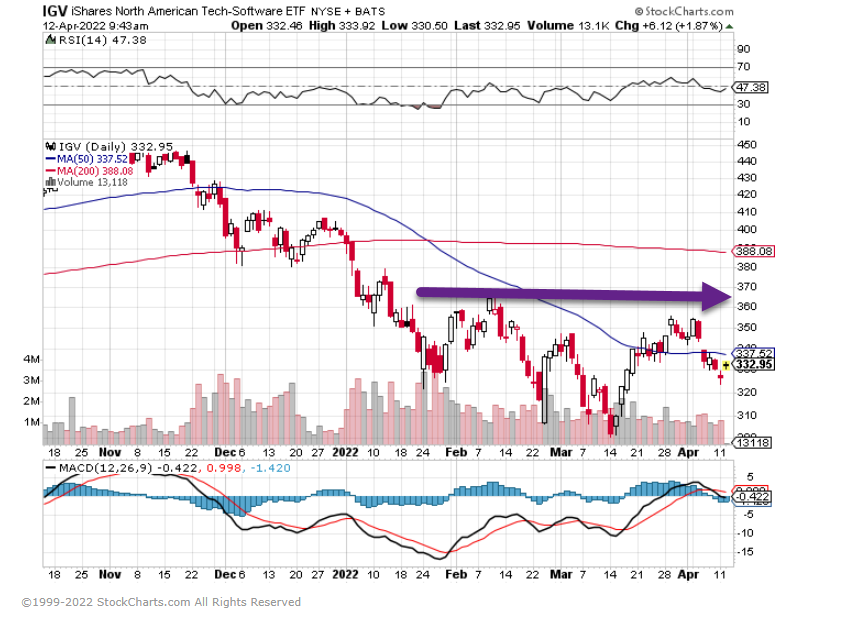
By choosing who you spend time with you are also choosing who you want to be. This is the environmental force at work on your subconscious and your biological instincts.

Here are three lessons you can take from this:

1. Curate your information diet to be rich and diverse. Follow people who think differently than you. Read old books. Remember that what you put into your mind today is the raw material you have to work with tomorrow.

2. Surround yourself with people whose default behavior is your desired behavior. If you want to run more, join a group that runs every day. Spend less time with people whose default behavior isn’t your desired behavior.

3. Design your environment knowing it will influence your future self. You can easily make undesired behaviors harder and desired behaviors easier.

Understanding the invisible influence of your environment allows you to turn your desired behaviors into your default behaviors.

https://fs.blog

Topley’s Top 10 – January 13, 2022

1. Last Time Fed Raised Rates….2 Double Digit Corrections

Ben Carlson A Wealth of Common Sense

The Fed. In 2018 we had two double-digit corrections in the U.S. stock market:

On Christmas Eve of that year we were basically in bear market territory. At the time no one really knew why the market was falling. There wasn’t a good reason.

After the fact most people agreed it was the Fed hiking rates:

The 3 Biggest Risks to the Market Right Now https://awealthofcommonsense.com/2022/01/the-3-biggest-risks-to-the-market-right-now/

2. Equity is Expensive but Cheaper than Bonds…Gundlach

From Dave Lutz at Jones

3. Where Does a Rise in Real Yields Start to Hurt Stock Investors?

Market watch The chart

Where does a rise in real yields start to hurt stock investors? A team of strategists at UBS, led by Bhanu Baweja, said that when yields rise more than 40 basis points over three months, “the impact on the market becomes material and goes nonlinear.”

“This is the range we regard as the rough threshold of real-rate pain
for the market. An incremental 10bp rise in real yields from here causes
the market to drop by about 0.8%, ceteris paribus. But what if other
things are not equal? A 5.2-point rise in PMIs will negate the hit to the
market from a 50bp rise in real yields,” said the strategists in a note to clients.

By

BY Barbara Kollmeyer

Follow

https://www.marketwatch.com/story/watch-out-for-stock-headwinds-and-recessionary-pressures-warns-bond-king-jeffrey-gundlach-11641989734?siteid=yhoof2

4. Bitcoin and Stocks are Increasingly Correlated

https://www.barrons.com/ Barrons

https://www.barrons.com/

5. Covid Favorite Carvana 54% From Highs

New Lows and 50 days through 200 days to downside

WSJ GM Takes Aim at Carvana, Vroom With Used-Car Website By

Mike Colias Follow

The Detroit auto maker is rolling out CarBravo, a new business that helps dealers put their used-car lots online

https://www.wsj.com/articles/gm-takes-aim-at-carvana-vroom-with-used-car-website-11641929229?mod=itp_wsj&ru=yahoo

6. The Video Game Industry Dwarfs the Box Office

Video games vs. the box office

The chart above gives some context on just how big the video game biz is. Last year the video game industry was pegged at somewhere around $180bn by Newzoo. That’s roughly ten times what the global movie industry brought in at the box office last year. Ten times. Admittedly last year the movie industry was still dealing with a pandemic hangover, but even in its best ever year the box office only brought in $39bn.

Video games may not carry the cultural impact of movies yet, but as a market they are in a completely different league.

Mobile making moves

Mobile games, that is games played on a smartphone or tablet, have grown so quickly over the last decade that they are now bigger than console and PC games combined.

Zynga’s pivot to mobile is a great example of a company that’s been flexible to its rapidly changing surroundings. Mobile games almost killed the company off, now they’re the reason it just got bought for $12.7bn.

www.chartr.com

7. The Housing Shortage Explained in One Chart

Steve Tuttle Fox Homes https://www.linkedin.com/in/steve-tuttle-871a3015a/

8. Lowest Apartment Vacancy Rate in 4o Years

From Zerohedge

Most new tenants are locked into a multi-year lease and have no intention of moving. Another issue for renters is the low housing supply, and surging prices have kept them on the sidelines. Prices are expected to continue rising in 2022.

In a separate report, Pew Research Center found rental homes and apartments across the country are experiencing the lowest vacancy rates in four decades. Despite the Covid-fueled migration patterns, a record low number of households moved between March 2020 and March 2021 because of low housing inventory.

“Rents are rising, and the discounts and concessions of 2020 are likely a thing of the past. Moreover, demand for housing continues to outpace the supply,” Bloomberg said.

https://www.zerohedge.com/markets/us-apartment-occupancy-hits-record-high-after-covid-Fueled-migration

9. Tuning out! Viewership at scandal-plagued CNN plummets by as much as 90% from last year in both overall audience and in advertiser-coveted 25-to-54 demographic.

  • CNN saw a sharp decline in viewership the first week of 2022 with a nearly 90% drop both overall and in the critical demographic coveted by advertisers
  • The network averaged just 548,000 viewers during the week of January 3, a precipitous drop to the nearly 2.7 million viewers from the same week in 2021
  • CNN in the last year has been plagued by high-profile scandals, most notably the firing of its top-rated prime time star Chris Cuomo
  • Critics have slammed network boss Jeff Zucker over the declining ratings, which began in 2021, with some accusing him of ‘protecting perverts and pedophiles’

By NATASHA ANDERSON FOR DAILYMAIL.COM

PUBLISHED: 14:07 EST, 12 January 2022 | UPDATED: 17:49 EST, 12 January 2022

https://www.dailymail.co.uk/news/article-10394997/CNN-loses-nearly-90-advertiser-coveted-demographics-overall-total-audience.html

10. A Super Reader Who Gets Through Hundreds of Books a Year Explains How to Read Way More

Economist, blogger, and super reader Tyler Cowen’s advice on how to get smarter by reading way more.

BY JESSICA STILLMAN, CONTRIBUTOR, INC.COM@ENTRYLEVELREBEL

How to get smarter isn’t mysterious and it isn’t complex. The answer has been the same for millennia. Read more (though it’s true these days we do now have lots more delivery methods for insightful words). The trick isn’t in figuring out what you need to do–it’s in actually managing to do it.

Which is why I’m always on the lookout for great, unexpected ideas to squeeze more reading into our lives. Previously, I’ve uncovered ideas like hijacking your impulse to check social media to advance your reading goals, shaming yourself with a little math, and letting your book-buying impulses run wild. But when I came across a recent Financial Times article by Pilita Clark promising tips from “super readers,” my ears perked up in anticipation of more good advice.

Is it possible to read hundreds of books a year? Apparently, yes.

The whole article is worth checking out if you’ve vowed to read more in 2022. But one particular “super reader” Clark spoke to stuck out. “All pale before Tyler Cowen,” she writes. The economist, blogger, and author “has claimed that on a good night he can get through ‘five whole books.'”

That sounds impossible, but if you’re familiar with Cowen’s blog Marginal Revolution, which offers an absolute avalanche of wildly eclectic book recommendations and commentary, you know that it appears to actually be true. How does Cowen manage to get through hundreds of books a year? Another blog, Driverless Crocodile, has done us all the favor of gathering up much of what Cowen has publicly said about his reading habits.

While it’s unlikely us mere mortals will manage three digits’ worth of titles in 2022, here are some of Cowen’s best tips to at least significantly increase the pace you get through books this year.

· Be ruthless. Not captivated by a particular book at a particular time? Then on to the next. “Just stop reading, put them down,” Cowen advises. A boring intro, bad design, or hard-to-read font is enough to persuade Cowen to chuck a book. There are countless amazing books out there. Don’t settle for less than good.

· Go ahead and skim. At least in the case of nonfiction, if you already know the material, feel free to skip ahead. “When you go to read actual books you’re like, ‘I know that, I know that, I know that,’ and you keep on going, and you read much more quickly. And that’s really the way to read a lot,” says Cowen. (This also creates a virtuous cycle in which the more you read, the more you’ll know, and the more you can skip.)

· Read to solve problems. “The best reading is focused reading, when you’re trying to solve some kind of problem,” Cowen believes. You could aim to answer a specific question, investigate a given author, or scratch an itch of curiosity. “You want to start with a problem or question when you’re reading,” he insists.

· Read in clusters. This naturally follows on from the point above. If you arrange your reading around questions or areas of exploration, you’ll end up reading multiple books about the same topic. That allows you to “do a kind of cross-sectional mental econometrics and see which pieces start fitting together,” says Cowen.

· Read fiction. Gathering a stack of non-fiction titles to explore a topic is great, but don’t neglect fiction. “Reading fiction is important to understand the cross-sectional variation in humanity, to understand how difficult generalizations can be, to just get a sense of how different social pieces fit together, and to get a sense of different historical eras — and plus, reading fiction is often just plain flat-out fun,” explains Cowen. Amen to that.

· Read books about topics you know nothing about. “Every area you don’t give a damn about you probably should read at least one book in. Because the very best book in that area is superb, and you’re not going to know what it is. So if tennis is something you don’t know anything about, well, read Andre Agassi’s memoir. That’s a wonderful book. You don’t have to know about or care about tennis,” claims Cowen.

· Have fun. “Take reading seriously, develop a passion for it, and view it as part of your practice as a knowledge worker to get ahead, but along the way, having fun doing so,” Cowen concludes.

Happy (and bountiful|) 2022 reading!

https://www.inc.com/jessica-stillman/books-reading-intelligence-tyler-cowen.html?cid=sf01003

Topley’s Top 10 – January 11, 2022

1. Fang Plus Index Holds 200 Day Moving Average.

FANG fails to top November highs….trades below 200 day most of yesterday but rallies to close above….

www.stockcharts.com


2. Nasdaq Comp Same Story….

Never breaks above November highs….holds 200day yesterday on afternoon rally.

www.stockcharts.com


3. MGC-MegaCap Tech ETF did Break November Highs.

MGC-made new highs and pulled back less than FANG and Naz Comp


4. ARKK Almost Cut in Half Mark.

ARKK approached the -50% from highs levels intra-day yesterday.

www.stockcharts.com


5. Nasdaq Averages Four 5% Pullbacks Per Year Going Back to 1972

Dorsey Wright–The Nasdaq Composite NASD has had a rocky start to 2022, with the index posting its fourth consecutive daily loss on Friday. In fact, the NASD has seen a decline in eight out of the last ten trading days. With Friday’s decline, the Composite has now pulled back over 5% from its closing value on December 27. There were a total of four 5% pullbacks in the NASD during 2021, which is right at the annual average dating back to 1972. There was only a 37-day gap between the last 5% pullback at the beginning of December and the most recent one, which is much quicker than the 92-day average gap between prior pullbacks. This also marks the swiftest 5% pullback since June 2020 at just eleven calendar days.

www.dorseywright.com


6. Pure Growth Factor Had Its Worst Week Ever Relative to Pure Value.


7. This Chart Shows KRE-Regional Bank Stocks vs. S&P to Start 2022 Massive Spike in Outperformance.

Jan 1. 2022 Bank Spike Vs. S&P

www.stockcharts.com


8. Gold and Warren Buffett Even 10 Year Performance.

@Charlie Bilello Same Outcome, Different Paths

It’s no secret that Warren Buffett is not a fan of Gold, having denounced the metal as an investment on numerous occasions.
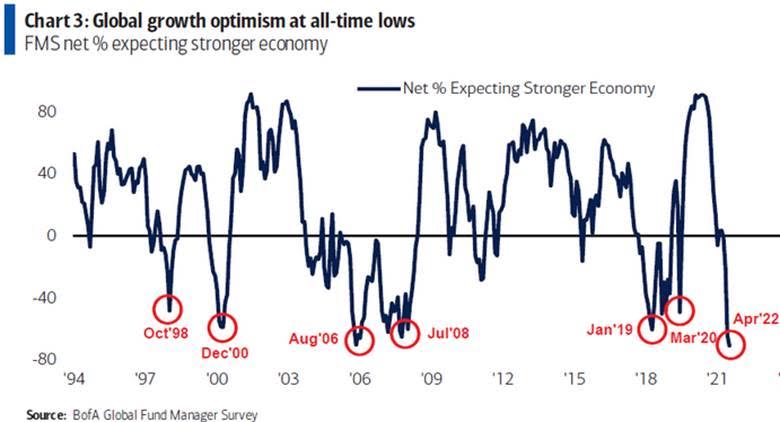
While there’s no denying Buffett’s huge long-term outperformance versus Gold, over the last 20 years they look exactly alike, with a return of +548%. Same end point, but very different paths getting there (first 10 years belonged to Gold, and the last 10 years to Buffett).

​Powered by YCharts


9. Suburban Housing Seeing Favorable Polls

Pew Research-Americans Are Less Likely Than Before COVID-19 To Want To Live in Cities, More Likely To Prefer Suburbs

https://www.pewresearch.org/social-trends/2021/12/16/americans-are-less-likely-than-before-covid-19-to-want-to-live-in-cities-more-likely-to-prefer-suburbs/


10. The Best Job Candidates Are the Best Storytellers

HBR by Kelsey Schurer

Summary.   A successful job interview hinges on a great story. A great story takes the audience on a journey. It has a clear beginning, middle, and end. The “before” version of you was met with a challenge that forced you to learn, grow, and ultimately do something differently. You…more

Where your work meets your life. See more from Ascend here.

Before the pandemic, and I do mean way before, I bought a beautiful suit — deep charcoal gray with a soft silk lining. It was my interview suit.

I’d just graduated from my Master of Fine Arts program and believed that first impressions were all about how we presented ourselves. This, to a degree, is true. But in the interview room, that presentation tends to stay on the surface. Of course, you need to speak intelligently and concisely, and you need the skills and experience to qualify for the roles you’re applying for. Still, as I stared at myself in my nice suit in the mirror, I naively forgot that first impressions extend far deeper.
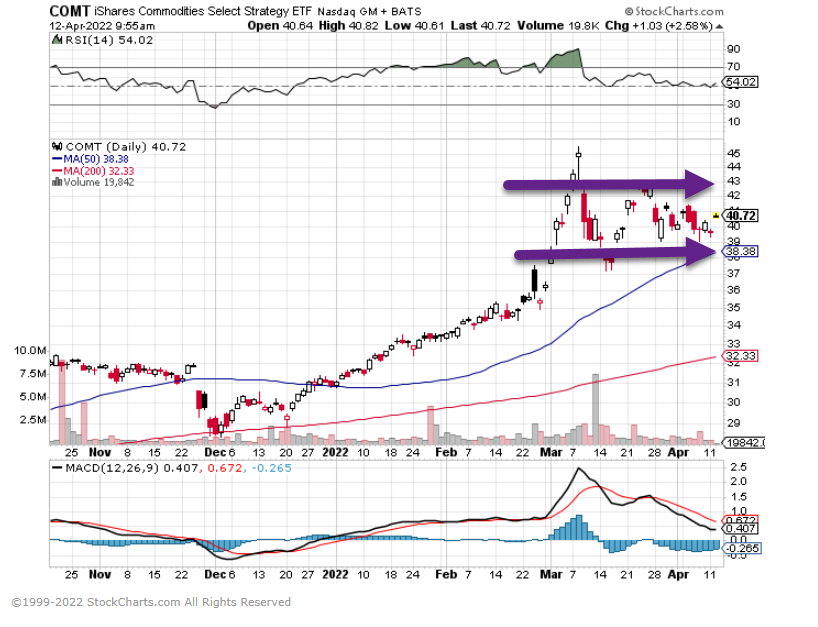
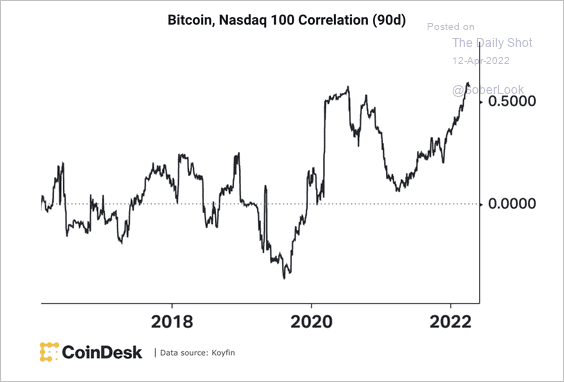
First impressions are meant to impress. The word “impress” has more than one meaning; the most common is to gain admiration or interest. But to impress also means to imprint, or to apply so much pressure or intent upon something that you leave a permanent mark behind.

If you think about it, the pandemic applied that pressure, imprinting us with the desire to reexamine what’s important in our lives — especially our work lives. Some of us were left with more than just a need to switch jobs, but also a radical wish for more flexibility, money, and happiness in our careers.

If you’re one of the people seeking a new work opportunity, then you’re probably prepping for a job interview (or a few).

Here’s what not to do:

  • Spend all your time memorizing facts about the company and role: Learning as much as you can about the company you’re interviewing with is smart, but everyone does this. The interviewer knows what their company already has, and they’re looking for what you can add.
  • Stay up late considering how you might respond to expected questions: Are you Googling “tips for a successful job interview” and reading the top articles? Rehearsing “your greatest strengths and weaknesses?” Yawn. Instantaneous boredom.
  • Only share the facts of your résumé: Without the context of how you show up when it counts, you won’t impress the interviewer. Your impression will stay at the surface level, leaving the interviewer with no emotional reaction to compel them to take a deeper look at you.

A successful interview hinges on a great story.

We’re all familiar with the most popular interview questions:

  • “Can you tell me about yourself?”
  • “What are your greatest strengths and weaknesses?”
  • “Can you explain a challenge you overcame?”

Every situational question your interviewer asks you can benefit from a great story. And understanding how to tell an authentic story about yourself in a way that leaves a permanent mark — in a way that allows your prospective employer to really see you — is the key to standing out. We all have a story to tell. Whether we’ve overcome an obstacle or learned through a mistake, our work forces us to reach within and surface our inner heroes.

But how do you paint that picture for your interviewers? As a book-writing coach who specializes in the business storytelling realm, my job is to help other people share their authentic stories (and I’ve gone through a fair number of job interviews myself).

What have I learned? A great story takes the audience on a journey. It has a clear beginning, middle, and end. The “before” version of you was met with a challenge that forced you to learn, grow, and ultimately do something differently (the beginning). You made a decision you never would have made before (the middle). Sometimes you succeeded. Other times you failed. Either way, you walked away with a lesson. You survived a challenge and emerged as a more powerful version of yourself (the end).

The Beginning: Choose a story that left a lasting imprint on you.

Every one of us has faced challenges at work. Your task is to unpack some of those moments — something few of us have taken the time to do — and practice relaying them in a compelling and authentic way.

Maybe you saved the day by speaking up when you saw something unjust. Maybe you salvaged a client account with a fantastic idea. Maybe you supported your coworker through a difficult day. Or maybe from time to time you’ve failed, walked away recognizing your mistakes, and are a stronger and more strategic performer as a result.

Remember that we’re all human, and sometimes we don’t always slay the monster — that doesn’t mean we aren’t heroes. Telling our interviewers stories of both successes and failures helps us stand out as emotionally intelligent and self-aware candidates. We each have ways, big and small, in which we’ve grown through difficult times.

To begin telling your story, start by outlining one of these instances, and do your best to choose a moment that connects to the question at hand.

For example, put yourself in the interviewer’s shoes. Pretend you have just asked me the question: Can you talk about a time when you had to overcome a challenge? Let’s say I’ve done my research and I know that “resilience” and “emotional intelligence” are qualities that your company values. To answer your question in a compelling way, I would choose a story that displays those skills and begin by explaining the obstacle I had to overcome:

During my first summer as a journalist at a local newspaper, I was assigned to photograph a festival. You should probably know now that I’m not a very good photographer, nor have I taken many photographs in my career. But I was a good field journalist, and I had proven to my editor that I could get a story from a crowded event.

The festival was guaranteed to be front-page news for the paper — which meant we needed high-quality photos and coverage. That was my job.

Talking to strangers about all the fun they were having? Piece of cake. Handling a professional-grade camera with a long, heavy lens that was such a big deal it had its own dust cloth and carrying case? That was my worst nightmare.

https://hbr.org/2021/12/the-best-job-candidates-are-the-best-storytellers?utm_campaign=hbr&utm_medium=social&utm_source=linkedin

Topley’s Top 10 – January 10, 2022

1. Marijuana ETFs -50% on Average from Highs.

MSOS-The Largest Weed ETF back to Covid lows

www.stockcharts.com


2. Market Rotation Out of Non-Profit Tech Stocks.

Investors dash out of US tech stocks in powerful market rotation

Source: Financial Times

From The Big Picture Blog

https://ritholtz.com


3. 10 Year Treasury Yield Broke Out of Short-Term Range…..Is 30 Year Next?

30 Year Treasury Yield

www.stockcharts.com


4. Unemployment Rate Drops to 3.9% Pointing to March Rate Hike

Strange Jobs Report Opens Door for March Rate Hike
The headline nonfarm payroll number was a big miss at 199,000 (vs. 450,000 expected). Seasonal adjustment problems may be partly to blame for the payrolls miss, but we expect the December release will also see upward revisions, as alternative data sources report much stronger job growth last month.
Despite the payrolls miss, the rest of the report points to a hot labor market. Most notably, the unemployment rate dropped by 30 basis points to 3.9 percent, which is just 40 basis points above where the Federal Reserve (Fed) expects unemployment to be in the fourth quarter of 2022. We could reach that level as early as this spring with the possibility of reaching 3 percent by December. The tight labor market will increase wage pressure, making a March increase in the overnight rate more likely.
The drop in the unemployment rate was due to a gain of 651,000 people working in the household survey, while the labor force participation rate was unchanged. The unchanged participation rate will add weight to Fed Chair Powell’s comments that a good portion of the participation shortfall is voluntary at this point, meaning that the labor market may already be at or beyond full employment.Most of Remaining Labor Force Shortfall is People 55+ Who Don’t Want to WorkNot in Labor Force by Age and Reason: Dec. 2021 Compared to 6M Pre-Covid Avg.

Source: Guggenheim Investments, Haver Analytics. Data as of 12.31.2021.


In another sign of how tight the labor market is, average hourly earnings rose 0.6 percent month over month, 20 basis points higher than expected, and November wage growth was also revised up. This wage data corroborate other data we’re seeing on worker bargaining power, with both the quits rate and small business wage plans at record highs. Powell has repeatedly cited strong wage growth as an upside risk to inflation.


Wages Are Booming with Business Signaling More Ahead

Source: Guggenheim Investments, Haver Analytics. Data as of 12.31.2021.

With the unemployment rate likely to reach the Fed’s end of 2022 target within the next few months, and with rising risks of soaring wage growth exacerbating inflation, a March rate hike is increasingly likely.

By the Macroeconomic and Investment Research Group

  • Brian Smedley, Chief Economist and Head of Macroeconomic and Investment Research
  • Matt Bush, CFA, CBE, U.S. Economist, Macroeconomic and Investment Research

https://www.guggenheiminvestments.com/perspectives


5. For Short-Term Traders…Bitcoin the Most Oversold on RSI Since 2020 Crash.

Zerohedge-Bitcoin be the most oversold since the March 2020 crash, surpassing even the furious liquidations observed during the May 2021 crash.

Waiting for the institutional bitcoin inflow?

Looks like you have to wait a bit longer. BTC has several problems when it comes to attracting the “real” institutional flow (we are not talking MSTR nor El Salvador). BTC lacks a shorter term trend and volatility continues to be huge. This is not what institutions are looking for…

Source: JPM

https://www.zerohedge.com/the-market-ear/daretobuy


6. History of Bitcoin Corrections

@Charlie Bilello

Small Coins Crushed

https://twitter.com/charliebilello


7. Crypto Fear and Greed Index at “Extreme Fear” Levels

https://news.bitcoin.com/crypto-fear-and-greed-index-score-hits-5-month-low-analyzed-sentiment-points-to-extreme-fear/


8. States and Local Governments Running Healthy Surpluses.

Barrons-While the U.S. economy is expected to cool in 2022 after a pandemic resurgence, there’s a largely untapped source of hundreds of billions of dollars in potential stimulus that could keep inflation elevated for longer—and it’s sitting with state and local governments. 

State budgets are flusher than ever, benefiting from a Covid-driven combination of an estimated $885 billion in direct federal stimulus, soaring tax revenue, and curbed costs as some state and local services shifted online. State and local receipts were 16% above the prepandemic trend in the third quarter of 2021, according to an analysis by the Committee for a Responsible Federal Budget. State and local noninterest spending, meanwhile, was up just 5%. 

States Could Drive Rising Prices Even Higher. Here’s How.By

Megan Cassella

https://www.barrons.com/articles/inflation-risk-states-stimulus-51641431634?mod=past_editions


9. Half of the U.S. Could Need Glasses by 2050

Myopia, or short-sightedness, is on the rise.

Data from the BHVI predicts that by 2050 almost half of the global population could be affected by Myopia — more than a doubling of the rate from the year 2000.

Has the pandemic made it worse?

With increased amounts of screen-time, it feels intuitive that our eyes might have been put under more strain in the last two years — and there’s a decent amount of scientific evidence to back that up, as myopia has long been associated with spending more time indoors.

Although there haven’t been any conclusive studies in adults since the pandemic, a study of children in Hong Kong from 2021 found that “the rate of nearsightedness that developed during the pandemic more than doubled what was found in a pre-pandemic study of children the same age”. Good time to be a glasses maker.

www.chartr.com


10. Turning Goals into Results

How high achievers attain their goals. 

Posted January 9, 2022 |  Reviewed by Kaja Perina

KEY POINTS

  • Not knowing, not doing, and the knowing-doing-gap keeps us from achieving our goals.
  • A desire-fueled approach enables us to turn our goals into results.
  • Track the percentage of time spent doing focused, productive work towards your goals.

At the start of a new year, we typically take account of what we have accomplished and what we would like to accomplish in the current and coming year(s). We find new determination to set and achieve our goals.

Yet many struggle to achieve the goals they so resolutely desire. We may fall into the blame game – blaming our situation or ourselves for not achieving them. Living through the challenges of the pandemic can make achieving our goals more daunting.

Learning to turn goals into results is important.

Having and achieving goals leads to having and living a life of meaning and purpose. Of the many hurdles that can get in the way of our achieving our goals, broadly speaking they fall into four areas.

Not knowing Sometimes the problem is that we are not clear about what we want. We don’t know what success would look like. So we meander in our efforts. In the absence of clarity, efforts are less directionally focused.

Not doing. Analysis paralysis is the swamp that can suck anybody in, but it is a special hazard for the more intellectually inclined. As they try to maximize and optimize choices, they incur the costs of indecisiveness and inaction. A mindset of risk aversion and reluctance to act leads to the next cause of failure to turn goals into results.

The knowing-doing gap. We know what our goals are at this point, and we often know what to do. But for many reasons, prominent of which is fear, we don’t do the needful. We may not know how to do what is required.

Circumstances change. Sometimes, however, extraneous circumstances beyond our control limit what we can do and force us to change our goals and how to achieve them. Buffeted by circumstances, our priorities change. We encounter losses – health, finances, and relationships – that narrow or close options, forcing us to accept what is, adjust accordingly, and accommodate the new normal.

How to turn goals into results 

There is a straightforward approach to turning our goals into results. It’s much like embarking on a road trip. It starts with having the desire to visit a destination. That leads to doing the required planning and preparation before setting off on the journey. Acknowledging the possibility that we may encounter road closures and detours that delay us can help us focus on reaching our destination. We can apply the same principles at scale to achieve our short-term and long-term goals.

Turning Goals into Results

Source: Rahul Bhandari

Desire is a powerful force of human nature. Advertising, branding, and marketing professionals harness it effectively. You, too, must tap into the power of desire to help you accomplish your goals. Generate within you a burning desire to achieve specific goals. Thinking of this process as strategic intent gives you the heuristic to align all you think and do towards achieving your goal(s). Shift your mindset from resisting what is required to the opportunity and ability to do it. This subtle shift from “I must do this” to “I get to do this” will allow you to take pleasure in and derive additional benefit beyond the task—giving you an added boost to do what is required.

Strategic intent in Sanskrit is known as sankalpa, a heartfelt desire, a solemn vow, an intention, determination, or a one-pointed resolve to do something. A sankalpa is a tool meant to harness the will, and to focus and harmonize mind and body on a specific goal. Your sankalpa is not just your intention. It’s your heartfelt desire: What you are meant to do in the world.

Planning is essential to achieving goals. An effective way of planning is to analyze, prioritize, and develop an operational plan. An excellent place to start is by taking an inventory of where you’re spending your time.

Over 13 weeks, track where you’re spending your time at 15-minute intervals. Then analyze the data by simply grouping the specific activities into types of activity. For example, a senior executive discovered she is spending 30% of her time in meetings she initiates, of which 80% are one-on-one meetings and 20% involve teams of people. Another 20% of her time goes into performance reviews. And so on.

\What percentage of your time are you spending doing focused, productive work towards your goals? This simple analysis gives you insights into what to stop doing, what to prioritize, and when to spend time aligned with fulfilling your desires. You can use the insights to then create a plan–for the year, quarters, months, weeks, and down to what you will accomplish each day and where you’d spend your time in 15-minute blocks. Bringing this intentionality alone provides the nudge to keep you focused on working towards achieving your goals.

Doing what is required is at the heart of achieving your goals. Three capabilities help. First, learn to manufacture time. Focus on the 20% of the effort that will get you 80% of the results. Don’t do that which you can have others do. Delegate. Second, build a team to help you in your journey. Think of elite athletes: They have an entire team of coaches, nutritionists, sports psychologists, and friends helping them prepare for and achieve their goals. Lastly, you don’t have to do everything all at once. Activate the power of compounding. Doing tasks incrementally but consistently over time accrues tremendous outcomes. This is the secret behind overnight success, which takes years of consistent and directionally focused effort.

The power of intentional living

Even the best-laid plans can sometimes be ineffective in helping us achieve our goals. The beauty of intentional living is that we can be agile – we can change our goals, come up with new plans, and take the required action to achieve them. Knowing what your goals are, planning and preparing to achieve them, and then doing what is required consistently is a proven recipe for success.

You’ve got this.

https://www.psychologytoday.com/us/blog/turning-adversity-advantage/202201/turning-goals-results

Topley’s Top 10 – January 07, 2022

1. The Stock Market was Up Big Last Year From Legit Huge Profit Margins.

Negative Manipulationby Michael BatnickOne more thing that stands out in the chart above is margin expansion. Bottom lines were hit last year as the shutdown put the squeeze on businesses. But as the economy reopened, companies found ways to improve their earnings. And that, my friends, is what ultimately drives the market.

https://theirrelevantinvestor.com/2022/01/04/negative-manipulation/

2. Meanwhile if you own a Nasdaq Stock without High Margins…..4 in 10 Nasdaq Composite Names Down -50% from Highs

“Massive Meltdown”: 40% Of Nasdaq Companies Are Down More Than Half From Their HighsBY TYLER DURDEN

In a testament to the narrow breadth of the Nasdaq, and the broader market in general, where as a reminder 51% of all market gains from April through December were just from the five most popular tech names – AAPL, MSFT, NVDA, TSLA, GOOGL – Sundial Research notes that a near-record number of tech stocks have plunged by some 50%, a number that was only surpassed by the March 2021 crash and the global financial crisis.

Roughly four in every 10 companies on the Nasdaq Composite have seen their market values cut by 50% or more from their 52-week highs, while a vast majority of index constituents are mired in bear markets, according to Jason Goepfert, chief research officer at Sundial.

“Whatever the fundamental and macro considerations, there is no doubt that investors have been selling first and trying to figure out the rest later,” Goepfert said in a note and first noted by Bloomberg.

https://www.zerohedge.com/markets/massive-meltdown-40-nasdaq-companies-are-down-more-half-their-highs

3. Gold Less Volatile than Most Alternative Investments

Advisors Perspectives-Frank Holmes

The Great Gold Love Trade Is Alive And Well, As India Buys A Record Amount https://www.advisorperspectives.com/commentaries/2022/01/06/the-great-gold-love-trade-is-alive-and-well-as-india-buys-a-record-amount

4. Bitcoin Next Support Technically $40,000

Ines Ferré https://finance.yahoo.com/news/bitcoin-will-see-its-dot-com-moment-over-next-year-or-two-charts-technician-193524135.html

5. Netflix -22% from Highs and Closes Below 200 Day Moving Average.

www.stockcharts.com

6. Summary of Bond Index Returns 2021

https://www.morningstar.com/articles/1073817/8-charts-on-2021-market-performance

7. Household Net Worth 20+ Year Record Gain Last Year

From Advisor Perspectives https://www.advisorperspectives.com/commentaries/2022/01/06/growth-cycle-outlook-2022-will-not-be-2021

8. Great Resignation in Healthcare

9. Change the Color of Your Car in the Flick of a Button

BMW just unveiled its first color-changing car, and you have to see it to believe it

BMW’s color-changing concept car is known as the “iX Flow featuring E Ink.” It was shown off at the Consumer Electronics Show in Las Vegas, Nevada this week. BMW

  • BMW unveiled a wild new concept at this year’s big tech trade show: A color-changing car.
  • Drivers can change the color of the car at the touch of a button, instantly, the automaker said.
  • Videos depicting the car changing color in real time are stunning.

Get the latest tech news & scoops — delivered daily to your inbox.

Luxury German carmaker BMW debuted a fascinating and futuristic new concept at this year’s Consumer Electronics Show: A car with the ability to change colors on-the-fly.

Rather than standard metal panels, the concept car features e-ink technology — the same tech that’s used to power Amazon’s wildly popular e-reader, the Kindle — as a means of changing colors in an instant.

The concept was shown off in real time with a modified version of the BMW iX, the company’s new flagship electric SUV, during CES this week in Las Vegas.

Attendees captured stunning videos of the car changing color in real time:

And a few media outlets got a closer look at the vehicle going through all sorts of wild color changes, which demonstrate a variety of different patterns that could be applied:

Beyond the car’s panels, there are also e-ink panels in the wheels that enable those to change as well.

“In the future, BMW customers may change the color of their car with the push of a button,” BMW project lead Stella Clarke said in a video announcing the new prototype.

When that future is remains to be seen: BMW didn’t say when the “Flow” technology it debuted this week is coming to any of its cars, but it stands to reason that it would arrive on the upcoming BMW iX model first.

The company’s first all-electric SUV is scheduled to begin arriving to pre-order customers this March.

Check out the full presentation from BMW right here:

https://www.businessinsider.com/bmw-just-unveiled-first-color-changing-car-video-2022-1

10. 3 Fundamentals of Marketing You Must Understand to Reach the Hearts and Minds of Your Customers

Marketing isn’t a panacea for your business, but it can help you grow bigger than you ever imagined.

By Scot Chrisman June 7, 2021

Opinions expressed by Entrepreneur contributors are their own.

Many “influencers” and self-proclaimed guru’s on the internet would have you believe that marketing is the solution to all of your issues in business. Unfortunately, the marketing industry is full of under-educated media buyers who are after your money because their “guru” told them they could make $10k a month by selling you ads on an open-source platform.

These platforms are created with the ability to hyper-target who sees your ads and when. It allows you to place ads in front of a demographic of people that could be your ideal customer based on their(the advertising platform’s) psychographic data, and the hope is that you’ll get leads.

By: JobsOhio

While, in theory, this sounds like a magic pill… a panacea for all of your business problems, it’s not quite how the world of marketing works. A majority of the prospects who will buy your product won’t do it the first time they see it.

Use these three marketing fundamentals to guide your marketing decisions and create marketing campaigns that convert customers into lifetime fans.

1. Marketing is about finding and understanding a market in need

Many marketing agencies would have you believe that your ideal customers are always on the platform that they happened to be best at ad buying on. That “Facebook has billions of users, so your ideal client is definitely on there.” While it might be, many people ignore ads on Facebook and are afraid of their data and privacy. For many people who may be your ideal customer, clicking on Facebook advertisements isn’t even a risk they’re willing to take.

Finding a market in need involves these things:

  • Understanding who the ideal customer is for your product or service
  • Understanding where those people spend time and how they choose to spend their money
  • Understanding how to place educational content in front of those people to help them understand why you’re the best option for them.

Marketing is not advertising. Ensure you understand the market before you spend your money on advertising with the assumption that it will be a magic bullet for your business. Look at where your competitors are advertising and how they’re doing it. Examine where your customers are spending their time and what their spending habits are. Research how they make their buying decisions. Utilize this information to create a true marketing strategy instead of guessing and wasting your valuable capital on guesswork and loose principles.

2. Marketing is about communicating with your potential customers

Marketing is a process of communication more than anything. Communication is about understanding each other’s point of view, not telling the other party why you’re right. Many companies will assume marketing is about telling their customers exactly why to buy their product or service… and it is, but it’s about more than that. It’s about communicating with your customers to ask what they want. It’s about learning about how you can serve them better.

Once you’ve found your market, find ways to communicate with them. This is a two-way street; offer a lead magnet, ask for direct feedback on that lead magnet, and ask them how they would ideally see their problems solved. Utilize both means of communication as a company, tell them about what you offer as well as asking for their input.

The more you can show your customers that your care about who they are and how they would like to be treated(within reason), the more you’ll earn their trust and word of mouth promotion. Utilize the channels of communication that you have to gain valuable insight and information about your customers.

See your customers as human beings with real needs and real struggles. They need empathy. They’re not just potential dollar signs. They’re people who deserve to be seen, heard, and valued. Understand and implement this, and you’ll stand head and shoulders above the crowd of other companies vying for their attention and money.

3. Marketing is a process of education

Many marketing agencies would have you believe that if you can just show your prospects the right offer, you’ll get leads. This is true but a giant waste of marketing dollars and effort if you’re not in a hot market. Often as entrepreneurs, we’re not selling a revolutionary product. We’re able to take an existing product or service and make it a little bit better.

This is at the heart of entrepreneurship, making things better… But it can make finding a hot market harder than those who have a truly revolutionary product. Entrepreneurs and businesses compete for the attention of their customers and clients. It’s once you’ve gained their attention that you can also earn their trust.

Consumers buy from people and companies that they know, like, and trust. Just like you, it’s hard to trust the stranger on the street trying to sell you… anything, so why would you expect yourself to be different? Certainly, you’d trust the food truck with great branding and a welcoming face if you’re hungry and leaving the bar, right? They’ve done their research and have placed themselves in a hot market with a professional presence.

Would you buy the same food from a stranger on the street with no food truck or professional presence after walking out of Chipotle? Not likely. But if they handed you a small flyer about who they are, why they do what they do, how they source all of their ingredients locally, and how they give back to the community, would you be intrigued to check it out next time instead of Chipotle? If you’re the right prospect, the answer would be yes.

If you’re in the wrong market or miss the timing, it’s not likely that your customers will want to buy from you at that very moment. That said, you can still educate them as to why you might be a better choice next time.

Use education to draw your ideal customers closer to a decision to buy. Don’t just throw your offer in front of them every time you get the chance. Spend time educating your prospects and allow them to make a new choice once they’ve learned why it’s advantageous for them.

Marketing is something that takes research, time, and understanding. It requires patience, compassion, and empathy. And it’s not about forcing or willing your product into the hands of your customers. It’s about understanding what they truly need and giving it to them in a way they admire and respect. Use these fundamentals to guide your next marketing campaign and see what new doors it opens up for your business.

https://www.entrepreneur.com/article/369736

Topley’s Top 10 – January 05, 2022

1. New Mayor in New York City…..NYC REIT Index Doubles +100% in a Month

America Needs NYC..Good Luck Mayor Adams

Dave Lutz Jones Trading Eric Adams declared New York City “open and alive” despite a record-breaking viral surge, in his first address as the city’s 110th mayor.  “I take this important office at a time of great challenges for our city,” Adams said Saturday in an inaugural speech at City Hall. He said he’d been sworn earlier in at Times Square because he “wanted New Yorkers and the world to be reminded of two things.”  The NYC REIT was on fire the last 2 days of 2021


2. Tech Software ETF -15% Correction.

www.stockcharts.com


3. 10-Year Treasury Yield 1.35% to 1.63% Since December 1

The most watched chart for 2022….

www.stockcharts.com


4. Bitcoin to U.S. Dollar Chart

Bitcoin trading straight down vs. U.S. dollar since November 2021

www.stockcharts.com


5. Bitcoin Now 20% of the “Store of Value Market”

Goldman estimates that Bitcoin’s float-adjusted market capitalization is just under $700 billion. That accounts for 20% share of the “store of value” market which it said is comprised of Bitcoin and gold. The value of gold that’s available for investment is estimated at $2.6 trillion.

Yahoo Finance Anchalee Worrachate https://finance.yahoo.com/news/goldman-says-bitcoin-100-000-201521761.html


6. Byron Wien’s Famous Ten Surprises for the Year….

Business Wire  https://www.businesswire.com/news/home/20220103005259/en/Byron-Wien-and-Joe-Zidle-Announce-the-Ten-Surprises-of-2022

More Important…How did last year’s predictions turn out?

Marketwatch While the pair have published their list of 2022 surprises, it might be more informative to review last year’s surprises.

  • “Former President Trump starts his own television network and also plans his 2024 campaign.” He certainly seems to be gearing up for a 2024 run. As for the TV network, there’s none in existence as yet, though the Trump Media & Technology Group has been formed on paper at least, hired Rep. Devin Nunes to be its chief executive, and has agreed to be acquired by special-purpose acquisition company Digital World Acquisition Company DWAC, +1.03%.
  • “Despite the hostile rhetoric from both sides during the U.S. presidential campaign, President Biden begins to restore a constructive diplomatic and trade relationship with China. China A shares SHCOMP, -0.20% lead emerging markets higher.” The diplomatic mending is still in its infancy, though what Wien and Zidle didn’t seem to account for was China derailing its own stock market with aggressive regulation.
  • “The success of between five and ten vaccines, together with an improvement in therapeutics, allows the U.S. to return to some form of ‘normal’ by Memorial Day 2021.” Mostly correct, even if some of the details, like spectators at the Olympics, didn’t materialize.
  • “The Justice Department softens its case against Google GOOGL, -0.41% and Facebook FB, -0.59%, persuaded by the argument that the consumer actually benefits from the services provided by these companies.” No sign of that, and many expect tougher action by U.S. authorities this year.
  • “The economy develops momentum on its own because of pent-up demand, and depressed hospitality and airline stocks become strong performers.” Right on the economy, mixed on stocks — the JETS JETS, +1.47% exchange-traded fund, for instance, peaked in March, while leisure stocks PEJ, +0.28% enjoyed strong gains but did underperform the S&P 500 SPX, -0.06%.
  • “The Federal Reserve and the Treasury openly embrace Modern Monetary Theory as their accommodative policies continue.” The rise of inflation stamped this trend out.
  • “Even as energy company executives cut estimates for long-term growth, near-term opportunities are increasing. The return to ‘normal’ increases both industrial activity and mobility, and the price of West Texas Intermediate oil rises to $65/bbl.” A good call here, with WTI CL.1, +1.49% surging 55%.
  • “The equity market broadens out. Stocks beyond health care and technology participate in the rise in prices.” Participate, yes, but the market was still overwhelmingly tech-focused.
  • “The surge in economic growth causes the 10-year Treasury TMUBMUSD10Y, 1.652% yield to rise to 2%.” Directionally correct, though a half-point off.
  • “The slide in the dollar turns around.” It sure did, with the WSJ dollar index BUXX, 0.01% jumping 5%.
This investing legend has been predicting surprises for the last 37 years. Here’s how he did last year — and what he’s forecasting now
https://www.marketwatch.com/story/this-investing-legend-has-been-predicting-surprises-for-the-last-37-years-heres-how-he-did-last-year-and-what-hes-predicting-now-11641292134?siteid=yhoof2

7. Surgical Robotics Market 21.6% CAGR 2021-2028

Grand View Research-The global surgical robots market size was valued at USD 2.3 billion in 2020 and is expected to grow at a compound annual growth rate (CAGR) of 21.6% from 2021 to 2028. Growing adoption and acceptance of Minimally Invasive Surgeries (MIS) owing to benefits, such as shorter hospital stays, and the introduction of cost-effective & flexible surgical robots by new players are some of the key factors driving the growth of this market. In addition, the increasing penetration of international players is positively impacting the market growth. Furthermore, the rising number of knee and hip replacement surgeries performed due to the high prevalence of arthritis, bone-degenerative diseases, osteoporosis, and related injuries is projected to drive the market growth.

https://www.grandviewresearch.com/industry-analysis/surgical-robot-market


8. Mercedes says its electric concept has 620 miles of range and seats made with mushrooms

Found at Morningbrew https://www.morningbrew.com/daily

Peter Valdes-Dapena, CNN Business

The new Mercedes-Benz EQS is a game changer

(CNN)Mercedes has unveiled a new all-electric concept car, the EQXX, that the company claims can go 620 miles on a single charge. The futuristic luxury car is also made with a host of innovative recycled and sustainable materials including mushroom fibers, ground up cacti and trash such as food scraps.

A rendering of the Mercedes-Benz Vision EQXX.

Mercedes’ range claim for this concept vehicle is based on computer simulated testing, not actual driving, the company said. If the claim is accurate, though, the EQXX would be able to drive farther on a single charge than a Toyota Prius hybrid can travel on a full tank of gas, according to United States Environmental Protection Agency estimates. The Prius can only manage 588 miles. It’s nearly as far as the 644 miles that a diesel-powered Chevrolet Suburban can go on a 28-gallon tank of fuel. It’s also much farther than any other electric car currently available in the United States, according to the EPA.

Mercedes plans to demonstrate the car’s range in an actual driving test this spring, the company said.

Mercedes has said it intends for half its sales to be electric cars by 2025 and, by 2030, for the brand to be virtually “ready to go all electric.” Mercedes referred to the EQXX as a “technology blueprint for series production.” Mercedes plans to put a car with the EQXX’s battery and electric motor technology, as well as some of the car’s other features, into production in 2024, said Markus Schäfer, chief technology officer of Mercedes’ parent company Daimler.

The Mercedes-Benz Vision EQXX concept car lacks the traditional grille seen on Mercedes cars today.

The EQXX achieves its remarkable range with a battery pack that is half as large and 30% lighter than the one in the Mercedes EQS, the German automakers current fully electric sedan, while storing the same amount of energy, according to Mercedes. At 620 miles, or 1,000 kilometers, the EQXX would provide about 133 miles more driving distance on a charge than the EQS based on European range estimates for that car.

The EQXX gains those extra miles largely through efficiency, according to Mercedes. Mercedes claims the EQXX can travel more than 6 miles per kilowatt hour of electricity. That’s almost three times farther per kilowatt hour than a Tesla Model S Long Range, according to US EPA estimates. A kilowatt-hour is a unit of electrical energy stored in a car’s battery so miles per kilowatt hour is like miles per gallon for a gasoline car. The figures are much lower, though, because a gallon of gasoline contains almost 34 kilowatt hours of energy.

To reach that level of efficiency, Mercedes designers focused on aerodynamics. The EQXX has a drag coefficient of just 0.17, which is sightly more aerodynamic than a properly thrown football. It’s also more aerodynamic than today’s Mercedes EQS which, while still very aerodynamic, has a drag coefficient of 0.20. A Porsche 911 Turbo has a drag coefficient of 0.33, according to Porsche.

The car is also designed to be as light as possible, according to Mercedes. Besides the relatively light battery pack it has wheels made from magnesium, and aluminum brakes. Springs in the EQXX’s suspension are made from glass-fiber reinforced plastic instead of metal.


Much of the Mercedes-Benz Vision EQXX’s extreme efficiency comes from attention to aerodynamics.

The EQXX’s body includes a web-like subframe designed to have metal only where it’s actually needed for structural integrity and crash safety. Empty spaces in the frame are filled in with a material called UBQ, created by an Israeli startup. UBQ is made from landfill waste that can include things like mixed plastics, cardboard, gardening waste and even diapers, according to Mercedes-Benz. Solar panels in the roof supply supplemental energy for things like air conditioning, lights and the car’s touchscreen systems reducing demands on battery power.

Besides the UBQ filler material in the body, the EQXX also utilizes sustainable materials in other parts of the car. A leather-like material made from mycelium, the underground root-like structures of mushrooms, is used in the seat cushions. Another leather substitute, made from pulverized cactus fibers, is used elsewhere in the interior. The carpets are made entirely of bamboo fiber, according to Mercedes.

Inside, the EQXX has an enormous touchscreen that stretches all they way across the dashboard. Unlike the ultra-wide “screen” in the EQS, which is actually three smaller screens under a single sheet of glass, the one in the EQXX really is a single four-foot wide screen. To save energy, unused portions of the screen dim.

Mercedes engineers and designers have also tried to give the car’s voice-control system more personality with a lifelike voice that’s more emotionally expressive. The system is represented by a human-shaped avatar made up of tiny stars. The figure is modeled on the young Mercedes Jellinek, the daughter of Emil Jellinek, an early (and particularly demanding) customer of Daimler, now Mercedes’ parent company.

In 1900, he commissioned a new sports car model that he insisted be named after his daughter. The car was such a success that her name later became attached to every car the company made.

Mercedes says its electric concept has 620 miles of range and seats made with mushrooms – CNN


9. OSU research finds way to scrub carbon dioxide from factory emissions, make useful products

Found at 1440 blog https://join1440.com/

CORVALLIS, Ore. – Carbon dioxide can be harvested from smokestacks and used to create commercially valuable chemicals thanks to a novel compound developed by a scientific collaboration led by an Oregon State University researcher.

Published in the Journal of Materials Chemistry A, the study shows that the new metal organic framework, loaded with a common industrial chemical, propylene oxide, can catalyze the production of cyclic carbonates while scrubbing CO2 from factory flue gases.

Carbon dioxide, a greenhouse gas, results from burning fossil fuels and is one of the primary causes of climate change. Cyclic carbonates are a class of compounds with great industrial interest, meaning the findings are a boost for green-economy initiatives because they show useful products such as battery electrolytes and pharmaceutical precursors can be derived from the same process deployed to clean emissions from manufacturing facilities.

The new, three-dimensional, lanthanide-based metal organic framework, or MOF, can also be used to catalyze cyclic carbonate production from biogas, a mix of carbon dioxide, methane and other gases arising from the decomposition of organic matter.

A catalyst is a substance that increases the rate of a chemical reaction without itself undergoing any permanent chemical change, and lanthanides are a group of soft, silvery-white metals whose applications range from night vision goggles to flints for cigarette lighters.

Examples of lanthanides include cerium, europium and gadolinium.

“We’ve taken a big step toward solving a crucial challenge associated with the hoped-for circular carbon economy by developing an effective catalyst,” said chemistry researcher Kyriakos Stylianou of the OSU College of Science, who led the study. “A key to that is understanding the molecular interactions between the active sites in MOFs with potentially reactive molecules.”

A MOF is an inorganic-organic hybrid, a crystalline porous material made up of positively charged metal ions surrounded by organic “linker” molecules, in this case lanthanide metals and tetracarboxylate linkers.

The metal ions make nodes that bind the linkers’ arms to form a repeating structure that looks something like a cage; the structure has nanosized pores that adsorb gases, similar to a sponge. MOFs can be designed with a variety of components, which determine the MOF’s properties.

Lanthanide-based materials are generally stable because of the relatively large size of lanthanide ions, Stylianou said, and that’s true as well with lanthanide MOFs, where the acidic metals form strong bonds with the linkers, keeping the MOFs stable in water and at high temperatures; that’s important because flue gases and biogas are hot as well as moisture rich.

The lanthanide MOFs are also selective for carbon dioxide, meaning they’re not bothered by the presence of the other gases contained by industrial emissions and biogas.

“We observed that within the pores, propylene oxide can directly bind to the cerium centers and activate interactions for the cycloaddition of carbon dioxide,” Stylianou said. “Using our MOFs, stable after multiple cycles of carbon dioxide capture and conversion, we describe the fixation of carbon dioxide into the propylene oxide’s epoxy ring for the production of cyclic carbonates.”

Cyclic carbonates have a broad range of industrial applications, including as polar solvents, precursors for polycarbonate materials such as eyeglass lenses and digital discs, electrolytes in lithium batteries, and precursors for pharmaceuticals.

“These are very exciting findings,” Stylianou said. “And being able to directly use carbon dioxide from impure sources saves the cost and energy of separating it before it can be used to make cyclic carbonates, which will be a boon for the green economy.”

David Le, Ryan Loughran and Isabelle Brooks of the College of Science collaborated on this research, as did scientists from Columbia University and the University of Cambridge.

The College of Science and the OSU Honors College funded the study.

About the OSU College of Science:  As one of the largest academic units at OSU, the College of Science has seven departments and 12 pre-professional programs. It provides the basic science courses essential to the education of every OSU student, builds future leaders in science, and its faculty are international leaders in scientific research.

https://today.oregonstate.edu/news/osu-research-finds-way-scrub-carbon-dioxide-factory-emissions-make-useful-products?utm_source=join1440&utm_medium=email


10. 10 Ways That a Sense of Purpose Can Change Your Life

Better health, higher life satisfaction, and greater resilience.– Elaine Shpungin Ph.D.

KEY POINTS

  • One of the best predictors of happiness is having a purpose in life.
  • Sense of purpose may improve resiliency, life satisfaction, health, academic and work success, and even longevity.
  • Seeking our purpose may change our trajectory.

This season we are tackling the four pillars of resilience:

  • Purpose and Meaning
  • Beliefs and Mindset
  • Habits and Practices
  • Relationships and Supports

In the last post, we examined the protective power of traveling back in time to assign strength-based meaning to past struggles. In this post, we will take a look at the importance of cultivating purpose in both our daily interactions and larger life pursuits.

Anthony Burrow, the author of “The Ecology of Purposeful Living Across the Lifespan,” describes purpose as the why that propels us forward, the reason we do what we do, the inspiration we have for being in this world. The John Templeton Foundation gives this fancy definition: Purpose is a stable and generalized intention to accomplish something that is at once personally meaningful and at the same time leads to productive engagement with some aspect of the world beyond the self.

Purpose combines the why behind what we do with a long-term desire to make a dent in the world.

Source: Elaine Shpungin (Conflict 180)

Let’s say you are a teacher. To “be a teacher” would not be your purpose but a vehicle for your purpose. The answer to “Why do you want to teach?” combined with “How might that make a positive contribution to the world?” would begin to give us hints about your purpose. For instance:

  • To inspire kids to read, which might open up new horizons in their lives.
  • To help kids enjoy math, which may help create more math-savvy citizens who don’t get exploited.
  • To expose kids to Spanish, so they can be better neighbors and global citizens.
  • To instill a life-long commitment to health by making exercise fun.

Having a sense of purpose predicts a multitude of positive outcomes that allow us to overcome obstacles, thrive in tough situations, and live healthier lives.

Below is a list of some of these outcomes, arranged in a Top 10 Countdown (though many of them were a tie for me). Some references are included within each section; others can be found in the larger summaries found at the bottom of this post.

article continues after advertisement

Top 10 Ways Purpose Can Change Your Life

10. May be related to higher income over time. A nine-year study of 6,000 American adults showed that people who rated themselves as having higher sense of purpose had higher incomes at the start of the study and increased their income more over time, compared with their peers who said their life felt more “aimless.” (However, we also know that higher income leads to increases in wealth through other pathways, such as investments, avoidance of fees, and less participation in predatory practices.)

9. Makes us more likable. A 2010 study showed that people who self-reported a more meaningful life were rated by others as more likable, more desirable conversation partners, more attractive, and having more “friend” potential.

8. Helps us be more even-keeled. Having a sense of purpose seems to help us stay off the emotional roller coaster of despair and joy caused by outside events, potentially creating more equanimity and peace in our lives.

7. Helps our brains resist aging and dementia. A 2015 study of 453 seniors in their 80s found that, after they died, those who had “a strong sense of life purpose were 44 percent less likely to have suffered major brain tissue damage, infarcts visible to the naked eye.” A series of studies by Patricia Boyle’s team at the Rush Alzheimer’s Disease Center also found astounding effects of Purpose in Life (PIL) on dementia symptoms. “After following more than 900 older people at risk for dementia for seven years, they found that those with a high PIL were only half as likely to develop Alzheimer’s disease than those with a low PIL. And were 30 percent less likely to develop mild cognitive impairment.”

6. Helps us live longer. Several studies suggest that a sense of purpose is related to longevity. For instance, one five-year longitudinal study found that older adults with a higher sense of purpose had a “substantially reduced risk of mortality,” even after controlling for differences in previous conditions, depression symptoms, and income.

5. Improves our health. Related to #6 above, purpose in Life (PIL) has been shown to dramatically lower the risk of heart attack, stroke, and cardiovascular diseases, and reduce the likelihood of developing a sleep disorder. In a correlational study, older women who scored higher on a measurement of purposeful well-being (sense of purpose, autonomy, environmental mastery, and other constructs) had lower levels of daily cortisol (a stress hormone) and lower inflammatory responses.

article continues after advertisement

4. Improves academic success. Students who rate themselves as having more purpose have better outcomes including increased persistence, a sense of self-efficacy, time spent studying, and satisfaction with school. Students who felt more connected to their purpose at the beginning of a college semester were more likely to exhibit “grit” or stick with it when things became difficult.

3. Increases work satisfaction and success. For instance, hospital custodians who believed they were an integral part of the hospital’s mission of saving lives and improving people’s health, had greater work satisfaction than those who believed they were doing a menial or technical job. A 2016 international study of over 26,000 LinkedIn members found that employees with a higher sense of purpose had more satisfaction, self-efficacy, and leadership opportunities.

2. Protects us from some of the negative effects of stressful events such as COVID-19, cancer treatment, bereavement, financial recession, surgery, daily stressors, looking at upsetting pictures, stressful social situations, and being the only minority in a majority group. On the flip side, people with low sense of purpose have been found to be more likely to experience depression, addiction, anxiety, loneliness, and boredom (see Templeton review below).

1. Helps us experience more hope, optimism, and life satisfaction. According to the extensive Templeton Foundation report on the Psychology of Purpose, “Purpose is a central component of most leading conceptions of optimal human development and psychological well-being (Bronk, 2013).” The report summarizes numerous studies showing that being connected to one’s purpose increases satisfaction in life, sense of efficacy, self-esteem, and hope in both adults and youth. Sense of purpose (especially with a prosocial focus) may be particularly potent in changing the trajectory of young people’s lives. Youth from low-income backgrounds experience similar levels of purpose and positive outcomes as youth from higher-income backgrounds, and can find meaning in their hardships. Teens who pursued meaningful lives “beyond self-gratification” experienced less depression a year later than those who were not connected to a sense of purpose. However, research also shows that purpose is important in midlife as well.

As stated by the Templeton report, although there are some exceptions, “Researchers have found that across the ages, one of the best predictors of happiness is having a purpose in life.”

Facebook image: Alliance Images/Shutterstock

https://www.psychologytoday.com/us/blog/peacemeal/202110/10-ways-sense-purpose-can-change-your-life?collection=1122097

Topley’s Top 10 – January 04, 2022

1. During the Entire History of the United States 70% of its Current Debt was Added in the Last 14 Years

https://twitter.com/NorthmanTrader


2. With Debt So High …Interest Rates Staying Low….The Short Bonds Trade Still Has Not Worked.

TBF short the 20 year treasury thru ETF back to 2020 lows.

www.stockcharts.com


3. Asian High Yield Market Detaches from Rest of World.

Guggenheim

Are High-Yield Markets Misjudging Evergrande Risk? | Guggenheim Investments


4. Energy Inventories are at Lowest in 5 Years but Intensity of Consumption has Slowed.

Blackrock-Energy prices are high, or at least higher than consumers have been used to in many years. Supporting prices into 2022 are inventories that are the lowest in five years, corporate capital expenditures that are at their lowest levels in 15 years, and spare capacity that is also relatively low. But spare capacity doesn’t need to be as high in a world that is unlikely to return to pre-Covid demand trends due to demand substitution (see Figure 9). The 1970s-style right tail in oil is capped by some structural forces, meaning energy prices aren’t likely to spiral out of control. We showed in a recent commentary (Halloween and Christmas for Markets) how the energy intensity of consumption has slowed, such that consumption, particularly in the form of retail sales, can continue displaying broad-based strength (as it has) without influencing, or being influenced by, oil prices.

Supply is tight, but global oil demand is struggling to return to its pre-Covid trend

Rieder- Investing as monetary policy evolves | BlackRock

XLE Energy ETF broke above 2019 levels…Now making another run at new highs

www.stockcharts.com


5. Speculative Indexes Underperformance

The Daily Shot Blog Equities: Speculative stocks favored by the Reddit crowd have underperformed sharply in recent weeks (2 charts).

https://dailyshotbrief.com/the-daily-shot-brief-january-3rd-2022/


6. Twitter Stock Chart -45% from Highs.

TWTR Technical levels– hits 200day moving average on long-term weekly chart last time it broke thru to downside was Covid

www.stockcharts.com


7. Global Value Stocks Sink Again to Well Below 1999 Internet Bubble Days.

Bloomberg

By Abhishek Vishnoi—

https://www.bloomberg.com/news/articles/2022-01-03/cheap-stocks-to-finally-have-their-day-in-2022-investors-say?srnd=premium&sref=GGda9y2L


8. Hydrogen Stock Returns 2020 vs. 2021

WSJ

WSJ By 

Rochelle Toplensky Follow

https://www.wsj.com/articles/a-bad-year-for-hydrogen-stocks-was-a-good-year-for-hydrogen-companies-11640865603


9. Be on the lookout for these fitness trends in 2022

NY Times

In 2021, New York’s Housing Market Made a Stunning Comeback- By Stefanos Chen  In 2021, New York’s Housing Market Made a Stunning Comeback – The New York Times (nytimes.com)


10. Ryan Holiday-9 Rules for a Better Life

https://www.linkedin.com/in/ryanholiday/

Topley’s Top 10 – January 03, 2022

1. Semiconductor Index -SOX is now trading at 7.9 times estimated next 12 months sales—more than double its historical 10-year average.


SOX +200% from Covid lows

www.stockcharts.com

By

Connor Smith

https://www.barrons.com/articles/cheap-chip-stocks-global-shortage-51640299331?mod=past_editions


3. Cathie Wood’s ARKK vs. S&P Chart

This chart is comparing ARKK ETF to S&P Index…..See straight down sell-off starting Feb 21

www.stockcharts.com


4. Emerging Market Internet ETF Cut in Half from Highs.

We have been showing KWEB China Internet ETF….Emerging Market Internet ETF -50%

www.stockcharts.com


5. Most Up Days Since 1945…

Bespsoke Investment Group–With this year’s 56%+ winning percentage, the last three years rank as just the second time since 1945 that the S&P 500 was up on more than 55% of all trading days for three straight years.  The only other similar streak was from 2004 to 2006 (55.56%, 55.95%, and 55.78%), but during that streak, not one of the three years was as consistent to the upside as any of the last three years.  Outside of one of the most tumultuous five weeks in history back in early 2020, for most of the last three years, the market has been on cruise control.  Hopefully, it doesn’t run into any speed traps in 2022.

https://www.bespokepremium.com/interactive/posts/think-big-blog/bespokes-morning-lineup-12-31-21-like-shooting-fish-in-a-barrel-sort-of


6. Only One 5% Pullback in 2021….S&P Averages 3 Per Year

LPL Research

Every Month in 2021 was a New High

https://Iplresearch.com/2021/12/29/charts-of-the-year/


7. Walmart 25% of Click and Pick Up at Store Model

CNBC-Click and collect — also called buy online, pick up in store — is now a key sales driver for pandemic-era retailers to deliver a safe, fast way to buy goods and limit person-to-person interactions. Consumers order groceries, sweatpants, lightbulbs, etc., online and then pick up their purchases in the parking lot or at a designated store counter.

Melissa Repko@MELISSA_REPKO

https://www.cnbc.com/2021/12/30/walmart-drew-one-in-four-dollars-on-click-and-collect-market-researcher.html


8. Huge Spike in Home Equity…Families De-levered After 2008…Now the Home Price Spike.

Ben Carlson A Wealth of Common Sense Just look at the spike in home equity:

https://awealthofcommonsense.com/2021/12/my-favorite-charts-of-2021/


9. Be on the lookout for these fitness trends in 2022

Steve Dorfman

Palm Beach Post

View Comments

From how, where — and even when — we exercise to how we manage our stress and diet, COVID-19 and its multiple variants have necessitated we all make adaptations in our fitness and wellness routines.

But as we’ve also learned, the fitness industry is ever evolving to meet the needs of those of us determined to stay in shape in this brave new world.

So, as we embark on Year 3 of a global pandemic, let’s take a quick look at what experts believe will be some of the most prominent fitness trends in 2022.

Quality over quantity 

There’s an old weight-training mantra that applies here: “Don’t count the reps — make the reps count.”

Now that so many people are working remotely full- or part-time, gone are the days when they had to set aside a one- or two-hour block of time to exercise.

Instead, two or three brisk five- to 15-minute sessions that have some component of endurance, strength-training, mobility and/or flexibility can add up over the day to really improve one’s fitness.

And really any activity — gardening, walking up and down the stairs with groceries, working around the house, etc. — can qualify as exercise if you do it vigorously enough.

A 2016 study in England found that a brisk 10-minute workout with just one minute of high-intensity training had the equivalent benefits of 45 minutes of steady cycling.

“I’m a huge fan of short workouts,” health and fitness coach Ariel Belgrave recently said on NBC’s “Today.” “A mantra I live by is ‘a workout is better than no workout. It’s not about how long you exercise, it’s about how hard you exercise.”

Hybrid gym memberships and smart home gyms 

After gyms closed at the beginning of the pandemic in March 2020, we all missed going to them. But then many of us began to realize that there were other ways and places to exercise — namely, outdoors and/or in our own homes with virtual personal trainers.

And now that we’ve been exposed to these options, they’re not likely to go away anytime soon.

As fitness and retail analyst Randy Konik told CNBC, “People are going to realize they can work out at a gym three days a week, and then three or four days a week just do something at the house. It’s all about convenience.”

Indeed, that’s certainly why Belgrave told “Today” that hybrid gym memberships are on the rise as “many brick-and-mortar gyms are already finding that members have a preference for a hybrid experience of being able to attend classes in person and virtually.”

Your stories live here.

Fuel your hometown passion and plug into the stories that define it.

Create Account

In terms of mixing both the in-person and virtual experience, Konik noted “what’s likely going to happen is demand for gyms will accelerate pretty dramatically but demand for [at-home] fitness equipment is likely to stay somewhat strong.”

And when folks do spend that money on at-home exercise equipment — be it yoga mats, adjustable dumbbells, resistance bands, jump ropes or more expensive machines like those from Peloton and NordicTrack — they’re making an investment in their own self-care, according to personal trainer Brady Dougherty.

As she told NBC’s TMRW, “The pandemic shined a light on how important it is to prioritize our health,” she said. “I think purchasing fitness equipment is another way to invest in our health just like we would go to an annual physical or get a massage.”

Wearable wellness technology 

Fitness trackers have been around for awhile but they’re now exponentially more advanced.

James Shapiro, a sports performance coach at Sports Academy, recently told Bustle, “Whichever wearable tech you’re into, you’ve probably noticed updated versions this year that have included more information on your resting heart rate, heart rate variability, skin temperature, alerts if there’s an irregular heart rate, activity detection, and respiratory rate, just to name a few. Expect more people being interested in these metrics for more wellness monitoring rather than just logging in your calories from a recent workout.”

‘Gamification’ for a new generation of gymgoers

As the oldest members of Generation Z enter early adulthood and, presumably, purchase gym memberships, they’ll bring their sensibilities to the fitness world.

And experts believe that means they’ll want more activities that are fun and bring them joy.

Colette Dang is a personal trainer and owner of a New York City fitness studio that specializes in beat-based trampoline cardio and sculpting workouts with a digital platform. As she told Bustle, “As younger generations start to engage with the fitness industry and explore what wellness means to them, there is going to be a big shift to an intuitive movement and workout approach,” she says. “There will be less pressure on changing the body and using fitness as punishment in lieu of approaching a workout as a form of joy, grounding, and mental stability.”

A holistic approach 

Many of today’s fitness influencers on social media are trying to get their followers to embrace the beauty in their own bodies and enjoy their fitness journeys rather than simply making their goal losing weight or transforming how they look.

Cassey Ho is a fitness influencer and creator of the Blogilates lifestyle space on Instagram. She recently told The Zoe Report, “If you’re too focused on the vanity of fitness (getting a bigger butt, a six pack, or thinner thighs) the experience becomes hollow. From personal experience, [I can say that] focusing too hard on physical achievements only can lead to body dysmorphia. It becomes a much more meaningful journey when you can shift your focus to finding the joy in your workout and finding the joy in making your healthy meals.”

In other words, forget the “no pain no gain” fitness mantra that baby boomers learned in the 1980s-90s.

Pursuing your fitness goals should be fun — and nourish your mind and soul as much as it does your body.


10. Do Less But Better

Farnam Street Tiny Thought

Do less but do better.

Any energy that goes into what doesn’t matter comes at the expense of what does.

With a little extra time, you can raise the standard from good enough to great.

Narrow the focus. Raise the standard. And set yourself apart.

https://fs.blog/newsletter/

Topley’s Top 10 – December 29, 2021

1. Gold vs. Bitcoin

Excellent Full Read from State Street

https://www.ssga.com/us/en/intermediary/etfs/insights/gold-versus-bitcoin-not-apples-to-apples?WT.mc_id=social_etf-wgc_gold-web_us_lkdin_img_n_n_n_nov21launch&spi=61956d36e1e8207b28fe9c4a

2. Crypto 2021 Best Performers…Bitcoin Last

Irrelevant Investor Blog

https://theirrelevantinvestor.com/2021/12/24/how-to-learn-about-crypto/

3. Over 340 US startups became unicorns in a record-breaking 2021.

340+ companies with $1B valuation in U.S. 2021

https://theworldstockmarkets.com/index.php/2021/09/03/unicorns-of-tomorrow-zilingo-mobile-premier-league-rebel-foods-are-top-3/

4. Electric Vehicles are Good for Car Industry Jobs….10 Year Increase in Jobs.

Blomberg- I highlighted how electric vehicles are now 10% of global passenger vehicle sales, up from 0.002% at the start of 2010. It’s a dramatic ramp-up in sales, with major implications for the millions of people working for motor vehicle dealers and parts suppliers (2 million of whom are in the U.S. alone). By

Nathaniel Bullard

+Follow

https://www.bloomberg.com/news/articles/2021-12-23/ten-year-end-charts-part-2?srnd=premium&sref=GGda9y2L

5. All ARKK Innovation Fund Outperformance Gone vs. QQQ

Zerohedge

https://cms.zerohedge.com/s3/files/inline-images/shed.png?itok=0RJnfYTr

6. Latest Covid Surge Topping End of 2020 Numbers

Barrons

https://www.barrons.com

7. Large Caps Beat Mid/Small Again 2021

WSJ-By Justin Baer

8. Botox sales erupt with younger patients

Bob Herman AXIOS

Jared Whalen/Axios

Botox sales have never been higher.

The big picture: The pandemic drastically reduced the number of people getting cosmetic skin treatments. But the rollout of the COVID vaccines and a larger, younger crowd willing to try Botox injections have led to swelling demand in dermatology offices and medical spas.

By the numbers: U.S. sales of Botox — just the cosmetic version that is used to smooth out face wrinkles and not the version that is used to treat conditions like migraines and neck spasms — surpassed $1 billion in the first nine months of 2021, compared with $600 million in the first nine months of 2020.

  • The revenue jump stems from “brand investment and strong recovery from the COVID-19 pandemic,” according to financial filings from AbbVie, which bought the company that makes Botox in 2020.
  • China is the second-biggest Botox market after the U.S., driving total international sales to $579 million in the first nine months of this year.

What they’re saying: “At this point, we’re not seeing [growth] driven by pent-up demand as much as just fundamental demand,” Carrie Strom, a senior vice president at AbbVie who oversees the company’s cosmetic drugs, said at an investment bank conference this month.

  • Patients getting Botox are now younger on average. “And by younger I mean closer to 40 versus 50,” Strom said.
  • Influencers promoting Botox and other cosmetic procedures on TikTok and Instagram and new Botox ads also have attracted and retained more people.

Follow the money: AbbVie charges $622 for a 100-unit vial of cosmetic Botox.

  • Dermatologists and plastic surgeons then charge $15-$20 on average per unit — the forehead, glabella and crow’s feet each require a certain number of Botox units — with the average procedure costing $466.
  • The huge demand is driving sales, but AbbVie suggested higher prices are coming because of the ubiquitous brand power and because inflation is giving the company cover: “We command a clear leadership position. And along with that comes premium pricing,” Strom said at the conference. “Our customers can also command that premium pricing when they’re treating their patients.”

What to watch: Whether the Omicron variant leads to more people deferring non-urgent care again.

https://www.axios.com/botox-sales-pandemic-younger-7c5c2520-2418-40a4-a8a7-7df2dcae6d9d.html?utm_source=twitter&utm_medium=social&utm_campaign=editorial&utm_content=health-botox

9. Regions with Greatest Drops in Housing Affordability.

Marketwatch-This Sun Belt city has seen the U.S.’s sharpest decline in housing affordability over the past year By Jacob Passy

Affordability has dropped to the lowest level since 2008 nationwide, amid rising interest rates and home prices

Looking for an affordable housing market? You may not find it in the Sun Belt anymore.

Title insurance company First American FAF, -0.24% released the latest edition of its monthly Real House Price Index, which gauges housing affordability nationwide.

As opposed to other home-price indexes that only look at changes to nominal prices, First American’s index put home-price fluctuations in context alongside changes in interest rates and household income.

‘The challenge for home buyers in 2022 will mirror 2020 and 2021.’

— Mark Fleming, First American’s chief economist

The latest index showed that housing affordability had fallen to the lowest level since 2008 in October, largely due to a rise in mortgage rates.

Across the markets that First American studies, Phoenix experienced the greatest decline in housing affordability. Buying a home there is now nearly 34% less affordable than it would have been a year ago.

“Robust investor activity and strong net in-migration to Phoenix has fueled soaring demand for homes against a limited supply of homes for sale,” Mark Fleming, First American’s chief economist, wrote in the report.

Here are the five markets that witnessed the greatest decline in housing affordability over the past year, as of October:

  1. Phoenix (33.7%)
  2. Charlotte, N.C. (32.3%)
  3. Tampa, Fla. (30.9%)
  4. Jacksonville, Fla. (29.3%)
  5. Memphis, Tenn. (27.5%)

“Higher mortgage rates decrease affordability equally in each market as mortgage rates are generally similar across the country,” Fleming added. “However, household income growth and nominal house prices vary by market, creating the market-level variance in affordability.”

At the other end of the spectrum, the markets where housing affordability worsened the least were a mix of Midwestern locales (Milwaukee, Chicago and Minneapolis) and pricey coastal cities (Boston and Washington, D.C.).

Looking to 2022, buyers shouldn’t expect much relief when it comes to rising housing costs. Mortgage rates are expected to increase, though most economists expect them to remain below 4%. Yet a limited supply of homes for sale will ensure fierce competition and continued home-price growth.

“The challenge for home buyers in 2022 will mirror 2020 and 2021 — you can’t buy what’s not for sale even if you can afford to,” Fleming wrote.

https://www.marketwatch.com/story/this-city-is-where-housing-affordability-worsened-the-most-and-its-not-in-california-11640690905?mod=home-page

10. 8 Signs to Immediately Recognize Someone With the Gift of Leadership

In ‘Servant Leadership in Action,’ best-selling author Raj Sisodia details the rare qualities of great leaders.


BY MARCEL SCHWANTES, FOUNDER AND CHIEF HUMAN OFFICER, LEADERSHIP FROM THE CORE@MARCELSCHWANTES

In Servant Leadership in Action, a collection of essays from 44 renowned servant leadership experts, Raj Sisodia, co-founder of the Conscious Capitalism movement and best-selling author, details the qualities of great leaders using the fitting acronym “Selfless”:

  • Strength
  • Enthusiasm
  • Love
  • Flexibility
  • Long-term orientation
  • Emotional intelligence
  • Systems intelligence
  • Spiritual intelligence

Sisodia says the Selfless approach to “conscious leadership” reflects a blend of mature masculine and mature feminine qualities. He writes, “Too many leaders today manifest only immature hypermasculine qualities such as domination, aggression, hypercompetitiveness, winning at all costs, etc. They view every leadership challenge through the lens of war — a mindset that is at best win-lose, and usually lose-lose.”

Without further ado, here’s how Sisodia defines each letter of the acronym.

Strength

The strength of conscious leaders is resolute and unshakable in standing up to those who get in the way of their convictions. They are confident without being arrogant, and “draw on the strengths of their teams without depleting the power of those teams.” Strength, writes Sisodia, is exercised as “power with, not power over, those they seek to lead.”

Enthusiasm

Because of their commitment to moral authority, integrity, and a higher purpose, conscious leaders generate great energy and enthusiasm, not to be confused with the social traits of extroverted and gregarious people. “When you’re aligned with your purpose, you can’t help but be enthusiastic,” writes Sisodia. “That is hard to fake if you don’t have it.”

Love

The opposite of love is fear, and when fear permeates an organization, it stifles creativity and innovation. Love here is actionable and noble: creating psychological safety, connecting with employees, and caring for their well-being, and not just managing their work performance.

Flexibility

Leaders must be agile, adaptable, open, and able to switch modes and make swift changes while taking into consideration all the moving parts of the business. Sisodia offers up a great metaphor: “Conscious leaders are like golfers with a full set of clubs; they know how to select and implement the right approach for each situation.”

Long-Term Orientation

This is leading with an eye toward the future, beyond your tenure with the company, and even beyond even your lifetime. Conscious leaders gauge success by what happens to their businesses after they’re long gone. They ensure that the business will continue to operate wth the high principles and purpose it was founded on, a century from now.

Emotional Intelligence

Emotional intelligence (EQ) is a force to be reckoned with when it shows up with self-awareness (understanding oneself) and empathy (the ability to feel and understand what others are feeling) in day-to-day interactions and decision-making. Research, however, paints a different picture. “The higher the position in the organization, the lower the level of EQ, with the CEO typically having the lowest level,” writes Sisodia.

Systems Intelligence

Systems intelligence is thinking systemically about how each part of the business interrelates within the context of the larger organization. Conscious leaders “understand the roots of problems and how the problems relate to organizational design and culture,” writes Sisodia.

Spiritual Intelligence

This is the moral intelligence with which conscious leaders access their deeper meanings, values, purposes and higher motivations. It’s where the ability to distinguish between right and wrong, and right from left, comes from. It’s discerning at our core when things are beginning to go off track from our intended purpose. From this intelligence, we exercise our goodness, truth, beauty, and compassion.

https://www.inc.com/marcel-schwantes/8-signs-to-immediately-recognize-someone-with-gift-of-true-leadership.html?cid=sf01003

Topley’s Top 10 – December 28, 2021

1.The Market Can’t Keep Rising Because of National Debt.

Charlie B–Stock market ignores debt


2.Second Most All-Time Highs in S&P Ever.

From Cal THomas The Weekly Chart Storm

All-Time Highs:  Not quite a new ATH in ATH’s but pretty close to it — the year 2021 is in second place at an updated 68 new All-Time-Highs.

Source:  @drtimedwards

https://www.linkedin.com/pulse/weekly-sp500-chartstorm-26-december-2021-callum-thomas/?trk=eml-email_series_follow_newsletter_01-hero-1-title_link&midToken=AQFjhnSMpoKQvw&fromEmail=fromEmail&ut=2kcMsQJEVseG41


3.Strongest Increase in 17 Years for Retail Sales.

US retail sales up 8.5 percent this holiday season

US consumers were in the mood to spend this holiday season, with retail sales soaring 8.5 percent over last year, a study released Sunday showed.

Online sales were up 11 percent and in-store sales up 8.1 percent between November 1 and Christmas Eve, according to the Mastercard SpendingPulse study.

The increase, which was the strongest in 17 years, does not reflect automobile sales.

“Consumers splurged throughout the season,” said Steve Sadove, senior advisor for Mastercard and former CEO of Saks Incorporated.

The boom saw “apparel and department stores experiencing strong growth as shoppers sought to put their best dressed foot forward,” he said.

Americans flocked to clothing, which experienced a 47.3 percent increase in sales year-to-year as well as jewelry, with a 32 percent increase.

The period included several weeks before the Omicron Covid-19 variant spread widely in the United States.

Department store sales were up 21.2 percent, while electronic products experienced 16.2 percent growth.

“It’s been a resurgent season for retailers as consumers stocked their carts with gifts and gadgets,” Mastercard said.

The study also indicated that US households made their purchases earlier than in years past, including to lock in “guaranteed by Christmas” delivery.

vmt/bfm/leg

https://news.yahoo.com/us-retail-sales-8-5-013714626.html

https://fred.stlouisfed.org/series/RSXFS


4.China Update

China Large Cap-Nowhere for 5 Years

China small cap -27% correction

China Internet Stocks break all support now below Covid lows -62% from highs

www.stockcharts.com


5. Real Yields Went from +1% to -1%….Growth Stock PE’s went from 17x to 33x

Cameron Dawson Fieldpoint–As real yields have gone from +`1% in late 2018 to -1% today, Growth PE valuations have gone from 17x to 33x today. Value has been left out of this re-rating, only increasing from 14x in 2018 to 17x today. The last time real rates rose meaningfully was 1Q21, increasing 50 bps. That quarter Growth underperformed Value by 10%. The underperformance was brief, though, as real rates resumed their decline and Growth valuations started to expand again through the summer of 2021 https://twitter.com/CameronDawson

https://twitter.com/CameronDawson/status/1475589446481465353/photo/1


6.77% of Investors Have Never Experienced Inflation

https://twitter.com/MacroAlf


7.Personal Savings Rate Dips from Covid Highs but Household Excess Savings are Massive.

The Daily Shot Blog United States: Savings as a share of disposable income are now at the low end of the pre-COVID range.

But cumulative excess savings remain massive.

Source: Patrick Zweifel, Pictet Wealth Management

But cumulative excess savings remain massive.


8.Boosted by Private Sales and NFTs, Christie’s Brought in a Total of $7.1 Billion in 2021—Its Best Results in Five Years

Christie’s came in second behind Sotheby’s in overall results, but private sales surged.

Eileen Kinsella, December 20, 2021

Christie’s New York on November 9. Photo: Katya Kazakina.

As end-of-year results roll in for more and more art businesses, it’s clear that the surge in global wealth is having a major impact on the demand for blue-chip art and luxury goods. And of course, no recap of 2021 would be complete without discussion of digital art and NFTs, or non-fungible tokens, the latter of which has taken off with considerable force this year.

This morning, Christie’s reported its 2021 sales at $7.1 billion, calling it the highest total in the last five years. This included projected private sales of $1.7 billion, which the house also said was a record high.  Private sales saw an increase of 12 percent over 2020, and 108 percent over 2019, with four individual sales bring in more than $50 million each. The auction house, which sold the first major and arguably market-verifying NFT—Beeple’s $69 million Everydays: The First 5000 Days this past March—also said it took in $150 million from sales of the digital art form this year.

Calling the results “exceptional,” Christie’s CEO Guillaume Cerutti said the house “made a breakthrough  in new sales formats and categories, NFTs in particular.” Cerutti, along with numerous other Christie’s executives, hosted an in-depth Zoom call with media this morning to discuss the results and field questions. In a statement, Cerutti said the new sale formats “have allowed us to showcase works by new, emerging and under-represented artists, and to reach out to a new audience of younger clients.”

Further, he noted serious progress in other recent initiatives including investments in Asia, and commitments to becoming carbon net zero by 2030.

Meanwhile, auction sales totaled $5.4 billion, up significantly from last year’s reported total of $4.4 billion. (That result was a 25 percent drop from 2019, attributed chiefly to the decrease in live auctions and a shutdown-induced shock of supply). Christie’s also cited an historic sell-through rate at auction of 87 percent, which it said “demonstrates depth of demand and performance.”

Christie’s is still a notch behind its main competitor Sotheby’s, however, which reported its totals for 2021 to date at $7.3 billion last week, also a record for the house. This marked the second consecutive year in which Sotheby’s overall total edged it out. But Christie’s private sales results outpaced the $1.3 billion that Sotheby’s reported in this category last week.

After a rocky year in 2020, all of the major auction houses skillfully pivoted in 2021 to embrace hybrid models for their sales that are heavy on technology and online bidding. They have disrupted the traditional seasonal schedule but also allowed for flexibility by holding major sales that are not tied to strict calendar dates. That trend is expected to continue moving forward.

Among its biggest bragging rights, Christie’s could claim the two most expensive works of art sold at auction this year: Picasso’s Femme assise près d’une fenêtre (Marie-Thérèse) (1932), for $103.4 million, and Jean-Michel Basquiat’s In This Case (1983), for $93.1 million, both in May.

Another highlight of the year was the auction house’s November sale of Impressionist works  amassed by the late Texas oil magnate Edwin Cox. The sale pulled in a total of $332 million with premium, surpassing the $267.6 million high estimate. According to Christie’s, just over half the works went to collectors based in the Americas, 35 percent went to Europe, and 13 percent went to Asia.

At that event, the Getty Museum in Los Angeles acquired one of one of the star lots, Gustave Caillebotte’s Jeune homme à sa fenêtre (1876), a rare and imposing painting of the artist’s brother gazing out a window from the family’s residence in Paris. Expected to bring in more than $50 million, it sold for $53 million including buyer’s premium, shattering the artist’s existing auction record of $22 million.

Beeple, HUMAN ONE(2021). Courtesy of Christie’s.

And as for those omnipresent NFTs, Christie’s said sales of the digital art form made up eight percent of its contemporary art total for the year and attracted younger buyers, 74 percent of whom were new to Christie’s. Beeple’s Everydays – The First 5000 Days accounted for a major portion of that $150 million total, and the artist’s HUMAN ONE hybrid NFT sculpture achieved just under $30 million in November ($28,985,000). Other NFT sale highlights included Larva Labs’ Cryptopunks, which brought in $17 million, and a digital artwork by FEWOCiOUS, which made $2.16 million.

Follow Artnet News on Facebook:

Want to stay ahead of the art world? Subscribe to our newsletter to get the breaking news, eye-opening interviews, and incisive critical takes that drive the conversation forward.

https://news.artnet.com/market/christies-reports-2021-results-best-five-years-2052122


9.Multifamily Apartments–The ‘5 Ps’ Shaping Function and Livability in Today’s Home Design

By: Quinn Purcell, Utopia Associate Editor, Nov. 11, 2021

National design firm Mary Cook Associates published its third white paper in a series on the fundamentals of interior design. Here’s how the increase in working from home and other lifestyle changes have affected the multifamily and single-family development process, and what designers can do to adapt.


Multifamily and single-family housing developments benefit from various recreational spaces, according to Mary Cook Associates. Photo by Pixabay from Pexels

Design firm Mary Cook Associates (MCA) recently released its third white paper dedicated to interior design methodology and fundamentals. This eight-part series from MCA highlights the ways developers and builders of multifamily and single-family units can respond to recent shifts in home life.

The paper, ‘Living It Up’, develops ‘Five Ps’ recharacterizing livability in single-family and multifamily interiors since the COVID-19 pandemic. These are factors that were not only relevant a year ago, but remain as mainstays for many design projects.

THE ‘5 PS’ IMPACTING HOME DESIGN IN THE AGE OF ‘WORK FROM HOME’

Packages

The increase in delivery-based consumerism—a pre-COVID-19 trend that went into overdrive, with 77% of people saying they changed the way they shop during the pandemic—is directly impacting design. Making spaces that accommodate packages of all shapes and sizes has become a major new priority.


‘Twenty-five years ago, nobody dreamed that one of the largest logistical challenges for multi-family developments would be how to handle all those Amazon deliveries. Now, delivery processing is as vital as plumbing!’ — Mary Cook, Founder and President of MCA


Pets

With the increase in pet adoption and ownership during the pandemic—an all-time high of 70% of U.S. households, according to the American Pet Products Association—functionality is vital for the wellbeing of pet and owner alike.

Communities and homes with interior and exterior pet-friendly spaces and functional amenities, from dog wash areas to feeding and sleeping stations, is a significant draw for pet lovers.

Plug-ins

As highlighted in Utopia’s ‘Top 10 Business and Technology Systems’ report on multifamily housing in 2021, the work-from-home societal shift comes with necessary changes to our tech and internet usage.

The evolving work-from-home (WFH) lifestyle has set new technology standards. Multifamily residents seek collaborative workspaces, strong WiFi, and well-thought-out places to plug in devices, while adaptable spaces are key for supporting WFH in single-family homes.

Play

Data shows that most U.S. adults (66%) are concerned with the pandemic interfering with their healthy habits. Coping with the challenges of the pandemic amplified almost everyone’s need for play, driving demand for recreational spaces and those that promote fitness and healthy habits, including curated space that fosters activity transitions.


‘We’re seeing burgeoning demand for varied uses of recreational space.’ — Mary Cook


Personal Space/Privacy

With the increase in remote work and learning during the pandemic, so arose the need for personal space and privacy. Separate areas of the home should be designed with this desire in mind, especially when an increasing lack of privacy has been linked to mental health issues in recent years.

Remote work, virtual school, more family members at home and changing quarantining restrictions have created the need for more personal space and privacy within the home, with “pocket spaces” that create mini-territories for specific activities emerging as a design solution.

KEY TAKEAWAY

The ‘5 Ps’—Packages, Pets, Plug-ins, Play, and Personal space/Privacy—are mainstays shaping function and livability in today’s residential interiors, according to MCA. Designs that take into account these factors impact residents’ well-being, inspiring positive moods and motivation.

“Long before we start thinking of color, pattern, and ornament, we have to start with something more basic,” Mary Cook says. “What should the space be? How should it work? What are the needs of the people using it?”

When we live in the era of ‘work from home’—including online teaching and learning as well—it’s important that home design match our increasingly complex necessities. A well-designed interior space may just turn someone’s simple home into an oasis.

To download the report or read more about how Mary Cook Associates uses psychographics, an understanding of target markets, and insights into shifting lifestyle needs, check out the full white paper on Mary Cook’s website.

https://www.constructutopia.com/5-ps


10. Rohn: A Good Life Contains These 6 Essentials

Success.com By Jim Rohn | September 9, 2014 | 0 


The ultimate expression of life is not a paycheck. The ultimate expression of life is not a Mercedes. The ultimate expression of life is not a million dollars or a bank account or a home. The ultimate expression of life is living a good life.

Here’s what we must ask constantly, What, for me, would be a good life? And you have to keep going over and over the list—a list including areas such as spirituality, economics, health, relationships and recreation.

So, what would constitute a good life? Here is a short list:

1. Productivity

You won’t be happy if you don’t produce. The game of life is not rest. Yes, we must rest, but only long enough to gather strength to get back to productivity.

What’s the reason for the seasons and the seeds, the soil and the sunshine, the rain and the miracle of life? It’s to see what you can do with it—to try your hand to see what you can do.

2. Good Friends

Friendship is probably the greatest support system in the world, so don’t deny yourself the time to develop it. Nothing can match it. It’s extraordinary in its benefit.

Friends are those wonderful people who know all about you and still like you. I lost one of my dearest friends when he was 53—heart attack. As one of my very special friends, I used to say that if I was stuck in a foreign jail somewhere accused unduly, and, if they would allow me one phone call, I would call David. Why? He would come and get me. That’s a real friend—somebody who would come and get you.

And we’ve all got casual friends, friends who, if you called them, they would say, “Hey, if you get back, call me and we’ll have a party.”

You’ve got to have both real friends and casual friends.

3. Your Culture

Language, music, ceremonies, traditions, dress. All of that is so vitally important that you must keep it alive. The uniqueness of all of us, when blended together, brings vitality, energy, power, influence, and rightness to the world.

4. Spirituality

It helps to form the foundation of the family that builds the nation. And make sure you study, practice and teach—don’t be careless about the spiritual part of your nature because it’s what makes us who we are, different from dogs, cats, birds and mice.

5. Don’t Miss Anything

My parents taught me not to miss anything, not the game, the performance, the movie, the dance. Just before my father died at 93, if you were to call him at 10:30 or 11 at night, he wouldn’t be home. He was at the rodeo, he was watching the kids play softball, he was listening to the concert, he was at church—he was somewhere every night.

Go to everything you possibly can. Buy a ticket to everything you possibly can. Go see everything and experience all you possibly can.

Live a vital life. If you live well, you will earn well. If you live well, it will show in your face; it will show in the texture of your voice. There will be something unique and magical about you if you live well. It will infuse not only your personal life but also your business life. And it will give you a vitality nothing else can give.

6. Your Family and the Inner Circle

Invest in them, and they’ll invest in you. Inspire them, and they’ll inspire you. Take care of the details with your inner circle.

When my father was still alive, I used to call him when I traveled. He’d have breakfast most every morning with the farmers at a little place called The Decoy Inn out in the country where we lived in Southwest Idaho.

When I was in Israel, I’d have to get up in the middle of the night, but I’d call Papa. I’d say, “Papa, I’m in Israel.” He’d say, “Israel! Son, how are things in Israel?” He’d talk real loud so everybody could hear. I’d say, “Papa, last night they gave me a reception on the rooftop underneath the stars overlooking the Mediterranean.” He’d say, “Son, a reception on the rooftop underneath the stars overlooking the Mediterranean?” Now everybody knew the story. And giving my father that special day only took five or 10 minutes.

If a father walks out of the house and he can still feel his daughter’s kiss on his face all day, he’s a powerful man. If a husband walks out of the house and he can still feel the imprint of his wife’s arms around his body, he’s invincible all day. It’s the special stuff with your inner circle that makes you strong and powerful and influential. So don’t miss that opportunity.

The prophet said, “There are many virtues and values, but here’s the greatest: one person caring for another.” There is no greater value than love.

So make sure in your busy day to remember the true purpose and the reasons you do what you do. May you truly live the kind of life that will bring the fruit and rewards that you desire.

Related: Rohn: 13 Ways to Improve Your Life

https://www.success.com/rohn-a-good-life-contains-these-6-essentials/

Topley’s Top 10 – December 23, 2021

1.December Sector Performance…Defensive Lead

www.dorseywright.com

2.Performance Difference 2020-2021 Between Non-Profitable and Profitable Stocks.

From Irrelevant Investor Blog

https://theirrelevantinvestor.com/2021/12/20/animal-spirits-massive-etf-inflows/

3.Private Markets Surpass $10 Trillion…Tons of Dry Powder on Sidelines.

Some extra trillions in buying power

In 2021, private markets (mainly PE) have surpassed the $10tn threshold. In 2021, a substantial increase in allocated capital took place as dealmaking was difficult in 2020. The fundraising in 2021 also caused the dry powder to remain high despite large commitments. Most of the assets are managed by the private equity industry and other types of assets.

https://www.zerohedge.com/the-market-ear/frustrating

4.Biggest Spread in U.S. Outperformance vs. International Since….You Guessed IT……1999

Just to put things into perspective: US stocks beating rest of world by most in 2 decades. The S&P 500 has surged 25% YTD compared w/3% gain from the MSCI All-Country World ex-US Index, BBG has calculated.

Holger Zschaepitz

https://twitter.com/Schuldensuehner

5.$119,717,895,834,140

Bloomberg That’s the total value of global equity markets, which reached a record of $120 trillion and has doubled from the low point reached at the start of the pandemic in March 2019. The rise has been relentless.
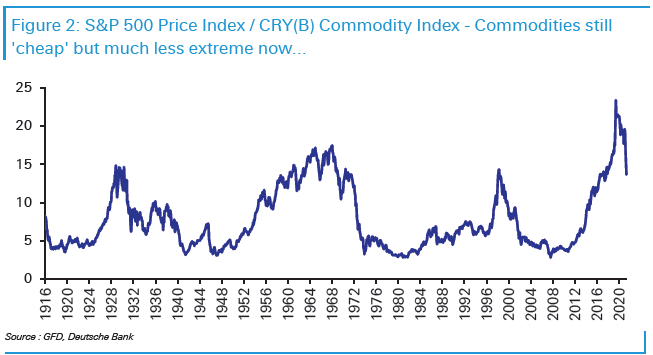
By

Mark Gilbert and

Marcus Ashworth

https://www.bloomberg.com/opinion/articles/2021-12-20/what-eight-charts-are-telling-us-about-markets-in-2022?utm_content=view&utm_medium=social&cmpid=socialflow-facebook-view&utm_campaign=socialflow-organic&utm_source=twitter&fbclid=IwAR1zhXoVA-TStrCMD1s0bizGkK1xjymLHFUYUN49meMYmAzvXR5e4Qa-lrU&cmpid%3D=socialflow-twitter-view&sref=GGda9y2L

6. Global oil consumption is expected to return to an average of 99.5 million barrels per day in 2022, about the same level it was at in 2019.

https://www.reuters.com/markets/commodities/global-oils-comeback-year-presages-more-strength-2022-2021-12-23/

7.Methane Gas Breakdown.

Found at 1440 Digest Letter https://join1440.com

McKinsey The Year in Charts

https://www.mckinsey.com/featured-insights/2021-year-in-review/2021-the-year-in-charts?utm_source=join1440&utm_medium=email&utm_placement=newsletter

8.Faster NFL Wide Receivers Doesn’t Mean Better

Five Thirty Eight Blog

https://fivethirtyeight.com/features/faster-nfl-prospects-arent-always-better/

9.The U.S. city where 1-bedroom rents rose the most since 2020 isn’t in California or New York

“The issue of affordability issue has been mounting for decades.”

Shawn M. Carter@SHAWNCARTERM

Share Article via FacebookShare Article via TwitterShare Article via LinkedInShare Article via Email

Twenty/20

After a slowdown during the beginning of the pandemic, rent prices are bouncing back big time. The median monthly cost for a one-bedroom apartment rose 11.6% over the course of the year, according to Zumper’s 2021 National Rent Report, and some cities have risen well beyond that.

While most people may think one-bedrooms have surged most in expensive states like California or New York, they’re actually rising faster in Florida.

Here are the 10 U.S. cities where costs have jumped the most.

10. St. Petersburg, Florida

Median one-bedroom rent: $1,580
Year-over-year growth: 24.4%

9. Mesa, Arizona

Median one-bedroom rent: $1,210
Year-over-year growth: 24.7%

8. Boise, Idaho

Median one-bedroom rent: $1,410
Year-over-year growth: 24.8%

7. Henderson, Nevada

Median one-bedroom rent: $1,590
Year-over-year growth: 25.2%

6. Jacksonville, Florida

Median one-bedroom rent: $1,220
Year-over-year growth: 27.1%

5. Glendale, Arizona

Median one-bedroom rent: $1,200
Year-over-year growth: 27.7%

4. New York, New York

Median one-bedroom rent: $3,190
Year-over-year growth: 32.4%

3. Orlando, Florida

Median one-bedroom rent: $1,620
Year-over-year growth: 32.8%

2. Tampa, Florida

Median one-bedroom rent: $1,630
Year-over-year growth: 38.1%

1. Miami, Florida

Median one-bedroom rent: $2,280
Year-over-year growth: 38.29%

https://grow.acorns.com/cities-where-rents-have-jumped-the-most-since-2020/?utm_source=join1440&utm_medium=email&utm_placement=newsletter

10.Some Stoic End of the Year Thoughts-Ryan Holiday

Here we are at the end of the year once again. It’s ironic to me that sandwiched at the completion of one year and the beginning of another, we have two vastly different rituals.

On the one hand, we have Christmas, which has for too many of us, become so materialistic and gluttonous. We expect gifts and good food and overindulge in both. On the other hand, we have the “New Year, New You” mentality which promotes ambitious new resolutions in which we commit to utterly change ourselves in the upcoming twelve months (or until we abandon these inconvenient goals).

It all seems to be all so misguided. In a way, one creates the problems that the other attempts to solve.

New Year’s resolutions can however be a useful way to reflect on your bad habits.

For example, one of my friends recently managed to give up smoking after first making the switch to vaping. This time last year, he bought an e-cigarette and some e-liquid from the Air Factory range and slowly but surely began to suppress his nicotine addiction. It’s no secret that vaping is claimed to be a safer alternative to regular cigarettes, so resolutions such as this can certainly have a positive impact on our lives and well being.

Furthermore, the Stoics provide good advice here, as always. These two thousand year old, pre-Christian philosophers offer us a clearer way to live–without the ups and downs and extra helpings of self-loathing.

Let’s look at three quick insights for the holiday season:

First, practice your “contemptuous expressions.” I know contempt seems like a weird emotion to bring to Christmas but stay with me. As you look out over the bountiful offering of Christmas–the presents, the food, the lights–remind yourself what this stuff really is: a bunch of stuff. As Marcus Aurelius once wrote, sounding like he was almost describing a Christmas dinner:

“Like seeing roasted meat and other dishes in front of you and suddenly realizing: This is a dead fish. A dead bird. A dead pig. Perceptions like that—latching onto things and piercing through them, so we see what they really are. That’s what we need to do all the time.”

What’s important are the people and the thoughts. Don’t let yourself get distracted from them.

Second, live in the present moment. That is, don’t obsess over what has happened in the past or lose yourself in visions of the future. Focus on what is right here, right in front of you. Make the most of it, and enjoy yourself. This moment could be all you have after all–it’s so much better to think that 2015 is not a guarantee and then to be grateful for all of it, then to have expectations and entitlements that go unfulfilled.
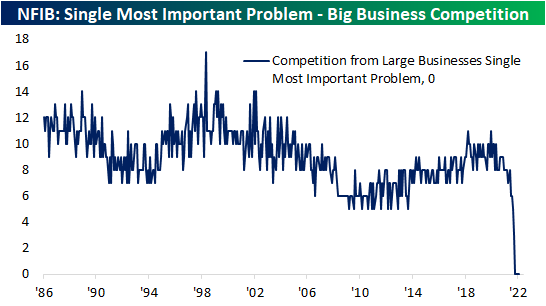
As Marcus Aurelius reminded himself:

“Don’t let your imagination be crushed by life as a whole. Don’t try to picture everything bad that could possibly happen. Stick with the situation at hand.”
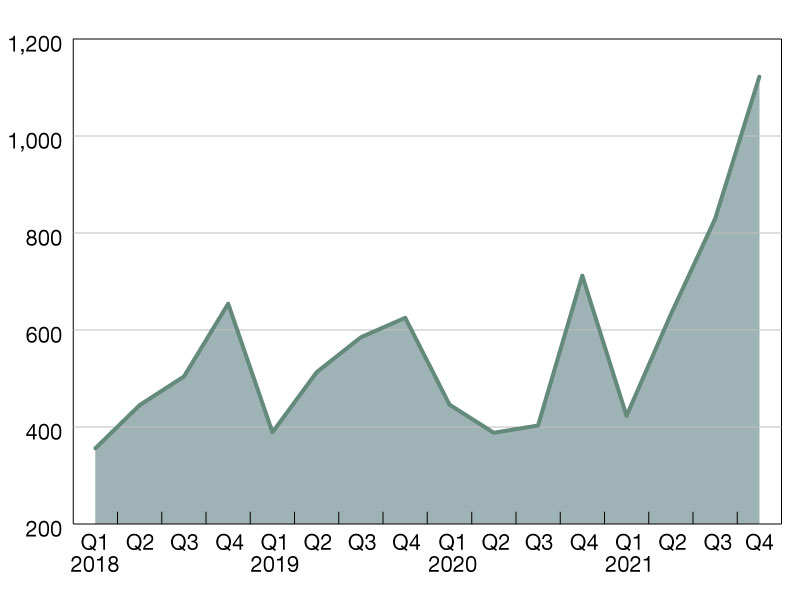
What matters right now is right now. Enjoy it.

Third, if you are going to try to improve in the next year or you do have some regrets about the previous year, don’t just hope that this will happen. That’s not how it works. As Seneca wrote to a friend who’d asked for advice, you need to pick a person or a model to hold yourself against.

“Choose someone whose way of life as well as words, and whose very face as mirroring the character that lies behind it, have won your approval. Be always pointing him out to yourself either as your guardian or as your model. There is a need, in my view, for someone as a standard against which our characters can measure themselves. Without a ruler to do it against you won’t make crooked straight. ”

So, who will it be for you this year?

**

Stoicism is not something you “believe”, it’s something you do. It’s a practical philosophy. The more you work it, the more it will do for you. So why not start now? There isn’t a better time.

As a final parting thought, remember that we choose whether this was a good year or a bad year. We choose whether everything is good or bad. As Seneca said, “a good person dyes events with his own color…and turns whatever happens to his own benefit.”

This is the attitude for success and optimism in all situations. By controlling our perceptions, we create a reality in which every situation, no matter what it is, provides us with a positive, exposed benefit we can act on, if only we look for it.

With this in mind, I hope you enjoy the holidays and consider the Stoics when you can.

For more on Stoicism visit The Daily Stoic.

https://ryanholiday.net/some-stoic-end-of-the-year-thoughts/

Topley’s Top 10 – December 22, 2021

1. 2021 1000 IPOs

Overall, 2021 marked the strongest year for IPO listings and volumes in history, with the barrier of 1,000 offerings being hit in the last month of the year, according to Dealogic data, which showed a record $315 billion raised when that total had never before hit $200 billion in a year. More than half of those deals were SPACs, as 606 blank-check companies went public in 2021, with most of them heavily frontloaded into the beginning of the year — 298 of the SPACs that went public were in the first quarter of 2021, according to Dealogic.

There were 1,000 IPOs in 2021 for the first time, but there may be some problems under the hoodBy 1.

Emily Bary https://www.marketwatch.com/story/there-were-1-000-ipos-in-2021-for-the-first-time-but-there-may-be-some-problems-under-the-hood-11640115839?mod=home-page

2. More Global Money Still Flowing into Bonds than Stocks….Savings Glut Holds Rates Down.

A Global Savings Glut Is Set to Anchor U.S. Yields Below 2%

Garfield Reynolds and Michael MacKenzie

(Bloomberg) — Anyone gearing up for bond yields to surge in 2022 should think again. A global glut of saved cash has the potential to restrain an increase in rates, even as central banks dial back their pandemic stimulus.

The strength of demand for bonds even in the face of deeply negative real returns underpins the broad consensus that 2% may act as a ceiling for U.S. 10-year yields in the coming year. Hedge funds have built up the biggest short positions in 11 months with rates expected to climb in 2022 thanks to both inflation and expectations that the Federal Reserve will respond. But strategists expect the advance to be gradual and top out in negative territory on an inflation-adjusted basis.

Fed Chair Jerome Powell highlighted the role of deep-pocketed foreign investors in repressing longer-dated yields just after this month’s final policy meeting for 2021. The way that dynamic is expected to keep anchoring yields helps explain why U.S. policy makers mostly seem relaxed about flattening yield curves, rather than fretting over whether they signal that aggressive rate hikes could kill off economic growth.

“Deep pools of savings in Europe, Japan and north Asia broadly are going to continue to underpin demand for bonds, hence the persistence of negative and ultra-low yields,” said Martin Whetton, head of fixed-income and foreign-exchange strategy at Commonwealth Bank of Australia, the nation’s largest lender. “These investors will always be attracted to positive yields, be they outright or FX-hedged, and so we expect 10-year Treasuries will find demand around the 2% mark.”

The global savings glut is set to come roaring back as a major driver in bond markets, offsetting a retreat from the Fed and other central banks as they end bond buying and start hiking rates in an attempt to cool off the strongest inflation readings in decades. While that may be bad news for bond bears, it could offer a sunnier path for equities and other risk assets by signaling that low longer-term yields don’t necessarily translate to a downbeat economic outlook.

https://finance.yahoo.com/news/global-savings-glut-set-anchor-010154421.html

3. Chart Comments.

CNBC-Cramer-One piece of technical data that Garner is considering is the S&P 500′s longer-term monthly chart, according to Cramer. After breaking through the trendline ceiling of resistance roughly a year ago, Cramer said it is now very far above trend.

“Historically, these types of breakouts almost always see a retest of the previously broken trendline,” Cramer said. “In other words, she’d expect the S&P to pull back near the trendline, which …would put it around 4,000. People, that’s down almost 14% from here. … If we get a close below 4,000, she thinks that would pave the way for a much larger correction.”

In Garner’s view, other worrisome signs include the momentum indicator Relative Strength Index sitting in overbought territory on a monthly chart basis, Cramer said. “When you look at the action over the last 20 years, a reading this high can open the door to some nasty declines,” he said.

Charts suggest the S&P 500 may not be as strong in 2022 as

Kevin Stankiewicz@KEVIN_STANK https://www.cnbc.com/2021/12/21/jim-cramer-charts-suggest-sp-500-may-not-be-as-strong-in-2022.html

4. Five Stocks Driving the Market

WSJ-One measure of market breadth compares the performance of the market-cap weighted S&P 500 with an equal-weighted version. The latter usually outperforms the former when a greater number of stocks are rising; that happened between November 2020 and April 2021, when the equal-weight benchmark outpaced its counterpart by 7 percentage points. Over the past six months, the S&P 500 has outpaced the equal-weight index by nearly 4 percentage points.

WSJ-Michael Wursthorn

https://www.wsj.com/articles/five-big-tech-stocks-are-driving-markets-that-worries-some-investors-11640060038?mod=itp_wsj&ru=yahoo

5. Euro Gas Prices 2021

From Dave Lutz at Jones Trading–Lower supplies into Germany will force Europe to keep withdrawing gas at high rates from its already depleted storages. As freezing temperatures spread across the continent this week, more gas will be needed to keep the lights on as Europe’s vast network of renewable sources also can’t fill the gap, with German wind output at the lowest in five weeks, Bloomberg reports.

6. What is Web 3.0?

Zerohedge–So what form might “Web 3.0” take? We lay out a few key principles:

  • Likely more control by the user of their data (including data residing on-device);
  • Likely a more micro focus – a mean reversion on scale (either in end market being tackled or in relationship between the platform and the user);
  • The rise of individual as creator & creator monetizing their content more directly with “fans”;
  • Increasingly decentralized (with the possible breakdown of the mobile operating system/app store distribution model over the next 5-10 years ); &
  • Flexibility (if not innovation) on payment mechanisms aimed at a mix of themes, including decentralized privacy and anti-establishment.

https://www.zerohedge.com/markets/jack-dorsey-elon-musk-slam-web-30-what-it

7. Crypto Poaching Silicon Valley Tech Talent.

By Daisuke Wakabayashi and Mike Isaac

OAKLAND, Calif. — When Sandy Carter left her job as a vice president of Amazon’s cloud computing unit this month, she announced in a LinkedIn post that she was joining a crypto technology company. She included a link for open positions at the start-up.

Within two days, she said, more than 350 people — many from the biggest internet companies — had clicked the link to apply for jobs at the firm, Unstoppable Domains. The start-up sells website addresses that sit on the blockchain, the distributed ledger system that underpins cryptocurrencies.

“It’s the perfect storm,” Ms. Carter said. “The momentum we’re seeing in this space is just incredible.”

Ms. Carter is part of a wave of executives and engineers leaving cushy jobs at Google, Amazon, Apple and other large tech companies — some of which pay millions of dollars in annual compensation — to chase what they see as a once-in-a-generation opportunity. That next big thing is crypto, they sasoared around 60 percent this yearid, a catchall designation that includes digital currencies like Bitcoin and products like nonfungible tokens, or NFTs, that rely on the blockchain.

Silicon Valley is now awash with stories of people riding seemingly ridiculous crypto investments like Dogecoin, a digital coin based on a dog meme, to life-changing wealth. Bitcoin has , while Ether, the cryptocurrency tied to the Ethereum blockchain, has increased more than fivefold in value.

But beyond that speculative mania, a growing contingent of the tech industry’s best and brightest sees a transformational moment that comes along once every few decades and rewards those who spot the seismic shift before the rest of the world. With crypto, they see historical parallels to how the personal computer and the internet were once ridiculed, only to upend the status quo and mint a new generation of billionaires.

Investors, too, have flooded in. They have poured more than $28 billion into global crypto and blockchain start-ups this year, four times the total in 2020, according to PitchBook, a firm that tracks private investments. More than $3 billion has gone into NFT companies alone.

“There is a giant sucking sound coming from crypto,” said Sridhar Ramaswamy, chief executive of search engine start-up Neeva and a former Google executive, who competes with crypto companies for talent. “It feels a bit like the 1990s and the birth of the internet all over again. It’s that early, that chaotic and that much full of opportunity.”

“There is a giant sucking sound coming from crypto,” said Sridhar Ramaswamy, chief executive of Neeva, outside the company’s office in Mountain View, Calif.Credit…Jessica Chou for The New York Times

Crypto, which has also been rebranded as the less foreboding web3, may be no different from past speculative bubbles like subprime mortgages or the tulip craze of the 17th century, skeptics said. Much of the mania, they said, is being driven by a desire to get rich quick by trading an asset class that often seems based on internet jokes.

https://www.nytimes,com/2021/12/20/technology/silicon-valley-cryptocurrency-start-ups.html

8. Here Are the 10 Trendiest Cities in America Where You Can Still Afford To Buy a Home

Realtor.com By Sara Ventiera

https://www.realtor.com/news/trends/where-the-cool-kids-are-10-trendy-u-s-metros-you-can-still-afford-to-buy-a-home/

9.Top 6 Wealth Killers

Peter Mallouk

@PeterMallouk

Top 6 Wealth Killers:

#1 by a landslide: credit card debt

2. High student loans without a high earning degree

3. House(s)/car(s) beyond needs and with a higher carrying cost than you can afford

4. A partner that encourages excessive spending

5. Lifestyle creep

6. Divorce

https://twitter.com/PeterMallouk/status/1473453913894436875

10.Are You Developing Skills That Won’t Be Automated?

by

Harvard Business Review Stephen M. Kosslyn

Summary. The future of work looks grim for many people. A recent study estimated that 10% of U.S. jobs would be automated this year, and another estimates that close to half of all U.S. jobs may be automated in the next decade. The jobs that are likely to be automated are…more

The future of work looks grim for many people. A recent study from Forrester estimated that 10% of U.S. jobs would be automated this year, and another from McKinsey estimates that close to half of all U.S. jobs may be automated in the next decade.

The jobs that are likely to be automated are repetitive and routine. They range from reading X-rays (human radiologists may soon have much more limited roles), to truck driving, to stocking a warehouse. While much has been written about the sorts of jobs that are likely to be eliminated, another perspective that has not been examined in as much detail is to ask not which jobs will be eliminated but rather which aspects of surviving jobs will be replaced by machines.

For example, consider the job of being a physician: It is clear that diagnosing illnesses will soon (if not already) be accomplished better by machines than humans. Machine learning is spectacularly effective when data sets are available for training and testing, which is the case for a wide range of diseases and ailments. However, what about sitting with a family to discuss treatment options? This is far less likely to be automated in the foreseeable future.

Now consider a profession at the other end of the status spectrum: barista. In San Francisco, Cafe X has replaced all baristas with industrial robot arms, which entertain customers with their antics as they make hot beverages. However, even Cafe X employs a human, who shows customers how to use the technology to order their drinks and troubleshoots problems that arise with the robot barista.

Contrast being a barista with being a bartender. People often strike up a conversation with the bartender. This job clearly is about more than just mixing drinks. Like the physician, we can easily parse this job into two components: the repetitive and routine one (actually mixing and serving the drinks) and the more interactive, unpredictable one that involves listening to and talking with customers.

After reflecting on characteristics of numerous jobs and professions, two non-routine kinds of work seem to me to be particularly common, and difficult to automate:

First, emotion. Emotion plays an important role in human communication (think about that physician sitting with the family, or that bartender interacting with customers). It is critically involved in virtually all forms of nonverbal communication and in empathy. But more than that, it is also plays a role in helping us to prioritize what we do, for example helping us decide what needs to be attended to right now as opposed to later in the evening. Emotion is not only complex and nuanced, it also interacts with many of our decision processes. The functioning of emotion has proven challenging to understand scientifically (although there has been progress), and is difficult to build into an automated system.

Second, context. Humans can easily take context into account when making decisions or having interactions with others. Context is particularly interesting because it is open ended — for instance, every time there’s a news story, it changes the context (large or small) in which we operate. Moreover, changes in context (e.g., the election of a maverick President) can change not just how factors interact with each other, but can introduce new factors and reconfigure the organization of factors in fundamental ways. This is a problem for machine learning, which operates on data sets that by definition were created previously, in a different context. Thus, taking context into account (as a congenial bartender can do effortlessly) is a challenge for automation.

Our ability to manage and utilize emotion and to take into account the effects of context are key ingredients of critical thinking, creative problem solving, effective communication, adaptive learning, and good judgment. It has proven very difficult to program machines to emulate such human knowledge and skills, and it is not clear when (or whether) today’s fledgling efforts to do so will bear fruit.

And in fact, these are the very skills that employers across industries consistently report seeking in job candidates. For example, in one survey, 93% of employers reported that “a candidate’s demonstrated capacity to think critically, communicate clearly, and solve complex problems is more important than his or her undergraduate major.” In addition, employers seek candidates who have other sorts of “soft skills,” such as being able to learn adaptively, to make good decisions and to work well with others. These sought-after abilities, of course, fit perfectly with the sorts of things that people can do well, but are and will continue to be difficult to automate.

All of this suggests that our educational systems should concentrate not simply on how people interact with technology (e.g., by teaching students to code), but also how they can do the things that technology will not be doing soon. This is a new approach to characterizing the underlying nature of “soft skills,” which are probably misnamed: These are the skills that are hardest to understand and systematize, and the skills that give — and will continue to give —humans an edge over robots.

Read more on Automation or related topics Technology and analytics, Careers, Managing yourself and Business education

SK

Stephen M. Kosslyn is President and CEO of Foundry College; former Chief Academic Officer of the Minerva Schools at KGI, and former John Lindsley Professor, Department Chair, and Dean of Social Science, Harvard University. He’s the author of Building the Intentional University: Minerva and the Future of Higher Education.

https://hbr.org/2019/09/are-you-developing-skills-that-wont-be-automated?utm_medium=social&utm_campaign=hbr&utm_source=linkedin&tpcc=orgsocial_edit

Topley’s Top 10 – December 21, 2021

1.Top Weighted Stocks in S&P 500-Performance Since May…AMZN and Facebook Lowest Performers.

www.dorseywright.com


2.Nasdaq 100 Headed for One of the Most Volatile Decembers in 20 Years

Naz 100 Average Daily Moves ..From Dave Lutz at Jones Trading

Santa has packed some Volatility in his bag for Christmas.


3.Global M&A Volume Doubles….$5.63 Trillion.

Reuters

  • Global M&A jumps 63% to $5.63 trillion
  • U.S. dealmaking nearly doubled to $2.61 trillion
  • Europe up 47% to $1.26 trillion, Asia Pacific up 37%
  • Private equity buyouts at record $985.2 bln
  • CEO confidence and cheap financing among key drivers

Global M&A activity smashes all-time records to top $5 trillion in 2021By Anirban Sen and Pamela Barbaglia, Kane Wu https://www.reuters.com/markets/europe/global-ma-activity-smashes-all-time-records-top-5-trillion-2021-2021-12-20/

Found at Crossing Wall Street Blog https://www.crossingwallstreet.com/


4.Marging Debt Post-Covid Spike

And margin debt, after its historic spike? Stock market margin debt in November fell by $17 billion, from the tip of the spike, to a still monstrous $918.6 billion, still up year-over-year by $197 billion, or by 27%, and up from January 2020 by $357 billion, or by 64%, for one doozie of a spike:

https://wolfstreet.com/2021/12/17/stocks-dont-need-more-alarm-bells-theyre-already-clanging-and-jangling-all-over-the-place-but-here-we-are-leverage/


5. Another Covid Stock Favorite….Teladoc Cut in Half and Back to January 2020 Levels

www.stockcharts.com


6.Lumber Spiked 95% in 5 Weeks.

Lumber Prices still well below 2021 Highs

https://tradingeconomics.com/commodity/lumber

Lumber prices have spiked 95% in 5 weeks as supply issues arise following Canadian floods while demand stays strong

Carla Mozée

  • Lumber prices have nearly doubled over the past five weeks, staying above $1,000 per thousand board feet. 
  • Floods last month in the key lumber export hub of British Columbia have contributed to price gains. 
  • US home building activity also rebounded strongly in November. 

https://markets.businessinsider.com/news/commodities/lumber-prices-rally-supply-shortages-commodities-markets-demand-housing-2021-12


7.New Research 0.01% of Bitcoin Holders Control 27% of Currency in Circulation.

WSJ-Bitcoin’s ‘One Percent’ Controls Lion’s Share of the Cryptocurrency’s Wealth

New research shows that just 0.01% of bitcoin holders controls 27% of the currency in circulation

The costs of mining bitcoin have become so high that only a small group of enterprise-level firms can afford to do it.

By 

Paul Vigna Follow

It’s good to be the bitcoin 1%. The top bitcoin holders control a greater share of the cryptocurrency than the most affluent American households control in dollars, according to a study by the National Bureau of Economic Research.

The study showed that the top 10,000 bitcoin accounts hold 5 million bitcoins, an equivalent of approximately $232 billion.

With an estimated 114 million people globally holding the cryptocurrency, according to crypto.com, that means that approximately 0.01% of bitcoin holders control 27% of the 19 million bitcoin in circulation.

By comparison, in the U.S., where wealth inequality is at its most extreme in decades, the top 1% of households hold about a third of all wealth, according to the Federal Reserve.

Markets

A pre-markets primer packed with news, trends and ideas. Plus, up-to-the-minute market data.


The study, conducted by finance professors Antoinette Schoar at MIT Sloan School of Management and Igor Makarov at the London School of Economics, for the first time mapped and analyzed every transaction in bitcoin’s more than 13-year history.

The ramifications of that centralization are mainly twofold, the paper argues. First, it makes the entire bitcoin network more susceptible to systemic risk. Second, it means the majority of the gains from the rising price and increased adoption go to a disproportionately small group of investors.

“Despite having been around for 14 years and the hype it has ratcheted up, it’s still the case that it’s a very concentrated ecosystem,” Ms. Schoar said about Bitcoin.

https://www.wsj.com/articles/bitcoins-one-percent-controls-lions-share-of-the-cryptocurrencys-wealth-11639996204


8.Inflation Adjusted Wages Negative

When Does Inflation Become a Problem?

Charlie Bilello–@charliebilello  Why is inflation increasingly being viewed as a problem? Workers are starting to notice that the rise in their earnings is failing to keep up with the rise in consumer prices. When real wage growth turns negative as it has today, that translates into a decline in your standard of living.

​Powered by YCharts​https://compoundadvisors.com/about


9.3 Reasons Why You Should Buy Property in the Metaverse

For information purposes only…

Nasdaq Kristi Waterworth  The Motley Fool

Investing is a huge give and take between risk and potential reward, but sometimes it feels a little bit more like gambling, especially when you’re reaching into new and uncharted territory. Take, for example, the metaverse. Virtual real estate is the newest buzzworthy investment right now, but it’s not new, nor is it without merit. In fact, if you have the stomach for it, I firmly believe you should be putting some money in well-chosen metaverse real estate.

If you know anything about me, you know I’m a cryptocurrency skeptic and a reasonably cautious investor by nature. I buy stocks in grocery store chains and food manufacturers but also in aerospace and electric vehicles. All of this is stuff that’s reasonably grounded in known quantities and has enough data to provide predictable, long-term outcomes (even if some of the projects are a bit unproven).

So, when I’m telling you to buy real estate in the metaverse, it means something. Maybe it means that my cheese has slid off my cracker entirely, or maybe it means that it’s not as speculative as it looks. There are a number of reasons I think that metaverse properties are where it’s going to be at for investors in the next five years.
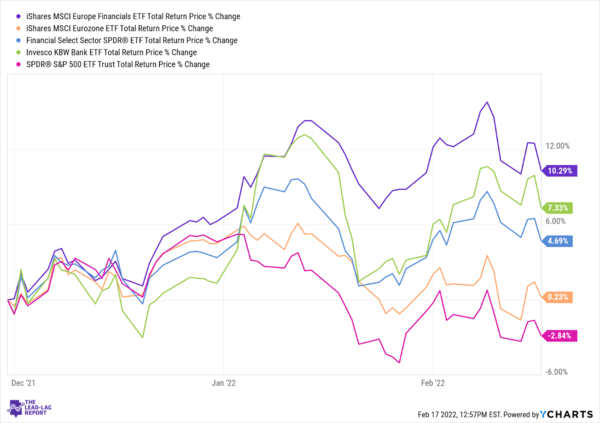
Image source: Getty Images.

1. Commercial names are jumping feet-first into the metaverse

Nike (NYSE: NKE) is the latest in a string of big name brands that are stepping into the metaverse (no pun intended). Just this month, it announced a purchase of a company that makes NFT sneakers called RTFKT. Yes, that’s correct. It makes sneakers that only exist in the metaverse.

Sponsored Links

Video from our partnersBrought to you by Taboola

Take This Quiz To See If You Can Retire ComfortablySmartAsset

Nike wants to make sure that every avatar in the metaverse is wearing Nike shoes, and it’s going to go in big and fast. It’s not waiting to see what other companies are doing because it has a solid understanding of what’s driving these platforms and how it can reap the benefits.

For example, Gucci, a division of Kering, ran a limited promotion this summer where it created a digital version of the Gucci Garden exhibit and gave away and sold metaverse versions of popular bags and other limited-edition items on Roblox (NYSE: RBLX). Items were initially priced between $1.20 to $9 each, but some resold for as much as $4,100 of Robux, demonstrating both a primary market need and a secondary market interest in branded products.

2. Real estate developers are dumping millions into the metaverse

Virtual real estate developer Republic Realm just set a record by purchasing a $4.3 million piece of land in metaverse platform The Sandbox, breaking a record set a week prior by Tokens.com for a $2.5 million purchase of land in Decentraland. That’s some walking-around money.

Given that these companies fully intend to create spaces like virtual malls and other rentable properties (where, for example, Nike might set up shop), and that both gave very serious consideration to how to determine the value of metaverse property, I have a hard time laughing this off as a weird kind of publicity stunt. These guys are serious as cancer — and have the business plans to prove it.

They foresee a world where they can rent storefronts to companies who want to sell merchandise but not maintain any virtual real estate; rent virtual condos to people who want to visit the metaverse but not drop $12,000 on a lot of their own; or even design and build custom homes for celebrities who feel like a metaverse presence is good for their brand image but don’t have the time to muck around with the messy bits.

3. Metaverse real estate isn’t new

Although the hottest platforms in the metaverse are fairly new, they’re far from the earliest examples of people getting into virtual real estate and making an absolute killing. Bloomberg covered Second Life’s first millionaire, Ailin Graef, in 2006. She got in to Second Life early, spent two years building up virtual land holdings and developing custom avatars, and now invests heavily in technology groups with a fortune made in a virtual world.

Just this year, Second Life (started in 2003) reported a GDP equivalent to $600 million and over $80 million in cash outs to creators based on their investments in the community. The Second Life Marketplace offers a wide range of rentals but rarely any real estate for sale. Presumably, owners are making enough on those rentals, even at $4 or $5 a week, that they have no desire to sell. These transactions are largely handled through real estate groups native to the platform.

If a platform that almost no one has heard of from a time before social media has captured the hearts and minds of about 70% of Americans and can continue to bring in this kind of money this long after it debuted, surely a platform that’s been built with all the lessons from Second Life in mind can be just as stable — and potentially at least as profitable.
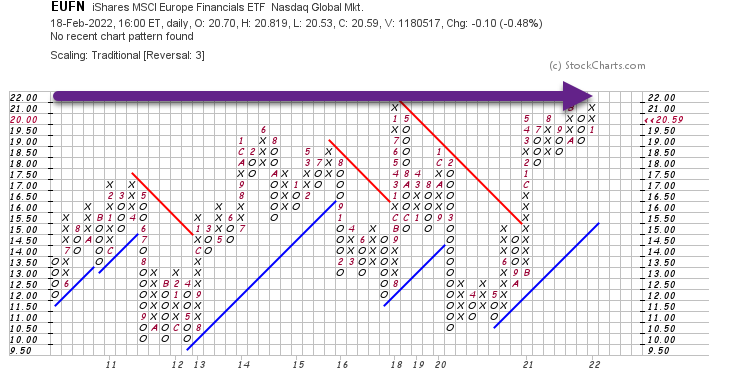
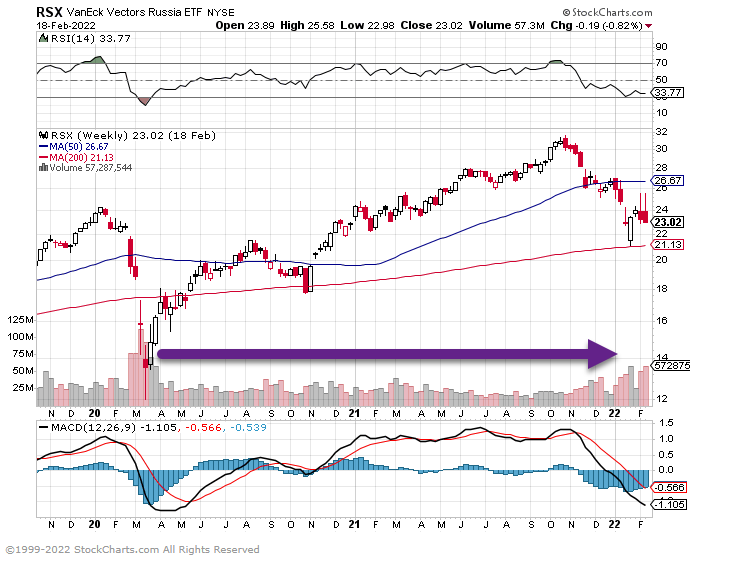
10 stocks we like better than Walmart
When our award-winning analyst team has an investing tip, it can pay to listen. After all, the newsletter they have run for over a decade, Motley Fool Stock Advisor, has tripled the market.*

They just revealed what they believe are the ten best stocks for investors to buy right now… and Walmart wasn’t one of them! That’s right — they think these 10 stocks are even better buys.
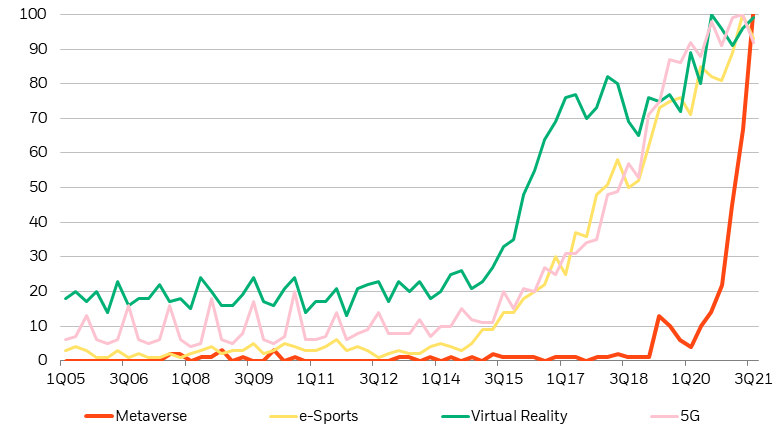
See the 10 stocks

Stock Advisor returns as of 6/15/21

Kristi Waterworth has no position in any of the stocks mentioned. The Motley Fool owns and recommends Nike and Roblox Corporation. The Motley Fool has a disclosure policy.

https://www.nasdaq.com/articles/3-reasons-why-you-should-buy-property-in-the-metaverse


10. 3 Things You Should Know About Every Person You Manage

There is no such thing as a good or a bad personality type. What’s important is understanding the way that someone tackles challenges and sees the world.


BY DAVID FINKEL, AUTHOR, ‘THE FREEDOM FORMULA: HOW TO SUCCEED IN BUSINESS WITHOUT SACRIFICING YOUR FAMILY, HEALTH, OR LIFE’@DAVIDFINKEL

A large number of entrepreneurs and business owners start their businesses not because they’re fantastic managers, but because they have the vision and drive to put a new product or service out into the marketplace. Most learn very quickly, however, that the ability to manage and coach their employees is a challenging yet important one and it takes a lot of effort and practice to be proficient at it. Many seek out help from those, like me, who specialize in business coaching for growth. And one of the first things I cover with a new coaching client is the set of three things that I think they should know about every person they manage.

These three things will not only help them get to know their employees better, but will give them the opportunity to meet them where they are in their career journey and help them grow and develop into leaders down the road.

1. Personality Style

There are a number of different “personality assessments” out there, from the Kolbe to Myers-Briggs to the MMPI to the Enneagram, etc. And all personality assessments have their strengths and weaknesses. So find one you’re comfortable with and go with what you know. Keep notes of where your team members fall in the different categories, paying attention to which team members share similar or complementary traits.

There is no such thing as a good or a bad personality type; it is simply the way that they tackle challenges and see the world. Remember, any assessment is simply a quick way to help you better understand and effectively interact with each team member.

2. Areas to Coach Around

The next thing you need to know about your team members has to do with their coachable areas. What are the key strengths this team member brings to the table? What are the areas this person needs to develop in order to progress in his or her career with your company? What areas of deficit are likely always going to be a deficit for this person? Knowing all of this helps you put this person in the right roles and assign them the most appropriate projects.

You want to leverage their strengths, give them opportunities to develop their key skills, and avoid placing them in a role that is one of their likely permanent deficit areas. And this will also help you develop a long-term coaching plan to help them mature as leaders themselves.

3. Performance Enhancers

The last thing you want to know about your team members is how to help them do their very best work. To bring out his or her best performance, consider these questions.

·         What three things do you need to remember to help bring out the best performance in this team member?

·         Does she thrive in novel, challenging roles but get bored with repetitive assignments?

·         Does he need projects that he’s done successfully before or else his anxiety overwhelms his performance?

While there likely could be a dozen or more ideas for each key team member that you can focus on, pick the three most important reminders to yourself to get the best performance from him or her.

Get Inc.’s top posts straight to your inbox. Sign up here and you’ll receive Today’s Must Reads before each day is done.

SEP 14, 2021

The opinions expressed here by Inc.com columnists are their own, n

https://www.inc.com/david-finkel/3-things-you-should-know-about-every-person-you-manage.html?cid=sf01003

Topley’s Top 10 – December 20, 2021

1.Hedge Funds Favorite Longs and Shorts Selling Off Together.

Zerohedge–Laggards: hedge fund concentration

If a stock is either on the “VIP” list, which means that a lot of hedge funds own it, or on the “Most shorted” list, which means that a lot of hedgies hate it – it has performed very poorly lately.

Source: Goldman https://www.zerohedge.com/the-market-ear/chaselaggards


2.U.S. Price to Sales Ratio 2x the Rest of World.

From Callum Thomas Chart Storms.

https://www.linkedin.com/pulse/weekly-sp500-chartstorm-19-december-2021-callum-thomas/?trk=eml-email_series_follow_newsletter_01-hero-1-title_link&midToken=AQFjhnSMpoKQvw&fromEmail=fromEmail&ut=2wihcLZ8jP3G41


3.Investments in Global Blockchains Startups +384% from 2020

WSJ-Globally, investment in blockchain startups in 2021 has shattered all previous records, topping $15 billion so far this year, a 384% increase from total investment in all of 2020, according to CB Insights.

By Christopher Mims https://www.wsj.com/articles/jack-dorsey-and-the-unlikely-revolutionaries-who-want-to-reboot-the-internet-11639803654?mod=itp_wsj&ru=yahoo


4.AAPL is 50% of Berkshire Portfolio

Bespoke Investment Group-Quarter-to-date, Berkshire’s portfolio (as it stood on 9/30/21) would be up 13.9%, and that’s due largely to Apple’s 28.5% gain so far in Q4.  Seven of Berkshire’s twenty largest holdings are in the red so far this quarter, with Charter (CHTR) down the most at 17.2%.

AAPL now makes up almost half of the overall Berkshire equity portfolio (and a quarter of the company’s market cap), which means that Berkshire Hathaway should be correlated to the performance of AAPL. Although the two equities have a semi-strong relationship over the last year with a correlation coefficient of 0.46, the correlation in Q4 has dramatically decreased. Since 9/30, the correlation coefficient is only 0.12, which implies only a very small correlation. Whereas AAPL has traded over 28.5% higher in Q4, BRK/B has only appreciated by about 6.5%. While AAPL shareholders have been rewarded so far in Q4, the stock of one of AAPL’s largest holders has lagged the S&P 500.  \

https://www.bespokepremium.com/interactive/posts/think-big-blog/berkshires-apple-aapl-weighting-swells-to-nearly-50


5. History of Last 6 Rate Cycles….Sector Performance.

Materials Best….Tech Lags….Utilities Worst.

https:://Iplresearch.com/2021/12/17/sector-playbook-for-fed-rate-hikes-favors-value


6.2022 Will Tell the Story….How will rising rates affect risk taking? How dependent is risk on negative real rates?

Global Developments: Risk-taking has been supported by extraordinarily accommodative monetary conditions.

The Daily Shot Blog https://dailyshotbrief.com/the-daily-shot-brief-december-17th-2021/


7.The Biggest Companies in the World in 2021

Jenna Ross
The Top 100, Ranked

PwC ranked the largest publicly-traded companies by their market capitalization in U.S. dollars. It’s also worth noting that sector classification is based on the FTSE Russell Industry Classification Benchmark, and a company’s location is based on where its headquarters are located.

Here is the top 100 ranking of the biggest companies in the world, organized from the biggest to the smallest.

Search:

Rank

Company name

Location

Sector

Market Capitalization

1

APPLE INC

🇺🇸 United States

Technology

$2.1T

2

SAUDI ARAMCO

🇸🇦 Saudi Arabia

Energy

$1.9T

3

MICROSOFT CORP

🇺🇸 United States

Technology

$1.8T

4

AMAZON.COM INC

🇺🇸 United States

Consumer Discretionary

$1.6T

5

ALPHABET INC

🇺🇸 United States

Technology

$1.4T

6

FACEBOOK INC

🇺🇸 United States

Technology

$839B

7

TENCENT

🇨🇳 China

Technology

$753B

8

TESLA INC

🇺🇸 United States

Consumer Discretionary

$641B

9

ALIBABA GRP

🇨🇳 China

Consumer Discretionary

$615B

10

BERKSHIRE HATHAWAY

🇺🇸 United States

Financials

$588B

A Sector View

Across the 100 biggest companies in the world, some sectors had higher weightings.

Sector

Total Market Cap in Top 100

% of Top 100 Market Cap

Number of Companies in Top 100

Technology

$10.5T

33.0%

20

Consumer Discretionary

$6.0T

18.9%

17

Financials

$3.4T

10.8%

14

Health Care

$3.3T

10.5%

16

Energy

$2.7T

8.5%

5

Consumer Staples

$2.0T

6.4%

9

Industrials

$2.0T

6.4%

9

Telecommunications

$1.3T

4.1%

7

Basic Materials

$0.3T

1.0%

2

Utilities

$0.1T

0.5%

1

Technology had the highest market capitalization and was also the most common sector, with Big Tech dominating the top 10. Companies in the consumer discretionary, financials, and health care sectors also had a strong representation in the ranking.

Despite having only five companies on the list, the energy sector amounted to almost 10% of the top 100’s market capitalization, mostly due to Saudi Aramco’s whopping valuation.

https://www.visualcapitalist.com/the-biggest-companies-in-the-world-in-2021/

From Barry Ritholtz Blog www.ritholtz.com


8.Housing prices are up, home equity is through the roof and mortgage rates have fallen:

by Ben Carlson

https://awealthofcommonsense.com/2021/12/inflation-in-the-housing-market/


9.Artificial intelligence can now predict who will develop DEMENTIA with 92% accuracy, breakthrough study reveals

  • AI can now predict whether someone will develop dementia within two years 
  • Data from 15,300 patients in the US was used to train the artificial intelligence 
  • The technique works by spotting patterns linked to dementia outcome in data
  • It can also be used to detect wrong diagnosis to improve patient outcomes 

By RYAN MORRISON FOR MAILONLINE 

Artificial intelligence systems have been developed to predict whether someone will develop dementia within two years, with 92 per cent accuracy, its developers claim.

Data from 15,300 patients in the US was used to train the AI by researchers from the University of Exeter, teaching it who would and wouldn’t go on to develop dementia. 

The technique works by spotting patterns in the data and learning who is most at risk, with researchers hoping it could cut the number of people wrongly diagnosed. 


Artificial intelligence systems have been developed to predict whether someone will develop dementia within two years, with 92 per cent accuracy, its developers claim

WHAT IS DEMENTIA? 

Dementia is an umbrella term used to describe a range of progressive neurological disorders (those affecting the brain) which impact memory, thinking and behaviour. 

There are many different types of dementia, of which Alzheimer’s disease is the most common.

Some people may have a combination of types of dementia.

Regardless of which type is diagnosed, each person will experience their dementia in their own unique way.

Dementia is a global concern but it is most often seen in wealthier countries, where people are likely to live into very old age.

Currently there is no cure for dementia.

But new drugs can slow down its progression and the earlier it is spotted the more effective treatments are.

 Source: Alzheimer’s Society  

Professor David Llewellyn, an Alan Turing fellow based at the University of Exeter, who oversaw the study, said the machine learning algorithm can predict who will develop dementia within two years.

‘We’re also excited to learn that our machine-learning approach was able to identify patients who may have been misdiagnosed,’ he said.

‘This has the potential to reduce the guesswork in clinical practice and significantly improve the diagnostic pathway.’

Prof Llewellyn added that it would help ‘families access the support they need as swiftly and as accurately as possible.’

Between 2005 and 2015, one in 10 attendees (1,568) at a memory clinic received a new diagnosis of dementia within two years of their visit.

The researchers found that around eight per cent (130) of the dementia diagnoses appeared to be made in error, as the diagnosis was subsequently reversed.

According to the study, published in JAMA Network Open, machine-learning models accurately identified more than 80 per cent of these inconsistent diagnoses.

The research suggests AI can not only accurately predict who will be diagnosed with dementia, but has the potential to improve the accuracy of the diagnoses.  

Machine learning works by using patient information routinely available in the clinic, such as memory and brain function, performance on cognitive tests and specific lifestyle factor

The team plans follow-up studies to evaluate the practical use of the machine-learning method in clinics, to assess whether it can be rolled out to improve diagnosis, treatment and care.

The researchers analysed data from people who attended a network of 30 National Alzheimer’s Coordinating Centre memory clinics in the US.

The attendees did not have dementia at the start of the study, though many were experiencing problems with memory or other brain functions.

Dr Janice Ranson, Research Fellow at the University of Exeter, involved in the study, said ‘we know that dementia is a highly feared condition.’ 


Data from 15,300 patients in the US was used to train the AI by researchers from the University of Exeter, teaching it who would and wouldn’t go on to develop dementia

‘Embedding machine learning in memory clinics could help ensure diagnosis is far more accurate, reducing the unnecessary distress that a wrong diagnosis could cause,’ she added. 

Dr Rosa Sancho, head of research at Alzheimer’s Research UK, which funded the research, said it has a huge potential for improving disease detection.

He said: ‘Artificial intelligence has huge potential for improving early detection of the diseases that cause dementia and could revolutionise the diagnosis process for people concerned about themselves or a loved one showing symptoms.

‘This technique is a significant improvement over existing alternative approaches and could give doctors a basis for recommending lifestyle changes and identifying people who might benefit from support or in-depth assessments.’

The findings have been published in the journal JAMA Network Open. 

AI systems rely on artificial neural networks (ANNs), which try to simulate the way the brain works in order to learn.

ANNs can be trained to recognise patterns in information – including speech, text data, or visual images – and are the basis for a large number of the developments in AI over recent years.

Conventional AI uses input to ‘teach’ an algorithm about a particular subject by feeding it massive amounts of information.   

  •  

AI systems rely on artificial neural networks (ANNs), which try to simulate the way the brain works in order to learn. ANNs can be trained to recognise patterns in information – including speech, text data, or visual images

Practical applications include Google’s language translation services, Facebook’s facial recognition software and Snapchat’s image altering live filters.

The process of inputting this data can be extremely time consuming, and is limited to one type of knowledge. 

A new breed of ANNs called Adversarial Neural Networks pits the wits of two AI bots against each other, which allows them to learn from each other. 

This approach is designed to speed up the process of learning, as well as refining the output created by AI systems. 

https://www.dailymail.co.uk/sciencetech/article-10317707/AI-accurately-predict-develop-dementia-two-years-study-suggests.html


10. 10 Qualities of a Good Listener

Susan Krauss Whitbourne Ph.D. Psychology Today


These ten qualities fall into the two categories of verbal and nonverbal behaviors and are as follows along with explanations of each: 

Verbal: Showing that you understand what the person is saying.

1.   Reflections: Paraphrase what the other person is saying to show you get the meaning.

2.   Open question: Ask questions that don’t have a simple “yes” or “no” answer to keep the conversation flowing.

3.   Validation: Reinforce what the person is saying by indicating you understand.

4.   Utterances: Use simple words that encourage the other person to keep speaking (e.g., uh-huh, okay).

5.   Use the speaker’s name: help the person feel more valued by repeating their name at various points in the conversation or when you want to show you hear them.

Nonverbal: Behaviors that indicate you’re paying attention.

1.   Facial expressions: Allow your face to convey interest, empathy, and curiosity.

2.   Head nodding: Occasionally nod along with what the person is saying, especially at important points in the conversation.

3.   Body posture: Orient your position to show you’re paying attention by allowing your body to turn towards the other person.

4.   Gaze: Maintain eye contact with the speaker and don’t look distractedly elsewhere.

5.   Silence: Stay quiet and don’t interrupt the other person or seem too eager to break in.

https://www.psychologytoday.com/us/blog/fulfillment-any-age/202112/10-ways-become-great-listener

Topley’s Top 10 – December 15, 2021

1.Bonds Worst Inflation Adjusted Returns Since 1980

The federal government’s debt has already lost about 2% outright over the past year as the Federal Reserve started removing pandemic-era stimulus from the economy and inched closer toward raising interest rates. But on top of that, the consumer price index has surged 6.8%, putting investors even deeper in the hole.

Taken together, that’s resulting in the worst real returns — or those adjusted for inflation — since the early 1980s, when then Fed Chair Paul Volcker was in the midst of fighting a wage-price spiral. What’s more, the dynamic isn’t expected to change: The bond market is projecting that 10-year Treasury yields will hold below the inflation rate for the next decade, meaning any investment income will be more than wiped out by the rising cost of living.

Bond Traders Stare at Worst Real Returns Since Volcker Era

https://www.bloomberg.com/news/articles/2021-12-13/bond-traders-stare-at-worst-real-returns-since-paul-volcker-era?sref=GGda9y2L

2.Charts from 2 Big Insider Sales TSLA and MSFT

Musk Sold Shares….Tesla clean close below 200 day after failing to make new highs.

Microsoft CEO sold large stake-Fails to make new high approaching 50 day.

www.stockcharts.com

3.Hong Kong Market Trading Below Book Value.

Hong Kong’s main stock benchmark is trading below book value. Yup, the entire index. @DavidInglesTV

https://twitter.com/DavidInglesTV

4.Fund Managers at 5.1% Cash….10 Year High

Fund managers dashed for cash in anticipation of more aggressive Federal Reserve policy, according to the latest survey conducted by Bank of America.

The allocation to cash rose to 5.1% in December from 4.4% in November, the survey of 371 panellists running $1.1 trillion in assets under management found. The survey was conducted between Dec. 3 and 9.

Fund managers dash for cash ahead of Fed decision https://www.marketwatch.com/story/fund-managers-dash-for-cash-ahead-of-fed-decision-11639485080?mod=bnbh_mwarticle&link=sfmw_tw

5.AAPL, MSFT, NVDA,TSLA, GOOGL Have Contributed 51% of S&P Returns Since April

Goldman Rings The Alarm On Collapsing Market Breadth: 51% Of All Market Gains Since April Are From Just 5 Stocks-BY TYLER DURDEN Goldman then calculates that just the five most popular tech names – AAPL, MSFT, NVDA, TSLA, GOOGL – have contributed 51% of S&P 500 returns since April. After contributing over double their starting weight to the index’s return, these stocks now make up 22% of the S&P 500 by market cap, a 4% increase from the start of the year.

Outside of these 5, the table below shows the 25 S&P 500 stocks that made the largest absolute contributions to the index YTD.

Good Full Read Below

https://www.zerohedge.com/markets/goldman-rings-alarm-collapsing-market-breadth-51-all-market-gains-april-are-just-5-stocks

6.It’s 5 Tech Stocks and Defensive Consumer Staples Leading Since November

Chart-Consumer Staples Breaking Out vs. S&P…..Megacap tech and consumer staples lead.

https://lplresearch.com/2021/12/14/record-high-for-the-consumer-staples-sector/

7.Lithium Benchmark +240% YTD

WSJ–By Amrith Ramkumar

https://www.wsj.com/articles/lithium-prices-soar-turbocharged-by-electric-vehicle-demand-and-scant-supply-11639334956?mod=itp_wsj&ru=yahoo

8.Population Growth of Prime Age Workers is Set to Slow thru 2025

John Burns Real Estate-Today’s labor shortage was perfectly predictable.
So is tomorrow’s labor shortage.
Immigration policy can move the needle, but the growth of the 80s, 90s and early 2000s will almost certainly not return.

https://www.linkedin.com/in/johnburns7/

9.Omicron 3% of Cases in U.S. Last Week.

Barrons

https://www.barrons.com

10.How to turn the 2 fears that most often lead to failure into strengths, according to a successful entrepreneur

Daniel Cáceres and Nathan Rennolds ,

There are ways to turn your fears into motivation. PeopleImages/Getty Images

  • Fear is natural. It often just means you’re stepping out of your comfort zone.
  • If you let it to get the better of you, though, it can stop you getting ahead — in and out of work.
  • The founder of a professional development program, Raul Villacis, gave his tips to beat two fears.

Get a daily selection of our top stories based on your reading preferences.

Fear is a natural way of telling you that you’re leaving your comfort zone and you should pay more attention to what you’re doing.

It can become a major problem, however, if it starts to dominate your mind — it can lead you to make bad decisions, both in daily life and at work.

You may find that you’re too afraid to ask for a raise or that you’re too scared to start the business you’ve always dreamed of starting.

In situations like this, fear causes you to fail. Fortunately, there are ways to turn your fears into motivation.

Raul Villacis, entrepreneur, investor, and motivational speaker, explained in a video for Entrepreneur the two most dangerous types of fear in the workplace and how to use them as motivation.

Fear of not being good enough

The first fear is the fear of not being good enough. Villacis explained that this fear stems from our ancestors, who had to hunt for their survival.

“The fear that if they were not good hunters, they would die,” he said.

That same fear still exists today, even though we no longer have to go out and hunt for our food.

Overcoming this fear is all about understanding that you’re working towards a better future.

“Yes you’re going to mess up, yes you’re not going to be perfect, but at the same time find the edge, meaning can you create progress every day?” Villacis said.

“Your job is not to be the best today. Your job is to create progress,” he added.

Fear of not being liked

The second fear that can harm your career is the fear of not being liked.

The good news is that this fear can motivate you to be a good person or a good worker.

However, it’s also easy to fall into the trap of constantly seeking appreciation, and this will always leave you feeling that you’re not good enough.

According to Villacis, the trick here is to understand that the most important thing is that you like yourself.

“The most important person that you have to be one with, that you have to love, is yourself,” he said.

The key is to truly realize and accept one thing.

“I am not perfect. But I am a work in progress,” he said.

for the virtual world

Read the original article on Business Insider España. Copyright 2021.

This post has been translated from Spanish.

Follow Business Insider España on Twitter.https://www.businessinsider.com/two-fears-that-can-make-you-fail-in-your-job-2021-12

Topley’s Top 10 – December 14, 2021

1.Probability of 3 Rate Hikes in 2022-96%

https://dailyshotbrief.com/the-daily-shot-brief-december-10th-2021/


2.Small Cap Russell 2000

Small caps below 200day…held support here 4x since Summer.

www.stockcharts.com


3.Elon Musk Person of the Year..Jeff Bezos Won in 1999

@donnelly_brent

https://twitter.com/donnelly_brent


4.Highly valued S&P 500 index is ‘near the top of its 85-year trend channel,’ says Deutsche Bank

MarketwatchChristine Idzelis

www.marketwatch.com


5.Follow Up to Yesterday’s Top 5 Stocks……NASDAQ WOULD HAVE FALLEN OVER 20% IN 2021 WITHOUT ITS 5 BIGGEST STOCKS!

Jonathan Baird–Only the most casual investors will be unaware that the gains accrued by U.S. equity markets in recent years have been driven by a small number of stocks that continues to diminish in size.
While the S&P 500 is typically the subject of the most discussion, consideration of the Nasdaq index is important because its behaviour tends to lead other markets in both bull and bear markets. It is for this reason that the accompanying chart should raise eyebrows.

The 5 biggest weightings (sic 5) have produced more than 100% of the appreciation seen by the Nasdaq thus far in 2021. Without the fabled 5, the Nasdaq would be down more than 20%!

https://www.linkedin.com/in/jonathanbaird88/


6.The Big Positive is Still Earnings….Positive Revisions Beating Negative

Liz Ann Sonders Schwab

https://www.schwab.com/resource-center/insights/content/moving-stereo-churn-and-rotations-causing-swings-sentiment


7.Growth in Uses of Cash by Public Companies….Buybacks +194%

Sober Look Blog–The Carlyle Group summarizes the use of corporate cash in Chart 5. Since 2009, share buybacks have increased at enormous rate of 194% ; dividends have grown by 67%; and, business investment expanded a modest 43%. Rewarding shareholders with higher dividends and propping up share prices at the expense of investment in new plant, equipment and technology is a serious misallocation of resources at a time when the economy is experiencing slow growth and very poor productivity performance. It also represents serious short-sightedness on the part of management who feel so beholden to shareholders that they risk the longer term health of their companies.

http://soberlook.com/


8.Worker pay isn’t keeping up with inflation

Kate Marino-For all the hype that wage growth has received this year, pay isn’t keeping up with price growth. Real earnings, or wage growth less inflation, turned sharply negative the last two months, after eeking out gains over the summer, consumer price data out Friday show.

Why it matters: That’s an erosion of spending power, which is a bummer. But for time being, it takes the edge off worries of a wage-price spiral, which happens when higher wages fuel inflation, which fuels the need for even higher wages — and so on.

  • The most recent data, of course, doesn’t tell us where we’re headed. “But you can try to extrapolate based on trends … and it seems like this fear of a wage-price spiral might not play out if wages aren’t actually keeping up with inflation,” Megan Greene, chief economist at the Kroll Institute and senior fellow at Harvard Kennedy School, tells Axios.

The big picture: Wage growth and price inflation are closely intertwined, but like the proverbial chicken and egg, experts have different views on what causes what.

  • Up to a certain point, wage growth is generally viewed as a good thing, especially when it flows to workers on the lower end of the income spectrum.
  • But corporate leaders and investors often view strong wage growth as a risk to company profits and, in times like this, a driver of inflation.
  • “It’s hard to know what’s leading and what’s lagging in that scenario,” Yung-Yu Ma, chief investment strategist at BMO Wealth Management, tells Axios.

The bottom line: A seemingly tight labor market means workers have power to demand pay increases — and there’s no reason they shouldn’t try to grab their piece of the pie.

  • If wages make gains in keeping up with inflation, we’ll probably argue about the chicken and egg regardless.

https://www.axios.com/wages-inflation-economic-data-c912afdb-b950-4183-8283-50afff593576.html


9.16% of Americans Have Earned Money in Gig Economy.

Pew Research

https://www.pewresearch.org/internet/2021/12/08/the-state-og-gig-work-in-2021/pi_2021-12-08_gig-work_0-01


10.Make Learning a Part of Your Daily Routine

by

Summary.   In our increasingly “squiggly” careers, where people change roles more frequently and fluidly and develop in different directions, the ability to unlearn, learn, and relearn is vital for long-term success. It helps us increase our readiness for the opportunities that change…more

Our capacity for learning is becoming the currency we trade on in our careers. Where we once went to work to learn to do a job, learning now is the job. Adaptive and proactive learners are highly prized assets for organizations, and when we invest in our learning, we create long-term dividends for our career development.

Reid Hoffman, the founder of LinkedIn, shared that when assessing founders of potential investments, he looks for individuals who have an “infinite learning curve”: someone who is constantly learning, and quickly. Satya Nadella, the CEO of Microsoft, echoed the importance of learning when he said, “The learn-it-all will always do better than the know-it all.”

However, it’s not as simple as acquiring new knowledge. In our increasingly “squiggly” careers, where people change roles more frequently and fluidly and develop in different directions, the ability to unlearn, learn, and relearn is vital for long-term success. Based on our experience designing and delivering career development training for over 50,000 people worldwide, working with organizations including Virgin, Unilever, and Microsoft, we’ve identified several techniques and tools to help you make learning part of your day-to-day development.  

Learning

Since we spend so much of our time, energy, and efforts at our day jobs, they provide the most significant opportunities for learning. The challenge is that we don’t invest intentionally in everyday development — we’re so busy with tasks and getting the job done that there’s no space left for anything else. Deprioritizing our development is a risky career strategy because it reduces our resilience and ability to respond to the changes happening around us. Here are three ways to take ownership of your learning at work.

Learn from others

The people you spend time with are a significant source of knowledge. Creating a diverse learning community will offer you new perspectives and reduce the risk that you’ll end up in an echo chamber. Set a goal of having one curiosity coffee each month, virtually or in person, with someone you haven’t met before. This could be someone in a different department who could help you view your organization through a new lens or someone in your profession at another company who could broaden your knowledge. You can extend your curiosity even further by ending each conversation with the question: “Is there anyone else you think it would be useful for me to connect with?” Not only does this create the chance for new connections, but you might also benefit from a direct introduction.

Experiment

Experiments help you test, learn, and adapt along the way. There are endless ways you can experiment at work — for example, using different tools to increase the interactivity of your virtual presentations, exploring the impact of camera-on versus camera-off meetings, switching from video to phone calls, or even trying out new negotiation tactics.

For an experiment to be effective, it needs to be a conscious choice and labeled as an opportunity for learning. Keep a learn-it-all log where you track the experiments you’re running and what you’re learning along the way. It’s important to remember that you should expect some experiments to fail, as that’s the nature of exploring the unknown.

Create a collective curriculum

In a squiggly career, everyone’s a learner and everyone’s a teacher. As a team, consider how you can create a collective curriculum where you’re learning from and with each other. We’ve seen organizations effectively use skills swaps where individuals share one skill they’re happy to help other people learn. This could look like a creative problem-solver offering to share the processes and tools they find most helpful, or someone who has expertise in coding running beginner lunch-and-learn sessions. Skills swaps are a good example of democratized development where everyone has something to contribute and is learning continually.

Unlearning

Unlearning means letting go of the safe and familiar and replacing it with something new and unknown. Skills and behaviors that helped you get to where you are can actually hold you back from getting to where you want to be. For example, a leader might need to unlearn their default of always being the person who speaks first in meetings. Or a new manager might need to unlearn always saying “yes” as their workload increases.

During the pandemic, we were all forced to unlearn some aspects of our lives, like how we collaborated on work or what school looked like for our kids. Unlearning feels uncomfortable, but the past couple of years have reminded us how adaptable we can be. Here are three ways to make unlearning an active part of how you work.

Connect with challengers

We unlearn when we look at a problem or opportunity through a new lens. This is more likely to happen if we’re spending time with people who challenge us and think differently than we do. The purpose of connecting with challengers is not to agree or debate but to listen and consider: What can I learn from this person?

Seek out people who have an opposite experience from you in some way. For example, if you’re in a large organization, find someone who has only ever worked for themselves. If you have 25 years of experience, find someone just starting out. People who have made different choices and have different areas of expertise than you are a good place to discover a new source of challenge. Asking people, “How would you approach this challenge?” or “What has your experience of this situation been?” is a good way to explore an alternative point of view.

Identify habits and hold backs

We all have habits that helped us get to where we are today. However, habits can create blind spots that stop us from seeing different ways of doing things or new approaches to try out. Our brains use habits to create mental shortcuts that might make us miss out on opportunities to reflect on and unlearn our automatic responses.

Create a habit tracker by writing down all the actions and activities you do by default over the course of a week. Pick three habits to consciously unlearn and try out a new way of working. For example, if you habitually set up meetings, see what happens when you leave it to someone else. If you habitually problem solve, try out asking for other people’s perspectives first. Testing your habits helps increase your awareness of your own actions.

Ask propelling questions

Propelling questions reset our status quo and encourage us to explore different ways of doing things. They often start with: How might we? How could I? What would happen if? These questions are designed to prevent our existing knowledge from limiting our ability to imagine new possibilities. They fast-forward us into the future and prompt positive action in the present.

To put propelling questions into practice, it’s helpful to pair up with someone else and take turns asking and answering questions. These five peer-to-peer propelling questions can get you started:

  1. Imagine it’s 2030. What three significant changes have happened in your industry?
  2. How might you divide your role between you and a robot?
  3. Which of your strengths would be most useful if your organization doubled in size?
  4. How could you transfer your talents if your industry disappeared overnight?
  5. If you were rebuilding this business tomorrow, what would you do differently?

Relearning

Relearning is recognizing that how we apply our strengths is always changing and that our potential is always a work in progress. We need to regularly reassess our abilities and how they need to be adapted for our current context. For example, collaboration remains as important as ever, but maybe you’re relearning how to do it in a hybrid world of work. Or maybe you’ve made a career change and you’re relearning what it looks like to transfer your talents to a new setting. Here are three ways to use relearning to stay nimble in the face of change.

Stretch your strengths

One of the ways to make your strengths stronger is to use them in as many different situations as possible. If you become too comfortable applying them in the same way, your development stalls. Strengths solving involves relearning how to use your strengths to offer support and solve problems outside of your day-to-day work. This could be in your networks, organizations you volunteer for, or even side projects you’re involved in. For example, one of our workshop participants is a commercial marketing director who applies her creativity not only in her day job, but also in the successful brownie business she started during lockdown.

Get fresh-eyed feedback

Looking at your skills from someone else’s perspective will help you identify opportunities to relearn. Asking for feedback can help open your eyes to your development blind spots and take back control of your growth. When your objective is to relearn, we find that presenting people with even-better questions works particularly well to provide them with the safety to share candid feedback. For example: How could I make my presentations even better? How could I make our team meetings even better? What’s one way I could do an even better job of progressing my performance?

Relearn resilience

Relearning takes resilience, and if you feel pessimistic about the progress you’re making, you might be tempted to give up. Refocusing on what’s working well can help you continue to move forward.

Try writing down three very small successes at the end of each day for two weeks. Your successes can come from your personal or professional life, and though it can be hard to spot them at first, the more you do this, the easier it gets. A very small success could include asking one person for feedback, helping a colleague prepare for a presentation, or even encouraging your toddler to eat a vegetable! At the end of two weeks, you’ll have 42 very small successes, creating the motivation and momentum to continue investing in your development, even when it feels hard.

* * *

We can’t predict how our careers will develop or what the world of work will look like in the future. Investing in our ability to learn, unlearn, and relearn helps us increase our readiness for the opportunities that change presents and our resilience to the inevitable challenges we’ll experience along the way.

Helen Tupper is the cofounder and CEO of Amazing If, a company with an ambition to make careers better for everyone

Sarah Ellis is the cofounder and CEO of Amazing If, a company with an ambition to make careers better for everyone.

https://hbr.org/2021/11/make-learning-a-part-of-your-daily-routine

Topley’s Top 10 – November 8, 2021

1.S&P 500 has only been Down 2 of the Last 18 Days….It’s Never Happened in 20 Years.

ZeroHedge Blog -Currently, the bulls control the market as we are in the middle of a “buying stampede.” Historically, buying stampedes last on average between 7 and 12 days. Logically, buying stampedes always get followed by selling stampedes of similar lengths. However, there are times these stampedes can last much longer than expected.

We are currently in one of those longer-term periods. As shown below, the S&P 500 has only been down in 2 of the last 18 days. How unusual is that? In the previous 20-years of the S&P 500, the number of times the market accomplished such a feat was precisely ZERO.

https://www.zerohedge.com/markets/did-fed-just-set-stock-market-crash

2.Best and Worst Performers Since the COVID Crash Low

Bespoke Investment Group-The major indices have consistently been hitting new record highs over the past few days with the S&P 500 having now more than doubled off the COVID Crash low on March 23, 2020. As for individual stocks, there are currently only nine S&P 500 stocks that are below their levels from March 23, 2020, and expanding the universe to the S&P 1500 which includes small and mid-caps, there are currently 41 stocks that are below their levels from that date. Obviously, March 23, 2020 may not coincide with a particular high or low point on these individual stocks’ charts, but declines since then would be quite painful to handle given that the broad market has more than doubled over the same time frame.

As shown below, eHealth (EHTH) currently is the biggest decliner versus March 23, 2020 levels having fallen over 60% with a large share of that decline occurring this year. The only other stock that has been more than cut in half since the bear market low is Tabula Rasa HealthCare (STRA). TRHC has been declining since the spring, but a large share of that decline is actually occurring today after it reported an EPS and sales miss in addition to lowered guidance on earnings last night. Today, the stock has fallen nearly 50% in reaction to those weak earnings. There are a handful of stocks on this list that are up on a year-to-date basis with Fresh Del Monte Produce (FDP), Tootsie Roll Industries (TR), and Gilead Sciences (GILD) the only ones that are up double digits. While below their levels from the bear market low, TR and FDP are also two of the only stocks that are simultaneously above levels from February 19, 2020 which marked the last high prior to the start of COVID Crash bear market.

As for the stocks that have gained the most since the COVID Crash low on 3/23/20, meme mania darling GameStop (GME) still tops the list having rallied 5,492%. That is twice the rally of the next best performer, SM Energy (SM). As for the rest of the top performers since the bear market low, there are another 15 that have gained over 1,000%. One of those is a member of the trillion-dollar market cap club: Tesla (TSLA). Another one of these top performers, Tupperware Brands (TUP), is also one of the only stocks that is actually lower on a year-to-date basis, and those declines are significant at a 43.81% loss. TUP got below $2/share at its lows during the COVID Crash, but then surged back into the mid-$30s in late 2020. It has since moved back down into the teens. Click here to view Bespoke’s premium membership options.

https://www.bespokepremium.com/interactive/posts/think-big-blog/best-and-worst-performers-since-the-covid-crash-low

3.The S&P 500 is at Near Record High Forward P/E and P/S Levels…Breakdown of Returns Since 2011…21% of Returns from Multiple Expansion

Steve Blumenthal CMG Weath–The chart below via Pavilion Global Markets shows the impact stock buybacks have had on the market over the last decade. The decomposition of returns for the S&P 500 breaks down as follows:

  • 21% from multiple expansion,
  • 4% from earnings,
  • 1% from dividends, and
  • 5% from share buybacks.

In other words, in the absence of share repurchases, the stock market would not be pushing record highs of 4600 but instead levels closer to 2700.

To put that into context, the high-water mark for the S&P 500 in October 2007 was 1556. In October 2021, after 14 years, the market would be 2700 without share buybacks. Such would mean that stocks returned a total of about 3% annually or 42% in total over those 14 years.

https://www.cmgwealth.com

4.Buffett Can’t Find Whale Takeover so Spending on Buybacks.

(Bloomberg) — Warren Buffett has spent more money buying back Berkshire Hathaway Inc.’s stock in recent years than he did amassing his biggest equity bet on Apple Inc.

Berkshire spent nearly $20 billion more repurchasing its own stock since the middle of 2018 than it deployed accumulating its Apple stake through the end of last year. In total, Buffett poured about $51 billion into buybacks since a change to its policy more than three years ago, and appears to have continued snapping up at least $1.7 billion of stock since the end of September.

Buffett, Berkshire’s chairman and chief executive officer, has built Berkshire into a sprawling conglomerate valued at more than $650 billion, but that immense size has heaped pressure on his need for what he deemed an “elephant-sized” acquisition to ramp up Berkshire’s growth. Buffett has been foiled on his recent deal hunt, outbid at times by aggressive private equity firms. That’s left him increasingly relying on buybacks, with more than $20 billion of repurchases so far this year, as a way to put some of Berkshire’s record cash pile to work.

“The bull case would say they bought back $20 billion worth of their stock because they’re confident in their future outlook and that should be a catalyst for the stock, and my sense is it probably will,” Cathy Seifert, an analyst at CFRA Research, said. “The bear case, which is also relevant to point out, is this is a company that has had, as a stated desire, the need to make additional acquisitions and they haven’t been able to do that.”

https://finance.yahoo.com/news/buffett-berkshire-appetite-surpasses-cash-173252893.html

5.The Beginning of the End of Easy Money…Feds Balance Sheet Increased by Over 1000% During Covid

Charlie Bilello-As expected by everyone, the Fed finally announced a tapering of asset purchases at this week’s FOMC meeting. The plan: reduce purchases of Treasuries by $10 billion per month and purchases of mortgage-backed securities by $5 billion (from current totals of $80 billion in Treasuries and $40 billion in MBS).

But a slowdown in the purchases is still an increase, and the Fed’s balance sheet hit another new high this week at $8.575 trillion.

Incredibly, this is an increase of $1.2 trillion in a year (2021) that has featured the highest US inflation rates in 30 years and the highest US growth rates in 40 years.

6.Bakkt will allow customers to trade ether on its platform in the ‘next few weeks’

Isabelle Lee

Gavin Michael, CEO of Bakkt, rings a ceremonial bell at the NYSE on October 18.

REUTERS/Brendan McDermid

Users of digital asset platform Bakkt Holdings will be able to buy, hold, and sell ether directly through its app by the end of the year, a spokesperson told Insider.

“We have received all required approvals and have already built the necessary technology to begin offering ethereum on the Bakkt platform. These capabilities will be live on the platform in the next few weeks,” the spokesperson said via email.

The Alpharetta, Georgia-based firm, which went public on October 18, also said institutional clients can choose the Bakkt Warehouse for custody of ether, according to a statement.

“At Bakkt, providing flexible opportunities for users to enjoy their digital assets is a top consideration, and adding Ethereum brings a popular and growing cryptocurrency to our roster,” Bakkt CEO Gavin Michael said in the statement.

Bakkt’s addition of the second-largest digital asset by market cap to its suite of offerings, which already include bitcoin trading, is a nod to its rapid growth.

Ether has notched a 509.7% year-to-date gain compared to bitcoin’s 110.4% surge. The two assets command more than half of crypto’s $2.8 trillion market cap, according to CoinGecko.

As ether and bitcoin scale record highs, analysts have been anxiously awaiting “the flippening,” a hypothetical point at which ether overtakes bitcoin in market valuation to become the largest cryptocurrency. For now, bitcoin remains dominant with a market cap of $1.16 trillion compared to $534.5 billion for ether.

https://markets.businessinsider.com/news/currencies/bakkt-ether-trading-ethereum-bitcoin-digital-assets-crypto-custody-investors-2021-11

An ethereum futures ETF will be available before one that holds bitcoin directly – and approval could come in the 1st quarter of 2022, Bloomberg analysts say

Matthew Fox

  • The approval of a bitcoin futures-based ETF means a similar offering for ether is imminent.
  • Bloomberg analysts believe the first ether futures-based ETF could launch in the first quarter of 2022.
  • And while a spot bitcoin ETF is possible, continued opposition from the SEC makes it less likely.

An ether futures-based ETF may launch as early as the first quarter of 2022, beating out the anticipated launch of a bitcoin spot ETF that directly holds the cryptocurrency, according to a Tuesday note from Bloomberg analysts.

Last month, the SEC approved the launch of a bitcoin futures-based ETF, which utilizes monthly futures contracts to gain exposure to the price movements of bitcoin.

Ether futures-based ETF applications were filed with the SEC earlier this summer. But VanEck and ProShares both withdrew their applications on August 20, suggesting the SEC is not yet ready to greenlight them.

However, that approval could come next year, according to the Bloomberg note. Ether futures currently have open interest of about $1.2 billion, according to data from the CME. That’s about the same amount bitcoin futures had when SEC Chairman Gary Gensler outlined requirements for futures-based ETFs in early August, the analysts pointed out.

To be sure, a futures-based method is more costly and less reliable in matching price movements than holding a cryptocurrency directly, similar to gold and silver ETFs. Still, the ProShares Bitcoin Strategy ETF was the fastest ETF launch to hit more than $1 billion in assets under management.

But while investor demand remains strong amid an ongoing bull market in crypto, don’t expect the SEC to take the next step soon with bitcoin.

“Though a spot Bitcoin ETF is possible in 2022, SEC approval may take longer due to concerns about regulation in the underlying bitcoin market,” the Bloomberg note said.

And a recent application for a leveraged bitcoin futures ETF has little chance of approval from the SEC, signalling that the agency still has a tough stance towards cryptocurrency regulation as it seeks to protect investors.

https://markets.businessinsider.com/news/currencies/ethereum-futures-etf-available-before-bitcoin-spot-fund-crypto-btc-2021-11

7.Meat Prices not Coming Down Soon?

Food for Thought: US meat prices:

With the pandemic igniting a collective reassessment of work, imagine posting openings for low-wage jobs that could require standing for 12-hour shifts, working six-day weeks and repeatedly lifting 70-pound objects in conditions that range from steaming hot to bloody and ice cold. And on top of all that, your industry recently made headlines for Covid-19 outbreaks that killed workers.

This is precisely what meatpackers are facing. Of all the industries experiencing crunches for hourly labor, it’s hard to find one with a greater recruiting challenge. Companies have tried all the usual tricks to lure applicants, including offering signing bonuses of as much as $3,000, but they’re still short workers and, as a result, there are an increasing number of sparse shelves.

By

Leslie Pattonand

Michael Hirtzer

https://www.bloomberg.com/news/articles/2021-11-04/meat-prices-higher-in-u-s-as-3-000-bonuses-fail-to-end-worker-shortage?sref=GGda9y2L

8.Daylight Savings Time Stats

@AdamMGrant

It’s time to stop changing clocks 2x a year. It costs us far more than sleep: -8% more car accidents -5% more heart attacks -More injuries at work -Lower SAT scores -5% harsher sentences in court 19 states support year-round Daylight Saving Time. 31 to go https://theconversation.com/the-dark-side-of-daylight-saving-time-91958

Adam Grant

9.Covid: Pfizer says antiviral pill 89% effective in high-risk cases

By Jim Reed and Philippa Roxby
BBC News

A pill to treat Covid developed by the US company Pfizer cuts the risk of hospitalisation or death by 89% in vulnerable adults, clinical trial results suggest.

The drug – Paxlovid – is intended for use soon after symptoms develop in people at high risk of severe disease.

It comes a day after the UK medicines regulator approved a similar treatment from Merck Sharp and Dohme (MSD).

Pfizer says it stopped trials early as the initial results were so positive.

The UK has already ordered 250,000 courses of the new Pfizer treatment, which has not yet been approved, along with another 480,000 courses of MSD’s molnupiravir pill.

Health and Social Care Secretary Sajid Javid called the results “incredible”, and said the UK’s medicines regulator would now assess its safety and effectiveness.

“If approved, this could be another significant weapon in our armoury to fight the virus alongside our vaccines and other treatments,” he said.

The Pfizer drug, known as a protease inhibitor, is designed to block an enzyme the virus needs in order to multiply. When taken alongside a low dose of another antiviral pill called ritonavir, it stays in the body for longer.

Three pills are taken twice a day for five days.

The combination treatment, which is still experimental because trials haven’t finished, works slightly differently to the Merck pill which introduces errors into the genetic code of the virus.

Pfizer said it plans to submit interim trial results for its pill to US medicines regulator the FDA as part of the emergency use application it started last month. Full trial data has not yet been published by either company.

The US has already secured millions of doses of the pill, according to President Joe Biden.

The company’s chairman and chief executive Albert Bourla said the pill had “the potential to save patients’ lives, reduce the severity of Covid-19 infections, and eliminate up to nine out of 10 hospitalisations”.

Trial results

Vaccines against Covid-19 are seen as the best way of controlling the pandemic but there is also demand for treatments that can be taken at home, particularly for vulnerable people who become infected.

Interim data from trials of the treatment in 1,219 high-risk patients who had recently been infected with Covid found that 0.8% of those given Paxlovid were hospitalised, compared with 7% of patients who were given a placebo or dummy pill.

They were treated within three days of Covid symptoms starting.

Seven patients given the placebo died compared to none in the group given the pill.

When treated within five days of symptoms appearing, 1% given Paxlovid ended up in hospital and none died. This compared to 6.7% of the placebo group being hospitalised and 10 of them dying.

Patients in the trial, which has not yet been published or verified, were elderly or had an underlying health condition which put them at higher risk of serious illness from Covid. They all had mild to moderate symptoms of coronavirus.

Dr Stephen Griffin, associate professor in the School of Medicine at the University of Leeds, said: “The success of these antivirals potentially marks a new era in our ability to prevent the severe consequences of Sars-CoV2 [coronavirus] infection, and is also a vital element for the care of clinically vulnerable people who may be unable to either receive or respond to vaccines.”

Pfizer is also studying the treatment’s impact on people at low risk of Covid illness and on those who have already been exposed to the virus by someone in their household.

2px presentational grey line

Developing truly effective antiviral drugs is notoriously difficult, so having two that look highly potent against Covid is a remarkable feat.

Viruses are much simpler beasts than bacteria or parasites.

That sounds like they should be easier to defeat, but in reality it means there are far fewer weak spots for drugs to exploit.

There is also a wide variety of different types of virus that exploit our bodies in different ways, which means scientists often have to go back to the drawing board for each one.

Then they hide inside our body’s own cells, which means drugs that seem potent in the lab may not work as well in the body.

There have been successes, notably in HIV, but reports concluded one antiviral for flu ended up being about as effective as paracetamol.

The question now is whether the success of these pills in clinical trials can be repeated in the real world, as people with Covid will have to be identified and treated within a matter of days of their symptoms developing.

https://www.bbc.com/news/health-59178291

10. Humility is simple to understand but hard to practice.

Farnam Street Blog

Tiny Thought

“It is impossible for a man to learn what he thinks he already knows.” — Epictetus

Humility is the anecdote to arrogance. Humility is a recognition that we don’t know, that we were wrong, that we’re not better than anyone else.

Humility is simple to understand but hard to practice.

Humility isn’t a lack of confidence but an earned confidence. The confidence to say that you might not be right, but you’ve done the diligence, and you’ve put in the work.

Humility keeps you wondering what you’re missing or if someone is working harder than you. And yet when pride and arrogance take over, humility flees and so does our ability to learn, adapt, and build lasting relationships with others.

Humility won’t let you take credit for luck. And humility is the voice in your mind that doesn’t let small victories seem larger than they are. Humility is the voice inside your head that says, ‘anyone can do it once, that’s luck. Can you do it consistently?’

More than knowing yourself, humility is accepting yourself.

Farnam Street Blog

Topley’s Top 10 – November 4, 2021

1.Shiller P/E Ratio Update.

Irrational exuberance

Answering that question is a bit like answering how long is a piece of string. Just limiting the question to US stock markets helps to narrow the focus, as does getting some help from Nobel laureate Robert Shiller.

Shiller is the creator of the Cyclically-Adjusted Price-to-Earnings Ratio (CAPE).

A simple price-to-earnings ratio compares how much one share costs with how much it earns. A share that costs $100, and earns $5 a year, has a P/E of 20x. It’s a rough but simple way to compare valuations between different companies, or history.

Shiller took that simple metric and… made it more complicated (but also probably better). Instead of just looking at one year of earnings, Shiller compares the price with the average from the last 10 years (adjusted for inflation). Doing that helps to smooth things out, as any company can have one good or bad year.

Lucky for us, Shiller has been calculating this CAPE ratio for the US stock market as a whole, for decades and decades.

So where are we now?

The latest CAPE ratio for the S&P 500 Index is 38x. That’s pretty close to the all-time record, which was 44x back in 2000. For those with a short memory, that was just before the dotcom bubble burst and markets (particularly tech) crashed hard.

www.chartr.com

2.ARKK ETF Update…Still $30 Below Highs.

ARKK had a +10% week but still well below highs.

www.stockcharts.com

3.Apple’s 8 Years of Buybacks=Greater than Market Cap of 490 S&P Companies

Charlie Bilello

Apple has bought back $435 billion in stock over the past 8 years, which is greater than the market cap of 490 companies in the S&P 500.

4.DeFi — the ‘Wild West’ of crypto — is next on regulators’ hit list

Ryan Browne@RYAN_BROWNE_

KEY POINTS

  • After a crackdown on Binance and other cryptocurrency firms, regulators are now turning attention to the world of decentralized finance.
  • Decentralized finance, or “DeFi,” lets users take part in traditional financial activities like lending but with no middle men involved.
  • Regulators are concerned about DeFi services marketing themselves as decentralized when that may not be the case.

The fast-growing decentralized finance industry could be about to get a rude awakening.

Decentralized finance, or “DeFi” as it’s commonly referred to, is a trend in cryptocurrencies that first started gaining traction in 2020.

It’s been called the “Wild West” of crypto — hoards of computer programmers trying to bring traditional financial products such as loans to the blockchain.

The idea sounds promising. In theory, anyone could lend and borrow digital money at competitive interest rates, with no middle men involved. Investors are lured by the promise of earning up to double-digit percentage yields on savings in certain digital tokens.

But with major hacks and scams plaguing the space this year, regulators are becoming increasingly worried about the risk of crime as well as harm to consumers.

“I think they’re going to pay more attention to the space,” Sid Powell, co-founder of DeFi lending platform Maple Finance, told CNBC.

Almost $90 billion has been deposited into Ethereum-based DeFi protocols so far, according to data from The Block.

“It’s probably inconceivable that you have meaningful growth of DeFi which does not need to complement existing regulation in future,” Powell said.

https://www.cnbc.com/2021/11/04/defi-the-wild-west-of-crypto-is-set-to-face-regulatory-crackdown.html

5.Where the Dow Would Be Without Change in Components Since 1997

Fascinating look at where Dow would be if the components hadn’t changed since 1997. (-65%) Chart:

@EconguyRosie

https://twitter.com/cullenroche

6.Update on Mortgage Rates.

30 Year Fixed Rates

15 Year Mortgage Rates

7.History of American Home Equity Loans….No Big Spike with Drop in Rates

Mark Riepe

8.We are Short Units in All Housing

There is not enough housing for sale or rent in communities across the country

From Barry Ritholtz The Big Picture Blog https://ritholtz.com/2021/11/10-tuesday-am-reads-355/

9.Government Debt 1965-2021

Ben Carlson A Wealth of Common Sense…It’s also interesting to see how government debt has evolved over time. Brian Riedl put together a bunch of charts that show the main reason for higher government debt and it may surprise you.

Mandatory vs. discretionary spending is vastly different than it was back in the 1960s:

There’s a reason for this.

The baby boomers are the biggest generation of all-time to live as long as they are. When Social Security and Medicare were first introduced no one really planned on those programs taking care of 70+ million people for multiple decades.

Now look at how these programs are taking up a bigger piece of the pie over time:

The United States Has Been Going Broke For Decadesby Ben Carlson

https://awealthofcommonsense.com/2021/10/the-united-states-has-been-going-broke-for-decades/

10.Dark Personality Factors

Arash Emamzadeh-Psychology Today

What’s at the Root of Narcissism and Other Dark Traits

The Dark Factor of Personality (D) seems to be at the heart of dark personalities and socially offensive psychopathology.

What these unpleasant traits and dark personalities appear to have in common include the following:

  1. Overvaluing oneself.
  2. Devaluing others.
  3. Subjective justifications for the above.

https://www.psychologytoday.com/us/blog/finding-new-home/202106/whats-the-root-narcissism-and-other-dark-traits?collection=1168095


Topley’s Top 10 – November 2, 2021

1.Rates Move Higher Globally.

Two Year Government Bond Charts-from Dave Lutz at Jones Trading

2.Short-Term Technicals

3.But Next 2 Months Favor Bulls

Ryan Detrick LPL-When the S&P 500 is up >20% for the yr heading in November did you know that stocks have never been lower in Nov or the final two months? 8 for 8 higher in Nov, up 3.7% vs. avg Nov up 1.7%. Final 2 months up 6.2% on avg vs. avg year up 3.2%.

https://twitter.com/RyanDetrick

4.Capitalism vs. Communism Part II –Stoxx 600 Europe Trailing S&P 500 by a Whopping 1300 Percentage Points Since Launch

Holger Zschaepitz-Just to put things into perspective: The Stoxx 600 may have marked a record today. But Europe’s benchmark index has lagged the US’s S&P 500 index by a whopping 1300 percentage points since the Stoxx 600 was launched in 1987.

https://twitter.com/Schuldensuehner

5.Wage Inflation Not Transitory

Reuters-Aspects of the job market, particularly the labor force participation rate, are unlikely to have recovered to pre-pandemic levels, and would seemingly still be short of the “maximum employment” the Fed has promised to restore before raising interest rates. But at that point, the Goldman team wrote, Fed officials would “conclude that most if not all of the remaining weakness in labor force participation is structural or voluntary,” and proceed with rate hikes to be sure inflation remains controlled.

Inflation, wage data, challenge Fed ‘transitory’ narrativeBy Howard Schneider

https://www.reuters.com/business/inflation-wage-data-challenge-fed-transitory-narrative-2021-11-01/

6.Price Index for Trucking Transportation into the Holidays.

7.Old Fashion Ha Freight Delivery Beating Space Travel 2021..S&P Kensho Space Index vs. S&P 500® Air Freight & Logistics Index

Richard Bernstein-Just as investors ignored the opportunities in the energy sector during the Technology Bubble, today’s investors continue to flood space-related companies with capital regardless of the significant need for capital in boring earth-bound logistical infrastructure. As the basic rules of investment suggest, too much capital is indeed hindering returns. Despite all the hoopla about Star Trek-like ventures into space, earth-bound logistics companies have been significantly outperforming space stocks during the recovery from the pandemic (See Chart 4).

Source: Bloomberg Finance L.P. For Index descriptors, see “Index Descriptions” at end of document.

https://www.advisorperspectives.com/commentaries/2021/10/30/a-world-of-opportunity-1

8. 80% of Venture Marked Up or Exited Last Quarter….Another Record

The State of Venture Capital-by Michael Batnick
The U.S. public stock market closed at an all-time high in October. Private markets are enjoying the same up only type of activity.

In a new report from AngelList, they shared that:

In 4Q20, 80% of startups that changed valuations were marked up or had a positive exit—a new record for startups on AngelList at the time. That record was broken in 1Q21 (85%) and then again in 2Q21 (90%).3Q21 fell just short of setting a new record for positive activity. Instead, it’ll be the second-best quarter ever for early-stage venture (Series A or prior): roughly 87% of events that happened to startups in the AngelList portfolio in 3Q21 were positive ones (i.e., markups and positive exits)

Private companies are growing bigger, faster, and stronger. The median pre-seed round is $8 million. Series B valuations are up 31% to $375 million. For context, and I know this a million years ago, but when Amazon went public in 1997, they were valued at $438 million.

The fastest-growing area in private markets are crypto and blockchain companies. Interestingly, one of the biggest players in the space is not a traditional venture capital fund. It’s a corporation, Coinbase. In Q3, they made a record 49 investments, averaging a new deal every 1.8 days.

On AngelList, blockchain/crypto investments made up 5% of all deals but garnered 16.6% of all deployed capital.

https://theirrelevantinvestor.com/2021/10/30/the-state-of-venture-capital/

9.Fortress Technologies Buys 4,500 Bitcoin Mining Machines From Bitmain

The purchase will more than triple Fortress’ hashrate.

By Jamie Crawley

Crypto mining machines (Shutterstock)

Bitcoin mining company Fortress Technologies has ordered 4,500 Bitmain Antminer S19j Pro machines as it seeks to capture a greater share of mining revenue.

  • The purchase will more than triple Fortress’ hashrate from 195 petahash per second to 645 PH/s, the company announced Monday. A petahash is a measure of computational power.
  • The machines are scheduled for delivery in monthly instalments from April to September 2022.
  • Financial terms weren’t disclosed, and Fortress didn’t immediately respond to CoinDesk’s request for details.
  • The purchase follows two weeks after Fortress bought 180 Whatsminers M30S machines, which are expected to be installed by the middle of this month.
  • Fortress, which is listed on the Toronto Venture Exchange (TSX-V: FORT), underwent a shake-up of its leadership team in September following the departure of CEO Aydin Kilic, who joined publicly traded crypto mining firm Hive Blockchain as president and chief operations officer.
  • At the time, Fortress named Antonin Scalia CEO and Drew Armstrong chief operating officer. Both executives came from Galaxy Digital.

Read more: Hive Blockchain Orders Another 6,500 Bitcoin Mining Machines From Canaan

https://www.coindesk.com/business/2021/11/01/fortress-purchases-4500-bitcoin-mining-machines-from-bitmain/

10.Carli Lloyd 5 Rules

Topley’s Top 10 – October 29, 2021

1.Money Managers Have Almost 5% Cash.

LPL Research Blog https://i0.wp.com/lplresearch.com/wp-content/uploads/2021/10/10.20.21-blog-chart-2.png?ssl=1

2.S&P 600 Small Cap Outperformance Vs. Peers.

Joseph Carr• 1stDirector at S&P Dow Jones Indices53m • 53 minutes ago

Join us at 11 ET for the S&P DJI Weekly Index Strategy Update. Happy 27th birthday to the S&P SmallCap 600! Hamish Preston, CFA will look at performance, what makes this index different, how it has held up against active, the small cap space, and how it relates to

https://www.linkedin.com/in/joseph-carr-5416907/

3.Short Interest Hits New Lows.

Emily Graffeo

(Bloomberg) — Bets against the stock market are hard to come by these days, but that’s not necessarily good news to Wells Fargo.

Short interest in the S&P 500 has remained near historic lows for a large portion of 2021 as the U.S. equity benchmark has climbed to new heights. That’s concerning in the longer term, as higher short interest levels tend to help minimize price gapping when the market is faced with unexpected risks or shocks, said a team of strategists including Christopher Harvey in a Thursday note to clients.

“Current levels of SI indicate significant scope for shorting, which we view as a risk,” the strategists said.

On the other hand, the continued trend of low short interest suggests that investors who brushed off fears of shrinking large cap margins prior to the third quarter earnings season have largely been correct. So far, 200 companies in the S&P 500 have beat earnings per share estimates, outpacing the 33 companies that have missed, according to data compiled by Bloomberg.

While the current low levels remain a risk, the strategists also said short interest may pick back up after the earnings season ends and investors begin to focus on the macroeconomic calendar.

“To me it feels more like complacency than euphoria — just the idea that equities are the default asset class of choice. Cash and bonds are so unattractive. That, over time, can lead to a degree of complacency or perhaps inattenton to risk factors,” David Donabedian, chief investment officer of CIBC Private Wealth Management, said by phone.

https://finance.yahoo.com/news/p-500-short-bets-worryingly-145225507.html

4.Amazon Miss…See What Happens to this 18 Month Range.

Amazon sideways range since June 2020

5.U.S.Power Plants Import 90% of their Uranium.

ETF.Com Currently, U.S. power plants import more than 90% of their uranium from foreign sources, including Kazakhstan and Russia, which some feel is a national security risk.

Jessica Ferringer Uranium ETFs Explode https://www.etf.com/sections/features-and-news/uranium-etfs-explode

6.Incredible Chart of Undervalued Sector Returns when the Internet Bubble Burst.

Never Too Early to Sell a Bubbleby Richard Bernstein of Richard Bernstein Advisors, 10/28/21 https://www.advisorperspectives.com/commentaries/2021/10/28/never-too-early-to-sell-a-bubble

7.Here’s how Biden’s Build Back Better framework would tax

Greg Iacurci@GREGIACURCI

KEY POINTS

  • President Joe Biden issued a $1.75 trillion social and climate spending plan on Thursday. About $1 trillion would be financed by higher taxes on wealthy Americans.
  • The Build Back Better proposal would levy a tax surcharge on Americans who earn more than $10 million, invest in more IRS enforcement and raise taxes for some business owners.
  • It’s unclear whether the plan has the full backing of Democrats in the House and Senate.

The White House issued a framework for a $1.75 trillion social and climate spending bill on Thursday — and would finance more than half of it from tax reforms aimed at wealthy Americans.

The plan would raise revenue by levying a tax surcharge on those making more than $10 million a year, raising taxes for some high-income business owners and strengthening IRS tax enforcement, according to the outline.

The framework was the product of several months of negotiations between moderate and progressive Democrats. Together, proposals targeting wealthy taxpayers would raise about $1 trillion of the nearly $2 trillion of total revenue being raised. (The rest would come from new taxes on corporations and stock buybacks, for example.)

President Joe Biden said the legislation was fully paid for and would help reduce the federal budget deficit.

“I don’t want to punish anyone’s success; I’m a capitalist,” President Biden said in a speech Thursday. “All I’m asking is, pay your fair share.”

Biden reiterated that households earning less than $400,000 a year wouldn’t “pay a penny more” in federal taxes and would likely get a tax cut from the proposal, via elements like the enhanced child tax credit, and reduced costs on child care and health care.

The framework omits specifics beyond high-level detail. But it seems to abandon many tax proposals issued last month by the House Ways and Means Committee, even while the overarching policy goal of targeting the wealthy is the same.

For example, the framework doesn’t raise the current top 37% income tax rate or 20% top rate on investment income (with the exception of multimillionaires subject to the proposed surtax). It also wouldn’t impose new required distributions from big retirement accounts or alter rules around estate taxes and trusts, for example.

“It’s far slimmed down,” said Kyle Pomerleau, a senior fellow at the American Enterprise Institute, a right-leaning think tank. “It forgoes a lot of things they’d proposed in the House bill.”

Of course, the proposal needs near-unanimous backing from Democrats in the House and Senate, given their razor-thin majorities, and it’s unclear whether it has the party’s full support.

Here are some of the major provisions in the Build Back Better framework.

Millionaire and billionaire surtax

The plan would impose a new surtax on the top 0.02% of Americans, according to the White House.

There would be a 5% surtax on adjusted gross income of more than $10 million, and an additional 3% (or, a total 8% surtax) on income of more than $25 million.

The surtax is estimated to raise $230 billion over 10 years.

“This is one of the main provisions in here that directly taxes the wealthy,” said Garrett Watson, senior policy analyst at the Tax Foundation.

It would affect a much larger number of people than another tax floated by Senate Democrats earlier this week on the wealth of billionaires. That tax would have affected about 700 people, whereas the millionaire surtax would perhaps affect hundreds of thousands of people, according to Watson’s rough estimate.

Essentially, an 8% surtax would mean the highest earners pay a top 45% federal marginal income tax rate on wages and business income. (They currently pay 37%.)

They’d also pay a top 28% top federal rate on long-term capital gains and dividends, plus the existing 3.8% net investment income tax on high earners. (Taxes on long-term capital gains apply to growth on stocks and other assets sold after one year of ownership. The top tax rate is currently 20%.)

That the tax seems to apply to “adjusted gross income” and not “taxable income” is significant, Watson said.

That’s because the AGI measure reflects income before it’s reduced by charitable contributions and other tax breaks — meaning the surtax would encompass more taxpayers.

IRS enforcement

Democrats’ plan would make investments in IRS enforcement to help close the so-called tax gap.

The top 1% evade more than $160 billion per year in taxes, according to the White House.

Relative to other taxpayers, they get a bigger share of income from opaque sources, such as certain business arrangements that aren’t as readily subject to tax reporting or withholding, according to Watson.

The IRS would hire enforcement agents trained to pursue wealthy tax evaders, overhaul 1960s-era technology and invest in taxpayer services to help ordinary Americans, according to the White House.

It estimates these measures would raise $400 billion over 10 years — the single-biggest revenue raiser in the proposal.

However, some question how lawmakers arrived at that revenue figure. The Treasury Department estimated last month that an $80 billion IRS investment would generate $320 billion in revenue over a decade.

Business income

There are two provisions in the Build Back Better framework related to business income.

One would apply a 3.8% Medicare surtax to all income from pass-through businesses and another would limit a tax break on business losses for the wealthy.

The reforms would raise $250 billion and $170 billion, respectively, over a decade, according to estimates.

Currently, the owners of most pass-through businesses are subject to a 3.8% self-employment tax or net investment income tax. (Such businesses, like sole proprietorships and partnerships, pass their earnings to owners’ individual tax returns.)

However, some profits (namely, those of S corporations) aren’t subject to the 3.8% net investment income tax, which was created by the Affordable Care Act to fund Medicare expansion. The proposal would close this loophole for wealthy business owners.

The second proposal is also somewhat vague on business losses. But the House tax proposal last month, which contained a similar measure, may offer a clue; it would permanently disallow excess business losses (meaning, net tax deductions that exceed their business income).

This applies to businesses that aren’t structured as a corporation.

This is a developing story. Check back for updates.

https://www.cnbc.com/2021/10/28/heres-how-bidens-build-back-better-framework-would-tax-the-rich.html

8.US Pending Home Sales Unexpectedly Tumble In September

BY TYLER DURDEN

After surging an unexpected 8.1% MoM in August, and on the heels of rebounds in new- and existing-home sales, Pending Home Sales in September were expected to scrape out a modest 0.5% MoM rise, but that was a long way off as Pending Home Sales tumbled 2.3% MoM…

That is the 3rd monthly drop in the last 4 months and leaves pending home sales down over 7% year-over-year.

“Contract transactions slowed a bit in September and are showing signs of a calmer home price trend, as the market is running comfortably ahead of pre-pandemic activity,” said Lawrence Yun, NAR’s chief economist.

“It’s worth noting that there will be less inventory until the end of the year compared to the summer months, which happens nearly every year.

“Rents have been mounting solidly of late, with falling rental vacancy rates,” Yun said.

“This could lead to more renters seeking homeownership in order to avoid the rising inflation,”

Because if you can’t afford to rent, you can afford a million-dollar starter-home?

Signings declined in all four U.S. regions from the prior month, led by a 3.5% drop in the Midwest

“Some potential buyers have momentarily paused their home search with intentions to resume in 2022.”

Pending sales are a forward-looking indicator of closed sales in 1-2 months so this decline suggests trouble ahead for the rebounding sentiment among homebuilders.

https://www.zerohedge.com/personal-finance/us-pending-home-sales-unexpectedly-tumble-september

9.Holiday Sales Set for Record.

Retail trade group: holiday sales could set new record

By ANNE D’INNOCENZIOyesterday

NEW YORK (AP) — The National Retail Federation, the nation’s largest retail trade group, expects that holiday sales gain could shatter last year’s record-breaking season even as a snarled global supply chain slows the flow of goods and results in higher prices for a broad range of items.

The trade group said Wednesday that it predicts that sales for the November and December period will grow between 8.5% and 10.5% to $843.4 billion and $859 billion. Holiday sales increased 8.2% in 2020 compared with the previous year when shoppers, locked down during the early part of the pandemic, splurged on pajamas and home goods, mostly online.

The group expects that online and other non-store sales, which are included in the total, will increase between 11% and 15% to a total of between $218.3 billion and $226.2 billion driven by online purchases.

The numbers exclude automobile dealers, gasoline stations and restaurants billion. Holiday sales have averaged gains of 4.4% over the past five years, according to the group.

The forecast considers a variety of indicators including employment, wages, consumer confidence, disposable income, consumer credit, previous retail sales and weather.

“There is considerable momentum heading into the holiday shopping season,” NRF President and CEO Matthew Shay said. “Consumers are in a very favorable position going into the last few months of the year as income is rising and household balance sheets have never been stronger.”

Shay also noted during a call with the media on Wednesday that the lifting of U.S. restrictions on international visitors from more than 30 countries early next next month should also give a jolt to retailers this holiday season.

NRF’s rosy forecast is similar to other predictions, which call for holiday sales to increase by at least 7%, according to Deloitte, MastercardSpending Pulse and KPMG.

Still, NRF executives acknowledged on the call that there are plenty of headwinds facing consumers who are dealing with the ripple effects of a clogged supply chain that has meant higher prices, less generous discounts and shortages of items.

For example, online prices are up 3% heading into the holidays; in contrast, that number, on average, has been down 5% in past years, according to the Adobe Digital Economy Index, which tracks more than one trillion visits to U.S. retail sites. Adobe predicts that discounts will be in the 5% to 25% range across categories this season, compared to a historical average of 10% to 30%.

Just like last year, shoppers are shopping early for the holiday season for fear of not getting what they want. But Shay said that retailers are doing a good job in making sure inventory is on the shelves though there will be some gaps in some categories. Still, he has seen shoppers learn to adjust by switching to other brands and items if they can’t find their top choice. That happened in the early days of the pandemic when customers were looking for alternative consumer packaged brands when they couldn’t find their top choice.

“Consumer will not be deterred,” said Shay. ”They will be out shopping for the holidays, and they won’t go home empty-handed.”

Follow Anne D’Innocenzio: http://twitter.com/ADInnocenzio

10.A Stoic Response to Power

A Stoic Response, Wisdom, and More

“To recognize the malice, cunning, and hypocrisy that power produces, and the peculiar ruthlessness often shown by people from ‘good families.’” Marcus Aurelius

At a young age, Marcus Aurelius is chosen to one day ‘assume the purple’—to become emperor—by Hadrian. Perhaps Hadrian saw something in him, perhaps since he lacked a son of his own, he thought he might be able to cultivate the traits needed to successfully rule the Roman empire.

Hadrian set in line a succession plan that involved Hadrian adopting the elderly Antoninus Pius who in turn adopted Marcus Aurelius. All the while, Marcus studied philosophy—he read and thought about what it meant to be a good person.

In 161 AD, after the death of Antoninus, Marcus becomes emperor. We’re told that absolute power corrupts absolutely. Well, Marcus was given that power. And what did he with it? What was the first thing he did upon ascending the throne?

He appointed his step-brother Lucius Verus co-emperor. Marcus Aurelius was given unlimited, executive power and the first thing he did was share it with someone he was not even technically related to. In fact, he essentially refused in front of the Senate to be made emperor unless Lucius would also rule with him. Marcus simply did it because he thought it was fair. Because it was the right thing to do.

That’s magnanimity. That’s what biographer Robert Caro, who has deeply studied some of the most powerful people in history, means when he says that power doesn’t corrupt, it reveals.

Marcus’s magnanimity didn’t stop there. Throughout his reign the power he held never seemed to go to his head—neither did the stress or burden. He rarely rose to excess or anger, and never to hatred or bitterness. What’s more impressive about his composure is all the challenges and obstacles Marcus faced during this period: Nearly constant war, a horrific plague, possible infidelity, an attempt at the throne by one of his closest allies, repeated and arduous travel across the empire—from Asia Minor to Syria, Egypt, Greece, and Austria—a rapidly depleting treasury, Lucius turning out to be an incompetent and greedy step-brother as co-emperor, and on and on and on. Despite all this, he adhered to philosophy as a guide.

It would be Machiavelli who would consider Marcus as one of the “Five Good Emperors” and say this about the respect he had earned through his virtuous rule: “Titus, Nerva, Trajan, Hadrian, Antoninus, and Marcus had no need of praetorian cohorts, or of countless legions to guard them, but were defended by their own good lives, the good-will of their subjects, and the attachment of the senate.”

Part of the reason Marcus was able to do this was practicing Stoicism and reminding himself of the important tenets of the philosophy. He was actively working to not let power go to his head. In his writings, we see him speak over and over again about the other emperors who had come before him and who would come after him. How many people even remember their names, he said? He reminded himself that his military successes paled in comparison to Alexander the Great’s. He reminded himself that all of Rome, which was his kingdom, was just a tiny piece of the earth—that it looked pathetic if you flew up in the clouds and looked down upon it. All of this was designed to escape what he called “imperialization”—the stain of power and popularity.

We can confidently conclude that it worked. As Matthew Arnold, the essayist, remarked in 1863, in Marcus we find a man who held the highest and most powerful station in the world—and the universal verdict of the people around him was that he proved himself worthy of it.

As he would write,

“But the great record for the outward life of a man who has left such a record of his lofty inward aspirations as that which Marcus Aurelius has left, is the clear consenting voice of all his contemporaries,—high and low, friend and enemy, pagan and Christian,—in praise of his sincerity, justice, and goodness. The world’s charity does not err on the side of excess, and here was a man occupying the most conspicuous station in the world, and professing the highest possible standard of conduct;—yet the world was obliged to declare that he walked worthily of his profession.”

Seneca’s fate, another prominent Stoic figure, eventually one of the most influential power brokers in the empire, was different. Like Marcus, he almost ascended through luck to the highest position in Rome. It would be a conspiracy’s plans—at the height of Seneca’s career—to murder the then-Emperor Nero and have Seneca take the throne, “being a man who seemed to be marked out for supreme power by the good qualities for which he was so famous.” But unlike Marcus, one can argue that Seneca was almost corrupted by power after becoming Nero’s tutor years earlier, a ruthless tyrant by most historical standards, and remaining by his side for years, amassing vast amounts of wealth and power in the process.

As the Roman proverb went, Amici vitia si feras, facias tua. If you put up with the crimes of a friend, you make them your own.

Seneca of course was deeply familiar with power’s corrupting effect, observing of Caligula, that “Nature produced him as an experiment, to show what absolute vice could accomplish when paired with absolute power.” He would eventually write to Nero, in the years after he became Emperor, how one should act when in a position to wield power. He would tell him that “great power is glorious and admirable only when it is beneficent; since to be powerful only for mischief is the power of a pestilence.” Seneca would also say that “cruel punishments do a king no honour: for who doubts that he is able to inflict them? But, on the other hand, it does him great honour to restrain his powers, to save many from the wrath of others, and sacrifice no one to his own.”

It was a letter that urged self-restraint, mercy and compassion and the beneficial exercise of power. Using a popular rhetorical device from the time, Seneca would write as if he was Nero, writing how a ruler, and particularly one with unlimited power, should behave,

“In this position of enormous power I am not tempted to punish men unjustly by anger, by youthful impulse, by the recklessness and insolence of men, which often overcomes the patience even of the best regulated minds, not even that terrible vanity, so common among great sovereigns, of displaying my power by inspiring terror.”

As Seneca’s biographer James Romm would observe, Seneca’s message was to show why power needs to be restrained. As Romm would say, the point was that “kindness from rulers wins adoration from subjects and results in a long, secure reign; severity breeds fear, and from fear springs conspiracy.”

And it would be Romm who would pose the timeless question in regards to Seneca’s life: “How could this sage, who constantly exhorted his readers toward virtue and reason, have served as the right-hand man of a despot notorious for madness, repression and family murder?”

We can never know. Seneca might as easily have told himself that he was the only one who could’ve controlled Nero. Without him, it might have been much worse. Or the answer is vastly simpler—he coveted to be close to power and wield influence as most of us would do given the chance. It may simply be that power corrupted Seneca and rendered all his Stoic training moot.

This tension between Stoicism and power seems to have always been there. Thrasea, a Stoic peer of Seneca’s would conspire against Nero rather than collaborate with him. Cato opposed Julius Caesar, and refusing to live under his rule, committed suicide. Musonius Rufus would be exiled by Vespasian and only returning to Rome after the emperor’s death. Epictetus has also observed power firsthand—as a slave, his own leg was broken by his master, was banished to Greece by Domitian, and his advice would be sought by Hadrian, the emperor who early on saw the potential in Marcus Aurelius.

And what we saw in Marcus was the true Stoic response to power—proving yourself worthy of it. He was a ruler that was universally acknowledged. Upon Marcus’s death, the renowned historian Cassius Dio would describe how things would turn for the worse: “My history now descends from a kingdom of gold to a kingdom of iron and rust, as affairs did for the Romans at that time.”

So for all the brilliance of Marcus, we can also look at Seneca as kind of a cautionary tale, a tragic figure that allows us to debate both the morality of his choices and the efficacy of what he claimed to believe. And through this complicated pairing of opposites, we have a set of important guideposts to orient ourselves against and be wary of.

Explore Our Daily Stoic Store

Topley’s Top 10 – October 28, 2021

1.Facebook Closes Below 200 Day Moving Average.

FB below 200 day and 50 day rolling over ….-19% from highs

www.stockcharts.com

2.Follow Up to my Coal Charts Earlier in the Week……Coal Inventory at 25 Year Low.

Dave Lutz Jones Trading–Coal stockpiles at U.S. power plants plunged to the lowest in at least 24 years as electricity generators burn the fuel faster than miners can dig it out of the ground. – Inventories fell to 84.3 million tons in August. That’s the lowest in records going back to 1997, when Bill Clinton was beginning his second term as U.S. president.

3.Two-Year Yield Rise…Bond Traders Betting FED will Raise Rates.

@lisaabramowicz1

4.October Volatility Drop…..VIX -30% in October to 52 Week Low

5.Microsoft (MSFT) Closes in on Apple (AAPL) as World’s Largest

With a gain of more than 4% today in reaction to earnings, Microsoft (MSFT) is suddenly challenging Apple (AAPL) for the title of world’s largest company. Coming into today, Apple had a market cap of $2.468 trillion versus Microsoft’s market cap of $2.328 trillion. That spread of $140 billion has shrunk all the way down to just $27 billion after Microsoft’s gain of $117 billion in market cap today alone.

As shown below, Microsoft (MSFT) had a market cap of $615 billion versus Apple’s (AAPL) market cap of just $15.9 billion back in late December 1999 near the peak of the Dot Com Bubble. From there, Apple began to gain ground with its iPod and iPhone releases in the early and mid-aughts. On May 26th, 2010, Apple’s market cap finally crossed above that of Microsoft and didn’t look back for quite some time. Remember, before shifting focus on the cloud, Microsoft’s business was struggling mightily. The company’s market cap essentially went sideways for 15 years before exploding higher again in the second half of the 2010s as Office 365 took hold.

While MSFT was actually bigger than AAPL at various points between 2018 and 2020, Apple’s widest market cap margin versus Microsoft actually came in January of this year when Apple was at $2.4 trillion versus MSFT at $1.74 trillion. Since that peak on January 25th, though, MSFT has been rapidly gaining ground. It will only take another small move higher on a relative basis for MSFT to eclipse AAPL’s market cap at this point. AAPL reports earnings on Thursday, so how the stock responds to that report will have a big impact on how this relationship stands heading into the month of November.

https://www.bespokepremium.com/interactive/posts/think-big-blog/msft-vs-aapl

6.Central Banks Are Getting Serious About Digital Money

By Carolynn Look

The rise of Bitcoin and other cryptocurrencies has prompted a major push among central banks to develop their own digital currencies. This week, Nigeria’s central bank joined those of the Bahamas and the Eastern Caribbean region in launching the world’s first digital versions of cash. China is likely to be among the countries to follow next as it prepares a digital yuan trial in time for the Beijing Winter Olympics in 2022.

Follow @crypto Twitter for the latest news.

Found at Crossing Wall Street https://www.bloomberg.com/news/articles/2021-10-26/central-banks-are-getting-serious-about-digital-money-map?sref=GGda9y2L

7.Inflation Sensitive Names Outperforming.

The stock market is also betting on higher inflation. The Horizon Kinetics Inflation Beneficiaries ETF has been outperforming.

www.etf.com

8.Tesla Becomes Lowest-Revenue Company to Hit $1 Trillion Market Value

Vehicles at a Tesla dealership in Vallejo, Calif. (David Paul Morris/Bloomberg News)

[Stay on top of transportation news: Get TTNews in your inbox.]

Tesla Inc. has joined the trillion-dollar-valuation club as the member with the lowest revenue.

The electric vehicle maker’s shares have run past several milestones over the past couple of weeks amid a rush of positive news. That helped bolster sentiment among investors, who are betting on Tesla’s potential for rapid future growth as EVs become mainstream and eventually replace gas-driven cars. Their focus means Tesla’s market valuation touched a trillion dollars even before its revenue could reach the $50 billion mark.

See more transportation stock listings

This unique feat came as car-rental company Hertz Global Holdings Inc. placed an order for 100,000 Tesla cars, a move that signals EVs are here to stay and gives bulls confidence that Tesla’s sky-high valuation is sustainable, too.

“Wall Street is starting to believe the skyrocketing move with Tesla’s stock price is nowhere near over since Tesla has a massive lead in the EV space and improving growth potential as the U.S., European and Asian markets for electric cars grows,” Oanda analyst Edward Moya wrote in a note Oct. 25.

— With assistance from Thyagaraju Adinarayan.

Want more news? Listen to today’s daily briefing below or go here for more info:

https://www.ttnews.com/articles/tesla-becomes-lowest-revenue-company-hit-1-trillion-market-value

9.News Sites Lower Traffic 2021

Big tech might be thriving, but news websites are having a slightly more modest year.

Data from SimilarWeb, via Press Gazette, reveals that the majority of English-speaking news websites have seen their web traffic fall in September, relative to this time last year, continuing a trend seen in recent months for some of the biggest publishers.

The “Trump Bump” was a well-documented boost in ratings for a number of news sites, that now seems to be somewhat reversing, with sites from both sides of the political spectrum struggling for traffic (particularly in a non-election year). Washington Post’s traffic fell 24% year-on-year in September. Fox News saw a 22% decline. The New York Times, Daily Mail, Buzzfeed and Business Insider are all down double-digits.

chartr.co must have just slipped off the rankings somehow.

10. 50 Things I Know at 50: Reflections on a Half-Century of Life

By Matt Crossman

I’m turning 50 this month. As in 50 years old. As in I have finished five decades and am starting my sixth. It’s just like every other birthday except it’s halfway to 100, so it’s not like any other birthday. At all.

I thought by now I would be a) creakier b) balder c) grayer and most of all d) smarter. I thought for sure I would know what life was about at this age, but ha, no, I have only marginally more of a clue now than I did 20 years ago. Young people, don’t tell anybody I said this, but all us geezers are winging it nearly as much as you are.

My parents, teachers, professors, mentors, bosses—all the “old” people I looked up to because I thought they had life figured out—had me completely snowed. I believed they knew what they were doing, why they were doing it, what they were talking about. I thought with age came wisdom.

Nope… unless you think these 50 lessons from a 50-year-old contain wisdom.

  1. Everyone wants to know if 50 feels different. Physically, no. Mentally, yes, not least because everybody and their brother keeps asking me. This is a big number, so of course I’m thinking big thoughts. What have I done with my life so far is healthy only as long as it turns into, what can I do with the rest of my life.
  2. I struggle with regret. I know it’s a waste of time to look back and wish I had/had not done this or that, but sometimes I can’t help it. On my better days, I try instead to pre-engineer a lack of regret. I try to imagine future me. What kind of life does he want to look back on? That’s the kind of life I want to lead. Twenty-year-old me did nothing intentionally to create 30-year-old me. Thirty-year-old me did marginally better, and 40-year-old me did better still. Forty-five-year-old me started to figure it out, and now 50-year-old me is going to try to fill 60-, 70-, 80-, 90-, 100-year-old me with joy, wisdom, strength and perseverance. I’m trying to create a me in the future who will look back at the me of now and say, “Thanks, brother. I’m worn out, but it was worth it. Thanks for occasionally having pie for breakfast, especially.”
  3. I know more now than I used to, but I am also more aware of how much I don’t know. The more questions I ask, the more I realize there are even more questions to ask that I don’t even know of yet. When I think about it that way, I come to the incongruent conclusion that my knowledge related to available knowledge is actually decreasing and will continue doing so forever.
  4. Related: I am never as right as I think I am.
  5. This is not to say I’m regressing. I suppose because of experience I won’t stick my honey-covered face into a nest full of murder hornets again. That’s not so much progress as it is stopping screwing up, and thank heaven for small victories. But I also know there’s always a chance my face will be covered with the equivalent of honey while I stick it into a metaphorical nest full of murder hornets and I’ll be whatever that version of stung is 100 times before I even know I’m in there.
  6. Life would be boring if it was easy.
  7. When I die and give my body back to God, I want Him to say, what did you do to this thing?
  8. I want to bring to Him a soul full to overflowing because of the relationships and experiences I have had. I want joy to be spilling over the side of my soul bucket like ice cream melting over the side of a cone.
  9. There are a million things I wish I knew when I was younger. Maybe No. 1 is that pursuing hard things brings joy. No. 26: Shrimp and grits should be eaten as frequently as possible.
  10. If you tell me you’re not ready for Hard Thing X I say do it anyway because if you wait until you’re ready you’ll never do it.
  11. I spent far too much of my life chasing easy and avoiding hard. No more.
  12. This I know to be true: Enduring one trial gives me more strength and perseverance when the next one arises.
  13. Please don’t interpret this as an unhealthy obsession with never quitting. It’s not that. It’s about enduring. There’s a difference. “Never quit” as an unyielding life motto is unsustainable.
  14. I wrestle with my ambition because it can be dangerous. If I slavishly follow my heart, it will take me places I’ll regret. But I can say this: my midlife crisis is ambitious as can be. I want to be a better and nicer version of me. That’s a never-ending cycle, too, but it’s not vicious.
  15. I don’t want better and/or nicer things. They’ll break, or get worn out, or my neighbor will get something even better or nicer and I’ll long for that instead. That’s a never-ending and vicious cycle.
  16. I love my friend Andy for many reasons. Among them is the fact he doesn’t think like I do. Twice on the morning of long hikes we took together, we went out to breakfast before hitting the trail, and he ordered pie. PIE FOR BREAKFAST. I was jealous both times.
  17. Next time we go out to breakfast before a hike, I’m ordering pie.
  18. It’s going to be chocolate, because if I’m going to eat pie for breakfast I need to love it.
  19. Corollary: Cherry pie for breakfast would completely miss the point of having pie for breakfast. (Don’t @ me, I just don’t like cherry pie.)
  20. Drive to a state you’ve never been to, find a small-town diner and tell the server, “bring me the most (name of state) item on your menu.” Eat it no matter what it is.
  21. Better yet, do that in a country you’ve never been to.
  22. Anyone who tells you age is just a number is either young, lying, or so old they forgot how old they are.
  23. Sandals paired with socks will never become cool, neither will what passes for your hairstyle, or really your overall aesthetic. You will just stop caring, or at least care less. Age is not an excuse to dress like a dork, but it often explains it.
  24. Just because not caring about your aesthetic is you being authentically you, you not caring what the world thinks, you not succumbing to the changing vagaries of style and culture, your spouse will not find it attractive.
  25. Everything in moderation.
  26. Except love.
  27. And generosity.
  28. And laughter.
  29. And especially practice moderation in having pie for breakfast.
  30. You have better things to do with your life than learning how to fold fitted sheets.
  31. Call your parents, not because they’ll be gone one day and you’ll wish you had more time with them. Well, not JUST because of that. Call them because they are your parents and they love you and want to hear from you. Hold up, calling my dad now.
  32. Get sweaty outside as often as you can, bare minimum once a week.
  33. There’s no such thing as work-life balance. There is just life, and work is part of it.
  34. Nobody looks back from the end of their life and wishes they worked more. Smarter, maybe, or more efficiently. But not more.
  35. Embrace hard conversations. You will be stronger for it, and so will the people you have the conversations with.
  36. I am not going to get bigger, faster, stronger, more flexible. In fact, to whatever extent I have any abilities in those areas, they are deteriorating even as I type this. But I can become kinder, more empathetic and more helpful.
  37. Be vulnerable.
  38. Be the kind of person other people feel comfortable being vulnerable with. Eventually one of you will say, “you too?!? I thought I was the only one!” and that’s when relationship magic happens.
  39. I love the song “Time Stand Still,” by Rush. The lyricist laments he’s moving so fast he’s not enjoying what’s important in life. The line that sticks with me, now more than ever, is “freeze this moment a little bit longer.” I want my life to be full of moments worth freezing. C.S. Lewis called those moments joy, elusive glimpses that show there is more going on in the world than what our five senses tell us.
  40. Those moments almost never happen when I’m alone, and they sure as hell never happen when I’m alone in front of a screen.
  41. This is universal. Everyone wants their lives to be full of meaningful and freezable moments, transcendent experiences. Others might catch those moments through art or music or food or animals. My vehicle happens to be adventure. I feel most alive when my heart is racing, my body is covered in sweat, and my mind is wondering what I’ve gotten myself into.
  42. I can hear objections now—I’m talking about slowing down and using adventure to illustrate my point. That’s a fair critique. But if I’m hiking, biking, canoeing, running, I’m never alone, and I never go faster than 15 miles per hour. We spend most of our time in conversation or absorbing the beauty of creation or, in the best of times, both.
  43. I sometimes worry that in chasing adventure I’m running away from my problems, that I’m going out into the woods and hiding under the guise of pursuing a vibrant life. Maybe I’m fooling myself, but I prefer to think that I’m preparing for whatever problems life throws at me. I’m going to keep telling myself that, at least.
  44. Work less, so you can sleep more, so you can play more.
  45. Be careful about the false masks you wear. Eventually you’re going to get confused about which one you wear in what setting. Try leaving them at home.
  46. Eight years ago I concluded I needed to be tougher. When life got difficult, I got scared and curled up into a little ball afraid of what the world would throw at me next. I needed to improve my perseverance. One way I have done that is continuously walking right up to the edge my comfort zone, taking a deep breath, and taking a few more steps. As my friends have taught me to do that, so do I try to pass that along to others—my kids especially.
  47. Being a journalist has been a tremendous blessing on my life. I get paid to ask people questions about their lives, listen to their answers, and then write the story. The most important skill—the one all of us need, without exception—is listening.
  48. Never be afraid to ask for help.
  49. Carry someone who needs it.
  50. Let someone carry you when you need it.


Matt Crossman

Articles

Matt Crossman is a writer based in St. Louis. He writes about sports, travel, adventure and professional development. Email him at mcrossman98@gmail.com.

https://www.success.com/50-things-i-know-at-50-reflections-on-a-half-century-of-life/

Topley’s Top 10 – October 27, 2021

1.Money Flows Remain At Historic Highs

Of course, it is not just corporate share buybacks supporting asset prices currently, but record global inflows of capital at a pace never before seen in history. Now at $982 billion, and counting, the flood of liquidity globally into equities is unprecedented.

“Global equity inflows surpassed $774.5 billion on a year-to date basis. It is the best year on record by a mile. In the 190 trading days ending on October 6th. This will be roughly $1 Trillion worth of inflows for 2021. That is approximately +$4.1 billion worth of [retail] demand every single day of 2021.” – Goldman Sachs

https://www.advisorperspectives.com/commentaries/2021/10/25/the-bullish-bearish-market-case-1

2.Three Markets Sitting Right at Highs

QQQ..No breakout yet.

Transports-No breakout yet

IWM Small Cap…No break out yet.

www.stockcharts.com

3.S&P and Dow New Highs

S&P new high

Dow Jones new high

www.stockcharts.com

4.Average Returns Versus Inflation Stocks and Bonds

Capital Group

Pramod Atluri and Ritchie Tuazon

https://www.capitalgroup.com/advisor/insights/articles/inflation-transitory-troublesome.html?sfid=1988901890&cid=80557084&et_cid=80557084&cgsrc=SFMC&alias=E-btn-LP-12-A2cta-Advisor

5. Bonds Are Set to Reap $5 Billion in Pension-Rebalance Shift

-Move from equities into debt likely by month-end: Wells Fargo

-Most of flows expected into long-term bonds, flattening curve

The flattening of the U.S. yield curve is set to get a bit more fuel as U.S. pension funds will need to rebalance this month by moving $5 billion into fixed income and out of equities.

Wells Fargo & Co. strategists reckon that shift will take place because the pensions’ funding ratios have improved given rising equities as well as higher yields — which reduce the discounted value of the systems’ liabilities. By the bank’s calculation it will be the biggest such wave since a $23 billion flow in March.

By Liz McCormick and Lu Wang https://www.bloomberg.com/news/articles/2021-10-25/bonds-are-about-to-reap-5-billion-from-a-pension-rebalance-wave?sref=GGda9y2L

6.Private Debt No Slowdown–Credit managers race to fundraise ever-larger funds

Despite lower expected returns, belief is funds will best fixed income

ARLEEN JACOBIUS

Private credit managers are moving fast, raising larger funds than ever, but the question for investors is whether these behemoths will break anything, chiefly the yield and illiquidity premium to public debt that makes the asset class attractive.

In the past, a maxim of alternative investment investing has been that the more capital pours into a sector, the lower the performance. Private credit returns already are muted compared with other alternative investment asset classes because they are tied to interest rates, which many expect to continue to remain low.

“Multiple factors impact returns for a given vintage, including the general level of interest rates, which is independent of fund flows,” said Mary Bates, Portland-based managing principal and private markets consultant at Meketa Investment Group.

Private credit is popular among investors as a fixed-income alternative. Asset owners now think about private credit as a separate asset class rather than a one-off investment, Ms. Bates said. What’s more, since the pandemic started, more investors are expanding their view of private credit beyond traditional loans to companies to include real estate and infrastructure credit, she said.

Managers are capitalizing on investor interest by raising funds sometimes 50% to 100% larger than their predecessor offerings and ex- panding into new types of private credit.

Burgeoning private funds

The average size of global private debt and direct lending fundraising has skyrocketed in 2021. Dollars are in U.S. millions.

https://www.pionline.com/alternatives/credit-managers-race-fundraise-ever-larger-funds

7.Robinhood Earnings…Revenues Down and Expenses Skyrocket.

From Michael Batnick Twitter https://twitter.com/michaelbatnick

Full Earnings Deck Presentation

https://s28.q4cdn.com/948876185/files/doc_financials/2021/q3/Q3-2021-Investor-Presentation.pdf

8.Top 10% of Americans Own 89% of Stocks.

Ben Carlson A Wealth of Common Sense–The top 1% now owns nearly $22 trillion in stocks and funds which represents almost 54% of the total ownership. The top 10% owns 89% of the stocks in this country, meaning the bottom 90% owns just 11% of the stocks.

Ownership Inequality in the Stock Market by Ben Carlson https://awealthofcommonsense.com/2021/10/ownership-inequality-in-the-stock-market/

9.The new Fear and Greed

by Joshua M Brown “All through time, people have basically acted and reacted the same way in the market as a result of: greed, fear, ignorance, and hope. That is why the numerical formations and patterns recur on a constant basis.”

Jesse Livermore said this a hundred years ago. It’s still true. But I want to modify it somewhat to account for the things I am seeing on a daily basis out there. I used to think of Fear and Greed as being the fear of losing money and the greed for making more money, but I have come to understand that it is not that simple.

The Fear I see these days is a fear of becoming a relic of the past. A fear of seeing your peers catapult themselves ahead of you. A fear of missing out, which has been well documented and has become the spirit of the times we live in. This has come to be as a result of the Nasdaq having gained an average annual 25% since the end of the last real bear market in 2009 – a 1500% return. Add on the hundreds of billions of dollars that have been flooding the private markets, creating a new class of mega wealthy while regular folks do not even get to see a ticker symbol or a price quote. Then add on the overnight billion-dollar fortunes for the crypto people as we watch the largest mass wealth creation event in the history of mankind taking place right before our very eyes.

The type of fear that now drives most market activity (because it drives most market participants) is something different than the fear we’ve been accustomed to from reading about history. I would label this type of fear Insecurity. The fear of being left behind and looking like a fool. It’s no surprise that Have Fun Staying Poor or #HFSP has become one of the most enduring memes of the moment we’re in now. It’s the anti-Keep Calm and Carry On. Whenever you see people doing inexplicable things with their capital in the markets these days (public or private), the explanation is not as far from your grasp as you might think. Insecurity is probably the answer.

The other driving force in the markets, traditionally, has been Greed. I think we’re witnessing a variation on Greed that I would label Envy. I spent 15 minutes on Financial Twitter yesterday for the first time since the spring of 2020. It’s everywhere. Almost every interaction I saw on my timeline was tinged with it. Just skirmishes and drive-by eggings and curb stompings.

Even the people winning – that’s not enough for them. The money is beside the point. They also need others to feel the pain of not having been right. I told you so, should’ve listened to me. The public victory laps and displays of haughtiness seem almost purposely staged to provoke hostile reactions from the crowd. Like it’s a sport. And fortunately for the engagement metrics, there is no supply chain shortage of bitterness to bring about this desired reaction. We have an infinite well of it from which to draw. If you’re looking for problems in your life, tweeting about your wins is a really convenient way to produce them. It has never been easier to get a thousand strangers to viscerally hate you and wish for your demise. Other than that, it’s a lot of fun.

Envy will make you take wild risks with a portfolio. Especially when all you see around you are so many people you have such little regard for profiting off of things you know they themselves barely understand. The more exposure we have to the way others are investing, the more we begin to look at their returns as though that’s the appropriate benchmark. All sense of reason and perspective is left behind. If that asshole is doing it, I can do it better. We have an entire class of stocks today that are invested in under the premise that the other people involved in them are bad people who don’t deserve to make money on either the long or the short side. It’s a Massively Multiplayer Online Role Playing Game (MMORPG) like World of Warcraft. That’s not investing anymore. It’s something else. On the Reddit boards, you can see how much of the emphasis is on those people losing as opposed to our side winning. It makes no sense until you start thinking about it in video game terms.

Livermore also said “There is nothing new in Wall Street. There can’t be because speculation is as old as the hills. Whatever happens in the stock market today has happened before and will happen again.” And I think that’s still true, but with a twist. Livermore had a few dozen men playing alongside him in the bucket shops of Boston, or a few hundred men on the stock or commodities exchange, where everyone knew each other and saw each other in person each morning. You had rivals, and counterparties you saw as the enemy, but it was small and it was close quarters. A knife fight. This thing today is nuclear war. No survivors. It’s a Squid Game event on a global scale. Millions of nameless, faceless strangers in an online environment that literally knows no spatial or geographic limitations. It’s an environment in which the wealthiest, most successful players like Chamath and Steve Cohen can be publicly – daily – accosted by the mob throwing fistfuls of horseshit at them from the alleyways. I don’t know if the heuristics Livermore played the game by would be so easily applied now.

Bloomberg has an index that calculates the rising and falling wealth of the world’s billionaires in real-time. Imagine sitting in your truck in the parking lot of a Walmart looking at that on your phone while your wife runs in to get detergent. While Nathan Mayer Rothschild was racking up his fortunes on the bourses of London and Paris in the early 1800’s, 99.99% of all people living on earth were wholly unaware of his existence, let alone the hourly exploits of his market speculations. Today we learn about rappers making reaping ten-figure profits on IPOs via text alerts from TMZ.

And in the midst of this miasma, with trillions of dollars being accumulated in full view of everyone, it’s no surprise that two feelings consistently bubble up to the surface – Insecurity and Envy – over and over again. Why am I falling behind? Why is that son of bitch not?

You can practically feel it in the air.

***

In The Divine Comedy, Dante and Virgil arrive at the Fourth Circle of Hell and come across the souls who are being punished for their greed. They are broken up into two distinct groups – those who hoarded their fortunes and those who ostentatiously spent too much and lived lavishly. The two sides are engaged in an eternal jousting match. They attack each other with giant weights pushed from their chests, a metaphor for their relentless drive toward wealth while they were alive. These tormented souls are so busy with this activity that the poet and his underworld guide do not even bother attempting to speak with them.

For disclosure information please visit: https://ritholtzwealth.com/blog-disclosures/

The new Fear and Greed

10.How to Speak Well… and Listen Better

By Nido Qubein | August 30, 2017 | 2

There are two sides to every conversation, and both are essential to the art of communication.

So, how are your conversation skills? Think about it: Are you a smooth talker, or do you ramble? Are you an attentive listener, or do you tend to interrupt?

Here’s how to master the art of conversation—both sides of it:

When it’s your turn to talk…

1. Get your thinking straight.

The most common source of confusing messages is muddled thinking. We have an idea we haven’t thought through. Or we have so much we want to say that we can’t possibly say it. Or we have an opinion that is so strong we can’t keep it in. As a result, we are ill-prepared when we speak, and we confuse everyone. The first rule of plain talk, then, is to think before you say anything. Organize your thoughts.

2. Say what you mean.

Say exactly what you mean.

3. Get to the point.

Effective communicators don’t beat around the bush. If you want something, ask for it. If you want someone to do something, say exactly what you want done.

4. Be concise.

Don’t waste words. Confusion grows in direct proportion to the number of words used. Speak plainly and briefly, using the shortest, most familiar words.

5. Be real.

Each of us has a personality—a blending of traits, thought patterns and mannerisms—which can aid us in communicating clearly. For maximum clarity, be natural and let the real you come through. You’ll be more convincing and much more comfortable.

6. Speak in images.

The cliché that “a picture is worth a thousand words” isn’t always true. But words that help people visualize concepts can be tremendous aids in communicating a message.

But talking, or sending messages, is only half the process. To be a truly accomplished communicator, you must also know how to listen, or receive messages.

If you’re approaching a railroad crossing around a blind curve, you can send a message with your car horn. But that’s not the most important part of your communication task. The communication that counts takes place when you stop, look and listen—a useful admonition for conversation, too.

So, when it’s your turn to listen…

1. Do it with thought and care.

Listening, like speaking and writing, requires genuine interest and attention. If you don’t concentrate on listening, you won’t learn much, and you won’t remember much of what you do learn. Most of us retain only 25 percent of what we hear—so if you can increase your retention and your comprehension, you can increase your effectiveness.

A sign on the wall of Lyndon Johnson’s Senate office put it in a down-to-earth way: “When you’re talking, you ain’t learning.”

2. Use your eyes.

If you listen only with your ears, you’re missing out on much of the message. Good listeners keep their eyes open while listening. Look for feelings. The face is an eloquent communication medium—learn to read its messages. While the speaker is delivering a verbal message, the face can be saying, “I’m serious,” “Just kidding,” “It pains me to be telling you this,” or “This gives me great pleasure.”

3. Observe these nonverbal signals when listening to people:

  • Rubbing one eye. When you hear “I guess you’re right,” and the speaker is rubbing one eye, guess again. Rubbing one eye often is a signal that the speaker is having trouble inwardly accepting something.
  • Tapping feet. When a statement is accompanied by foot-tapping, it usually indicates a lack of confidence in what is being said.
  • Rubbing fingers. When you see the thumb and forefinger rubbing together, it often means that the speaker is holding something back.
  • Staring and blinking. When you see the other person staring at the ceiling and blinking rapidly, the topic at hand is under consideration.
  • Crooked smiles. Most genuine smiles are symmetrical. And most facial expressions are fleeting. If a smile is noticeably crooked, you’re probably looking at a fake one.
  • Eyes that avoid contact. Poor eye contact can be a sign of low self-esteem, but it can also indicate that the speaker is not being truthful.

It would be unwise to make a decision based solely on these visible signals. But they can give you valuable tips on the kind of questions to ask and the kind of answers to be alert for.

4. Make things easy.

People who are poor listeners will find few who are willing to come to them with useful information. Good listeners make it easy on those to whom they want to listen. They make it clear that they’re interested in what the other person has to say.

This post was originally published in May 2015 and has been updated for freshness and comprehensiveness.
Image by nchlsft/Shutterstock.com

Nido Qubein

Topley’s Top 10 – October 26, 2021

1.U.S. Five Year Inflation Expectations Hit 20 Year High.

From Dave Lutz at Jones Trading

2.Public Companies with Bitcoin Reserves.

www.dorseywright.com

3.Musk Blasts Past Bezos

Joe Weisenthal (@TheStalwart) / Twitter

4.Biggest cryptocurrency exchanges based on 24hour volume in the world

https://www.statista.com/statistics/864738/leading-cryptocurrency-exchanges-traders/

Regulation ? Close to $3B in Fines

The crypto industry has racked up $2.5 billion in fines since bitcoin was launched in 2009—Isabelle Lee

https://markets.businessinsider.com/news/currencies/crypto-industry-bitcoin-racked-up-25-billion-fines-penalty-sec-2021-6

5.Bulk of Earnings Coming in the Next Week.

Heavy Hitters on Deck for Earnings

Earnings season is now off to the races and the week ahead is one of the busiest of the season. Of the S&P 1500 index members, 472 are scheduled to report over the coming week, and another 557 are scheduled to report the following week. In terms of market cap, that is more than $20 trillion this week and $7 trillion the next. Obviously, there is a huge divergence in the number of companies reporting and the size of those companies over the next couple of weeks. As we noted in today’s Chart of the Day and as shown in the chart below, one big reason for that is the fact that the FAAMG cohort is reporting this week. Today, Facebook (FB) is the first of those stocks with its $900+ billion market cap. Similarly, Tuesday will see Alphabet (GOOG) and Microsoft (MSFT) report, and their combined market cap is over a trillion dollars more than the 86 other S&P 1500 members reporting that day. Even more impressive, on Thursday, Amazon (AMZN) and Apple’s (AAPL) combined $4 trillion market cap outweighs the entire market cap of every other S&P 1500 stock reporting that day. In other words, this week has a huge number of stocks reporting, but the overall market’s direction will likely be dictated by the results of a small handful of names.

https://www.bespokepremium.com/interactive/posts/think-big-blog/heavy-hitters-on-deck-for-earnings

6.Energy High Yield Spreads Fall to 2013 Levels.

https://dailyshotbrief.com/the-daily-shot-brief-october-22nd-2021/

7.Tesla Gained More than the Market Cap of GM and Ford in One Day.

Here Is The Gamma Bomb That Just Sparked Tesla’s Insane Meltup BY TYLER DURDEN-ZEROHEDGE If you, like us, are watching the insane meltup in TSLA which not only topped $1 trillion in market cap today, but has gained more than $140 billion since opening, a value that is almost as big as the market cap of GM and Ford, and is now rising by $1 billion every 5 seconds…

… the last thing you care about is what is behind this move (clearly it is not fundamentals). Still, some may ask just what is the driving force in this market that allows a $1 trillion company to trade like a pennystock, and gain over $100 billion in market cap the answer – to no one’s surprise – is gamma, and specifically $900 call shorts who were trapped by today’s jerk higher and who have been unable to exit their positions in time, creating a gamma vacuum above $900…

… that sparked a covering feedback scenario which has sent the stock surging and forcing yet another Volkswagen-like squeeze.

The full explanation in the clip below courtesy of our friends at Spot Gamma.

https://www.zerohedge.com/markets/here-gamma-bomb-just-sparked-teslas-insane-meltup

8. Remote work is bringing the city to the suburbs….The number of net new households that moved to the suburbs grew 43 percent last year

VOX–By Rani Molla@ranimolla In the spring of 2020, many of the typical draws to cities — plays, nightclubs, restaurants — shut down. Space took on a premium, as small apartments close to others felt particularly claustrophobic. All of a sudden, a big home in the suburbs for the same monthly price as a tiny apartment in the city got a whole lot more attractive. The lifestyle also seemed safer, as you could travel in the isolation of your own vehicle and play in personal green spaces with less fear of infection. More companies than ever are allowing employees to work from home, and studies say that between 13 and 45 percent of the workforce is now remote some or all of the time.

As a result, a new rush to the suburbs is well underway. The number of net new households that moved to the suburbs grew 43 percent last year, according to data from the Wall Street Journal, compared to 2019. While that naturally slowed in the first half of 2021, urban areas are still losing people as they relocate to suburban and rural areas.

People who left their city apartments for houses in the suburbs aren’t just living in the suburbs, they’re working there now, too. In turn, the people and services these workers may have relied on in city centers are moving to the suburbs as well. All of this will affect which businesses thrive and what real estate develops in the suburbs. It could also change traffic patterns, exacerbate urban sprawl, and heighten inequality.

New suburban businesses and improved real estate trends could lead to revitalized communities, less travel, and better quality of living for some. But not everyone will benefit. Sprawl is bad for the environment and can make life worse for the poorest Americans

Housing in the suburbs is changing, too. It’s getting more expensive. Due to high demand and limited supply, housing prices in the suburbs and exurbs have skyrocketed, while prices in major city centers have stagnated. For example, central Boston saw its home value grow 9 percent in the last two years, while prices for places within commuting distance of the city like Worcester and Providence grew about 30 percent, according to data from Zillow and HERE Technologies.

The difference is even more apparent in New York City — a city with a high concentration of remote workers — where the median home price in urban areas of Manhattan, Brooklyn, and Queens actually declined while prices for homes 90 minutes away went up about 25 percent in the past two years.

“Small, expensive homes close to the office that previously benefited from a short commute as well as proximity to urban amenities — those homes saw a lot of their appeal decline,” Jeff Tucker, senior economist at Zillow, said. That’s because many of the city amenities were curtailed during the pandemic. Meanwhile, the home office became the new office.

“The relative value of space definitely went up,” he said.

https://www.vox.com/recode/22714777/remote-work-from-home-city-suburbs-housing-traffic

9.Opinion: These are 5 promising ways to live healthier for longer – and it’s more than diet and exercise

By Richard Faragherand Lynne Cox

However fit you are and well you eat, your immune system will get less effective as you age — how to fight back

Most people want to live a long and happy life – or at least avoid a short and miserable one. If you’re in that majority, then you’re in luck. Over the last decade, a quiet research revolution has occurred in our understanding of the biology of aging.

The challenge is to turn this knowledge into advice and treatments we can benefit from. Here we bust the myth that lengthening healthy life expectancy is science fiction, and show that it is instead scientific fact.

1. Nutrition and lifestyle

There’s plenty of evidence for the benefits of doing the boring stuff, such as eating right. A study of large groups of ordinary people show that keeping the weight off, not smoking, restricting alcohol to moderate amounts and eating at least five servings of fruit and vegetable a day can increase your life expectancy by seven to 14 years compared with someone who smokes, drinks too much and is overweight.

Cutting down calories even more – by about a third, so-called dietary restriction – improves health and extends life in mice and monkeys, as long as they eat the right stuff, though that’s a tough ask for people constantly exposed to food temptation. The less extreme versions of time-restricted or intermittent fasting – only eating during an eight-hour window each day, or fasting for two days every week – is thought to reduce the risk of middle-aged people getting age-related diseases.

2. Physical activity

You can’t outrun a bad diet, but that doesn’t mean that exercise does not do good things. Globally, inactivity directly causes roughly 10% of all premature deaths from chronic diseases, such as coronary heart disease, Type 2 diabetes and various cancers. If everyone on Earth got enough exercise tomorrow, the effect would probably be to increase healthy human life expectancy by almost a year.

But how much exercise is optimal? Very high levels are actually bad for you, not simply in terms of torn muscles or sprained ligaments. It can suppress the immune system and increase the risk of upper respiratory illness. Just over 30 minutes a day of moderate to vigorous physical activity is enough for most people. Not only does that make you stronger and fitter, it has been shown to reduce harmful inflammation and even improve mood.

3. Boosting the immune system

However fit you are and well you eat, your immune system will, unfortunately, get less effective as you get older. Poor responses to vaccination and an inability to fight infection are consequences of this “immunosenescence”. It all starts to go downhill in early adulthood when the thymus – a bowtie-shaped organ in your throat – starts to wither.

That sounds bad, but it’s even more alarming when you realize that the thymus is where immune agents called T cells learn to fight infections. Closing such a major education center for T cells means that they can’t learn to recognize new infections or fight off cancer effectively in older people.

You can help – a bit – by making sure you have enough key vitamins, especially A and D. A promising area of research is looking at signals that the body sends to help make more immune cells, particularly a molecule called IL-7. We may soon be able to produce drugs that contain this molecule, potentially boosting the immune system in older people.

Another approach is to use the food supplement spermidine to trigger immune cells to clear out their internal garbage, such as damaged proteins, which improves the elderly immune system so much that it’s now being tested as a way of getting better responses to COVID vaccines in older people.

4. Rejuvenating cells

Senescence is a toxic state that cells enter into as we get older, wreaking havoc across the body and generating chronic low-grade inflammation and disease – essentially causing biological aging. In 2009, scientists showed that middle-aged mice lived longer and stayed healthier if they were given small amounts of a drug called rapamycin, which inhibits a key protein called mTOR that helps regulate cells’ response to nutrients, stress, hormones and damage.

In the lab, drugs like rapamycin (called mTOR inhibitors) make senescent (aged) human cells look and behave like their younger selves. Though it’s too early to prescribe these drugs for general use, a new clinical trial has just been set up to test whether low-dose rapamycin can really slow down aging in people.

Discovered in the soil of Easter Island, Chile, rapamycin carries with it significant mystique and [has been hailed] in the popular press as a possible “elixir of youth”. It can even improve the memory of mice with dementia-like disease.

But all drugs come with pros and cons – and as too much rapamycin suppresses the immune system, many doctors are averse to even consider it to stave off age-related diseases. However, the dose is critical and newer drugs such as RTB101 that work in a similar way to rapamycin support the immune system in older people, and can even reduce COVID infection rates and severity.

5. Clearing out old cells

Completely getting rid of senescent cells is another promising way forward. A growing number of lab studies in mice using drugs to kill senescent cells – so-called “senolytics” – show overall improvements in health, and as the mice aren’t dying of disease, they end up living longer too.

Removing senescent cells also helps people. In a small clinical trial, people with severe lung fibrosis reported better overall function, including how far and fast they could walk, after they had been treated with senolytic drugs.

But this is only the tip of the iceberg. Diabetes and obesity, as well as infection with some bacteria and viruses, can lead to more senescent cells forming. Senescent cells also make the lungs more susceptible to COVID infection, and COVID makes more cells become senescent. Importantly, getting rid of senescent cells in old mice helps them to survive COVID infection.

Aging and infection are a two-way street. Older people get more infectious diseases as their immune systems start to run out of steam, while infection drives faster aging through senescence. Since aging and senescence are inextricably linked with both chronic and infectious diseases in older people, treating senescence is likely to improve health across the board.

It is exciting that some of these new treatments are already looking good in clinical trials and may be available to us all soon.

Richard Faragher is a professor of biogerontology at the University of Brighton in England. Lynne Cox is an associate professor of biochemistry at the University of Oxford, also in England. This was first published by The Conversation — “Life extension: the five most promising methods – so far“.

https://www.marketwatch.com/story/these-are-5-promising-ways-to-live-healthier-for-longer-and-its-more-than-diet-and-exercise-11634831792?mod=article_inline

10.A Stoic Response to Bad News

A Stoic Response, Wisdom, and More

“The art of living is more like wrestling than dancing, because an artful life requires being prepared to meet and withstand sudden and unexpected attacks.” Marcus Aurelius

Life can knock us on our ass, can’t it? Just out of nowhere, our legs are suddenly in the air and we’re on the ground. An email from your investors—they are pulling out. A phone call from your wife—your place has burned down. The specifics vary for each one of us but in a second, your whole life changes. How do you respond? How do you carry on?

Step 1) Get control of yourself.

We must steady our nerves and take hold of any extreme emotions (anger, fear, resentment). Replace them with grace. The modern day Stoic and philosopher Nassim Taleb would write that in some moments we are only left with one solution: dignity in the face of the unthinkable. As he would advise, “Start stressing personal elegance at your next misfortune. Try not to blame others for your fate, even if they deserve blame. Never exhibit self-pity. Do not complain. The only article Lady Fortuna has no control over is your behavior.”

“The first qualification of a general is a cool head,” Napoleon once said. So too for the Stoic.

Step 2) Focus on what you’re going to do about the bad news.

What happened, happened. Now the question is, what are you going to do about it? The great astronaut Chris Hadfield would say, “I know that this is dangerous, but there are six things that I could do right now, all of which will help make things better. And it’s worth remembering, too, there’s no problem so bad that you can’t make it worse also.”

The Greeks had a word for this: apatheia. It’s the kind of calm equanimity that comes with the absence of irrational or extreme emotions. Not the loss of feeling altogether, just the loss of the harmful, unhelpful kind. Don’t let the negativity in, don’t let those emotions even get started. Just say: No, thank you. I can’t afford to panic. I can’t afford to make it worse.

The student of Stoic philosophy learns many things but the first and the most important: Don’t make hard things harder by losing your cool.

Step 3) Look for some good in the situation.

Viktor Frankl, when he lost nearly everyone he loved in the Holocaust, was able to find solace in the fact that they were spared the pain that he felt. That they did not have to live through the horrors he faced.

This is only a small consolation of course, but small is better than nothing.

Think of Seneca here: “A good person dyes events with his own color . . . and turns whatever happens to his own benefit.”

The great philosopher Nietzsche’s recipe for greatness was the phrase amor fati. “That one,” he said, “wants nothing to be different, not forward, not backward, not in all eternity. Not merely bear what is necessary, still less conceal it…but love it.” What he meant was that since we cannot change what happened, we can at least embrace it. We can embrace it as something that was chosen for us. The bestselling author of 48 Laws of Power Robert Greene has talked about how amor fati is a kind of power, a power “so immense that it’s almost hard to fathom.” “With it,” he said, “you feel that everything happens for a purpose, and that it is up to you to make this purpose something positive and active.”

The Stoics were not only familiar with this attitude but they embraced it. Two thousand years ago, writing in his own personal journal which would become known as Meditations, Emperor Marcus Aurelius would say: “A blazing fire makes flame and brightness out of everything that is thrown into it.” Another Stoic, Epictetus, who as a crippled slave has faced adversity after adversity, echoed the same: “Do not seek for things to happen the way you want them to; rather, wish that what happens happen the way it happens: then you will be happy.”

It is why amor fati is the Stoic mindset that you take on for making the best out of anything that happens: Treating each and every moment—no matter how challenging—as something to be embraced, not avoided. To not only be okay with it, but love it and be better for it. So that like oxygen to a fire, obstacles and adversity become fuel for your potential.

Step 4) Remember that the Stoics actually practice mental preparation for future disasters so that bad news will not hurt so much in the future.

“Nothing happens to the wise man against his expectation,” Seneca wrote to a friend. Why? Because he engaged in the Stoic practice of premeditatio malorum (premeditation of evils). It is a simple exercise that asks you to visualize all the things that can and will go wrong. A writer like Seneca would begin by reviewing or rehearsing his plans, say, to take a trip. And then, in his head (or in writing), he would go over the things that could go wrong or prevent it from happening—a storm could arise, the captain could fall ill, the ship could be attacked by pirates.

Let us dig in and be prepared from this point forward. The specifics of the attacks might be unknowable, but that they are coming? Well, you’re on notice.

A Stoic Response to Bad News (dailystoic.com)

Topley’s Top 10 – October 21, 2021

1.Hockey Sticks Galore in Venture Capital.

Venture Investments in Tech Spike

Nontraditional investors are breaking into venture capital-Venture capital firms are no longer the only—or even the biggest—game in town when it comes to startup funding, according to Pitchbook’s analysis. The firm estimates that traditional venture funds have about $221 billion in cash on hand to invest, compared with the $350 billion that nontraditional startup backers like hedge fund Tiger Global and private-equity firm SoftBank are prepared to invest in startups.

2021 has already shattered yearly records for startup funding By Nicolás Rivero

2021 has already shattered yearly records for startup funding — Quartz (qz.com)

2.QE Ending, Rates Rising, Oil Prices Rising…VIX Falling.

Bloomberg-The global pandemic is still raging, U.S. policy makers are about to cut stimulus, energy prices are surging and bonds are being sold off. And yet, Wall Street’s fear gauge is near an 18-month low.

The Cboe volatility index or VIX, which measures expected fluctuations in the S&P 500 Index, has been on a downtrend for the past month and dropped to 15.7 on Tuesday, near the lowest since February last year. The gauge is now well below its lifetime average of about 19.5, according to data compiled by Bloomberg stating in 1990.

The divergence between what is happening in the stock and bond markets can be seen in the ratio of the VIX and the MOVE Index, which tracks implied volatility in Treasury options. That proportion surged this week to the highest level since February 2020.

There are four potential reasons why the VIX may be so subdued, according to Chris Murphy, a derivatives strategist at Susquehanna International Group.

  • U.S. earnings have been positive so far, and earnings season tends to reduce correlations and overall volatility
  • Investors may be getting more comfortable with the “inevitable” Federal Reserve tapering of asset purchases, and are focusing on historical tendencies for equities to perform well in the early stages of a rate-hike cycle
  • There may be expectations for investors to boost stock allocations due to a lack of appealing alternatives and high levels of cash
  • The S&P 500 was below its 50-day moving average for most of the past two weeks, the longest stretch since it emerged from its Covid lows

Joanna Ossinger

https://www.bloomberg.com/news/articles/2021-10-20/stock-fear-gauge-defies-bond-turmoil-here-are-four-reasons-why?sref=GGda9y2L

3.Tesla Deliveries Still Beat During Chip Shortage.

Reporting by Subrat Patnaik in Bengaluru and Hyunjoo Jin in San Francisco; Editing by Maju Samuel

https://www.reuters.com/business/autos-transportation/tesla-beats-quarterly-revenue-estimates-2021-10-20/

4.The Correlation Between Bond Yields and Total Returns Since 1984

Mark Hulbert Marketwatch-This chart plots the yields of intermediate-term corporate bonds for each month since 1984, along with what your total return would have been for each of those months had you bought and held for nine subsequent years. Notice how remarkably close is the correlation between the two.


https://www.marketwatch.com/story/you-can-beat-your-fear-of-losing-money-with-bonds-as-interest-rates-rise-if-you-understand-this-one-thing-11634742389?mod=home-page

5.BITO-Bitcoin Futures ETF $570m One Day vs. GLD $1B in 3 Days.

The fastest ETF to ever get to $1b (naturally) was $GLD in 2004. It did it in 3 days. No one has really come that close since. $BITO has $570m after one day a legit shot to at least tie this DiMaggio-esque feat. Here’s the fastest in a Missile Command-y looking chart from @JSeyff


@EricBalchunas

https://twitter.com/EricBalchunas/status/1450795276977987587/photo/1

6.Another bitcoin-futures ETF is slated to start trading in October

Carla Mozée

Bitcoin notched a new all-time high above $66,000 on Wednesday.

Edward Smith/Getty Images

  • VanEck looks ready to launch its bitcoin-futures ETF next week under the ticker “XBTF,” according to an SEC filing.
  • VanEck’s Bitcoin Strategy ETF will begin trading after October 23, suggesting the launch could be on Monday, October 25.
  • ProShares on Tuesday was the first to launch a bitcoin-futures ETF.

Asset management firm VanEck looks set next week to launch an exchange-traded fund tied to bitcoin futures, just days after ProShares debuted the first-ever such product in the public markets.

VanEck’s Bitcoin Strategy ETF will begin trading after October 23 on the Cboe BZX Exchange, according to a company filing Wednesday with the Securities and Exchange Commission. The fund will only invest in cash-settled bitcoin futures traded on exchanges registered with the Commodity Futures Trading Commission, such as the CME Group.

The product will carry the ticker symbol “XBTF” and will begin trading “[as] soon as practicable after the effective date,” of the registration statement. Since October 23 is a Saturday, that points to a potential start date of Monday, October 25.

Investors would then have another choice in a futures-based product after Tuesday’s launch of the ProShares Bitcoin Strategy ETF. The “BITO” ETF invests in bitcoin futures contracts rather than the bitcoin, the world’s most-traded cryptocurrency.

Meanwhile, a filing on Monday by alternative asset management firm Valkyrieindicates it’s also set to soon launch its own bitcoin futures ETF.

The new ETFs will follow a blockbuster debut by ProShares, which reportedly said its ETF brought in $570 million in assets on its launch day. It was the second-most heavily traded fund, landing turnover of nearly $1 billion with more than 24 million shares exchanged, according to Bloomberg data.

Bitcoin on Wednesday soared to a new all-time record high of $66,930.39, according to CoinMarketCap.

https://markets.businessinsider.com/news/currencies/vaneck-launch-bitcoin-futures-etf-october-cryptocurrencies-xbtf-sec-markets-2021-10

7.Chicago Board Options Exchange to aquire cryptocurrency market Erisx…Adds to Institutionalizing Crypto Market

Kia Kokalitcheva-Axios

The Chicago Board Options Exchange (Cboe) has agreed to acquire ErisX, a crypto derivatives and spot market. Cboe invested in ErisX back in 2018.

Why it matters: The move underscores the increasing institutional interest in cryptocurrency investments.

Details: A group, including DRW, Fidelity Digital Assets, Galaxy Digital, Interactive Brokers, NYDIG, Paxos, Robinhood, Virtu Financial and Webull have agree to advise Cboe as part of a committee, and some participants also intend to acquire minority stakes in Cboe Digital (the ErisX rebrand).

The bottom line: “Cboe was among the first companies to try listing bitcoin futures in the U.S., taking its cash-settled futures product live at the end of 2017 just days before CME launched a similar product. … ‘That was an early entry and looking back at it, it was, it was a good entry … we tend to iterate on products and usually the first iteration of a product is not perfect,’ [Cboe COO Chris] Isaacson said.” — Nikhilesh De, Coindesk

https://www.axios.com/authors/kiakokalitcheva/

8.Manheim Used Vehicle Index Spike.

Jim Reid DB Bank–Yesterday we saw another spectacular increase in the Manheim used car index for the first half of October which could easily lead to this month seeing the largest increase in prices ever. The index was up +8.3% in the first 15 days of the month. The record is the +8.9% and +9% mom rate seen in May and June 2020 after a -11.3% monthly fall in April 2020 immediate after the pandemic hit.

Although used cars and trucks make up only about 4% of the core US CPI index, they have added nearly 1pp to YoY core CPI inflation recently. You can see this graphically on pages 13 and 14 of DB’s US economists’ latest chart book (link here) on the current more persistent price pressures.

The YoY rate is currently at +37% for the Manheim index with used cars at +24.4% YoY in the last US CPI report. There has been a lag of 2-3 months between the two so as we enter 2022 used cars will still likely be a big upward influence on the CPI number.

Clearly this can’t last forever and at some point this will surely mean revert and take a chunk out of CPI. However, remember primary rents and owners’ equivalent rent (OER) make up around a third of the basket (40% for core), and while they are not going to grow at the same breakneck speed, the forward looking models suggest that they could be a big story in 2022 and the baton could be passed from cars to housing for CPI strength.

9.Zillow …How do they Make Money?

Off the market

For a long time, property website Zillow didn’t surprise anyone. The company listed houses for sale or rent, making money from sponsored listings, advertising and agent fees.

Then, in 2019, Zillow started ramping up its side hustle: house flipping.

Armed with a mountain of property data, Zillow was — in theory — in a unique position to find bargains in the home aisle. Since then the company has scaled “house flipping” into a sizeable business that accounted for almost 60% of its revenue last quarter.

Open door for OpenDoor

But this week Zillow slammed the brakes on buying homes, announcing that it would stop buying and renovating homes for the rest of 2021, as it grapples with labor shortages and a huge backlog of properties that it’s already bought. That news sent Zillow shares down more than 10% on Monday, while doing the opposite for shares of OpenDoor — Zillow’s biggest competitor in the space.

It will be interesting to see if Zillow returns to house flipping in the same way in 2022. Buying real houses, renovating and selling them is a much messier business than just listing properties on a website — and it’s a lot less profitable too. Zillow’s gross profit margin was around 9% in its Homes division. Its Internet, Media and Tech division? More than 90%.

www.chartr.com

10.3 Stoic Exercises That Will Help Create Your Best Month Yet

Stoic Exercises, Wisdom, and More

For more than two thousand years, wise men and women have relied on an ancient philosophy known as Stoicism to help them live their best lives. It’s been a source of guidance, wisdom and practical advice for millions. It’s been used by everyone from Marcus Aurelius and Seneca (one of the richest men in Rome), to Theodore Roosevelt, Frederick the Great and Michel de Montaigne and now coaches like Pete Carroll and athletes like Kerri Walsh Jennings to help them live better, more resiliently and more peacefully. Below are three Stoic exercises and strategies, pulled from The Daily Stoic, that will help you have your best month yet.

RISE AND SHINE
“On those mornings you struggle with getting up, keep this thought in mind—I am awakening to the work of a human being. Why then am I annoyed that I am going to do what I’m made for, the very things for which I was put into this world? Or was I made for this, to snuggle under the covers and keep warm? It’s so pleasurable. Were you then made for pleasure? In short, to be coddled or to exert yourself?”

—Marcus Aurelius, Meditations, 5.1

Nobody likes Mondays so it’s comforting to think that even two thousand years ago the emperor of Rome (who was reportedly a bit of an insomniac) was giving himself a pep talk in order to summon up the willpower to throw the blankets off each morning and get out of bed. From the time we’re first sent off to school until we retire, we’re faced with that same struggle. It’d be nicer to shut our eyes and hit the snooze button a few more times. But we can’t.

Because we have a job to do. Not only do we have the calling we’ve dedicated ourselves to, but we have the larger cause that the Stoics speak about: the greater good. We cannot be of service to ourselves, to other people, or to the world unless we get up and get working—the earlier the better. So c’mon. Get in the shower, have your coffee, and get going.

THE CHAIN METHOD
“If you don’t wish to be a hot-head, don’t feed your habit. Try as a first step to remain calm and count the days you haven’t been angry. I used to be angry every day, now every other day, then every third or fourth . . . if you make it as far as 30 days, thank God! For habit is first weakened and then obliterated. When you can say ‘I didn’t lose my temper today, or the next day, or for three or four months, but kept my cool under provocation,’ you will know you are in better health.”

—Epictetus, Discourses, 2.18.11b–14

The comedian Jerry Seinfeld once gave a young comic named Brad Isaac some advice about how to write and create material. Keep a calendar, he told him, and each day that you write jokes, put an X. Soon enough, you get a chain going—and then your job is to simply not break the chain. Success becomes a matter of momentum. Once you get a little, it’s easier to keep it going.

Whereas Seinfeld used the chain method to build a positive habit, Epictetus was saying that it can also be used to eliminate a negative one. It’s not all that different than taking sobriety “one day at a time.” Start with one day doing whatever it is, be it managing your temper or wandering eyes or procrastination. Then do the same the following day and the day after that. Build a chain and then work not to break it. Don’t ruin your streak.

HOW YOU DO ANYTHING IS HOW YOU DO EVERYTHING
“Pay attention to what’s in front of you—the principle, the task, or what’s being portrayed.”

—Marcus Aurelius, Meditations, 8.22

It’s fun to think about the future. It’s easy to ruminate on the past. It’s harder to put that energy into what’s in front of us right at this moment—especially if it’s something we don’t want to do. We think: This is just a job; it isn’t who I am. It doesn’t matter. But it does matter. Who knows—it might be the last thing you ever do. Here lies Dave, buried alive under a mountain of unfinished business.

There is an old saying: “How you do anything is how you do everything.” It’s true. How you handle today is how you’ll handle every day. How you handle this minute is how you’ll handle every minute.

A final trick for having a great month comes to us from the Stoic philosopher Seneca. In a letter to his older brother Novatus, Seneca describes a beneficial exercise he borrowed from another prominent philosopher. At the end of each day he would ask himself variations of the following questions: What bad habit did I curb today? How am I better? Were my actions just? How can I improve?

We shouldn’t just do this daily, but also monthly, quarterly and yearly. We should reflect on our lives and on our actions. What could we do better? How have we kept our chain of progress and good actions unbroken (or indeed, where have we failed?) And finally, have we done our proper job as people? Have we done the work we’ve needed to do? The more we think about this, the more we follow these habits, the better we will get at them.

3 Stoic Exercises That Will Help Create Your Best Month Yet (dailystoic.com)

Topley’s Top 10 – October 06, 2021

1. Crude Oil Breakout.

Brent Crude Oil…50day thru 200day to upside on long-term weekly chart.


2. Investor Polls Favoring Energy and Financials.

RBC—What are Investors Favored Sectors Going into Next Year?


3. Nasdaq 100 -8% from Highs Before Rally Yesterday.

NDX broke thru 50day in blue.


4. Fund Managers Voting “Long Tech” as Most Crowded Trade

Dave Lutz at Jones Trading–40% of fund managers surveyed by BofA Global Research in September said buying U.S. technology stocks was the market’s most crowded trade, a designation tech stocks have received for three straight months.

Chart, waterfall chart Description automatically generated

5. NFT Sales Up 8x Quarter Over Quarter.

(Reuters) – Sales volumes of non-fungible tokens (NFTs) surged to $10.7 billion in the third quarter of 2021, up more than eightfold from the previous quarter, according to data from market tracker DappRadar, as the frenzy for crypto assets reached new highs.

NFT sales surge to $10.7 bln in Q3 as crypto asset frenzy hits new highs–By Elizabeth Howcroft  https://www.reuters.com/technology/nft-sales-surge-107-bln-q3-crypto-asset-frenzy-hits-new-highs-2021-10-04/?utm_source=morning_brew


6. No Panic From Volatility Measures.

VIX Volatility Index…Nowhere Near Panic Levels.

Put/Call Ratio …Sideways.

Image
From Liz Ann Sonders  Schwab https://twitter.com/LizAnnSonders

7. FAANG Hit 24% Weight of S&P 500

Mega-Cap Tech ETF…-5% Correction…Closes below 50 day…..pulls back to July low


8. Manhattan Homebuyers Send Sales Soaring to Best in Three Decades

Oshrat Carmiel  8 hrs ago

(Bloomberg) — Manhattan apartment sales surged to a record in the third quarter as buyers grabbed what they could while inventory remains high. 

Closed purchases totaled 4,523, the most for any quarter in data going back to 1989, according to a report Tuesday by appraiser Miller Samuel Inc. and brokerage Douglas Elliman Real Estate. The median price of all properties that changed hands climbed 1.4% from a year earlier to $1.12 million.

Home shoppers who held back in Covid-19’s early days have returned in force, sensing a chance to secure a deal while the city is still recovering. Employers are gradually summoning workers back to the office as the recent rise in cases flattens and Broadway returns — small measures of confidence that it’s a good time to invest. 

“There’s more optimism and a sense of safety in the market,” said Jonathan Miller, president of Miller Samuel. “And there’s a sense that Covid discounts are evaporating quickly. They’re not going to have a lot of life left in them.”

Manhattan Rising

Buyers moved fast: Homes that sold in the quarter spent an average of 152 days on the market, 10% less time than in the prior three months. 

And some were willing to enter bidding wars: The share of deals closing above the asking price was 8.3%, the highest in three years.

Read more: NYC’s Surging Real Estate Market Boosts Coffers With Tax Revenue

“People learned a decade ago that when you get a buying opportunity like this, you want to take advantage of it,” said Greg Heym, chief economist at brokerage Brown Harris Stevens, which released its own report on Manhattan home sales. 

The median price of resale apartments jumped 9% from a year earlier to a median of $999,250, Brown Harris said.

The deal surge helped whittle down Manhattan’s massive pile of listings from earlier in the pandemic. As of mid-September, there were 6,850 apartments for sale, 28% fewer than a year ago, according to a report by Corcoran Group. 

Still, inventory remained historically high — at 17% more than the decade average for a third quarter, according to Miller. 

“Buyers still have a significant amount of control over the transactions,” he said.

https://www.msn.com/en-us/money/other/manhattan-homebuyers-send-sales-soaring-to-best-in-three-decades/ar-AAP8WZX


9. Pandora Papers Leading Countries.

Infographic: Where Politicans Are Named in The Pandora Papers | Statista

10. 6 Creative Ways to Solve a Problem

By Bryan Lindenberger | September 26, 2021 | 0

Creative problem-solving strategies separate forward-moving solutions from quick fixes. Truly an art, creative strategies address challenges by guiding you to see challenges in a whole new light. Can crisis equal opportunity? With these 6 creative ways to solve a problem, the answer is often a resounding yes.

1. Six Step Problem-Solving Model

Some problems seem overwhelming in their complexity. You don’t know where to begin. And this lack of direction can leave you running in circles.

The six step problem-solving model aids you by creating a structured, coherent approach to problem solving. In a sense, it gives you the opportunity to step back, take a breath, and approach the issue methodically.

The six steps of this method are:

  1. Define the problem.
  2. Define the root cause or causes of the problem.
  3. Develop possible solutions.
  4. Choose the best-seeming solution from the list.
  5. Implement the solution.
  6. Evaluate the outcome of the solution.

Although the steps are sequential, any one of them can be repeated. For instance, deep thought about Step 4 might lead you to realize that you defined the root causes of the problem in step 2 incorrectly. And evaluation of outcomes at the final stage may be negative, calling upon you to repeat the process. In this sense, the model functions as a sort of algorithm, with feedback loops at each stage.

2. Drill-Down Technique

Defining root causes of a problem is often the most difficult part of problem solving. You know that something is wrong. You see something isn’t working. But the causes remain vague or elusive. The drill-down technique helps you resolve this issue by breaking the problem down into progressively smaller pieces. More accurately, you define a large problem and “drill down” closer and closer to the root causes.

To use the drill-down technique, you will draw a simple table. On the left side you write down the problem you face. To the right, in the middle, you list possible causes of that problem. And even further to the right, you will list potential causes of each of the middle issues. Although it sounds complicated, a graphic example shows how easy it is:


Sales are Down


Store Inventory is Low

Supplier is Unreliable

Some Items Discontinued


Outside Sales Team
Below Goals

High Team Turnover


Low Team Morale


In this simple example, you’ve drilled down from one large problem to its core issues. Once you know root causes, solutions present themselves more easily. In this case, you may consider looking at a new, more reliable supplier that has items similar to ones that have been discontinued. At the same time, you may want to meet with the outside sales team to show you care about their challenges and help to address them.

3. Reverse Brainstorming

You likely have some familiarity with brainstorming techniques. That is, a gathering of interested parties to throw out spontaneous solutions to a problem without judgment. Often, a team leader facilitates the brainstorming session by writing the team’s ideas on a white board. With practice, you can brainstorm on your own, too.

But what is reverse brainstorming?

The process may appear the same to an outsider. The difference lies in the fact that you don’t try to find solutions to the problem. You’re looking for ways to make the problem worse

With reverse brainstorming, everyone offers how to decreasesales, increaseemployee turnover, raiseexpenses—bring us your worst. It may seem silly at first, but people will get quite focused and creative as the brainstorming period evolves. Once you have a satisfactory number of negative solutions, work on reversing them to uncover the realsolutions. The method is highly effective at finding new angles to solve problems.

4. Reverse Engineer—Work Backwards Problem Solving Strategy

While we’re in reverse, let’s look at the “work backwards problem solving strategy.” With origins in mathematics and engineering, it’s not for everyone. But you hardly need a mathematics degree to try it out. It requires mostly patience with yourself as you learn to “walk backward.”

We usually approach problems from a starting point of the present. Then, we define the consecutive steps required to reach our goal. But any particular step may lead us off the best, most efficient path. But sometimes, plans in action go completely astray when implemented. Backwards problem solving serves as a sort of check against this possibility.

With the work backwards strategy to problem solving, you start with your goal. Then you work backward: what was the final stage prior to reaching that goal? And what came before that? Step by step, you work backward to the situation as it currently exists. When you are finished, compare the stages to your more standard, forward plan. Where are they the same, and how do they differ?

5. Make the Problem Bigger (aka 10X Problem Solving or the Eisenhower Principle

The 10X Rule teaches you to reach for 10X the success. What if you attempted to solve problems by making them—or at least, imagining them to be—10X bigger?

Any organization faces a multitude of problems. Managers or entrepreneurs race to resolve one mini “crisis” after another. In this rushed state, it’s easy to lose perspective of the issues that are truly critical. But not all problems deserve the same amount of attention. One way to manage task prioritization is to imagine that each issue is 10 times bigger.

Suppose you manage an office staff of 10. Three issues arise. An employee is consistently 10 minutes late, a company computer has gone missing, and your administrative assistant neglected to schedule your important lunch meeting. Each issue needs to be resolved. And at an emotional level, the late employee gets under your skin in particular.

But imagine the problems as 10 times bigger, and you may prioritize differently. One missing computer seems easy to put off. But the entire office would grind to a standstill if 10 of them were missing. Your first move may be to call security to help resolve the issue, thenaddress your administrative assistant’s lack of focus. After all, 10 missed lunch meetings could be disastrous when one of them is with the CEO. The tardy employee can wait until the end of the day.

This process, famously used by General Eisenhower on the battlefield, allows you to take a step back and see issues more holistically. You develop a big picture to assist you in prioritization.

6. Don’t Just Step Back—Sleep on It

Each of the above creative problem-solving strategies uses an entirely different method. And yet, they all share one thing in common: they help you step back and re-assess the problem in a new way. But if you find yourself embroiled in a single, complex problem—the sort of thing that consumes your days and weeks—you may need to do more than simply step back. You might want to sleep on it.

We sometimes over-emphasize the benefits of “sticking with it.” We admire the person who works hard, stays up late, and gets up early to attack the problem again. But lack of sleep not only takes a toll on your health. It can also prevent your brain from doing what it is designed to do during rest. That is, process and correlate the information of the day in ways our waking minds may have missed.

Abundant research makes clear that a proper night’s sleep aids in problem solving. That time you woke up refreshed and a solution seemed clear? That wasn’t a unique occurrence. The process has been widely documented across cultures. Historically, Thomas Edison, Albert Einstein, and others have resolved complex problems during sleep.

Yes, you might sometimes need to burn the midnight oil to catch up on routine tasks. Filing taxes, meeting payroll, and ordering inventory are valid reasons to miss a little sleep if they all hit at once. But for complex problem solving—and overall health and wellness—don’t deprive yourself of sleep for long periods. That night of quality sleep might provide unique, creative solutions your overworked conscious mind would have never imagined.

Photo by mavo/Shutterstock

Bryan Lindenberger

Articles

Bryan Lindenberger loves a challenge. He served as the first communications specialist for the Arrowhead Entrepreneurial Institute at the New Mexico State University business college with SBA funding. He has since worked in marketing, communications, and development for science, engineering, and business projects. His clients have included NASA, Disney, state education institutions, and multiple corporations and nonprofits. A former PC gamer, Bryan enjoys hiking, amateur photography, and delving into history books.

Topley’s Top 10 – October 5, 2021

1.The Correlation Between Stocks and Bonds Most Elevated Since 2013

Equities: The correlation between stocks and bonds remains elevated (nowhere to hide).

Source: The Daily Post

2.Add Up Net Outflows from Mutual Funds vs. Net Inflows from ETFs……Equities have Negative Flows 2020-2021

Little thing out today on how the equity ETF flow-a-thon gets a little less dramatic as a sentiment indicator when context provided, namely the $304b out of equity MFs and the $415b net outflows in 2020. Add it up and equity fund flows over past 20mo are negative $240b.

@EricBalchunas

https://twitter.com/EricBalchunas

3.Record Amount of ETF Launches….59% of New ETFS are Actively Managed.

ETF.COM This year has been just as dizzying, but in a different way. At the quarter’s close, we had a total of 332 launches, breaking 2021’s record-setting number in just nine months. Since that number averages out to roughly 110 launches per quarter, we could easily see 400 launches by the end of the year.

A lot of those launches have come from the active side of things. Consider that in 2018, before the ETF Rule and when defined outcome ETFs were just getting started, there were 67 active launches. That’s out of a total of 267 launches for the whole year. That represents a quarter of all launches in 2018.

Now consider that out of the 332 launches in the first three quarters of 2021, there were 197 active ETFs in the mix, or 59% of all launches year-to-date. That’s a huge difference in just a few years. And it shows that the shape of the ETF industry is changing before our eyes.

ETFs Up The Ante Again In 2021-Heather Bell https://www.etf.com/sections/features-and-news/etfs-ante-again-2021

4.Onshore Chinese Investors Calm During Evergrande Collapse

https://dailyshotbrief.com/the-daily-shot-brief-september-30th-2021/

5.China Ring Fencing Evergrande.

Bloomberg -Beijing nudges banks to ease credit, support real estate firms

-Moves show China will put homebuyers ahead of bond creditors

The moves underscore that China will do everything it can to ring-fence Evergrande, while showing little interest in a direct bailout of the developer that has roiled global markets for weeks. That doesn’t bode well for bondholders — both onshore and abroad — looking for some kind of rescue from the Chinese government.

“The first obligation is going to make sure that homeowners who bought those homes take delivery and are made whole,” said Marathon Asset Management Chief Executive Officer Bruce Richards, who started buying Evergrande debt last week. “At the very end of the pecking order are offshore bondholders.”

Asia High Yield Index Not Collapsing

China Real Estate Index 5 Year Chart—No Collapse

China Steps Up Efforts to Ring-Fence Evergrande, Not Save It  https://www.bloomberg.com/news/articles/2021-10-03/china-steps-up-efforts-to-ring-fence-evergrande-not-to-save-it?srnd=premium&sref=GGda9y2L

6.Clear Picture of Chinese Worker Demographic Cliff…Inflationary?

Annual Change in China Working Age Population, Aged 20-59

From Liz Ann Sonders Schwab

https://twitter.com/LisAnnSonders

7.S&P -4.6% September vs. Commodities Up

Charlie Bilello-Hot Commodities–While US equities had their worst month of the year in September (S&P 500: -4.8%), Commodities continued their steady advance. In an interesting change of leadership, Commodities have bested equities over the past 18 months. The last time that happened was back in 2011.

The CRB Index ended the week at a 6-year high, up 128% from the lows last April.

Cotton is the latest commodity to spike, surging to levels we haven’t seen in over 10 years. This will likely mean higher prices to come for clothing.

https://twitter.com/charliebilello?ref_src=twsrc%5Egoogle%7Ctwcamp%5Eserp%7Ctwgr%5Eauthor

8.Seasonality….There has been Crashes in October…But Overall the Month is Positive for Stocks.

Keep in mind these are average numbers…no adjustment from valuation standpoint.

LPL Research

https://lplresearch.com/2021/09/30/could-there-be-an-october-crash/

9.Mid-Term Elections One Year Away

Capital Group-Midterm elections will produce a divided Congress–All these momentous events are happening against a backdrop of what could be one of the more consequential midterm elections in U.S. history. Make no mistake, every move in Washington right now is being carefully calculated with the midterms in mind. While the election is still more than a year away — and that’s a lifetime in politics — history suggests we will see a backlash against the party in power that will result in Republicans taking back control of the House and potentially the Senate.

Democrats are certainly worried about this outcome, which is why they feel the urgent need to pass their ambitious agenda now. Assuming history repeats itself, Republican control of the House or the Senate will end the affirmative phase of Joe Biden’s presidency and the Democratic Party’s lofty legislative ambitions.

https://www.capitalgroup.com/advisor/insights/articles/3-predictions-Congress-tax-budget-plans.html

10.Tasks or initiatives?

Seth’s Blog

For the longest time, just about all jobs were task jobs.

Factory work.

Inbox then outbox.

The assembly line, the ticket taker, the cook…

We learned how to hire for these jobs, measure them, manage the work to be done. Over time, we’ve figured out how to outsource them, mechanize them and pay as little as possible for them.

But in many pockets of our economy, the new jobs and the best jobs aren’t task jobs. They are jobs of initiative. Work that’s taken, not simply assigned. Work that can’t be easily forecast, and work that thrives with a different sort of teamwork.

These jobs often have a lot of task work mixed in, which is really confusing for everyone involved. Because reverting to task work feels safe and hiring for task work is easier. Apparently, people are supposed to learn how to do initiative work on their own and do it in their spare time.

Most organizations do an astonishingly bad job at creating, initiating and dancing with the next thing. And so they struggle and eventually become Yahoo.

First step: announce what the jobs around here are like. Hire for them and measure and reward appropriately.

https://seths.blog/2021/10/tasks-or-initiatives/

Found at Abnormal Returns www.abnormalreturns.com


Topley’s Top 10 – September 27, 2021

1. Hedge Funds Take Off Bullish Bets on Palladium.

WSJ By Hardika Singh  “If you can’t get chips to build the car, you don’t need as much palladium for the time being,” said Bob Haberkorn, senior market strategist at RJO Futures.

Price declines in the relatively small, volatile markets for palladium and platinum are being driven by an acute shortage of semiconductor chips, commonly used in cars for everything from engines to touch-screen displays. The shortage has dented global vehicle demand and production. Global auto makers in recent weeks have warned the chip shortage will extend production slowdowns.

https://www.wsj.com/articles/palladium-prices-hit-by-car-production-slowdown-11632348053?mod=itp_wsj&ru=yahoo

PALL—3 Lower highs over on chart…..still above 200 day


2. Lots of Talk About Hight Natural Gas Prices.

Natural Gas Sideways for 14 Years

www.stockcharts.com


3. Large Cap China ETF FXI Sideways for a Decade

FXI China Large Cap ETF in a 10 year range bound chart

www.stockcharts.com


4. KRE Regional Bank Index Held Rising Support Line for Second Time This Year.

Blue rising support line on banks in play during recent pullback

www.stockcharts.com


5. Top 20 Patent Recipients 2020

Here is a list of the top 20 patent recipients for 2020, including the number of patents they have received.

https://fortune.com/2021/01/12/ibm-most-patents-2020-full-rankings/


6. Netflix About to Break Previous Record for Content Spending.


Streaming wars, episode 317
This week’s episode of the streaming wars has been an eventful one. CNN announced a streaming service (?), Netflix paid almost $700m to acquire the works of Roald Dahl and Disney announced that its streaming subscriber growth was likely to slowdown this year.

A golden ticket

The most notable of those headlines is almost certainly the £500m ($680m) that Netflix spent to acquire the works of Roald Dahl — the author behind books such as Matilda, Charlie & The Chocolate Factory, Fantastic Mr. Fox and many others.

Spending the best part of $700m for creative control of Dahl’s works is a huge bet, even for a streaming giant like Netflix. That number doesn’t include any future production costs of actually making the shows, movies or merchandise — confirming that Netflix is looking to ramp its content spending back up, after a lull during the pandemic. In its most recent quarter Netflix spent more than $4bn in cash on content assets, close to its quarterly record from 2019.

Handing over the money is, of course, the easy bit. Getting good value for every dollar spent on content is the hard part — even if you have access to the viewing habit data of more than 200 million subscribers, as Netflix does.

If your family owns the rights to some popular characters or stories, you might want to give Netflix / Disney / Amazon / Apple a call.

www.chartr.com


7. Big 4 Airlines Looking at Baby Boomer Pilot Retirement Boom

https://iflycoast.com/aviation-industry-demand/cft_graphs_02/


8. Household net worth rises above $141 trillion, but debt up sharply as well

Jeff Cox@JEFF.COX.7528@JEFFCOXCNBCCOM

KEY POINTS

  • Household net worth at the end of the second quarter was $141.7 trillion, the Fed reported.
  • Household debt rose 7.9% as well, while the federal government’s red ink also ballooned.

American households saw another significant jump in net worth as well as hefty increases in debt and credit, the Federal Reserve reported Thursday.

Thanks in good part to a big surge in stock market earnings, total household net worth rose to $141.7 trillion through the second quarter of 2021, the central bank’s Financial Accounts of the United States report showed.

That was good for a $5.85 trillion increase, or 4.3% from the first quarter. Looking back to a year ago, when the nation was in the early days of the Covid-19 pandemic, the net worth total represents a 19.6% increase.

A large chunk of the new wealth came from stocks, which accounted for $3.5 trillion of the gain, while real estate appreciation was responsible for $1.2 trillion.

However, along with that increase came a big surge in debt.

Consumers debt totaled $17.3 trillion as of June 30, a quarterly gain of 7.9%. Consumer credit grew at an annual pace of 8.6%, while mortgage debt was up 8%.

Household debt mirrored that of the federal government, which ended the quarter owing $28.5 trillion after a 9.6% increase. That was the largest percentage gain since the second quarter of 2020 as the government launched an aggressive stimulus program to pull the economy out of the pandemic. State and local government debt increased 3.1%, a slowdown from the 3.5% pace in the first quarter.

Nonfinancial business debt grew much more slowly, rising just 1.4% to $18 trillion.

Total nonfinancial debt outstanding across all sectors was $63.3 trillion, a quarterly increase of 6.4%, down from the 6.7% rise in the first quarter.

https://www.cnbc.com/2021/09/23/household-net-worth-rises-above-141-trillion-but-debt-up-sharply-as-well.html?utm_source=chartr


9. Top 10 Poorest States in U.S.

https://www.fcnl.org/updates/2020-10/top-10-poorest-states-us


10. We unconsciously become what we are near


Farnam Street Brainfood.

“We have been fighting on this planet for ten thousand years; it would be idiotic and unethical to not take advantage of such accumulated experiences. If you haven’t read hundreds of books, you are functionally illiterate, and you will be incompetent, because your personal experiences alone aren’t broad enough to sustain you.” 

— General Jim Mattis

Tiny Thought

“It is inevitable if you enter into relations with people on a regular basis…that you will grow to be like them. Place an extinguished piece of coal next to a live one, and either it will cause the other one to die out, or the live one will make the other reignite. … If you consort with someone covered in dirt you can hardly avoid getting a little grimy yourself.” — Epictetus

We unconsciously become what we are near. If you work for a jerk, sooner or later you will become one yourself. If your colleagues are selfish, sooner or later you become selfish. If you hang around someone who is unkind, you will slowly become unkind.

Few things are more important in life than avoiding the wrong people. It’s tempting to think that we’re strong enough to avoid adopting the worst of others. But that’s not how it typically works. The changes are too gradual to notice until they are too large to address.

Over a long enough timeline, bad people eventually destroy themselves. They ignore relevant data because it doesn’t agree with them, they take unwarranted risks, they end up alone, without any friends. They might achieve external success, but they lack inner calmness and clarity.

Just as you watch what you put into your body or your mind, closely look at who you spend your time with. Are they kind? Are they honest? Are they thoughtful? Are they helping you or pulling you down? Are they reliable? Are they clear thinking? In short, are they the things you want to become? If not, don’t tempt fate, cut bate.

Distance yourself from the people you don’t want to become. Cultivate people in your life that make you better. People whose default behavior is your desired behavior. If circumstances make this difficult, choose among the eminent dead.

https://fs.blog/newsletter/

Topley’s Top 10 – September 24, 2021

1. China ADR ETF -50% Correction From Highs.

PGJ-China ADRs huge correction but held above Covid lows

www.stockcharts.com

2. Ten Year Treasury Yield Moving Higher Not Signaling China Global Panic.

10 Year yield chart…..trending up…

www.stockcharts.com

3. U.S. Investment Grade Companies Issued $1.1 Trillion in Debt this Year

LPL Blog

https://i2.wp.com/lplresearch.com/wp-content/uploads/2021/09/9.16.21-Blog-Chart-1.png?ssl=1

4. 6 stats that put into perspective the sheer size of Evergrande, China’s embattled real-estate giant that has $300 billion in debt

Business Insider Evergrande is the second-largest property developer in China by sale

It’s also on the brink of defaulting on its loans.

The developer owes money to hundreds of banks and financial firms, and if it fails to pay its loans, those companies will also feel the crunch.

Analysts are worried that if the company collapses, it could shockwaves across China’s economy. Some experts are calling it China’s “Lehman Brothers moment.”

To help you understand the scale of China’s real-estate giant, we’ve pulled together some statistics and comparisons that put it into perspective.

1. Evergrande owns more than 1,300 real estate projects in China.

An Evergrande housing complex in China’s eastern Jiangsu province STR/ Getty images

Evergrande has constructed more than 1,300 projects across the country, its website states. Many of these are sprawling housing complexes like the one pictured above.

2. Evergrande is $300 billion in debt, the most out of any company in the world.

Evergrande is estimated to have $300 billion in liabilities.

That’s enough to cover the entire debts of Peru ($93.3 billion), the Philippines ($97 billion), Iceland ($20.3 billion), Bulgaria ($46.5 billion), and Panama ($31.7 billion) combined.

3. Around 12 million homeowners live in properties built by Evergrande.

y for over 12 million homeowners, its website states.

That means more people live in Evergrande properties than in any of the following countries: Greece (population 10.4 million); Portugal (10.1 million); Cuba (11.3 million); or Sweden (10.1 million).

4. Evergrande manages enough land to cover the entire area of Manhattan.

Construction underway for Guangzhou Evergrande football stadium in Guangzhou in China’s southern Guangdong province. STR/AFP via Getty Images

The developer has contracted 7.3 billion square feet of land, and is currently developing 1.4 billion square feet of it, according to an announcement it made in February.

In comparison, Manhattan has a total land area of 23 square miles, or 6.4 billion square feet.

5. Evergrande is indirectly responsible for 3.8 million jobs, which is enough to employ all of Los Angeles.

While Evergrande employs about 200,000 people, it is indirectly responsible for creating 3.8 million jobs a year, the company says.

That’s nearly enough jobs to employ every single person who lives in the city of Los Angeles (population 3.98 million as of 2019), or the entire population of the state of Connecticut (population 3.5 million).

6. Evergrande’s debt load is equivalent to 2% of China’s GDP.

Equivalent to 2% of China’s $14.7 trillion gross domestic product, Evergrande’s debt is bigger than the GDP of any of the following countries: Finland ($271.2 billion); New Zealand ($212.5 billion); Qatar ($146.4 billion); or Hungary ($155 billion).

https://www.businessinsider.com/what-is-evergrande-china-real-estate-giant-scale-perspective-2021-9

5. Wood, Arnott Debate Market’s Status

Dan Mika

Two prominent ETF players faced off in a  wide-ranging debate this week on the outlook for growth equities.

Cathie Wood of ARK Invest Management and Rob Arnott of Research Affiliates appeared during the Morningstar Investment Conference Wednesday evening. Following are a few of their key quotes from a wide-ranging, multitopic conversation.

Growth Vs. Value Spreads

Arnott: We always hear the observation that “It’s different this time.” And the thing that’s interesting about that is, it’s always true. Things are always different this time; they’re just not necessarily different enough to matter. Now, what we’ve observed over the course of decades is that the spread and valuation between growth and value stocks widens and narrows, widens and narrows.

One of the marvelous things is that when it widens, that’s a good predictor for subsequent performance of value relative to growth. Same holds true when it narrows; it was abnormally narrow in 2007. Well, that’s when we had the quantum crash, because everyone was piling into value, and value cratered. In fact, to the best of my recollection, the Goldman Sachs global alpha strategy, I think, lost 40% in three days. So yes, I do think they will mean-revert.

Wood: The seeds for [ARK’s main investment themes] were planted during the 20 years that ended in the tech and telecom bubble. As we know so well, too much capital chased too much/too few opportunities, and it all ended badly. But that does not change the fact that the seeds were planted, that they have been gestating for 20, 25 years.

Now we’re on the cusp of transformations to every sector, globally, the likes of which we have not seen since the early 1900s. The major technological platforms back then were the telephone, electricity and the automobile. Life as we knew back then certainly changed, and never reverted to the mean, we did not want to go backwards. And I think the same will be true this time as well.

Price Vs. Fundamentals

Arnott: We saw in the internet bubble that there were countless disruptors, and they were radically reshaping the way we communicate, the way we transact, the way we interact with our clients. And thank goodness for that internet revolution, because when COVID came along, all of those innovations turned out to be massively important to all of us.

But the market got ahead of what was likely to happen. Briefly, Cisco had the largest market-cap stock on the planet. Since that time, for 21 years, they’ve had 12% annual earnings growth, 13% annual sales growth, and their share price is lower than it was at the peak in 2000, with double digit growth for 21 years. So the market was expecting stupendous growth. It got impressive growth. But it was priced to reflect expectations of stupendous growth. And that’s where I’m inclined to push back.

Wood: We are looking at exponential growth opportunities that have evolved as these innovation platforms have started to mature and move into prime time. When I say “mature,” I mean from an innovation point of view. These seeds, as I mentioned earlier, were planted probably in the 20 years that ended in 2000. And I think the power of the growth rates, the exponential growth rates that we’re going to see, is a function of how long they have gestated. When I throw out a number like 88%, 89% compound annual growth in units, that sounds preposterous, but it is tracking Wright’s law, and gives us a very nice guide.

I think most of the world is used to looking at the world in linear growth opportunities. That’s the kind of growth that has dominated ever since the telephone, electricity and internal combustion engine has evolved. We got a glimpse of exponential growth during the internet [bubble], it turned many people off because it was so wrong, the costs were too high, the technologies weren’t ready, we’ve got now 20, 25, 30 years, and the costs are low enough that technologies are ready. And not only are we seeing these five innovation platforms evolve at the same time, we’re beginning to see them converge. And we’re beginning to see S-curves feeding S-curves feeding S-curves.

Hype From News, Social Media

Arnott: I was at a conference where the then-CEO of CNBC was one of the speakers, and this was in the early 2010s. Somebody in the audience asked, “Do you feel any remorse or guilt about being a cheerleader for the very industries or the various segments of the market that fit into the crash and the global financial crisis”? And to my surprise, he was very thoughtful. And his answer was not a glib answer. He said, “You’ve got to understand that we’re in the entertainment business. We entertain by producing news, we entertain by producing analysis that relates to that news. But it’s an entertainment business, and viewed from that perspective, of course it’s cheerleading something that has nosebleed valuations and has a great story.”

Things that are expensive are always expensive, are based on a narrative of everything going amazingly well, of pathbreaking disruption. And here’s the trick: narratives are true. The narratives that drive these companies to lofty valuations are, for the most, part true. But the important question to ask is not if this is an amazing narrative; the important thing to ask is, what about this narrative isn’t known to the broad market and isn’t already reflected in the share price.

Wood: I think what the market is missing is this convergence between and among platforms. I want to get back to this idea of bubble. Are we in a bubble? Well, the tech and telecom bust and the 2008 debacle put such fear into investors that many just became benchmark sensitive and very backward-looking and flight to safety. And that continued until and throughout the first four years of our evolution as a company. It was palpable. That muscle memory is still there, because the word “volatility” puts fear in investors’ hearts and heads. But volatility on the upside is a good thing, as we saw last year.

Did I think that performance or innovation was going to last? No. In fact, if you asked everyone in the firm, I said, “We’ve got to prepare for the other side of it.” Well, we got the other side of it. The entertainment side of media was all about, how is this ARK Invest up 150% last year? Is it a reenactment of the bubble? How fast is it going to blow up and we’ll be rid of it? The entertainment daily on CNBC, and perhaps other channels, was all about that. That does not happen in a bubble.

Contact Dan Mika at dan.mika@etf.com, and follow him on Twitter

6. S&P/Naz 100 Stocks that are in Bear Market -20% Mode.

By

Philip van Doorn

15

More than 100 large-cap stocks are at least 20% below their 52-week highs. But analysts love Micron Technology, Activision Blizzard and JD.com, among others

MarketwatchTo broaden a list of large-cap stocks, the following screen began with the S&P 500 and the components of the Nasdaq-100 Index, which is made up of the 100 largest Nasdaq-listed companies by market capitalization. After removing duplicates, this left a list of 523 stocks.

Among the 523 stocks, 107 are in a bear market — that is, they were down at  least 20% from their 52-week highs through Sept. 21, according to data provided by FactSet.

Among the 107, there are 35 with “buy” or equivalent ratings from at least two-thirds of analysts polled by FactSet. Here they are, sorted by the 12-month upside potential implied by the consensus price targets:

Company

Decline from 52-week high

Closing Price – Sept. 21

52-week high

Date of 52-week high

Share “buy” ratings

Consensus price target

Implied 12-month upside potential

Western Digital Corp. WDC,+1.61%

-29.1%

$55.47

$78.19

06/04/2021

70%

$93.39

68%

Baidu Inc. ADR Class A BIDU,+0.39%

-55.8%

$156.71

$354.82

02/22/2021

86%

$258.24

65%

Micron Technology Inc. MU,+0.09%

-25.6%

$72.14

$96.96

04/12/2021

88%

$114.03

58%

Activision Blizzard Inc. ATVI,+2.55%

-30.1%

$73.03

$104.53

02/16/2021

94%

$115.34

58%

NetEase Inc. ADR NTES,+0.32%

-40.5%

$79.95

$134.33

02/11/2021

94%

$125.11

56%

News Corp. Class A NWSA,+3.85%

-20.6%

$22.21

$27.97

05/10/2021

80%

$32.86

48%

General Motors Co. GM,+2.24%

-23.2%

$49.37

$64.30

06/07/2021

92%

$72.79

47%

Hess Corp. HES, +5.48%

-26.1%

$67.31

$91.09

06/23/2021

67%

$99.13

47%

Global Payments Inc. GPN,+1.77%

-29.1%

$156.58

$220.81

04/26/2021

81%

$227.15

45%

VF Corp. VFC, +1.98%

-27.0%

$66.25

$90.79

04/29/2021

67%

$95.95

45%

Pinduoduo Inc. ADR Class A PDD, +0.70%

-55.3%

$95.10

$212.60

02/16/2021

79%

$136.67

44%

Diamondback Energy Inc. FANG, +4.12%

-21.9%

$80.04

$102.53

07/01/2021

91%

$114.09

43%

Take-Two Interactive Software Inc. TTWO, +0.98%

-32.2%

$145.72

$214.91

02/08/2021

67%

$206.82

42%

Freeport-McMoRan Inc. FCX,+1.74%

-33.9%

$30.48

$46.10

05/10/2021

72%

$43.21

42%

Vertex Pharmaceuticals Inc. VRTX, +0.44%

-33.9%

$185.80

$280.99

10/13/2020

74%

$260.67

40%

Alaska Air Group Inc. ALK,+4.09%

-24.4%

$56.11

$74.25

04/07/2021

93%

$78.71

40%

Lamb Weston Holdings Inc. LW, -1.07%

-29.1%

$61.26

$86.41

03/08/2021

78%

$85.43

39%

Eastman Chemical Co. EMN,+1.65%

-24.0%

$99.18

$130.47

06/01/2021

73%

$137.90

39%

PTC Inc. PTC, +2.27%

-22.0%

$119.93

$153.73

07/23/2021

76%

$165.23

38%

Fidelity National Information Services Inc. FIS, +0.20%

-22.2%

$121.38

$155.96

04/29/2021

72%

$165.93

37%

Halliburton Co. HAL, +5.37%

-22.1%

$19.48

$25.00

06/04/2021

69%

$26.47

36%

Stanley Black & Decker Inc. SWK, +1.45%

-20.0%

$179.89

$225.00

05/10/2021

67%

$241.71

34%

Schlumberger Ltd. SLB,+6.37%

-27.0%

$26.93

$36.87

06/04/2021

80%

$35.90

33%

Newmont Corp. NEM, -1.10%

-27.6%

$54.51

$75.31

05/19/2021

71%

$72.65

33%

Southwest Airlines Co. LUV,+3.30%

-24.1%

$49.15

$64.75

04/14/2021

82%

$65.00

32%

Valero Energy Corp. VLO,+2.83%

-25.5%

$63.32

$84.95

06/03/2021

86%

$83.41

32%

Zimmer Biomet Holdings Inc. ZBH, +3.23%

-20.8%

$142.76

$180.36

04/29/2021

77%

$187.58

31%

FMC Corp. FMC, +0.48%

-24.5%

$93.31

$123.66

01/13/2021

68%

$122.29

31%

Cigna Corp. CI, +0.23%

-25.8%

$202.39

$272.81

05/10/2021

83%

$264.73

31%

Corning Inc. GLW, +1.26%

-20.3%

$37.31

$46.82

04/26/2021

67%

$48.75

31%

Leidos Holdings Inc. LDOS,+0.89%

-20.1%

$90.90

$113.75

01/25/2021

83%

$117.78

30%

WestRock Co. WRK, +2.78%

-22.3%

$48.19

$62.03

05/17/2021

67%

$62.31

29%

Peloton Interactive Inc. Class A PTON, -0.18%

-41.0%

$100.92

$171.09

01/14/2021

74%

$129.67

28%

FedEx Corp. FDX, -0.07%

-21.2%

$252.07

$319.90

05/27/2021

75%

$321.15

27%

JD.com Inc. ADR Class A JD,+0.28%

-32.1%

$73.50

$108.29

02/17/2021

94%

$93.11

27%

Source: FactSet

https://www.marketwatch.com/story/these-stocks-are-in-bear-market-territory-but-wall-street-expects-them-to-soar-as-much-as-68-11632319597?mod=home-page

7. Housing Shortage has Increased 52% Since 2018….Entry Level Homes Went from 40% of Inventory to 7% Since 1980

Still facing a housing shortage

An underbuilt market is one of the factors helping sustain valuation in the hot housing market.

An analysis by housing giant Freddie Mac suggests that the housing shortage has increased 52% from 2.5 million in 2018 to 3.8 million in 2020.

Housing inventory

The decline in entry-level housing is even more pronounced than the overall shortage, it found. The share of entry-level homes in overall construction declined from 40% in the early 1980s to around 7% in 2019.

“A lack of supply rather than credit-driven speculation is driving house price growth,” says Leonard Kiefer, deputy chief economist at Freddie Mac. “House prices may be high, but there are some fundamental economic forces and not just speculation and very loose credit holding up the values.”

Even a price drop should not affect the housing market because of the pent-up demand and people who were priced out, says Lawrence Yun, chief economist for the National Association of Realtors.

“They’ll just jump back into the market, viewing it as a second opportunity,” he says. “We are still facing a housing shortage with inventory still down from one year ago and significantly down from two years ago.”

https://finance.yahoo.com/news/housing-crash-horizon-eight-experts-090018014.html

8. Housing Demand +27% Year Over Year with No Inventory

The Daily Shot Blog United States: Despite some recent talk of a pause in the housing market, high-frequency data from Redfin shows demand near multi-year highs.

9. Biggest Quarterly Increase Net Worth vs. Disposable Income in History

Zero Hedge

https://www.zerohedge.com/markets/has-be-mistake

10. 8 benefits of journaling for your success

Keeping a journal was something that I had neglected for many years. However, when I started blogging, I asked myself why not journal again? This is indeed a great decision that I’ve taken! Read my blog post to see how journaling equips you in planning for success…

1. Achieve goals

I make use of daily journaling to achieve my set goals! It helps me to monitor my progress and see when I need to go back on track (so that I don’t derail from my milestones). Journaling will keep you focused on what you want to achieve with long-term benefits.

“Writing in a journal reminds you of your goals and of your learning in life. It offers a place where you can hold a deliberate, thoughtful conversation with yourself.” – Robin S. Sharma

2. Aspects of life

Journaling will bring you many benefits. You can use it as you want to, to see progress in any aspects of your life that you’re determined to improve and work on. Set and track your personal, professional or any other types of goals. You may even instead choose to record daily life events, thoughts of gratitude, ponder on ideas in your mind and more.

3. Life purpose

Knowing your ‘why’ or ‘raison d’être’ is key to achieving what you really want to. The life goals that you set for yourself, need to be reflected on. This way you put in hard work and precious time, only on the things that you truly want to accomplish!

4. Intentional living

When you journal about the right goals for yourself, you ensure that you’re moving in the right direction. Intentional living involves knowing/thinking about what you truly want to achieve.

“My job in space will be to observe and write a journal. I am also going to be teaching a class for students on earth about life in space and on the space shuttle and conducting experiments.” – Christa McAuliffe

5. Emotional Quotient (EQ)

When you spend time expressing yourself on paper, you’re aware of your thoughts, feelings, and emotions. You understand and accept them, thus, can take calculated actions! With better EQ, you can work on harnessing relationships that matter to you, both in your personal and professional life.

6. Be accountable

With the habit of daily journaling, you hold yourself accountable for how you’re progressing towards your set goals. Think of it as business reporting! You need to answer about your results and improve upon what’s not quite up to the level.

7. Analyze situations

You’ll be better equipped to analyze matters in a rational way. This, in turn, will help you to act in a wise and informed manner. You can then better avoid misunderstandings and future regrets. You’ll make the most of handling situations and avoid blunders!

8. Mindfulness

Reflecting upon your thoughts, feelings, and emotions before acting has mental health benefits. Meditation and journaling go hand in hand. Include both in your daily routine and live mindfully!

“Whether you’re keeping a journal or writing as a meditation, it’s the same thing. What’s important is you’re having a relationship with your mind.” – Natalie Goldberg

8 benefits of journaling for your success

Topley’s Top 10 – September 23, 2021

1. Sectors 10% Off Highs.

80% of Materials and 75% of Energy


2. Velocity of Money Making New Lows. Checking and Savings Accounts Record Highs…Velocity of Money Stuck.

What Is the Velocity of Money?–The velocity of money is a measurement of the rate at which money is exchanged in an economy. It is the number of times that money moves from one entity to another. It also refers to how much a unit of currency is used in a given period of time. Simply put, it’s the rate at which consumers and businesses in an economy collectively spend money.

https://www.investopedia.com/terms/v/velocity.asp


3. Deutsche Bank Poll…Only 8% of Institutional Money Managers Think Evergrande is Significant Market Impact Event.

Jim Reid DB Bank

As we await to see what the reopening of Chinese markets brings tomorrow post holiday, our flash poll asking your opinion of what Evergrande will mean for global markets in a month’s time had over 700 response in two hours. So many thanks.

Only 8% of you felt it would be significantly impacting global financial markets by then with a combined 68% expecting limited or no impact.

So for now markets are generally of the view that notable contagion is highly unlikely.

To read more my colleague Craig Nicol has just put out a note (link here) about the contagion risk to the broader HY market. He sums it up nicely as to why we should care one way or another. “Evergrande is the largest corporate in the largest sector of the second largest economy in the world.”


4. Why is Shorting so Hard? Citron had First Short Report on Evergrande in 2012…Forensic Accounting Shorts Timing Impossible.

Evergrande’s potential debt blowup is ‘not a contagion’ event for the stock market, says the man who said the firm was insolvent 10 years ago

By  Mark DeCambre  Citron Research founder Andrew Left was feeling a modicum of vindication on Monday, as China’s Evergrande looked to be on the brink of collapse, sending shock waves through financial markets.

“Yeah, I feel vindicated,” he told MarketWatch, in a phone interview on Monday.

Back in 2012, Left accused the prominent property developer of engaging in aggressive accounting practices and charged that it was actually insolvent, based on his research.

Left said that China’s second-largest property developer’s balance sheet hasn’t changed very much since his original analysis of its problems, aside from the scale of the issues.

“Nothing has changed in the 10 years since that research … I just identified when the problems started,” Left told MarketWatch.

Evergrande 6666, +2.94% is nursing more than $300 billion in debt and holders of Evergrande’s approximately $19 billion in dollar-denominated bonds are left to wonder what will become of their investments, while Wall Street attempts to gauge the potential spillover effects a collapse could have on China’s property sector and global financial markets.

Left, however, sees the problem as likely one that will be contained by dint of China’s nature of controlling its economy and propensity to bail out embattled companies.

“So, they are going to do whatever they have to do” to contain the harm to the broader economy and limit spillover, Left explained. He said that investors here, however, aren’t likely to observe the wheels within the Chinese machinery moving because of Beijing’s tendency to operate behind a veil when it comes to business matters.

As The Wall Street Journal described it in a Friday article, China’s Evergrande Group turned billions of dollars in borrowed money “into the dream of homeownership for millions of Chinese citizens.”

However, that dream was funded on outsize loans that are coming due soon.

Evergrande faces an $83.5 million interest payment Sept. 23 on its March 2022 bonds and a $42.5 million payment on Sept. 29 on its March 2024 notes, according to news reports. Failure to settle those payments within 30 days of their due date would put Evergrande in default.

S&P Global Ratings on Monday said a default by Evergrande would cause more than mere ripples in financial markets, but would be unlikely to lead to a tidal wave of defaults.

Left believes that a likely intervention by China in Evergrande will limit any spillover, preventing potentially harmful ripples throughout global markets, he speculated. “They’ll just take more control of it,” Left said of China’s government regarding Evergrande. “It’s not a contagion event,” he said.

Almost a decade ago, the Citron Research founder was banned from trading in Hong Kong markets after losing a civil case against regulators related to his allegations about Evergrande. The legal dispute lasted more than half a decade and cost him millions.

Left said that his ban from the Hong Kong market lifts next month but it isn’t clear that he will do much investing there in any event.

“I got a complete black mark on me for saying everything that’s already turned out to be true,” he was quoted as saying in Institutional Investor last month. “It’s Hong Kong’s attempt to stifle the truth. They knew it was going to happen, but they didn’t need a short seller to say anything about it.”

Left told MarketWatch that part of the reason he believes that Evergrande has been allowed to become so highly levered is because of the prominence of its Chief Executive, Hui Ka Yan, who founded the company in 1996 in Guangzhou as Hengda Group.

“Obviously, China is overbuilt,” Left said of China’s property market. “But I think it is a problem that they let this guy run wild,” he said of the Evergrande CEO.

Hui boasts a personal fortune of around $10.7 billion, according to Forbes. Hui took Evergrande public in 2009 and he owns the majority of the company, according to reports.

The South China Morning Post last month reported that Hui stepped down as chairman of the closely held Hengda Real Estate Group, in a reshuffling that “raised concerns about his grip on his flagship China Evergrande Group.”

Worries about Evergrande were being blamed for a broad selloff in the market that saw the Dow Jones Industrial Average on track for its worst daily fall since Oct. 28, 2020, according to data compiled by Dow Jones Market Data.

https://www.marketwatch.com/story/evergrandes-potential-debt-blowup-is-not-a-contagion-event-for-the-stock-market-says-the-man-who-said-the-firm-was-insolvent-10-years-ago-11632165402?mod=home-page


5. Evergrande Default? Historically Largest Default.

Jim Reid -Deutsche Bank

As we wait to see how the Evergrande situation evolves it looks highly likely to be the largest global corporate bond default of 2021. It has just under $20bn of offshore bonds which rating agencies opine on.

For perspective today’s CoTD shows the largest global corporate bond default each year since 1994.

A near $20bn default would certainly be the largest globally so far this year. We can only find ones a fraction of this so far in 2021. However it’s not out of line with the scale of the post GFC largest defaults in each year.

However we would say that this will be a more complicated default in that Evergrande is a much more complicated structure than a typical corporate.

S&P and Bloomberg have cited total liabilities of up to $300bn covering trade payables, wealth management products, onshore bonds, bank loans etc.

From this list Enron and Lehman also had more complicated structures than a typical corporate bond default.

We would agree that the most likely scenario is that China controls the contagion. However it’s worth highlighting that this is likely to be the biggest global corporate bond default of the year and probably the most complicated structure of a global corporate default for at least a decade.


6. Dow Transports Close Below 200 day

Transports 13.6% Off Highs….breaks thru August lows.

www.stockcharts.com


7. Biggest Drop in Oil Supplies 3 Months.

Dave Lutz at Jones Trading Stockpiles at the Cushing storage hub declined 1.75 million barrels, the biggest drop in more than three months if confirmed by the EIA


8. IPO 2021…Number of IPOs and Proceeds Raised Already Above Previous Bull Market Yearly Highs.

Number of IPOs Above 2014 highs………….IPO Proceeds Above 2014 Highs

IPOs | 2021 Upcoming & Recently Priced IPOs – Renaissance Capital


9. International Markets Large Spreads in Returns Last 3 Months Due to China.

Frontier Markets (FM) +5.6%….Developed International Flat………Emerging Markets (EEM) -6.4%

www.yahoofinance.com


10. How to Be the Calmest Person in the Room

By Nick Papple | 04/8/2016 | 0 Comments

There are 13.5 seconds left on the clock in the NCAA Division I men’s basketball final. The North Carolina Tar Heels trail the Villanova Wild Cats by three points.

The Tar Heels inbound the ball to guard, Joel Berry, who dribbles up the court.

Just past half, senior, Marcus Paige cuts behind the three-point line. Berry fires a pass to Paige — just beating the hands of one Wild Cat defender.

Paige catches the ball, takes two dribbles, then shoots a contested off-balance three.

He makes it. The NRG Stadium erupts.

Now there are 4.7 seconds left on the clock and the score is tied, 74—74. Villanova inbounds the ball under pressure from the Tar Heels defense.

As the clock winds down, guard, Ryan Arcidiacono dribbles up the court, weaving past Tar Heel defenders.

Out of the corner of Arch’s eye, he sees teammate Kris Jenkins stepping into range behind the three-point line.

Arch makes a shovel pass to Jenkins, who without hesitation steps into the game-winning shot.

As the ball releases from Jenkins fingertips, time expires and the buzzer blares. The shot goes in and the Villanova Wild Cats are the 2016 Division I NCAA men’s basketball Champs.

Streamers and confetti pour down from the rafters, as fans scream and Charles Barkley jumps up and down.

Everyone loses it — except for one man. Head coach of the Villanova Wild Cats, Jay Wright.

Wright’s reaction is downright stoic. Ice — Cold.

Did people notice? You bet.

This Vine of Wright’s reaction has been viewed over 6,421,298 times as of writing this.

Today, we’re going to talk about something all great leaders possess.

John D. Rockefeller had it, Ulysses S. Grant had it, Jay Wright seems to have it, and former New York Mayor Rudy Giuliani has it too.

All great leaders have sangfroid: unflappable coolness under pressure.

I first heard this term used by Ryan Holiday in this article about John D. Rockefeller. When Rockefeller just started his career the financial panic of 1857 hit. While everyone was losing their chill, Rockefeller kept quiet, saved his money and watched what others did wrong. We all know how that turned out.

Another man who had sangfroid was Ulysses S. Grant. My favorite story is told again by Ryan Holiday in The Obstacle is the Way:

During the Overland Campaign, Grant was surveying the scene through field glasses when an enemy shell exploded, killing the horse immediately next to him. Grant’s eyes stayed fixed on the front, never leaving the glasses. 

Other than looking like the coolest guy in the room or battlefield, you might be wondering why you’d want to develop sangfroid?

The answer is simple: people who stay calm in high-pressure situations perform better than people who don’t.

Whether it’s sports, investing, debating, war — you name it. Research shows that in high-pressure situations the man who has sangfroid will have the advantage.

How Successful People Stay Calm

Dr. Travis Bradberry, author of the bestselling book Emotional Intelligence 2.0 and cofounder of TalentSmart an agency that studies human psychology found there are10 things anyone can do to steady their nerves in stressful situations.

To be honest, most of the things Bradberry recommends are uninspiring. Things like deep breathing, disconnecting from technology for 24 hours, using a support system, quashing negative self-talk. The kinds of things you know probably work, but will never actually do in a stressful situation.

I wanted to know why Ulysses S. Grant could stand next to a horse being blown up and not flinch. I doubt Grant was practicing deep breathing at the time, or pumping himself up with positive self-talk.

So I kept researching and found this interview with Simon Sinek (the Golden Circle guy). Sinek explains how most high-performers keep their cool and he uses a sports analogy — go figure. He says:

Performing under pressure, whether it’s me or anybody else, is the same. What I find fascinating is the interpretation of the stimuli. Let me explain. So I was watching the Olympics and I was amazed at how bad the questions were that the reporters were asking all the athletes. And almost always they would ask the same question. Whether they were about to compete or after they competed: Were you nervous? To a T, all the athletes went: No. What I realized is it’s not that they’re not nervous, it’s their interpretation of what’s happening in their bodies. What happens when you’re nervous? Your heart rate starts to go, your breathing shortens, you get a little tense, you get a little sweaty. You have expectations of what’s coming. You interpret that as I’m nervous.

Now what’s the interpretation of excited? Your heart rate starts to go, your breathing shortens, you get a little tense, you get a little sweaty. You have expectations of what’s coming. It’s all the same thing. It’s the same stimuli. Except these athletes have learned to interpret the stimuli that the rest of us would interpret as nervous, as excited. They all say the same thing: No, I’m not nervous. I’m excited.

One thing Dr. Bradberry does mention in his 10 things is reframing. He explains that people who manage their cool know how to reframe and put their problems into perspective. This is similar to what Sinek recommends, which ultimately is the key to automatic sangfroid.

After the game on Monday night, Villanova coach Jay Wright was asked about his cold reaction to the win. Here’s what he said:

You know when you’re a coach you’re just always thinking about the next play. I was really thinking is there going to be more time on the clock. And I’m the adult. And I’ve got all these 18-and 22-year olds around me. And they’re going to go crazy. And I’m going to have to get them gathered up here and we’re going to have to defend a play with 0.7 seconds. That’s what I was thinking.

Wright’s frame of mind was different than everyone else. When I heard this, it reminded me of what former Mayor of New York City Rudy Giuliani said in an interview right after 9/11. Giuliani had to lead 20 of his panicked co-workers out of an office building on 9/11. When asked by reporters how he kept his cool, Giuliani said:

My father taught me when I was very young, that if you’re ever in an emergency, become calm. Become the calmest person in the room and if you do, you have the best chance of surviving. I don’t know why he taught me that but he did.

Nick Papple
Managing Editor
The Daily Brief

https://www.earlytorise.com/calmest-person-room/

Topley’s Top 10 – September 21, 2021

1. China Sovereign 5 Yr CDS Blowout.

I may have jumped gun yesterday on calmness of China money market chart…..CDS Blowing Out.

BY TYLER DURDEN-ZEROHEDGE

One glance at global markets this morning suggests, at a minimum, that risk is being de-grossed across everything from European utilities to cryptos to US materials stocks.

However, the biggest – and ultimate-est – contagion is that of China’s sovereign risk itself… and that is starting to blow out…

This sudden surge in default risk on China’s sovereign debt is very significant in the context of China’s constant reassurance to the rest of the world that it is solid-as-a-rock (just as Larry fink, but don’t ask George Soros). However, we do note that China CDS spiked to around 90bps in March 2020 (as the COVID crisis hit) and around 150bps in early 2016 (accelerating after China devalued the yuan in late 2015).

The question is, of course, where will this stop this time? How much ‘risk’ is China willing to take with its sovereign risk?

https://www.zerohedge.com/markets/ultimate-contagion-china-sovereign-risk-starting-blow-out


2.China Real Estate ETF -44% from Highs.

CHIR ETF trading at half of book value.

www.stockcharts.com


3.China Internet ETF Holding Previous Low

KWEB China Internet ETF held August low…..August low was above previous Covid low see March 2020 on chart

www.stockcharts.com

China Small Caps holding up relatively well…15% off highs…50day still well above 200day on chart

www.stockcharts.com


4.Money Market Funds 2021 vs. 2008 Great Financial Crisis.


5.Hedge Fund Bets on Higher Commodities Falls to 11 Month Low.

Speculators slashed wagers on further price gains for agricultural markets such as soybeans, corn and hogs, and turned actively bearish on wheat, amid an improved supply outlook. That more than offset an increase in bullish bets, particularly in energy markets, as disruptions in U.S. production following two hurricanes led to a surge in prices during the past few weeks, Bloomberg reports.

From Dave Lutz at Jones Trading


6.Producer Price Index +8.8% vs. Consumer Price Index +5.5%…Something has to give, either producers have to pass on price increases or commodities have to come down in price.

Producer Prices +8.8%

Producer Prices +8.8%

https://fred.stlouisfed.org/series/PPIACO


7.2021-Share of Oil Reserves by Country….93.5% from 14 Countries.

https://www.visualcapitalist.com/ranking-the-countries-with-the-largest-proven-global-oil-reserves-in-the-world/


8.Cybersecurity Job Growth.

In the United States alone, jobs for Information Security Analysts are expected to grow by 15% by 2024.

https://www.franklin.edu/blog/is-a-masters-degree-in-cyber-security-worth-it

https://www.indeed.com/lead/cybersecurity-outlook-2019


9.College graduate starting salaries are at an all-time high—and these 10 majors earn the most

Abigail Johnson Hess@ABIGAILJHESS

Despite a global pandemic that caused massive unemployment and slashed earnings among working-class Americans, starting salaries for recent college graduates continue to rise.

According to a recent report from the National Association of Colleges and Employers, the average starting salary for the college Class of 2020 was $55,260 — 2.5% higher than that of the Class of 2019 ($53,889 ) and 8.5% higher than the Class of ’18 ($50,944).

Among graduates who majored in science, technology, engineering and mathematics fields, average earnings were even higher.

“In some cases, salary increases most likely reflect these unique times,” says Shawn VanDerziel, NACE executive director. “For example, the increased demand for nurses as front-line workers during the Covid-19 pandemic may have fueled the 2.1% increase in the average starting salary for registered nursing majors, from $57,416 for these graduates from the Class of 2019 to $58,626 for Class of 2020 registered nursing graduates.”

“Technical majors typically are the highest paid as they are usually the highest in-demand,” explains Andrea J. Koncz, NACE research manager. “Also, as a result of the Covid-19 pandemic and the greater need for technology in the new ‘virtual world’ that we live and work, the computer-related majors account for 4 of the top 10 paying bachelor’s degrees from the Class of 2020.”

This trend has also been observed by other researchers.

A recent analysis of Department of Education data of 2.2 million college students who graduated in 2015 and 2016 and their early career earnings by public policy group Third Way found that STEM degrees provide some of the highest return on investment for graduates.

STEM degrees “tend to have the strongest job prospects, so they can start earning a lot of money right after graduating,” Third Way senior fellow Michael Itzkowitz tells CNBC Make It.

Beyond highlighting the financial benefits of earning an advanced degree, the pandemic has also shed light on how educational opportunity impacts the physical health of Americans.

According to a March study published in the Proceedings of the National Academy of Sciences, life expectancy for the two-thirds of Americans without a college degree is declining — creating a growing gap in life expectancy between those with and without a secondary education.

“When you look at the data, you see life expectancy rising until 2012, and then it starts going down for people without a B.A.,” Sir Angus Deaton, professor of economics at USC and Princeton University and one of the study’s co-authors, previously told CNBC Make It. “The decrease in life expectancy is happening not to everybody, but to Americans who do not have a four-year college degree. There is a huge educational divide.”

https://www.cnbc.com/2021/09/01/college-graduate-starting-salaries-are-at-an-all-time-high.html?utm_content=Main&utm_medium=Social&utm_source=Twitter#Echobox=1632137790


10.10 Surprising Things Successful Leaders Do Differently

Kevin Kruse

ContributorOver the last three years, I’ve interviewed over 200 highly successful CEO’s, military officers, entrepreneurs and leadership gurus including John C. Maxwell, Ken Blanchard, Stephen M.R. Covey, Liz Wiseman, Kim Scott, Patty McCord and others. I always get them to reveal their number one secret to leadership; what advice would they give to a younger version of themselves? After analyzing their answers 10 themes emerged.

#1 Great Leaders Close Their Open Door Policy

Open door policies are passive ways to facilitate communication and do more harm than good. They make deep work and strategic thinking virtually impossible for the manager. Worse, research shows that half of all employees won’t go through the open door with problems or ideas because they fear repercussions. It’s time to close your door and open your calendar. Recurring, weekly one-on-one meetings are a far better way to proactively facilitate communication, and pre-scheduled “office hours”—perhaps an hour each day—is the best way to facilitate time-sensitive communication. 

#2 Great Leaders Don’t Bring Smartphones Into Meetings

PROMOTED

If you use your smartphone in meetings, research from the University of Southern California’s Marshall School of Business suggests your colleagues probably think you’re being rude or unprofessional. Seventy-five percent of those surveyed thought it was inappropriate to read or write texts or emails in meetings, and 22% think it’s inappropriate to use the phone at all in any kind of meeting. And in a study titled “The Pen Is Mightier Than the Keyboard”, researchers discovered that when it comes to comprehension and memory, taking notes by hand was far superior to typing notes on a keyboard. To avoid distraction, to remain mindful and present, and to maximize recall, a leader should leave their smartphone in their desk and use good old fashioned pen and notebooks in meetings.

#3 Great Leaders Have No Rules

Every time we bump into a rule, it takes away a chance for us to make a choice or a decision. And it becomes “your” company, not mine.  Rules crowd out conversation. Managers become rule enforcers instead of leaders. Instead of rules, have standards or guardrails that are rooted in company values. Use these standards as topics of discussion starting with recruiting and onboarding, and continuing throughout the employee life cycle. And when someone deviates from the values–the standards–well that’s a time for some feedback, that’s a coachable moment. Strive to model the Netflix culture of freedom with accountability.

#4 Great Leaders Are Likable, Not Liked

Are you a people pleaser? It’s normal to want to be liked, but it’s a problem if you have a need to be liked. A need to be liked causes managers to withhold direct, constructive feedback. It can lead to delayed decision making in the hopeless quest to get universal agreement. You don’t need to act like a jerk at work, but realize that your team members don’t need another friend, they need a leader who will coach them and advance their career, who will make the sometimes tough decisions to protect the team or advance the company. Replace your need to be liked, with a need to lead right.  And replace your need to be liked by everyone, with the realization that if you are liked by your family and close friends, that’s enough.

#5 Great Leaders Lead With Love

Yes, I say leaders should love their team members. The Greeks called it agape; Professors Sigal Barsade and Olivia O’Neill call it companionate love. It’s the warmth, connection and caring we feel for humankind–absent the passionate kind of love. Leaders who care about their team members and show it achieve high employee engagement and business outcomes. Remember the words of the legendary basketball coach, John Wooden. He would tell his players, “I will not like you all the same, but I will love you all the same.”

#6 Great Leaders Crowd Their Calendar

Great leaders are obsessed with minutes. They know that every minute wasted or freely given away is another minute that can’t be spent coaching their team or on getting results. For best results, throw out your to-do list, and schedule everything. Identify your daily most important task and schedule it first thing in the morning (before interruptions and while you are cognitively at your best). Pre-schedule time to lead; schedule your recurring weekly one-on-one’s, your quarterly town-halls, your twice a year career path meetings. What about downtime? What about time to think? Yes, schedule that too. Great leaders, including LinkedIn CEO Jeff  Weiner, actually schedule “nothing” time.

#7 Great Leaders Play Favorites

In a misguided attempt to be impartial and fair, too many managers treat all their team members the same. But it turns out that’s the most unfair thing we can do to people. And it’s the fastest way for you to lose top talent. Instead of treating everyone alike, you need to learn to individualize your leadership approach. You need to take the time to understand each of our team members when it comes to their: talent, experience, attitudes, strengths and goals. Then you play favorites, not based on who you like better, but based on who’s earned it.

#8 Great Leaders Reveal Everything

In traditional organizations information flowed “up” and the decisions came “down,” but to compete now, we have to replace “knowledge is power” to “sharing is power.” In his book Team of Teams, U.S. Army general Stanley McChrystal explained that radical transparency was a key to defeating Al Qaeda in Iraq because it enabled decision making to be pushed to the very lowest levels. In business, radical transparency means sharing everything, including all the financials needed to understand what makes the business work.

#9 Great Leaders Show Weakness

“Will you tell me about a time you failed?” It’s the first question I ask all my guests on the LEADx Leadership podcast. From Dan Pink and Captain Sully Sullenberger to Alan Alda and John Maxwell, I ask them to start with failure. Too many old school leaders believe “leadership is acting” or we must always wear a mask to project confidence and optimism. The best leaders today realize that authenticity and vulnerability are the fastest ways to earn trust. And as Stephen M.R. Covey told me, “Trust is the one thing that changes everything.” I’m not talking about striving to shed tears and share fears. That’s an inauthentic way of being authentic. Share your past failures as learning experiences. Share the bad news with the good. Drop your mask and be your unique self.  

#10 Great Leaders Know: Leadership Is Not a Choice

The greats all agree that leadership in a word is: influence. And we know from behavioral psychology that we are always influencing those around us. You influence when you stand up to the bully, but also when you remain a bystander. You influence when you challenge the idea in the conference room, and also when you remain silent. Leadership isn’t a choice, because you are leading (i.e., influencing) all of the time. This means you are leading not just at work but also at the dinner table, and on the sidelines of the soccer field. But are you leading in a positive direction or a negative direction? Be mindful of your power as a leader. Remember, lead with intent.

Tying It All Together

Whether you are a front-line supervisor, middle manager, or senior executive, these 10 secrets will help you to become both the boss everyone wants to work for and the high achiever every CEO wants to hire–all without drama, stress, and endless hours in the office.

https://www.forbes.com/sites/kevinkruse/2019/04/02/10-surprising-things-successful-leaders-do-differently/?sh=3b458c901243

Topley’s Top 10 – September 20, 2021

1. Crypto Now $2.5 Trillion Market…6500 Total Cryptos.

Barrons

Inside the Coming War Over Digital Currencies—and What It Means for Your MoneyBy 

Daren Fonda

https://www.barrons.com/articles/coming-war-money-cryptos-51631845330?mod=past_editions


2. The CRB Commodity Index hit a 6-year high this week and is up 122% from its low in 2020.

@CharlieBilello


3. S&P Dividend and Treasury Yields Are Nearly Identical

Bespoke-On February 25th of this year, the 10-Year Treasury yield surpassed the dividend yield of the S&P 500 for the first time since January 17th, 2020.  Currently, the S&P 500’s dividend yield stands at 1.33% vs. the 10-Year’s yield of 1.31%, so they’re essentially right inline with each other at the moment.

Since 1971, the 10-Year yield has been higher than that of the S&P 90.7% of the time, and the median spread between the 10-Year yield and the S&P’s dividend yield has been +3.5 percentage points. Both yields are much lower than their typical level since 1970. The S&P’s dividend yield has been higher than its current level 94.62% of the time. As for the 10-Year Treasury, its yield has been higher 97.55% of the time.

https://www.bespokepremium.com/interactive/posts/think-big-blog/sp-dividend-and-treasury-yields-are-nearly-identical


4. Shanghai and Baltic Freight Index Unprecedented Increase in Shipping Costs.

“The supply chain challenges have only worsened of late,” BofA economists wrote.

BOFA GLOBAL RESEARCH REPORT FROM SEPT. 17 2021


Marketwatch

https://www.marketwatch.com/story/inflation-challenges-stock-market-underpinnings-as-investors-look-ahead-to-fed-meeting-11631971001?mod=home-page


5. But…..S&P Air Freight & Logistics Index Correcting

Supply Chain….-12% correction from highs…right on 200 day moving average

www.stockcharts.com


6. Door Dash Worth as Much as Uber

Chartr.com blog

 www.chartr.com


7. Another Trend Working Against Office Space….38% of Co2 Emissions are Buildings.

Buildings, not cars, are the biggest source of carbon emissions

Source: Global Alliance for Buildings and Construction, 2020 Global Status Report. Data includes all CO2 emissions in 2019.

Beyond the FAANGs: Tech savvy companies in non-tech sectors

https://www.capitalgroup.com/advisor/insights/articles/beyond-faangs-tech-savvy-companies.html


8. No Signs of Stress in Chinese Money Market Funds….With Recent Political Over Reach and Property Blow Up….No Systemic Stress.

LPL Research As shown in the LPL Chart of the Day, China’s money markets aren’t showing any signs of systemic risk. These tend to be the canary in the coal mine, and the fallout appears to be fairly contained as of now.

View enlarged chart.

Why Evergrande Isn’t The Next Lehman


9. United States: The Treasury curve has been flattening at the longer end, which may signify falling inflation expectations

The Daily Shot Blog

Source: Guggenheim

https://dailyshotbrief.com/the-daily-shot-brief-september-17th-2021/


10. The 7 Keys to Real Success

Psychology Today Lawrence R. Samuel Ph.D.

The 7 Keys to Real Success

Adopting an alternative narrative of success can lead to greater happiness.

KEY POINTS

  • Society heavily defines achievement, acquisitions, and upward mobility as success.
  • Research has shown outer-directed measures of success to be less correlated with contentment and satisfaction in life than inner-directed ones. 
  • Adopting an alternative narrative of success may be more likely to lead to happiness.

By all the usual measures, I have a friend who might be considered an unsuccessful person. In her early 30s, she’s had no career and has never been in a serious relationship. Her professional and personal lives have never taken off, something of which she is keenly aware but doesn’t seem too bothered by.

By a different set of measures, however, I would say this woman is very successful. She’s intelligent and funny and is known in the neighborhood as a kind and generous person. She spends a lot of time caring for her mother, with whom she lives, and walks dogs and babysits to make some money. While she can’t afford luxuries, she’s well-liked, happy, and spends her time as she wishes.

My friend’s case nicely illustrates the complexities attached to the subject of success in America. Our classic narrative of success is heavily defined by achievement, acquisitions, and upward mobility. Those who don’t subscribe to those measures, whether by choice or otherwise, are often (and mistakenly) cast as losers. Those who’ve amassed the primary symbols of success—a well-paying job, a nice home, and traditional family life—are generally seen as the winners.

However, anecdotal and hard evidence shows that the so-called winners are no happier than the so-called losers. In fact, according to several research studies, outer-directed measures of success are less correlated with contentment and satisfaction in life than inner-directed ones. Still, recognized experts continue to prescribe the recipes of and for externally defined success, reinforcing the classic narrative.

I propose an alternative narrative of success that is more likely to lead to happiness than the one we have been taught to embrace. There are seven keys to real success, I believe, which are as follows:

1.   Rejecting the standard model predicated on money, power, and fame.In America, we equate money, power, and fame with success, making it no surprise that many are in hot pursuit of one or more of them. Besides the fact that most of us fail in this pursuit, realizing any of them rarely delivers the kind of happiness we expected them to.

2.   Avoiding comparisons to others. Stacking your achievements, no matter how significant, against those of others is an unwinnable proposition. There is always someone else who has accomplished bigger and/or better things, making it unwise to view success in relative terms.

3.   Taking a holistic view of yourself. Rather than focus on your career or personal life, it’s more productive to see yourself as a complete individual. Each of us is unique in our own way, leading to the unarguable truth that no one is more successful of being you than you.

4.   Celebrating your victories, no matter how big or small. Many of us are hesitant to declare victory when we achieve something worthy, always waiting for a bigger victory to happen. Instead of entering this purgatorial state of success, relish every victory that comes your way.

5.   Accepting failures. Failing to reach the desired goal is entirely normal, as it is the chase rather than the capture that offers more fulfillment. Take comfort in the fact that the average major league baseball getting paid millions of dollars a year gets a hit one in four times and will get into the Hall of Fame if he can do it one in three chances.

6.   Prioritizing relationships with other people. Our model of success is overwhelmingly me-centric, i.e., grounded in individualism and serving one’s self-interests. More than anything else, however, humans are social organisms, suggesting that success should be defined in how we relate to and ideally improve the lives of others.

7.   Leaving something behind. I’m a big believer in legacy, meaning what remains of us after our bodies are no more. In the big scheme of things, we’re here for a relatively short period of time, making it important that our lives continue to resonate for as long as possible.

https://www.psychologytoday.com/us/blog/future-trends/202109/the-7-keys-real-success

Topley’s Top 10 – September 17, 2021

1. Tencent Holdings Market Cap Shrinks by Almost $400B

Tencent Holding 200 day moving average going back to 2019

Tencent Music $30 to $9

www.stockcharts.com


2. Index of Macau/China Casinos Hits 2016 Levels

These Charts Show Impact of China’s Casino Crackdown on Macau By Joanna Ossingerand David Ingles

https://www.bloomberg.com/news/articles/2021-09-16/these-charts-show-impact-of-china-s-casino-crackdown-on-macau?sref=GGda9y2L


3. Retail Sales Breakdown

https://doubleline.com/podcast/mmm-episode-32-sep-7-10-macro-market-recap-eviction-elucidation-janets-alarm-bells/


4. Household Appliance Prices Rise the Most in 10 Years …Rising Steel Costs.

WSJ-The higher costs are already hitting consumers, especially for products like cars and appliances. Household appliance prices rose by 6.8% in August, the highest year-over-year increase in a decade, according to Labor Department data.

https://www.wsj.com/articles/high-steel-prices-have-manufacturers-scrounging-for-supplies-11631698202?mod=itp_wsj&ru=yahoo

Steel ETF SLX sideways since March

www.stockcharts.com


5. Growth vs Value was Following 1998-2001 Market Exactly….But See Divergence as the Government Turned Up the Stimulus.

Ben Carlson Blog

https://awealthofcommonsense.com/2021/09/animal-spirits-the-crypto-gateway-drug/


6.18-34 Year Old’s Opinion on Sustainability and Work

Value Walk https://www.valuewalk.com/


7. Wall Street Whistleblowers Awarded $1B Since 2012

Wall Street’s newest millionaires are whistleblowers


  • The SEC announced awards ranging from $4 million to $110 million paid to Wall Street whistleblowers.
  • In total, the watchdog program has paid $1 billion, awarding 207 whistleblowers since 2012. 
  • But not all whistleblowers hit it big — and some never see a single dollar. 

The US Securities and Exchange Commission just paid two multi-million dollar awards to Wall Street whistleblowers, according to a statement released Wednesday. The payouts of $110 million and $4 million bring the agency’s whistle-blowing awards to a total of $1 billion. A record-breaking payment of $114 million was awarded last October. “The whistleblower program has been instrumental to the success of numerous enforcement actions since it was instituted a decade ago,” said Gurbir S. Grewal, the SEC’s Director of Division of Enforcement.”We hope that today’s announcement encourages whistleblowers to continue to come forward with credible information about potential violations of the securities laws.”A total of 207 whistleblowers have received payouts from the SEC since the program began in 2012. In order to qualify for an award, the information provided to the agency must be “original, timely, and credible” and result in “a successful enforcement action.” All watchdog payments are financed through sanctions paid to the SEC by securities law violators. The awards can be anywhere from 10% to 30% of the money collected from the guilty party if the sanctions exceed $1 million, according to the SEC. But not all whistleblowers hit it big — and some never see a single dollar. John McPherson, a whistleblower who aided the SEC’s investigation into an alleged $1.4 billion scam at Life Partners Holdings Inc., received zero compensation from the agency, The Wall Street Journal reported this June. The lack of payment was due to a controversial SEC rule that states whistleblowers cannot be paid if the guilty party declares bankruptcy, which is a common outcome for fraudulent companies. Effective December of last year, the SEC amended the whistleblower program rules to clarify that awards cannot be sourced from private actions such as bankruptcy. 

https://www.businessinsider.com/new-wall-street-millionaires-are-whistleblowers-sec-payouts-2021-9


8. Education Spending by Country

Statista


9. Top 10 Markets for Rent Growth

As rents skyrocket, here is where they’re rising the most. It’s NOT New York or San Francisco-By Jacob Passy 

 https://www.marketwatch.com/story/as-rents-skyrocket-here-is-where-theyre-increasing-the-most-hint-its-not-new-york-or-san-francisco-11631804785?mod=home-page

10. How Purpose Could Be Key to Work Wellness

Being happy at work may depend on it, says best-selling author Daniel Goleman. Daniel Goleman, author of the best seller Emotional Intelligence, and host of the podcast First Person Plural: Emotional Intelligence and Beyond, is a regular contributor to Korn Ferry. His latest book, Altered Traits: Science Reveals How Meditation Changes Your Mind, Brain, and Body, is available now. 

The new thinking about wellbeing goes beyond what we’ve traditionally considered “good for us.” I look to  Richard Davidson’s research on wellbeing for the definitive word. A neuroscientist and the founder of the Center for Healthy Minds at the University of Wisconsin, Davidson and his colleagues have developed a framework for wellbeing that has purpose as one of its four pillars.

Davidson’s work builds on decades of research. This research has shown that a sense of meaning in life has been associated with a range of positive physical and psychological outcomes, including, among many benefits, increased physical activity; decreased chances of a stroke; better cardiovascular health; reduced risk of death; better financial health; psychological resilience; and healthier psychological functioning.

Given the state of the world and the growing issue of burnout in the workplace, it’s worth taking a closer look at what Davidson means when talking about purpose. In particular, what kinds of purpose actually bolster our physical, mental and emotional health?

In the most simple terms, Davidson and his colleagues define purpose as the degree to which we understand our aims and values, and how well we are able to embody them in our daily lives.

Aims inform our goals and allow us to establish an overarching narrative that can help us make sense of our lives. Values guide our behaviors— they help us assess people and situations and assist us in persevering through challenges by keeping us oriented to what we feel is important.

Purpose can be either heightened or diminished. Take the example of an oncologist. An oncologist’s aim is to eliminate cancer, prevent it from returning, and help patients live longer, more fulfilling lives. To do this, they might be guided by values such as compassion, collaboration, or patient-centered care.

In a state of heightened purpose the oncologist not only understands these aims and values, but also has the opportunity to act on them. The combination of both knowing and acting allows the oncologist to feel their pursuit has meaning and significance. Whether or not they meet their aim, the oncologist feels a sense of meaning and wellbeing just by aligning with these values. In other words, even if the aim is too aspirational to accomplish in every circumstance, the very act of being compassionate, collaborative, and patient centered leaves the oncologist feeling fulfilled (and no doubt improves patient satisfaction, too).

In a state of diminished purpose, oncologists feels something different. Either they aren’t totally clear on their values and aims; or they are clear but lack the environment to express them.

In one way, this may seem simple. The more we know our aims and values and the more we can live them, the better off we are. But when it comes to wellbeing—to reaping the full benefits of purpose— not all aims and values are created equal.

A study of more than 25,000 young adults from 58 countries found that intrinsically meaningful values, things related to social connections and contributing to one’s community, more strongly correlated with wellbeing than outward-facing values, like those related to power and financial gain. Although the nature of these relationships varied across countries and cultures, the findings all point back to something very important. When it comes to feeling good in the world, money and status are not enough. If we are going to reap the full benefits of purpose, values have to be self-transcendent; they must involve others.

What does this mean for individuals and organizations?

In the simplest terms, it means thinking about our aims and values in the context of helping others. Health, joy, and happiness—in our lives and in our workplaces—may ultimately depend on finding ways to be of service to the world around us. 

Click here to learn more about Daniel Goleman’s Building Blocks of Emotional Intelligence.  

https://www.kornferry.com/insights/this-week-in-leadership/how-purpose-could-be-the-key-to-work-wellness

Topley’s Top 10 – August 9, 2021

1. Another Look at Global Venture Capital Explosion.. Geographically speaking, almost half of that money has been invested in the US, with Asia picking up another 29%, and Europe 17%.

We’re running out of superlative adjectives to describe what is happening in financial markets these days. The latest stat that’s breaking our minds is that global venture capital funding hit $156bn in Q2 2021 (three months of April, May and June). That number breaks the record from the first quarter of this year when $136bn found its way into the coffers of promising startups looking to one day become the next letter in the FAATMAN acronym (thanks to CB Insights for the great data from their latest report).

Where did you come from?

Venture capital investors are able to add the odd zero to the end of their checks these days because investors are entrusting them with more and more money. Many asset classes, particularly stock markets and residential real estate, are at-or-near record high valuations. That means more capital is available to find a home in VC funds.

Where did you go?

Geographically speaking, almost half of that money has been invested in the US, with Asia picking up another 29%, and Europe 17%. In terms of industries, things are a little more fragmented. Around 20% of all VC dollars invested in Q2 2021 went into fintech companies, which is a pretty broad category that could include investing platforms, digital banks or innovative loan companies. E-commerce companies scooped $16bn, or about 10% of the total, as did startups working in the field of artificial intelligence.
Continue reading →

Topley’s Top 10 – August 4, 2021

1. Transitory Inflation……S&P Real Earnings Yield Hits 1970’s Level.

Michaela Arouet

https://twitter.com/MichaelaArouet

2. Consumer Price Index (CPI)-Is the Measurement of Housing Costs Disconnected ?

Opinion: Shock: Rents rising three times as fast as ‘official’ inflation figures

Brett Arends

Another reason to own your home in retirement

Rise since January 2020 in the “Shelter” component of the official CPI figures, S&P/ Case-Shiller U.S. National House Price Index, and median listing prices at Realtor.com

If you want to be reminded why it’s such a good idea to own your own home in retirement, listen up to Matthew Fine.

He’s the guy who’s taken over Marty Whitman’s old mutual fund, Third Avenue Value TVFVX, -1.02% (up 66% in the past 12 months, incidentally). And in his latest letter to his investors he’s pointed out something that he has been watching and a lot of Wall Street hasn’t.

In a nutshell: The official inflation figures are a bit of a crock (my word, not his, of course). And the reason is that actual house price inflation is running way, way ahead of the official house price inflation.

Not sure where to live in retirement? Our tool can help you decide

You can see the numbers in my chart, above.

The number on the left is what the U.S. Labor Department, which compiles the official inflation data, says is the increase in housing costs from January 2020 through April of this year. (I’ve used what they call the “Shelter” number, which excludes all the other homeownership costs like utilities. This is just the cost of owning the home.)

The number in the middle is what the nationally-recognized S&P/ Case-Shiller U.S. National House Price Index says has happened to house prices over the same period.

The number on the right is what Realtor.com—which, like MarketWatch, is owned by News Corp. NWSA, +0.45% —says has happened to average listing prices over the same period.

Hmmmm.

Nothing to see here, folks! Move along!

Fine is an inflationista: He thinks inflation is likely to be higher than the Federal Reserve expects, and less “transitory.” He has a number of arguments to do with low, low interest rates, and material and labor shortages as the world reopens. But one of them is this issue with the official inflation figures and housing.

“As it relates to inflation as depicted by the Consumer Price Index (CPI),” he writes, “the measurement of housing costs appears to be substantially disconnected from reality.”

“The U.S. government has estimated rental rates for primary residences to be growing at 2% or less in recent months,” Fine writes. After talking to homeowners, he adds, it reckons “market rental rates for owner-occupied homes have been growing slightly above 2% recently and at a decelerating pace.”

I added the italics. You can see why. Have you seen any decelerating pace in real estate costs lately? Where are these people talking to homeowners?

And this isn’t trivial. Shelter costs account for about one-third of the total official inflation figure. Yet the government has to guess at it. The biggest number? They ask owners how much their home would cost to rent. Yes, really.

OK, so house prices and housing costs aren’t the same. You don’t have to buy a new home every year. The collapse in mortgage rates means your monthly housing costs go down, even if house prices stay the same or go up. This is why the government focuses on “rents” rather than purchase prices.

 But the numbers here aren’t that helpful for the Labor Department either.

According to the official figures from the Labor Department, rents nationwide rose about 2.5% in the 12 months to June.

But Realtor.com tracks rents too, using actual market data through its website, and it has a different inflation figure.

Try: 8.1%. Yep. In other words, the private market’s estimate of housing cost inflation is more than three times the “official” number.

https://www.marketwatch.com/story/shock-rents-rising-three-times-as-fast-as-official-inflation-figures-11627397608

3. Wall Street Buy Ratings Back to Highest Levels Since Internet Bubble Burst.

https://twitter.com/Schuldensuehner  Holger Zschaepitz

4. 10 Year Hit 1.13…Back to Feb. Levels

10 Year Treasury Yields.

www.stockcharts.com

5. Peaks in Early August are Normal Under New Party

LPL Research

https://i2.wp.com/lplresearch.com/wp-content/uploads/2021/08/8.2.21-Blog-Chart-2.png?ssl=1

6. Amazon Post Earnings Correction Put the Stock Back in Sideways 1 Year Pattern.

AMZN July 2020 to July 2021 in a Box

www.stockcharts.com

7. Capex is Set to Grow for Most Sectors

2021-2023 Capex Growth Sizeable

https://hsl-pnw-downloadable-files.s3.amazonaws.com/1181/c9988993-817c-4dcf-b17c-b9254b87f269-v12.0-66d03c143f724620a1ba4002a0952375.pdf

8. Ratio of MSCI China to U.S. Equities Lowest Since 2005

This weakness has pushed the ratio of Chinese to U.S. equities down to its lowest level since 2005.

9. New SEC Boss Wants More Crypto Oversight to Protect Investors

Bloomberg-The nation’s top securities regulator has unusual expertise in digital assets, but he says he’s no cheerleader for them

By Robert Schmidt and Benjamin Bain

It’s become a parlor game in Washington, on Wall Street, and in Silicon Valley to figure out where U.S. Securities and Exchange Commission Chair Gary Gensler stands on cryptocurrencies. Industry lobbyists tune in when he testifies before Congress. Lawyers parse his speeches. Goldman Sachs Group Inc. wealth advisers recently boasted in a research report about looking for clues in 29 hours of the Blockchain and Money course he developed at the Massachusetts Institute of Technology. That’s an arduous but perhaps not novel undertaking, since videos of the classes have garnered millions of views online, something that amazes even Gensler.

In his first extensive interview about the digital money craze, Gensler signaled that his deep interest in the subject doesn’t mean he’s simpatico with the hands-off oversight approach that many enthusiasts would like to see. Policymakers have struggled with how to respond to the mostly unregulated $1.6 trillion market, which has seen explosive growth and wild price swings. Gensler is contemplating a robust oversight regime, centered on establishing safeguards for the millions of investors who’ve been stocking their portfolios with tokens. “While I’m neutral on the technology, even intrigued—I spent three years teaching it, leaning into it—I’m not neutral about investor protection,” says Gensler, who on Tuesday gave a speech about crypto at the Aspen Security Forum. “If somebody wants to speculate, that’s their choice, but we have a role as a nation to protect those investors against fraud.”

Gensler has asked Congress to pass a law that could give the agency the legal authority to monitor crypto exchanges, but he says the SEC’s powers are already broad. There’s been much discussion over the years about which kinds of digital assets fall under the SEC’s purview. Some such as Bitcoin that act like currencies are considered commodities, not securities. But there are thousands of other coins, and Gensler believes most are unregistered securities that must comply with SEC rules.

Broadly he noted that technology has sparked economic progress throughout human history, and he sees a similar boost from digital assets. That may only come, however, with strong and thoughtful regulation. As an analogy, he says the automobile industry didn’t fully take off until governments laid out driving rules. Speed limits and traffic lights provided public safety but also helped cars become mainstream. “It’s only with bringing things inside—and sort of clearly within our public policy goals—that a technology has a chance of broader adoption,” he says.

Hester Peirce, a Republican commissioner on the SEC known for her advocacy of light-touch regulation of digital assets, says she’s eager to work with Gensler. “A lot people just want more clarity,” she says. “I come from a perspective that people should have the maximum freedom to engage in transactions they want to engage in voluntarily. Society needs to have that discussion about what is the right regulatory framework.

https://www.bloomberg.com/news/articles/2021-08-03/will-government-regulate-crypto-sec-chair-gary-gensler-on-bitcoin-and-oversight?srnd=premium&sref=GGda9y2L

10. The Science Of Sleep: 10 Surprising Health Benefits

Improved sleep habits can be a panacea for modern living. Thomas Rutledge Ph.D.

KEY POINTS

  • Sleep may be our most important health habit.
  • In lives dominated by mental and emotional stress, our need for sleep is greater than ever.
  • The most effective remedies for sleep are behavioral rather than pharmaceutical.

For all its amenities, modern life is surprisingly difficult. A century ago, the primary challenges of living were physical; we worked in factories or on farms, and housework and meal preparation demanded hours of labor. After many millennia of existence defined by dawn-to-dusk physical demands, the burden of modern living has been lightened by vehicles, automated devices, broadband internet, and same-day delivery services. Citizens from the 1920’s, however, would likely be disappointed to learn that a century of unparalleled technological progress has largely exchanged lives dominated by physical stressors with lives dominated by emotional and social stressors. It is difficult to argue that we are happier than a century ago and—despite having longer lifespans boosted by clean water and antibiotics—in most ways less healthy. The same technological forces that shaped modern times have offered many remedies to 21st century ailments. We have activity trackers to inspire exercise, social media to assuage loneliness, diet books and internet health gurus to guide our nutrition, and a dizzying number of entertainment options in the form of television channels and video games.

Yet for all these breakthrough gadgets and expensive technologies, arguably the most effective balm for modern living is sleep. No medicine, supplement, or psychotherapy provides even a fraction of the benefits conferred by sleep to our minds, bodies, and spirits. While a profit-hungry industry strives to create market demand for sleep products, the wise consumer appreciates that healthy sleep is overwhelmingly the product of cost-free habits and lifestyle practices rather than equipment or pharmaceuticals. We know what works: regular sleep and wake routines; morning sunlight to optimize circadian hormones; regular exercise to generate physical fatigue and ameliorate stress; meditation and relaxation for calming the mind; cool and dark bedrooms to facilitate restful slumber; and consistent CPAP use for those with sleep apnea. For the typical person, their sleep can be dramatically improved by the practice of these latter strategies without lightening their wallet. Recent science further demonstrates the diverse ways that sleep improves our well-being. The range may surprise you; virtually no area of physical or mental health is exempt from the effects of sleep.

A summary of sleep science

1. Sleep and pain sensitivity: Even a single night of poor sleep reduces our pain threshold. A study by Matt Walker’s team at UC Berkeley showed that, compared to brain function after a full night’s sleep, pain-related areas of the brain were 42 percent more sensitive to pain stimuli induced by laboratory tests. For context’s sake, a 42 percent difference in pain sensitivity is larger than the effect of many pain medicines.

2. Sleep and alcohol: The relationship between sleep and alcohol use is complex. On one hand, small amounts of alcohol show short-term benefits in helping some people initiate sleep (this benefit wears off, however, for most people within a few days). In contrast, any benefit from falling asleep faster may be nullified by the suppression of REM sleep caused by alcohol. The alcohol-REM suppression effect appears to be dose-related. For example, REM sleep may rebound to higher than normal levels in the second half (i.e., catching up on lost REM) of the night after smaller doses of alcohol have been metabolized. In the case of higher doses of alcohol, however, REM suppression may occur throughout the night as is often seen in persons with alcohol dependence.

article continues after advertisement

3. Sleep and caffeine: With an estimated 90 percent of Americans reporting daily caffeine intake, it is important to understand the effects of caffeine on sleep and health. Research shows that caffeine has an average half-life (the time needed to metabolize 50 percent of the drug) of approximately five hours. However, due to differences in drug metabolism between people, this can range from one and a half to nine and a half hours! In real-life circumstances, this means that the average person consuming a cup of coffee at noon (about 100 mg of caffeine) would still have about 50 mg of caffeine in their body at 5 p.m. and 25 mg at 10 p.m. These results, however, would vary markedly for slower caffeine metabolizers, who might still have a high percentage of caffeine affecting their body in the evening. For these reasons, many researchers encourage stopping caffeine use at least six hours before bedtime.

4. Sleep and vaccine response: In a world dominated by pandemic news and recommendations to vaccinate, a curiously overlooked fact is the importance of vaccinating in a well-rested state. Quality sleep profoundly affects the ability of our immune system to mount a favorable response to vaccination. For example, in one of several studies measuring immune system response to flu vaccines, a group of healthy participants restricted to four hours of sleep for six nights showed less than half the number of antibodies ten days after vaccination. Expressed reversely, this implies that receiving a vaccination in a well-rested state could double its effectiveness.

5. Sleep and learning: Practice does not make perfect. More accurately stated, it is practice—coupled with quality sleep—that enables learning and improvement. In a 2002 study of participants assigned to a motor learning task combined with differing sleep-wake patterns, participants obtaining a regular night’s sleep after learning showed a 20 percent improvement in the task the next day. In contrast, participants staying awake for the same period showed no improvement. Interestingly, more than 50 percent of the improvement could be explained by the amount of stage 2 non-REM sleep that is typically obtained early in the night.

6. Sleep and dementia: Because the brain is an energy-intensive organ, it produces a lot of metabolic waste products. Sleep serves a vital restorative function by facilitating the removal of the waste products accumulated in the brain during the day. Without sleep, this cleaning process does not occur, with potential long-term implications for dementia. For example, in a 2018 cross-over study assigning participants to a normal sleep versus a single night of sleep deprivation, the latter condition was associated with significantly reduced clearance of β-amyloid, a plaque associated with risk of Alzheimer’s Disease.

7. Sleep and hormones: One of the primary roles of sleep is hormone regulation. Optimizing sleep improves the function of appetite hormones such as leptin and ghrelin as well as sex hormones such as testosterone. Even in young men, sleep loss rapidly disrupts hormone function. In a study restricting sleep to five hours per night for one week in a group of healthy men in their 20’s, daytime testosterone levels were lowered by 10-15 percent and accompanied by large self-reported decreases in vigor.

8. Sleep and healing: Whether you are an athlete recovering from training or a patient recovering from surgery, sleep is critical for your body to heal. In addition to the above hormonal and immune system effects of sleep, sleep is also the period of peak protein synthesis. Protein synthesis is the process of creating new proteins and is an essential part of repairing damaged tissues and creating new cells. A 2021 study recruiting healthy young adults found that a single night of sleep deprivation decreased protein synthesis by 18 percent, along with a 21 percent increase in cortisol and 24 percent decrease in testosterone.

9. Sleep and heart rate variability: Heart rate variability (HRV) refers to beat-to-beat variability between heartbeats. Counterintuitively, greater HRV is healthy, representing a dynamic heart capable of responding effectively to internal and external demands. Low HRV is associated with poorer metabolic function and increased risk of cardiovascular events. Improving the quality and quantity of our sleep is one established way to maintaining higher levels of HRV and it is never too young to start. Even in children and young adults, for example, research shows that impaired sleep is associated with reduced HRV.

10. Sleep and insulin sensitivity: Even partial sleep deprivation has rapid adverse effects on insulin sensitivity. For example, in a crossover study of participants with type 1 diabetes obtaining full and four-hour sleep intervals, insulin sensitivity was reduced by more than 20 percent following the night of partial sleep deprivation. Many other studies with type 2 diabetes and even metabolically normal participants show similar results. For comparison’s sake, the improvement in insulin resistance achieved by healthy sleep is as large or larger than established diabetes medicines such as metformin.

Disclosure

Indices that may be included herein are unmanaged indices and one cannot directly invest in an index. Index returns do not reflect the impact of any management fees, transaction costs or expenses. The index information included herein is for illustrative purposes only.
Material for market review represents an assessment of the market environment at a specific point in time and is not intended to be a forecast of future events, or a guarantee of future results.
Material compiled by Lansing Street Advisors is based on publicly available data at the time of compilation. Lansing Street Advisors makes no warranties or representation of any kind relating to the accuracy, completeness or timeliness of the data and shall not have liability for any damages of any kind relating to the use such data.
To the extent that content includes references to securities, those references do not constitute an offer or solicitation to buy, sell or hold such security as information is provided for educational purposes only. Articles should not be considered investment advice and the information contain within should not be relied upon in assessing whether or not to invest in any securities or asset classes mentioned. Articles have been prepared without regard to the individual financial circumstances and objectives of persons who receive it. Securities discussed may not be suitable for all investors. Please keep in mind that a company’s past financial performance, including the performance of its share price, does not guarantee future results.
Lansing Street Advisors is a registered investment adviser with the State of Pennsylvania.

Topley’s Top 10 – August 2, 2021

1. The gap between US home price appreciation and overall inflation has never been wider.

Charlie Bilello

2. S&P 500 Held 50 Day 5 Times Since March

cidimage001.png@01D7853F.8FEC2250

www.stockcharts.com

3. Future Returns of Nasdaq Based on Historical

Marketwatch-So the real point of these parlor games should be to introduce a reality check into your projections of the market’s future. Recent years have been far better for equities than we have any right to expect going forward.

What is realistic? The answer depends on various factors, such as whether you take the market’s current extreme overvaluation into account. But if you simply extrapolate the past into the future without regard to valuation, you should look at as long a past as possible. In the case of the U.S. market, data is available at least as far back as 1793 (courtesy of a database from Edward McQuarrie, professor emeritus at the Leavey School of Business at Santa Clara University).

Based on his database, here’s what I project for the Nasdaq’s performance in coming years:

·  Overall market’s annualized return since 1793: 6.1% annualized above inflation

·  Expected inflation over next decade: 1.6% (per Cleveland Fed model)

·  Nasdaq Composite’s expected return relative to overall market: Minus 0.1% annualized (per data since 1926 from Dartmouth professor Ken French on the performance of the large-cap growth sector, which is closest to the stocks that dominate the Nasdaq Composite)

The net result: A nominal return of 7.6% annualized in future years. That’s a lot lower than the Nasdaq Composite’s 41.8% return over the past 12 months, or its 23.8% annualized return over the past five years.

In fact, 7.6% annualized is not much better than the Nasdaq Composite’s average return since the top of the internet bubble. At a 7.6% annualized clip, it will take 9.7 years for the index to reach 30,000. Keep in mind that, assuming that the market’s current overvaluation impacts equities’ future return, it will take even longer for the Nasdaq Composite index to reach 30,000.

The bottom line? Trees don’t grow to the sky. While celebrating the good fortune the markets have produced in recent years, most definitely you should not get greedy.

Mark Hulbert is a regular contributor to MarketWatch. His Hulbert Ratings tracks investment newsletters that pay a flat fee to be audited. He can be reached at mark@hulbertratings.com

https://www.marketwatch.com/story/nasdaq-15-000-is-near-do-i-hear-30-000-11627374665?mod=home-page

4. Tesla Good Quarter…Now Valued about 4-and-a-half Volkswagens ($149bn market cap), 12 Ford Motor Companys ($56bn) or 16 Ferraris ($41bn).

Most investors in Tesla aren’t probably expecting to see major profits at the company any time soon, instead investing in the hope that in 5, 10 or 15 years Tesla will be at the core of the electric vehicle revolution — and making the profits that go with that position.

So those investors may have been pleasantly surprised this week when Tesla reported a tidy profit in its latest quarter. They’ll have been even more surprised that Tesla reported a profit even if you were to exclude the $354mthe company got from selling regulatory credits (which it gets because its cars are zero emissions).

That’s a first for the company, which historically has always had to rely on selling its excess regulatory credits in order to turn a net profit.

Of course, Tesla needs to keep delivering (cars, and eventually profits) in order to justify its massive share price — which currently values the equity in the company at $670bn. That is about 4-and-a-half Volkswagens ($149bn market cap), 12 Ford Motor Companys ($56bn) or 16 Ferraris ($41bn).

https://www.chartr.co

5. ETFs Take Over Active Management …..2021 Active ETFs Arriving at Double the Rate of Passive.

Bloomberg-Sam Potter and Elaine Chen

Sat, July 31, 2021, 8:00 AM

(Bloomberg) — Record inflows. Record fund launches. Record assets. If active money management is in decline, someone forgot to tell the ETF industry.

Amped up by a meme-crazed market and emboldened by the success of Cathie Wood’s Ark Investment Management, stock pickers are storming the $6.6 trillion U.S. exchange-traded fund universe like never before — adding a new twist in the 50-year invasion from passive investing.

Passive funds still dominate the industry, but actively managed products have cut into that lead, scooping up three-times their share of the unprecedented $500 billion plowed into ETFs in 2021, according to data compiled by Bloomberg. New active funds are arriving at double the rate of passive rivals, and the cohort has boosted its market share by a third in a year.

fdd0d32d0118596fd9d3c51512277c54

Cathie Wood Is Just a Start as Stock Pickers Storm the ETF World

https://finance.yahoo.com/news/cathie-wood-just-start-stock-120000320.html

6. Fixed Income Returns YTD.

Bespoke-Fixed Income Weekly: In this week’s report we look at the long term history of real rates.
Our Fixed Income Weekly helps investors stay on top of fixed income markets and gain new perspective on the developments in interest rates.  You can sign up for a Bespoke research trial below to see this week’s report and everything else Bespoke publishes free for the next two weeks!

https://www.bespokepremium.com/interactive/posts/think-big-blog/fixed-income-weekly-7-28-21

7. Inflation has Never Been this High with Bond Yields this Low.

Bonds and Inflation Posted July 26, 2021 by Michael Batnick

So this is different. Inflation has never been this high, with bond yields this low.

Rates should, in theory, be a way to gauge what market participants think about future inflation. Higher inflation would cripple today’s coupons, so again, in theory, investors would demand higher rates for that risk.

But investing isn’t about theories. At some point, we need to acknowledge reality. It’s probably time we update our models, mental and otherwise.

There are varying explanations as to why this relationship may no longer hold, and I think the most compelling one is that there are so many price-insensitive buyers.

Allison Schrager recently highlighted this, showing that 54% of U.S. debt was purchased by the fed and government last year.

Tracy Alloway has been all over this concept of “flows before pros,” first writing about it in 2017.

In a world with so much money, buyers are as important as fundamentals. This concept is widely discussed, but I think still underappreciated. It impacts everything and isn’t going away any time soon.

8. A Few Things to Know About FED Bond Buying

Deal Book NY Times…Here are a few key things to know about the bond-buying, and key details that Wall Street will be watching:

  • The Fed is buying $120 billion in government backed bonds each month — $80 billion in Treasury debt and $40 billion in mortgage-backed securities.
  • Economists mostly expect the central bank to announce plans to slow those purchases this year, perhaps as soon as August, before actually dialing them back late this year or early next. That slowdown is what Wall Street refers to as a “taper.”
  • There’s a hot debate among policymakers about how that taper should play out. Some officials think the Fed should slow mortgage debt buying first because the housing market is booming. Others have said mortgage security buying has little special effect on the housing market. They have hinted or said they would favor tapering both types of purchases at the same speed.
  • The Fed is moving cautiously, and for a reason: Back in 2013, markets convulsed when investors realized that a similar bond-buying program after the financial crisis would slow soon. Mr. Powell and crew do not want to stage a rerun.
  • Bond-buying is just one of the Fed’s policy tools, and is used to lower longer-term interest rates and to get money chugging around the economy. The Fed also sets a policy interest rate, the federal funds rate, to keep borrowing costs low. It has been near zero since March 2020.
  • Central bankers have been clear that tapering off bond purchases is the first step toward moving policy away from an emergency setting. Increases in the funds rate remain off in the distant future.

Jeanna Smialek writes about the Federal Reserve and the economy. She previously covered economics at Bloomberg News, where she also wrote feature stories for Businessweek magazine. @jeannasmialek

Jumping prices and the ghost of 2013’s market meltdown loom over the Fed.

Found at Crossing Wall Street https://www.crossingwallstreet.com

9. Infrastructure Bill May Tax Crypto

“Not A Drill”: Infrastructure Bill Could Sink American Crypto Industry

BY TYLER DURDENAuthored by Jeff John Roberts via Decrypt.co,

The government aims to partially cover the cost of a massive infrastructure bill by taxing crypto companies… and the entire industry will feel it.

Things just got ugly for crypto in Washington, D.C.

For years, the threat of major regulation has been raised like a hammer, ready to smash the crypto industry. Now, the hammer is ready to drop in the unlikely form of a major infrastructure bill in the U.S. Senate.

“This is not a drill,” writes Jake Chervinsky, an influential crypto lawyer and a sober voices in a hype-prone industry. In a must-read Twitter thread, Chervinsky explains how the $550 billion bill – which is primarily about roads and bridges – could shiv American crypto companies.

The pain comes in the part of the bill that explains how the U.S. will help pay for those roads and bridge. Namely, the bill states that Uncle Sam plans to cover $28 billion of the costs by squeezing crypto brokers.

The trouble is that the bill defines “broker”—a term normally used to describe the likes of Coinbase and Robinhood—as basically any business that touches crypto.

As Chervinsky writes,

“This definition is so broad, it could apply to nearly every economic actor in the US crypto industry, if read literally.”

The catch-all “broker” term could apply to miners, DeFi startups, and others who will have to file customer forms with the IRS, a task that is in some cases impossible.

The upshot is that the U.S. crypto industry is in the same position as the online gambling industry a decade ago when Congress regulated it out of existence. In the eyes of lawmakers, crypto companies—like online casinos—appear to be both sinful and rich, which makes them the perfect target for a revenue raid.

https://www.zerohedge.com/crypto/not-drill-infrastructure-bill-could-sink-american-crypto-industry

10. People Complain About Everything.

Hiram Figueroa Jr• 2ndCo Host Leaders Lead the PodCast, KeyNote Speaker, PHP Cooridinator, Entrepreneur Leadership within the Veteran Community, Never Above you, Never Below you, Always Besides you.6d • 6 days ago

Follow

Imagine being born in 1900.
When you are 14 years old
World War I begins
and ends when you are 18,
with 22 million dead.

Shortly after the world pandemic,
flu called ′′ Spanish “,
killing 50 million people.
You go out alive and free,
and you are 20 years old.

Then at the age of 29 you survive the global economic crisis that started with the collapse of the New York Stock Exchange causing inflation, unemployment and hunger.

Nazis come to power at 33.

You are 39 when world war 2. begins
and it ends when you are 45 during the Holocaust (Shoah), 6 million Jews die.

There will be a total of more than 60 million dead.

When your 52th Korean war begins.

When you are 64, the Vietnam war begins and ends when you are 75.

A baby born in 1985 believes his grandparents have no idea how hard life is,
and survived several wars and disasters.

A boy born in 1995 and 25 today believes that the end of the world when his Amazon package takes more than three days to arrive or if he doesn’t exceed 15 likes for his posted photo on Facebook or Instagram…

In 2020., many of us live in comfort, have access to various sources of entertainment at home and often have more than needed.

But people complain about everything.

They have electricity, phone, food, hot water and a roof.

a picture of people smiling and posing for the camera

https://www.linkedin.com/in/hiram-figueroa-jr-97837bb6/?miniProfileUrn=urn%3Ali%3Afs_miniProfile%3AACoAABidiqwB3x6bd5FucusZyf_bsWasv2kmoBg

Disclosure

Indices that may be included herein are unmanaged indices and one cannot directly invest in an index. Index returns do not reflect the impact of any management fees, transaction costs or expenses. The index information included herein is for illustrative purposes only.
Material for market review represents an assessment of the market environment at a specific point in time and is not intended to be a forecast of future events, or a guarantee of future results.
Material compiled by Lansing Street Advisors is based on publicly available data at the time of compilation. Lansing Street Advisors makes no warranties or representation of any kind relating to the accuracy, completeness or timeliness of the data and shall not have liability for any damages of any kind relating to the use such data.
To the extent that content includes references to securities, those references do not constitute an offer or solicitation to buy, sell or hold such security as information is provided for educational purposes only. Articles should not be considered investment advice and the information contain within should not be relied upon in assessing whether or not to invest in any securities or asset classes mentioned. Articles have been prepared without regard to the individual financial circumstances and objectives of persons who receive it. Securities discussed may not be suitable for all investors. Please keep in mind that a company’s past financial performance, including the performance of its share price, does not guarantee future results.
Lansing Street Advisors is a registered investment adviser with the State of Pennsylvania.

Topley’s Top 10 – July 30, 2021

1. American Consumer Net Worth All-Time Highs.

2. Stock Buybacks Set to Ramp Up

Image

In the USA, Buybacks are going to start ramping post Earnings..

PKW Stock Buyback ETF…sideways since March

www.stockcharts.com

3. Short High Yield Bond ETF New Lows.

Spreads all time lows for high yield bonds but SJB short ETFs making new lows.

www.stockcharts.com

4. Inventory to Sales Ratio at Record Lows

United States: At the national level, inventories-to-sales ratios are at record lows.

Source: Deutsche Bank Research

The Daily Shot Blog https://dailyshotbrief.com/the-daily-shot-brief-july-28th-2021/

5. Blackrock Dominates ETP Market (Exchange Traded Product) ETFs

Source: Bloomberg via @EricBalchunas

From Barry Ritholtz Blog https://ritholtz.com/2021/07/10-tuesday-am-reads-343/

6. Dow Jones Coal Index…$75 to $250 Since Nov. 2020

www.stockcharts.com

7. Renewables Became Second Most Prevalent Energy Source in 2020……..Coal was Cut in Half.

Morning Brew

8. A Look at What the Bipartisan Infrastructure Deal Would Do

The White House and bipartisan lawmakers have agreed on a package that would provide funding for roads, bridges and other physical infrastructure

President Biden during an event marking Amtrak’s 50th anniversary in Philadelphia in April. The deal would inject $66 billion in rail to address Amtrak’s maintenance backlog and upgrade and expand service.Credit…Stefani Reynolds for The New York Times

By Madeleine Ngo

Published July 28, 2021Updated July 29, 2021, 8:11 a.m. ET

After weeks of debate and discussion, the White House and a bipartisan group of senators said on Wednesday that they had reached agreement on an infrastructure bill.

The $1 trillion package is far smaller than the $2.3 trillion plan that President Biden had originally proposed and would provide about $550 billion in new federal money for public transit, roads, bridges, water and other physical projects over the next five years, according to a White House fact sheet. That money would be cobbled together through a range of measures, including “repurposing” stimulus funds already approved by Congress, selling public spectrum and recouping federal unemployment funds from states that ended more generous pandemic benefits early.

Although Mr. Biden conceded that “neither side got everything they wanted,” he said the deal would create new union jobs and make significant investments in public transit.

“This deal signals to the world that our democracy can function, deliver and do big things,” Mr. Biden said in a statement. “As we did with the transcontinental railroad and the interstate highway, we will once again transform America and propel us into the future.”

Lawmakers have yet to release legislative text of the bill, and although the Senate voted to advance it in an initial vote on Wednesday evening, it still faces several hurdles. But if enacted, the package would mark a significant step toward repairing the nation’s crumbling infrastructure and preparing it for the 21st century.

Here is a look at the bipartisan group’s agreement for the final package.

Funding for roads and bridges

The package provides $110 billion in new funding for roads, bridges and other major projects. The funds would be used to repair and rebuild with a “focus on climate change mitigation,” according to the White House.

That funding would only begin to chip away at some of the nation’s pressing infrastructure needs, transportation experts say. The most recent estimate by the American Society of Civil Engineers found that the nation’s roads and bridges have a $786 billion backlog of needed repairs.

Highway and pedestrian safety programs would receive $11 billion under the deal. Traffic deaths, which have increased during the pandemic, have taken a particular toll on people of color, according to a recent analysis from the Governors Highway Safety Association. Traffic fatalities among Black people jumped 23 percent in 2020 from the year before, according to the National Highway Traffic Safety Administration. In comparison, traffic fatalities among white people increased 4 percent during the same time period.

The deal also includes funding dedicated to “reconnecting communities” by removing freeways or other past infrastructure projects that ran through Black neighborhoods and other communities of color. Although Mr. Biden originally proposed investing $20 billion in the new program, the latest deal includes only $1 billion.

Investments in public transit

Public buses, subways and trains would receive $39 billion in new funding, which would be used to repair aging infrastructure and modernize and expand transit service across the country.

While the amount of new funding for public transit was scaled back from a June proposal, which included $49 billion, the Biden administration said it would be the largest federal investment in public transit in history.

Yet the funds might not be enough to fully modernize the country’s public transit system. According to a report from the American Society of Civil Engineers, there is a $176 billion backlog for transit investments.

Big investments in rail and freight lines

The deal would inject $66 billion in rail to address Amtrak’s maintenance backlog, along with upgrading the high-traffic Northeast corridor from Washington to Boston (a route frequented by East Coast lawmakers). It would also expand rail service outside the Northeast and mid-Atlantic.

Mr. Biden frequently points to his connection to Amtrak, which began in the 1970s, when he would travel home from Washington to Delaware every night to care for his two sons while serving in the Senate. The new funding would be the largest investment in passenger rail since Amtrak was created 50 years ago, according to the administration, and would come as the agency tries to significantly expand its service nationwide by 2035.

Clean water initiatives

The package would invest $55 billion in clean drinking water, which would be enough to replace all of the nation’s lead pipes and service lines. While Congress banned lead water pipes three decades ago, more than 10 million older ones remain, resulting in unsafe lead levels in cities and towns across the country.

Beefing up electric vehicles

To address the effects of climate change, the deal would invest $7.5 billion in building out the nation’s network of electric vehicle charging stations, which could help entice more drivers to switch to such cars by getting rid of so-called charger deserts. The package would also expand America’s fleet of electric school buses by investing $2.5 billion in zero-emission buses.

See more

Funding the investments

How to pay for the spending has been one of the most contentious areas, with Republicans opposed to Mr. Biden’s plan to raise taxes and empower the I.R.S. to help pay for the package. Instead, the bipartisan group has agreed on a series of so-called pay-fors that largely repurpose already-approved funds, rely on accounting changes to raise funds and, in some cases, assume the projects will ultimately pay for themselves.

The biggest funding source is $205 billion that the group says will come from “repurposing of certain Covid relief dollars.” The government has approved trillions in pandemic stimulus funds, and much, but not all, of it has been allocated. The proposal does not specify which money will be repurposed, but Republicans have pushed for the Treasury Department to take back funds from the $350 billion that Democrats approved in March to help states, local governments and tribes deal with pandemic-related costs.

Another $53 billion is assumed to come from states that ended more generous federal unemployment benefits early and return that money to the Treasury Department. An additional $28 billion is pegged to requiring more robust reporting around cryptocurrencies, and $56 billion is presumed to come from economic growth “resulting from a 33 percent return on investment in these long-term infrastructure projects.”

9. Taliban is Assassinating Afghan Pilots.

Reuters–Special Report: Afghan pilots assassinated by Taliban as U.S. withdraws

Phil StewartIdrees AliHamid Shalizi

A member of the Afghan air force marshals in an A-29 Super Tucano at Hamid Karzai International Airport near Kabul, Afghanistan, January 15, 2016. Picture taken January 15, 2016. To match Special Report USA-AFGHANISTAN/PILOTS U.S. Air

KABUL, July 9, (Reuters) – Afghan Air Force Major Dastagir Zamaray had grown so fearful of Taliban assassinations of off-duty forces in Kabul that he decided to sell his home to move to a safer pocket of Afghanistan’s sprawling capital.

Instead of being greeted by a prospective buyer at his realtor’s office earlier this year, the 41-year-old pilot was confronted by a gunman who walked inside and, without a word, fatally shot the real estate agent in the mouth.

Zamaray reached for his sidearm but the gunman shot him in the head. The father of seven collapsed dead on his 14-year-old son, who had tagged along. The boy was spared, but barely speaks anymore, his family says.

Zamaray “only went there because he personally knew the realtor and thought it was safe,” Samiullah Darman, his brother-in-law, told Reuters. “We didn’t know that he would never come back.”

At least seven Afghan pilots, including Zamaray, have been assassinated off base in recent months, according to two senior Afghan government officials. This series of targeted killings, which haven’t been previously reported, illustrate what U.S. and Afghan officials believe is a deliberate Taliban effort to destroy one of Afghanistan’s most valuable military assets: its corps of U.S.- and NATO-trained military pilots.

In so doing, the Taliban — who have no air force — are looking to level the playing field as they press major ground offensives. The militants are quickly seizing territory once controlled by the U.S.-backed government of President Ashraf Ghani, raising fears they could eventually try to topple Kabul.

Reuters confirmed the identities of two of the slain pilots through family members. It could not independently verify the names of the other five who were allegedly targeted.

In response to questions from Reuters, Taliban spokesman Zabihullah Mujahid confirmed the group had killed Zamaray, and that it had started a program that will see Afghan Air Force pilots “targeted and eliminated because all of them do bombardment against their people.”

A U.N. report documented 229 civilian deaths caused by the Taliban in Afghanistan in the first three months of 2021, and 41 civilian deaths caused by the Afghan Air Force over the same period.

Afghanistan’s government has not publicly disclosed the number of pilots assassinated in targeted killings. The nation’s Defense Ministry did not respond to requests for comment. The Pentagon said it was aware of the deaths of several Afghan pilots in killings claimed by the Taliban, but declined comment on U.S. intelligence and investigations.

Afghan military pilots are particularly attractive assassination targets, current and former U.S. and Afghan officials say. They can strike Taliban forces massing for major attacks, shuttle commandos to missions and provide life-saving air cover for Afghan ground troops. Pilots take years to train and are hard to replace, representing an outsized blow to the country’s defenses with every loss.

Shoot-downs and accidents are ever-present risks. Yet these pilots often are most vulnerable in the streets of their own neighborhoods, where attackers can come from anywhere, said retired U.S. Brigadier General David Hicks, who commanded the training effort for the Afghan Air Force from 2016 to 2017.

“Their lives were at much greater risk during that time (off base) than they were while they were flying combat missions,” Hicks said.

Although Taliban assassinations of pilots have happened in years past, the recent killings take on greater significance as the Afghan Air Force is tested like never before.

Just last week, U.S. forces left America’s main military bastion in Afghanistan, Bagram Air Base outside Kabul, as they complete their withdrawal from the country 20 years after ousting the Taliban following the Al Qaeda attacks of Sept. 11, 2001.

https://www.reuters.com/world/asia-pacific/afghan-pilots-assassinated-by-taliban-us-withdraws-2021-07-09/

10. Top Meaningful Activities

Before discussing the study, let me quickly describe two common paths to psychological well-being: Living a happy life and living a meaningful life.

·  Happy life: A pleasurable life of safety, security, and comfort.

·  Meaningful life: A life of self-actualization and pursuit of worthy goals.

Arash Emamzadeh (adapted from Hooker et al., 2020)

Psychology Today

Are Meaningful Daily Activities Linked to Well-Being? Arash Emamzadeh  https://www.psychologytoday.com/us/blog/finding-new-home/202101/are-meaningful-daily-activities-linked-well-being?collection=1164317

Disclosure

Indices that may be included herein are unmanaged indices and one cannot directly invest in an index. Index returns do not reflect the impact of any management fees, transaction costs or expenses. The index information included herein is for illustrative purposes only.
Material for market review represents an assessment of the market environment at a specific point in time and is not intended to be a forecast of future events, or a guarantee of future results.
Material compiled by Lansing Street Advisors is based on publicly available data at the time of compilation. Lansing Street Advisors makes no warranties or representation of any kind relating to the accuracy, completeness or timeliness of the data and shall not have liability for any damages of any kind relating to the use such data.
To the extent that content includes references to securities, those references do not constitute an offer or solicitation to buy, sell or hold such security as information is provided for educational purposes only. Articles should not be considered investment advice and the information contain within should not be relied upon in assessing whether or not to invest in any securities or asset classes mentioned. Articles have been prepared without regard to the individual financial circumstances and objectives of persons who receive it. Securities discussed may not be suitable for all investors. Please keep in mind that a company’s past financial performance, including the performance of its share price, does not guarantee future results.
Lansing Street Advisors is a registered investment adviser with the State of Pennsylvania.

Topley’s Top 10 – July 27, 2021

1. Highest Amount on Record Pours into SPY ETF Last Monday

Dave Lutz Jones Trading–This week is lesson to everyone on Wall Street who thought the day-trading army had beaten a retreat: They snapped up stocks at the fastest clip on record, pouring around $2.2 billion into equities on Monday alone, according to Vanda Research.  Vanda, which tracks traffic on trading platforms and order flows, estimates they poured $482 million into the SPDR S&P 500 ETF Trust (ticker SPY) on Monday, the highest amount on record

Chart Description automatically generated
Continue reading →

Topley’s Top 10 – July 26, 2021

1. FAANGM Market Cap 8% of S&P 2013 to 26% 2021

The Lead Lag Report

If you look at the equity markets since the March 2020 recession low (or even back over the past few years actually), the topic of market leadership has probably come up more than once. While many investors are probably satisfied with the fact that the S&P 500 and the Nasdaq 100 are sitting at or near all-time highs, it’s important to know what’s going on under the surface since it can offer hints as to whether the rally might be sustainable or not.

To be clear, there’s no right or wrong when it comes to whether market leadership is narrow or a rally is broad-based. Investors probably believe that it’s better if more sectors are participating in gains, but there’s also nothing to say that stock prices can’t keep pushing higher if only a few groups are leading the way.

We need to look no further than the tech sector over the past several years for evidence of that. The FAANMG stocks – Facebook, Apple, Amazon, Netflix, Microsoft and Alphabet – have been driving market returns for the past decade.

Continue reading →

Topley’s Top 10 – July 22, 2021

1.  The market has never run this far this quickly to a multiple this high.  

KCR Concepts-Record Returns & Record Prices:

  • The chart shows the rolling annual returns of the S&P 500 since 1963 
  • We put the Price to Sales ratio above the years that returned over 40% (the 96th percentile) 
  • In the year ending March 1998 the market rose 48% and was valued at 1.8x sales – a level which was a precursor to the final run higher into the peak of the dot.com bubble 
  • The 12 months ending in March 2021, the S&P was up 56% – the third highest return in history 
  • Post this 56% run the market hit 3.0x sales, valuing the market higher than the peak of the speculative bubble in 2000  

The market has never run this far this quickly to a multiple this high.   Massive stimulus from the federal reserve, record low bond yields and investor enthusiasm have sent equities markets to peak returns and peak valuations.   

Continue reading →