
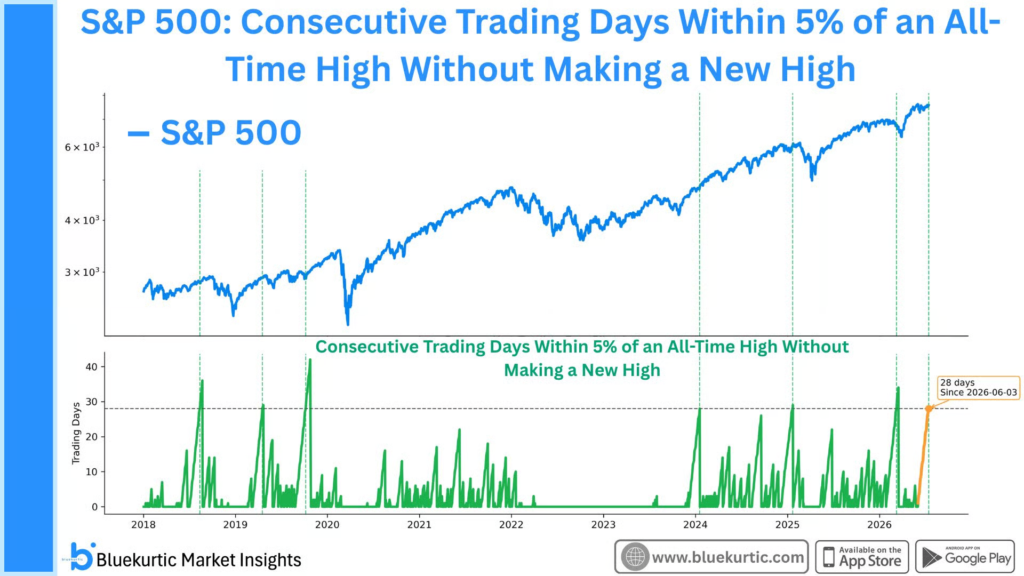
1. History of Consecutive Trading Days Within 5% of All Time Highs
SPX vs. ATHs. “Feels like the market ‘s gone nowhere lately? You’re not wrong. Only the 4th time this bull market $SPX has sat within 5% of its ATH without a new high. Excluding 2024, every prior case saw a real pullback.”
@bluekurtic
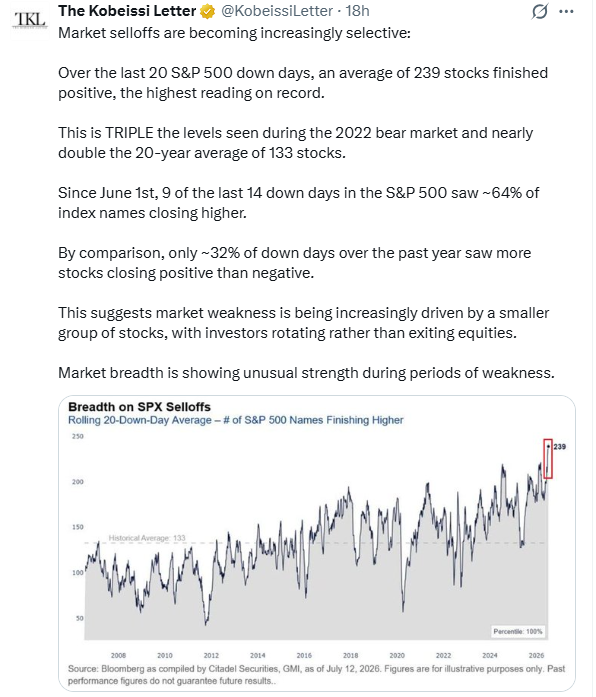
2. Market Breadth Comments
The Kobeissi Letter
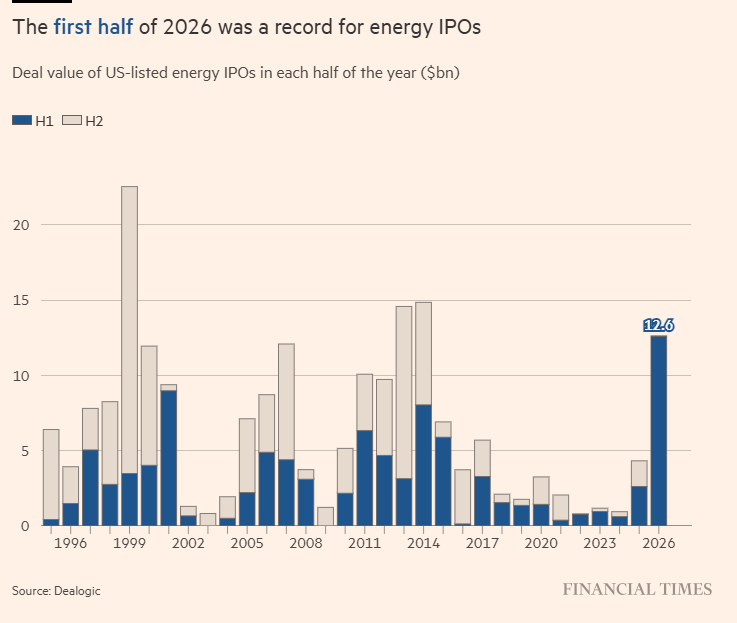
3. The First Half of 2026 was a Record for Energy IPOs-FT
Financial Times
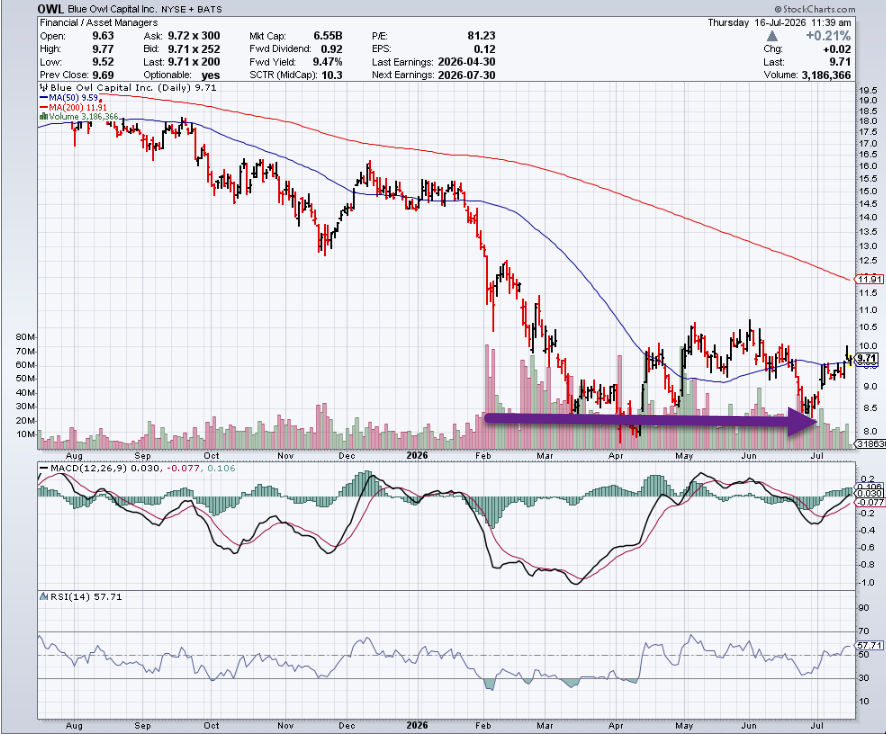
4. Blue Owl is Poster Child of Private Lending Worries But Holding Lows Right Now
StockCharts
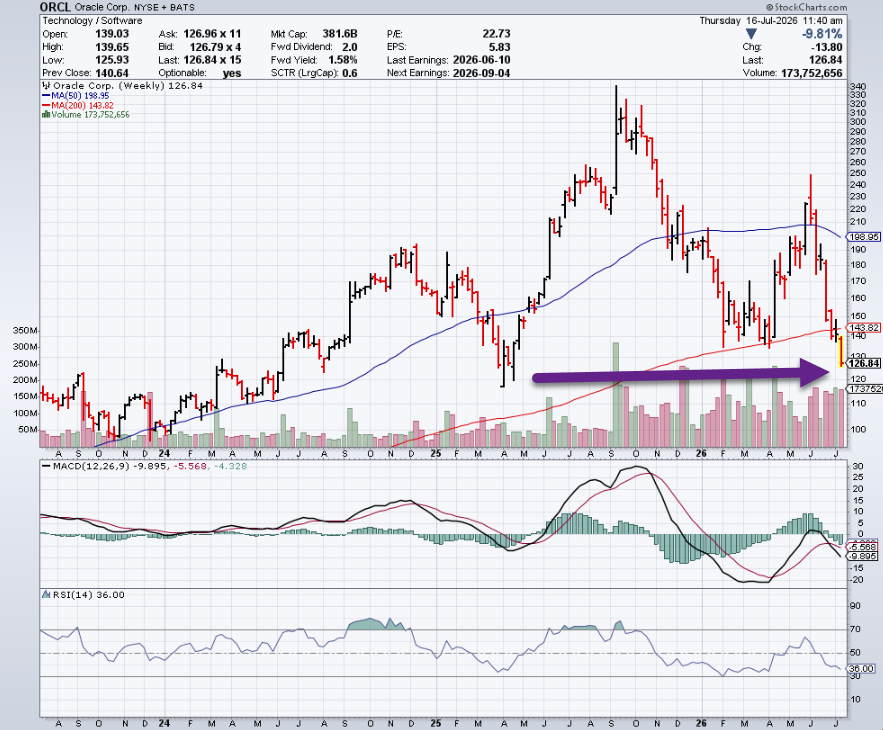
5. ORCL $330 to $126….Right Back to March 2025 Blowout Earnings that Skyrocketed Stock
StockCharts
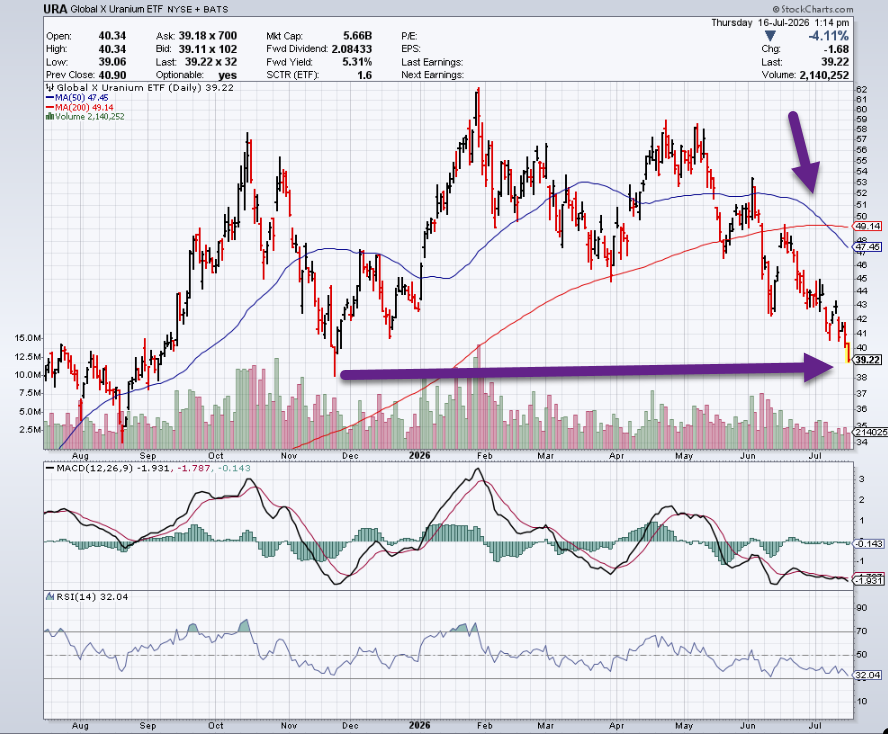
6. URA -35% from Highs…50day thru 200day to Downside
StockCharts
7. Kalshi Coming for Wall Street?
Kalshi bets on Wall Street
Jul 16, 2026, 12:38pm EDT
Courtesy of Kalshi
Kalshi continues its push onto Wall Street. The prediction market platform on Thursday launched 13 contracts that let users bet on the outcome of clinical drug trials, distilling the biggest milestones for biotech stocks into a simple yes or no. In recent days, it has also expanded its contracts that track the cost of AI compute — a useful tool for hyperscalers, neoclouds, and companies whose token budgets are exploding — and it launched its own version of the Bloomberg terminal.
I’ve long argued that prediction markets can evolve past their casino roots to become key players in financial markets and useful economic hedges. Home Depot could hedge its lumber costs; Vail Resorts could hedge its snow risk (though it isn’t, yet, CEO Rob Katz told us recently); a mediocre soccer team could protect itself against relegation. They can replace some market activity — biotech IPOs will be a tougher sell if investors can get the same binary exposure on Kalshi — but also grow the pie: Insurers will offer more policies on better terms if they can offload some of that risk to prediction markets. CFTC Chairman Michael Selig has made a similar argument to justify elbowing the states out of regulatory oversight of these platforms.
Kalshi’s recent moves, which also include a crackdown on insider trading (the latest nab is President Donald Trump’s teleprompter operator), show it wants to bolt on institutional financial markets to its legally questionable sports trading. These companies are “worth far more as the platform where companies like Meta hedge their future AI compute-pricing risk than as an OTB window for US black-op nighttime raids,” I wrote last month. Self-interest will rule the day.
— Liz Hoffman Semafor
https://www.semafor.com/article/07/16/2026/kalshi-bets-on-wall-street
8. The UAE Increased Its Oil Production by 80% Since Leaving OPEC

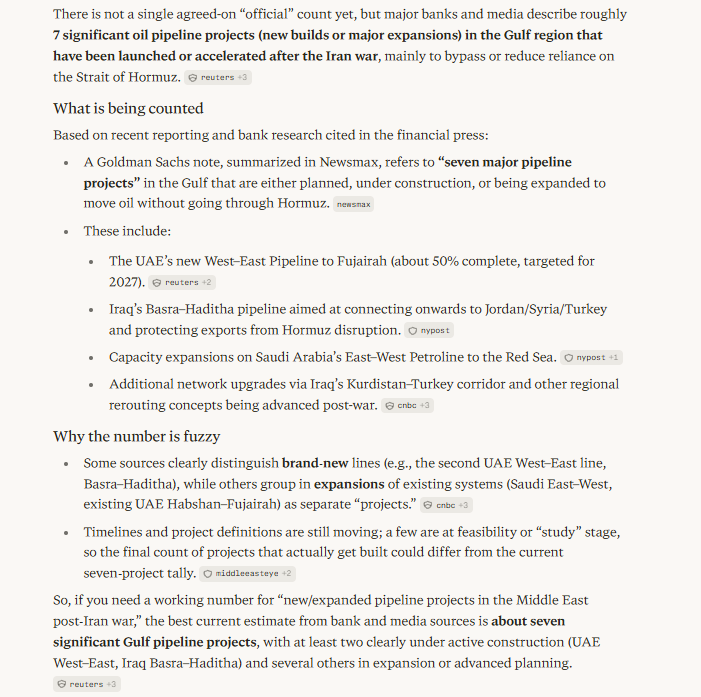
9. How Many New Pipeline Projects in Middle East Since Iran War? Countries are Planning Future Around Strait of Hormuz
Perplexity
10. Can Reading Really Help You Live Longer? Here’s What Experts Say
Time to get bookish By Sian Ferguson
Key Takeaways
- People who regularly read books may live longer than those who don’t, research suggests.
- Frequent reading may lower the risk of cognitive decline, depression, and loneliness as people age.
- Reading can reduce stress, encourage mindfulness, and provide a screen-free way to support emotional well-being.
Reading isn’t just fun—research suggests books can actually extend your life. “Reading is more than a pastime, it’s a powerful tool for cognitive health,” says Kathleen Jordan, MD and Chief Medical Officer of Midi Health, a longevity program designed specifically for women. “Mentally stimulating activities like reading, learning new skills, or doing puzzles help keep the brain active, reduce stress, and build resilience over time.”
What Does the Science Say?
In a widely cited 2016 study, researchers from Yale followed 3,635 adults over the age of 50 for 12 years. They found that participants who read books for 30 minutes or more daily lived an average of 23 months longer than non-readers—even after adjusting for variables like age, gender, education, and health.1
Interestingly, this life-extending benefit wasn’t as strong among those who read only newspapers or magazines. Books seemed to offer something uniquely protective, Jordan says.
“When you sit down with a book, it often requires deeper concentration, more sustained focus, and more active engagement than flipping through shorter articles,” she explains.
While it’s not completely clear why reading might improve your lifespan, there is plenty of other research connecting reading to overall health benefits—particularly for your brain and mental health.
How Does Reading Support Brain Function?
“Activities that challenge the mind, like regular reading, are a valuable part of a brain-healthy routine,” says Dr. Jonathan Graff-Radford, a behavioral neurologist. “Large studies have found that people who read more often may have a lower risk of memory loss or cognitive decline as they age.”2
This is because reading can help you develop cognitive reserve, a mental “buffer” that allows the brain to better compensate for aging or injury. Cognitive reserve helps your brain function at a higher level, even if you experience age-related changes in brain health.
Your Brain on Books
Plenty of research suggests that reading supports long-term brain health:
- A 14-year longitudinal study of older adults found that those who read at least once weekly had a significantly lower risk of cognitive decline over time. This was true across 6-, 10-, and 14-year follow-ups.3
- A 2021 study observed that elderly individuals who remained mentally active—through reading, writing letters, or playing games—developed Alzheimer’s disease about five years later than less cognitively active peers.4
- A 2023 review found that older people with mild cognitive impairment benefit from cognitive stimulation programs (which can include reading, among other activities).5
While interesting, these studies don’t tell us whether specific types of reading are better at promoting cognitive health.
What Are the Emotional Benefits?
Stress can wreak havoc on your mental and physical health. Yet many of us struggle to find stress-reducing practices that are affordable, accessible, and effective. Reading books can be all three.
“There is some evidence that reading can reduce stress, and lower stress translates into less inflammation, which we know helps our health globally too,” Jordan says. Here’s how reading supports emotional well-being:
- Encourages mindfulness: Reading slows you down and draws you into the present moment.
- May foster empathy: Immersing yourself in a character’s life broadens emotional awareness, research suggests.6
- Could facilitate connection: Reading is often a solitary activity, but it can be a point of connection—for example, through book clubs, forums, libraries, and book launch events. A 2023 study that analyzed data from 19,821 middle-aged and older adults across 15 countries found that reading and other mind-stimulating activities are associated with a lower risk of depression and loneliness.7
- Provides a healthy escape: Fiction, in particular, offers a low-stakes way to mentally “get away” without engaging in avoidance behaviors.
- Is a screen-free activity: If you’re struggling to cut down on doomscrolling or need to avoid screens before bed, a book is the perfect replacement.
- Offers a sense of purpose and accomplishment: It can feel satisfying to finish a book or learn something new.
Tips To Make Reading a Daily Habit
In a world where our screens are always screaming for attention, it can be difficult to put down your phone and pick up a book. To make matters worse, many of us are overwhelmed by responsibilities, making it tricky to get into the habit of reading.
However, just a few intentional minutes each day can support long-term brain and body health. Here are some ways to start:
- Set a simple goal: “A few minutes a day is enough to build the habit,” says Jordan; 10–20 minutes a day is a great starting point. Use a timer or app if needed.
- Try habit-stacking: Read while you drink your morning coffee, during your commute, or at bedtime to wind down.
- Always keep a book with you: This can help you sneak in a few pages while you wait in lines, eat your lunch, or take a break during your workday.
- Make it social: Join a book club (virtual or in-person) for accountability and connection. Apps like Goodreads or Storygraph can also inspire you to read more.
- Take advantage of your local library: It’s the cheapest and most convenient way to read widely.
- Be consistent: As with all habits, consistency is key. “Small, regular doses of engagement add up over time to support brain health,” Jordan says.
- Don’t stress about finding the “right” book: “There is no clear evidence on which types of reading best support brain health, so people should simply read what they enjoy,” Graff-Radford says. The best book is the one you’ll actually read. So if you’re struggling to get through “Middlemarch”or the latest romantasy novel TikTok is obsessing over, that’s fine! Just head to the library and pick up something you think you’ll actually like.
https://www.verywellmind.com/can-reading-help-you-live-longer-11975116