
1. Aggregate Net Asset Value of Bitcoin-Treasury Companies
Marketwatch The chart below shows that the aggregate market net asset value of bitcoin-treasury companies — or the aggregate market capitalization of such companies divided by the value of bitcoin they held — has fallen sharply from earlier this year.

MarketWatch
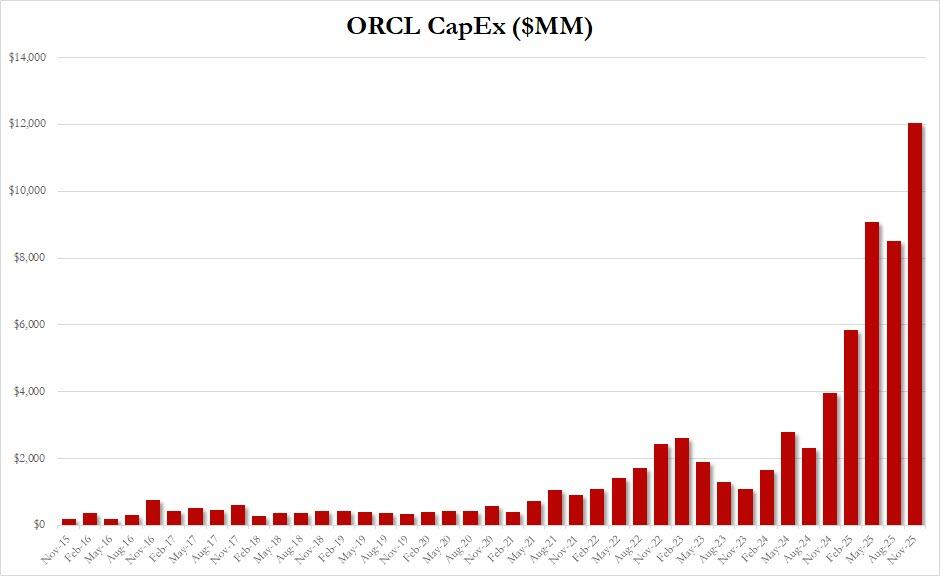
2. ORCL Capex Chart
ZeroHedge
3. Apple Capex vs. Big Tech Leaders-Barrons

Barron’s
4. MAG 7 Vs. NFLX Chart….NFLX -23% in 6 Months

StockCharts
5. You Tube vs. NFLX

A Wealth of Common Sense
6. ARKK Big Year…5 Years S&P +15.20% CAGR vs. ARKK -6.2%

Google Finance
7. Projections by the 19 FOMC members for the midpoint of the federal funds rate
Wolf Street Amid 3 dissenters in both directions, FOMC cuts by 25 basis points. “Dot Plot” sees 1 cut next year, 3 members see 1 hike. Reserve management purchases of T-bills begins.
The FOMC voted today to cut the Fed’s five policy rates by 25 basis points, as widely expected, the third cut in 2025, after cutting by 100 basis points in 2024.
There were 3 dissenters of the 12 voting FOMC members, the most dissenters since September 2019, under Powell. Two dissenters (Goolsbee and Schmid) wanted no cut. Miran wanted a 50-basis-point cut. Dissents are a breath of fresh air.
Projections by the 19 FOMC members for the midpoint of the federal funds rate by the end of 2026 (bold = median):
- 1 sees 6 cuts
- 1 sees 4 cuts
- 2 sees 3 cuts
- 4 see 2 cuts
- 4 see 1 cut
- 4 see no change
- 3 see 1 rate hike.
Wolf Street https://wolfstreet.com/2025/12/10/this-fed-meeting-must-have-been-an-epic-circus/
8. Global Long-Term Bond Yields Hit 16-Year Highs


Yahoo Finance
9. Getting Less Than 7 Hours Of Sleep Linked To Shorter Life Expectancy Across America
Reviewed by John Anderer

Study Finds
10. The New College Version of “The Dog Ate My Homework”
Psychology Today Personal Perspective: Students are using mental health excuses for academic shortcomings. Deborah J. Cohan Ph.D.
As a college professor for 30 years, I’m no stranger to the range of excuses that students provide for missed work or poor performances. But in the past year, a new phenomenon has emerged in relation to excuse-making.
First, students are relying on AI to craft emails to professors. In fact, one of my colleagues just shared with me that a student sent an email to him with the salutation, Dear Professor Last Name. I would have fantasies of writing back to that student, Dear Student First Name.
I’m left wondering if and how students are relying on faculty for good faith responses when they are querying with bad faith questions and excuses.
But the more pressing problem is when students use AI to craft these messages while also incorporating lengthy commentary about mental health, alluding to how, for example, their depression got in the way of their ability to do their work.
I get the importance of mental health. I’ve spent my career researching, writing, and teaching about mental health issues and have also worked as a counselor for years. I don’t take it lightly when students share difficult things. I’ve sat for hours with students in crisis, reeling from trauma, and struggling to heal.
These emails are not that.
Following the sentences about how they forgot about classwork, didn’t plan their time well, and generally forget their hybrid and online classes, students launch into the mental health issue and simultaneously ask if I might have it in my heart to change their grades. They tell me how much it would mean to them if I would just add a few more points or give them an extra assignment or extra credit days before the semester is ending. They add, “I know it never hurts to ask,” not understanding that it most certainly does. I feel like a film director, wanting to yell “Cut!” I experience these messages as desperately manipulative.
Students are active agents in the larger cultural discourse around mental health, and they have intuited that they can pull on the heartstrings of their teachers to get what they want. Moreover, this comes across as controlling because they also know that an educator will have a much harder time maintaining a penalty if there is a mental health issue, because what educator working with young people would be so mean? They’ve surmised that it’s insufficient to just say that they forgot or that they did not prioritize the classwork.
As I discuss in my book, The Complete U: Over 100 Lessons for Success in and out of the College Classroom, students don’t simply state that they are sad. They diagnose themselves as being depressed. They are not nervous about a test; they suffer from anxiety. And when they’re really nervous, they’re having a panic attack. Everything is at full throttle—except for any zest and curiosity about actual learning.
The trouble with these messages is how predictable and formulaic they are. Moreover, where are these students all semester long? The emails I receive from students are no longer about concepts they don’t thoroughly understand or about something they read or learned in another class that connects with what we’re talking about in our class, or a movie they saw that reminds them of a theory I had been teaching, and they want me to know about it. Those came in the days when students connected with me and other faculty in a human-to-human relationship and made critical and analytical connections. Now the emails are about wanting a few more points for something, or having an issue with technology, or saying that they’re confused even though they later admit to having never read whatever they said they were confused about.
Two things happened in higher education around the same time, both of which have been fairly detrimental to the whole experience: One is the openness of the online gradebook; the other is email. Of course, many things have contaminated higher education both from the outside and from the inside, but two things are for sure: The instantly transparent grade book gives students the chance to immediately react to a grade, and they can then email a professor with their dissatisfaction.
This is one of those moments where I can really say I did walk a mile and trudge uphill in the snow to find out about a grade. I was an undergraduate student at the University of Wisconsin-Madison, and when professors posted grades, it was on a sheet outside their office door, and since we didn’t have email, we just relied on when they said they might be posting the grades. It was common to arrive at the door and find that nothing was posted yet. We did not bang on the door, asking why it had taken a little longer. We didn’t march to the provost’s or president’s office and demand to talk to someone about our complaints. Instead, we walked back downhill, picked up a coffee, and headed home. A day or two later, we would try again. And if we had questions about those grades, we checked the syllabus for when the office hours were and planned to see the professor then.
Students aren’t discerning what is an emergency, or when it is appropriate to contact someone, or why it’s inappropriate to ask for special favors like redos, extra assignments, or extra credit. Do they really think I’m going to do it for them and no one else? And if they think their begging and quibbling will get me to offer an opportunity to the whole class, they’re not thinking about the massive undertaking it is to add additional grading assignments to a syllabus.
It’s the world larger than themselves that I’m forever trying to get them to see.