
1. 2025 Powered by Margins and Sales
Return drivers. The S&P 500’s returns in 2025 have been powered mostly by earnings (sales + margin growth), with some multiple expansion.

2. Gas Prices Falling Below $3

Bespoke
3. Gas Helping Transports…Good for Economic Outlook…Transports Breaking Out to New Highs

StockCharts
4. Netflix -22% from Highs…50day Close to Crossing Below 200day on Chart
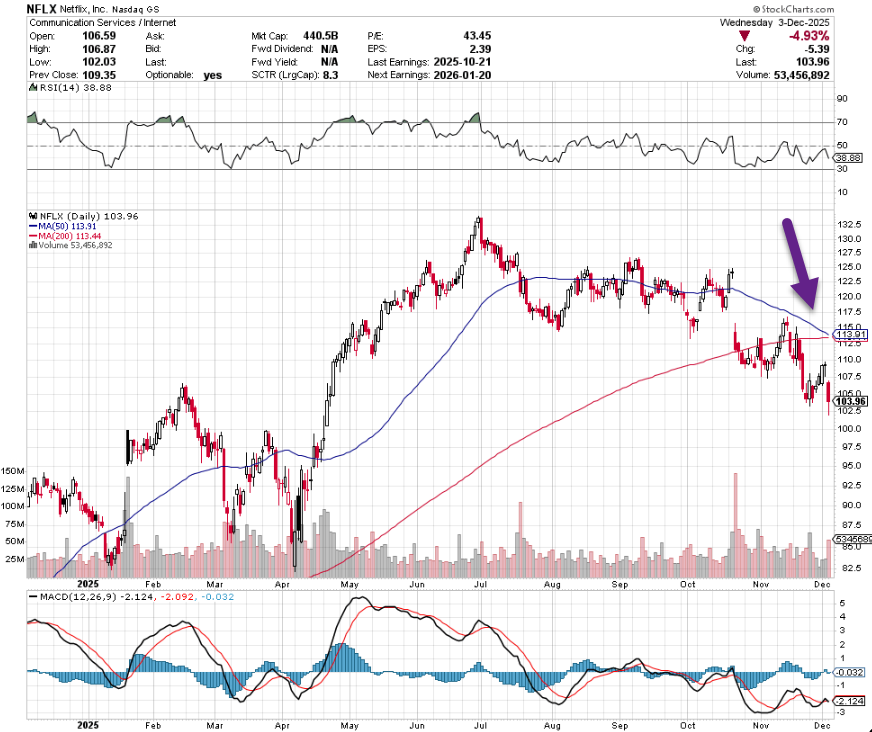
StockCharts
5. The Market is Bearish on Netflix Buying Warner Bros…What Would They Be Gaining?

chartr
6. Another $1 Trillion Bump in Money Markets

The Big Picture
7. Interesting Chart on from Callum Thomas Blog on Bond Bear Market
Bonds Basing? It’s a question many are pondering, and while TLT is still basically in bear market, we’re also seeing a clear basing process in progress.

Source: @Mr_Derivatives @Callum Thomas (Weekly S&P500 #ChartStorm)
8. The Counter Argument? Valuations?
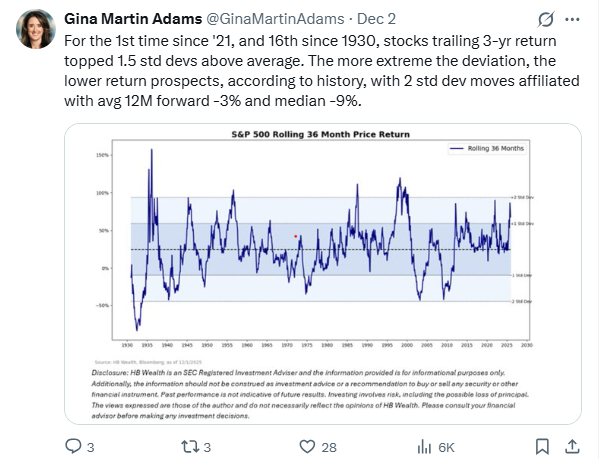
Gina Martin Adams
9. Members of House are Quitting Congress at Record Rate-AXIOS


Axios
10. 7 Ways to Learn Faster and Improve Your Memory, Backed by Neuroscience-Inc.
1. Test yourself.
A classic study published in Psychological Science in the Public Interest shows self-testing is an extremely effective way to speed up the learning process.
Partly that’s because of the additional context you create. Test yourself and answer incorrectly and not only are you more likely to remember the right answer after you look it up, but you’ll also remember the fact you didn’t remember. (Especially if you tend to be hard on yourself.)
So, don’t just rehearse your sales pitch. Test yourself on what comes after your intro. Test yourself by listing the four main points you want to make. Test your ability to remember cost savings figures, or price schedules, or how you will respond to the most common questions or types of customer resistance.
Not only will you gain confidence in how much you do know, but you’ll also more quickly learn the things you don’t know — at least not yet.
2. Learn two or three things at (nearly) the same time.
The process is called interleaving: studying related concepts or skills in parallel. Instead of focusing on one subject, one task, or one skill during a learning session, purposely learn or practice several subjects or skills in succession.
It turns out interleaving is a much more effective way to train your brain and train your motor skills. Why?
One theory proposed in a study published in Educational Psychology Review is that interleaving improves your brain’s ability to differentiate between concepts or skills. When you block practice one skill, you can drill down until muscle memory takes over and the skill becomes more or less automatic. When you interleave several skills, any one skill can’t become mindless.
And that’s a good thing, because you’re instead constantly forced to adapt and adjust. You’re constantly forced to see, feel, and discriminate between different movements or different concepts.
And that helps you really learn what you’re trying to learn, because it helps you gain understanding at a deeper level.
Speaking of adapting …
3. Change the way you study or practice.
Repeating anything over and over again in the hopes you will master that task will not only keep you from improving as quickly as you could; in some cases, it may actually decrease your skill as well.
According to research published in Johns Hopkins Medicine, practicing a slightly modified version of a task you want to master helps you “actually learn more and faster than if you just keep practicing the exact same thing multiple times in a row.” The most likely cause is reconsolidation, a process where existing memories are recalled and modified with new knowledge.
Say you want to master an investor pitch. Do this:
- Rehearse the basic skill. Run through your pitch a couple of times under the same conditions you’ll eventually face when you do it live. Naturally, the second time through will be better than the first; that’s how practice works. But then, instead of going through it a third time …
- Wait. Give yourself at least six hours so your memory can consolidate. (Meaning that you may need to wait until tomorrow before you practice again, which, as you’ll see in a moment, is a great approach.)
- Practice again, but this time:
- Go a little faster. Speak a little — just a little — faster than you normally do. Run through your slides slightly faster. Increasing your speed means you’ll make more mistakes, but that’s OK — in the process, you’ll modify old knowledge with new knowledge, and lay the groundwork for improvement. Or …
- Go a little slower. The same thing will happen. (Plus, you can experiment with new techniques — including the use of silence for effect — that aren’t apparent when you present at your normal speed.) Or …
- Break your presentation into smaller chunks. Almost every task includes a series of discrete steps. That’s definitely true for presentations. Pick one section of your pitch. Deconstruct it. Master it. Then put the whole presentation back together. Or …
- Change the conditions. Use a different projector. Or a different remote. Or a lavaliere instead of a headset mic. Switch up the conditions slightly; not only will that help you modify an existing memory, but it will also make you better prepared for the unexpected.
4. And keep modifying the conditions.
You can extend the process to almost anything. While it’s clearly effective for learning motor skills, the process can also be applied to learning almost anything.
4. Say it out loud.
Mentally rehearsing is good. Rehearsing out loud is better.
Research published in Journal of Experimental Psychology: Learning, Memory, and Cognition found that compared with reading or thinking silently (as if there’s another way to think), the act of speech is a “quite powerful mechanism for improving memory for selected information.”
According to the researchers, “Learning and memory benefit from active involvement. When we add an active measure or a production element to a word, that word becomes more distinct in long-term memory, and hence more memorable.”
So don’t just practice that investor pitch in your head. Rehearse out loud. That way you’ll remember what you thought, and also what you heard yourself say.
5. Learn in bursts.
Once you’ve drafted that pitch, run through it once. Then take a few minutes to make corrections and revisions.
Then step away for a few hours, or even for a day, before you repeat the process, because a study published in Psychological Science shows “distributed practice” is a much more effective way to learn. Why?
The study-phase retrieval theory says each time you attempt to retrieve something from memory and the retrieval is more successful, that memory becomes harder to forget. If you go over your pitch back to back to back, much of your presentation is still top of mind — which means you don’t have to retrieve it from memory.
Another theory regards contextual variability. When information gets encoded into memory, some of the context is also encoded. That’s why listening to an old song can cause you to remember where you were, what you were feeling, etc., when you first heard that song. The additional context creates useful cues for retrieving information.
Either way, distributed practice definitely works. So give yourself enough time to space out your learning sessions. You’ll learn more efficiently and more effectively.
Especially if you …
6. Sleep on it.
According to a 2016 study published in Psychological Science, people who studied before bed, then slept, and then did a quick review the next morning not only spent less time studying, but they also increased their long-term retention by 50 percent.
Why? One factor is what psychologists call sleep-dependent memory consolidation. As the researchers write:
Converging evidence, from the molecular to the phenomenological, leaves little doubt that offline memory reprocessing during sleep is an important component of how our memories are formed and ultimately shaped.
Sleeping after learning is definitely a good strategy, but sleeping between two learning sessions is a better strategy.
Or in non-researcher-speak, sleeping on it not only helps your brain file away what you’ve learned, but it also makes that information easier to access — especially if you chunk your learning sessions by studying a little the next morning.
7. Exercise.
Want to learn information faster? A study published in Scientific Reports found that moderate-intensity workouts — keeping your heart rate between 50 and 80 percent of max — dramatically improve recall and associative learning and increase your brain’s ability to absorb and retain information.
Want to learn or improve a task where motor skills are involved? According to a different study published in Scientific Reports, 15 minutes of cycling at 80 percent of max heart rate (“intense” exercise) resulted in better memory performance than 30 minutes of moderate exercise, which was better than no exercise at all.
In other words, exercising hard for 15 minutes “fired up” participants’ brains and allowed them to learn motor skills better and faster. To a lesser degree, so did 30 minutes of moderate-intensity exercise.
And then there’s this. A study published in Proceedings of the National Academy of Sciences shows exercise can increase the size of your hippocampus, even if you’re in your 60s or 70s, helping to mitigate the impact of age-related memory loss.
Yep: Exercise helps make your brain healthier, too — which helps you be smarter and stay smarter.