
1. S&P 500 Call Volume Soars to Highs
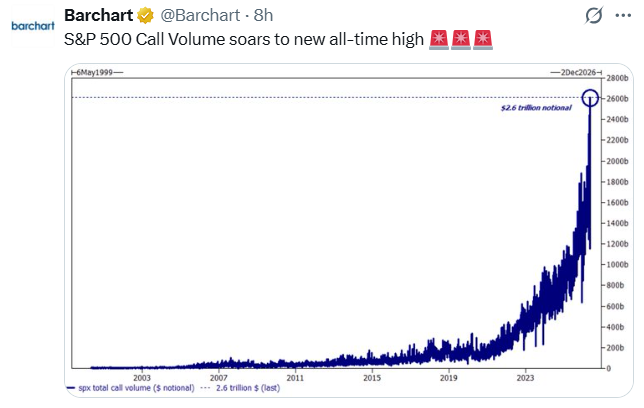
Barchart
2. Internet Boom was Massive Job Creator
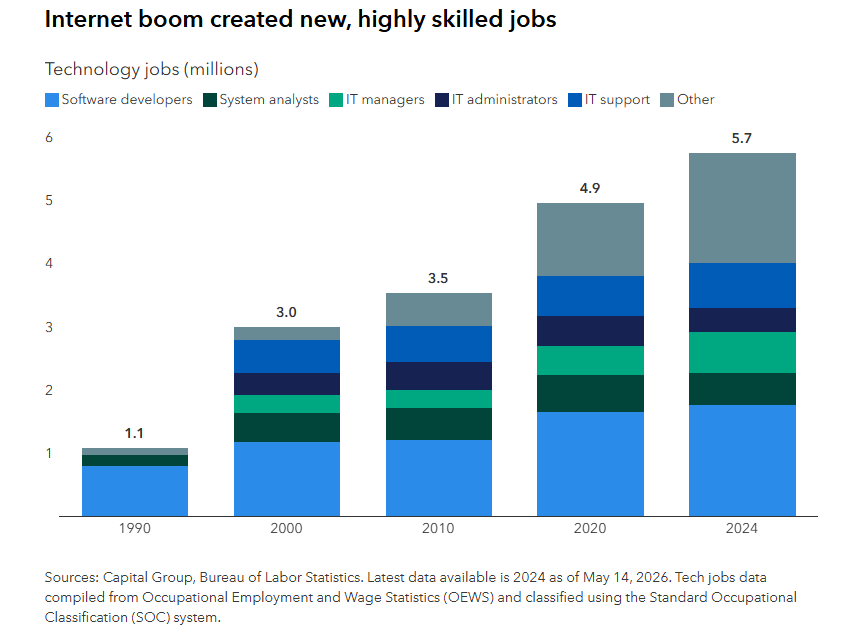
Capital Group
3. DRAM ETF Raises $10B in 45 Days
Morningstar Roundhill Memory ETF amassed nearly $10 billion in net assets in just 45 days.

Morningstar
4. SpaceX Prospectus -The One Business that Works is Starlink
One business that works-OM Blog
Starlink generated $11.4 billion in revenue in 2025. Operating income was $4.4 billion. Adjusted EBITDA was $7.2 billion, a margin of 63%. Revenue grew 49.8% year over year. Operating income more than doubled.
Comcast, providing cable broadband to 32 million American subscribers for decades, runs EBITDA margins in the mid-30s. AT&T is around 35%. Starlink, which commercially launched its first satellite in 2020, is running circles around both. It is not fiber broadband, but it is not selling that anyway.
The service had 2.3 million subscribers at end of 2023. By end of 2024, 4.6 million. By end of 2025, 9.2 million. The S-1 discloses 10.3 million subscribers as of March 31, 2026, across 164 countries. In November and December 2025, Starlink was adding 20,000 new customers per day.

Om Malik
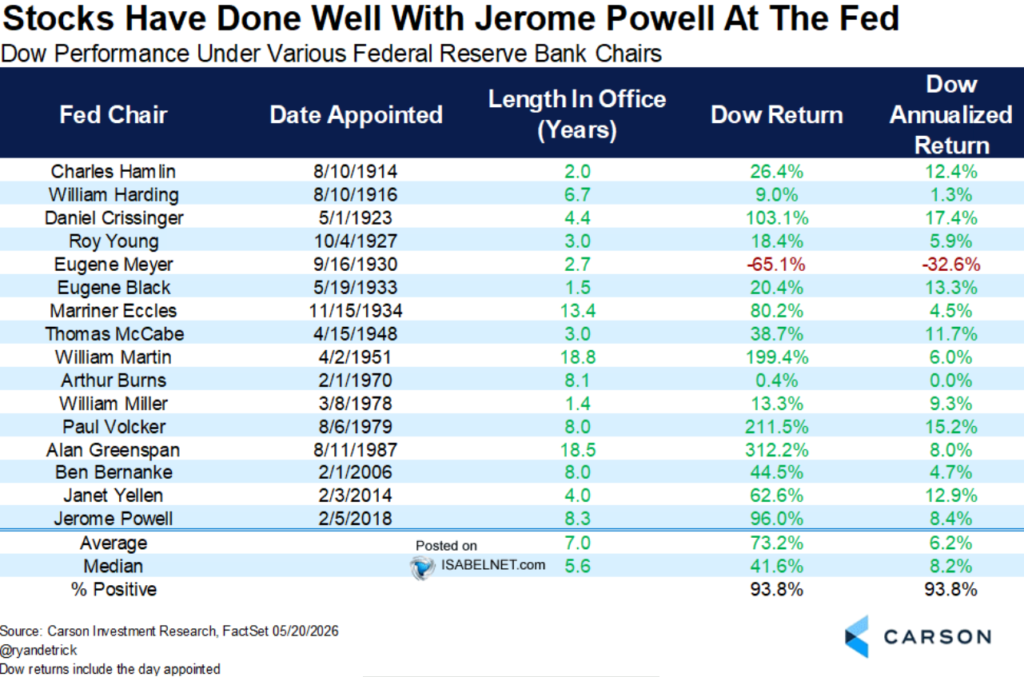
5. Powell Outperformed Greenspan and Yellen
6. Wal-Mart Made New Highs Then Pulled Back to Support

StockCharts
7. One Year Chart-COST +27% vs. WMT +3%
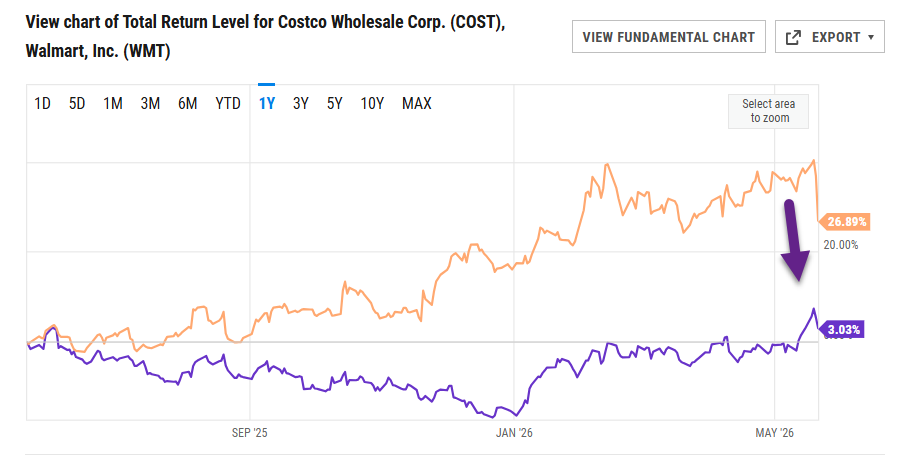
Ycharts
8. Stocks Wealth Now Exceeds Real Estate Wealth in U.S.
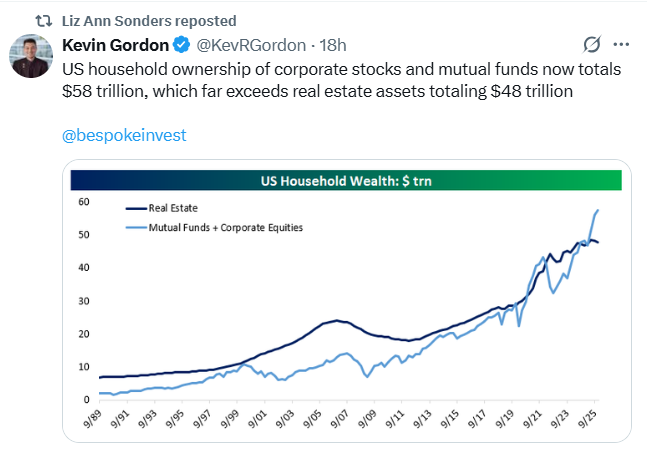
Kevin Gordon
9. Kuwait Oil Exports at Complete Standstill….70% of Population (5.1m) are Expats

10. Warren Buffett Once Revealed the No. 1 Sign Someone Is Destined for Success
According to Buffett, people with this learnable skill may be the ones most likely to succeed.
EXPERT OPINION BY MARCEL SCHWANTES, INC. CONTRIBUTING EDITOR, EXECUTIVE COACH, SPEAKER, AND AUTHOR @MARCELSCHWANTES
Good communication skills are often perceived as confidence, charisma, or the ability to give dynamic presentations in front of a room full of people. Warren Buffett sees it differently.
For Buffett, communication determines whether your ideas stay trapped inside your head or actually influence people, build trust, and move organizations forward.
Here’s how he once explained it:
You’ve got to be able to communicate in life, and it’s enormously important. Schools, to some extent, underemphasize that. If you can’t communicate and talk to other people and get across your ideas, you’re giving up your potential.
That last sentence hits harder than most people realize.
Alexis Ohanian is Betting on Women’s Sports as a Billion-Dollar Opportunity
You’re giving up your potential.
Buffett is saying that even if you’re highly intelligent, have a strong vision for your career or business, and an amazing work ethic, it won’t matter much if the people you come in contact with cannot clearly understand you.
The pattern that keeps showing up
I’ve spent years studying leadership behavior and coaching executives, and one pattern keeps emerging: The leaders who struggle most are rarely the least capable in the room. They’re often the least clear communicators in the room.
They overexplain. They ramble. They hide behind jargon. When faced with navigating conflict, they avoid hard conversations. When having to show up authentically to deliver bad news, they delegate it to avoid criticism. They assume people “should already know.” They talk at employees instead of with them. You get the picture.
Then they wonder why trust erodes and why peers and co-workers question their credibility.
I believe a major facet of effective communication, especially in leadership roles, is reducing confusion and ambiguity. That’s the real job of a strong communicator.
What the best communicators do
The best communicators make people feel safe, informed, and aligned. Their team members and colleagues know where they stand. They know why decisions are being made.
And in workplaces drowning in uncertainty and constant change, which is the current reality for many businesses, clarity has become a leadership advantage.
Also, we can’t forget that communication is a two-way street. One of the biggest misconceptions is that speaking matters more than listening. In reality, leaders who dominate conversations without truly listening usually miss the data sitting right in front of them.
Practicing emotional intelligence is also strongly linked to great communication. In fact, they are inseparable. For example, many executives unintentionally sabotage themselves by communicating under pressure with the wrong delivery, tone, or body language, rather than being fully present, responsive, and grounded. In meetings, they rush conversations or jump straight into fixing mode.
But leadership communication is different; it’s relational work. People remember how leaders make them feel during difficult conversations. Especially during uncertainty, layoffs, restructuring, conflict, or performance feedback.
If you want people to trust you as a leader, here’s some free advice: Stop trying to sound perfect and start trying to sound human.
Buffett is right. Schools underemphasize communication. But many workplaces do too.
We promote technically brilliant people into management roles without teaching them how to navigate conflict, deliver feedback, listen with empathy, or communicate vision in ways people can emotionally connect to.
Then we act surprised when teams disengage.
The good news is that communication is trainable. You can learn to ask better questions, listen without interrupting, and slow down before reacting emotionally.
You can learn to speak with clarity by simplifying your message. You can even learn to have difficult conversations without avoiding them.
And when you do any of that, something important happens. You start working and leading with newfound confidence, authenticity, and ownership. That’s when leadership multiplies.
Buffett understood that decades ago. The leaders who will stand out over the next decade will be the clearest, calmest, and most emotionally grounded communicators.
Like this article? Subscribe here for more related content and exclusive insights from executive coach and global speaker Marcel Schwantes.