
1. Staples Sector Forward PE Equal to Tech

The Irrelevant Investor
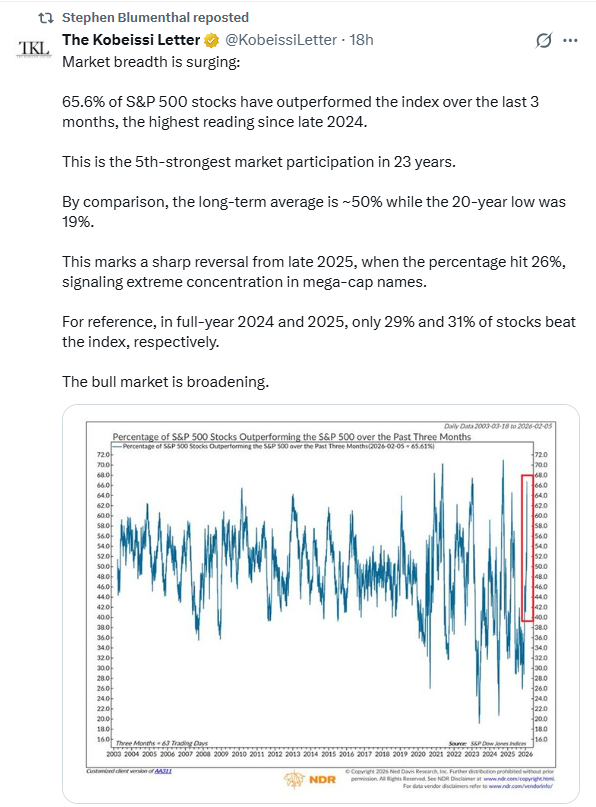
2. Market Breath Surging….65% of Stocks Outperforming Over Last 3 Months
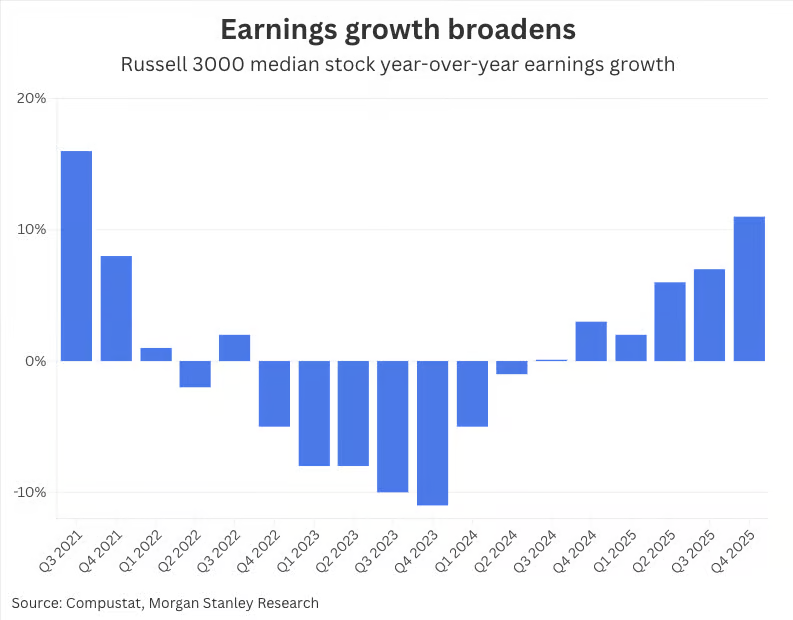
3. Small Cap Earnings Growth at Highest Level in 3 Years
R3K earnings growth. And finally, “earnings growth for the median Russell 3000 stock is at its highest level in four years. Fundamentals are in line with the stock market broadening.”
Daily Chartbook
4. Goldman Predicting Record IPO Year 2026


5. Huge Amount of Short Selling…Not Usually a Sing of Market Top
Hedge fund shorts. “Short selling across single stocks last week was the biggest on record going back to 2016”.

Goldman Sachs via @macrocharts
6. Copper Inventories at All-Time Highs
Bloomberg The US has quietly built up its biggest stockpile of copper in decades, distorting flows of the red metal to the rest of the world.
The influx of copper into American inventories has gathered momentum over the past year and added to upward pricing pressures. The higher prices have reverberated across the copper supply chain.

Bloomberg
7. U.S. Total Oil Production Declining for the First Time in 5 Years
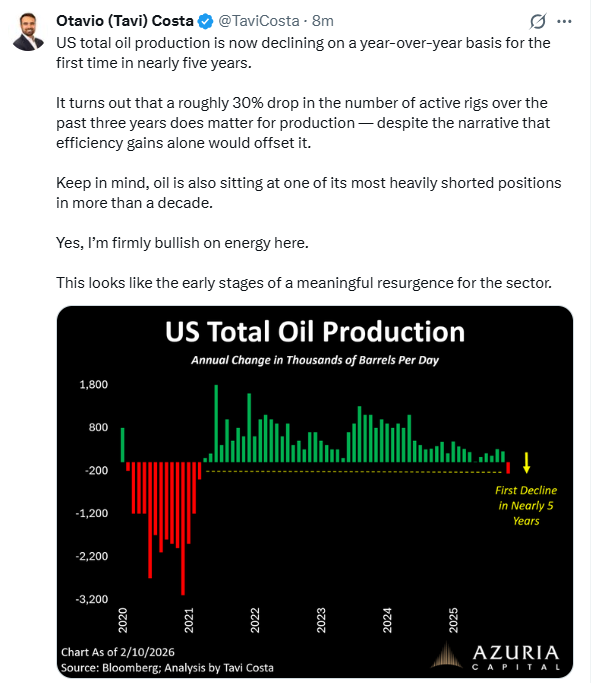
Otavio (Tavi) Costa
8. Polymarket Odds 57% that Digital Asset Clarity Act Passes

Perplexity
9. Leading Crypto Political PAC Raises $193M


Axios
10. 2 “Annoying” Habits That Actually Signal Intelligence
If you’re prone to these two “annoying” habits, you could be smarter than you think. Mark Travers Ph.D.
Key points
- Mind wandering can support creative thinking and cognitive flexibility.
- Talking to oneself can support self-regulation, planning, and metacognition.
- When we idealize focus, discipline, and a silent mind, we overlook powers of the brain beyond concentration.
We often judge habits like a drifting mind or moments of spontaneous “zoning out” as flaws. To most people, these are considered signs of poor focus, weak discipline, or even cognitive decline.
However, what we often fail to factor in is that our perceptions are influenced by the culture of relentless productivity and tangible rewards that surrounds us. From this lens, these mental habits will obviously look like distractions that need to be corrected, rather than cognitive processes that simply need to be understood.
Psychological research tells us that, under the right conditions, these seemingly unproductive behaviors can reflect cognitive flexibility, creative problem-solving, and the brain’s ability to adaptively shift between modes of thought. In other words, rather than being mental glitches, they may be signs of an active mind doing important background work.
Here are two common behaviors many people dismiss or try to suppress, as well as what they really mean, when they can be helpful, and how to start approaching them with greater psychological nuance.
1. A Habit of Daydreaming
Mind-wandering, or the drifting of attention away from the present task toward self-generated thoughts, has long been considered a telltale sign of inattention. However, recent studies show that it can also support creative thinking and cognitive flexibility.
For example, a 2025 study involving more than 1,300 adults found that deliberate mind-wandering (that is, a person intentionally allowing themselves to daydream) predicted higher creative performance. Neuroimaging data suggested this effect was supported by increased connectivity between large-scale brain networks involved in executive control and the default mode network, a system associated with self-generated thought and imagination.
People with higher spontaneous mind-wandering tendencies also show better performance on task-switching paradigms, meaning they can shift mental sets more quickly, which is a clear sign of flexible thinking.
Another habit closely related to mind-wandering is an individual’s capacity for spontaneous thought. A 2024 study published in PNAS Nexus analyzed spontaneous thought samples from more than 3,300 participants using natural language processing. According to the results, unprompted thoughts tend to organize around goal-relevant information and support memory consolidation. In other words, this means that “idle” thinking often serves adaptive cognitive functions rather than being random mental noise.
It’s important to note, however, that mind-wandering isn’t a magic bullet. Its benefits will only take root when balanced with attention control. If you find your mind often drifting, and if you also have good focus and self-awareness, then you might be tapping into a mental mode that supports creativity, flexible thinking, and problem-solving.
2. A Habit of Talking to Yourself
Talking to yourself, whether silently in your head or softly out loud, might look odd or even neurotic from the outside. However, recent psychological research suggests that inner speech and self-talk can actually be used to support self-regulation, planning, and metacognition (the act of thinking about your own thoughts).
According to a 2023 study of university students published in the journal Behavioral Sciences, there is a considerable correlation between reported use of inner speech and measures of self-regulation and self-concept clarity. In other words, individuals who “talked to themselves” more often than others would report significantly clearer self-identity as well as better self-regulation.
Of course, this does not mean that self-talk directly signals higher intelligence. Instead, it suggests that inner speech may function as a cognitive scaffold, or as a way to organize complex ideas, sequence actions, and monitor goals.
This means that by externalizing thoughts internally (or quietly aloud), the brain may find it easier to reduce cognitive noise. As a result, it may also impose structure on abstract or emotionally charged problems more efficiently and effectively. So, if you catch yourself murmuring through your thoughts, it could be your brain’s way of scaffolding complex ideas, turning chaotic thinking into ordered plans or self-reflection.
However, as with mind-wandering, self-talk also benefits only in moderation. Excessive or negative self-talk, especially in the form of rumination or harsh self-criticism, can undermine focus and mental well-being. When used constructively, however, that same internal dialogue can transform half-thoughts into actionable plans.
What to Do if You Have These ‘Annoying’ Habits
If you have one or both of these supposedly “annoying” habits, then you must always remind yourself that there isn’t anything wrong with you; they’re both incredibly common and totally normal. However, despite their benefits, they aren’t necessarily guaranteed markers of genius, either.
In reality, the relationships between these habits and their associated productive behaviors are contextual and conditional. This means minds that wander with purpose, self-talk used for planning rather than rumination, and rest that is balanced with effort will correlate most strongly with enhanced thinking or creativity.
On the other hand, when these behaviors spiral into chronic distraction, anxiety, or disorganization, then they may risk becoming problematic. However, if an individual engages in them consciously and moderately, they can indeed be used as valuable tools. Here are three steps you can follow to use them adaptively:
- Notice context. Pay attention to when and where you typically start mind-wandering or talking to yourself. Are you daydreaming during monotonous tasks? Do you talk to yourself when trying to focus on something critical? Try giving yourself a 10-minute idle moment first, then return to the task.
- Use inner speech consciously. When planning or thinking through ideas, speak (silently or quietly) as if guiding yourself. That structure can help shape clarity.
- Allow mental rest. Schedule micro-breaks for reflection. Sometimes, the best ideas come when the brain has space and freedom to wander.
When we idealize focus, discipline, and silence inside the mind, we overlook the powers of the human brain beyond sheer concentration. The next time you catch your mind drifting, hear a soft whisper of self-talk, or notice your gaze drifting out the window, don’t immediately judge it as laziness or lack of control. Sometimes, it’s just your mind thinking in a language beyond tasks and deadlines.
A version of this post also appears on Forbes.com. https://www.psychologytoday.com/us/blog/social-instincts/202602/2-annoying-habits-that-actually-signal-intelligence